
[ACMMM 2026] PLUME: Latent Reasoning Based Universal Multimodal Embedding
Python
26
6 commits
updated Apr 29, 2026
README
PLUME: Latent Reasoning Based Universal Multimodal Embedding
🏡 Project Page | 📄 Paper | 🤗 Model | 🤗 Training Data | 🤗 Eval Data
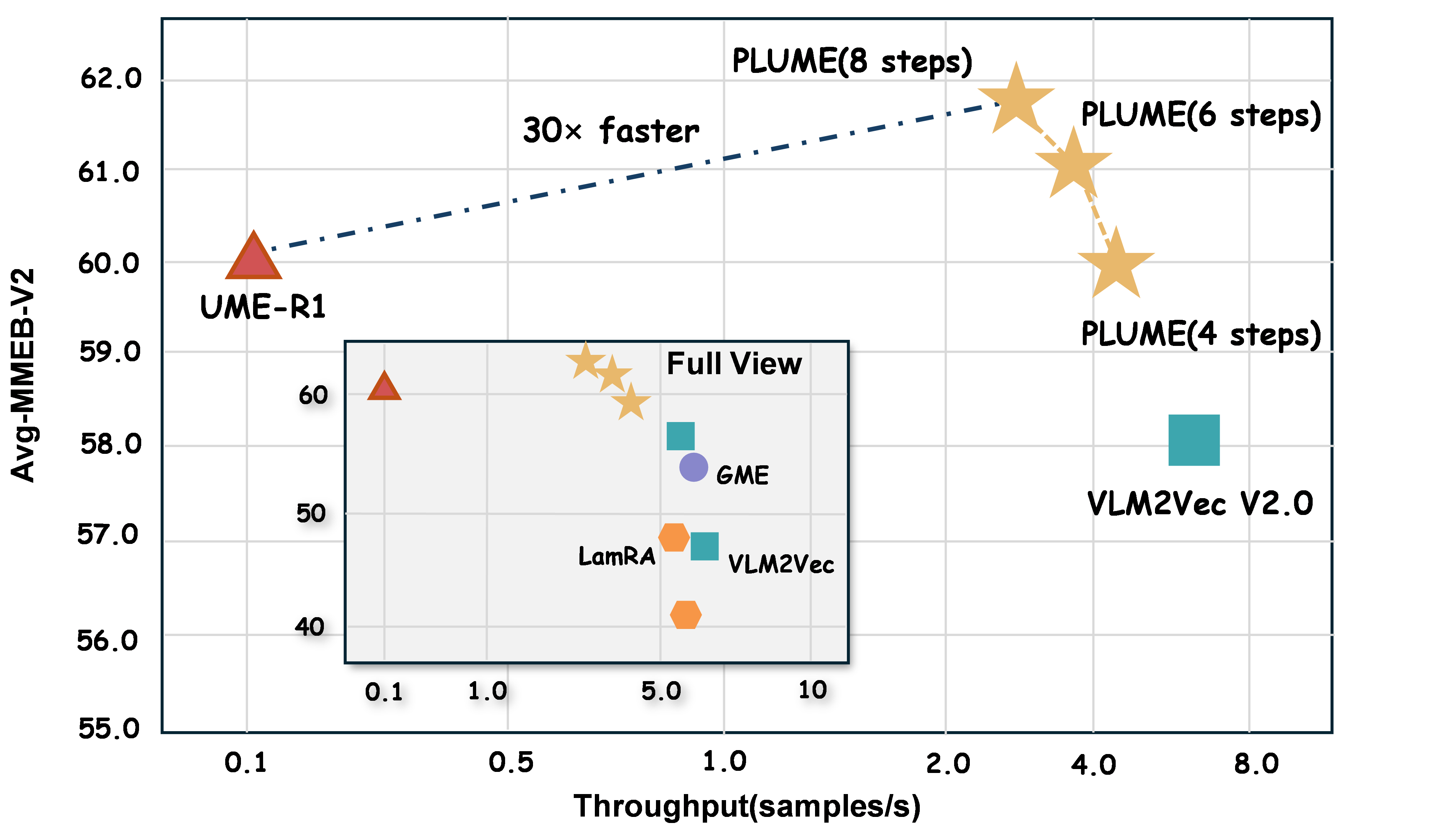
PLUME is a latent reasoning framework for universal multimodal embedding (UME). It replaces explicit chain-of-thought (CoT) generation with a short autoregressive rollout of continuous latent states, combined with a semantic-anchor-guided transition adapter (Latent MoE) and a progressive explicit-to-latent curriculum. Built on Qwen2-VL-2B, PLUME achieves 61.6 on the 78-task MMEB-v2 benchmark while delivering over 30x faster inference compared to explicit-CoT methods.
This repository is the official implementation of the paper PLUME: Latent Reasoning Based Universal Multimodal Embedding.
📰 News
- [2026/04] Paper released on arXiv.
- [2025] Code and model weights released.
📝 TODO
- Code Released: Training and evaluation pipeline.
- Model Released: Pre-trained PLUME-Qwen2-VL-2B weights.
- Paper: arXiv.
💡 Highlights
- Replaces hundreds of explicit reasoning tokens with only 8 latent steps, delivering 30.3x faster inference
- 61.6 overall on the 78-task MMEB-v2 benchmark, surpassing UME-R1 (60.1) and VLM2Vec-V2 (58.0)
- Curriculum-based latent reasoning -- gradually replaces chain-of-thought text with continuous thought (
<ct>) tokens across training stages - Contrastive learning -- cross-device bidirectional contrastive loss for query/positive embedding alignment
- Latent MoE -- Mixture-of-Experts transition layer with 4 routed experts + shared expert in the latent reasoning loop
- Multi-modal evaluation -- MMEB image / video / visdoc evaluation with latent-MoE support
🏗️ Method
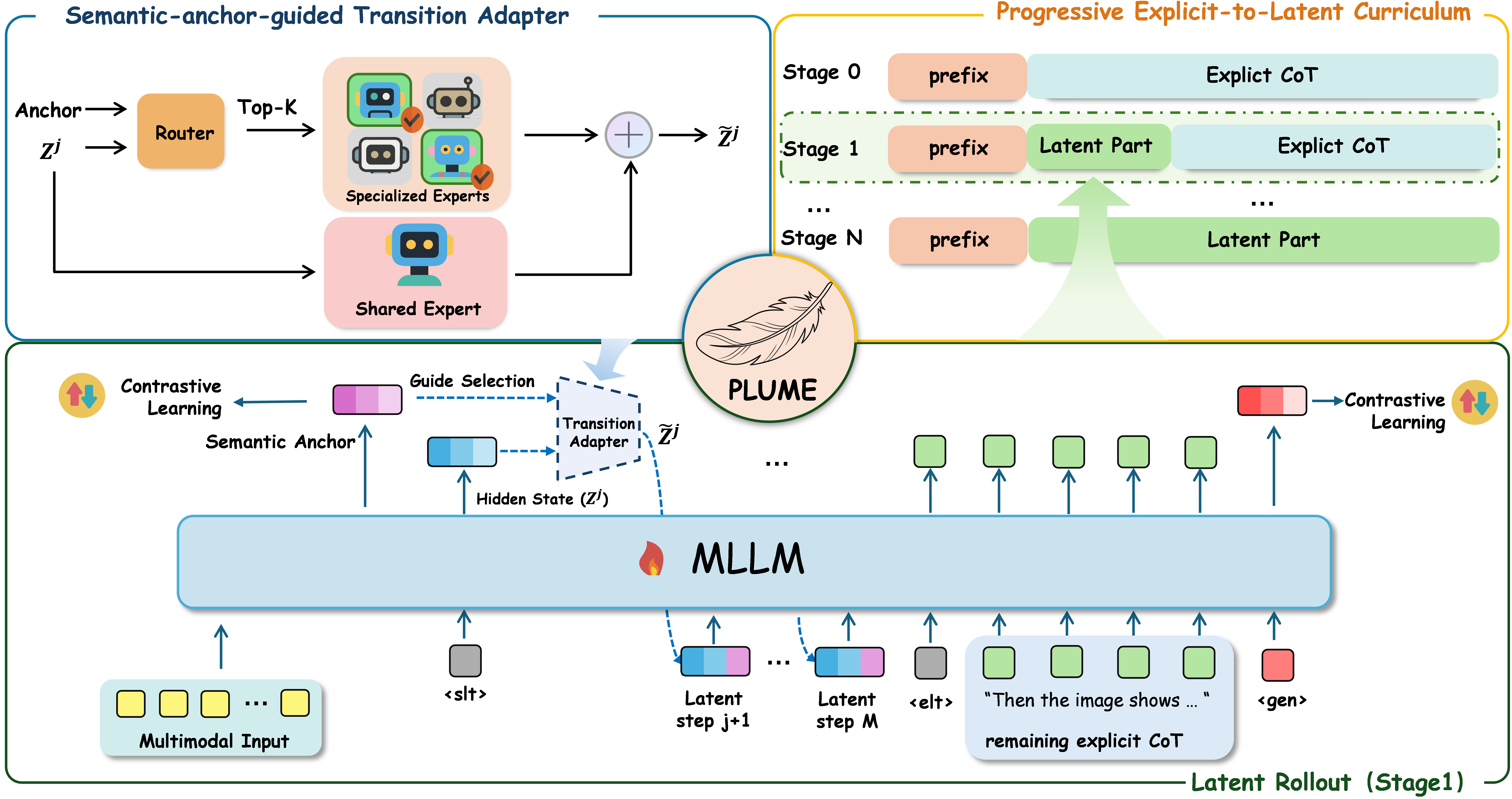
Overview of PLUME. The bottom panel illustrates the latent rollout process. The top-left panel expands the semantic-anchor-guided transition adapter with shared and specialized experts. The top-right panel shows the progressive explicit-to-latent curriculum.
🎞️ Results on MMEB-v2
All methods share the same Qwen2-VL-2B backbone.
| Model | Image | Video | VisDoc | All |
|---|---|---|---|---|
| VLM2Vec-V2 | 64.9 | 34.9 | 65.4 | 58.0 |
| UME-R1 | 66.6 | 42.2 | 63.9 | 60.1 |
| PLUME | 66.3 | 44.1 | 67.5 | 61.6 |
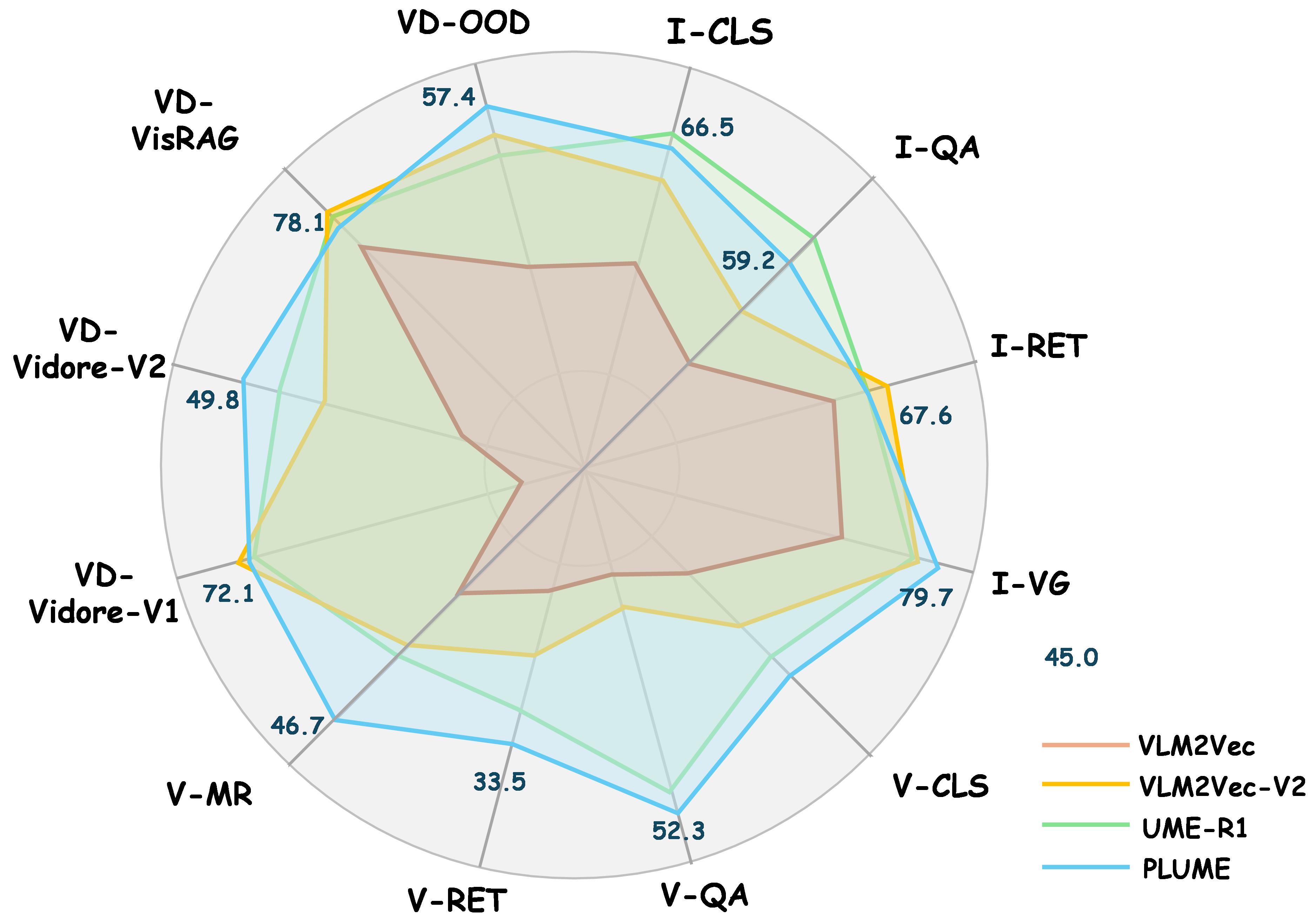
Per-task performance comparison on MMEB-v2. PLUME consistently outperforms UME-R1 and single-pass baselines across most sub-tasks.
📦 Model & Data
| Resource | Link | Description |
|---|---|---|
| Model weights | CUDAOUTOFMEMORY/PLUME-Qwen2-VL-2B | Pre-trained PLUME model (Qwen2-VL-2B + Latent MoE) |
| Training annotations | zhibinlan/UME-sft-train | JSONL annotations for training |
| Images & eval data | TIGER-Lab/MMEB-V2 | Multi-modal images for training and evaluation |
🔧 Getting Started
📁 Directory Structure
PLUME/
├── README.md
├── plume/                              # Python package
│   ├── train/                          #   Training
│   │   ├── train_plume.py              #     Core trainer (PlumeTrainer)
│   │   ├── train_plume_gc.py           #     Gradient-checkpointing variant
│   │   ├── latent_moe.py              #     Latent MoE transition module
│   │   └── argument.py                #     Dataclass argument definitions
│   ├── data/                           #   Data processing
│   │   ├── data_plume.py              #     Dataset, collator, curriculum sampler
│   │   └── rope2d.py                  #     2D/3D RoPE index computation
│   └── eval/                           #   Evaluation analysis tools
│       ├── compare_eval_results.py
│       ├── compute_mmeb_image_hit1_avg.py
│       ├── compute_mmeb_video_hit1_avg.py
│       └── analyze_max_tokens.py
├── configs/
│   ├── deepspeed/                      #   DeepSpeed configs (zero2/zero3/offload)
│   └── eval/                           #   MMEB dataset configs (image/video/visdoc)
├── scripts/                            #   Shell launchers
│   ├── train_singlenode.sh
│   ├── train_multinode.sh
│   ├── launch_multinode.sh
│   └── eval_plume_moe.sh
├── VLM2Vec/                            #   Bundled MMEB eval engine with eval_twomode.py
├── tools/
│   └── check_image.py
└── docs/                               #   Documentation
    ├── environment.md
    ├── training.md
    └── evaluation.md
🫡 Acknowledgements
Many thanks to the code bases from VLM2Vec and Qwen2-VL.
Citation
If you use this code for your research or project, please cite:
@misc{he2026plumelatentreasoningbased,
      title={PLUME: Latent Reasoning Based Universal Multimodal Embedding},
      author={Chenwei He and Xiangzhao Hao and Tianyu Yang and Yuxiang Ma and Yuheng Jia and Lingxiang Wu and Chaoyang Zhao and Haiyun Guo and Jinqiao Wang},
      year={2026},
      eprint={2604.02073},
      archivePrefix={arXiv},
      primaryClass={cs.CV},
      url={https://arxiv.org/abs/2604.02073},
}
License
See the repository root for license information.
Similar repos



Languages
Python
97.2%
Shell
2.8%
[ACMMM 2026] PLUME: Latent Reasoning Based Universal Multimodal Embedding
Python
26
6 commits
updated Apr 29, 2026
README
PLUME: Latent Reasoning Based Universal Multimodal Embedding
🏡 Project Page | 📄 Paper | 🤗 Model | 🤗 Training Data | 🤗 Eval Data
PLUME is a latent reasoning framework for universal multimodal embedding (UME). It replaces explicit chain-of-thought (CoT) generation with a short autoregressive rollout of continuous latent states, combined with a semantic-anchor-guided transition adapter (Latent MoE) and a progressive explicit-to-latent curriculum. Built on Qwen2-VL-2B, PLUME achieves 61.6 on the 78-task MMEB-v2 benchmark while delivering over 30x faster inference compared to explicit-CoT methods.
This repository is the official implementation of the paper PLUME: Latent Reasoning Based Universal Multimodal Embedding.
📰 News
- [2026/04] Paper released on arXiv.
- [2025] Code and model weights released.
📝 TODO
- Code Released: Training and evaluation pipeline.
- Model Released: Pre-trained PLUME-Qwen2-VL-2B weights.
- Paper: arXiv.
💡 Highlights
- Replaces hundreds of explicit reasoning tokens with only 8 latent steps, delivering 30.3x faster inference
- 61.6 overall on the 78-task MMEB-v2 benchmark, surpassing UME-R1 (60.1) and VLM2Vec-V2 (58.0)
- Curriculum-based latent reasoning -- gradually replaces chain-of-thought text with continuous thought (
<ct>) tokens across training stages - Contrastive learning -- cross-device bidirectional contrastive loss for query/positive embedding alignment
- Latent MoE -- Mixture-of-Experts transition layer with 4 routed experts + shared expert in the latent reasoning loop
- Multi-modal evaluation -- MMEB image / video / visdoc evaluation with latent-MoE support
🏗️ Method
Overview of PLUME. The bottom panel illustrates the latent rollout process. The top-left panel expands the semantic-anchor-guided transition adapter with shared and specialized experts. The top-right panel shows the progressive explicit-to-latent curriculum.
🎞️ Results on MMEB-v2
All methods share the same Qwen2-VL-2B backbone.
| Model | Image | Video | VisDoc | All |
|---|---|---|---|---|
| VLM2Vec-V2 | 64.9 | 34.9 | 65.4 | 58.0 |
| UME-R1 | 66.6 | 42.2 | 63.9 | 60.1 |
| PLUME | 66.3 | 44.1 | 67.5 | 61.6 |
Per-task performance comparison on MMEB-v2. PLUME consistently outperforms UME-R1 and single-pass baselines across most sub-tasks.
📦 Model & Data
| Resource | Link | Description |
|---|---|---|
| Model weights | CUDAOUTOFMEMORY/PLUME-Qwen2-VL-2B | Pre-trained PLUME model (Qwen2-VL-2B + Latent MoE) |
| Training annotations | zhibinlan/UME-sft-train | JSONL annotations for training |
| Images & eval data | TIGER-Lab/MMEB-V2 | Multi-modal images for training and evaluation |
🔧 Getting Started
📁 Directory Structure
PLUME/
├── README.md
├── plume/                              # Python package
│   ├── train/                          #   Training
│   │   ├── train_plume.py              #     Core trainer (PlumeTrainer)
│   │   ├── train_plume_gc.py           #     Gradient-checkpointing variant
│   │   ├── latent_moe.py              #     Latent MoE transition module
│   │   └── argument.py                #     Dataclass argument definitions
│   ├── data/                           #   Data processing
│   │   ├── data_plume.py              #     Dataset, collator, curriculum sampler
│   │   └── rope2d.py                  #     2D/3D RoPE index computation
│   └── eval/                           #   Evaluation analysis tools
│       ├── compare_eval_results.py
│       ├── compute_mmeb_image_hit1_avg.py
│       ├── compute_mmeb_video_hit1_avg.py
│       └── analyze_max_tokens.py
├── configs/
│   ├── deepspeed/                      #   DeepSpeed configs (zero2/zero3/offload)
│   └── eval/                           #   MMEB dataset configs (image/video/visdoc)
├── scripts/                            #   Shell launchers
│   ├── train_singlenode.sh
│   ├── train_multinode.sh
│   ├── launch_multinode.sh
│   └── eval_plume_moe.sh
├── VLM2Vec/                            #   Bundled MMEB eval engine with eval_twomode.py
├── tools/
│   └── check_image.py
└── docs/                               #   Documentation
    ├── environment.md
    ├── training.md
    └── evaluation.md
🫡 Acknowledgements
Many thanks to the code bases from VLM2Vec and Qwen2-VL.
Citation
If you use this code for your research or project, please cite:
@misc{he2026plumelatentreasoningbased,
      title={PLUME: Latent Reasoning Based Universal Multimodal Embedding},
      author={Chenwei He and Xiangzhao Hao and Tianyu Yang and Yuxiang Ma and Yuheng Jia and Lingxiang Wu and Chaoyang Zhao and Haiyun Guo and Jinqiao Wang},
      year={2026},
      eprint={2604.02073},
      archivePrefix={arXiv},
      primaryClass={cs.CV},
      url={https://arxiv.org/abs/2604.02073},
}
License
See the repository root for license information.
Similar repos
Languages
Python
97.2%
Shell
2.8%