
Model merging is a highly efficient approach for long-to-short reasoning.
Python
104
12 commits
updated Oct 15, 2025
README
Unlocking Efficient Long-to-Short LLM Reasoning with Model Merging
News 🔔 🔔 🔔
- [October, 2025] Our recent model merging work Activation-Guided Consensus Merging for Large Language Models has been accepted by NeurIPS 2025.
- [October, 2025] The codebase of Sens-Merging has been updated.
- [04 June, 2025] We found the fantastic performance of TIES-Merging on shortening the output length of DeepSeek-R1-0528-Qwen3-8B.
[!IMPORTANT] Reducing around 50% length with performance improvement 4 points on AIME24! AND preserving the no_think ability!
- 💡 [27 March, 2025] We release the code of Average Merging, Task Arithmetic, Ties-Merging and DARE. Special thanks to MergeLM for their great work. We use this repo as our codebase.
- 📣 [26 March, 2025] Our work is available on [ArXiv].
🔥 Early Test on DeepSeek-R1-0528-Qwen3-8B
We directly merge the R1-Qwen3-8B with the Qwen3-8B (as base) models using TIES-Merging with k = 0.7, α = 0.7. We sample 16 answers for each question and calculate the the average score (generation_parameters: max_new_tokens = 32768, temperature = 0.6, top_p = 0.95, top_k = 20}).
| Model | R1-0528-Qwen3-8B | Merged Qwen3-8B |
|---|---|---|
| AIME24 | 70.63 (11328.25) | 74.58 (6448.5) |
According to Qwen3's guidelines, there are two ways to achieve the switch between the /think and /no_think modes, i.e. enable_thinking=False|True and appending /think | /no_think to the instruction.
- Extensive experiments on R1-Qwen3-8B reveal that the no_think capability has been completely diminished in both modes, resulting in excessively lengthy responses.
- Our merged model perserves the no_think ability according to our testing. We found that the model can directly generate the answer part by setting
enable_thinking=False. However, the alternative switch mode triggered by the/no_thinkkeyword appears to fail in most cases.
Stay tuned to our more new results!
Summary of our findings 🔥🔥🔥:
-
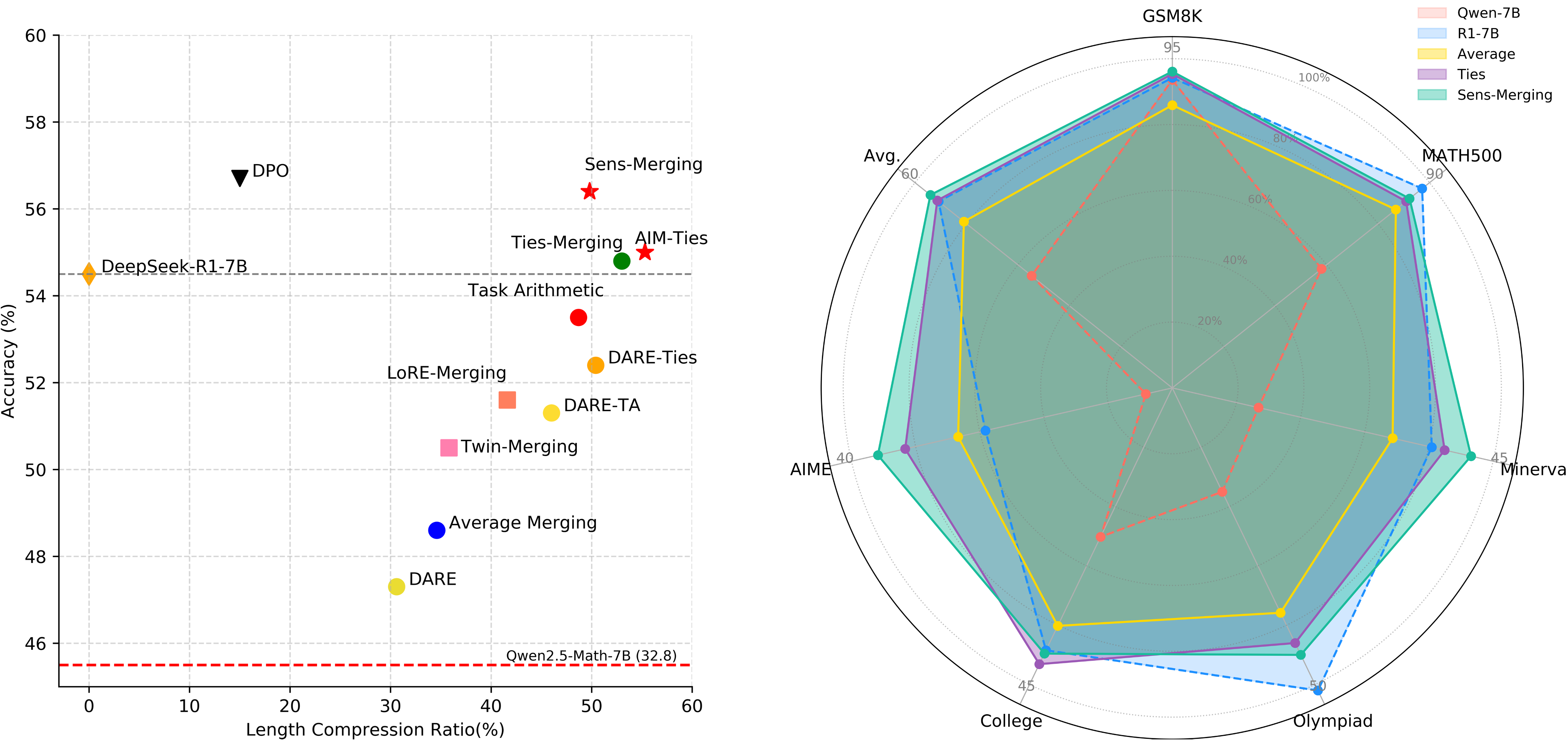
Model merging is a highly efficient approach for long-to-short reasoning, as it directly operates on model parameters without requiring additional training.
-
Task-vector based merging methods, especially like TA and Ties-Merging, can achieve long-to-short reasoning with around 50% length reduction alongside accuracy parity or even marginal gains on 7B models.
-
SVD-based merging methods exhibit limited effectiveness, delivering moderate performance and serving as viable alternatives only when task vectors inherently possess low-rank spectral characteristics.
-
Activation-based merging is the future, as it demonstrates impressive performance in terms of both reasoning accuracy (+1.9) and response length compression ratios (-49.8%).
-
Model merging methods applied to 1.5B-scale models remain effective on simple tasks. Smaller models struggle to learn long CoT reasoning ability through model merging.
-
The merging of large-scale models (14B and 32B) poses significant challenges in simultaneously maintaining reasoning performance while substantially reducing response length.
Related Work 📑
-
Average Merging: Model soups: averaging weights of multiple fine-tuned models improves accuracy without increasing inference time
-
Task Arithmetic: Editing Models with Task Arithmetic
-
Ties-Merging: TIES-Merging: Resolving Interference When Merging Models
-
DARE: Language Models are Super Mario: Absorbing Abilities from Homologous Models as a Free Lunch
-
LoRE-Merging: LoRE-Merging: Exploring Low-Rank Estimation For Large Language Model Merging
-
Twin-Merging: Twin-Merging: Dynamic Integration of Modular Expertise in Model Merging
-
Sens-Merging: Sens-Merging: Sensitivity-Guided Parameter Balancing for Merging Large Language Models
Environments
For merging methods:
numpy==1.26.4
torch==2.5.1
transformers==4.48.2
For the evaluation, we recommend following the usage of [Qwen2.5-Math Eval Toolkit].
Implementation
Our implementation is adapted from MergeLM. We optimize the code of some merging methods, such as TA and Ties-Merging, for computational efficiency.
Average merging
python src/main_merging.py --merge_method average_merging \
                           --output_dir DIR \
                           --base_model MODEL_PATH \
                           --models_to_merge MODEL_PATH1,MODEL_PATH2,...,MODEL_PATHn
Task Arithmetic
python src/main_merging.py --merge_method task_arithmetic \
                           --output_dir DIR \
                           --base_model MODEL_PATH \
                           --models_to_merge MODEL_PATH1,MODEL_PATH2,...,MODEL_PATHn \
                           --scaling_coefficient α
Ties-Merging
python src/main_merging.py --merge_method ties_merging/ties_merging_dare \
                           --output_dir DIR \
                           --base_model MODEL_PATH \
                           --models_to_merge MODEL_PATH1,MODEL_PATH2,...,MODEL_PATHn \
                           --scaling_coefficient α \
                           --param_value_mask_rate k
Note: You can choose to use ties_merging that we optimize the implementation for better computational efficiency or ties_merging_dare which is the original implementation in MergeLM. We have compared two implementations and find the results are comparable.
DARE
python src/main_merging.py --merge_method mask_merging \
                           --output_dir DIR \
                           --base_model MODEL_PATH \
                           --models_to_merge MODEL_PATH1,MODEL_PATH2,...,MODEL_PATHn \
                           --scaling_coefficient α \
                           --param_value_mask_rate k \
                           --mask_apply_method [average_merging || task_arithmetic || ties_merging || ties_merging_dare] \
                           --weight_mask_rates p
AIM & Sens-Merging
We will release the code of activation-based methods soon. Stay tuned!
Evaluations
git clone https://github.com/QwenLM/Qwen2.5-Math.git
cd Qwen2.5-Math-main/evaluation
Move src/evaluation/data_process.py and src/evaluation/l2s_eval.sh as following:
Qwen2.5-Math-Main/evaluation
├── sh
│   ├── l2s_eval.sh
├── data
│   ├── math500
├── outputs
│   ├── ...
├── data_process.py
└── ...
Note: MATH500 are not in original database. You should manually add it to Qwen2.5-Math-Main/evaluation/data.
Run the evaluation:
CUDA_VISIBLE_DEVICES="0,1,2,3" bash sh/l2s_eval.sh [PROMPT_TYPE:qwen25-math-cot] [MODEL_PATH] [MAX_TOKEN:10240] [NUM_SHOTS:0] [DATASETS:aime24,math500,gsm8k,college_math,minerva_math,olympiadbench]
To make sure the reproducibility of the results, we set temperature=0, top_p=1.
Configurations
| Method | 1.5B | 7B | 14B | 32B |
|---|---|---|---|---|
| Task Arithmetic | α = 0.7 | α = 0.7 | α = 0.7 | α = 0.7 |
| Ties-Merging | k = 0.8, α = 1.0 | k = 0.8, α = 1.0 | k = 0.2, α = 0.5 | k = 0.25, α = 0.55 |
| DARE | p = 0.3 | p = 0.3 | p = 0.4 | - |
| AIM-Ties | ω = 0.4 | ω = 0.4 | ω = 0.4 | - |
| Sens-Merging | α = 0.4, T = 3.0 | α = 0.7, T = 2.0 | α = 0.8, T = 6.0 | - |
Table: The hyper-parameters of various merging methods. α means the coefficient in TA merging. p means the drop rate in DARE. k denotes the trim ratio in Ties-Merging. ω means the balance factor in AIM. T is the temperature in Sens-Merging.
Citation
@article{wu2025unlockingefficientlongtoshortllm,
      title={Unlocking Efficient Long-to-Short LLM Reasoning with Model Merging},
      author={Han Wu and Yuxuan Yao and Shuqi Liu and Zehua Liu and Xiaojin Fu and Xiongwei Han and Xing Li and Hui-Ling Zhen and Tao Zhong and Mingxuan Yuan},
      year={2025},
      eprint={2503.20641},
      archivePrefix={arXiv},
      primaryClass={cs.CL},
      url={https://arxiv.org/abs/2503.20641},
}
Similar repos




Languages
Python
98.9%
Shell
1.1%
Model merging is a highly efficient approach for long-to-short reasoning.
Python
104
12 commits
updated Oct 15, 2025
README
Unlocking Efficient Long-to-Short LLM Reasoning with Model Merging
News 🔔 🔔 🔔
- [October, 2025] Our recent model merging work Activation-Guided Consensus Merging for Large Language Models has been accepted by NeurIPS 2025.
- [October, 2025] The codebase of Sens-Merging has been updated.
- [04 June, 2025] We found the fantastic performance of TIES-Merging on shortening the output length of DeepSeek-R1-0528-Qwen3-8B.
[!IMPORTANT] Reducing around 50% length with performance improvement 4 points on AIME24! AND preserving the no_think ability!
- 💡 [27 March, 2025] We release the code of Average Merging, Task Arithmetic, Ties-Merging and DARE. Special thanks to MergeLM for their great work. We use this repo as our codebase.
- 📣 [26 March, 2025] Our work is available on [ArXiv].
🔥 Early Test on DeepSeek-R1-0528-Qwen3-8B
We directly merge the R1-Qwen3-8B with the Qwen3-8B (as base) models using TIES-Merging with k = 0.7, α = 0.7. We sample 16 answers for each question and calculate the the average score (generation_parameters: max_new_tokens = 32768, temperature = 0.6, top_p = 0.95, top_k = 20}).
| Model | R1-0528-Qwen3-8B | Merged Qwen3-8B |
|---|---|---|
| AIME24 | 70.63 (11328.25) | 74.58 (6448.5) |
According to Qwen3's guidelines, there are two ways to achieve the switch between the /think and /no_think modes, i.e. enable_thinking=False|True and appending /think | /no_think to the instruction.
- Extensive experiments on R1-Qwen3-8B reveal that the no_think capability has been completely diminished in both modes, resulting in excessively lengthy responses.
- Our merged model perserves the no_think ability according to our testing. We found that the model can directly generate the answer part by setting
enable_thinking=False. However, the alternative switch mode triggered by the/no_thinkkeyword appears to fail in most cases.
Stay tuned to our more new results!
Summary of our findings 🔥🔥🔥:
-
Model merging is a highly efficient approach for long-to-short reasoning, as it directly operates on model parameters without requiring additional training.
-
Task-vector based merging methods, especially like TA and Ties-Merging, can achieve long-to-short reasoning with around 50% length reduction alongside accuracy parity or even marginal gains on 7B models.
-
SVD-based merging methods exhibit limited effectiveness, delivering moderate performance and serving as viable alternatives only when task vectors inherently possess low-rank spectral characteristics.
-
Activation-based merging is the future, as it demonstrates impressive performance in terms of both reasoning accuracy (+1.9) and response length compression ratios (-49.8%).
-
Model merging methods applied to 1.5B-scale models remain effective on simple tasks. Smaller models struggle to learn long CoT reasoning ability through model merging.
-
The merging of large-scale models (14B and 32B) poses significant challenges in simultaneously maintaining reasoning performance while substantially reducing response length.
Related Work 📑
-
Average Merging: Model soups: averaging weights of multiple fine-tuned models improves accuracy without increasing inference time
-
Task Arithmetic: Editing Models with Task Arithmetic
-
Ties-Merging: TIES-Merging: Resolving Interference When Merging Models
-
DARE: Language Models are Super Mario: Absorbing Abilities from Homologous Models as a Free Lunch
-
LoRE-Merging: LoRE-Merging: Exploring Low-Rank Estimation For Large Language Model Merging
-
Twin-Merging: Twin-Merging: Dynamic Integration of Modular Expertise in Model Merging
-
Sens-Merging: Sens-Merging: Sensitivity-Guided Parameter Balancing for Merging Large Language Models
Environments
For merging methods:
numpy==1.26.4
torch==2.5.1
transformers==4.48.2
For the evaluation, we recommend following the usage of [Qwen2.5-Math Eval Toolkit].
Implementation
Our implementation is adapted from MergeLM. We optimize the code of some merging methods, such as TA and Ties-Merging, for computational efficiency.
Average merging
python src/main_merging.py --merge_method average_merging \
                           --output_dir DIR \
                           --base_model MODEL_PATH \
                           --models_to_merge MODEL_PATH1,MODEL_PATH2,...,MODEL_PATHn
Task Arithmetic
python src/main_merging.py --merge_method task_arithmetic \
                           --output_dir DIR \
                           --base_model MODEL_PATH \
                           --models_to_merge MODEL_PATH1,MODEL_PATH2,...,MODEL_PATHn \
                           --scaling_coefficient α
Ties-Merging
python src/main_merging.py --merge_method ties_merging/ties_merging_dare \
                           --output_dir DIR \
                           --base_model MODEL_PATH \
                           --models_to_merge MODEL_PATH1,MODEL_PATH2,...,MODEL_PATHn \
                           --scaling_coefficient α \
                           --param_value_mask_rate k
Note: You can choose to use ties_merging that we optimize the implementation for better computational efficiency or ties_merging_dare which is the original implementation in MergeLM. We have compared two implementations and find the results are comparable.
DARE
python src/main_merging.py --merge_method mask_merging \
                           --output_dir DIR \
                           --base_model MODEL_PATH \
                           --models_to_merge MODEL_PATH1,MODEL_PATH2,...,MODEL_PATHn \
                           --scaling_coefficient α \
                           --param_value_mask_rate k \
                           --mask_apply_method [average_merging || task_arithmetic || ties_merging || ties_merging_dare] \
                           --weight_mask_rates p
AIM & Sens-Merging
We will release the code of activation-based methods soon. Stay tuned!
Evaluations
git clone https://github.com/QwenLM/Qwen2.5-Math.git
cd Qwen2.5-Math-main/evaluation
Move src/evaluation/data_process.py and src/evaluation/l2s_eval.sh as following:
Qwen2.5-Math-Main/evaluation
├── sh
│   ├── l2s_eval.sh
├── data
│   ├── math500
├── outputs
│   ├── ...
├── data_process.py
└── ...
Note: MATH500 are not in original database. You should manually add it to Qwen2.5-Math-Main/evaluation/data.
Run the evaluation:
CUDA_VISIBLE_DEVICES="0,1,2,3" bash sh/l2s_eval.sh [PROMPT_TYPE:qwen25-math-cot] [MODEL_PATH] [MAX_TOKEN:10240] [NUM_SHOTS:0] [DATASETS:aime24,math500,gsm8k,college_math,minerva_math,olympiadbench]
To make sure the reproducibility of the results, we set temperature=0, top_p=1.
Configurations
| Method | 1.5B | 7B | 14B | 32B |
|---|---|---|---|---|
| Task Arithmetic | α = 0.7 | α = 0.7 | α = 0.7 | α = 0.7 |
| Ties-Merging | k = 0.8, α = 1.0 | k = 0.8, α = 1.0 | k = 0.2, α = 0.5 | k = 0.25, α = 0.55 |
| DARE | p = 0.3 | p = 0.3 | p = 0.4 | - |
| AIM-Ties | ω = 0.4 | ω = 0.4 | ω = 0.4 | - |
| Sens-Merging | α = 0.4, T = 3.0 | α = 0.7, T = 2.0 | α = 0.8, T = 6.0 | - |
Table: The hyper-parameters of various merging methods. α means the coefficient in TA merging. p means the drop rate in DARE. k denotes the trim ratio in Ties-Merging. ω means the balance factor in AIM. T is the temperature in Sens-Merging.
Citation
@article{wu2025unlockingefficientlongtoshortllm,
      title={Unlocking Efficient Long-to-Short LLM Reasoning with Model Merging},
      author={Han Wu and Yuxuan Yao and Shuqi Liu and Zehua Liu and Xiaojin Fu and Xiongwei Han and Xing Li and Hui-Ling Zhen and Tao Zhong and Mingxuan Yuan},
      year={2025},
      eprint={2503.20641},
      archivePrefix={arXiv},
      primaryClass={cs.CL},
      url={https://arxiv.org/abs/2503.20641},
}
Similar repos
Languages
Python
98.9%
Shell
1.1%