
README
Neuro-3D: Towards 3D Visual Decoding from EEG Signals
Zhanqiang Guo(#)
Jiamin Wu(#)
Yonghao Song
Jiahui Bu
Weijian Mai
Qihao Zheng
Wanli Ouyang*
Chunfeng Song*
Shanghai AI Laboratory Tsinghua University The Chinese University of Hong Kong
Shanghai Jiao Tong University South China University of Technology
🏠 About
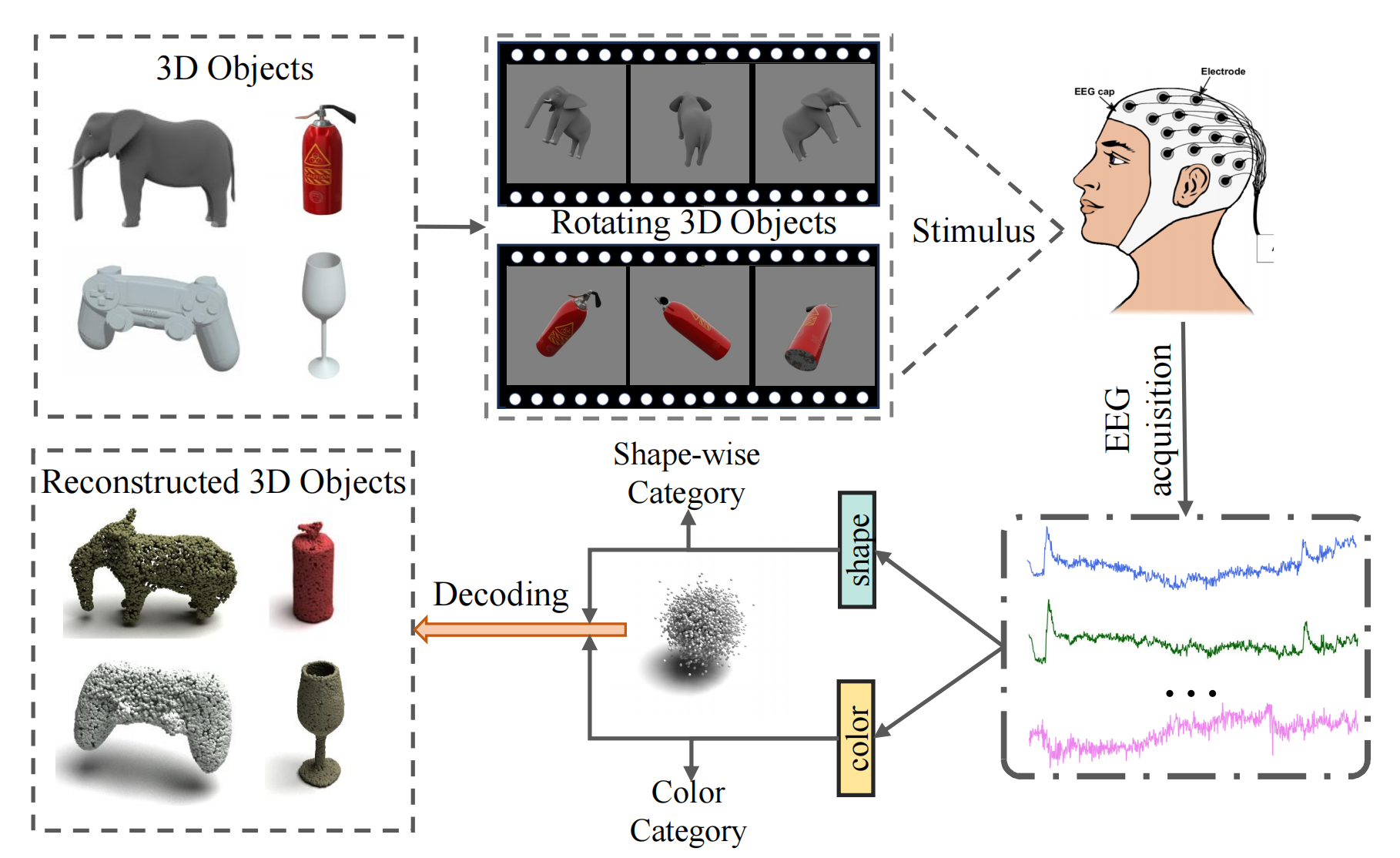
🔥 News
- [2024-11-21] We release the paper of Neuro-3D.
- [2025-02-26] Our paper is accepted to CVPR2025.
- [2025-03-07] We release the training and inferencing codes.
- [2025-03-09] We release our dataset.
🔍 Overview
Framework
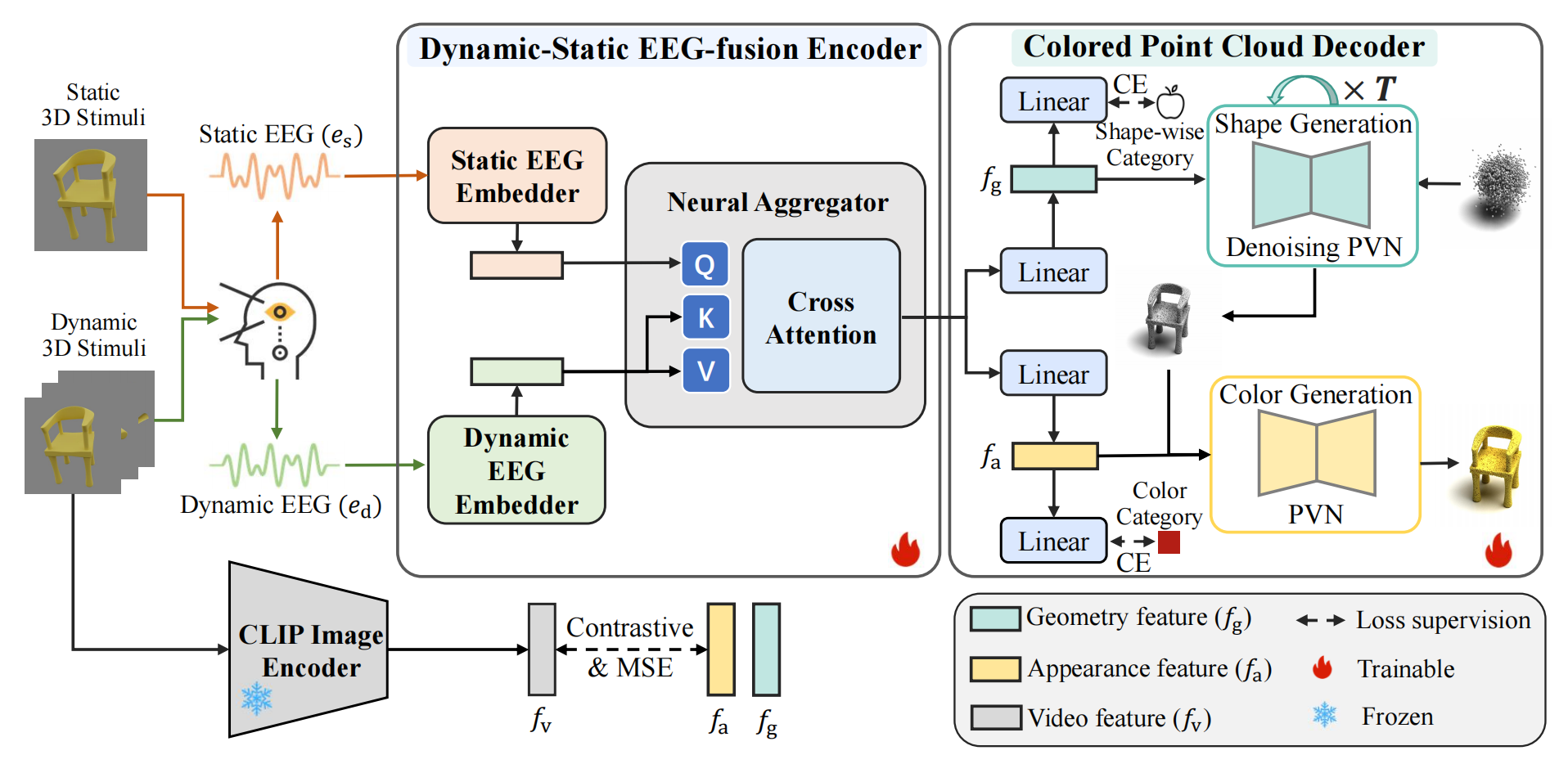
The input static and dynamic signals ($e_\mathrm{s}$ and $e_\mathrm{d}$) are aggregated via the dynamic-static EEG-fusion encoder. Subsequently, the fused EEG features are decoupled into geometry and appearance features ($f_\mathrm{g}$ and $f_\mathrm{a}$). After aligning with clip image embeddings, $f_\mathrm{g}$ and $f_\mathrm{a}$ serve as guidance for the generation of geometric shapes and overall colors.
Dataset
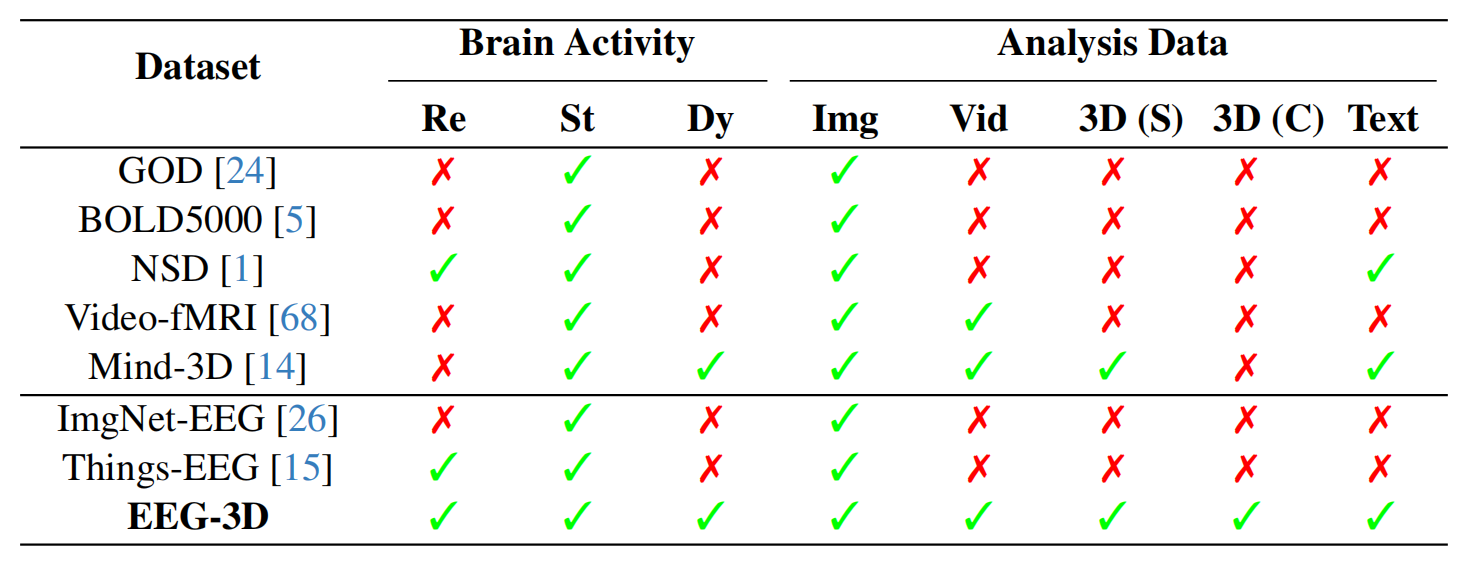
Comparison between EEG-3D and other datasets, categorizing brain activity into resting-state (Re), responses to static stimuli (St) and dynamic stimuli (Dy). The analysis data includes images (Img), videos (Vid), text captions (Text), 3D shape (3D (S)) and color attributes (3D (C)). The EED-3D dataset distinguishes itself from existing datasets by the attributes of Comprehensive EEG signal recordings and Multimodal analysis data and labels.
Experiment Results
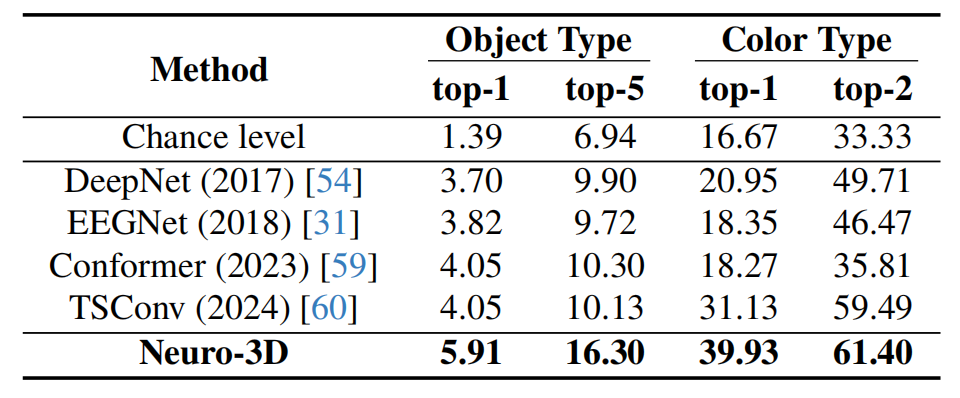
Comparison with Related Methods on Classification Task
Please refer to our paper for more results.
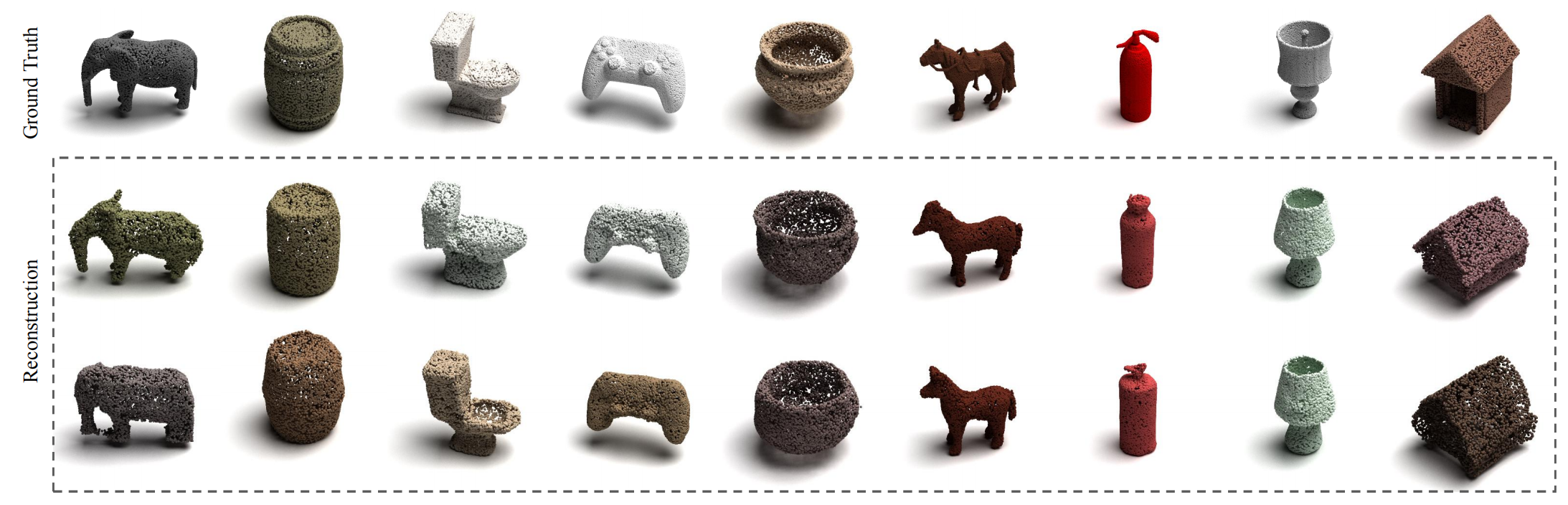
Reconstructed Examples
Please refer to our paper for more results.
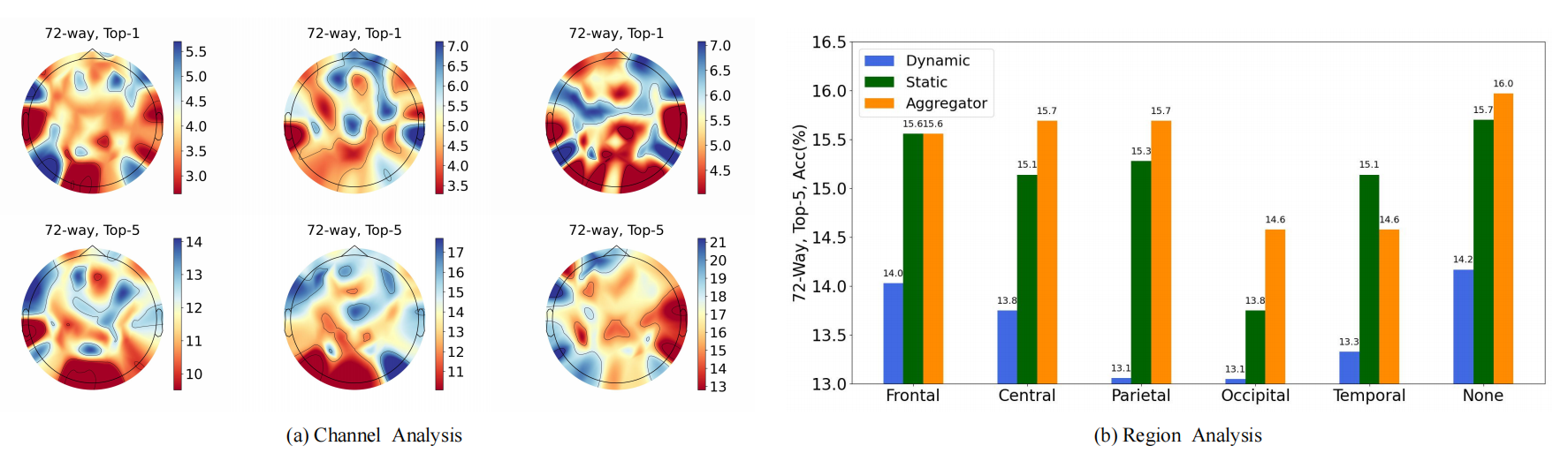
Analysis of Brain Regions
Please refer to our paper for more results.
📦 Training and Evaluation
Installation
- Python = 3.9.19
- Pytorch = 2.0.1
- CUDA = 11.8
- Install other packages in
requirements.txt
Data Preparation
- Download the dataset
The data download link will be announced soon. The directory should look like this:
root_path
├── EEGdata
├──── sub01
├──────── process_data_1s_250Hz.npy
├──────── process_data_6s_100Hz.npy
├── point_cloud
├── video_new
└── clip_feature.pth
where clip_feature.pth is the CLIP feature corresponding to text, video, and point cloud extracted from the pre-trained model.
- Run the code to divide the dataset:
python eeg_data_process/EEG_organization.py
Training
- The Training of Classification Model
python classification/retri_shape_color.py --root_path root_path --sub 'sub01'
- The Training of Reconstruction Model
The name of the model saved in step 1 is denoted as cls_model, such as retri_color_shape_03-07_21-39_VideoImageEEGClassifyColor3_color_video_fea_time_len1.
python recon_main.py --data_path root_path --generation_type 'shape' --sub 'sub01' --in_channels 1027 --pretrain_model cls_model
- The Training of Color Prediction Model
python add_color_main.py --data_path root_path --generation_type 'color' --in_channel 1033 --sub 'sub01' --max_steps 40000 --checkpoint_freq 5000 --pretrain_model cls_model
Inferencing
- Inferencing of Reconstruction Model
python recon_main.py --data_path root_path --generation_type 'shape' --task 'sample' --sub 'sub03' --in_channels 1027 --checkpoint_resume chechpoint_path
- Inferencing of Color Prediction Model
python add_color_main.py --data_path root_path --generation_type 'color' --task 'sample' --in_channel 1033 --sub 'sub25' --checkpoint_resume chechpoint_path --ply_point_path recon_result_path
🔗 Citation
If you find our work and this codebase helpful, please consider starring this repo 🌟 and cite:
@article{guo2024neuro,
  title={Neuro-3D: Towards 3D Visual Decoding from EEG Signals},
  author={Guo, Zhanqiang and Wu, Jiamin and Song, Yonghao and Mai, Weijian and Zheng, Qihao and Ouyang, Wanli and Song, Chunfeng},
  journal={arXiv preprint arXiv:2411.12248},
  year={2024}
}
📧 Contact us
If you have any questions about this code, please do not hesitate to contact me.
Zhanqiang Guo: guozq21@mails.tsinghua.edu.cn
Similar repos


Languages
Python
75.8%
Cuda
15.6%
C++
8.6%
README
Neuro-3D: Towards 3D Visual Decoding from EEG Signals
Zhanqiang Guo(#)
Jiamin Wu(#)
Yonghao Song
Jiahui Bu
Weijian Mai
Qihao Zheng
Wanli Ouyang*
Chunfeng Song*
Shanghai AI Laboratory Tsinghua University The Chinese University of Hong Kong
Shanghai Jiao Tong University South China University of Technology
🏠 About
🔥 News
- [2024-11-21] We release the paper of Neuro-3D.
- [2025-02-26] Our paper is accepted to CVPR2025.
- [2025-03-07] We release the training and inferencing codes.
- [2025-03-09] We release our dataset.
🔍 Overview
Framework
The input static and dynamic signals ($e_\mathrm{s}$ and $e_\mathrm{d}$) are aggregated via the dynamic-static EEG-fusion encoder. Subsequently, the fused EEG features are decoupled into geometry and appearance features ($f_\mathrm{g}$ and $f_\mathrm{a}$). After aligning with clip image embeddings, $f_\mathrm{g}$ and $f_\mathrm{a}$ serve as guidance for the generation of geometric shapes and overall colors.
Dataset
Comparison between EEG-3D and other datasets, categorizing brain activity into resting-state (Re), responses to static stimuli (St) and dynamic stimuli (Dy). The analysis data includes images (Img), videos (Vid), text captions (Text), 3D shape (3D (S)) and color attributes (3D (C)). The EED-3D dataset distinguishes itself from existing datasets by the attributes of Comprehensive EEG signal recordings and Multimodal analysis data and labels.
Experiment Results
Comparison with Related Methods on Classification Task
Please refer to our paper for more results.
Reconstructed Examples
Please refer to our paper for more results.
Analysis of Brain Regions
Please refer to our paper for more results.
📦 Training and Evaluation
Installation
- Python = 3.9.19
- Pytorch = 2.0.1
- CUDA = 11.8
- Install other packages in
requirements.txt
Data Preparation
- Download the dataset
The data download link will be announced soon. The directory should look like this:
root_path
├── EEGdata
├──── sub01
├──────── process_data_1s_250Hz.npy
├──────── process_data_6s_100Hz.npy
├── point_cloud
├── video_new
└── clip_feature.pth
where clip_feature.pth is the CLIP feature corresponding to text, video, and point cloud extracted from the pre-trained model.
- Run the code to divide the dataset:
python eeg_data_process/EEG_organization.py
Training
- The Training of Classification Model
python classification/retri_shape_color.py --root_path root_path --sub 'sub01'
- The Training of Reconstruction Model
The name of the model saved in step 1 is denoted as cls_model, such as retri_color_shape_03-07_21-39_VideoImageEEGClassifyColor3_color_video_fea_time_len1.
python recon_main.py --data_path root_path --generation_type 'shape' --sub 'sub01' --in_channels 1027 --pretrain_model cls_model
- The Training of Color Prediction Model
python add_color_main.py --data_path root_path --generation_type 'color' --in_channel 1033 --sub 'sub01' --max_steps 40000 --checkpoint_freq 5000 --pretrain_model cls_model
Inferencing
- Inferencing of Reconstruction Model
python recon_main.py --data_path root_path --generation_type 'shape' --task 'sample' --sub 'sub03' --in_channels 1027 --checkpoint_resume chechpoint_path
- Inferencing of Color Prediction Model
python add_color_main.py --data_path root_path --generation_type 'color' --task 'sample' --in_channel 1033 --sub 'sub25' --checkpoint_resume chechpoint_path --ply_point_path recon_result_path
🔗 Citation
If you find our work and this codebase helpful, please consider starring this repo 🌟 and cite:
@article{guo2024neuro,
  title={Neuro-3D: Towards 3D Visual Decoding from EEG Signals},
  author={Guo, Zhanqiang and Wu, Jiamin and Song, Yonghao and Mai, Weijian and Zheng, Qihao and Ouyang, Wanli and Song, Chunfeng},
  journal={arXiv preprint arXiv:2411.12248},
  year={2024}
}
📧 Contact us
If you have any questions about this code, please do not hesitate to contact me.
Zhanqiang Guo: guozq21@mails.tsinghua.edu.cn
Similar repos
Languages
Python
75.8%
Cuda
15.6%
C++
8.6%