A library of composable functions for the type-level! Transform your TypeScript types in any way you want using functions you already know.
TypeScript
3,680
310 commits
updated Dec 28, 2024
A library of composable functions for the type level!
Transform your TypeScript types in any way you want using functions you already know.
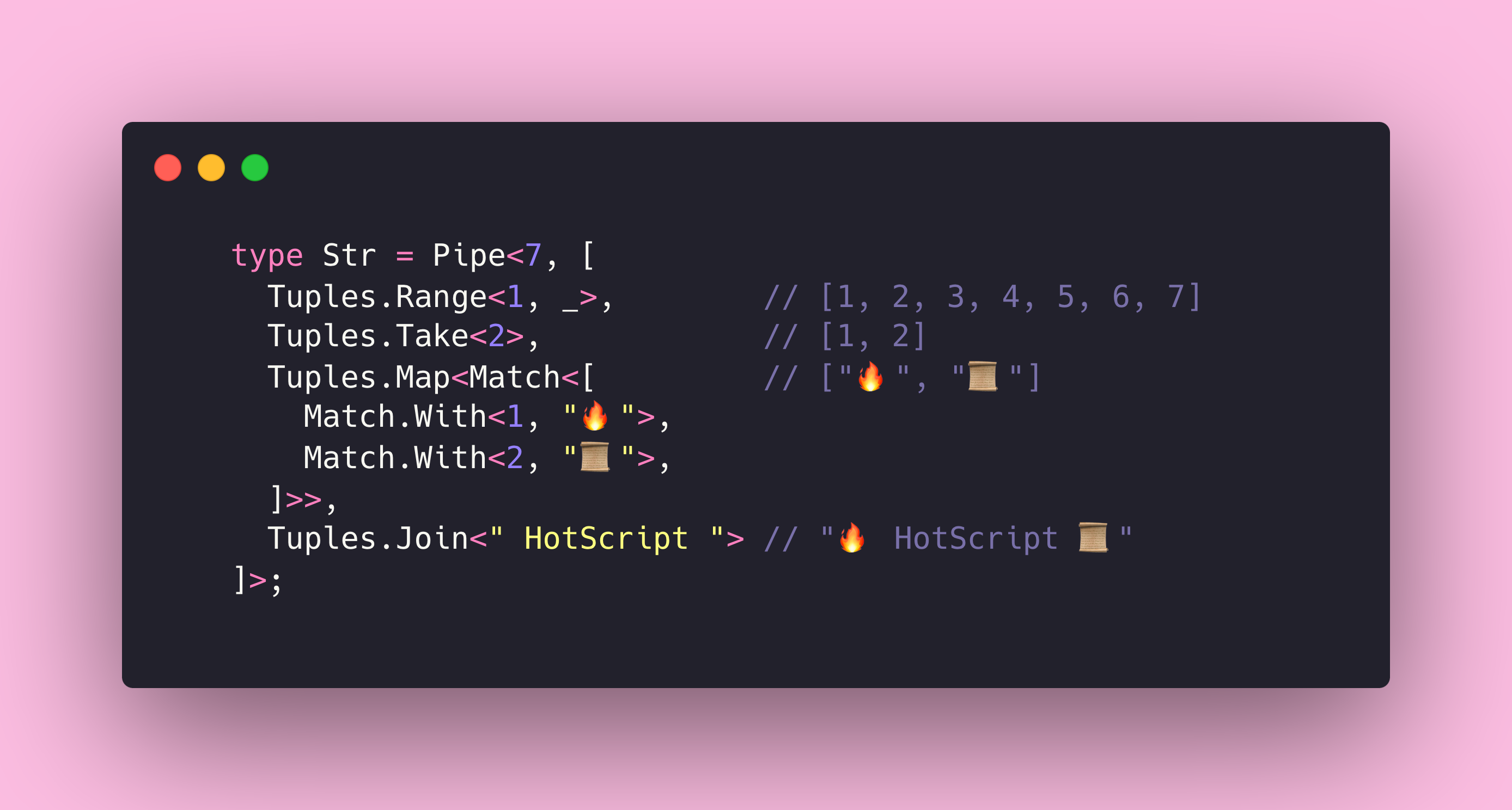
Tuples.Map, Tuples.Filter, Objects.MapValues, etc).Match.Numbers.Add, Numbers.Sub, Numbers.Mul, Numbers.Div, etc).🚧 work in progress 🚧
You can find HotScript on npm:
npm install -D hotscript
HotScript is a work-in-progress library, so expect breaking changes in its API.
Run this as a TypeScript Playground
import { Pipe, Tuples, Strings, Numbers } from "hotscript";

type res1 = Pipe<
  //  ^? 62
  [1, 2, 3, 4],
  [
    Tuples.Map<Numbers.Add<3>>,       // [4, 5, 6, 7]
    Tuples.Join<".">,                 // "4.5.6.7"
    Strings.Split<".">,               // ["4", "5", "6", "7"]
    Tuples.Map<Strings.Prepend<"1">>, // ["14", "15", "16", "17"]
    Tuples.Map<Strings.ToNumber>,     // [14, 15, 16, 17]
    Tuples.Sum                        // 62
  ]
>;
Run this as a TypeScript Playground
import { Call, Fn, Tuples } from "hotscript";

// This is a type-level "lambda"!
interface Duplicate extends Fn {
  return: [this["arg0"], this["arg0"]];
}

type result1 = Call<Tuples.Map<Duplicate>, [1, 2, 3, 4]>;
//     ^? [[1, 1], [2, 2], [3, 3], [4, 4]]

type result2 = Call<Tuples.FlatMap<Duplicate>, [1, 2, 3, 4]>;
//     ^? [1, 1, 2, 2, 3, 3, 4, 4]
Run this as a TypeScript Playground
import { Pipe, Objects, Booleans } from "hotscript";

// Let's compose some functions to transform an object type:
type ToAPIPayload<T> = Pipe<
  T,
  [
    Objects.OmitBy<Booleans.Equals<symbol>>,
    Objects.Assign<{ metadata: { newUser: true } }>,
    Objects.SnakeCaseDeep,
    Objects.Assign<{ id: string }>
  ]
>;
type T = ToAPIPayload<{
  id: symbol;
  firstName: string;
  lastName: string;
}>;
// Returns:
type T = {
  id: string;
  metadata: { new_user: true };
  first_name: string;
  last_name: string;
};
Run this as a TypeScript Playground
https://user-images.githubusercontent.com/2315749/222081717-96217cd2-ac89-4e06-a942-17fbda717cd2.mp4
import { Pipe, Objects, Strings, ComposeLeft, Tuples, Match } from "hotscript";

type res5 = Pipe<
  //    ^? { id: string, index: number }
  "/users/<id:string>/posts/<index:number>",
  [
    Strings.Split<"/">,
    Tuples.Filter<Strings.StartsWith<"<">>,
    Tuples.Map<ComposeLeft<[Strings.Trim<"<" | ">">, Strings.Split<":">]>>,
    Tuples.ToUnion,
    Objects.FromEntries,
    Objects.MapValues<
      Match<[Match.With<"string", string>, Match.With<"number", number>]>
    >
  ]
>;
Run this as a TypeScript Playground
import * as H from 'hotscript'

declare function querySelector<T extends string>(selector: T): ElementFromSelector<T> | null

interface Trim extends H.Fn {
    return:
    this["arg0"] extends `${infer Prev} ,${infer Next}` ?
    H.$<Trim, `${Prev},${Next}`> :
    this["arg0"] extends `${infer Prev}, ${infer Next}` ?
    H.$<Trim, `${Prev},${Next}`> :
    this["arg0"] extends `${infer Prev}:is(${infer El})${infer Rest}` ?
    H.$<Trim, `${Prev}${El}${Rest}`> :
    this["arg0"] extends `${infer Prev}:where(${infer El})${infer Rest}` ?
    H.$<Trim, `${Prev}${El}${Rest}`> :
    this["arg0"] extends `${infer El}(${string})${infer Rest}` ?
    H.$<Trim, `${El}${Rest}`> :
    this["arg0"] extends `${infer El}[${string}]${infer Rest}` ?
    H.$<Trim, `${El}${Rest}`> :
    this["arg0"]
}

type ElementFromSelector<T> = H.Pipe<T, [
    Trim,
    H.Strings.Split<' '>,
    H.Tuples.Last,
    H.Strings.Split<','>,
    H.Tuples.ToUnion,
    H.Strings.Split<":" | "[" | "." | "#">,
    H.Tuples.At<0>,
    H.Match<[
        H.Match.With<keyof HTMLElementTagNameMap, H.Objects.Get<H._, HTMLElementTagNameMap>>,
        H.Match.With<any, HTMLElement>
    ]>
]>
Pipe<Input, Fn[]>: Pipes a type through several functions.PipeRight<Fn[], Input>: Pipe a type from right to left.Call<Fn, ...Arg>: Call a type level Fn function.Apply<Fn, Arg[]>: Apply several arguments to an Fn function.PartialApply<Fn, Arg[]>: Make an Fn partially applicable.Compose<Fn[]>: Compose Fn functions from right to left.ComposeLeft<Fn[]>: Compose Fn functions from left to right.args, arg0, arg1, arg2, arg3: Access piped parameters (Useful in combination with Objects.Create)._: Placeholder to partially apply any built-in functions, or functions created with PartialApply.ReturnType<FunctionType>: Extract the return type from a function type.Parameters<FunctionType>: Extract the parameters from a function type as a tuple.Parameter<N, FunctionType>: Extract the parameter at index N from a function type.MapReturnType<Fn, FunctionType>: Transform the return type of a function type using an Fn.MapParameters<Fn, FunctionType>: Transform the tuple of parameters of a function type using an Fn.Create<X> -> [X]: Create a unary tuple from a type.Partition<Fn, Tuple>: Using a predicate Fn, turn a list of types into two lists [Passing[], Rejected[]].IsEmpty<Tuple>: Check if a tuple is empty.Zip<...Tuple[]>: Zips several tuples together. For example. it would turn [[a,b,c], [1,2,3]] into [[a, 1], [b, 2], [c, 3]].ZipWith<Fn, ...Tuple[]>: Zip several tuples by calling a zipper Fn with one argument per input tuple.Sort<Tuple>: Sorts a tuple of number literals.Head<Tuple>: Returns the first element from a tuple type.Tail<Tuple>: Drops the first element from a tuple type.At<N, Tuple>: Returns the Nth element from a tuple.Last<Tuple>: Returns the last element from a tuple.FlatMap<Fn, Tuple>: Calls an Fn function returning a tuple on each element of the input tuple, and flattens all of the returned tuples into a single one.Find<Fn, Tuple>: Finds an element from a tuple using a predicate Fn.Drop<N, Tuple>: Drops the N first elements from a tuple.Take<N, Tuple>: Takes the N first elements from a tuple.TakeWhile<Fn, Tuple>: Take elements while the Fn predicate returns true.GroupBy<Fn, Tuple>: Transform a list into an object containing lists. The Fn function takes each element and returns the key it should be added to.Join<Str, Tuple>: Joins several strings together using the Str separator string.Map<Fn, Tuple>: Transforms each element in a tuple.Filter<Fn, Tuple>: Removes elements from a tuple if the Fn predicate function doesn't return true.Reduce<Fn, Init, Tuple>: Iterates over a tuple a reduce it to a single function using a reducer Fn.ReduceRight<Fn, Init, Tuple>: like Reduce, but starting from the end of the list.Reverse<Tuple>: Reverses the tuple.Every<Fn, Tuple>: Checks if all element passes the Fn predicate.Some<Fn, Tuple>: Checks if at least one element passes the Fn predicate.SplitAt<N, Tuple>: Split a tuple into a left and a right tuple using an index.ToUnion<Tuple>: Turns a tuple into a union of elements.ToIntersection<Tuple>: Turns a tuple into an intersection of elements.Prepend<X, Tuple>: Adds a type at the beginning of a tuple.Append<X, Tuple>: Adds a type at the end of a tuple.Concat<T1, T2>: Merges two tuples together.Min<Tuple>: Returns the minimum number in a list of number literal types.Max<Tuple>: Returns the maximum number in a list of number literal types.Sum<Tuple>: Add all numbers in a list of number literal types together.Readonly<Obj>: Makes all object keys readonly.Mutable<Obj>: Removes readonly from all object keys.Required<Obj>: Makes all keys required.Partial<Obj>: Makes all keys optional.ReadonlyDeep<Obj>: Recursively makes all object keys readonly.MutableDeep<Obj>: Recursively removes readonly from all object keys.RequiredDeep<Obj>: Recursively makes all keys required.PartialDeep<Obj>: Recursively makes all keys optional.Update<Path, Fn | V, Obj>: Immutably update an object's field under a certain path. Paths are dot-separated strings: a.b.c.Record<Key, Value>: Creates an object type with keys of type Key and values of type Value.Keys<Obj>: Extracts the keys from an object type Obj.Values<Obj>: Extracts the values from an object type Obj.AllPaths<Obj>: Extracts all possible paths of an object type Obj.Create<Pattern, X>: Creates an object of type Pattern with values of type X.Get<Path, Obj>: Gets the value at the specified path Path in the object Obj.FromEntries<[Key, Value]>: Creates an object from a union of key-value pairs.Entries<Obj>: Extracts the union of key-value pairs from an object type Obj.MapValues<Fn, Obj>: Transforms the values of an object type Obj using a mapper function Fn.MapKeys<Fn, Obj>: Transforms the keys of an object type Obj using a mapper function Fn.Assign<...Obj>: Merges multiple objects together.Pick<Key, Obj>: Picks specific keys Key from an object type Obj.PickBy<Fn, Obj>: Picks keys from an object type Obj based on a predicate function Fn.Omit<Key, Obj>: Omits specific keys Key from an object type Obj.OmitBy<Fn, Obj>: Omits keys from an object type Obj based on a predicate function Fn.CamelCase<Obj>: Converts the keys of an object type Obj to camelCase.CamelCaseDeep<Obj>: Recursively converts the keys of an object type Obj to camelCase.SnakeCase<Obj>: Converts the keys of an object type Obj to snake_case.SnakeCaseDeep<Obj>: Recursively converts the keys of an object type Obj to snake_case.KebabCase<Obj>: Converts the keys of an object type Obj to kebab-case.KebabCaseDeep<Obj>: Recursively converts the keys of an object type Obj to kebab-case.Map<Fn, U>: Transforms each member of a union type U using a mapper function Fn.Extract<T, U>: Extracts the subset of a union type U that is assignable to type T.ExtractBy<Fn, U>: Extracts the subset of a union typeUthat satisfies the predicate function Fn.Exclude<T, U>: Excludes the subset of a union typeUthat is assignable to type T.ExcludeBy<Fn, U>: Excludes the subset of a union typeUthat satisfies the predicate function Fn.NonNullable<U>: Removes null and undefined from a union type U.ToTuple<U>: Converts a union typeUto a tuple type.ToIntersection<U>: Converts a union typeUto an intersection type.Length<Str>: Returns the length of a string type Str.TrimLeft<Char, Str>: Removes the specified character from the left side of a string type Str.TrimRight<Char, Str>: Removes the specified character from the right side of a string type Str.Trim<Char, Str>: Removes the specified character from both sides of a string type Str.Join<Sep, Str>: Joins multiple string type Str with a separator Sep.Replace<From, To, Str>: Replaces all occurrences of a substring From with another substring To in a string type Str.Slice<Start, End, Str>: Extracts a portion of a string type Str from index Start to index End.Split<Sep, Str>: Splits a string type Str into a tuple of substrings using a separator Sep.Repeat<N, Str>: Repeats a string type Str N times.StartsWith<S, Str>: Checks if a string type Str starts with a substring S.EndsWith<E, Str>: Checks if a string type Str ends with a substring E.ToTuple<Str>: Converts a string type Str to a tuple type.ToNumber<Str>: Converts a string type Str to a number type.ToString<T>: Converts any literal type T to a string literal type.Prepend<Start, Str>: Prepends a string type Start to the beginning of a string type Str.Append<End, Str>: Appends a string type End to the end of a string type Str.Uppercase<Str>: Converts a string type Str to uppercase.Lowercase<Str>: Converts a string type Str to lowercase.Capitalize<Str>: Capitalizes the first letter of a string type Str.Uncapitalize<Str>: Converts the first letter of a string type Str to lowercase.SnakeCase<Str>: Converts a string type Str to snake_case.CamelCase<Str>: Converts a string type Str to camelCase.KebabCase<Str>: Converts a string type Str to kebab-case.Compare<Str1, Str2>: Compares two string types Str1 and Str2 and returns a number indicating their relative order.Equal<Str1, Str2>: Checks if two string types Str1 and Str2 are equal.NotEqual<Str1, Str2>: Checks if two string types Str1 and Str2 are not equal.LessThan<Str1, Str2>: Checks if Str1 is less than Str2 in lexicographical order.LessThanOrEqual<Str1, Str2>: Checks if Str1 is less than or equal to Str2 in lexicographical order.GreaterThan<Str1, Str2>: Checks if Str1 is greater than Str2 in lexicographical order.GreaterThanOrEqual<Str1, Str2>: Checks if Str1 is greater than or equal to Str2 in lexicographical order.Add<N, M>: Adds two number types N and M.Multiply<N, M>: Multiplies two number types N and M.Subtract<N, M>: Subtracts the number type M from N.Negate<N>: Negates a number type N by changing its sign.Power<N, M>: Raises a number type N to the power of M.Div<N, M>: Divides a number type N by M.Mod<N, M>: Calculates the remainder of dividing a number type N by M.Abs<N>: Returns the absolute value of a number type N.Compare<N, M>: Compares two number types N and M and returns a number indicating their relative order.GreaterThan<N, M>: Checks if the number type N is greater than M.GreaterThanOrEqual<N, M>: Checks if the number type N is greater than or equal to M.LessThan<N, M>: Checks if the number type N is less than M.LessThanOrEqual<N, M>: Checks if the number type N is less than or equal to M.And<Bool1, Bool2>: Performs a logical AND operation between two boolean types Bool1 and Bool2.Or<Bool1, Bool2>: Performs a logical OR operation between two boolean types Bool1 and Bool2.XOr<Bool1, Bool2>: Performs a logical XOR (exclusive OR) operation between two boolean types Bool1 and Bool2.Not<Bool>: Performs a logical NOT operation on a boolean type Bool.Extends<A, B>: Checks if type A extends or is equal to type B.Equals<A, B>: Checks if type A is equal to type B.DoesNotExtend<A, B>: Checks if type A does not extend type B.(top 24 of 83)
673 followers · starred Apr 2023
678 followers · starred Apr 2023
49,598 followers · starred Feb 2023
325 followers · starred Feb 2023
A library of composable functions for the type-level! Transform your TypeScript types in any way you want using functions you already know.
TypeScript
3,680
310 commits
updated Dec 28, 2024
A library of composable functions for the type level!
Transform your TypeScript types in any way you want using functions you already know.
Tuples.Map, Tuples.Filter, Objects.MapValues, etc).Match.Numbers.Add, Numbers.Sub, Numbers.Mul, Numbers.Div, etc).🚧 work in progress 🚧
You can find HotScript on npm:
npm install -D hotscript
HotScript is a work-in-progress library, so expect breaking changes in its API.
Run this as a TypeScript Playground
import { Pipe, Tuples, Strings, Numbers } from "hotscript";

type res1 = Pipe<
  //  ^? 62
  [1, 2, 3, 4],
  [
    Tuples.Map<Numbers.Add<3>>,       // [4, 5, 6, 7]
    Tuples.Join<".">,                 // "4.5.6.7"
    Strings.Split<".">,               // ["4", "5", "6", "7"]
    Tuples.Map<Strings.Prepend<"1">>, // ["14", "15", "16", "17"]
    Tuples.Map<Strings.ToNumber>,     // [14, 15, 16, 17]
    Tuples.Sum                        // 62
  ]
>;
Run this as a TypeScript Playground
import { Call, Fn, Tuples } from "hotscript";

// This is a type-level "lambda"!
interface Duplicate extends Fn {
  return: [this["arg0"], this["arg0"]];
}

type result1 = Call<Tuples.Map<Duplicate>, [1, 2, 3, 4]>;
//     ^? [[1, 1], [2, 2], [3, 3], [4, 4]]

type result2 = Call<Tuples.FlatMap<Duplicate>, [1, 2, 3, 4]>;
//     ^? [1, 1, 2, 2, 3, 3, 4, 4]
Run this as a TypeScript Playground
import { Pipe, Objects, Booleans } from "hotscript";

// Let's compose some functions to transform an object type:
type ToAPIPayload<T> = Pipe<
  T,
  [
    Objects.OmitBy<Booleans.Equals<symbol>>,
    Objects.Assign<{ metadata: { newUser: true } }>,
    Objects.SnakeCaseDeep,
    Objects.Assign<{ id: string }>
  ]
>;
type T = ToAPIPayload<{
  id: symbol;
  firstName: string;
  lastName: string;
}>;
// Returns:
type T = {
  id: string;
  metadata: { new_user: true };
  first_name: string;
  last_name: string;
};
Run this as a TypeScript Playground
https://user-images.githubusercontent.com/2315749/222081717-96217cd2-ac89-4e06-a942-17fbda717cd2.mp4
import { Pipe, Objects, Strings, ComposeLeft, Tuples, Match } from "hotscript";

type res5 = Pipe<
  //    ^? { id: string, index: number }
  "/users/<id:string>/posts/<index:number>",
  [
    Strings.Split<"/">,
    Tuples.Filter<Strings.StartsWith<"<">>,
    Tuples.Map<ComposeLeft<[Strings.Trim<"<" | ">">, Strings.Split<":">]>>,
    Tuples.ToUnion,
    Objects.FromEntries,
    Objects.MapValues<
      Match<[Match.With<"string", string>, Match.With<"number", number>]>
    >
  ]
>;
Run this as a TypeScript Playground
import * as H from 'hotscript'

declare function querySelector<T extends string>(selector: T): ElementFromSelector<T> | null

interface Trim extends H.Fn {
    return:
    this["arg0"] extends `${infer Prev} ,${infer Next}` ?
    H.$<Trim, `${Prev},${Next}`> :
    this["arg0"] extends `${infer Prev}, ${infer Next}` ?
    H.$<Trim, `${Prev},${Next}`> :
    this["arg0"] extends `${infer Prev}:is(${infer El})${infer Rest}` ?
    H.$<Trim, `${Prev}${El}${Rest}`> :
    this["arg0"] extends `${infer Prev}:where(${infer El})${infer Rest}` ?
    H.$<Trim, `${Prev}${El}${Rest}`> :
    this["arg0"] extends `${infer El}(${string})${infer Rest}` ?
    H.$<Trim, `${El}${Rest}`> :
    this["arg0"] extends `${infer El}[${string}]${infer Rest}` ?
    H.$<Trim, `${El}${Rest}`> :
    this["arg0"]
}

type ElementFromSelector<T> = H.Pipe<T, [
    Trim,
    H.Strings.Split<' '>,
    H.Tuples.Last,
    H.Strings.Split<','>,
    H.Tuples.ToUnion,
    H.Strings.Split<":" | "[" | "." | "#">,
    H.Tuples.At<0>,
    H.Match<[
        H.Match.With<keyof HTMLElementTagNameMap, H.Objects.Get<H._, HTMLElementTagNameMap>>,
        H.Match.With<any, HTMLElement>
    ]>
]>
Pipe<Input, Fn[]>: Pipes a type through several functions.PipeRight<Fn[], Input>: Pipe a type from right to left.Call<Fn, ...Arg>: Call a type level Fn function.Apply<Fn, Arg[]>: Apply several arguments to an Fn function.PartialApply<Fn, Arg[]>: Make an Fn partially applicable.Compose<Fn[]>: Compose Fn functions from right to left.ComposeLeft<Fn[]>: Compose Fn functions from left to right.args, arg0, arg1, arg2, arg3: Access piped parameters (Useful in combination with Objects.Create)._: Placeholder to partially apply any built-in functions, or functions created with PartialApply.ReturnType<FunctionType>: Extract the return type from a function type.Parameters<FunctionType>: Extract the parameters from a function type as a tuple.Parameter<N, FunctionType>: Extract the parameter at index N from a function type.MapReturnType<Fn, FunctionType>: Transform the return type of a function type using an Fn.MapParameters<Fn, FunctionType>: Transform the tuple of parameters of a function type using an Fn.Create<X> -> [X]: Create a unary tuple from a type.Partition<Fn, Tuple>: Using a predicate Fn, turn a list of types into two lists [Passing[], Rejected[]].IsEmpty<Tuple>: Check if a tuple is empty.Zip<...Tuple[]>: Zips several tuples together. For example. it would turn [[a,b,c], [1,2,3]] into [[a, 1], [b, 2], [c, 3]].ZipWith<Fn, ...Tuple[]>: Zip several tuples by calling a zipper Fn with one argument per input tuple.Sort<Tuple>: Sorts a tuple of number literals.Head<Tuple>: Returns the first element from a tuple type.Tail<Tuple>: Drops the first element from a tuple type.At<N, Tuple>: Returns the Nth element from a tuple.Last<Tuple>: Returns the last element from a tuple.FlatMap<Fn, Tuple>: Calls an Fn function returning a tuple on each element of the input tuple, and flattens all of the returned tuples into a single one.Find<Fn, Tuple>: Finds an element from a tuple using a predicate Fn.Drop<N, Tuple>: Drops the N first elements from a tuple.Take<N, Tuple>: Takes the N first elements from a tuple.TakeWhile<Fn, Tuple>: Take elements while the Fn predicate returns true.GroupBy<Fn, Tuple>: Transform a list into an object containing lists. The Fn function takes each element and returns the key it should be added to.Join<Str, Tuple>: Joins several strings together using the Str separator string.Map<Fn, Tuple>: Transforms each element in a tuple.Filter<Fn, Tuple>: Removes elements from a tuple if the Fn predicate function doesn't return true.Reduce<Fn, Init, Tuple>: Iterates over a tuple a reduce it to a single function using a reducer Fn.ReduceRight<Fn, Init, Tuple>: like Reduce, but starting from the end of the list.Reverse<Tuple>: Reverses the tuple.Every<Fn, Tuple>: Checks if all element passes the Fn predicate.Some<Fn, Tuple>: Checks if at least one element passes the Fn predicate.SplitAt<N, Tuple>: Split a tuple into a left and a right tuple using an index.ToUnion<Tuple>: Turns a tuple into a union of elements.ToIntersection<Tuple>: Turns a tuple into an intersection of elements.Prepend<X, Tuple>: Adds a type at the beginning of a tuple.Append<X, Tuple>: Adds a type at the end of a tuple.Concat<T1, T2>: Merges two tuples together.Min<Tuple>: Returns the minimum number in a list of number literal types.Max<Tuple>: Returns the maximum number in a list of number literal types.Sum<Tuple>: Add all numbers in a list of number literal types together.Readonly<Obj>: Makes all object keys readonly.Mutable<Obj>: Removes readonly from all object keys.Required<Obj>: Makes all keys required.Partial<Obj>: Makes all keys optional.ReadonlyDeep<Obj>: Recursively makes all object keys readonly.MutableDeep<Obj>: Recursively removes readonly from all object keys.RequiredDeep<Obj>: Recursively makes all keys required.PartialDeep<Obj>: Recursively makes all keys optional.Update<Path, Fn | V, Obj>: Immutably update an object's field under a certain path. Paths are dot-separated strings: a.b.c.Record<Key, Value>: Creates an object type with keys of type Key and values of type Value.Keys<Obj>: Extracts the keys from an object type Obj.Values<Obj>: Extracts the values from an object type Obj.AllPaths<Obj>: Extracts all possible paths of an object type Obj.Create<Pattern, X>: Creates an object of type Pattern with values of type X.Get<Path, Obj>: Gets the value at the specified path Path in the object Obj.FromEntries<[Key, Value]>: Creates an object from a union of key-value pairs.Entries<Obj>: Extracts the union of key-value pairs from an object type Obj.MapValues<Fn, Obj>: Transforms the values of an object type Obj using a mapper function Fn.MapKeys<Fn, Obj>: Transforms the keys of an object type Obj using a mapper function Fn.Assign<...Obj>: Merges multiple objects together.Pick<Key, Obj>: Picks specific keys Key from an object type Obj.PickBy<Fn, Obj>: Picks keys from an object type Obj based on a predicate function Fn.Omit<Key, Obj>: Omits specific keys Key from an object type Obj.OmitBy<Fn, Obj>: Omits keys from an object type Obj based on a predicate function Fn.CamelCase<Obj>: Converts the keys of an object type Obj to camelCase.CamelCaseDeep<Obj>: Recursively converts the keys of an object type Obj to camelCase.SnakeCase<Obj>: Converts the keys of an object type Obj to snake_case.SnakeCaseDeep<Obj>: Recursively converts the keys of an object type Obj to snake_case.KebabCase<Obj>: Converts the keys of an object type Obj to kebab-case.KebabCaseDeep<Obj>: Recursively converts the keys of an object type Obj to kebab-case.Map<Fn, U>: Transforms each member of a union type U using a mapper function Fn.Extract<T, U>: Extracts the subset of a union type U that is assignable to type T.ExtractBy<Fn, U>: Extracts the subset of a union typeUthat satisfies the predicate function Fn.Exclude<T, U>: Excludes the subset of a union typeUthat is assignable to type T.ExcludeBy<Fn, U>: Excludes the subset of a union typeUthat satisfies the predicate function Fn.NonNullable<U>: Removes null and undefined from a union type U.ToTuple<U>: Converts a union typeUto a tuple type.ToIntersection<U>: Converts a union typeUto an intersection type.Length<Str>: Returns the length of a string type Str.TrimLeft<Char, Str>: Removes the specified character from the left side of a string type Str.TrimRight<Char, Str>: Removes the specified character from the right side of a string type Str.Trim<Char, Str>: Removes the specified character from both sides of a string type Str.Join<Sep, Str>: Joins multiple string type Str with a separator Sep.Replace<From, To, Str>: Replaces all occurrences of a substring From with another substring To in a string type Str.Slice<Start, End, Str>: Extracts a portion of a string type Str from index Start to index End.Split<Sep, Str>: Splits a string type Str into a tuple of substrings using a separator Sep.Repeat<N, Str>: Repeats a string type Str N times.StartsWith<S, Str>: Checks if a string type Str starts with a substring S.EndsWith<E, Str>: Checks if a string type Str ends with a substring E.ToTuple<Str>: Converts a string type Str to a tuple type.ToNumber<Str>: Converts a string type Str to a number type.ToString<T>: Converts any literal type T to a string literal type.Prepend<Start, Str>: Prepends a string type Start to the beginning of a string type Str.Append<End, Str>: Appends a string type End to the end of a string type Str.Uppercase<Str>: Converts a string type Str to uppercase.Lowercase<Str>: Converts a string type Str to lowercase.Capitalize<Str>: Capitalizes the first letter of a string type Str.Uncapitalize<Str>: Converts the first letter of a string type Str to lowercase.SnakeCase<Str>: Converts a string type Str to snake_case.CamelCase<Str>: Converts a string type Str to camelCase.KebabCase<Str>: Converts a string type Str to kebab-case.Compare<Str1, Str2>: Compares two string types Str1 and Str2 and returns a number indicating their relative order.Equal<Str1, Str2>: Checks if two string types Str1 and Str2 are equal.NotEqual<Str1, Str2>: Checks if two string types Str1 and Str2 are not equal.LessThan<Str1, Str2>: Checks if Str1 is less than Str2 in lexicographical order.LessThanOrEqual<Str1, Str2>: Checks if Str1 is less than or equal to Str2 in lexicographical order.GreaterThan<Str1, Str2>: Checks if Str1 is greater than Str2 in lexicographical order.GreaterThanOrEqual<Str1, Str2>: Checks if Str1 is greater than or equal to Str2 in lexicographical order.Add<N, M>: Adds two number types N and M.Multiply<N, M>: Multiplies two number types N and M.Subtract<N, M>: Subtracts the number type M from N.Negate<N>: Negates a number type N by changing its sign.Power<N, M>: Raises a number type N to the power of M.Div<N, M>: Divides a number type N by M.Mod<N, M>: Calculates the remainder of dividing a number type N by M.Abs<N>: Returns the absolute value of a number type N.Compare<N, M>: Compares two number types N and M and returns a number indicating their relative order.GreaterThan<N, M>: Checks if the number type N is greater than M.GreaterThanOrEqual<N, M>: Checks if the number type N is greater than or equal to M.LessThan<N, M>: Checks if the number type N is less than M.LessThanOrEqual<N, M>: Checks if the number type N is less than or equal to M.And<Bool1, Bool2>: Performs a logical AND operation between two boolean types Bool1 and Bool2.Or<Bool1, Bool2>: Performs a logical OR operation between two boolean types Bool1 and Bool2.XOr<Bool1, Bool2>: Performs a logical XOR (exclusive OR) operation between two boolean types Bool1 and Bool2.Not<Bool>: Performs a logical NOT operation on a boolean type Bool.Extends<A, B>: Checks if type A extends or is equal to type B.Equals<A, B>: Checks if type A is equal to type B.DoesNotExtend<A, B>: Checks if type A does not extend type B.(top 24 of 83)
673 followers · starred Apr 2023
678 followers · starred Apr 2023
49,598 followers · starred Feb 2023
325 followers · starred Feb 2023



