
See what people are saying
README
GleamDrill
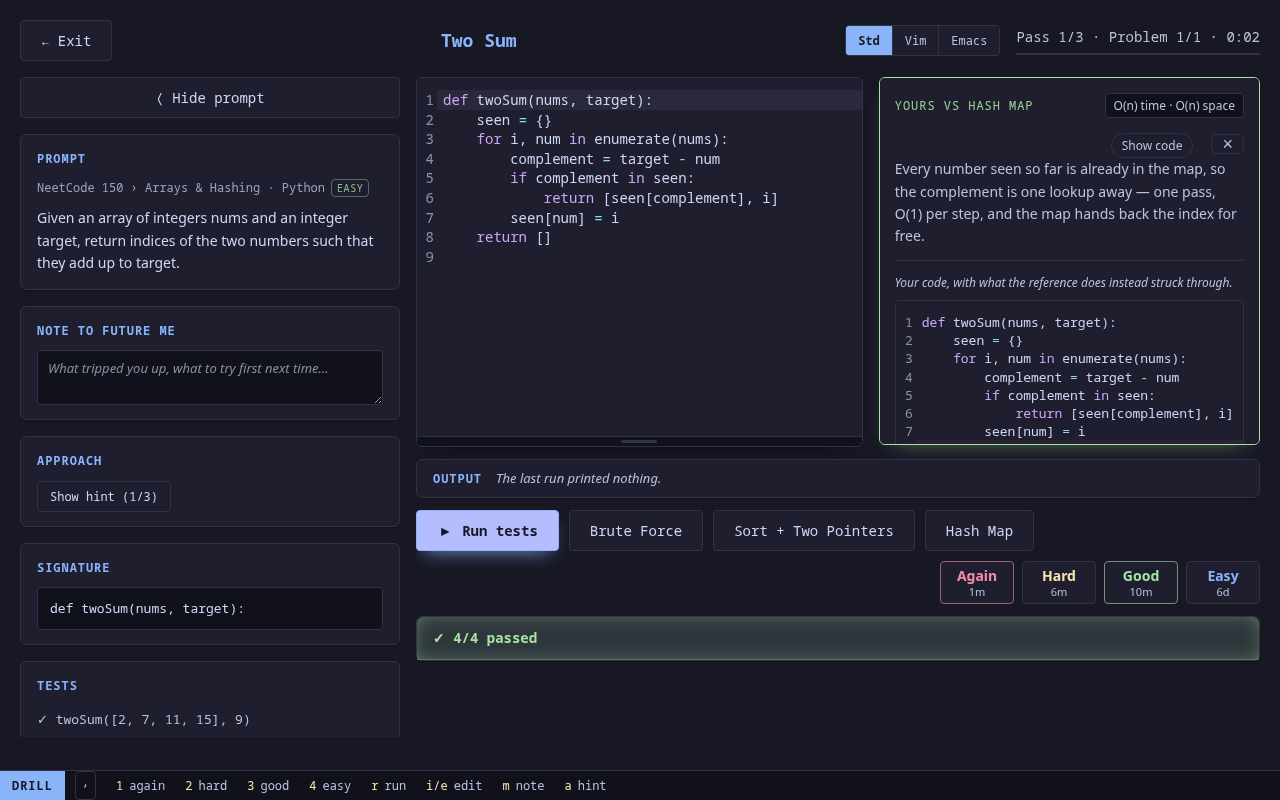
Spaced-repetition drilling for algorithm problems — type the solution from memory, run it against real tests, grade yourself, and let FSRS decide when it comes back.
gleamdrill.com · no account needed




What it is
The NeetCode 150 as an Anki deck, in five languages. Solve each problem in a real editor against a real test harness, grade yourself Again/Hard/Good/Easy, and FSRS-6 schedules the next review. Gleam, Python and TypeScript run in the browser; Elixir and Go run sandboxed on the server. Works as a guest, offline, on a phone; an account syncs progress. Built end to end in Gleam (Lustre + Wisp, scheduler shared between them).
Quick start
Use it: https://gleamdrill.com.
Run it:
git clone https://github.com/gudetimes1234/gleamdrill.git && cd gleamdrill
cp .env.example .env            # set SECRET_KEY_BASE: openssl rand -hex 48
make run                        # docker compose up -d --build
open http://localhost:8080
Content
| Deck | Drills | Runs |
|---|---|---|
| NeetCode 150 — Python, Gleam, TypeScript | 150 each, 2+ solutions per problem | browser |
| NeetCode 150 — Elixir, Go | 150 each, 2+ solutions per problem | server sandbox |
| Gleam Language Tour | 63 lessons | browser, not scheduled |
| System Design | 20 multiple-choice + exam mode | self-graded |
| System Design Board | 6 component-selection boards, 36-piece palette | auto-graded |
Every drill is a runnable file under drills/ with its harness beside it;
make verify checks every solution. Authoring conventions: docs/design.md.
Development
Gleam 1.18.1, Erlang/OTP 27, bun 1.3.14, Postgres 13+; python3, elixir,
go for the verifiers. make check-versions confirms pins.
make dev           # frontend :1234 + backend :1637
make build         # regenerate content, bundle workers, build dist/
make bundle        # dist/ only, no content regeneration — what the web image runs
make verify        # every solution + scheduler + app tests
make e2e           # real browser against built app + backend
make check-format  # gleam format --check, all four projects
Layout: src/ Lustre app, server/ Wisp backend, fsrs/ and wire/
shared between both targets, drills/ content. dist/ is build output, not
committed — run make build once before make e2e, make run or
make serve-dist, which all serve it.
Why it is shaped this way, and how it deploys: docs/design.md.
Code audit
tools/jev_audit.py asks Jev the same rubric about every
first-party Gleam file — duplication, complexity, error handling, naming, risk if
silently wrong — and ranks the answers. It needs TYPESAFE_API_KEY and network,
so it is not part of make verify.
tools/jev_audit.py fetch --dry-run   # what would be asked, no network
make audit                           # fetch, then the ranked list
tools/jev_audit.py explain src/gleamdrill/model.gleam
tools/jev_audit.py deep --top 10     # follow-up pass on the worst-ranked files
Answers are cached under build/jev_audit/ by content hash: a re-run only pays
for files that changed, and re-weighting in WEIGHTS costs nothing. The output
is a ranked reading list, not a verdict — every row cites a path so it can be
checked by hand.
Contributing
Add a solution + harness under drills/<language>/, a note in drills/notes/,
a hint ladder in drills/approaches/, run make verify, open a PR.
Support
Free, open source, no account wall. Server costs: GitHub Sponsors · Liberapay.
License
MIT. Tour lessons under drills/tour/ are Apache-2.0 from
gleam-lang/language-tour;
vendored runtimes keep their own licences.
Similar repos


See what people are saying
README
GleamDrill
Spaced-repetition drilling for algorithm problems — type the solution from memory, run it against real tests, grade yourself, and let FSRS decide when it comes back.
gleamdrill.com · no account needed
What it is
The NeetCode 150 as an Anki deck, in five languages. Solve each problem in a real editor against a real test harness, grade yourself Again/Hard/Good/Easy, and FSRS-6 schedules the next review. Gleam, Python and TypeScript run in the browser; Elixir and Go run sandboxed on the server. Works as a guest, offline, on a phone; an account syncs progress. Built end to end in Gleam (Lustre + Wisp, scheduler shared between them).
Quick start
Use it: https://gleamdrill.com.
Run it:
git clone https://github.com/gudetimes1234/gleamdrill.git && cd gleamdrill
cp .env.example .env            # set SECRET_KEY_BASE: openssl rand -hex 48
make run                        # docker compose up -d --build
open http://localhost:8080
Content
| Deck | Drills | Runs |
|---|---|---|
| NeetCode 150 — Python, Gleam, TypeScript | 150 each, 2+ solutions per problem | browser |
| NeetCode 150 — Elixir, Go | 150 each, 2+ solutions per problem | server sandbox |
| Gleam Language Tour | 63 lessons | browser, not scheduled |
| System Design | 20 multiple-choice + exam mode | self-graded |
| System Design Board | 6 component-selection boards, 36-piece palette | auto-graded |
Every drill is a runnable file under drills/ with its harness beside it;
make verify checks every solution. Authoring conventions: docs/design.md.
Development
Gleam 1.18.1, Erlang/OTP 27, bun 1.3.14, Postgres 13+; python3, elixir,
go for the verifiers. make check-versions confirms pins.
make dev           # frontend :1234 + backend :1637
make build         # regenerate content, bundle workers, build dist/
make bundle        # dist/ only, no content regeneration — what the web image runs
make verify        # every solution + scheduler + app tests
make e2e           # real browser against built app + backend
make check-format  # gleam format --check, all four projects
Layout: src/ Lustre app, server/ Wisp backend, fsrs/ and wire/
shared between both targets, drills/ content. dist/ is build output, not
committed — run make build once before make e2e, make run or
make serve-dist, which all serve it.
Why it is shaped this way, and how it deploys: docs/design.md.
Code audit
tools/jev_audit.py asks Jev the same rubric about every
first-party Gleam file — duplication, complexity, error handling, naming, risk if
silently wrong — and ranks the answers. It needs TYPESAFE_API_KEY and network,
so it is not part of make verify.
tools/jev_audit.py fetch --dry-run   # what would be asked, no network
make audit                           # fetch, then the ranked list
tools/jev_audit.py explain src/gleamdrill/model.gleam
tools/jev_audit.py deep --top 10     # follow-up pass on the worst-ranked files
Answers are cached under build/jev_audit/ by content hash: a re-run only pays
for files that changed, and re-weighting in WEIGHTS costs nothing. The output
is a ranked reading list, not a verdict — every row cites a path so it can be
checked by hand.
Contributing
Add a solution + harness under drills/<language>/, a note in drills/notes/,
a hint ladder in drills/approaches/, run make verify, open a PR.
Support
Free, open source, no account wall. Server costs: GitHub Sponsors · Liberapay.
License
MIT. Tour lessons under drills/tour/ are Apache-2.0 from
gleam-lang/language-tour;
vendored runtimes keep their own licences.