
Quiet tmux status for Claude Code, Codex, opencode & pi — shows nothing while agents work, a small marker when one needs you. No dashboard, no daemon.
Shell
3
13 commits
updated Oct 4, 2026
See what people are saying
README
tmux-agent-status


The anti-dashboard for AI coding agents in tmux. No sidebar, no live feed of prompts and tool calls, no desktop notifications, no daemon. For Claude Code, Codex, opencode and pi: nothing is shown while an agent works. When one needs you — blocked on a permission, or just finished — you get a small marker in the bar, plus a searchable popup to jump straight to it. It lives entirely inside tmux.
What you see
Three states, and only two of them ever show up. Working is deliberately invisible.
| state | meaning | bar / window marker | banner (optional) |
|---|---|---|---|
| working | agent busy | nothing | never |
| waiting | blocked on a permission or a question | ⚠N / ⚠ | yes, unless you're already looking at it |
| done | finished, you haven't looked yet | ✓N / ✓ | never |
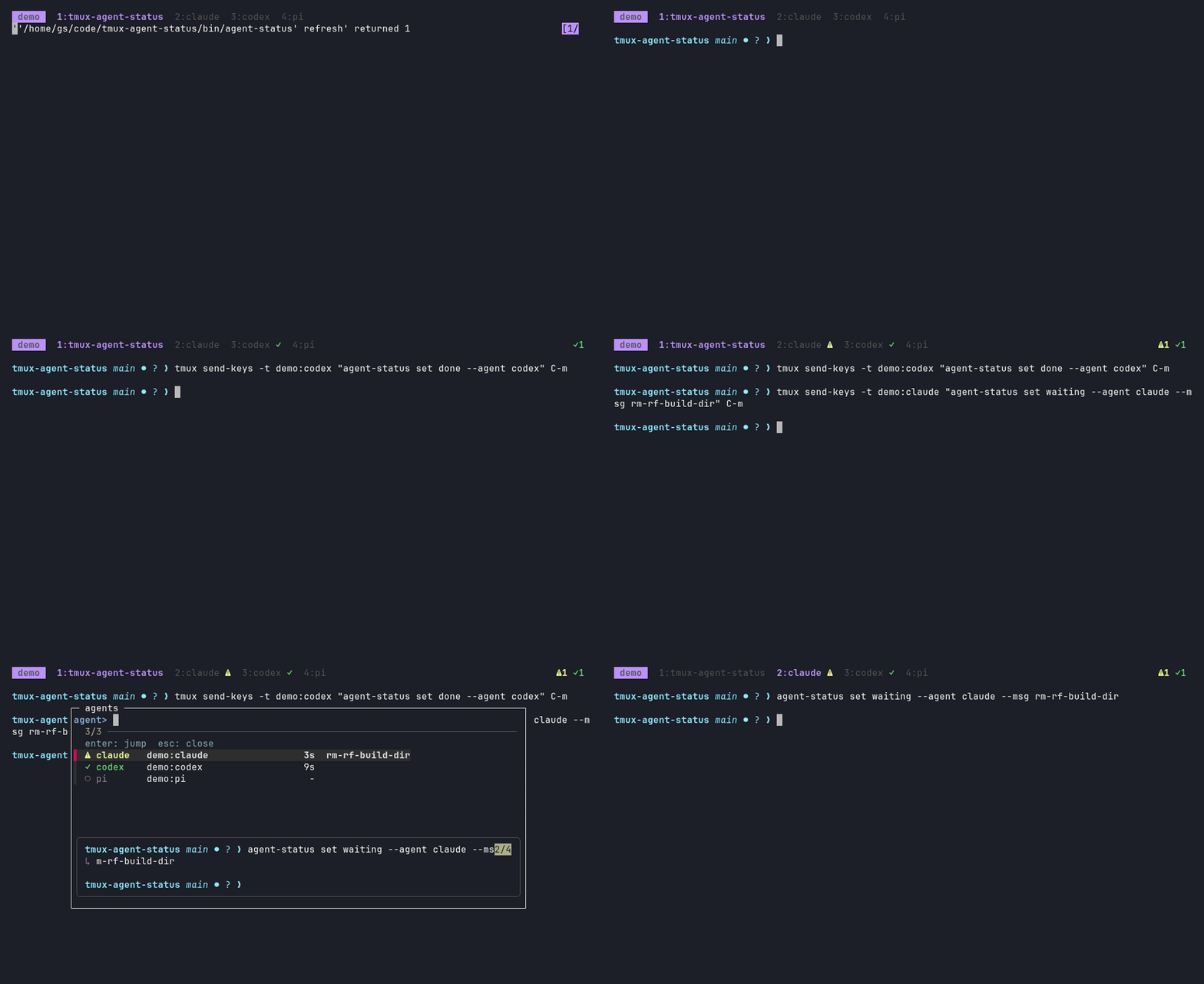
1. Silent until something needs you
The bar at three moments: five agents working (nothing shown), codex finishing (a quiet ✓), and
claude blocking on a permission prompt in another session (⚠). The ✓ clears the moment you
focus that pane, with nothing to dismiss.

2. When an agent needs you
The ⚠ stays in the bar until you deal with it. If you want a nudge as well, turn on the banner
(set -g @agent-status-banner on): for a few seconds the status line of every attached client shows
which agent is blocked and where. It never shows if you're already looking at that pane, and never
twice within 10 seconds for the same one.

3. prefix a (or prefix A): search and jump
A popup lists every agent in every session: needs-you first, then done, then working, then agents
that haven't reported yet (○, found by process name). The preview shows the selected pane's
latest output, here the exact command it is asking permission for.
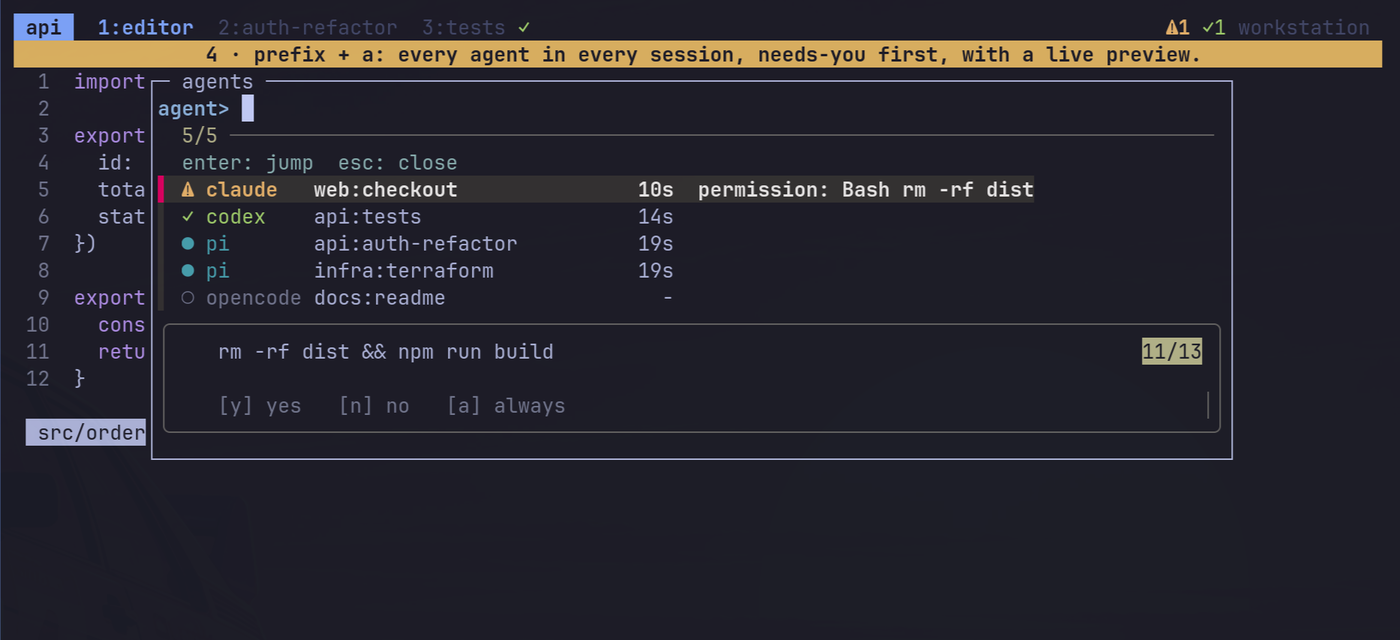
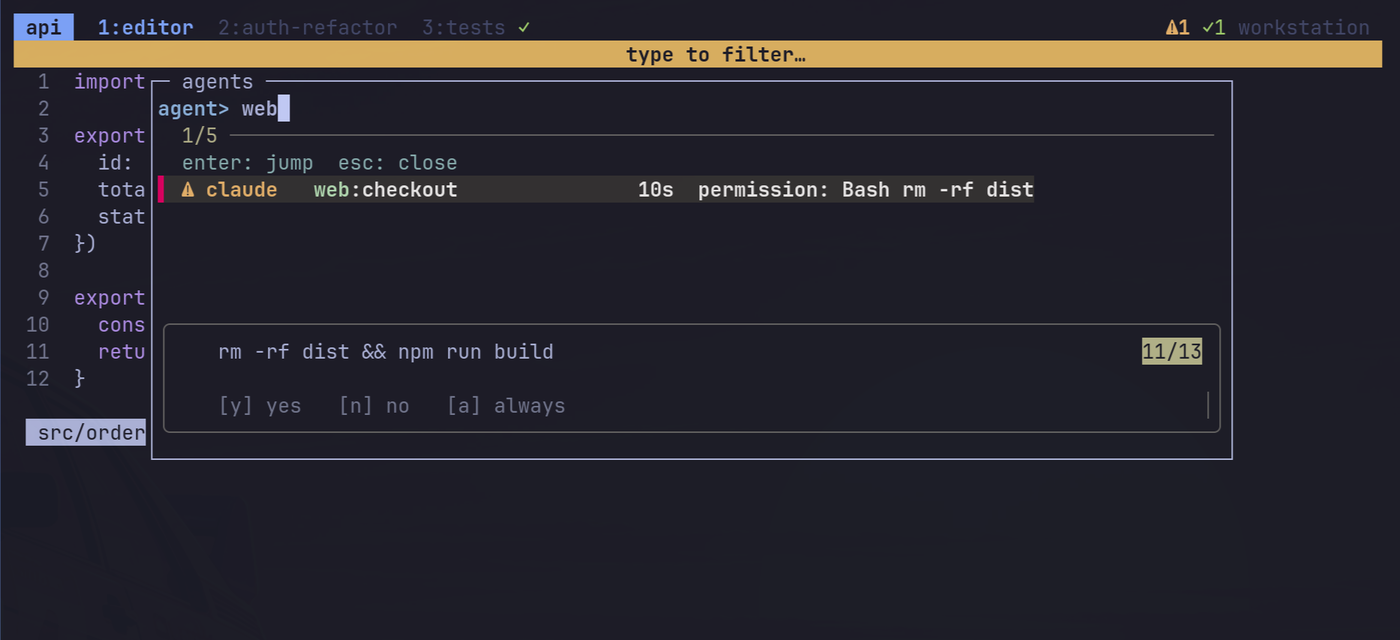
Type to filter by agent, session or window. Enter jumps.
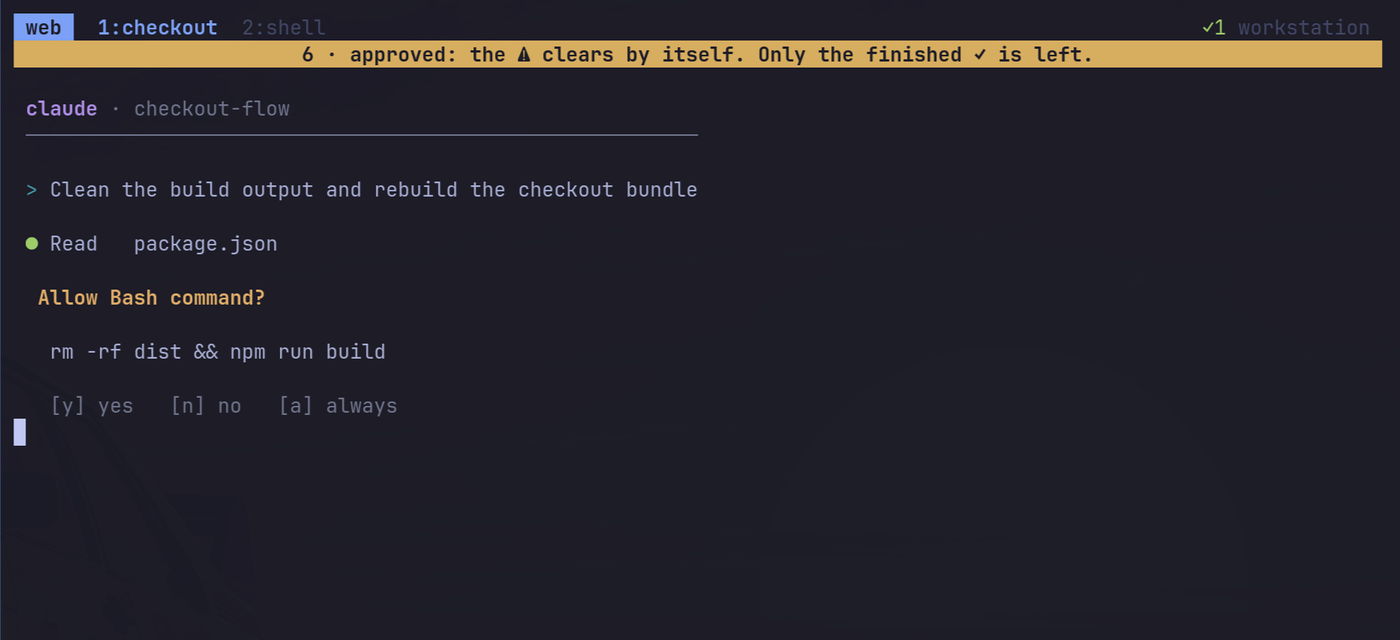
4. Land right on the prompt
Enter switches session, window and pane.
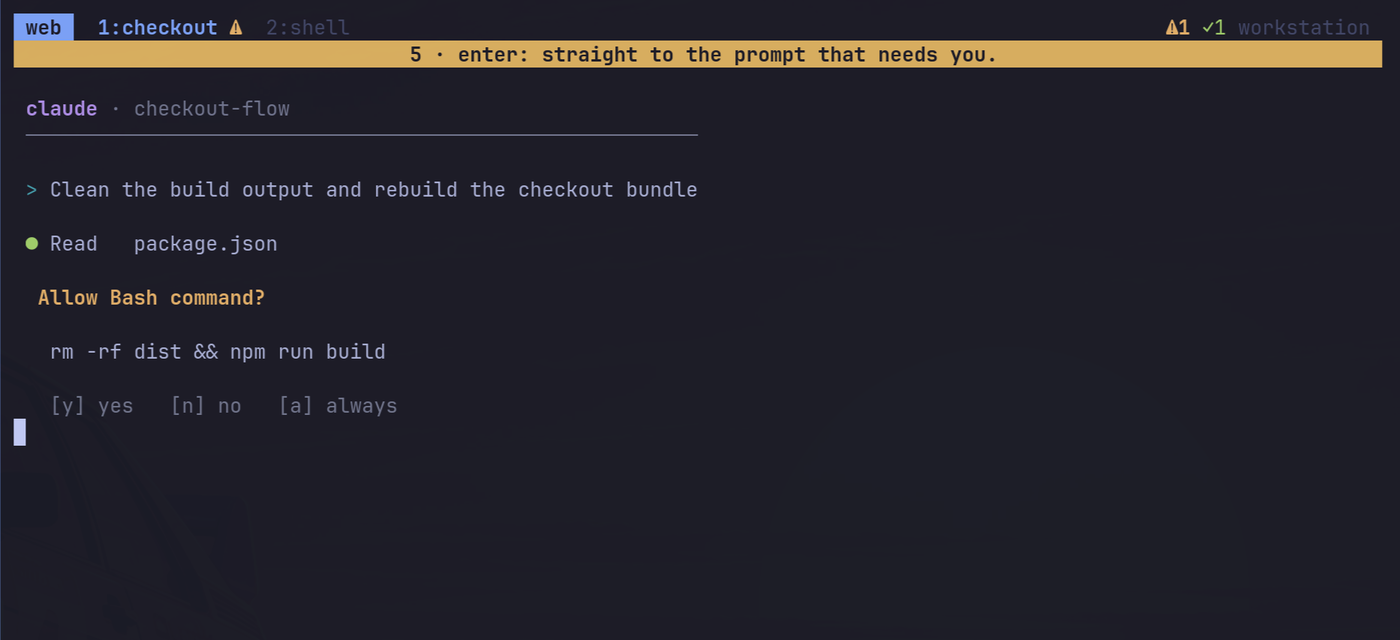
Answer it and the warning clears itself. The finished agent's ✓ waits for you.
Requirements
| need | why | notes |
|---|---|---|
| tmux ≥ 3.2 | display-popup, array hooks | required |
| bash ≥ 4.2 | associative arrays | required. macOS ships 3.2: brew install bash |
| git | clone / TPM | to install |
procps (ps) | knows when an agent has really exited | required in practice; without it the plugin falls back to the foreground command name, which is less reliable for wrapper scripts |
coreutils, sed, awk, util-linux (readlink -f, sort, flock) | ordinary plumbing | present on any normal Linux; flock is optional |
| fzf | the searchable popup | optional. Without it prefix a opens a plain numbered tmux menu |
| jq | install.sh editing your agents' JSON configs | needed to run install.sh; the hooks themselves work without it |
Debian/Ubuntu: sudo apt install tmux git jq fzf (the rest is normally preinstalled).
Arch: sudo pacman -S tmux git jq fzf.
Linux is what it's developed and tested on. Nothing here is desktop-specific, so macOS should work with a newer bash, but it is untested. The pi and opencode adapters run inside those agents' own runtimes (Node), so they need nothing extra.
Install
Quick start (TPM): needs TPM installed first.
# ~/.tmux.conf
set -g @plugin 'gs/tmux-agent-status'
tmux source ~/.tmux.conf   # then press prefix + I to fetch the plugin
~/.tmux/plugins/tmux-agent-status/install.sh all   # wire up every installed agent
That's it — two commands, no binary to download, no config to hand-edit. install.sh all is
idempotent and safe to re-run; add --uninstall to undo it.
Without TPM, add to tmux.conf, after your status-bar options (use the path you cloned this
repo into):
run-shell /path/to/tmux-agent-status/agent-status.tmux
The plugin prepends #{@agent_summary} to status-right and appends a marker to the window formats.
Set @agent-status-modify-status off / @agent-status-modify-window-format off to place
#{@agent_summary} / #{@agent_mark} yourself.
Then connect the agents — this is the same step the TPM quick start above already ran for you via
install.sh all; run it yourself if you installed without TPM, or to wire up individual agents (each
step is optional, idempotent and reversible with --uninstall):
./install.sh all # or: claude | codex | opencode | pi
| agent | how it reports | notes |
|---|---|---|
| Claude Code | hooks in ~/.claude/settings.json (existing hooks are kept) | working / waiting / done |
| Codex | hooks in ~/.codex/hooks.json | approve the new hooks once with /hooks |
| opencode | plugin symlinked into ~/.config/opencode/plugin/ | sub-agent sessions are ignored |
| pi | extension symlinked into ~/.pi/agent/extensions/ | working / done only (pi has no permission prompts) |
Verified so far: pi (live), Claude Code (live: a real claude -p run goes working → done → cleared;
the permission waiting path is covered by payload-shape tests, not a live prompt). Codex and
opencode adapters are written against their documented events but not yet run live: please
report what you see.
Agents that were already running when you installed keep running without reporting: restart them
(in pi, /reload). They still appear in the list as ○ because they are found by process name.
Keys
| key | action |
|---|---|
prefix a / prefix A | searchable agent list, enter jumps (Esc closes); a plain menu if fzf isn't installed |
@agent-status-key-next (unbound by default) | one key: jump to the oldest agent that needs you |
Banner (optional, off by default)
A short message on the status line when an agent starts waiting (not when it finishes). It is the only "notification" the plugin has, and it stays inside tmux: nothing is sent to your desktop, so it also works over SSH and on machines with no notification daemon.
- Skipped when you're looking at that pane; repeats for the same pane within
debounceseconds are dropped. - Enable:
set -g @agent-status-banner on. Length:@agent-status-banner-ms(default 5000).
Options
set -g @agent-status-<name> <value>
| option | default | |
|---|---|---|
key-pick | a A | keys for the popup; "" to skip |
key-next | none | key for jump-to-oldest-waiting |
agents | pi claude codex opencode | process names listed before they report |
banner | off | status-line banner when an agent starts waiting |
banner-ms | 5000 | how long the banner stays |
debounce | 10 | min seconds between banners per pane |
icon-waiting / icon-done | ⚠ / ✓ | bar and window markers |
color-waiting / color-done | yellow / green | |
modify-status / modify-window-format | on | let the plugin edit status-right / window formats |
How it works
Agents push their state through hooks: agent-status set working|waiting|done. The state is one small
file per pane in $XDG_RUNTIME_DIR/agent-status-$UID/. Every change recomputes two tmux options,
@agent_summary and @agent_mark, so the bar updates instantly and nothing polls.
- Records of closed panes, or panes with no process left except a shell, are dropped automatically
(decided from the pane's process tree, so wrappers like
sh -c "agent; …"are fine). - A
donethat arrives while you are watching that pane is never recorded. - Everything is a silent no-op outside tmux, and hooks never fail or slow the agent.
agent-status set <working|waiting|done> [--agent NAME] [--msg TEXT]
agent-status clear | seen [PANE] | refresh | list
agent-status pick [CLIENT]                 # the fzf popup
agent-status jump next [CLIENT] [PANE]     # oldest agent that needs you
agent-status jump pane PANE [CLIENT]       # used by the fzf-less menu
agent-status open | menu [CLIENT]          # what the key runs / the plain tmux menu
Privacy and safety
Everything is local: no network, no telemetry. State is a few bytes per pane in your runtime directory
($XDG_RUNTIME_DIR, mode 700; the /tmp fallback is only used if it is owned by you). Agent-supplied
text (messages, names) is stripped of control characters and # is escaped before it reaches tmux.
install.sh edits ~/.claude/settings.json and ~/.codex/hooks.json (backed up next to them as
*.bak.tmux-agent-status) and only ever adds or removes its own entries.
Development
tests/run.sh          # runs against a private tmux server
shellcheck -x -S warning bin/agent-status adapters/hook.sh agent-status.tmux install.sh
CI (status) runs both on every push.
License
MIT. Copy it, change it, sell it — just keep the copyright notice.
Similar repos


Quiet tmux status for Claude Code, Codex, opencode & pi — shows nothing while agents work, a small marker when one needs you. No dashboard, no daemon.
Shell
3
13 commits
updated Oct 4, 2026
See what people are saying
README
tmux-agent-status
The anti-dashboard for AI coding agents in tmux. No sidebar, no live feed of prompts and tool calls, no desktop notifications, no daemon. For Claude Code, Codex, opencode and pi: nothing is shown while an agent works. When one needs you — blocked on a permission, or just finished — you get a small marker in the bar, plus a searchable popup to jump straight to it. It lives entirely inside tmux.
What you see
Three states, and only two of them ever show up. Working is deliberately invisible.
| state | meaning | bar / window marker | banner (optional) |
|---|---|---|---|
| working | agent busy | nothing | never |
| waiting | blocked on a permission or a question | ⚠N / ⚠ | yes, unless you're already looking at it |
| done | finished, you haven't looked yet | ✓N / ✓ | never |
1. Silent until something needs you
The bar at three moments: five agents working (nothing shown), codex finishing (a quiet ✓), and
claude blocking on a permission prompt in another session (⚠). The ✓ clears the moment you
focus that pane, with nothing to dismiss.
2. When an agent needs you
The ⚠ stays in the bar until you deal with it. If you want a nudge as well, turn on the banner
(set -g @agent-status-banner on): for a few seconds the status line of every attached client shows
which agent is blocked and where. It never shows if you're already looking at that pane, and never
twice within 10 seconds for the same one.
3. prefix a (or prefix A): search and jump
A popup lists every agent in every session: needs-you first, then done, then working, then agents
that haven't reported yet (○, found by process name). The preview shows the selected pane's
latest output, here the exact command it is asking permission for.
Type to filter by agent, session or window. Enter jumps.
4. Land right on the prompt
Enter switches session, window and pane.
Answer it and the warning clears itself. The finished agent's ✓ waits for you.
Requirements
| need | why | notes |
|---|---|---|
| tmux ≥ 3.2 | display-popup, array hooks | required |
| bash ≥ 4.2 | associative arrays | required. macOS ships 3.2: brew install bash |
| git | clone / TPM | to install |
procps (ps) | knows when an agent has really exited | required in practice; without it the plugin falls back to the foreground command name, which is less reliable for wrapper scripts |
coreutils, sed, awk, util-linux (readlink -f, sort, flock) | ordinary plumbing | present on any normal Linux; flock is optional |
| fzf | the searchable popup | optional. Without it prefix a opens a plain numbered tmux menu |
| jq | install.sh editing your agents' JSON configs | needed to run install.sh; the hooks themselves work without it |
Debian/Ubuntu: sudo apt install tmux git jq fzf (the rest is normally preinstalled).
Arch: sudo pacman -S tmux git jq fzf.
Linux is what it's developed and tested on. Nothing here is desktop-specific, so macOS should work with a newer bash, but it is untested. The pi and opencode adapters run inside those agents' own runtimes (Node), so they need nothing extra.
Install
Quick start (TPM): needs TPM installed first.
# ~/.tmux.conf
set -g @plugin 'gs/tmux-agent-status'
tmux source ~/.tmux.conf   # then press prefix + I to fetch the plugin
~/.tmux/plugins/tmux-agent-status/install.sh all   # wire up every installed agent
That's it — two commands, no binary to download, no config to hand-edit. install.sh all is
idempotent and safe to re-run; add --uninstall to undo it.
Without TPM, add to tmux.conf, after your status-bar options (use the path you cloned this
repo into):
run-shell /path/to/tmux-agent-status/agent-status.tmux
The plugin prepends #{@agent_summary} to status-right and appends a marker to the window formats.
Set @agent-status-modify-status off / @agent-status-modify-window-format off to place
#{@agent_summary} / #{@agent_mark} yourself.
Then connect the agents — this is the same step the TPM quick start above already ran for you via
install.sh all; run it yourself if you installed without TPM, or to wire up individual agents (each
step is optional, idempotent and reversible with --uninstall):
./install.sh all # or: claude | codex | opencode | pi
| agent | how it reports | notes |
|---|---|---|
| Claude Code | hooks in ~/.claude/settings.json (existing hooks are kept) | working / waiting / done |
| Codex | hooks in ~/.codex/hooks.json | approve the new hooks once with /hooks |
| opencode | plugin symlinked into ~/.config/opencode/plugin/ | sub-agent sessions are ignored |
| pi | extension symlinked into ~/.pi/agent/extensions/ | working / done only (pi has no permission prompts) |
Verified so far: pi (live), Claude Code (live: a real claude -p run goes working → done → cleared;
the permission waiting path is covered by payload-shape tests, not a live prompt). Codex and
opencode adapters are written against their documented events but not yet run live: please
report what you see.
Agents that were already running when you installed keep running without reporting: restart them
(in pi, /reload). They still appear in the list as ○ because they are found by process name.
Keys
| key | action |
|---|---|
prefix a / prefix A | searchable agent list, enter jumps (Esc closes); a plain menu if fzf isn't installed |
@agent-status-key-next (unbound by default) | one key: jump to the oldest agent that needs you |
Banner (optional, off by default)
A short message on the status line when an agent starts waiting (not when it finishes). It is the only "notification" the plugin has, and it stays inside tmux: nothing is sent to your desktop, so it also works over SSH and on machines with no notification daemon.
- Skipped when you're looking at that pane; repeats for the same pane within
debounceseconds are dropped. - Enable:
set -g @agent-status-banner on. Length:@agent-status-banner-ms(default 5000).
Options
set -g @agent-status-<name> <value>
| option | default | |
|---|---|---|
key-pick | a A | keys for the popup; "" to skip |
key-next | none | key for jump-to-oldest-waiting |
agents | pi claude codex opencode | process names listed before they report |
banner | off | status-line banner when an agent starts waiting |
banner-ms | 5000 | how long the banner stays |
debounce | 10 | min seconds between banners per pane |
icon-waiting / icon-done | ⚠ / ✓ | bar and window markers |
color-waiting / color-done | yellow / green | |
modify-status / modify-window-format | on | let the plugin edit status-right / window formats |
How it works
Agents push their state through hooks: agent-status set working|waiting|done. The state is one small
file per pane in $XDG_RUNTIME_DIR/agent-status-$UID/. Every change recomputes two tmux options,
@agent_summary and @agent_mark, so the bar updates instantly and nothing polls.
- Records of closed panes, or panes with no process left except a shell, are dropped automatically
(decided from the pane's process tree, so wrappers like
sh -c "agent; …"are fine). - A
donethat arrives while you are watching that pane is never recorded. - Everything is a silent no-op outside tmux, and hooks never fail or slow the agent.
agent-status set <working|waiting|done> [--agent NAME] [--msg TEXT]
agent-status clear | seen [PANE] | refresh | list
agent-status pick [CLIENT]                 # the fzf popup
agent-status jump next [CLIENT] [PANE]     # oldest agent that needs you
agent-status jump pane PANE [CLIENT]       # used by the fzf-less menu
agent-status open | menu [CLIENT]          # what the key runs / the plain tmux menu
Privacy and safety
Everything is local: no network, no telemetry. State is a few bytes per pane in your runtime directory
($XDG_RUNTIME_DIR, mode 700; the /tmp fallback is only used if it is owned by you). Agent-supplied
text (messages, names) is stripped of control characters and # is escaped before it reaches tmux.
install.sh edits ~/.claude/settings.json and ~/.codex/hooks.json (backed up next to them as
*.bak.tmux-agent-status) and only ever adds or removes its own entries.
Development
tests/run.sh          # runs against a private tmux server
shellcheck -x -S warning bin/agent-status adapters/hook.sh agent-status.tmux install.sh
CI (status) runs both on every push.
License
MIT. Copy it, change it, sell it — just keep the copyright notice.