
Recursive Language Models for efficient long-context processing. Analyze 1M+ tokens by storing context in a Python REPL while reducing LLM token usage.
Python
607
0 commits
updated Sep 3, 2026
README
Recursive Language Models (RLM)




Analyze large contexts with bounded cost and inspectable execution. Instead of placing the full source in model prompts, RLM keeps it in a restricted Python REPL, where the model can search, compute, partition, and send only selected sections to language-model calls.
This is an independent Python implementation of the Recursive Language Models paper, focused on practical library use: provider portability, tree-wide budgets, structured failures, reproducible benchmarks, and complete run trajectories.
Quick start | Measured results | Document-format evaluation | Configuration | Security | Original implementation
Why use this implementation?
| Capability | What it provides |
|---|---|
| Externalized context | Large source text stays in the REPL instead of being repeated in model prompts |
| Bounded execution | Tree-wide limits for calls, tokens, estimated cost, elapsed time, and local execution |
| Observable runs | Per-run statistics, typed failures, versioned JSONL records, and complete trajectories |
| Provider portability | OpenAI, Anthropic, DeepSeek, local models, and other LiteLLM providers |
| Reproducible evaluation | Exact graders, generated corpora, pinned public documents, and repeated live runs |
| Restricted execution | Spawned RestrictedPython worker with hard timeouts and optional POSIX resource limits |
Measured results
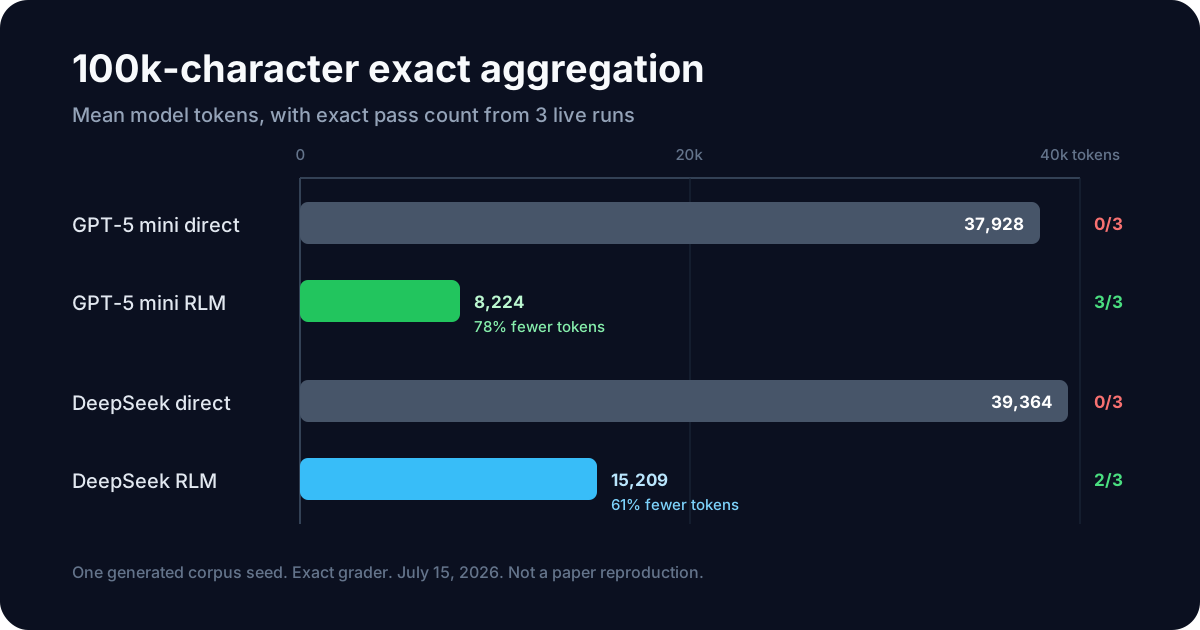
The exact 100k-character aggregation benchmark used one generated corpus seed and three live runs per configuration. On this task, RLM improved exact correctness while reducing model-token usage.
| Model and mode | Exact passes | Mean model tokens | Mean estimated cost |
|---|---|---|---|
| GPT-5 mini, direct | 0/3 | 37,928 | $0.0088788 |
| GPT-5 mini, RLM | 3/3 | 8,224 | $0.0048132 |
| DeepSeek V4 Flash, direct | 0/3 | 39,364 | $0.0012240 |
| DeepSeek V4 Flash, RLM | 2/3 | 15,209 | $0.0010156 |
These measurements are an engineering check, not a paper reproduction or a universal quality claim. Direct completion was faster and cheaper on short tasks. A separate 1M-character RLM scale check passed 6/6 exact-graded runs, but those runs used local REPL computation without child RLMs. See BENCHMARK_RESULTS.md for methodology, raw summaries, public-document experiments, limitations, and reproduction commands. The separate document-format evaluation compares RLM with direct completion on a SHA-pinned TXT book, PDF, CSV, and HTML documentation page and records two reliability/performance changes evaluated one at a time.
When to use RLM
RLM is a good fit when:
- the source is too large or too expensive to place in a normal model prompt;
- the task benefits from search, filtering, exact counting, or local Python computation;
- selected sections can be delegated to model calls instead of repeatedly sending the full source;
- call, token, cost, and time limits must apply to the whole recursive run.
Prefer direct completion when the context fits comfortably in the model window and the task is small. Semantic synthesis across long narrative text remains difficult and should be evaluated on your own data before production use.
Execution at a glance
query -> root model -> Python REPL over full context -> selected chunks or child calls -> answer
                       |                           |
                       +-- local search/compute   +-- shared budgets and trajectory
The root model receives the query and instructions, while the source is exposed as the context
variable. REPL state persists across iterations. The model can inspect small regions, perform local
computation, call a plain LM, or create a child RLM when the configured depth permits it.
Installation
Note: This package is not yet published to PyPI. Install from source:
git clone https://github.com/grishahq/recursive-llm.git
cd recursive-llm
pip install -e .
Or install the current GitHub version directly:
pip install "recursive-llm @ git+https://github.com/grishahq/recursive-llm.git"
Requirements
- Python 3.9 or higher
- An API key for your chosen LLM provider (OpenAI, Anthropic, etc.)
- Or a local model setup (Ollama, llama.cpp, etc.)
Quick Start
Set the provider key, create quickstart.py, and point it at a UTF-8 text file:
export OPENAI_API_KEY="sk-..."
from pathlib import Path

from rlm import RLM


def main():
    rlm = RLM(model="gpt-5-mini")

    result = rlm.complete_result(
        query="What are the main themes in this document?",
        context=Path("document.txt").read_text(encoding="utf-8"),
    )
    print(result.answer)
    print(result.stats)


if __name__ == "__main__":
    main()
python quickstart.py
RLM uses a spawned worker process for isolated REPL execution. Executable Python scripts must use
the standard if __name__ == "__main__": entry-point guard, as shown above. This is required by
Python multiprocessing on spawn-based platforms; all repository examples follow this pattern.
Usage and Cost Statistics
RLM.stats aggregates model calls across the complete recursion tree. Token usage comes from
provider responses, while cost is calculated on a best-effort basis using LiteLLM's model pricing
metadata.
rlm = RLM(
    model="gpt-5-mini",
    recursive_model="deepseek/deepseek-v4-flash",
)
result = rlm.complete(query="Summarize this", context=document)

print(rlm.stats)
# {
#     "llm_calls": 11,
#     "root_calls": 3,
#     "recursive_calls": 8,
#     "leaf_calls": 4,
#     "prompt_tokens": 12500,
#     "completion_tokens": 3200,
#     "cached_tokens": 6000,
#     "estimated_cost_usd": 0.0047,
#     "by_model": {
#         "gpt-5-mini": {"calls": 3, ...},
#         "deepseek/deepseek-v4-flash": {"calls": 8, ...},
#     },
# }
Each root completion receives fresh statistics, so they describe one recursion tree rather than
lifetime usage.
estimated_cost_usd is None when LiteLLM has no pricing metadata for any completed call. Compare
priced_calls with llm_calls before treating the estimate as the full run cost.
When the same RLM instance runs concurrent completions, RLM.stats describes whichever root run
completed most recently. Use the structured result API for exact per-run statistics and trajectory:
result = rlm.complete_result(query="Summarize this", context=document)
print(result.answer)
print(result.stats)
for event in result.trajectory:
    print(event.kind, event.depth, event.node_id, event.parent_id)

# Append one complete, versioned run record for later comparison
result.write_jsonl("runs.jsonl")
acomplete_result is the asynchronous equivalent. Trajectories include the complete root, child
RLM, and leaf-call tree. Query, context, model response, code, and output content are represented by
character counts by default. Set capture_trajectory_content=True only when the resulting logs are
allowed to contain that data. An optional event_handler receives events as they occur; handler
failures do not interrupt model completion.
Use the non-raising result API when failed runs must be persisted or compared alongside successful runs:
run = rlm.try_complete_result(query="Summarize this", context=document)
if run.succeeded:
    print(run.answer)
else:
    print(run.error_type, run.error)

# Success and failure records share the same versioned JSONL schema.
run.write_jsonl("runs.jsonl")
atry_complete_result is the asynchronous equivalent. Ordinary run failures return a
FailedCompletionResult with exact per-run statistics, secret-free configuration, and the complete
partial trajectory, including its terminal run_error event. Cancellation and other process-control
exceptions are not converted. The existing complete, acomplete, complete_result, and
acomplete_result APIs keep their exception behavior.
Completed JSONL records contain the final answer; failed records contain answer: null and a typed
error. Query, context, intermediate model responses, code, and REPL output follow the same redaction
setting as the in-memory trajectory.
Live Model Comparison
The comparison script uses the same model for both root and recursive calls. It runs one small recursive smoke test by default and reports latency, calls, tokens, and estimated cost:
python benchmarks/compare_same_model.py gpt-5-mini
python benchmarks/compare_same_model.py deepseek/deepseek-v4-flash
Use repeated runs and save raw records before comparing configurations:
python benchmarks/compare_same_model.py gpt-5-mini --full --runs 3 --jsonl results.jsonl
python benchmarks/compare_same_model.py gpt-5-mini --full --runs 3 --mode direct
python benchmarks/compare_same_model.py gpt-5-mini --generated-chars 100000 --seed 2026
--max-depth compares recursion capabilities; --mode direct sends task and context in one normal
long-context model request. The script reports pass rate, p50/p95 latency, calls, tokens, and
best-effort cost. Task-specific graders require exact IDs, numeric boundaries, and explicit labeled
counts rather than accepting arbitrary substrings. Live benchmarks make paid API calls and require
the corresponding provider keys. --trace includes sensitive content-bearing trajectories in the
JSON output and should be used deliberately.
The repository also includes a SHA-pinned real-document benchmark over the public-domain English translation of War and Peace. The book itself is downloaded separately and is not committed:
curl -L https://www.gutenberg.org/files/2600/2600-0.txt \
    -o /tmp/war-and-peace-2600-0.txt
python benchmarks/war_and_peace.py gpt-5-mini /tmp/war-and-peace-2600-0.txt
python benchmarks/war_and_peace.py deepseek/deepseek-v4-flash \
    /tmp/war-and-peace-2600-0.txt
benchmarks/multi_document.py extends this to three independently sourced large corpora: War and
Peace, the official 9/11 Commission Report, and the official Python 3.14 text documentation. It
verifies every prepared artifact by SHA-256 and uses exact labeled-field graders. Download and PDF
extraction commands, hashes, task definitions, and measured candidate results are in
BENCHMARK_RESULTS.md.
API Keys Setup
Copy the example environment file and add keys only for the providers you use:
cp .env.example .env
OPENAI_API_KEY=sk-...
DEEPSEEK_API_KEY=...
MOONSHOT_API_KEY=...
Use the LiteLLM provider prefix for non-OpenAI models, for example
deepseek/deepseek-v4-flash or moonshot/kimi-k2.6. This lets a hybrid RLM select the correct API
key for each model automatically.
Or pass directly in code:
rlm = RLM(model="gpt-5-mini", api_key="sk-...")
Supported Models
Works with 100+ LLM providers via LiteLLM:
# OpenAI
rlm = RLM(model="gpt-5")
rlm = RLM(model="gpt-5-mini")

# Anthropic
rlm = RLM(model="claude-sonnet-4")
rlm = RLM(model="claude-sonnet-4-20250514")

# Ollama (local)
rlm = RLM(model="ollama/llama3.2")
rlm = RLM(model="ollama/mistral")

# llama.cpp (local)
rlm = RLM(
    model="openai/local",
    api_base="http://localhost:8000/v1"
)

# Azure OpenAI
rlm = RLM(model="azure/gpt-4-deployment")

# And many more via LiteLLM...
Advanced Usage
Two Models (Optimize Cost)
Use a cheaper model for recursive calls:
rlm = RLM(
    model="gpt-5",              # Root LM (main decisions)
    recursive_model="gpt-5-mini"  # Recursive calls (cheaper)
)
Async API
For better performance with parallel recursive calls:
import asyncio

async def main():
    rlm = RLM(model="gpt-5-mini")
    result = await rlm.acomplete(query, context)
    print(result)

if __name__ == "__main__":
    asyncio.run(main())
Configuration
rlm = RLM(
    model="gpt-5-mini",
    max_depth=2,                 # One child RLM level, then a plain-LM fallback
    max_iterations=20,           # Maximum REPL iterations per RLM
    repl_timeout=5,              # Hard timeout for each local Python step
    max_output_chars=2000,       # Observation truncation limit
    repl_max_snapshot_bytes=1_000_000,  # Parent-copy cap; full state stays in the worker
    max_concurrent_subcalls=4,   # Bound batch concurrency
    max_total_calls=24,          # Exact provider-call cap for the full recursion tree
    max_total_tokens=100_000,    # Stop after reported usage crosses this value
    max_total_cost_usd=0.10,     # Stop after reported cost crosses this value
    max_elapsed_seconds=300,     # Deadline shared by root and child calls
    max_retries=2,                # Retry transient provider failures; default is 0
    retry_backoff_seconds=1.0,   # Exponential retry delay; Retry-After is respected
    # Optional LiteLLM params: temperature, timeout, etc.
)
Call limits are reserved atomically before provider requests, including batched and recursive
subcalls. Token and cost limits are evaluated after each response because providers only report
those values after generation; the crossing response is included in partial statistics attached to
BudgetExceededError. A deadline also bounds in-flight provider requests and REPL exchanges, and
prevents a validator result completed after the deadline from being accepted. A synchronous
validator cannot be forcibly stopped safely, so slow validator code can delay delivery of the
resulting BudgetExceededError; validators should remain fast and independently bounded. All
limits are optional and are reset for each root completion.
Retries are opt-in and share the same call and elapsed-time budgets as the rest of the recursion
tree. Every retry is counted as a provider call and recorded in statistics and trajectories.
RLM disables hidden LiteLLM retries to preserve exact accounting; configure max_retries on RLM
instead of passing num_retries or max_retries as a LiteLLM option. Null provider content is
normalized to an empty response so the existing repair iteration can recover, while malformed
response structures fail with ProviderResponseError or use the bounded retry path when enabled.
Final Answer Validation
Applications can reject a syntactically valid final answer and give deterministic feedback to the model without leaving the bounded run:
def validate_answer(answer: str):
    if not answer.startswith("count="):
        return "Answer must start with 'count='."
    return None

rlm = RLM(
    model="gpt-5-mini",
    final_answer_validator=validate_answer,
)
The validator returns None to accept an answer or a non-empty error string to reject it. Rejected
answers and feedback are represented by lengths in redacted trajectories and by content only when
capture_trajectory_content=True. Validator exceptions abort the run as application errors.
max_depth is an explicit constructor option so that runs remain reproducible. It is not read from
an environment variable by the library. Applications may map their own configuration or environment
variables to this argument.
max_depth | Behavior |
|---|---|
0 | Root RLM and REPL only; no LM subcalls |
1 (default) | Root RLM may call a plain LM |
2 | Root RLM may create one child RLM; the child falls back to a plain LM |
n | Adds one child RLM level for every increment above 1 |
This follows the paper's capability-based depth convention. The root RLM itself is depth 0 and is
still valid when max_depth=0.
REPL Subcall API
The model can use these functions from its persistent REPL:
# One plain LM call, without another REPL loop
llm_query("Extract the date", context[1000:2000])

# Child RLM when depth permits; otherwise one plain-LM boundary call
rlm_query("Analyze this section", context[2000:8000])

# Ordered parallel calls, limited by max_concurrent_subcalls
results = llm_query_batched(queries, chunks)
recursive_llm remains as a backward-compatible alias for rlm_query. A step can finish directly
through FINAL(...), FINAL_VAR(...), or the mutable answer object:
answer["content"] = result
answer["ready"] = True
How It Works
- Context is stored as a variable in a Python REPL environment
- Root LM gets only the query plus instructions
- LM can explore context using Python code:
# Peek at context context[:1000] # Search with regex re.findall(r'pattern', context) # Recursive processing with a plain-LM boundary fallback rlm_query("extract dates", context[1000:2000]) - Returns the final answer via a standalone
FINAL("answer"),FINAL_VAR(name), oranswerpublication
REPL variables persist between iterations. Each local step executes in an isolated subprocess, its
final expression is evaluated exactly once, print output is isolated per step, and non-terminating
local code is terminated by repl_timeout. Time spent waiting for model subcalls is not charged to
the local Python timeout. Imports are limited to the already exposed re, json, math,
datetime, and collections helpers; arbitrary modules remain blocked.
Ordinary user variables are copied back to the parent after each step only up to
repl_max_snapshot_bytes (1 MB by default), preferring smaller values. Larger values remain intact
in the persistent worker and are still available to later code and FINAL_VAR; the cap avoids
repeatedly serializing large intermediate lists or strings. Increase the limit only when an
application directly depends on the parent-side compatibility snapshot.
POSIX deployments may also opt in to worker-process limits:
rlm = RLM(
    model="gpt-5-mini",
    repl_memory_limit_mb=512,
    repl_cpu_time_limit_seconds=10,
    repl_max_open_files=64,
)
These values depend on the runtime and workload, so the library does not guess defaults. A configured limit that the platform cannot enforce fails worker startup explicitly. RestrictedPython and a subprocess are defense-in-depth controls, not a security boundary for hostile code; read SECURITY.md before processing untrusted prompts or contexts.
Examples
See the examples/ directory for complete working examples:
basic_usage.py- Simple complete with OpenAIollama_local.py- Using Ollama locallytwo_models.py- Cost optimization with two modelslong_document.py- Processing 50k+ token documentsdata_extraction.py- Extract structured data from textmulti_file.py- Process multiple documentscustom_config.py- Advanced configuration
Run an example:
# Set your API key first
export OPENAI_API_KEY="sk-..."

# Run example
python examples/basic_usage.py
Performance
Paper Results
On OOLONG benchmark (132k tokens):
- GPT-5: baseline
- RLM(GPT-5-Mini): 33% better than GPT-5 at similar cost
Reproducible Project Benchmark
benchmarks/compare_same_model.py contains deterministic structured contexts with exact expected
answers. benchmarks/generated_long_context.py creates byte-reproducible transaction corpora with
seed, SHA-256 identity, and a computed answer key. Model outputs remain stochastic, so use --runs
and compare pass rate plus p50/p95 latency before drawing quality conclusions. See
BENCHMARK_RESULTS.md for the latest checked-in live comparison.
benchmarks/war_and_peace.py adds exact chapter counting, distant fact retrieval, and narrative
evidence synthesis over a verified 3.2-million-character real document.
Development
# Clone repository
git clone https://github.com/grishahq/recursive-llm.git
cd recursive-llm

# Install with dev dependencies
pip install -e ".[dev]"

# Run tests, branch coverage, and the enforced coverage gate
pytest

# Type checking
mypy src/rlm

# Linting
ruff check src tests benchmarks examples

# Format code
black src tests examples benchmarks

# Build the source distribution and wheel
python -m build
GitHub Actions runs these gates across Python 3.9-3.12 on Linux, plus Python 3.12 on macOS and Windows. It also installs the built wheel and runs the offline demo.
Architecture
RLM
├── Core (async completion logic)
├── Run State (per-invocation budget, usage, and trajectory)
├── REPL Executor (restricted subprocess, persistent state, hard step timeout)
├── Prompt Builder (system prompts)
└── Parser (extract FINAL() answers)
Built on top of LiteLLM for universal LLM support.
Limitations
- Python REPL steps are sequential; explicit batched LM/RLM subcalls can run concurrently
- No prefix caching (future enhancement)
- Recursion depth is limited (configurable via
max_depth) - No streaming support yet
Troubleshooting
"Max iterations exceeded"
- Increase
max_iterationsparameter - Simplify your query
- Check if the model is getting stuck in a loop
"API key not found"
- Copy
.env.exampleto.envand set the appropriate provider variable:OPENAI_API_KEYfor OpenAIDEEPSEEK_API_KEYfor DeepSeekMOONSHOT_API_KEYfor Kimi
- Or pass
api_keyparameter to RLM constructor
"Model not found"
- Check model name format for your provider
- See LiteLLM docs: https://docs.litellm.ai/docs/providers
Using Ollama
- Make sure Ollama is running:
ollama serve - Pull a model first:
ollama pull llama3.2 - Use model format:
ollama/model-name
Contributing
Contributions welcome! Please:
- Fork the repository
- Create a feature branch
- Add tests for new features
- Ensure all tests pass (
pytest tests/) - Follow code style (use
blackandruff) - Submit a pull request
Citation
This implementation is based on the RLM paper by Alex L. Zhang, Tim Kraska, and Omar Khattab.
To cite this implementation:
@software{rlm_python,
  title = {recursive-llm: Python Implementation of Recursive Language Models},
  author = {Gvadzabia, Grisha},
  year = {2025},
  url = {https://github.com/grishahq/recursive-llm}
}
To cite the original paper:
@misc{zhang2025rlm,
  title = {Recursive Language Models},
  author = {Zhang, Alex L. and Kraska, Tim and Khattab, Omar},
  year = {2025},
  url = {https://arxiv.org/abs/2512.24601},
  eprint = {2512.24601},
  archivePrefix = {arXiv}
}
License
MIT License - see LICENSE file for details
Acknowledgments
Based on the Recursive Language Models paper by Alex L. Zhang, Tim Kraska, and Omar Khattab.
Built using:
- LiteLLM for universal LLM API support
- RestrictedPython for restricted code execution
Links
- Paper: https://alexzhang13.github.io/blog/2025/rlm/
- arXiv: https://arxiv.org/abs/2512.24601
- Official implementation: https://github.com/alexzhang13/rlm
- LiteLLM Docs: https://docs.litellm.ai/
- Changelog: https://github.com/grishahq/recursive-llm/blob/main/CHANGELOG.md
- Releases: https://github.com/grishahq/recursive-llm/releases
- Issues: https://github.com/grishahq/recursive-llm/issues
Significant stargazers

35 followers · starred Jan 2026
Similar repos




Languages
Python
100.0%
Recursive Language Models for efficient long-context processing. Analyze 1M+ tokens by storing context in a Python REPL while reducing LLM token usage.
Python
607
0 commits
updated Sep 3, 2026
README
Recursive Language Models (RLM)
Analyze large contexts with bounded cost and inspectable execution. Instead of placing the full source in model prompts, RLM keeps it in a restricted Python REPL, where the model can search, compute, partition, and send only selected sections to language-model calls.
This is an independent Python implementation of the Recursive Language Models paper, focused on practical library use: provider portability, tree-wide budgets, structured failures, reproducible benchmarks, and complete run trajectories.
Quick start | Measured results | Document-format evaluation | Configuration | Security | Original implementation
Why use this implementation?
| Capability | What it provides |
|---|---|
| Externalized context | Large source text stays in the REPL instead of being repeated in model prompts |
| Bounded execution | Tree-wide limits for calls, tokens, estimated cost, elapsed time, and local execution |
| Observable runs | Per-run statistics, typed failures, versioned JSONL records, and complete trajectories |
| Provider portability | OpenAI, Anthropic, DeepSeek, local models, and other LiteLLM providers |
| Reproducible evaluation | Exact graders, generated corpora, pinned public documents, and repeated live runs |
| Restricted execution | Spawned RestrictedPython worker with hard timeouts and optional POSIX resource limits |
Measured results
The exact 100k-character aggregation benchmark used one generated corpus seed and three live runs per configuration. On this task, RLM improved exact correctness while reducing model-token usage.
| Model and mode | Exact passes | Mean model tokens | Mean estimated cost |
|---|---|---|---|
| GPT-5 mini, direct | 0/3 | 37,928 | $0.0088788 |
| GPT-5 mini, RLM | 3/3 | 8,224 | $0.0048132 |
| DeepSeek V4 Flash, direct | 0/3 | 39,364 | $0.0012240 |
| DeepSeek V4 Flash, RLM | 2/3 | 15,209 | $0.0010156 |
These measurements are an engineering check, not a paper reproduction or a universal quality claim. Direct completion was faster and cheaper on short tasks. A separate 1M-character RLM scale check passed 6/6 exact-graded runs, but those runs used local REPL computation without child RLMs. See BENCHMARK_RESULTS.md for methodology, raw summaries, public-document experiments, limitations, and reproduction commands. The separate document-format evaluation compares RLM with direct completion on a SHA-pinned TXT book, PDF, CSV, and HTML documentation page and records two reliability/performance changes evaluated one at a time.
When to use RLM
RLM is a good fit when:
- the source is too large or too expensive to place in a normal model prompt;
- the task benefits from search, filtering, exact counting, or local Python computation;
- selected sections can be delegated to model calls instead of repeatedly sending the full source;
- call, token, cost, and time limits must apply to the whole recursive run.
Prefer direct completion when the context fits comfortably in the model window and the task is small. Semantic synthesis across long narrative text remains difficult and should be evaluated on your own data before production use.
Execution at a glance
query -> root model -> Python REPL over full context -> selected chunks or child calls -> answer
                       |                           |
                       +-- local search/compute   +-- shared budgets and trajectory
The root model receives the query and instructions, while the source is exposed as the context
variable. REPL state persists across iterations. The model can inspect small regions, perform local
computation, call a plain LM, or create a child RLM when the configured depth permits it.
Installation
Note: This package is not yet published to PyPI. Install from source:
git clone https://github.com/grishahq/recursive-llm.git
cd recursive-llm
pip install -e .
Or install the current GitHub version directly:
pip install "recursive-llm @ git+https://github.com/grishahq/recursive-llm.git"
Requirements
- Python 3.9 or higher
- An API key for your chosen LLM provider (OpenAI, Anthropic, etc.)
- Or a local model setup (Ollama, llama.cpp, etc.)
Quick Start
Set the provider key, create quickstart.py, and point it at a UTF-8 text file:
export OPENAI_API_KEY="sk-..."
from pathlib import Path

from rlm import RLM


def main():
    rlm = RLM(model="gpt-5-mini")

    result = rlm.complete_result(
        query="What are the main themes in this document?",
        context=Path("document.txt").read_text(encoding="utf-8"),
    )
    print(result.answer)
    print(result.stats)


if __name__ == "__main__":
    main()
python quickstart.py
RLM uses a spawned worker process for isolated REPL execution. Executable Python scripts must use
the standard if __name__ == "__main__": entry-point guard, as shown above. This is required by
Python multiprocessing on spawn-based platforms; all repository examples follow this pattern.
Usage and Cost Statistics
RLM.stats aggregates model calls across the complete recursion tree. Token usage comes from
provider responses, while cost is calculated on a best-effort basis using LiteLLM's model pricing
metadata.
rlm = RLM(
    model="gpt-5-mini",
    recursive_model="deepseek/deepseek-v4-flash",
)
result = rlm.complete(query="Summarize this", context=document)

print(rlm.stats)
# {
#     "llm_calls": 11,
#     "root_calls": 3,
#     "recursive_calls": 8,
#     "leaf_calls": 4,
#     "prompt_tokens": 12500,
#     "completion_tokens": 3200,
#     "cached_tokens": 6000,
#     "estimated_cost_usd": 0.0047,
#     "by_model": {
#         "gpt-5-mini": {"calls": 3, ...},
#         "deepseek/deepseek-v4-flash": {"calls": 8, ...},
#     },
# }
Each root completion receives fresh statistics, so they describe one recursion tree rather than
lifetime usage.
estimated_cost_usd is None when LiteLLM has no pricing metadata for any completed call. Compare
priced_calls with llm_calls before treating the estimate as the full run cost.
When the same RLM instance runs concurrent completions, RLM.stats describes whichever root run
completed most recently. Use the structured result API for exact per-run statistics and trajectory:
result = rlm.complete_result(query="Summarize this", context=document)
print(result.answer)
print(result.stats)
for event in result.trajectory:
    print(event.kind, event.depth, event.node_id, event.parent_id)

# Append one complete, versioned run record for later comparison
result.write_jsonl("runs.jsonl")
acomplete_result is the asynchronous equivalent. Trajectories include the complete root, child
RLM, and leaf-call tree. Query, context, model response, code, and output content are represented by
character counts by default. Set capture_trajectory_content=True only when the resulting logs are
allowed to contain that data. An optional event_handler receives events as they occur; handler
failures do not interrupt model completion.
Use the non-raising result API when failed runs must be persisted or compared alongside successful runs:
run = rlm.try_complete_result(query="Summarize this", context=document)
if run.succeeded:
    print(run.answer)
else:
    print(run.error_type, run.error)

# Success and failure records share the same versioned JSONL schema.
run.write_jsonl("runs.jsonl")
atry_complete_result is the asynchronous equivalent. Ordinary run failures return a
FailedCompletionResult with exact per-run statistics, secret-free configuration, and the complete
partial trajectory, including its terminal run_error event. Cancellation and other process-control
exceptions are not converted. The existing complete, acomplete, complete_result, and
acomplete_result APIs keep their exception behavior.
Completed JSONL records contain the final answer; failed records contain answer: null and a typed
error. Query, context, intermediate model responses, code, and REPL output follow the same redaction
setting as the in-memory trajectory.
Live Model Comparison
The comparison script uses the same model for both root and recursive calls. It runs one small recursive smoke test by default and reports latency, calls, tokens, and estimated cost:
python benchmarks/compare_same_model.py gpt-5-mini
python benchmarks/compare_same_model.py deepseek/deepseek-v4-flash
Use repeated runs and save raw records before comparing configurations:
python benchmarks/compare_same_model.py gpt-5-mini --full --runs 3 --jsonl results.jsonl
python benchmarks/compare_same_model.py gpt-5-mini --full --runs 3 --mode direct
python benchmarks/compare_same_model.py gpt-5-mini --generated-chars 100000 --seed 2026
--max-depth compares recursion capabilities; --mode direct sends task and context in one normal
long-context model request. The script reports pass rate, p50/p95 latency, calls, tokens, and
best-effort cost. Task-specific graders require exact IDs, numeric boundaries, and explicit labeled
counts rather than accepting arbitrary substrings. Live benchmarks make paid API calls and require
the corresponding provider keys. --trace includes sensitive content-bearing trajectories in the
JSON output and should be used deliberately.
The repository also includes a SHA-pinned real-document benchmark over the public-domain English translation of War and Peace. The book itself is downloaded separately and is not committed:
curl -L https://www.gutenberg.org/files/2600/2600-0.txt \
    -o /tmp/war-and-peace-2600-0.txt
python benchmarks/war_and_peace.py gpt-5-mini /tmp/war-and-peace-2600-0.txt
python benchmarks/war_and_peace.py deepseek/deepseek-v4-flash \
    /tmp/war-and-peace-2600-0.txt
benchmarks/multi_document.py extends this to three independently sourced large corpora: War and
Peace, the official 9/11 Commission Report, and the official Python 3.14 text documentation. It
verifies every prepared artifact by SHA-256 and uses exact labeled-field graders. Download and PDF
extraction commands, hashes, task definitions, and measured candidate results are in
BENCHMARK_RESULTS.md.
API Keys Setup
Copy the example environment file and add keys only for the providers you use:
cp .env.example .env
OPENAI_API_KEY=sk-...
DEEPSEEK_API_KEY=...
MOONSHOT_API_KEY=...
Use the LiteLLM provider prefix for non-OpenAI models, for example
deepseek/deepseek-v4-flash or moonshot/kimi-k2.6. This lets a hybrid RLM select the correct API
key for each model automatically.
Or pass directly in code:
rlm = RLM(model="gpt-5-mini", api_key="sk-...")
Supported Models
Works with 100+ LLM providers via LiteLLM:
# OpenAI
rlm = RLM(model="gpt-5")
rlm = RLM(model="gpt-5-mini")

# Anthropic
rlm = RLM(model="claude-sonnet-4")
rlm = RLM(model="claude-sonnet-4-20250514")

# Ollama (local)
rlm = RLM(model="ollama/llama3.2")
rlm = RLM(model="ollama/mistral")

# llama.cpp (local)
rlm = RLM(
    model="openai/local",
    api_base="http://localhost:8000/v1"
)

# Azure OpenAI
rlm = RLM(model="azure/gpt-4-deployment")

# And many more via LiteLLM...
Advanced Usage
Two Models (Optimize Cost)
Use a cheaper model for recursive calls:
rlm = RLM(
    model="gpt-5",              # Root LM (main decisions)
    recursive_model="gpt-5-mini"  # Recursive calls (cheaper)
)
Async API
For better performance with parallel recursive calls:
import asyncio

async def main():
    rlm = RLM(model="gpt-5-mini")
    result = await rlm.acomplete(query, context)
    print(result)

if __name__ == "__main__":
    asyncio.run(main())
Configuration
rlm = RLM(
    model="gpt-5-mini",
    max_depth=2,                 # One child RLM level, then a plain-LM fallback
    max_iterations=20,           # Maximum REPL iterations per RLM
    repl_timeout=5,              # Hard timeout for each local Python step
    max_output_chars=2000,       # Observation truncation limit
    repl_max_snapshot_bytes=1_000_000,  # Parent-copy cap; full state stays in the worker
    max_concurrent_subcalls=4,   # Bound batch concurrency
    max_total_calls=24,          # Exact provider-call cap for the full recursion tree
    max_total_tokens=100_000,    # Stop after reported usage crosses this value
    max_total_cost_usd=0.10,     # Stop after reported cost crosses this value
    max_elapsed_seconds=300,     # Deadline shared by root and child calls
    max_retries=2,                # Retry transient provider failures; default is 0
    retry_backoff_seconds=1.0,   # Exponential retry delay; Retry-After is respected
    # Optional LiteLLM params: temperature, timeout, etc.
)
Call limits are reserved atomically before provider requests, including batched and recursive
subcalls. Token and cost limits are evaluated after each response because providers only report
those values after generation; the crossing response is included in partial statistics attached to
BudgetExceededError. A deadline also bounds in-flight provider requests and REPL exchanges, and
prevents a validator result completed after the deadline from being accepted. A synchronous
validator cannot be forcibly stopped safely, so slow validator code can delay delivery of the
resulting BudgetExceededError; validators should remain fast and independently bounded. All
limits are optional and are reset for each root completion.
Retries are opt-in and share the same call and elapsed-time budgets as the rest of the recursion
tree. Every retry is counted as a provider call and recorded in statistics and trajectories.
RLM disables hidden LiteLLM retries to preserve exact accounting; configure max_retries on RLM
instead of passing num_retries or max_retries as a LiteLLM option. Null provider content is
normalized to an empty response so the existing repair iteration can recover, while malformed
response structures fail with ProviderResponseError or use the bounded retry path when enabled.
Final Answer Validation
Applications can reject a syntactically valid final answer and give deterministic feedback to the model without leaving the bounded run:
def validate_answer(answer: str):
    if not answer.startswith("count="):
        return "Answer must start with 'count='."
    return None

rlm = RLM(
    model="gpt-5-mini",
    final_answer_validator=validate_answer,
)
The validator returns None to accept an answer or a non-empty error string to reject it. Rejected
answers and feedback are represented by lengths in redacted trajectories and by content only when
capture_trajectory_content=True. Validator exceptions abort the run as application errors.
max_depth is an explicit constructor option so that runs remain reproducible. It is not read from
an environment variable by the library. Applications may map their own configuration or environment
variables to this argument.
max_depth | Behavior |
|---|---|
0 | Root RLM and REPL only; no LM subcalls |
1 (default) | Root RLM may call a plain LM |
2 | Root RLM may create one child RLM; the child falls back to a plain LM |
n | Adds one child RLM level for every increment above 1 |
This follows the paper's capability-based depth convention. The root RLM itself is depth 0 and is
still valid when max_depth=0.
REPL Subcall API
The model can use these functions from its persistent REPL:
# One plain LM call, without another REPL loop
llm_query("Extract the date", context[1000:2000])

# Child RLM when depth permits; otherwise one plain-LM boundary call
rlm_query("Analyze this section", context[2000:8000])

# Ordered parallel calls, limited by max_concurrent_subcalls
results = llm_query_batched(queries, chunks)
recursive_llm remains as a backward-compatible alias for rlm_query. A step can finish directly
through FINAL(...), FINAL_VAR(...), or the mutable answer object:
answer["content"] = result
answer["ready"] = True
How It Works
- Context is stored as a variable in a Python REPL environment
- Root LM gets only the query plus instructions
- LM can explore context using Python code:
# Peek at context context[:1000] # Search with regex re.findall(r'pattern', context) # Recursive processing with a plain-LM boundary fallback rlm_query("extract dates", context[1000:2000]) - Returns the final answer via a standalone
FINAL("answer"),FINAL_VAR(name), oranswerpublication
REPL variables persist between iterations. Each local step executes in an isolated subprocess, its
final expression is evaluated exactly once, print output is isolated per step, and non-terminating
local code is terminated by repl_timeout. Time spent waiting for model subcalls is not charged to
the local Python timeout. Imports are limited to the already exposed re, json, math,
datetime, and collections helpers; arbitrary modules remain blocked.
Ordinary user variables are copied back to the parent after each step only up to
repl_max_snapshot_bytes (1 MB by default), preferring smaller values. Larger values remain intact
in the persistent worker and are still available to later code and FINAL_VAR; the cap avoids
repeatedly serializing large intermediate lists or strings. Increase the limit only when an
application directly depends on the parent-side compatibility snapshot.
POSIX deployments may also opt in to worker-process limits:
rlm = RLM(
    model="gpt-5-mini",
    repl_memory_limit_mb=512,
    repl_cpu_time_limit_seconds=10,
    repl_max_open_files=64,
)
These values depend on the runtime and workload, so the library does not guess defaults. A configured limit that the platform cannot enforce fails worker startup explicitly. RestrictedPython and a subprocess are defense-in-depth controls, not a security boundary for hostile code; read SECURITY.md before processing untrusted prompts or contexts.
Examples
See the examples/ directory for complete working examples:
basic_usage.py- Simple complete with OpenAIollama_local.py- Using Ollama locallytwo_models.py- Cost optimization with two modelslong_document.py- Processing 50k+ token documentsdata_extraction.py- Extract structured data from textmulti_file.py- Process multiple documentscustom_config.py- Advanced configuration
Run an example:
# Set your API key first
export OPENAI_API_KEY="sk-..."

# Run example
python examples/basic_usage.py
Performance
Paper Results
On OOLONG benchmark (132k tokens):
- GPT-5: baseline
- RLM(GPT-5-Mini): 33% better than GPT-5 at similar cost
Reproducible Project Benchmark
benchmarks/compare_same_model.py contains deterministic structured contexts with exact expected
answers. benchmarks/generated_long_context.py creates byte-reproducible transaction corpora with
seed, SHA-256 identity, and a computed answer key. Model outputs remain stochastic, so use --runs
and compare pass rate plus p50/p95 latency before drawing quality conclusions. See
BENCHMARK_RESULTS.md for the latest checked-in live comparison.
benchmarks/war_and_peace.py adds exact chapter counting, distant fact retrieval, and narrative
evidence synthesis over a verified 3.2-million-character real document.
Development
# Clone repository
git clone https://github.com/grishahq/recursive-llm.git
cd recursive-llm

# Install with dev dependencies
pip install -e ".[dev]"

# Run tests, branch coverage, and the enforced coverage gate
pytest

# Type checking
mypy src/rlm

# Linting
ruff check src tests benchmarks examples

# Format code
black src tests examples benchmarks

# Build the source distribution and wheel
python -m build
GitHub Actions runs these gates across Python 3.9-3.12 on Linux, plus Python 3.12 on macOS and Windows. It also installs the built wheel and runs the offline demo.
Architecture
RLM
├── Core (async completion logic)
├── Run State (per-invocation budget, usage, and trajectory)
├── REPL Executor (restricted subprocess, persistent state, hard step timeout)
├── Prompt Builder (system prompts)
└── Parser (extract FINAL() answers)
Built on top of LiteLLM for universal LLM support.
Limitations
- Python REPL steps are sequential; explicit batched LM/RLM subcalls can run concurrently
- No prefix caching (future enhancement)
- Recursion depth is limited (configurable via
max_depth) - No streaming support yet
Troubleshooting
"Max iterations exceeded"
- Increase
max_iterationsparameter - Simplify your query
- Check if the model is getting stuck in a loop
"API key not found"
- Copy
.env.exampleto.envand set the appropriate provider variable:OPENAI_API_KEYfor OpenAIDEEPSEEK_API_KEYfor DeepSeekMOONSHOT_API_KEYfor Kimi
- Or pass
api_keyparameter to RLM constructor
"Model not found"
- Check model name format for your provider
- See LiteLLM docs: https://docs.litellm.ai/docs/providers
Using Ollama
- Make sure Ollama is running:
ollama serve - Pull a model first:
ollama pull llama3.2 - Use model format:
ollama/model-name
Contributing
Contributions welcome! Please:
- Fork the repository
- Create a feature branch
- Add tests for new features
- Ensure all tests pass (
pytest tests/) - Follow code style (use
blackandruff) - Submit a pull request
Citation
This implementation is based on the RLM paper by Alex L. Zhang, Tim Kraska, and Omar Khattab.
To cite this implementation:
@software{rlm_python,
  title = {recursive-llm: Python Implementation of Recursive Language Models},
  author = {Gvadzabia, Grisha},
  year = {2025},
  url = {https://github.com/grishahq/recursive-llm}
}
To cite the original paper:
@misc{zhang2025rlm,
  title = {Recursive Language Models},
  author = {Zhang, Alex L. and Kraska, Tim and Khattab, Omar},
  year = {2025},
  url = {https://arxiv.org/abs/2512.24601},
  eprint = {2512.24601},
  archivePrefix = {arXiv}
}
License
MIT License - see LICENSE file for details
Acknowledgments
Based on the Recursive Language Models paper by Alex L. Zhang, Tim Kraska, and Omar Khattab.
Built using:
- LiteLLM for universal LLM API support
- RestrictedPython for restricted code execution
Links
- Paper: https://alexzhang13.github.io/blog/2025/rlm/
- arXiv: https://arxiv.org/abs/2512.24601
- Official implementation: https://github.com/alexzhang13/rlm
- LiteLLM Docs: https://docs.litellm.ai/
- Changelog: https://github.com/grishahq/recursive-llm/blob/main/CHANGELOG.md
- Releases: https://github.com/grishahq/recursive-llm/releases
- Issues: https://github.com/grishahq/recursive-llm/issues
Similar repos
Significant stargazers
35 followers · starred Jan 2026
Languages
Python
100.0%