Stress-testing Machine Generated Text Detection: Shifting Language Models Writing Style to Fool Detectors. Findings of ACL 2025
Jupyter Notebook
7
169 commits
updated Jun 4, 2025
Code for the ACL 2025 Findings paper "Stress-testing Machine Generated Text Detection: Shifting Language Models Writing Style to Fool Detectors" [ACL] [arxiv]
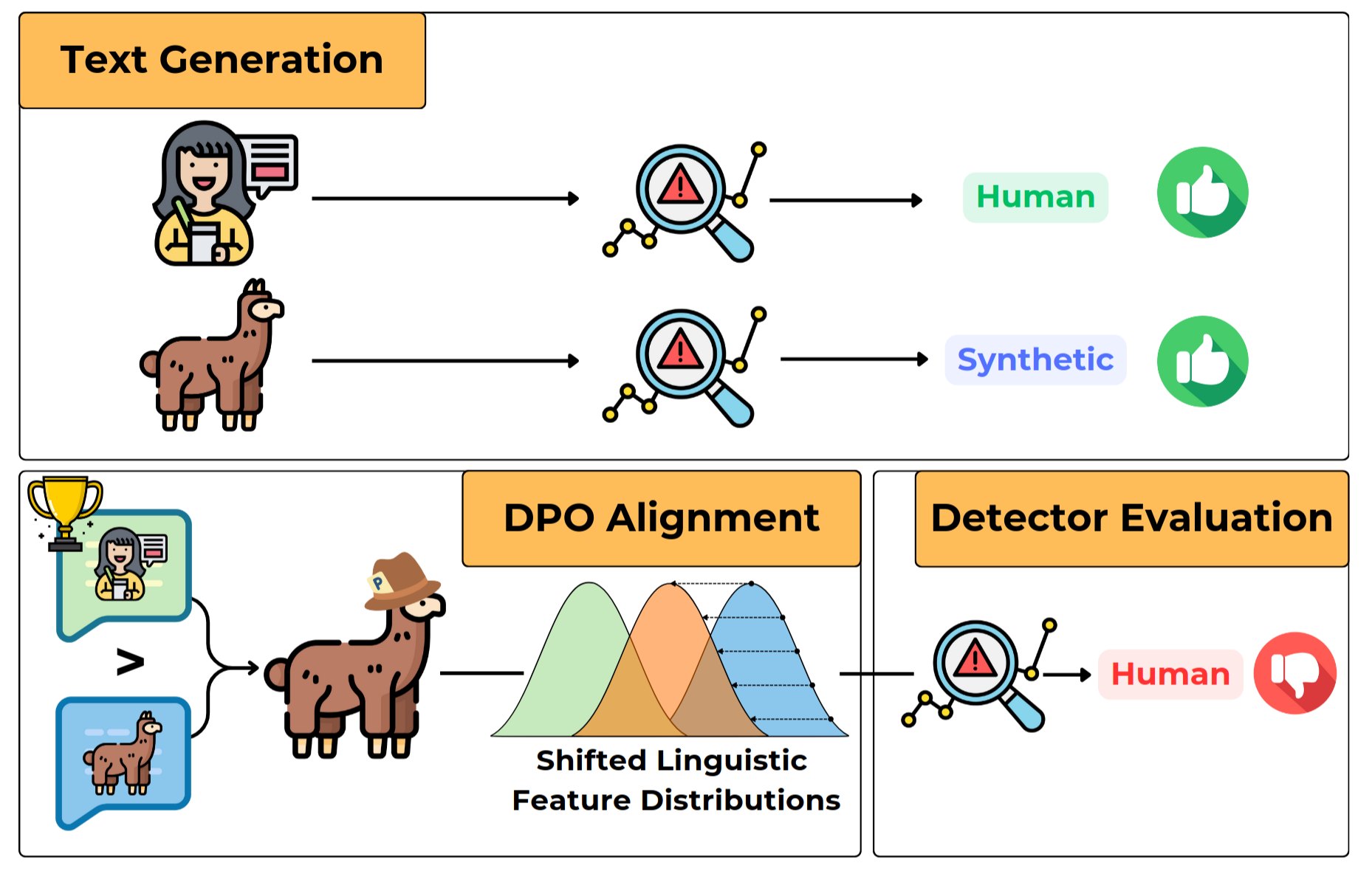
We perform our exepriments starting from two datasets: XSUM and M4-Abstract. The train-test splits are stored in the data folder.
For both datasets, the adversarial datasets that we generate via the DPO fine-tuned models are stored in the adversarial_dataset folder.
All the DPO fine-tunings are performed via the TRL library. In all our trainings, we leverage LoRA via the PEFT library.
The dpo_trainer folder contains the code to perform any iteration of the dpo fine-tuning.
This is an example script to perform the first round of DPO fine-tuning on
python dpo_trainer/train.py \
                --model_name "llama-3.1-8b" \
                --datapath "data/xsum/vanilla/xsum.zip" \
                --lora \
                --dataset_name "xsum-iter-1" \
                --nepochs 1 \
                --lr 5e-5 \
                --beta 1.0
This will save a LoRA module in the models-dpo folder, under a subfolder named $dataset_name/$timestamp.
For subsquent iteration, user need to additionally provide a path to the LoRA weights obtained after the first-iteration, and select the adversarial dataset generated with the dpo-fine tuned model. To instruction on how to obtain the adversarial dataset check out the adversarial dataset generation section below. This is an example script:
python dpo_trainer/train.py \
                --model_name "llama-3.1-8b" \
                --lora \
                --adapter_path "models-dpo/llama-3.1-8b_lora/xsum-iter-1/$timestamp" \
                --datapath "dpo_dataset/adversarial_dataset/xsum/llama/adversarial_dpo_dataset.json" \
                --dataset_name "xsum-iter-2" \
                --nepochs 1 \
                --lr 5e-5 \
                --beta 1.0
The generation_code folder contains the code to obtain the outputs of the DPO-fine tuned models used in the adversarial datasets. Generations are computed via the vllm library. This is an example script for the llama model and the xsum dataset:
python generation_code/fastgen.py \
        --datapath "data/xsum/vanilla/xsum.zip" \
        --split_path "data/xsum/splits/split.100000.json" \
        --model "meta-llama/Meta-Llama-3.1-8B-Instruct" \
        --model_name "llama-dpo-iter1" \
        --adapter_path "models-dpo/llama-3.1-8b_lora/xsum-iter-1/$timestamp" \
        --max_tokens 256 \
        --batch 10000 \
Generations will be stored in the generation_code/generation folder, in a subfolder named after the $dataset_name/$model_name/$timestamp.
For the profiling phase, we leverage ProfilingUD. You can run the profiler on the texts via the online tool.
The dpo_dataset/adversarial_dataset_generator.py is responsible for generating the final adversarial dataset. It takes as input the generations obtained in the previous step. This is an example script for the xsum dataset ,
python dpo_dataset/adversarial_dataset_generator.py \
        --dataset_name "xsum" \
        --split_file "data/xsum/splits/split.100000.json" \
        --profile_path_mgt 'path to the profiling results of machine generated texts' \
        --profile_path_hwt 'path to the profling results of human written texts' \
        --mgt_text "generation_code/generations/xsum-iter-1/llama-dpo-iter1/0130-2348/generations-0203_1752.json" \
        --hwt_text "data/xsum/vanilla/xsum.zip" \
        --mgt_method "llama-iter-1"
        --tokenizer_name "meta-llama/Llama-3.1-8B-Instruct" \
        --max_length 256
        --epsilon 0.1
        --second_iter True/False
        --prev_svm path to previously trained SVM, iff second_iter is True
The evaluation_code folder contains the code to pefrom the MGT Detectors evaluation. This is an example script to evaluate MAGE:
python evaluation_code/fastdetect_mage.py \
        --datapath "generation_code/generations/m4abs-naive-iter-2/gemma-dpo-iter2/0211-1226/generations-testset-0211_1652.json" \
        --max_length 256 \
        --batchsize 128 \
        --target "llama" \
        --split_path "data/m4abs/splits/splits.20000.json"
To download the data install git lfs
If you find our code useful for your research, please cite our paper:
@misc{pedrotti2025stresstestingMGT,
      title={Stress-testing Machine Generated Text Detection: Shifting Language Models Writing Style to Fool Detectors},
      author={Andrea Pedrotti and Michele Papucci and Cristiano Ciaccio and Alessio Miaschi and Giovanni Puccetti and Felice Dell'Orletta and Andrea Esuli},
      year={2025},
      eprint={2505.24523},
      archivePrefix={arXiv},
      primaryClass={cs.CL},
      url={https://arxiv.org/abs/2505.24523},
}
Stress-testing Machine Generated Text Detection: Shifting Language Models Writing Style to Fool Detectors. Findings of ACL 2025
Jupyter Notebook
7
169 commits
updated Jun 4, 2025
Code for the ACL 2025 Findings paper "Stress-testing Machine Generated Text Detection: Shifting Language Models Writing Style to Fool Detectors" [ACL] [arxiv]
We perform our exepriments starting from two datasets: XSUM and M4-Abstract. The train-test splits are stored in the data folder.
For both datasets, the adversarial datasets that we generate via the DPO fine-tuned models are stored in the adversarial_dataset folder.
All the DPO fine-tunings are performed via the TRL library. In all our trainings, we leverage LoRA via the PEFT library.
The dpo_trainer folder contains the code to perform any iteration of the dpo fine-tuning.
This is an example script to perform the first round of DPO fine-tuning on
python dpo_trainer/train.py \
                --model_name "llama-3.1-8b" \
                --datapath "data/xsum/vanilla/xsum.zip" \
                --lora \
                --dataset_name "xsum-iter-1" \
                --nepochs 1 \
                --lr 5e-5 \
                --beta 1.0
This will save a LoRA module in the models-dpo folder, under a subfolder named $dataset_name/$timestamp.
For subsquent iteration, user need to additionally provide a path to the LoRA weights obtained after the first-iteration, and select the adversarial dataset generated with the dpo-fine tuned model. To instruction on how to obtain the adversarial dataset check out the adversarial dataset generation section below. This is an example script:
python dpo_trainer/train.py \
                --model_name "llama-3.1-8b" \
                --lora \
                --adapter_path "models-dpo/llama-3.1-8b_lora/xsum-iter-1/$timestamp" \
                --datapath "dpo_dataset/adversarial_dataset/xsum/llama/adversarial_dpo_dataset.json" \
                --dataset_name "xsum-iter-2" \
                --nepochs 1 \
                --lr 5e-5 \
                --beta 1.0
The generation_code folder contains the code to obtain the outputs of the DPO-fine tuned models used in the adversarial datasets. Generations are computed via the vllm library. This is an example script for the llama model and the xsum dataset:
python generation_code/fastgen.py \
        --datapath "data/xsum/vanilla/xsum.zip" \
        --split_path "data/xsum/splits/split.100000.json" \
        --model "meta-llama/Meta-Llama-3.1-8B-Instruct" \
        --model_name "llama-dpo-iter1" \
        --adapter_path "models-dpo/llama-3.1-8b_lora/xsum-iter-1/$timestamp" \
        --max_tokens 256 \
        --batch 10000 \
Generations will be stored in the generation_code/generation folder, in a subfolder named after the $dataset_name/$model_name/$timestamp.
For the profiling phase, we leverage ProfilingUD. You can run the profiler on the texts via the online tool.
The dpo_dataset/adversarial_dataset_generator.py is responsible for generating the final adversarial dataset. It takes as input the generations obtained in the previous step. This is an example script for the xsum dataset ,
python dpo_dataset/adversarial_dataset_generator.py \
        --dataset_name "xsum" \
        --split_file "data/xsum/splits/split.100000.json" \
        --profile_path_mgt 'path to the profiling results of machine generated texts' \
        --profile_path_hwt 'path to the profling results of human written texts' \
        --mgt_text "generation_code/generations/xsum-iter-1/llama-dpo-iter1/0130-2348/generations-0203_1752.json" \
        --hwt_text "data/xsum/vanilla/xsum.zip" \
        --mgt_method "llama-iter-1"
        --tokenizer_name "meta-llama/Llama-3.1-8B-Instruct" \
        --max_length 256
        --epsilon 0.1
        --second_iter True/False
        --prev_svm path to previously trained SVM, iff second_iter is True
The evaluation_code folder contains the code to pefrom the MGT Detectors evaluation. This is an example script to evaluate MAGE:
python evaluation_code/fastdetect_mage.py \
        --datapath "generation_code/generations/m4abs-naive-iter-2/gemma-dpo-iter2/0211-1226/generations-testset-0211_1652.json" \
        --max_length 256 \
        --batchsize 128 \
        --target "llama" \
        --split_path "data/m4abs/splits/splits.20000.json"
To download the data install git lfs
If you find our code useful for your research, please cite our paper:
@misc{pedrotti2025stresstestingMGT,
      title={Stress-testing Machine Generated Text Detection: Shifting Language Models Writing Style to Fool Detectors},
      author={Andrea Pedrotti and Michele Papucci and Cristiano Ciaccio and Alessio Miaschi and Giovanni Puccetti and Felice Dell'Orletta and Andrea Esuli},
      year={2025},
      eprint={2505.24523},
      archivePrefix={arXiv},
      primaryClass={cs.CL},
      url={https://arxiv.org/abs/2505.24523},
}



