
AutoBound automatically computes upper and lower bounds on functions.
Python
365
44 commits
updated Oct 24, 2025
README
AutoBound: Automatically Bounding Functions


AutoBound is a generalization of automatic differentiation. In addition to computing a Taylor polynomial approximation of a function, it computes upper and lower bounds that are guaranteed to hold over a user-specified trust region.
As an example, here are the quadratic upper and lower bounds AutoBound computes
for the function f(x) = 1.5*exp(3*x) - 25*(x**2), centered at 0.5, and
valid over the trust region [0, 1].
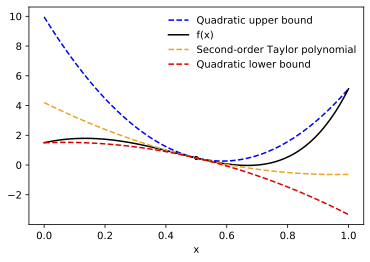
The code to compute the bounds shown in this plot looks like this (see quickstart):
import autobound.jax as ab
import jax.numpy as jnp

f = lambda x: 1.5*jnp.exp(3*x) - 25*x**2
x0 = .5
trust_region = (0, 1)
# Compute quadratic upper and lower bounds on f.
bounds = ab.taylor_bounds(f, max_degree=2)(x0, trust_region)
# bounds.upper(1) == 5.1283045 == f(1)
# bounds.lower(0) == 1.5 == f(0)
# bounds.coefficients == (0.47253323, -4.8324013, (-5.5549355, 28.287888))
These bounds can be used for:
- Computing learning rates that are guaranteed to reduce a loss function
- Upper and lower bounding integrals
- Proving optimality guarantees in global optimization
and more!
Under the hood, AutoBound computes these bounds using an interval arithmetic variant of Taylor-mode automatic differentiation. Accordingly, the memory requirements are linear in the input dimension, and the method is only practical for functions with low-dimensional inputs. A reverse-mode algorithm that efficiently handles high-dimensional inputs is under development.
A detailed description of the AutoBound algorithm can be found in this paper.
Installation
Assuming you have installed pip, you can install this package directly from GitHub with
pip install git+https://github.com/google/autobound.git
or from PyPI with
pip install autobound
You may need to upgrade pip before running these commands.
Testing
To run unit tests, first install the packages the unit tests depend on with
pip install autobound[dev]
As above, you may need to install or upgrade pip before running this command.
Then, download the source code and run the tests using
git clone https://github.com/google/autobound.git
python3 -m pytest autobound
or
pip install -e git+https://github.com/google/autobound.git#egg=autobound
python3 -m pytest src/autobound
Limitations
The current code has a few limitations:
- Only JAX-traceable functions can be automatically bounded.
- Many JAX library functions are not yet supported. What is
supported is bounding the squared error loss of a multi-layer perceptron or convolutional neural network that uses the
jax.nn.sigmoid,jax.nn.softplus, orjax.nn.swishactivation functions. - To compute accurate bounds for deeper neural networks, you may need to use
float64rather thanfloat32.
Citing AutoBound
To cite this repository:
@article{autobound2022,
  title={Automatically Bounding the Taylor Remainder Series: Tighter Bounds and New Applications},
  author={Streeter, Matthew and Dillon, Joshua V},
  journal={arXiv preprint arXiv:2212.11429},
  url = {http://github.com/google/autobound},
  year={2022}
}
This is not an officially supported Google product.
Contributors

42 commits

2 commits
Similar repos




Languages
Python
57.4%
Jupyter Notebook
42.6%
AutoBound automatically computes upper and lower bounds on functions.
Python
365
44 commits
updated Oct 24, 2025
README
AutoBound: Automatically Bounding Functions
AutoBound is a generalization of automatic differentiation. In addition to computing a Taylor polynomial approximation of a function, it computes upper and lower bounds that are guaranteed to hold over a user-specified trust region.
As an example, here are the quadratic upper and lower bounds AutoBound computes
for the function f(x) = 1.5*exp(3*x) - 25*(x**2), centered at 0.5, and
valid over the trust region [0, 1].
The code to compute the bounds shown in this plot looks like this (see quickstart):
import autobound.jax as ab
import jax.numpy as jnp

f = lambda x: 1.5*jnp.exp(3*x) - 25*x**2
x0 = .5
trust_region = (0, 1)
# Compute quadratic upper and lower bounds on f.
bounds = ab.taylor_bounds(f, max_degree=2)(x0, trust_region)
# bounds.upper(1) == 5.1283045 == f(1)
# bounds.lower(0) == 1.5 == f(0)
# bounds.coefficients == (0.47253323, -4.8324013, (-5.5549355, 28.287888))
These bounds can be used for:
- Computing learning rates that are guaranteed to reduce a loss function
- Upper and lower bounding integrals
- Proving optimality guarantees in global optimization
and more!
Under the hood, AutoBound computes these bounds using an interval arithmetic variant of Taylor-mode automatic differentiation. Accordingly, the memory requirements are linear in the input dimension, and the method is only practical for functions with low-dimensional inputs. A reverse-mode algorithm that efficiently handles high-dimensional inputs is under development.
A detailed description of the AutoBound algorithm can be found in this paper.
Installation
Assuming you have installed pip, you can install this package directly from GitHub with
pip install git+https://github.com/google/autobound.git
or from PyPI with
pip install autobound
You may need to upgrade pip before running these commands.
Testing
To run unit tests, first install the packages the unit tests depend on with
pip install autobound[dev]
As above, you may need to install or upgrade pip before running this command.
Then, download the source code and run the tests using
git clone https://github.com/google/autobound.git
python3 -m pytest autobound
or
pip install -e git+https://github.com/google/autobound.git#egg=autobound
python3 -m pytest src/autobound
Limitations
The current code has a few limitations:
- Only JAX-traceable functions can be automatically bounded.
- Many JAX library functions are not yet supported. What is
supported is bounding the squared error loss of a multi-layer perceptron or convolutional neural network that uses the
jax.nn.sigmoid,jax.nn.softplus, orjax.nn.swishactivation functions. - To compute accurate bounds for deeper neural networks, you may need to use
float64rather thanfloat32.
Citing AutoBound
To cite this repository:
@article{autobound2022,
  title={Automatically Bounding the Taylor Remainder Series: Tighter Bounds and New Applications},
  author={Streeter, Matthew and Dillon, Joshua V},
  journal={arXiv preprint arXiv:2212.11429},
  url = {http://github.com/google/autobound},
  year={2022}
}
This is not an officially supported Google product.
Similar repos
Contributors
42 commits
2 commits
Languages
Python
57.4%
Jupyter Notebook
42.6%