
README
VoxTell Web Interface




Free-text promptable 3D medical image segmentation with optimizations for consumer hardware
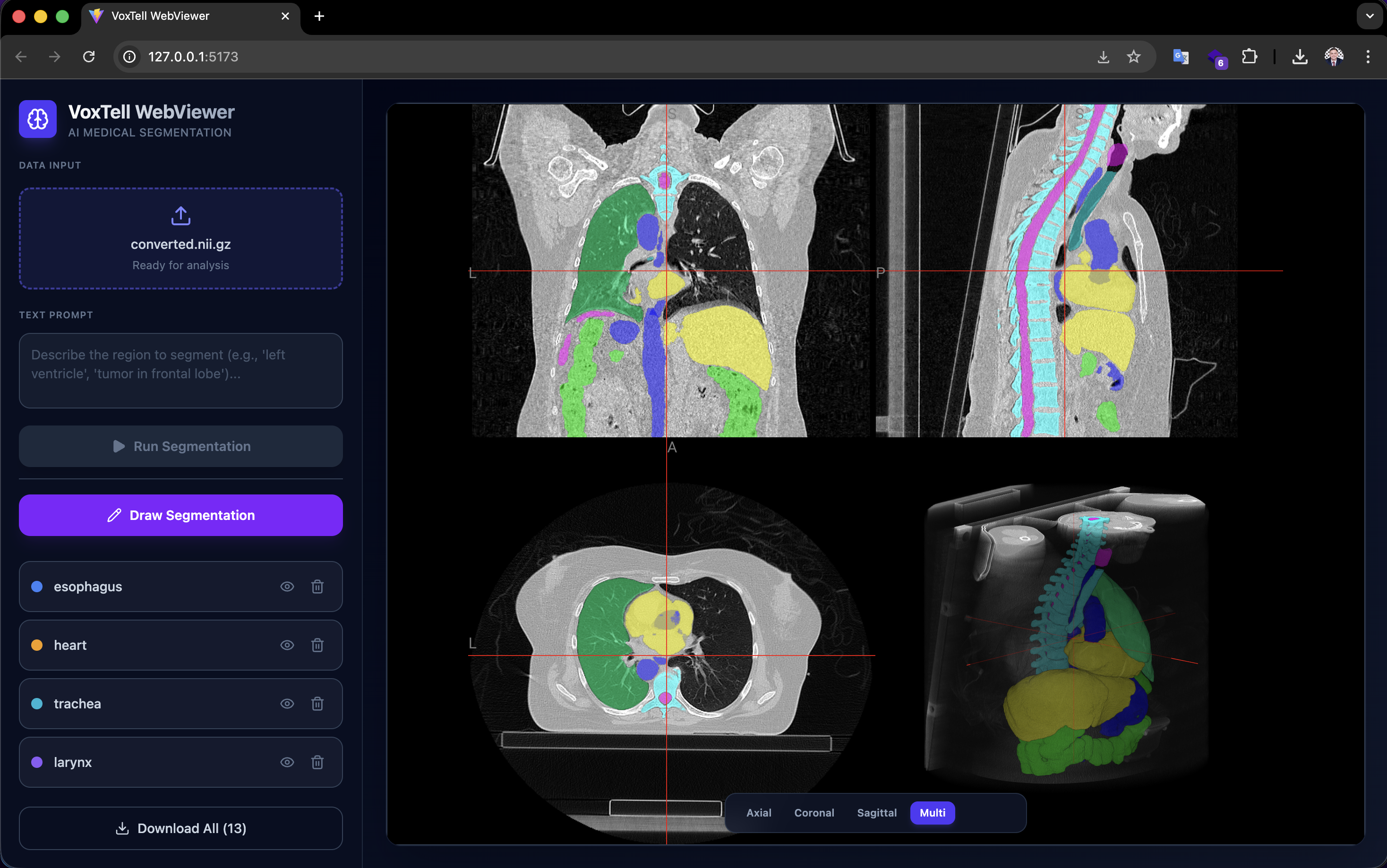
About
This project provides a web-based interface for VoxTell, a state-of-the-art 3D vision-language model for medical image segmentation. VoxTell enables natural language-driven anatomical segmentation across CT, PET, and MRI modalities—simply describe what you want to segment in plain English.
What is VoxTell?
VoxTell is a deep learning model that combines 3D image understanding with natural language processing to segment anatomical structures from text prompts. Instead of traditional segmentation tools that require manual annotation or predefined labels, VoxTell accepts prompts like:
- Single organs:
"liver","brain","left kidney" - Substructures:
"right lung upper lobe","L5 vertebra" - Complex queries:
"prostate tumor","pancreatic head"
The model was trained on 158 public datasets with over 62,000 volumetric images, covering brain, thorax, abdomen, pelvis, musculoskeletal structures, and pathological findings.
Key Features
🔹 Low-VRAM Optimizations
This implementation includes critical optimizations to run VoxTell on consumer GPUs with limited VRAM (e.g., RTX 3060 12GB, RTX 4060 Ti 16GB):
| Component | Optimization | VRAM Savings |
|---|---|---|
| Text Encoder | Load Qwen3-Embedding-4B in float16 precision | ~15GB → ~7.5GB |
| Memory Allocator | PYTORCH_CUDA_ALLOC_CONF="expandable_segments:True" | Reduces GPU memory fragmentation |
| Sliding Window | perform_everything_on_device = False | Offloads CPU-compatible ops to reduce peak VRAM |
[!IMPORTANT] Hardware Requirements
- Minimum: 12GB VRAM (tested on RTX 3080 12GB version)
- Recommended: 16GB+ VRAM for larger volumes
- CPU: Multi-core recommended for sliding window fallback
🔹 Interactive 3D Viewer
- Multi-volume support: Accumulate and compare multiple segmentations
- Real-time 3D rendering: Powered by NiiVue
- Interactive overlay controls: Toggle visibility and adjust opacity
- Manual drawing: Create and refine segmentation masks with an integrated drawing tool
- Export segmentation masks: Download individual or multiple segmentation masks as NIfTI (
.nii.gz) or RTStruct files
🔹 Production-Ready Architecture
- FastAPI backend: Async inference server with CORS support
- React + TypeScript frontend: Modern, responsive UI built with Vite
- Multi-format support: Direct
.nii,.nii.gz, and DICOM upload/processing
Installation
Prerequisites
- Python: 3.10 or higher
- Node.js: 20.x or higher (required for frontend — see Troubleshooting if you run into errors)
- CUDA: 11.8+ (for GPU acceleration)
- Conda (recommended for environment management)
1. Clone the Repository
git clone https://github.com/gomesgustavoo/voxtell-web-plugin.git
cd voxtell-web-plugin
2. Backend Setup
Create and activate a Conda environment:
conda create -n voxtell python=3.12
conda activate voxtell
Install PyTorch (adjust CUDA version as needed):
[!WARNING] PyTorch 2.9.0 Compatibility Issue
There is a known OOM bug in PyTorch 2.9.0 affecting 3D convolutions. Use PyTorch 2.8.0 or earlier until resolved (PyTorch Issue #166122).
pip install torch==2.8.0 torchvision==0.23.0 --index-url https://download.pytorch.org/whl/cu126
Install VoxTell dependencies:
pip install -e .
Download the VoxTell model (see download_model.py):
# huggingface_hub is required
python download_model.py
3. Frontend Setup
Navigate to the frontend directory and install dependencies:
cd frontend
npm install
Quick Start
From the project root:
chmod +x run.sh  # only needed once
./run.sh
The script starts the backend (:8000) and the frontend (:5173) together. Open http://localhost:5173 in your browser. Press Ctrl+C to stop both servers.
[!NOTE] The backend loads the VoxTell model at startup, which takes 30–60 seconds. The frontend will be immediately available, but inference requests will fail until the backend prints
Model loaded successfully.
Usage
- Upload a Scan: Click the file input to select a
.nii,.nii.gzfile or a DICOM series - Enter a text prompt: Describe the anatomical structure (e.g.,
"liver","prostate tumor","left kidney") - Run segmentation: Click the button and wait for inference to complete
- View results: The 3D viewer displays your scan with the segmentation overlay (red, 50% opacity)
- Accumulate masks: Multiple segmentations are preserved—use the "Segmentations" tab to manage visibility
- Download results: Export segmentations as
.nii.gzor RTStruct files for further analysis
Additional Tools
- Manual Drawing: Optional drawing mode (pencil icon) for manual refinement or custom annotations
- Batch Download: Download all segmentation masks at once using the "Download All" button
Example Prompts
| Prompt | Target Structure |
|---|---|
"lungs" | Both lungs |
"right kidney" | Right kidney only |
"prostate tumor" | Clinical target volume |
"L4 vertebra" | L4 vertebral body |
"thoracic aorta" | Descending thoracic aorta |
[!TIP] Image Orientation
VoxTell requires images in RAS orientation for correct left/right anatomical localization. If segmentations appear mirrored or incorrect (e.g., liver segments spleen instead), verify your NIfTI metadata.
Technical Details
Architecture Overview
┌─────────────────┐
│  React Frontend │  ← User uploads .nii.gz + text prompt
└────────┬────────┘
         │ HTTP POST /predict
         │
┌────────▼────────┐
│  FastAPI Server │  ← Receives file + prompt
└────────┬────────┘
         │
┌────────▼────────┐
│ VoxTell Model   │  ← 3D vision-language inference
│  - Image Encoder│     (optimized for low VRAM)
│  - Text Encoder │
│  - Fusion Decoder│
└────────┬────────┘
         │
         └─────────► Returns .nii.gz segmentation mask
Key Files
| File | Description |
|---|---|
backend/server.py | FastAPI inference server with /predict endpoint |
voxtell/inference/predictor.py | VoxTell inference engine with FP16 text encoder |
frontend/src/App.tsx | Main React application with file upload and API logic |
frontend/src/components/Viewer.tsx | NiiVue-based 3D medical image viewer |
VRAM Optimization Details
The following modifications were made to the original VoxTell implementation:
1. Text Encoder Precision Reduction
voxtell/inference/predictor.py
# Load Qwen3-Embedding-4B in float16 instead of float32
self.text_encoder = AutoModel.from_pretrained(
    "Qwen/Qwen3-Embedding-4B",
    torch_dtype=torch.float16  # ← Halves VRAM usage
)
2. Memory Fragmentation Mitigation
backend/server.py
os.environ["PYTORCH_CUDA_ALLOC_CONF"] = "expandable_segments:True"
3. Sliding Window CPU Offload
backend/server.py
predictor.perform_everything_on_device = False
# Allows nnUNet to use CPU for preprocessing/postprocessing
Troubleshooting
Backend fails to load the model
- Make sure you ran
python download_model.pyfirst — the model files must exist undermodels/voxtell_v1.1/. - Ensure you have at least 12GB of GPU VRAM available. Close other GPU-intensive applications before starting the server.
Segmentations appear mirrored or incorrect
VoxTell requires images in RAS orientation for correct left/right anatomical localization. If results seem flipped (e.g., liver appears on the wrong side), verify your NIfTI file metadata and orientation.
📄 License
This project inherits the Apache 2.0 License from the original VoxTell repository. See LICENSE for details.
Acknowledgments
This project builds upon VoxTell by the Division of Medical Image Computing (MIC), German Cancer Research Center (DKFZ):
Rokuss et al. (2025). VoxTell: Free-Text Promptable Universal 3D Medical Image Segmentation. arXiv:2511.11450.
@misc{rokuss2025voxtell,
  title={VoxTell: Free-Text Promptable Universal 3D Medical Image Segmentation},
  author={Maximilian Rokuss and Moritz Langenberg and Yannick Kirchhoff and Fabian Isensee and Benjamin Hamm and Constantin Ulrich and Sebastian Regnery and Lukas Bauer and Efthimios Katsigiannopulos and Tobias Norajitra and Klaus Maier-Hein},
  year={2025},
  eprint={2511.11450},
  archivePrefix={arXiv}
}
Special thanks to the authors for open-sourcing this amazing work.
Contact
For questions about this web interface implementation, contact:
📧 https://www.linkedin.com/in/gustavoogomesss/
For questions about the original VoxTell model, contact:
📧 maximilian.rokuss@dkfz-heidelberg.de / moritz.langenberg@dkfz-heidelberg.de
Similar repos




Languages
Python
57.8%
TypeScript
37.9%
Shell
2.8%
README
VoxTell Web Interface
Free-text promptable 3D medical image segmentation with optimizations for consumer hardware
About
This project provides a web-based interface for VoxTell, a state-of-the-art 3D vision-language model for medical image segmentation. VoxTell enables natural language-driven anatomical segmentation across CT, PET, and MRI modalities—simply describe what you want to segment in plain English.
What is VoxTell?
VoxTell is a deep learning model that combines 3D image understanding with natural language processing to segment anatomical structures from text prompts. Instead of traditional segmentation tools that require manual annotation or predefined labels, VoxTell accepts prompts like:
- Single organs:
"liver","brain","left kidney" - Substructures:
"right lung upper lobe","L5 vertebra" - Complex queries:
"prostate tumor","pancreatic head"
The model was trained on 158 public datasets with over 62,000 volumetric images, covering brain, thorax, abdomen, pelvis, musculoskeletal structures, and pathological findings.
Key Features
🔹 Low-VRAM Optimizations
This implementation includes critical optimizations to run VoxTell on consumer GPUs with limited VRAM (e.g., RTX 3060 12GB, RTX 4060 Ti 16GB):
| Component | Optimization | VRAM Savings |
|---|---|---|
| Text Encoder | Load Qwen3-Embedding-4B in float16 precision | ~15GB → ~7.5GB |
| Memory Allocator | PYTORCH_CUDA_ALLOC_CONF="expandable_segments:True" | Reduces GPU memory fragmentation |
| Sliding Window | perform_everything_on_device = False | Offloads CPU-compatible ops to reduce peak VRAM |
[!IMPORTANT] Hardware Requirements
- Minimum: 12GB VRAM (tested on RTX 3080 12GB version)
- Recommended: 16GB+ VRAM for larger volumes
- CPU: Multi-core recommended for sliding window fallback
🔹 Interactive 3D Viewer
- Multi-volume support: Accumulate and compare multiple segmentations
- Real-time 3D rendering: Powered by NiiVue
- Interactive overlay controls: Toggle visibility and adjust opacity
- Manual drawing: Create and refine segmentation masks with an integrated drawing tool
- Export segmentation masks: Download individual or multiple segmentation masks as NIfTI (
.nii.gz) or RTStruct files
🔹 Production-Ready Architecture
- FastAPI backend: Async inference server with CORS support
- React + TypeScript frontend: Modern, responsive UI built with Vite
- Multi-format support: Direct
.nii,.nii.gz, and DICOM upload/processing
Installation
Prerequisites
- Python: 3.10 or higher
- Node.js: 20.x or higher (required for frontend — see Troubleshooting if you run into errors)
- CUDA: 11.8+ (for GPU acceleration)
- Conda (recommended for environment management)
1. Clone the Repository
git clone https://github.com/gomesgustavoo/voxtell-web-plugin.git
cd voxtell-web-plugin
2. Backend Setup
Create and activate a Conda environment:
conda create -n voxtell python=3.12
conda activate voxtell
Install PyTorch (adjust CUDA version as needed):
[!WARNING] PyTorch 2.9.0 Compatibility Issue
There is a known OOM bug in PyTorch 2.9.0 affecting 3D convolutions. Use PyTorch 2.8.0 or earlier until resolved (PyTorch Issue #166122).
pip install torch==2.8.0 torchvision==0.23.0 --index-url https://download.pytorch.org/whl/cu126
Install VoxTell dependencies:
pip install -e .
Download the VoxTell model (see download_model.py):
# huggingface_hub is required
python download_model.py
3. Frontend Setup
Navigate to the frontend directory and install dependencies:
cd frontend
npm install
Quick Start
From the project root:
chmod +x run.sh  # only needed once
./run.sh
The script starts the backend (:8000) and the frontend (:5173) together. Open http://localhost:5173 in your browser. Press Ctrl+C to stop both servers.
[!NOTE] The backend loads the VoxTell model at startup, which takes 30–60 seconds. The frontend will be immediately available, but inference requests will fail until the backend prints
Model loaded successfully.
Usage
- Upload a Scan: Click the file input to select a
.nii,.nii.gzfile or a DICOM series - Enter a text prompt: Describe the anatomical structure (e.g.,
"liver","prostate tumor","left kidney") - Run segmentation: Click the button and wait for inference to complete
- View results: The 3D viewer displays your scan with the segmentation overlay (red, 50% opacity)
- Accumulate masks: Multiple segmentations are preserved—use the "Segmentations" tab to manage visibility
- Download results: Export segmentations as
.nii.gzor RTStruct files for further analysis
Additional Tools
- Manual Drawing: Optional drawing mode (pencil icon) for manual refinement or custom annotations
- Batch Download: Download all segmentation masks at once using the "Download All" button
Example Prompts
| Prompt | Target Structure |
|---|---|
"lungs" | Both lungs |
"right kidney" | Right kidney only |
"prostate tumor" | Clinical target volume |
"L4 vertebra" | L4 vertebral body |
"thoracic aorta" | Descending thoracic aorta |
[!TIP] Image Orientation
VoxTell requires images in RAS orientation for correct left/right anatomical localization. If segmentations appear mirrored or incorrect (e.g., liver segments spleen instead), verify your NIfTI metadata.
Technical Details
Architecture Overview
┌─────────────────┐
│  React Frontend │  ← User uploads .nii.gz + text prompt
└────────┬────────┘
         │ HTTP POST /predict
         │
┌────────▼────────┐
│  FastAPI Server │  ← Receives file + prompt
└────────┬────────┘
         │
┌────────▼────────┐
│ VoxTell Model   │  ← 3D vision-language inference
│  - Image Encoder│     (optimized for low VRAM)
│  - Text Encoder │
│  - Fusion Decoder│
└────────┬────────┘
         │
         └─────────► Returns .nii.gz segmentation mask
Key Files
| File | Description |
|---|---|
backend/server.py | FastAPI inference server with /predict endpoint |
voxtell/inference/predictor.py | VoxTell inference engine with FP16 text encoder |
frontend/src/App.tsx | Main React application with file upload and API logic |
frontend/src/components/Viewer.tsx | NiiVue-based 3D medical image viewer |
VRAM Optimization Details
The following modifications were made to the original VoxTell implementation:
1. Text Encoder Precision Reduction
voxtell/inference/predictor.py
# Load Qwen3-Embedding-4B in float16 instead of float32
self.text_encoder = AutoModel.from_pretrained(
    "Qwen/Qwen3-Embedding-4B",
    torch_dtype=torch.float16  # ← Halves VRAM usage
)
2. Memory Fragmentation Mitigation
backend/server.py
os.environ["PYTORCH_CUDA_ALLOC_CONF"] = "expandable_segments:True"
3. Sliding Window CPU Offload
backend/server.py
predictor.perform_everything_on_device = False
# Allows nnUNet to use CPU for preprocessing/postprocessing
Troubleshooting
Backend fails to load the model
- Make sure you ran
python download_model.pyfirst — the model files must exist undermodels/voxtell_v1.1/. - Ensure you have at least 12GB of GPU VRAM available. Close other GPU-intensive applications before starting the server.
Segmentations appear mirrored or incorrect
VoxTell requires images in RAS orientation for correct left/right anatomical localization. If results seem flipped (e.g., liver appears on the wrong side), verify your NIfTI file metadata and orientation.
📄 License
This project inherits the Apache 2.0 License from the original VoxTell repository. See LICENSE for details.
Acknowledgments
This project builds upon VoxTell by the Division of Medical Image Computing (MIC), German Cancer Research Center (DKFZ):
Rokuss et al. (2025). VoxTell: Free-Text Promptable Universal 3D Medical Image Segmentation. arXiv:2511.11450.
@misc{rokuss2025voxtell,
  title={VoxTell: Free-Text Promptable Universal 3D Medical Image Segmentation},
  author={Maximilian Rokuss and Moritz Langenberg and Yannick Kirchhoff and Fabian Isensee and Benjamin Hamm and Constantin Ulrich and Sebastian Regnery and Lukas Bauer and Efthimios Katsigiannopulos and Tobias Norajitra and Klaus Maier-Hein},
  year={2025},
  eprint={2511.11450},
  archivePrefix={arXiv}
}
Special thanks to the authors for open-sourcing this amazing work.
Contact
For questions about this web interface implementation, contact:
📧 https://www.linkedin.com/in/gustavoogomesss/
For questions about the original VoxTell model, contact:
📧 maximilian.rokuss@dkfz-heidelberg.de / moritz.langenberg@dkfz-heidelberg.de
Similar repos
Languages
Python
57.8%
TypeScript
37.9%
Shell
2.8%