
Cross-process cache stampede protection for the cache you already use.
TypeScript
4
63 commits
updated Sep 30, 2026
See what people are saying
README





Crossflight
Cross-process cache stampede protection for the cache you already use.
const crossflight = createCrossflight({
  cache: existingCacheAdapter,
  coordinator: redisCoordinator(redis),
})

const user = await crossflight.wrap(
  "user:123",
  () => loadUser("123"),
  { ttl: 60_000 },
)
What it does
When multiple processes miss the same cache key simultaneously, each of them will independently run the loader unless something coordinates between them. Most cache libraries already solve the within-process version of this problem by coalescing concurrent misses into a single in-flight Promise. That is not enough once the application runs on more than one server.
Crossflight adds a distributed coordinator to the picture. One process acquires ownership of the key, runs the loader, and writes the result to the cache. Every other caller, regardless of which process they live in, waits for that result rather than running their own copy of the same work.
Without coalescing
Every caller across every process independently runs the loader.
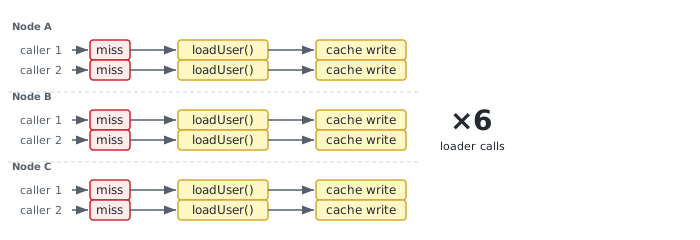
With in-process coalescing only
Callers within the same process share one in-flight Promise, but each process still runs the loader independently. This is what most cache libraries give you.
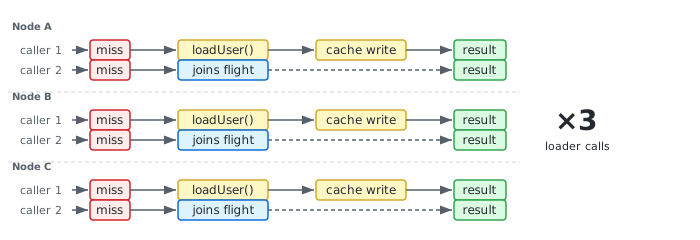
With distributed coalescing
One process acquires ownership, runs the loader once, and writes the result. Every other caller waits for that result.
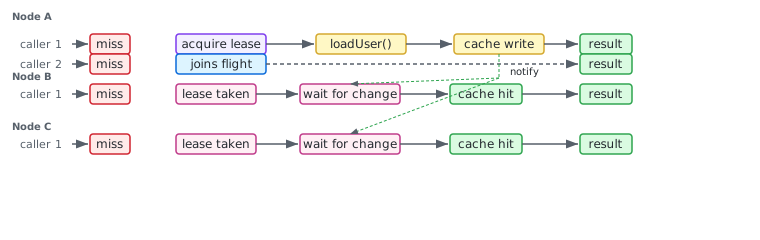
Architecture
Crossflight is built around two separate contracts.
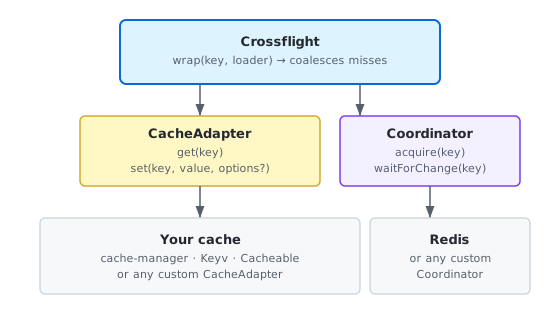
The CacheAdapter describes how values are stored and retrieved. The Coordinator describes how ownership is acquired and how processes signal each other when a key changes. Crossflight depends on these two interfaces and knows nothing about the backing storage or the coordination mechanism.
The cache and the coordinator do not need to be the same system. You can use cache-manager backed by Memcached for values and Redis for coordination, or any combination that satisfies the interfaces. Redis is the first coordinator implementation, not a definition of what a coordinator has to be.
Installation
npm install crossflight ioredis
Getting started
import { createCrossflight } from 'crossflight'
import { redisCoordinator } from 'crossflight/coordinators/redis'
import { cacheManagerAdapter } from 'crossflight/adapters/cache-manager'
import { Redis } from 'ioredis'

const redis = new Redis()

const crossflight = createCrossflight({
  cache: cacheManagerAdapter(cacheManager),
  coordinator: redisCoordinator(redis),
})

const value = await crossflight.wrap(
  'product:42',
  (signal) => fetchProductFromDatabase(42, { signal }),
  { ttl: 30_000 },
)

// When you're done
await crossflight.close()
await redis.quit()
See the Redis coordinator guide for the built-in distributed coordination behavior, key layout, lease semantics, and running against a Redis Cluster.
Adapters
Built-in adapters are available for cache-manager, Keyv, and Cacheable:
import { cacheManagerAdapter } from 'crossflight/adapters/cache-manager'
import { keyvAdapter }         from 'crossflight/adapters/keyv'
import { cacheableAdapter }    from 'crossflight/adapters/cacheable'
Each adapter takes the library's own instance. The value the cache's set() resolves is ignored, so cache-manager's stored value and the booleans Cacheable and Keyv return all fit without a cast.
If your cache library is not on that list, the interface is two methods:
interface CacheAdapter {
  get<T>(key: string): Promise<{ hit: true; value: T } | { hit: false }>
  set<T>(key: string, value: T, options?: { ttl?: number }): Promise<void>
}
The reason get returns a discriminated union rather than a nullable value is that undefined is a valid cached result in many applications; a nullable return would make a genuine hit indistinguishable from a miss.
Configuration
All options passed to createCrossflight():
| Option | Type | Default | Description |
|---|---|---|---|
cache | CacheAdapter | required | Cache backend adapter |
coordinator | Coordinator | required | Distributed coordination backend |
failureMode | 'fail-closed' | 'fail-open' | 'fail-closed' | Fall back to running the loader when a coordination call fails (see fail-open) |
defaultTimeoutMs | number | none | Per-call timeout in ms |
defaultTtlMs | number | 30000 | Default lease TTL when a call does not pass leaseTtlMs (independent of the cache ttl) |
defaultFlightDeadlineMs | number | none | Whole-flight deadline in ms; when it passes the flight is aborted, its lease abandoned, and late callers rejected (see shared flight deadline) |
maxRetryAttempts | number | 64 | Distributed retry limit before throwing CoordinationTimeoutError |
retryBackoff | (attempt: number) => number | stepped 25–200ms | Wait duration per retry attempt |
onEvent | (event: CrossflightEvent) => void | none | Observability hook |
onEventError | (error: unknown) => void | none | Called when onEvent throws |
cacheUndefined | boolean | false | Cache a loader result of undefined by writing every value into a reserved envelope (see undefined results) |
Per-call overrides in wrap(): ttl, leaseTtlMs, flightDeadlineMs, timeoutMs, failureMode, signal.
The cache lifetime and the lease lifetime are separate: ttl controls only how long the value is cached, while the coordination lease uses leaseTtlMs when a call passes it, otherwise defaultTtlMs. A short cache lifetime therefore cannot expire the lease mid-load, and a long one cannot keep a crashed owner's lease alive. Lease TTLs are floored at 50 ms - twice the minimum renewal interval - so a lease always outlives at least one renewal.
The loader receives the shared flight's AbortSignal. Pass it to anything that can be cancelled - a fetch, a driver query - so the work stops when the flight does. A loader that ignores it still works; the flight simply stops waiting for it (see Cancellation).
Shared flight deadline
By default a flight has no deadline of its own: each caller's timeoutMs bounds only that caller's wait, so a second caller joining a slow flight gets a fresh full timeout and the group's latency is bounded only by the loader.
defaultFlightDeadlineMs puts one budget on the whole flight, measured from the moment the flight is created. When it passes, the flight is aborted: callers waiting on it reject with CoordinationTimeoutError, the owner abandons its lease, and a caller that arrives afterwards is rejected immediately instead of starting a new flight - which is what keeps a deadline from becoming a stampede. flightDeadlineMs overrides it per call, and the call that creates a flight decides the budget its joiners inherit. Coordination and cleanup are held to the same budget: acquisition, the distributed wait and renewal are raced with the flight signal, and releasing a lease is handed to the coordinator rather than awaited, so a coordinator that stops answering cannot hold the callers open. A lease that arrives after the flight gave up waiting is abandoned in the background instead of leaking until its TTL.
The deadline is a latency budget rather than a coordination failure, so it applies in both failure modes: fail-open cannot fall back to running the loader, because the flight's signal is already aborted - a loader that received that signal will have stopped, or will stop as soon as it observes it. A caller's own timeoutMs still bounds that caller, maxRetryAttempts still bounds the distributed retry loop, and leaseTtlMs still bounds ownership; the flight deadline is what bounds the flight as a whole.
Cache reads are raced with the flight's signal, so a stalled read cannot hold the flight past the deadline either. The cache write is the one step that cannot be interrupted: it still finishes and hands its value to the callers still attached to the flight. The deadline bounds how long the flight waits for work; releasing the lease is not part of that wait, so aborting a flight settles its callers even while the coordinator is still catching up.
Undefined results
Every built-in adapter reports a stored undefined as a miss, because that is what the underlying backends return for a missing key. A loader that resolves undefined is therefore never cached: each caller runs it again.
cacheUndefined: true closes that gap. While it is on, every value Crossflight writes goes into the reserved envelope { "__crossflight_envelope__": 1, value } - a loader result of undefined is the same envelope without a value key - and is unwrapped on read. Wrapping every value is what makes the format unambiguous: whatever your loader returns comes back exactly as it was, including an object that looks like the envelope itself.
__crossflight_envelope__ is reserved, and only a stored value of exactly the envelope's shape is unwrapped: an application object that carries the name next to fields of its own is returned as it was stored, not decoded. Shape is the only discriminator there is, though, so a raw value that is exactly an envelope - one written before you turned the option on, or by a process that has it off - is indistinguishable from an envelope and reads back as the value inside it, or as undefined if it has none. Enabling cacheUndefined on a cache that already holds data therefore needs a migration: namespace or flush the keys you are reusing, because Crossflight cannot tell those values apart from its own.
Raw values that are not of the reserved shape still read back as they were. Two processes sharing a cache still have to agree on the setting: an option-off process reading an enveloped value sees the envelope, not the value, and anything else reading those keys directly has to unwrap it too. An older version of Crossflight that predates the shape check unwraps any object carrying the marker, so two processes running different versions can disagree about a lookalike value.
Errors
When coordination fails, Crossflight throws one of four typed errors, all extending CoordinationError. CoordinationClosedError is thrown if close() is called while a wrap() is still running, and by every wrap() that starts after close(): a closed instance serves nothing - not even a value already in the cache - and runs no loader in either failure mode, because ownership can no longer be coordinated. CoordinationTimeoutError is thrown when the per-call timeout elapses, the flight deadline passes, or the distributed retry limit is exhausted, and carries a key property. OwnershipLostError is thrown to the owner process when a periodic lease renewal confirms the lease is gone (renew() returns false); it surfaces through onEvent as a failed event and the owner's wrap() call rejects. The one exception is publication: when ownership is lost while the cache write is already in flight, the value is still published - the write cannot be cancelled and deleting it afterwards could remove the newer owner's value - so failed is reported and wrap() resolves with the published value (see failure semantics).
| Class | When thrown |
|---|---|
CoordinationError | Base class. |
CoordinationClosedError | close() was called - while a wrap() was in flight, or before a later one started. Every wrap() on a closed instance rejects with it. |
CoordinationTimeoutError | Per-call timeout elapsed or distributed retry limit exhausted. Has a key property. |
OwnershipLostError | Periodic lease renewal confirmed ownership is gone (renew() returned false). The owner's wrap() rejects with this error. Has a key property. |
import { CoordinationError, CoordinationTimeoutError } from 'crossflight'

try {
  const value = await crossflight.wrap('key', loadValue)
} catch (error) {
  if (error instanceof CoordinationTimeoutError) {
    console.error(`Gave up waiting for key: ${error.key}`)
  } else if (error instanceof CoordinationError) {
    console.error('Coordination failed:', error.message)
  } else {
    throw error
  }
}
Events
The onEvent hook receives a CrossflightEvent on every significant state change. All events carry at least type and key.
| Event type | Trigger | Extra fields |
|---|---|---|
hit | Cache hit — value returned without coordination | waitedMs |
miss | Cache miss — coordination starting | — |
local_join | Caller joined an existing in-process flight for the same key | — |
distributed_join | Caller is waiting for a remote owner to complete | — |
wait_exhausted | Retry budget ran out while the lease stayed contended | attempts |
ownership_acquired | This process acquired the lease and will run the loader | — |
fallback | fail-open ran the loader without owning the lease | reason |
cancelled | This caller's own wait ended (signal fired or timeoutMs elapsed) | reason |
completed | Owner finished, result written to cache | durationMs, waitedMs |
failed | Any failure: coordination error, loader error, or ownership loss | error |
renewal_failed | Periodic lease renewal threw during owner execution; owner will abort | error |
Each failure produces exactly one failed event. Coordination errors that surface from an inner catch are not reported again when they reach the caller, so onEvent consumers can count failed events directly without deduplicating.
waitedMs reports how long the caller waited on another owner before the value arrived, and is 0 when the first read hit — so you can measure whether coalescing actually saves loader work. fallback counts the calls that ran the loader without owning the lease, and wait_exhausted shows when the retry budget, rather than the caller's own timeout, ended the wait.
renewal_failed fires immediately before the owner aborts. It is always followed by a failed event. Use it to distinguish renewal-specific failures from loader failures in your observability tooling.
Failure semantics
Distributed coalescing is a best-effort reduction of redundant work, not a guarantee that the loader runs exactly once. While the owner is executing the loader - and while it publishes the result - Crossflight periodically renews the lease to keep ownership valid for long-running work. If an owner process fails after completing the loader but before writing the result to cache, the lease eventually expires and another process takes over. Loaders should therefore tolerate running more than once under failure conditions.
The guarantee Crossflight offers is narrower: under normal operation, concurrent misses for the same key across all participating processes produce one loader execution, and every waiting caller receives that result.
Ownership is released on every exit path: the owner completes the lease after the cache write, and abandons it when the loader fails, the flight aborts, or the ownership recheck finds a value another process already cached.
Because renewal keeps running until the publication settles, a slow write cannot lose the lease and let a newer owner be overwritten. One window remains: if a renewal fails while the write is in flight, the value is still published - a cache write cannot be cancelled, and deleting it afterwards could remove the newer owner's value instead - and the flight reports failed (plus renewal_failed when the renewal threw) before emitting completed. Closing that window requires the store itself to reject a stale write, through a conditional write or a fencing token, which CacheAdapter cannot express today; treat a failed reported during publication as a signal that the cached value may be stale. A cache write that never settles keeps the lease renewed for as long as the owner lives: letting the lease lapse underneath a live write is exactly what publishes stale values, so bound slow writes in your store or adapter if a hung write matters to you.
fail-open
failureMode: 'fail-open' is about a failed coordination call, not about losing the race for the lease. When acquire(), waitForChange() or a re-acquire throws, Crossflight reports a failed event and runs the loader itself instead of rejecting the caller. A closed instance is the exception: wrap() rejects with CoordinationClosedError rather than falling back to a loader that would run after close() without any lease protecting it.
Ordinary contention is different: acquire() resolving null means another owner holds the lease, so the caller still joins the distributed wait and serves that owner's result - exactly as it does under fail-closed. Only if the retry budget runs out while the lease stays contended does fail-open report a failed event carrying CoordinationTimeoutError and fall back to the loader (fail-closed rejects with the same error instead). Without that distinction, fail-open would run the loader on every contended miss and recreate the stampede it is meant to prevent.
Renewal-failure policy
When periodic lease renewal fails during owner execution, Crossflight follows a fail-fast policy: the owner aborts immediately, the lease is abandoned, and another process can reacquire ownership. This applies whether renewal fails because renew() throws (e.g. a Redis command timeout) or because renew() returns false (confirmed ownership loss). The abort is not held back by the loader: wrap() rejects with the renewal error as soon as it fires, and the abort signal lets the loader stop its own work.
This is the only policy. A best-effort alternative — swallowing transient renewal errors and continuing the loader — was considered and rejected: without a coordinator-specific contract there is no reliable way to distinguish a transient blip from a permanent failure, and if the lease has already expired on the coordinator side, the loader is running without ownership regardless. The fail-fast policy makes failure visible and deterministic.
To reduce unnecessary aborts under short-lived coordinator disruptions, tune two knobs:
defaultTtlMs(or per-callleaseTtlMs): increase the lease TTL so the lease survives longer before expiring, giving the coordinator more time to recover before a renewal failure forces an abort.commandTimeoutMson the Redis coordinator: a short command timeout causes renewals to throw quickly on a blip, triggering an abort. Raising it allows the renewal to wait longer for a slow Redis before giving up.
Cancellation
Passing an AbortSignal to wrap() cancels that caller's participation, and timeoutMs bounds that caller's own wait. Both are scoped to the individual caller: they reject only that caller, and if other callers are waiting on the same flight the loader and the coordination lease continue unaffected. The shared flight is cancelled only when the last waiting caller cancels or when close() is called; close() also marks the instance closed, so a wrap() that arrives afterwards rejects with CoordinationClosedError instead of starting a flight - whether the coordinator has finished shutting down yet or not; otherwise it ends when the owner completes or abandons it. A cancelled caller receives its own reason (signal.reason or CoordinationTimeoutError).
The signal handed to the loader is the flight's own signal, not any one caller's. When the flight aborts - the last caller cancels, close() is called, or the lease is lost - Crossflight stops waiting for the loader immediately, reports a single failed event, and abandons the lease. The loader keeps running until it observes the signal, so give it a way to stop: wrap('product:42', (signal) => fetchProduct(42, { signal })). A cache write is not abortable, so ownership is held until it settles: renewal keeps running while the write is in flight, and the lease is completed afterwards, so a replacement owner cannot publish a newer value that this write would then overwrite. If ownership is genuinely lost mid-write - a renewal reports the lease as gone - the write still lands and the store keeps the last write (see failure semantics).
Scope
Crossflight coordinates cache misses and nothing else. Managing stored values, enforcing TTLs, handling eviction, serialization, and invalidation all remain the responsibility of your cache.
Alternatives
Redis locks are the most common approach to this problem. A distributed lock wraps the loader directly, which works, but it couples coordination and caching together, requires careful TTL tuning to avoid blocking callers permanently when the owner crashes, and leaves you writing the same retry-and-wait loop for every resource you want to protect.
LayerCache and similar unified caching frameworks solve the problem by owning the entire caching layer. The coordination is built in, but so is the migration - your TTL configuration, serialization, invalidation, and data layer all need to move to the new system.
Crossflight wraps the cache you already have. Coordination is handled by a separate coordinator, the cache contract is two methods, and nothing about your existing storage layer changes.
Performance
The overhead on a cache hit is negligible (a Map lookup and a resolved Promise). The benefit comes from stampede reduction: in my measurements under realistic concurrent load, eliminating redundant loader executions produces a 2–5% throughput gain. That is enough to consider adding Crossflight alongside an existing cache without any migration, although it may not be a number that would justify rebuilding your caching layer or tolerating the ongoing maintenance of a hand-rolled Redis lock.
The repository includes a benchmark suite that exercises coalescing under configurable concurrency and loader latency. See docs/benchmark.md for how to run it and what the results measure.
Extending
License
MIT
Similar repos


Languages
TypeScript
98.7%
JavaScript
1.3%
Cross-process cache stampede protection for the cache you already use.
TypeScript
4
63 commits
updated Sep 30, 2026
See what people are saying
README
Crossflight
Cross-process cache stampede protection for the cache you already use.
const crossflight = createCrossflight({
  cache: existingCacheAdapter,
  coordinator: redisCoordinator(redis),
})

const user = await crossflight.wrap(
  "user:123",
  () => loadUser("123"),
  { ttl: 60_000 },
)
What it does
When multiple processes miss the same cache key simultaneously, each of them will independently run the loader unless something coordinates between them. Most cache libraries already solve the within-process version of this problem by coalescing concurrent misses into a single in-flight Promise. That is not enough once the application runs on more than one server.
Crossflight adds a distributed coordinator to the picture. One process acquires ownership of the key, runs the loader, and writes the result to the cache. Every other caller, regardless of which process they live in, waits for that result rather than running their own copy of the same work.
Without coalescing
Every caller across every process independently runs the loader.
With in-process coalescing only
Callers within the same process share one in-flight Promise, but each process still runs the loader independently. This is what most cache libraries give you.
With distributed coalescing
One process acquires ownership, runs the loader once, and writes the result. Every other caller waits for that result.
Architecture
Crossflight is built around two separate contracts.
The CacheAdapter describes how values are stored and retrieved. The Coordinator describes how ownership is acquired and how processes signal each other when a key changes. Crossflight depends on these two interfaces and knows nothing about the backing storage or the coordination mechanism.
The cache and the coordinator do not need to be the same system. You can use cache-manager backed by Memcached for values and Redis for coordination, or any combination that satisfies the interfaces. Redis is the first coordinator implementation, not a definition of what a coordinator has to be.
Installation
npm install crossflight ioredis
Getting started
import { createCrossflight } from 'crossflight'
import { redisCoordinator } from 'crossflight/coordinators/redis'
import { cacheManagerAdapter } from 'crossflight/adapters/cache-manager'
import { Redis } from 'ioredis'

const redis = new Redis()

const crossflight = createCrossflight({
  cache: cacheManagerAdapter(cacheManager),
  coordinator: redisCoordinator(redis),
})

const value = await crossflight.wrap(
  'product:42',
  (signal) => fetchProductFromDatabase(42, { signal }),
  { ttl: 30_000 },
)

// When you're done
await crossflight.close()
await redis.quit()
See the Redis coordinator guide for the built-in distributed coordination behavior, key layout, lease semantics, and running against a Redis Cluster.
Adapters
Built-in adapters are available for cache-manager, Keyv, and Cacheable:
import { cacheManagerAdapter } from 'crossflight/adapters/cache-manager'
import { keyvAdapter }         from 'crossflight/adapters/keyv'
import { cacheableAdapter }    from 'crossflight/adapters/cacheable'
Each adapter takes the library's own instance. The value the cache's set() resolves is ignored, so cache-manager's stored value and the booleans Cacheable and Keyv return all fit without a cast.
If your cache library is not on that list, the interface is two methods:
interface CacheAdapter {
  get<T>(key: string): Promise<{ hit: true; value: T } | { hit: false }>
  set<T>(key: string, value: T, options?: { ttl?: number }): Promise<void>
}
The reason get returns a discriminated union rather than a nullable value is that undefined is a valid cached result in many applications; a nullable return would make a genuine hit indistinguishable from a miss.
Configuration
All options passed to createCrossflight():
| Option | Type | Default | Description |
|---|---|---|---|
cache | CacheAdapter | required | Cache backend adapter |
coordinator | Coordinator | required | Distributed coordination backend |
failureMode | 'fail-closed' | 'fail-open' | 'fail-closed' | Fall back to running the loader when a coordination call fails (see fail-open) |
defaultTimeoutMs | number | none | Per-call timeout in ms |
defaultTtlMs | number | 30000 | Default lease TTL when a call does not pass leaseTtlMs (independent of the cache ttl) |
defaultFlightDeadlineMs | number | none | Whole-flight deadline in ms; when it passes the flight is aborted, its lease abandoned, and late callers rejected (see shared flight deadline) |
maxRetryAttempts | number | 64 | Distributed retry limit before throwing CoordinationTimeoutError |
retryBackoff | (attempt: number) => number | stepped 25–200ms | Wait duration per retry attempt |
onEvent | (event: CrossflightEvent) => void | none | Observability hook |
onEventError | (error: unknown) => void | none | Called when onEvent throws |
cacheUndefined | boolean | false | Cache a loader result of undefined by writing every value into a reserved envelope (see undefined results) |
Per-call overrides in wrap(): ttl, leaseTtlMs, flightDeadlineMs, timeoutMs, failureMode, signal.
The cache lifetime and the lease lifetime are separate: ttl controls only how long the value is cached, while the coordination lease uses leaseTtlMs when a call passes it, otherwise defaultTtlMs. A short cache lifetime therefore cannot expire the lease mid-load, and a long one cannot keep a crashed owner's lease alive. Lease TTLs are floored at 50 ms - twice the minimum renewal interval - so a lease always outlives at least one renewal.
The loader receives the shared flight's AbortSignal. Pass it to anything that can be cancelled - a fetch, a driver query - so the work stops when the flight does. A loader that ignores it still works; the flight simply stops waiting for it (see Cancellation).
Shared flight deadline
By default a flight has no deadline of its own: each caller's timeoutMs bounds only that caller's wait, so a second caller joining a slow flight gets a fresh full timeout and the group's latency is bounded only by the loader.
defaultFlightDeadlineMs puts one budget on the whole flight, measured from the moment the flight is created. When it passes, the flight is aborted: callers waiting on it reject with CoordinationTimeoutError, the owner abandons its lease, and a caller that arrives afterwards is rejected immediately instead of starting a new flight - which is what keeps a deadline from becoming a stampede. flightDeadlineMs overrides it per call, and the call that creates a flight decides the budget its joiners inherit. Coordination and cleanup are held to the same budget: acquisition, the distributed wait and renewal are raced with the flight signal, and releasing a lease is handed to the coordinator rather than awaited, so a coordinator that stops answering cannot hold the callers open. A lease that arrives after the flight gave up waiting is abandoned in the background instead of leaking until its TTL.
The deadline is a latency budget rather than a coordination failure, so it applies in both failure modes: fail-open cannot fall back to running the loader, because the flight's signal is already aborted - a loader that received that signal will have stopped, or will stop as soon as it observes it. A caller's own timeoutMs still bounds that caller, maxRetryAttempts still bounds the distributed retry loop, and leaseTtlMs still bounds ownership; the flight deadline is what bounds the flight as a whole.
Cache reads are raced with the flight's signal, so a stalled read cannot hold the flight past the deadline either. The cache write is the one step that cannot be interrupted: it still finishes and hands its value to the callers still attached to the flight. The deadline bounds how long the flight waits for work; releasing the lease is not part of that wait, so aborting a flight settles its callers even while the coordinator is still catching up.
Undefined results
Every built-in adapter reports a stored undefined as a miss, because that is what the underlying backends return for a missing key. A loader that resolves undefined is therefore never cached: each caller runs it again.
cacheUndefined: true closes that gap. While it is on, every value Crossflight writes goes into the reserved envelope { "__crossflight_envelope__": 1, value } - a loader result of undefined is the same envelope without a value key - and is unwrapped on read. Wrapping every value is what makes the format unambiguous: whatever your loader returns comes back exactly as it was, including an object that looks like the envelope itself.
__crossflight_envelope__ is reserved, and only a stored value of exactly the envelope's shape is unwrapped: an application object that carries the name next to fields of its own is returned as it was stored, not decoded. Shape is the only discriminator there is, though, so a raw value that is exactly an envelope - one written before you turned the option on, or by a process that has it off - is indistinguishable from an envelope and reads back as the value inside it, or as undefined if it has none. Enabling cacheUndefined on a cache that already holds data therefore needs a migration: namespace or flush the keys you are reusing, because Crossflight cannot tell those values apart from its own.
Raw values that are not of the reserved shape still read back as they were. Two processes sharing a cache still have to agree on the setting: an option-off process reading an enveloped value sees the envelope, not the value, and anything else reading those keys directly has to unwrap it too. An older version of Crossflight that predates the shape check unwraps any object carrying the marker, so two processes running different versions can disagree about a lookalike value.
Errors
When coordination fails, Crossflight throws one of four typed errors, all extending CoordinationError. CoordinationClosedError is thrown if close() is called while a wrap() is still running, and by every wrap() that starts after close(): a closed instance serves nothing - not even a value already in the cache - and runs no loader in either failure mode, because ownership can no longer be coordinated. CoordinationTimeoutError is thrown when the per-call timeout elapses, the flight deadline passes, or the distributed retry limit is exhausted, and carries a key property. OwnershipLostError is thrown to the owner process when a periodic lease renewal confirms the lease is gone (renew() returns false); it surfaces through onEvent as a failed event and the owner's wrap() call rejects. The one exception is publication: when ownership is lost while the cache write is already in flight, the value is still published - the write cannot be cancelled and deleting it afterwards could remove the newer owner's value - so failed is reported and wrap() resolves with the published value (see failure semantics).
| Class | When thrown |
|---|---|
CoordinationError | Base class. |
CoordinationClosedError | close() was called - while a wrap() was in flight, or before a later one started. Every wrap() on a closed instance rejects with it. |
CoordinationTimeoutError | Per-call timeout elapsed or distributed retry limit exhausted. Has a key property. |
OwnershipLostError | Periodic lease renewal confirmed ownership is gone (renew() returned false). The owner's wrap() rejects with this error. Has a key property. |
import { CoordinationError, CoordinationTimeoutError } from 'crossflight'

try {
  const value = await crossflight.wrap('key', loadValue)
} catch (error) {
  if (error instanceof CoordinationTimeoutError) {
    console.error(`Gave up waiting for key: ${error.key}`)
  } else if (error instanceof CoordinationError) {
    console.error('Coordination failed:', error.message)
  } else {
    throw error
  }
}
Events
The onEvent hook receives a CrossflightEvent on every significant state change. All events carry at least type and key.
| Event type | Trigger | Extra fields |
|---|---|---|
hit | Cache hit — value returned without coordination | waitedMs |
miss | Cache miss — coordination starting | — |
local_join | Caller joined an existing in-process flight for the same key | — |
distributed_join | Caller is waiting for a remote owner to complete | — |
wait_exhausted | Retry budget ran out while the lease stayed contended | attempts |
ownership_acquired | This process acquired the lease and will run the loader | — |
fallback | fail-open ran the loader without owning the lease | reason |
cancelled | This caller's own wait ended (signal fired or timeoutMs elapsed) | reason |
completed | Owner finished, result written to cache | durationMs, waitedMs |
failed | Any failure: coordination error, loader error, or ownership loss | error |
renewal_failed | Periodic lease renewal threw during owner execution; owner will abort | error |
Each failure produces exactly one failed event. Coordination errors that surface from an inner catch are not reported again when they reach the caller, so onEvent consumers can count failed events directly without deduplicating.
waitedMs reports how long the caller waited on another owner before the value arrived, and is 0 when the first read hit — so you can measure whether coalescing actually saves loader work. fallback counts the calls that ran the loader without owning the lease, and wait_exhausted shows when the retry budget, rather than the caller's own timeout, ended the wait.
renewal_failed fires immediately before the owner aborts. It is always followed by a failed event. Use it to distinguish renewal-specific failures from loader failures in your observability tooling.
Failure semantics
Distributed coalescing is a best-effort reduction of redundant work, not a guarantee that the loader runs exactly once. While the owner is executing the loader - and while it publishes the result - Crossflight periodically renews the lease to keep ownership valid for long-running work. If an owner process fails after completing the loader but before writing the result to cache, the lease eventually expires and another process takes over. Loaders should therefore tolerate running more than once under failure conditions.
The guarantee Crossflight offers is narrower: under normal operation, concurrent misses for the same key across all participating processes produce one loader execution, and every waiting caller receives that result.
Ownership is released on every exit path: the owner completes the lease after the cache write, and abandons it when the loader fails, the flight aborts, or the ownership recheck finds a value another process already cached.
Because renewal keeps running until the publication settles, a slow write cannot lose the lease and let a newer owner be overwritten. One window remains: if a renewal fails while the write is in flight, the value is still published - a cache write cannot be cancelled, and deleting it afterwards could remove the newer owner's value instead - and the flight reports failed (plus renewal_failed when the renewal threw) before emitting completed. Closing that window requires the store itself to reject a stale write, through a conditional write or a fencing token, which CacheAdapter cannot express today; treat a failed reported during publication as a signal that the cached value may be stale. A cache write that never settles keeps the lease renewed for as long as the owner lives: letting the lease lapse underneath a live write is exactly what publishes stale values, so bound slow writes in your store or adapter if a hung write matters to you.
fail-open
failureMode: 'fail-open' is about a failed coordination call, not about losing the race for the lease. When acquire(), waitForChange() or a re-acquire throws, Crossflight reports a failed event and runs the loader itself instead of rejecting the caller. A closed instance is the exception: wrap() rejects with CoordinationClosedError rather than falling back to a loader that would run after close() without any lease protecting it.
Ordinary contention is different: acquire() resolving null means another owner holds the lease, so the caller still joins the distributed wait and serves that owner's result - exactly as it does under fail-closed. Only if the retry budget runs out while the lease stays contended does fail-open report a failed event carrying CoordinationTimeoutError and fall back to the loader (fail-closed rejects with the same error instead). Without that distinction, fail-open would run the loader on every contended miss and recreate the stampede it is meant to prevent.
Renewal-failure policy
When periodic lease renewal fails during owner execution, Crossflight follows a fail-fast policy: the owner aborts immediately, the lease is abandoned, and another process can reacquire ownership. This applies whether renewal fails because renew() throws (e.g. a Redis command timeout) or because renew() returns false (confirmed ownership loss). The abort is not held back by the loader: wrap() rejects with the renewal error as soon as it fires, and the abort signal lets the loader stop its own work.
This is the only policy. A best-effort alternative — swallowing transient renewal errors and continuing the loader — was considered and rejected: without a coordinator-specific contract there is no reliable way to distinguish a transient blip from a permanent failure, and if the lease has already expired on the coordinator side, the loader is running without ownership regardless. The fail-fast policy makes failure visible and deterministic.
To reduce unnecessary aborts under short-lived coordinator disruptions, tune two knobs:
defaultTtlMs(or per-callleaseTtlMs): increase the lease TTL so the lease survives longer before expiring, giving the coordinator more time to recover before a renewal failure forces an abort.commandTimeoutMson the Redis coordinator: a short command timeout causes renewals to throw quickly on a blip, triggering an abort. Raising it allows the renewal to wait longer for a slow Redis before giving up.
Cancellation
Passing an AbortSignal to wrap() cancels that caller's participation, and timeoutMs bounds that caller's own wait. Both are scoped to the individual caller: they reject only that caller, and if other callers are waiting on the same flight the loader and the coordination lease continue unaffected. The shared flight is cancelled only when the last waiting caller cancels or when close() is called; close() also marks the instance closed, so a wrap() that arrives afterwards rejects with CoordinationClosedError instead of starting a flight - whether the coordinator has finished shutting down yet or not; otherwise it ends when the owner completes or abandons it. A cancelled caller receives its own reason (signal.reason or CoordinationTimeoutError).
The signal handed to the loader is the flight's own signal, not any one caller's. When the flight aborts - the last caller cancels, close() is called, or the lease is lost - Crossflight stops waiting for the loader immediately, reports a single failed event, and abandons the lease. The loader keeps running until it observes the signal, so give it a way to stop: wrap('product:42', (signal) => fetchProduct(42, { signal })). A cache write is not abortable, so ownership is held until it settles: renewal keeps running while the write is in flight, and the lease is completed afterwards, so a replacement owner cannot publish a newer value that this write would then overwrite. If ownership is genuinely lost mid-write - a renewal reports the lease as gone - the write still lands and the store keeps the last write (see failure semantics).
Scope
Crossflight coordinates cache misses and nothing else. Managing stored values, enforcing TTLs, handling eviction, serialization, and invalidation all remain the responsibility of your cache.
Alternatives
Redis locks are the most common approach to this problem. A distributed lock wraps the loader directly, which works, but it couples coordination and caching together, requires careful TTL tuning to avoid blocking callers permanently when the owner crashes, and leaves you writing the same retry-and-wait loop for every resource you want to protect.
LayerCache and similar unified caching frameworks solve the problem by owning the entire caching layer. The coordination is built in, but so is the migration - your TTL configuration, serialization, invalidation, and data layer all need to move to the new system.
Crossflight wraps the cache you already have. Coordination is handled by a separate coordinator, the cache contract is two methods, and nothing about your existing storage layer changes.
Performance
The overhead on a cache hit is negligible (a Map lookup and a resolved Promise). The benefit comes from stampede reduction: in my measurements under realistic concurrent load, eliminating redundant loader executions produces a 2–5% throughput gain. That is enough to consider adding Crossflight alongside an existing cache without any migration, although it may not be a number that would justify rebuilding your caching layer or tolerating the ongoing maintenance of a hand-rolled Redis lock.
The repository includes a benchmark suite that exercises coalescing under configurable concurrency and loader latency. See docs/benchmark.md for how to run it and what the results measure.
Extending
License
MIT
Similar repos
Languages
TypeScript
98.7%
JavaScript
1.3%