
[ACL 2025] Graph-guided agentic framework for code localization https://arxiv.org/abs/2503.09089
Python
629
12 commits
updated Aug 12, 2026
README
LocAgent: Graph-Guided LLM Agents for Code Localization
📑 Paper | 📊 Loc-bench | 🤗 Qwen2.5-Coder-7B-CL | 🤗 Qwen2.5-Coder-32B-CL
[!NOTE] CodeNib serves LocAgent's search and graph-navigation tools from reusable, manifest-backed symbol-graph and BM25 indexes, without building a separate LocAgent index. The CodeNib integration starts from a prepared
repo_manifest.jsonand runs LocAgent's localization policy over these indexes; model training and the original reproduction pipeline remain in this repository.
ℹ️ Overview
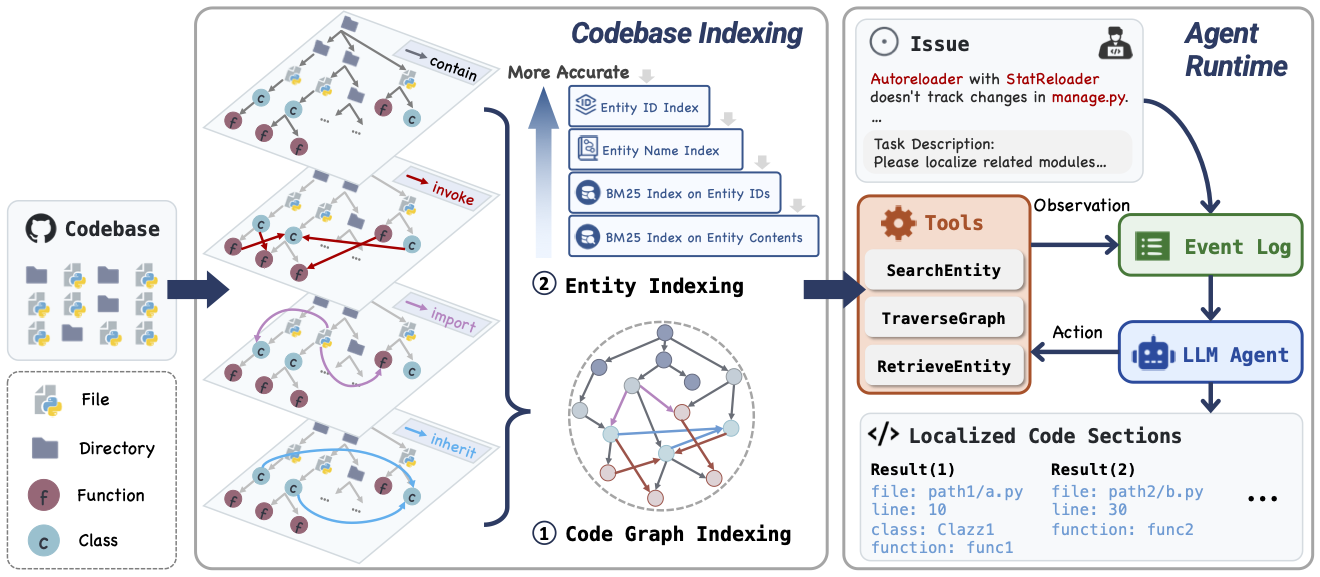
We introduce LocAgent, a framework that addresses code localization through graph-based representation. By parsing codebases into directed heterogeneous graphs, LocAgent creates a lightweight representation that captures code structures and their dependencies, enabling LLM agents to effectively search and locate relevant entities through powerful multi-hop reasoning.
⚙️ Setup
- Follow these steps to set up your development environment:
git clone git@github.com:gersteinlab/LocAgent.git
cd LocAgent

conda create -n locagent python=3.12
conda activate locagent
pip install -r requirements.txt
🚀 Launch LocAgent
-
(Optional but recommended) Parse the codebase for each issue in the benchmark to generate graph indexes in batch.
python dependency_graph/batch_build_graph.py \ --dataset 'czlll/Loc-Bench_V1' \ --split 'test' \ --num_processes 50 \ --download_repodataset: select the benchmark (by default it will beSWE-Bench_Lite); you can choose from['czlll/SWE-bench_Lite', 'czlll/Loc-Bench_V1'](adapted for code localization) and SWE-bench series datasets like['princeton-nlp/SWE-bench_Lite', 'princeton-nlp/SWE-bench_Verified', 'princeton-nlp/SWE-bench']repo_path: the directory where you plan to pull or have already pulled the codebaseindex_dir: the base directory where the generated graph index will be saveddownload_repo: whether to download the codebase torepo_pathbefore indexing
-
Export the directory of the graph indexes and the BM25 sparse index. If not generated in advance, the graph index will be generated during the localization process.
export GRAPH_INDEX_DIR='{INDEX_DIR}/{DATASET_NAME}/graph_index_v2.3' export BM25_INDEX_DIR='{INDEX_DIR}/{DATASET_NAME}/BM25_index' -
Run the script
scripts/run_lite.shto lauch LocAgent.python auto_search_main.py \ --dataset 'czlll/SWE-bench_Lite' \ --split 'test' \ --model 'azure/gpt-4o' \ --localize \ --merge \ --output_folder $result_path/location \ --eval_n_limit 300 \ --num_processes 50 \ --use_function_calling \ --simple_desclocalize: set to start the localization processmerge: merge the result of multiple samplesuse_function_calling: enable function calling features of LLMs. If disabled, codeact will be used to support function callingsimple_desc: use simplified function descriptions due to certain LLM limitations. Set to False for better performance when using Claude.
-
Evaluation After localization, the results will be saved in a JSONL file. You can evaluate them using
evaluation.eval_metric.evaluate_results. Refer toevaluation/run_evaluation.ipynbfor a demonstration.
📑 Cite Us
@inproceedings{chen-etal-2025-locagent,
 title = "{L}oc{A}gent: Graph-Guided {LLM} Agents for Code Localization",
 author = "Chen, Zhaoling  and
   Tang, Robert  and
   Deng, Gangda  and
   Wu, Fang  and
   Wu, Jialong  and
   Jiang, Zhiwei  and
   Prasanna, Viktor  and
   Cohan, Arman  and
   Wang, Xingyao",
 editor = "Che, Wanxiang  and
   Nabende, Joyce  and
   Shutova, Ekaterina  and
   Pilehvar, Mohammad Taher",
 booktitle = "Proceedings of the 63rd Annual Meeting of the Association for Computational Linguistics (Volume 1: Long Papers)",
 month = jul,
 year = "2025",
 address = "Vienna, Austria",
 publisher = "Association for Computational Linguistics",
 url = "https://aclanthology.org/2025.acl-long.426/",
 doi = "10.18653/v1/2025.acl-long.426",
 pages = "8697--8727",
 ISBN = "979-8-89176-251-0",
 abstract = "Code localization{--}identifying precisely where in a codebase changes need to be made{--}is a fundamental yet challenging task in software maintenance. Existing approaches struggle to efficiently navigate complex codebases when identifying relevant code snippets.The challenge lies in bridging natural language problem descriptions with the target code elements, often requiring reasoning across hierarchical structures and multiple dependencies.We introduce LocAgent, a framework that addresses code localization through a graph-guided agent.By parsing codebases into directed heterogeneous graphs, LocAgent creates a lightweight representation that captures code structures and their dependencies, enabling LLM agents to effectively search and locate relevant entities through powerful multi-hop reasoning.Experimental results on real-world benchmarks demonstrate that our approach significantly enhances accuracy in code localization.Notably, our method with the fine-tuned Qwen-2.5-Coder-Instruct-32B model achieves comparable results to SOTA proprietary models at greatly reduced cost (approximately 86{\%} reduction), reaching up to 92.7{\%} accuracy on file-level localization while improving downstream GitHub issue resolution success rates by 12{\%} for multiple attempts (Pass@10). Our code is available at \url{https://github.com/gersteinlab/LocAgent}."
}
Contributors


Similar repos


Languages
Python
95.1%
Jinja
3.1%
[ACL 2025] Graph-guided agentic framework for code localization https://arxiv.org/abs/2503.09089
Python
629
12 commits
updated Aug 12, 2026
README
LocAgent: Graph-Guided LLM Agents for Code Localization
📑 Paper | 📊 Loc-bench | 🤗 Qwen2.5-Coder-7B-CL | 🤗 Qwen2.5-Coder-32B-CL
[!NOTE] CodeNib serves LocAgent's search and graph-navigation tools from reusable, manifest-backed symbol-graph and BM25 indexes, without building a separate LocAgent index. The CodeNib integration starts from a prepared
repo_manifest.jsonand runs LocAgent's localization policy over these indexes; model training and the original reproduction pipeline remain in this repository.
ℹ️ Overview
We introduce LocAgent, a framework that addresses code localization through graph-based representation. By parsing codebases into directed heterogeneous graphs, LocAgent creates a lightweight representation that captures code structures and their dependencies, enabling LLM agents to effectively search and locate relevant entities through powerful multi-hop reasoning.
⚙️ Setup
- Follow these steps to set up your development environment:
git clone git@github.com:gersteinlab/LocAgent.git
cd LocAgent

conda create -n locagent python=3.12
conda activate locagent
pip install -r requirements.txt
🚀 Launch LocAgent
-
(Optional but recommended) Parse the codebase for each issue in the benchmark to generate graph indexes in batch.
python dependency_graph/batch_build_graph.py \ --dataset 'czlll/Loc-Bench_V1' \ --split 'test' \ --num_processes 50 \ --download_repodataset: select the benchmark (by default it will beSWE-Bench_Lite); you can choose from['czlll/SWE-bench_Lite', 'czlll/Loc-Bench_V1'](adapted for code localization) and SWE-bench series datasets like['princeton-nlp/SWE-bench_Lite', 'princeton-nlp/SWE-bench_Verified', 'princeton-nlp/SWE-bench']repo_path: the directory where you plan to pull or have already pulled the codebaseindex_dir: the base directory where the generated graph index will be saveddownload_repo: whether to download the codebase torepo_pathbefore indexing
-
Export the directory of the graph indexes and the BM25 sparse index. If not generated in advance, the graph index will be generated during the localization process.
export GRAPH_INDEX_DIR='{INDEX_DIR}/{DATASET_NAME}/graph_index_v2.3' export BM25_INDEX_DIR='{INDEX_DIR}/{DATASET_NAME}/BM25_index' -
Run the script
scripts/run_lite.shto lauch LocAgent.python auto_search_main.py \ --dataset 'czlll/SWE-bench_Lite' \ --split 'test' \ --model 'azure/gpt-4o' \ --localize \ --merge \ --output_folder $result_path/location \ --eval_n_limit 300 \ --num_processes 50 \ --use_function_calling \ --simple_desclocalize: set to start the localization processmerge: merge the result of multiple samplesuse_function_calling: enable function calling features of LLMs. If disabled, codeact will be used to support function callingsimple_desc: use simplified function descriptions due to certain LLM limitations. Set to False for better performance when using Claude.
-
Evaluation After localization, the results will be saved in a JSONL file. You can evaluate them using
evaluation.eval_metric.evaluate_results. Refer toevaluation/run_evaluation.ipynbfor a demonstration.
📑 Cite Us
@inproceedings{chen-etal-2025-locagent,
 title = "{L}oc{A}gent: Graph-Guided {LLM} Agents for Code Localization",
 author = "Chen, Zhaoling  and
   Tang, Robert  and
   Deng, Gangda  and
   Wu, Fang  and
   Wu, Jialong  and
   Jiang, Zhiwei  and
   Prasanna, Viktor  and
   Cohan, Arman  and
   Wang, Xingyao",
 editor = "Che, Wanxiang  and
   Nabende, Joyce  and
   Shutova, Ekaterina  and
   Pilehvar, Mohammad Taher",
 booktitle = "Proceedings of the 63rd Annual Meeting of the Association for Computational Linguistics (Volume 1: Long Papers)",
 month = jul,
 year = "2025",
 address = "Vienna, Austria",
 publisher = "Association for Computational Linguistics",
 url = "https://aclanthology.org/2025.acl-long.426/",
 doi = "10.18653/v1/2025.acl-long.426",
 pages = "8697--8727",
 ISBN = "979-8-89176-251-0",
 abstract = "Code localization{--}identifying precisely where in a codebase changes need to be made{--}is a fundamental yet challenging task in software maintenance. Existing approaches struggle to efficiently navigate complex codebases when identifying relevant code snippets.The challenge lies in bridging natural language problem descriptions with the target code elements, often requiring reasoning across hierarchical structures and multiple dependencies.We introduce LocAgent, a framework that addresses code localization through a graph-guided agent.By parsing codebases into directed heterogeneous graphs, LocAgent creates a lightweight representation that captures code structures and their dependencies, enabling LLM agents to effectively search and locate relevant entities through powerful multi-hop reasoning.Experimental results on real-world benchmarks demonstrate that our approach significantly enhances accuracy in code localization.Notably, our method with the fine-tuned Qwen-2.5-Coder-Instruct-32B model achieves comparable results to SOTA proprietary models at greatly reduced cost (approximately 86{\%} reduction), reaching up to 92.7{\%} accuracy on file-level localization while improving downstream GitHub issue resolution success rates by 12{\%} for multiple attempts (Pass@10). Our code is available at \url{https://github.com/gersteinlab/LocAgent}."
}
Similar repos
Contributors
Languages
Python
95.1%
Jinja
3.1%