
Elmish type-safe state and side effect manager using RxJS
JavaScript
86
71 commits
updated May 20, 2016
README
Table of Contents
- Setup
- Features
- Workflow
- Flow
- Example
- Writing tests
- Reducing the boilerplate and adding type safety
- Implementing sagas
- Router
- Recipes
- More examples
Setup
npm install tom --save
Features
- Elmish architecture
- Handles side effects in a declarative way
- Models, events and effects may be (static or runtime) type-checked
- Events are not required to be plain objects nor require a type field
Workflow
App configuration
A tom app is defined by a config object owning the following keys:
init. a function returning the initial state (a state is an object with a required key model and an optional key effect).
update. a update(model, event) pure function, returns the new state.
view. a view(model, dispatch) pure function, returns the ui declaration.
run (optional). a run(effect, event$) function, returns an optional stream of events.
Wire them all
Call the start(config) API.
Flow
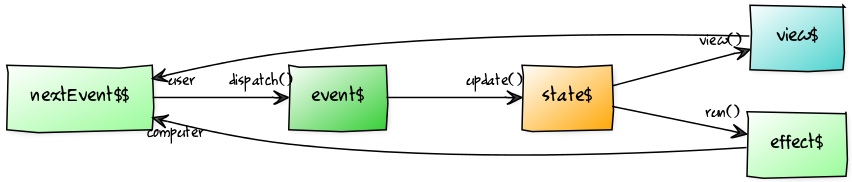
Typings
(Flow syntax)
type IState<Model, Effect> = {
  model: Model;
  effect?: Effect;
};

type Dispatch<Event> = (event: Event) => void;

type IConfig<Model, Effect, Event, View> = {
  init: () => IState<Model, Effect>;
  update: (model: Model, event: Event) => IState<Model, Effect>;
  view: (model: Model, dispatch: Dispatch<Event>) => View;
  run?: (effect: Effect, event$: Observable<Event>) => ?Observable<Event>;
};

type IApp<Event, View> = {
  dispatch: Dispatch<Event>;
  event$: Subject<Event>,
  state$: Observable<IState>,
  model$: Observable<Model>,
  view$: Observable<View>,
  effect$: Observable<Effect>,
  nextEvent$$: Observable<Observable<Event>>,
  nextEvent$: Observable<Event>
};

start<Model, Effect, Event, View>(config: IConfig<Model, Effect, Event, View>): IApp<Event, View>
Example
A delayed counter. When the buttons are pressed the counter is updated after 1 sec.
import React from 'react'
import ReactDOM from 'react-dom'
import { start, Rx } from 'tom'

const config = {

  init() {
    return { model: 0 }
  },

  update(model, event) {
    switch (event) {
      case 'INCREMENTED' :
        return { model: model + 1 }
      case 'DECREMENTED' :
        return { model: model - 1 }
      case 'INCREMENT_REQUESTED' :
        return { model, effect: 'SCHEDULE_INCREMENT' } // here side effects are just declared
      case 'DECREMENT_REQUESTED' :
        return { model, effect: 'SCHEDULE_DECREMENT' }
      default :
        return { model }
    }
  },

  view(model, dispatch) {
    const increment = () => dispatch('INCREMENT_REQUESTED')
    const decrement = () => dispatch('DECREMENT_REQUESTED')
    return (
      <div>
        <p>Counter: {model}</p>
        <button onClick={increment}>+1</button>
        <button onClick={decrement}>-1</button>
      </div>
    )
  },

  // runs the side effects
  run(effect) {
    switch (effect) {
      case 'SCHEDULE_INCREMENT' :
         // effects may return an observable of events which will feed the system
        return Rx.Observable.just('INCREMENTED').delay(1000)
      case 'SCHEDULE_DECREMENT' :
        return Rx.Observable.just('DECREMENTED').delay(1000)
    }
  }

}

// start app
const { view$ } = start(config)
// render
view$.subscribe(view => ReactDOM.render(view, document.getElementById('app')))
Writing tests
You can easily test every part of you app:
import test from 'tape'
import counter from './delayed-counter'

// testing events

test('INCREMENT event', assert => {
  assert.plan(1)
  const state = counter.update(0, 'INCREMENT')
  assert.equal(state.model, 1, 'should increment the model')
})

test('INCREMENT_REQUEST event', assert => {
  assert.plan(2)
  const state = counter.update(0, 'INCREMENT_REQUESTED')
  assert.equal(state.model, 0, 'should not increment the model')
  assert.equal(state.effect, 'SCHEDULE_INCREMENT', 'should return the correct effect')
})

// testing effects

test('DELAYED_INCREMENT effect', { timeout: 2000 }, assert => {
  assert.plan(2)
  const nextEvent$ = counter.run('SCHEDULE_INCREMENT')
  assert.ok(nextEvent$)
  nextEvent$.subscribe(event => {
    assert.equal(event, 'INCREMENTED', 'should return an INCREMENTED event')
  })
})
Reducing the boilerplate and adding type safety
When your app grows you will face several issues:
update,viewandrunwill become giant functions- using
switchs inupdateandrunviolates the open close principle - events and effects are not typed ("string programming"). The usual solution is to define constants and action creators (even more boilerplate)
- state is not type safe:
modelis actually an integer and this invariant should be enforced
To address the first 2 issues let's replace the strings with constructors and get rid of switchs leveraging a kind of dynamic dispatch:
// events
class IncrementRequested {
  update(model) {
    return { model, effect: new ScheduleIncrement() }
  }
}
class Increment {
  update(model) {
    return { model: model + 1 }
  }
}
class DecrementRequested {
  update(model) {
    return { model, effect: new ScheduleDecrement() }
  }
}
class Decrement {
  update(model) {
    return { model: model - 1 }
  }
}

// effects
class ScheduleIncrement {
  run() {
    return Rx.Observable.just(new Increment()).delay(1000)
  }
}
class ScheduleDecrement {
  run() {
    return Rx.Observable.just(new Decrement()).delay(1000)
  }
}

const framework = {

  update(model, event) {
    return event.update(model)
  },

  run(effect) {
    return effect.run()
  }

}

const config = {

  init() {
    return { model: 0 }
  },

  view(model, dispatch) {
    const increment = () => dispatch(new IncrementRequested())
    const decrement = () => dispatch(new DecrementRequested())
    return (
      <div>
        <p>Counter: {model}</p>
        <button onClick={increment}>+1</button>
        <button onClick={decrement}>-1</button>
      </div>
    )
  }

}

Object.assign(config, framework)
The update and run functions can now be reutilized across your apps.
Adding type safety
Here I'll use tcomb to add runtime type checking to a simple counter (alternatively you can use other tools like TypeScript or Flow, see the "More examples" section below):
import React from 'react'
import { Rx } from 'tom'
import t from 'tcomb'

// events
const Increment = t.struct({}, 'Increment')
Increment.prototype.update = function(model) {
  return { model: model + 1 }
}

const Decrement = t.struct({}, 'Decrement')
Decrement.prototype.update = function(model) {
  return { model: model - 0.5 } // this will throw "[tcomb] Invalid value -0.5 supplied to State/model: Integer"
}

const Event = t.union([Increment, Decrement], 'Event')

// state
const Integer = t.refinement(t.Number, n => n % 1 === 0, 'Integer')
const State = t.struct({
  model: Integer,
  effect: t.Nil // no effects allowed
}, 'State')

const config = {

  init() {
    return State({ model: 0 })
  },

  update(model, event) {
    // type checking
    return State(Event(event).update(model))
  },

  view(model, dispatch) {
    const increment = () => dispatch(Increment({}))
    const decrement = () => dispatch(Decrement({}))
    return (
      <div>
        <p>Counter: {model}</p>
        <button onClick={increment}>+1</button>
        <button onClick={decrement}>-1</button>
      </div>
    )
  }

}
Implementing sagas
(Example stolen from https://github.com/salsita/redux-saga-rxjs)
Let's imagine you want to withdraw money from ATM, the first thing you need to do is enter your credit card and then enter the PIN. So the sequence of transitions could be as follows:
WAITING_FOR_CREDIT_CARD->CARD_INSERTED->AUTHORIZEDorREJECTEDbut we would like to allow user enter invalid PIN 3 times before rejecting
const VALID_PIN = '123'
const PIN_VALIDATED = { type: 'PIN_VALIDATED' }
const INVALID_PIN = { type: 'INVALID_PIN' }
const PIN_REJECTED = { type: 'PIN_REJECTED' }

class ATM extends React.Component {
  onEnter = () => {
    this.props.onEnter(this.refs.pin.value)
  }
  render() {
    const { model } = this.props
    const canIEnterPin = !model.authFailure && !model.authorized
    return (
      <div>
        {canIEnterPin &&
          <div>
            <input ref="pin" />
            <button disabled={model.isValidating} onClick={this.onEnter}>pin</button>
          </div>
        }
        <p>{model.error && 'Invalid pin'}</p>
        <p>{model.authorized && 'Authorized :)'}</p>
        <p>{model.authFailure && 'Unauthorized :('}</p>
      </div>
    )
  }
}

export default {

  init() {
    return {
      model: {}
    }
  },

  update(model, event) {
    switch (event.type) {
    case 'PIN_ENTERED' :
      return {
        model: { isValidating: true },
        effect: { type: 'VALIDATE_PIN', pin: event.pin }
      }
    case PIN_VALIDATED.type :
      return {
        model: { authorized: true }
      }
    case INVALID_PIN.type :
      return {
        model: { error: true }
      }
    case PIN_REJECTED.type :
      return {
        model: { authFailure: true }
      }
    default :
      return { model }
    }
  },

  view(model, dispatch) {
    const onEnter = pin => dispatch({ type: 'PIN_ENTERED', pin })
    return <ATM model={model} onEnter={onEnter} />
  },

  run(effect, event$) {
    switch (effect.type) {
    case 'VALIDATE_PIN' :

      const nextEvent$ = Rx.Observable
        .just(effect.pin === VALID_PIN ? PIN_VALIDATED : INVALID_PIN)
        .delay(500) // fake validation delay

      const rejectPin$ = event$
        .concat(nextEvent$)
        .filter(e => e.type === INVALID_PIN.type)
        .bufferWithCount(3)
        .map(() => PIN_REJECTED)
        .take(1)

      return nextEvent$.merge(rejectPin$)
    }
  }

}
Router
This library comes with a basic router that plays well with view streams.
Typings
type History = ...created with the history package...;

type Location = {
  pathname: string,
  query: Object
}

type Request<Context> = {
  context?: Context,
  history: History,
  params: Object,
  path: string,
  pathname: string,
  query: Object
};

type Handler<Context, View> = (request: Request<Context>) => View;

type Route<Context, View> = {
  path: string,
  handler: Handler<Context, View>
};

interface Router<Context, View> {
  new(routes: Array<Route<Context, View>>, history: History);
  addRoute(path: string, handler: Handler<Context, View>);
  match(location: Location, context?: Context) => View;
}
Example
import { useQueries } from 'history'
import createHistory from 'history/lib/createHashHistory'
import Router from 'tom/lib/Router'

const history = useQueries(createHistory)(/*{ queryKey: false }*/)

const router = new Router(createLocationMatcher([
  { path: '/', handler: ({ history: h }) => h.replace('/user?a=1') },
  { path: '/user', handler: ({ params, query }) => <Component1 params={params} query={query} /> },
  { path: '/orders/:orderId', handler: ({ params, query }) => <Component2 params={params} query={query} /> }
], history))
Recipes
Given a state how to get the corresponding view stream
import config from './myapp'
const { view$ } = start({
  init() { return state },
  update: config.update,
  view: config.view,
  run: config.run
})
How to know when a stable equilibrium is reached
import config from './myapp'
const { nextEvent$$ } = start(config)
let pending = []
app.nextEvent$$.subscribe(x => {
  pending.push(x)
  x.subscribe(() => {}, null, () => {
    pending = pending.filter(o => o !== x)
    if (pending.length === 0) {
      console.log('the app is stable')
    }
  })
})
Monitoring
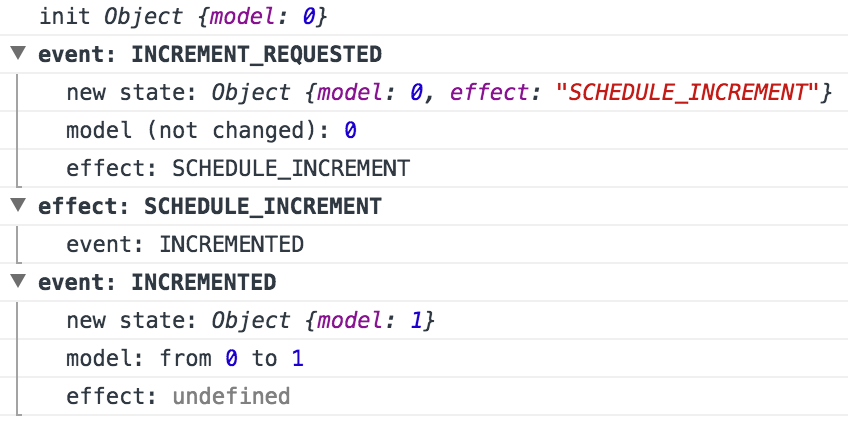
Monitoring an app is easy, just wrap the app with an helper function:
function logEvent(model, event, state) {
  console.groupCollapsed(`event:`, event)
  console.log('new state:', state)
  if (model !== state.model) {
    console.log('model: from', model, 'to', state.model)
  } else {
    console.log('model (not changed):', model)
  }
  console.log('effect:', state.effect)
  console.groupEnd()
}

function logEffect(effect, nextEvent$) {
  if (nextEvent$) {
    // group produced events
    console.groupCollapsed(`effect:`, effect)
    nextEvent$.subscribe(
      event => console.log('event:', event),
      error => console.error('error:', error),
      () => console.groupEnd()
    )
  } else {
    console.log(`effect:`, effect)
  }
}

export default function monitor(config) {
  return {
    init() {
      const init = config.init()
      console.log('init', init)
      return init
    },
    update(model, event) {
      const state = config.update(model, event)
      logEvent(model, event, state)
      return state
    },
    view: config.view,
    run(effect, event$) {
      const nextEvent$ = config.run(effect, event$)
      logEffect(effect, nextEvent$)
      return nextEvent$
    }
  }
}
More examples
- A simple counter
- How to handle effects (delayed counter)
- How to reduce the boilerplate (dynamic dispatching)
- How to cancel effects (cancelable delayed counter)
- Perpetual effects (clock)
- Http requests
- Routing
- Saga pattern (Withdraw saga)
- How to handle optmistic updates (optmistic counter)
- How to test events and effects
Type safety
Apps as groupoid
Apps as react components
License
The MIT License (MIT)
Contributors

71 commits
Similar repos


Languages
JavaScript
100.0%
Elmish type-safe state and side effect manager using RxJS
JavaScript
86
71 commits
updated May 20, 2016
README
Table of Contents
- Setup
- Features
- Workflow
- Flow
- Example
- Writing tests
- Reducing the boilerplate and adding type safety
- Implementing sagas
- Router
- Recipes
- More examples
Setup
npm install tom --save
Features
- Elmish architecture
- Handles side effects in a declarative way
- Models, events and effects may be (static or runtime) type-checked
- Events are not required to be plain objects nor require a type field
Workflow
App configuration
A tom app is defined by a config object owning the following keys:
init. a function returning the initial state (a state is an object with a required key model and an optional key effect).
update. a update(model, event) pure function, returns the new state.
view. a view(model, dispatch) pure function, returns the ui declaration.
run (optional). a run(effect, event$) function, returns an optional stream of events.
Wire them all
Call the start(config) API.
Flow
Typings
(Flow syntax)
type IState<Model, Effect> = {
  model: Model;
  effect?: Effect;
};

type Dispatch<Event> = (event: Event) => void;

type IConfig<Model, Effect, Event, View> = {
  init: () => IState<Model, Effect>;
  update: (model: Model, event: Event) => IState<Model, Effect>;
  view: (model: Model, dispatch: Dispatch<Event>) => View;
  run?: (effect: Effect, event$: Observable<Event>) => ?Observable<Event>;
};

type IApp<Event, View> = {
  dispatch: Dispatch<Event>;
  event$: Subject<Event>,
  state$: Observable<IState>,
  model$: Observable<Model>,
  view$: Observable<View>,
  effect$: Observable<Effect>,
  nextEvent$$: Observable<Observable<Event>>,
  nextEvent$: Observable<Event>
};

start<Model, Effect, Event, View>(config: IConfig<Model, Effect, Event, View>): IApp<Event, View>
Example
A delayed counter. When the buttons are pressed the counter is updated after 1 sec.
import React from 'react'
import ReactDOM from 'react-dom'
import { start, Rx } from 'tom'

const config = {

  init() {
    return { model: 0 }
  },

  update(model, event) {
    switch (event) {
      case 'INCREMENTED' :
        return { model: model + 1 }
      case 'DECREMENTED' :
        return { model: model - 1 }
      case 'INCREMENT_REQUESTED' :
        return { model, effect: 'SCHEDULE_INCREMENT' } // here side effects are just declared
      case 'DECREMENT_REQUESTED' :
        return { model, effect: 'SCHEDULE_DECREMENT' }
      default :
        return { model }
    }
  },

  view(model, dispatch) {
    const increment = () => dispatch('INCREMENT_REQUESTED')
    const decrement = () => dispatch('DECREMENT_REQUESTED')
    return (
      <div>
        <p>Counter: {model}</p>
        <button onClick={increment}>+1</button>
        <button onClick={decrement}>-1</button>
      </div>
    )
  },

  // runs the side effects
  run(effect) {
    switch (effect) {
      case 'SCHEDULE_INCREMENT' :
         // effects may return an observable of events which will feed the system
        return Rx.Observable.just('INCREMENTED').delay(1000)
      case 'SCHEDULE_DECREMENT' :
        return Rx.Observable.just('DECREMENTED').delay(1000)
    }
  }

}

// start app
const { view$ } = start(config)
// render
view$.subscribe(view => ReactDOM.render(view, document.getElementById('app')))
Writing tests
You can easily test every part of you app:
import test from 'tape'
import counter from './delayed-counter'

// testing events

test('INCREMENT event', assert => {
  assert.plan(1)
  const state = counter.update(0, 'INCREMENT')
  assert.equal(state.model, 1, 'should increment the model')
})

test('INCREMENT_REQUEST event', assert => {
  assert.plan(2)
  const state = counter.update(0, 'INCREMENT_REQUESTED')
  assert.equal(state.model, 0, 'should not increment the model')
  assert.equal(state.effect, 'SCHEDULE_INCREMENT', 'should return the correct effect')
})

// testing effects

test('DELAYED_INCREMENT effect', { timeout: 2000 }, assert => {
  assert.plan(2)
  const nextEvent$ = counter.run('SCHEDULE_INCREMENT')
  assert.ok(nextEvent$)
  nextEvent$.subscribe(event => {
    assert.equal(event, 'INCREMENTED', 'should return an INCREMENTED event')
  })
})
Reducing the boilerplate and adding type safety
When your app grows you will face several issues:
update,viewandrunwill become giant functions- using
switchs inupdateandrunviolates the open close principle - events and effects are not typed ("string programming"). The usual solution is to define constants and action creators (even more boilerplate)
- state is not type safe:
modelis actually an integer and this invariant should be enforced
To address the first 2 issues let's replace the strings with constructors and get rid of switchs leveraging a kind of dynamic dispatch:
// events
class IncrementRequested {
  update(model) {
    return { model, effect: new ScheduleIncrement() }
  }
}
class Increment {
  update(model) {
    return { model: model + 1 }
  }
}
class DecrementRequested {
  update(model) {
    return { model, effect: new ScheduleDecrement() }
  }
}
class Decrement {
  update(model) {
    return { model: model - 1 }
  }
}

// effects
class ScheduleIncrement {
  run() {
    return Rx.Observable.just(new Increment()).delay(1000)
  }
}
class ScheduleDecrement {
  run() {
    return Rx.Observable.just(new Decrement()).delay(1000)
  }
}

const framework = {

  update(model, event) {
    return event.update(model)
  },

  run(effect) {
    return effect.run()
  }

}

const config = {

  init() {
    return { model: 0 }
  },

  view(model, dispatch) {
    const increment = () => dispatch(new IncrementRequested())
    const decrement = () => dispatch(new DecrementRequested())
    return (
      <div>
        <p>Counter: {model}</p>
        <button onClick={increment}>+1</button>
        <button onClick={decrement}>-1</button>
      </div>
    )
  }

}

Object.assign(config, framework)
The update and run functions can now be reutilized across your apps.
Adding type safety
Here I'll use tcomb to add runtime type checking to a simple counter (alternatively you can use other tools like TypeScript or Flow, see the "More examples" section below):
import React from 'react'
import { Rx } from 'tom'
import t from 'tcomb'

// events
const Increment = t.struct({}, 'Increment')
Increment.prototype.update = function(model) {
  return { model: model + 1 }
}

const Decrement = t.struct({}, 'Decrement')
Decrement.prototype.update = function(model) {
  return { model: model - 0.5 } // this will throw "[tcomb] Invalid value -0.5 supplied to State/model: Integer"
}

const Event = t.union([Increment, Decrement], 'Event')

// state
const Integer = t.refinement(t.Number, n => n % 1 === 0, 'Integer')
const State = t.struct({
  model: Integer,
  effect: t.Nil // no effects allowed
}, 'State')

const config = {

  init() {
    return State({ model: 0 })
  },

  update(model, event) {
    // type checking
    return State(Event(event).update(model))
  },

  view(model, dispatch) {
    const increment = () => dispatch(Increment({}))
    const decrement = () => dispatch(Decrement({}))
    return (
      <div>
        <p>Counter: {model}</p>
        <button onClick={increment}>+1</button>
        <button onClick={decrement}>-1</button>
      </div>
    )
  }

}
Implementing sagas
(Example stolen from https://github.com/salsita/redux-saga-rxjs)
Let's imagine you want to withdraw money from ATM, the first thing you need to do is enter your credit card and then enter the PIN. So the sequence of transitions could be as follows:
WAITING_FOR_CREDIT_CARD->CARD_INSERTED->AUTHORIZEDorREJECTEDbut we would like to allow user enter invalid PIN 3 times before rejecting
const VALID_PIN = '123'
const PIN_VALIDATED = { type: 'PIN_VALIDATED' }
const INVALID_PIN = { type: 'INVALID_PIN' }
const PIN_REJECTED = { type: 'PIN_REJECTED' }

class ATM extends React.Component {
  onEnter = () => {
    this.props.onEnter(this.refs.pin.value)
  }
  render() {
    const { model } = this.props
    const canIEnterPin = !model.authFailure && !model.authorized
    return (
      <div>
        {canIEnterPin &&
          <div>
            <input ref="pin" />
            <button disabled={model.isValidating} onClick={this.onEnter}>pin</button>
          </div>
        }
        <p>{model.error && 'Invalid pin'}</p>
        <p>{model.authorized && 'Authorized :)'}</p>
        <p>{model.authFailure && 'Unauthorized :('}</p>
      </div>
    )
  }
}

export default {

  init() {
    return {
      model: {}
    }
  },

  update(model, event) {
    switch (event.type) {
    case 'PIN_ENTERED' :
      return {
        model: { isValidating: true },
        effect: { type: 'VALIDATE_PIN', pin: event.pin }
      }
    case PIN_VALIDATED.type :
      return {
        model: { authorized: true }
      }
    case INVALID_PIN.type :
      return {
        model: { error: true }
      }
    case PIN_REJECTED.type :
      return {
        model: { authFailure: true }
      }
    default :
      return { model }
    }
  },

  view(model, dispatch) {
    const onEnter = pin => dispatch({ type: 'PIN_ENTERED', pin })
    return <ATM model={model} onEnter={onEnter} />
  },

  run(effect, event$) {
    switch (effect.type) {
    case 'VALIDATE_PIN' :

      const nextEvent$ = Rx.Observable
        .just(effect.pin === VALID_PIN ? PIN_VALIDATED : INVALID_PIN)
        .delay(500) // fake validation delay

      const rejectPin$ = event$
        .concat(nextEvent$)
        .filter(e => e.type === INVALID_PIN.type)
        .bufferWithCount(3)
        .map(() => PIN_REJECTED)
        .take(1)

      return nextEvent$.merge(rejectPin$)
    }
  }

}
Router
This library comes with a basic router that plays well with view streams.
Typings
type History = ...created with the history package...;

type Location = {
  pathname: string,
  query: Object
}

type Request<Context> = {
  context?: Context,
  history: History,
  params: Object,
  path: string,
  pathname: string,
  query: Object
};

type Handler<Context, View> = (request: Request<Context>) => View;

type Route<Context, View> = {
  path: string,
  handler: Handler<Context, View>
};

interface Router<Context, View> {
  new(routes: Array<Route<Context, View>>, history: History);
  addRoute(path: string, handler: Handler<Context, View>);
  match(location: Location, context?: Context) => View;
}
Example
import { useQueries } from 'history'
import createHistory from 'history/lib/createHashHistory'
import Router from 'tom/lib/Router'

const history = useQueries(createHistory)(/*{ queryKey: false }*/)

const router = new Router(createLocationMatcher([
  { path: '/', handler: ({ history: h }) => h.replace('/user?a=1') },
  { path: '/user', handler: ({ params, query }) => <Component1 params={params} query={query} /> },
  { path: '/orders/:orderId', handler: ({ params, query }) => <Component2 params={params} query={query} /> }
], history))
Recipes
Given a state how to get the corresponding view stream
import config from './myapp'
const { view$ } = start({
  init() { return state },
  update: config.update,
  view: config.view,
  run: config.run
})
How to know when a stable equilibrium is reached
import config from './myapp'
const { nextEvent$$ } = start(config)
let pending = []
app.nextEvent$$.subscribe(x => {
  pending.push(x)
  x.subscribe(() => {}, null, () => {
    pending = pending.filter(o => o !== x)
    if (pending.length === 0) {
      console.log('the app is stable')
    }
  })
})
Monitoring
Monitoring an app is easy, just wrap the app with an helper function:
function logEvent(model, event, state) {
  console.groupCollapsed(`event:`, event)
  console.log('new state:', state)
  if (model !== state.model) {
    console.log('model: from', model, 'to', state.model)
  } else {
    console.log('model (not changed):', model)
  }
  console.log('effect:', state.effect)
  console.groupEnd()
}

function logEffect(effect, nextEvent$) {
  if (nextEvent$) {
    // group produced events
    console.groupCollapsed(`effect:`, effect)
    nextEvent$.subscribe(
      event => console.log('event:', event),
      error => console.error('error:', error),
      () => console.groupEnd()
    )
  } else {
    console.log(`effect:`, effect)
  }
}

export default function monitor(config) {
  return {
    init() {
      const init = config.init()
      console.log('init', init)
      return init
    },
    update(model, event) {
      const state = config.update(model, event)
      logEvent(model, event, state)
      return state
    },
    view: config.view,
    run(effect, event$) {
      const nextEvent$ = config.run(effect, event$)
      logEffect(effect, nextEvent$)
      return nextEvent$
    }
  }
}
More examples
- A simple counter
- How to handle effects (delayed counter)
- How to reduce the boilerplate (dynamic dispatching)
- How to cancel effects (cancelable delayed counter)
- Perpetual effects (clock)
- Http requests
- Routing
- Saga pattern (Withdraw saga)
- How to handle optmistic updates (optmistic counter)
- How to test events and effects
Type safety
Apps as groupoid
Apps as react components
License
The MIT License (MIT)
Similar repos
Contributors
71 commits
Languages
JavaScript
100.0%