Fine-tuning Qwen3-4B for text-to-SQL on Apple Silicon, benchmarked against the base model by execution accuracy against real databases
Python
0
22 commits
updated Sep 15, 2026
A 4-billion-parameter Qwen3 model fine-tuned to turn an English question and a SQLite schema into a query that runs — trained on a laptop, measured against the base model by executing every query against a real database, and served behind a web demo.
| Demo | https://text2sql-qwen3.vercel.app |
| Model | https://huggingface.co/bharatverse11/qwen3-4b-text2sql |
| GGUF (CPU) | https://huggingface.co/bharatverse11/qwen3-4b-text2sql-gguf |
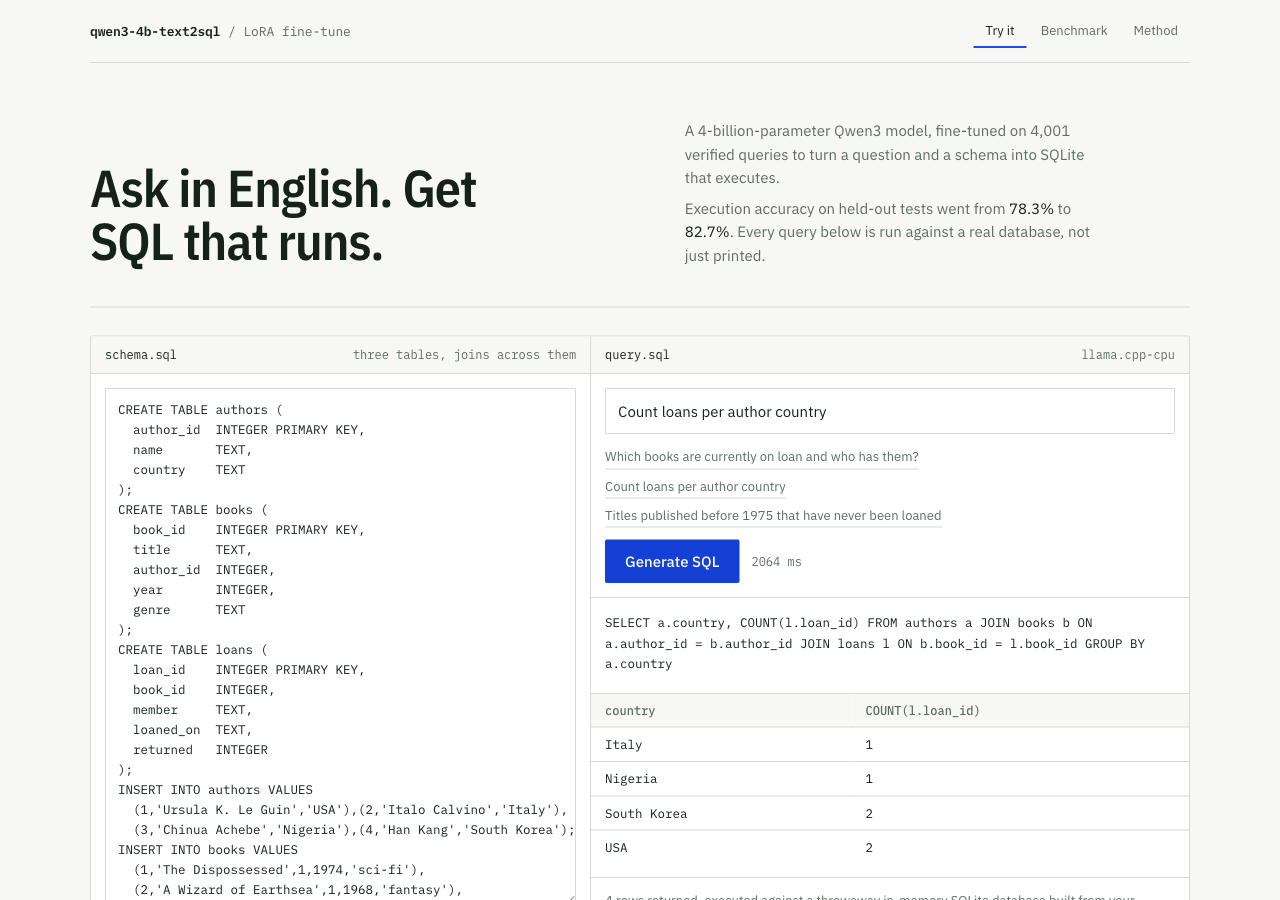
Held-out set of 300 examples the model never saw, greedy decoding, scored by execution accuracy: build the database from each example's own schema, run both the generated and the reference query, compare the result sets.
| metric | base Qwen3-4B | fine-tuned | change |
|---|---|---|---|
| execution accuracy | 78.3% | 84.0% | +5.7 |
| valid SQL rate | 97.7% | 98.3% | +0.7 |
| exact string match | 31.3% | 39.7% | +8.3 |
29 wins, 223 both right, 12 regressions, 36 both wrong.
The gains land where the base model was weak, and the dilution is visible: more than half the evaluation set is "basic SQL" the base already handled.
| query type | n | base | fine-tuned |
|---|---|---|---|
| window functions | 10 | 30.0% | 60.0% |
| single join | 38 | 63.2% | 79.0% |
| aggregation | 71 | 70.4% | 80.3% |
| basic SQL | 165 | 88.5% | 90.3% |
| subqueries | 13 | 69.2% | 61.5% |
Training cost 45 minutes on one Apple M5 Pro. No rented GPU.
Execution accuracy is the headline because string matching undercounts: a correct query written differently still counts here. Beyond that:

tests/frontend_e2e.py sends 18 questions across three schemas to the same API
the browser calls, executes the returned SQL, and compares against hand-written
reference queries.
executed without error : 18/18
matched the reference  : 16/18
needed a repair pass   : 0
latency                : 1.0-3.0s
Both misses are the metric rather than the model: asked which product sold the
most units it returned ('Widget', 416) where the reference is ('Widget',).
The answer is right; strict result-set comparison penalises the extra column.
By content it scored 18 of 18.
All 18 reference queries were themselves verified to execute and return rows, so a failure implicates the model and not the test.
Every run is scored on the same 300 held-out examples, so the numbers below are directly comparable. Significance is McNemar's exact test on the paired results.
| run | training data | execution accuracy | verdict |
|---|---|---|---|
| base | — | 78.3% | |
| 1 | 4,000, natural mix | 84.0% | published |
| 2 | 4,000, headroom-balanced | 82.7% | p = 0.454, indistinguishable |
| 3 | 5,400, + synthetic multi-level | 82.7% | p = 0.557, indistinguishable |
| 4 | 16,000, three sources, T4 | 82.7% | p = 0.454, indistinguishable |
Nothing beat run 1. Four attempts, three of them substantial changes in data size, mix and source, and every one landed inside the noise band. That is the honest headline, and it is worth more than a fifth attempt dressed up as a win.
More than half of run 1's data was "basic SQL" where the base already scored 88.5%, while window functions, with 70 points of headroom, got 3%. Rebalancing toward the hard classes did not help.
Run 3 added 1,400 synthetic multi-level examples and scored 100% on a held-out set drawn from the same generator. That number was wrong, not good: the generator emitted one query shape per kind with fixed column aliases, so the model memorised a template. On hand-written questions it scored 1 of 6.
100% exact-match is not a result real generalisation produces. The lesson is that a held-out split is not an independent benchmark when both sides come from the same generator.
The generator was rebuilt to randomise aliases (5 fixed → 35), phrasings (4 → 113), schema shapes and SQL formulations, with no two examples sharing an identical gold query. Evaluation moved to 18 hand-written questions across four schemas that the generator never produced. Trained on Kaggle: 16,000 examples from three sources on a T4.
| run 1 | run 4 | |
|---|---|---|
| general SQL | 84.0% | 82.7% (p = 0.454) |
| hand-written multi-level | 0 of 6 | 27.8%, 0 regressions |
Run 4 genuinely learned something run 1 could not do at all, and 27.8% is what partial transfer actually looks like. It was still not published, for the reason in the next section.
Run 4 is better at multi-level aggregation and statistically tied everywhere else, so publishing it would have been defensible. It was not published because the concrete query that motivated the work still fails:
WITH summed AS (
  SELECT f.country AS grp, f.category AS b, ...
  FROM orders f JOIN customers g ... JOIN products h ...
no such column: f.country
The structure is correct — two-stage CTE, share computed over the aggregate,
rank filtered in an outer select. What is wrong is schema grounding: it put
country on orders when the schema puts it on customers. That accounts for
5 of its 13 hand-written failures, and three repair attempts returned the
identical query.
The cause is in the generator, and it is measurable. Every three-table example it produces has the same layout: the fact table holds the quantity and the foreign keys, one dimension holds the group label, another holds the price. A model can infer where a column lives from that pattern without ever reading the schema. Real schemas scatter columns, so the skill never transferred.
Fixing it means generating schemas where column placement is genuinely unpredictable — the measure sometimes on the dimension, the label sometimes on the fact table, distractor columns with the same name on several tables, group keys that need a two-hop join. That is a generator change and another run, and it is the single most promising next step.
The model breaks when a question needs more than one level of aggregation. That is the sharpest boundary found so far, and it is worth stating precisely.
Given a three-table e-commerce schema and the question "for each country, find the top 2 product categories by completed-order revenue, with each category's revenue, unique customers, percentage of country revenue, and rank", it produces SQL that runs without error and is wrong three ways:
SELECT c.country, p.category,
       SUM(o.quantity * p.price) AS revenue,
       SUM(o.quantity * p.price) OVER (PARTITION BY c.country) AS country_revenue,
       SUM(...) OVER (PARTITION BY c.country) / SUM(...) OVER (PARTITION BY c.country) AS percentage,
       RANK() OVER (PARTITION BY c.country ORDER BY SUM(...) DESC) AS rank_within_country
FROM ... GROUP BY c.country, p.category
country_revenue windows over the rows before grouping, giving India 1900
where the real total is 2900.The correct shape is two-stage: aggregate in a CTE, then window over the
aggregate. Earlier versions of the same query class fail louder, with
misuse of window function SUM(), because SQLite rejects an aggregate wrapped
around a window function.
Three repair strategies were tried and all failed: feeding the problem back, sampling at two temperatures, and supplying a literal CTE skeleton to copy. The model returned the identical query every time. Narrow supervised fine-tuning made it strong at one-shot schema-to-SQL and largely deaf to corrective instructions.
So the serving layer detects rather than repairs this class.
lint_sql() in serving/app.py flags queries that run but answer a different
question — a rank computed and never filtered, a share windowed over
pre-aggregation rows, a stated row restriction with no WHERE — and the
frontend shows the warning instead of presenting wrong numbers as fact. The
rules were checked against correct queries (the proper CTE form, plain joins,
LIMIT-based top-N) and fire on none of them.
training/gen_multilevel.py synthesises training data for exactly this shape:
1,400 verified examples across six domains covering shares, ranks, top-N per
group and above-group-average. Every gold query executes, every set of
percentages sums to 100 within its group, every rank starts at 1, and none trip
the linter.
Smaller issues:
training/   data preparation, training on two backends, evaluation, publishing
serving/    the inference server, deployable as a Hugging Face Space or locally
web/        Next.js frontend: playground, benchmark, method
tests/      end-to-end accuracy check against a deployed URL
Unsloth needs CUDA, so the Apple path uses MLX instead.
cd training
set -a && . ../.env && set +a        # HF_TOKEN and HF_REPO
bash mac_pipeline.sh
Prepares data, trains, evaluates, fuses into full-precision weights and publishes. Every stage is idempotent.
cd training
export HF_TOKEN=hf_... HF_REPO=<user>/qwen3-4b-text2sql
bash runpod_bootstrap.sh
For Kaggle, open training/kaggle_text2sql.ipynb. Set the accelerator to
GPU T4 x2 in the sidebar: Kaggle defaults to a P100, whose compute
capability 6.0 has no kernels in modern PyTorch builds, and the GPU type cannot
be set through the API. The notebook checks this and stops with instructions
rather than failing deep into the run.
Every number in mlx_lora_config.yaml was measured on the target machine.
| config | throughput | peak memory | |
|---|---|---|---|
| batch 8, no checkpointing | — | OOM | |
| batch 4, checkpointing on | 1.4 ex/s | 6.0 GB | 3x slower for memory we have |
| batch 4, checkpointing off | 1.9 ex/s | 17.7 GB | swaps |
| batch 2, checkpointing off | 3.2 ex/s | 9.1 GB | chosen |
Three things that are easy to get wrong:
grad_accumulation_steps only changes how often the optimizer updates.iters / grad_accumulation_steps. Set it to
iters and the rate barely decays at all.mac_pipeline.sh checks all three against each other and refuses to start if
they disagree.
serving/app.py runs either backend, chosen by environment variable:
| variable | effect |
|---|---|
USE_GGUF=0 | transformers on a GPU, full-precision weights |
USE_GGUF=1 | llama.cpp on CPU, q8_0 GGUF (6.7s/query at 2 threads) |
GGUF_PATH | load a local .gguf and skip the Hub download |
It executes only read queries, against a throwaway in-memory database, and
refuses DROP, ALTER, PRAGMA and ATTACH.
A note on free hosting. A free Hugging Face account cannot host a CPU-basic Gradio Space — that needs PRO — and a ZeroGPU Space will not run a CPU-only app, since it expects GPU work to schedule. ZeroGPU itself works well but has a small daily quota. The options that actually stay free are a local server behind a Cloudflare tunnel, or a provider with free credits.
cd web && npm install
cp .env.example .env.local     # set HF_SPACE_URL, or MOCK_BACKEND=1 to work offline
npm run dev
The browser never talks to the model host directly; requests go through
app/api/generate/route.ts, so no token reaches the client.
.env is gitignored and holds the Hugging Face token.Fine-tuning Qwen3-4B for text-to-SQL on Apple Silicon, benchmarked against the base model by execution accuracy against real databases
Python
0
22 commits
updated Sep 15, 2026
A 4-billion-parameter Qwen3 model fine-tuned to turn an English question and a SQLite schema into a query that runs — trained on a laptop, measured against the base model by executing every query against a real database, and served behind a web demo.
| Demo | https://text2sql-qwen3.vercel.app |
| Model | https://huggingface.co/bharatverse11/qwen3-4b-text2sql |
| GGUF (CPU) | https://huggingface.co/bharatverse11/qwen3-4b-text2sql-gguf |
Held-out set of 300 examples the model never saw, greedy decoding, scored by execution accuracy: build the database from each example's own schema, run both the generated and the reference query, compare the result sets.
| metric | base Qwen3-4B | fine-tuned | change |
|---|---|---|---|
| execution accuracy | 78.3% | 84.0% | +5.7 |
| valid SQL rate | 97.7% | 98.3% | +0.7 |
| exact string match | 31.3% | 39.7% | +8.3 |
29 wins, 223 both right, 12 regressions, 36 both wrong.
The gains land where the base model was weak, and the dilution is visible: more than half the evaluation set is "basic SQL" the base already handled.
| query type | n | base | fine-tuned |
|---|---|---|---|
| window functions | 10 | 30.0% | 60.0% |
| single join | 38 | 63.2% | 79.0% |
| aggregation | 71 | 70.4% | 80.3% |
| basic SQL | 165 | 88.5% | 90.3% |
| subqueries | 13 | 69.2% | 61.5% |
Training cost 45 minutes on one Apple M5 Pro. No rented GPU.
Execution accuracy is the headline because string matching undercounts: a correct query written differently still counts here. Beyond that:
tests/frontend_e2e.py sends 18 questions across three schemas to the same API
the browser calls, executes the returned SQL, and compares against hand-written
reference queries.
executed without error : 18/18
matched the reference  : 16/18
needed a repair pass   : 0
latency                : 1.0-3.0s
Both misses are the metric rather than the model: asked which product sold the
most units it returned ('Widget', 416) where the reference is ('Widget',).
The answer is right; strict result-set comparison penalises the extra column.
By content it scored 18 of 18.
All 18 reference queries were themselves verified to execute and return rows, so a failure implicates the model and not the test.
Every run is scored on the same 300 held-out examples, so the numbers below are directly comparable. Significance is McNemar's exact test on the paired results.
| run | training data | execution accuracy | verdict |
|---|---|---|---|
| base | — | 78.3% | |
| 1 | 4,000, natural mix | 84.0% | published |
| 2 | 4,000, headroom-balanced | 82.7% | p = 0.454, indistinguishable |
| 3 | 5,400, + synthetic multi-level | 82.7% | p = 0.557, indistinguishable |
| 4 | 16,000, three sources, T4 | 82.7% | p = 0.454, indistinguishable |
Nothing beat run 1. Four attempts, three of them substantial changes in data size, mix and source, and every one landed inside the noise band. That is the honest headline, and it is worth more than a fifth attempt dressed up as a win.
More than half of run 1's data was "basic SQL" where the base already scored 88.5%, while window functions, with 70 points of headroom, got 3%. Rebalancing toward the hard classes did not help.
Run 3 added 1,400 synthetic multi-level examples and scored 100% on a held-out set drawn from the same generator. That number was wrong, not good: the generator emitted one query shape per kind with fixed column aliases, so the model memorised a template. On hand-written questions it scored 1 of 6.
100% exact-match is not a result real generalisation produces. The lesson is that a held-out split is not an independent benchmark when both sides come from the same generator.
The generator was rebuilt to randomise aliases (5 fixed → 35), phrasings (4 → 113), schema shapes and SQL formulations, with no two examples sharing an identical gold query. Evaluation moved to 18 hand-written questions across four schemas that the generator never produced. Trained on Kaggle: 16,000 examples from three sources on a T4.
| run 1 | run 4 | |
|---|---|---|
| general SQL | 84.0% | 82.7% (p = 0.454) |
| hand-written multi-level | 0 of 6 | 27.8%, 0 regressions |
Run 4 genuinely learned something run 1 could not do at all, and 27.8% is what partial transfer actually looks like. It was still not published, for the reason in the next section.
Run 4 is better at multi-level aggregation and statistically tied everywhere else, so publishing it would have been defensible. It was not published because the concrete query that motivated the work still fails:
WITH summed AS (
  SELECT f.country AS grp, f.category AS b, ...
  FROM orders f JOIN customers g ... JOIN products h ...
no such column: f.country
The structure is correct — two-stage CTE, share computed over the aggregate,
rank filtered in an outer select. What is wrong is schema grounding: it put
country on orders when the schema puts it on customers. That accounts for
5 of its 13 hand-written failures, and three repair attempts returned the
identical query.
The cause is in the generator, and it is measurable. Every three-table example it produces has the same layout: the fact table holds the quantity and the foreign keys, one dimension holds the group label, another holds the price. A model can infer where a column lives from that pattern without ever reading the schema. Real schemas scatter columns, so the skill never transferred.
Fixing it means generating schemas where column placement is genuinely unpredictable — the measure sometimes on the dimension, the label sometimes on the fact table, distractor columns with the same name on several tables, group keys that need a two-hop join. That is a generator change and another run, and it is the single most promising next step.
The model breaks when a question needs more than one level of aggregation. That is the sharpest boundary found so far, and it is worth stating precisely.
Given a three-table e-commerce schema and the question "for each country, find the top 2 product categories by completed-order revenue, with each category's revenue, unique customers, percentage of country revenue, and rank", it produces SQL that runs without error and is wrong three ways:
SELECT c.country, p.category,
       SUM(o.quantity * p.price) AS revenue,
       SUM(o.quantity * p.price) OVER (PARTITION BY c.country) AS country_revenue,
       SUM(...) OVER (PARTITION BY c.country) / SUM(...) OVER (PARTITION BY c.country) AS percentage,
       RANK() OVER (PARTITION BY c.country ORDER BY SUM(...) DESC) AS rank_within_country
FROM ... GROUP BY c.country, p.category
country_revenue windows over the rows before grouping, giving India 1900
where the real total is 2900.The correct shape is two-stage: aggregate in a CTE, then window over the
aggregate. Earlier versions of the same query class fail louder, with
misuse of window function SUM(), because SQLite rejects an aggregate wrapped
around a window function.
Three repair strategies were tried and all failed: feeding the problem back, sampling at two temperatures, and supplying a literal CTE skeleton to copy. The model returned the identical query every time. Narrow supervised fine-tuning made it strong at one-shot schema-to-SQL and largely deaf to corrective instructions.
So the serving layer detects rather than repairs this class.
lint_sql() in serving/app.py flags queries that run but answer a different
question — a rank computed and never filtered, a share windowed over
pre-aggregation rows, a stated row restriction with no WHERE — and the
frontend shows the warning instead of presenting wrong numbers as fact. The
rules were checked against correct queries (the proper CTE form, plain joins,
LIMIT-based top-N) and fire on none of them.
training/gen_multilevel.py synthesises training data for exactly this shape:
1,400 verified examples across six domains covering shares, ranks, top-N per
group and above-group-average. Every gold query executes, every set of
percentages sums to 100 within its group, every rank starts at 1, and none trip
the linter.
Smaller issues:
training/   data preparation, training on two backends, evaluation, publishing
serving/    the inference server, deployable as a Hugging Face Space or locally
web/        Next.js frontend: playground, benchmark, method
tests/      end-to-end accuracy check against a deployed URL
Unsloth needs CUDA, so the Apple path uses MLX instead.
cd training
set -a && . ../.env && set +a        # HF_TOKEN and HF_REPO
bash mac_pipeline.sh
Prepares data, trains, evaluates, fuses into full-precision weights and publishes. Every stage is idempotent.
cd training
export HF_TOKEN=hf_... HF_REPO=<user>/qwen3-4b-text2sql
bash runpod_bootstrap.sh
For Kaggle, open training/kaggle_text2sql.ipynb. Set the accelerator to
GPU T4 x2 in the sidebar: Kaggle defaults to a P100, whose compute
capability 6.0 has no kernels in modern PyTorch builds, and the GPU type cannot
be set through the API. The notebook checks this and stops with instructions
rather than failing deep into the run.
Every number in mlx_lora_config.yaml was measured on the target machine.
| config | throughput | peak memory | |
|---|---|---|---|
| batch 8, no checkpointing | — | OOM | |
| batch 4, checkpointing on | 1.4 ex/s | 6.0 GB | 3x slower for memory we have |
| batch 4, checkpointing off | 1.9 ex/s | 17.7 GB | swaps |
| batch 2, checkpointing off | 3.2 ex/s | 9.1 GB | chosen |
Three things that are easy to get wrong:
grad_accumulation_steps only changes how often the optimizer updates.iters / grad_accumulation_steps. Set it to
iters and the rate barely decays at all.mac_pipeline.sh checks all three against each other and refuses to start if
they disagree.
serving/app.py runs either backend, chosen by environment variable:
| variable | effect |
|---|---|
USE_GGUF=0 | transformers on a GPU, full-precision weights |
USE_GGUF=1 | llama.cpp on CPU, q8_0 GGUF (6.7s/query at 2 threads) |
GGUF_PATH | load a local .gguf and skip the Hub download |
It executes only read queries, against a throwaway in-memory database, and
refuses DROP, ALTER, PRAGMA and ATTACH.
A note on free hosting. A free Hugging Face account cannot host a CPU-basic Gradio Space — that needs PRO — and a ZeroGPU Space will not run a CPU-only app, since it expects GPU work to schedule. ZeroGPU itself works well but has a small daily quota. The options that actually stay free are a local server behind a Cloudflare tunnel, or a provider with free credits.
cd web && npm install
cp .env.example .env.local     # set HF_SPACE_URL, or MOCK_BACKEND=1 to work offline
npm run dev
The browser never talks to the model host directly; requests go through
app/api/generate/route.ts, so no token reaches the client.
.env is gitignored and holds the Hugging Face token.