
Route to the cheapest model in claude code for your task using jev-router
JavaScript
61
36 commits
updated Sep 17, 2026
See what people are saying (1)
README
jev-router
Automatic per-turn model routing for Claude Code and OpenAI Codex. Jev sends simple work to the fast tier and difficult work to the strong tier, while preserving each CLI's native interface, tools, sessions, permissions, and authentication.
| Command | Interface | Authentication | Routing decision |
|---|---|---|---|
jev-claude | Claude Code | Existing claude login | Status line |
jev-codex | OpenAI Codex | Existing codex login | Commentary line |
Both commands launch the real upstream CLI. Jev only chooses the model for a fresh user turn.
Quick start
Requires Node.js 20.12+ and at least one supported CLI: Claude Code or OpenAI Codex.
1. npm package
npm install -g jev-router
echo "JEV_API_KEY=..." > ~/.jev-router.env
2. Local repository
git clone https://github.com/gargpratyush/jev-router.git
cd jev-router
npm install
npm link
echo "JEV_API_KEY=..." > ~/.jev-router.env
On Windows PowerShell:
Set-Content "$HOME\.jev-router.env" "JEV_API_KEY=..."
Get a key from TypeSafe. Then launch either interface from any repository:
jev-claude
jev-codex
No Anthropic or OpenAI API key is required when the corresponding CLI is already logged in with a subscription. Every CLI argument is forwarded:
jev-claude --resume
jev-claude -p "fix the failing test"
jev-codex resume --last
jev-codex exec "fix the failing test"
For a local checkout, npm link installs both commands. Without it, run
node bin/jev-claude.mjs or node bin/jev-codex.mjs.
Claude Code interface

jev-claude launches Claude Code with Jev Router selected in /model. Selecting another
model pauses routing; selecting Jev Router resumes it.
The injected status line shows the model used for the last turn:
⚡ haiku p=0.98 · my-project · 8% context
⏸ manual Opus 4.6 · my-project · 21% context
Claude Code otherwise remains unchanged, including its keybindings, tools, permission prompts,
/compact, /resume, and session handling. An existing custom statusLine is preserved;
set JEV_NO_STATUSLINE=1 to disable Jev's status line.
The explanation skill is bundled with the npm package and loaded automatically: run
/jev-explain in jev-claude, or $jev-explain in jev-codex, to see the factors behind
the last routing decision:
┌─────────────────────────────────┐
│ Jev Router                      │
│                                 │
│ Jev request                     │
│ Prompt: explain the router      │
│ Current tier: HAIKU             │
│ Context tokens: 6200            │
│                                 │
│ Jev response                    │
│ Task complexity     0.82        │
│ Reasoning required  0.91        │
│ Tool complexity     0.64        │
│ Context size        0.31        │
│                                 │
│ Recommended tier: SONNET        │
│ Selected model: SONNET          │
│                                 │
│ Confidence: 94%                 │
│ Decision: Jev recommendation    │
└─────────────────────────────────┘
The report is rendered locally from the exact prompt, System One request, and System One response saved when routing occurred. Recent decisions are retained per CLI session; invoking the explanation skill does not ask Jev to score the prompt again.
Explanation data location
Both jev-claude and jev-codex keep up to 20 recent routing exchanges in one JSON file per
CLI session under Node.js's operating-system temporary directory:
| Platform | Default location |
|---|---|
| Windows | %TEMP%\jev-claude\<session-id>.json |
| macOS | $TMPDIR/jev-claude/<session-id>.json (normally under /var/folders/.../T) |
| Ubuntu/Linux | ${TMPDIR:-/tmp}/jev-claude/<session-id>.json |
Print the exact directory selected on the current machine with:
node -e "console.log(require('node:path').join(require('node:os').tmpdir(), 'jev-claude'))"
Claude filenames use Claude Code's session UUID. Codex filenames use
codex-<jev-codex-process-id>.json. These temporary files contain prompt text and Jev's exact
request and response; the operating system may remove them during normal temporary-file cleanup.
Choosing a model with
Entercan save it as Claude Code's default.jev-clauderestores the previous default on exit sojev-autocannot break plainclaude.
OpenAI Codex interface
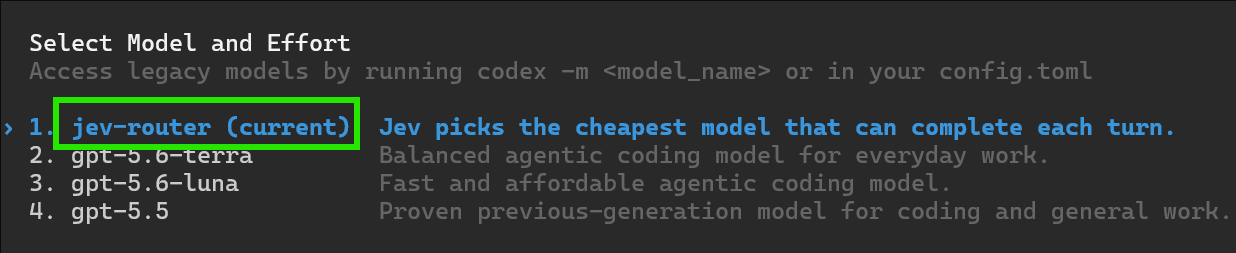
jev-codex launches Codex with a temporary Jev Router provider and selects jev-router.
The native /model picker still contains the models available to the account. Selecting a
concrete model pauses routing; selecting Jev Router resumes it.
Each fresh decision appears as Codex commentary:
[Jev] routed this turn to gpt-5.6-sol (jev, confidence 0.91).
jev-codex installs or refreshes the packaged $jev-explain skill when it starts, so it is
available from any repository without separate setup.
Codex's footer shows jev-router because it displays the selected picker entry,
not the model chosen behind that provider. If Jev is unavailable, the commentary names the
fallback model and explains how to set JEV_API_KEY.
How it works
Each command starts a loopback proxy, launches the real CLI, and forwards the CLI's existing authorization headers without reading, storing, or modifying them.
you -> Claude Code -> jev-claude proxy -> Anthropic
                         |
                         +-> Jev: choose a tier

you -> OpenAI Codex -> jev-codex proxy -> OpenAI
                         |
                         +-> Jev: choose a tier
Claude Code uses ANTHROPIC_BASE_URL; Codex uses a temporary custom provider with
requires_openai_auth=true. Claude uses jev-auto and Codex uses jev-router as the
routing sentinel.
Any concrete model selected by the user passes through unchanged.
Routing policy
One Jev call per fresh user turn selects a shared abstract tier:
| Tier | Claude Code default | Codex default |
|---|---|---|
| Fast | Haiku | gpt-5.6-luna |
| Balanced | Sonnet | gpt-5.6-terra |
| Strong | Opus | gpt-5.6-sol |
| Long | Fable | gpt-6-astra |
src/policy.mjs then applies these rules:
- explicit requests such as
use opus,use luna, oruse strongwin; - failure, timeout, or an unrecognised Jev answer keeps the current model;
- low confidence never downgrades and caps upgrades at the balanced tier;
- large conversations refuse downgrades that would waste more prompt-cache work than they save;
- unavailable tiers step upward rather than silently choosing a weaker model;
- the long tier is disabled unless
JEV_ALLOW_FABLE=1.
Tool-loop continuations keep the tier chosen at the start of the turn. Main conversations and sub-agents are pinned separately. Routing is fail-open: Jev failure never blocks the CLI.
Configuration
| Variable | Interface | Effect |
|---|---|---|
JEV_API_KEY | Both | Enables routing. TYPESAFE_API_KEY also works. |
JEV_ALLOW_FABLE | Both | Enables the opt-in long tier. |
JEV_DEBUG | Both | Logs decisions and rewrites to ~/.jev-claude.log in interactive sessions. |
JEV_DUMP | Both | Dumps request bodies for debugging wire-format changes. |
JEV_NO_STATUSLINE | Claude | Disables the injected Claude status line. |
JEV_CODEX_FAST_MODEL | Codex | Fast model; defaults to gpt-5.6-luna. |
JEV_CODEX_BALANCED_MODEL | Codex | Balanced model; defaults to gpt-5.6-terra. |
JEV_CODEX_STRONG_MODEL | Codex | Strong model; defaults to gpt-5.6-sol. |
JEV_CODEX_LONG_MODEL | Codex | Long model; defaults to gpt-6-astra. |
Existing environment variables have highest precedence, followed by .env in the launch
directory, ~/.jev-router.env, and the legacy ~/.jev-claude.env.
Tier definitions, Jev's question, confidence thresholds, and timeouts live in src/config.mjs.
Compatibility notes
- Claude Code needs schema normalisation for older MCP JSON Schema fields when a custom base URL is active.
- Claude request fields unsupported by a routed tier, such as adaptive thinking on Haiku, are removed before forwarding.
- Codex's current request format stores tool definitions inside its Responses API input.
- Codex's ChatGPT backend may stream SSE without a
Content-Typeheader; the proxy detects the event stream from its first frame. - Codex workspace-specific enterprise origins are internal to its built-in provider and cannot be reproduced by a custom provider.
Development
npm install
echo "JEV_API_KEY=..." > .env

npm test
node test/live-routing.mjs
node bin/jev-claude.mjs -p "what is 2+2?"
node bin/jev-codex.mjs exec "what is 2+2?"
The test suite covers shared policy, both request formats, model rewriting, capability handling, settings restoration, Codex authentication forwarding, native model-picker injection, and decision display.
Limitations
- The user's prompt text is sent to TypeSafe for the routing decision. Nothing else is.
- Jev adds latency only to the first request of a turn; tool-loop continuations add none.
- Claude Code and Codex request formats are not public contracts. Use
JEV_DUMPto diagnose upstream changes. - Developed and tested on Windows against Claude Code v2.1.101 and OpenAI Codex v0.154.0.
Contributing
Issues and pull requests are welcome. Use Issues to report bugs, request improvements, or ask questions. Include the relevant Claude Code or Codex version, reproduction steps, expected behavior, and useful logs with secrets removed.
For a pull request:
- Open an issue first - all PRs by contributors should be linked with an approved issue. Explain the problem and validation in the issue description.
- Fork the repository and create a focused branch from
master. - Make the smallest change that solves the problem.
- Run
npm testand include tests for non-trivial behavior changes. - Claude/Copilot/Codex shall not be the contributors.
Please do not commit API keys or other secrets. All contributions require review, and only the repository owner can merge pull requests.
License
MIT
Contributors

36 commits
Similar repos


Languages
JavaScript
100.0%
Route to the cheapest model in claude code for your task using jev-router
JavaScript
61
36 commits
updated Sep 17, 2026
See what people are saying (1)
README
jev-router
Automatic per-turn model routing for Claude Code and OpenAI Codex. Jev sends simple work to the fast tier and difficult work to the strong tier, while preserving each CLI's native interface, tools, sessions, permissions, and authentication.
| Command | Interface | Authentication | Routing decision |
|---|---|---|---|
jev-claude | Claude Code | Existing claude login | Status line |
jev-codex | OpenAI Codex | Existing codex login | Commentary line |
Both commands launch the real upstream CLI. Jev only chooses the model for a fresh user turn.
Quick start
Requires Node.js 20.12+ and at least one supported CLI: Claude Code or OpenAI Codex.
1. npm package
npm install -g jev-router
echo "JEV_API_KEY=..." > ~/.jev-router.env
2. Local repository
git clone https://github.com/gargpratyush/jev-router.git
cd jev-router
npm install
npm link
echo "JEV_API_KEY=..." > ~/.jev-router.env
On Windows PowerShell:
Set-Content "$HOME\.jev-router.env" "JEV_API_KEY=..."
Get a key from TypeSafe. Then launch either interface from any repository:
jev-claude
jev-codex
No Anthropic or OpenAI API key is required when the corresponding CLI is already logged in with a subscription. Every CLI argument is forwarded:
jev-claude --resume
jev-claude -p "fix the failing test"
jev-codex resume --last
jev-codex exec "fix the failing test"
For a local checkout, npm link installs both commands. Without it, run
node bin/jev-claude.mjs or node bin/jev-codex.mjs.
Claude Code interface
jev-claude launches Claude Code with Jev Router selected in /model. Selecting another
model pauses routing; selecting Jev Router resumes it.
The injected status line shows the model used for the last turn:
⚡ haiku p=0.98 · my-project · 8% context
⏸ manual Opus 4.6 · my-project · 21% context
Claude Code otherwise remains unchanged, including its keybindings, tools, permission prompts,
/compact, /resume, and session handling. An existing custom statusLine is preserved;
set JEV_NO_STATUSLINE=1 to disable Jev's status line.
The explanation skill is bundled with the npm package and loaded automatically: run
/jev-explain in jev-claude, or $jev-explain in jev-codex, to see the factors behind
the last routing decision:
┌─────────────────────────────────┐
│ Jev Router                      │
│                                 │
│ Jev request                     │
│ Prompt: explain the router      │
│ Current tier: HAIKU             │
│ Context tokens: 6200            │
│                                 │
│ Jev response                    │
│ Task complexity     0.82        │
│ Reasoning required  0.91        │
│ Tool complexity     0.64        │
│ Context size        0.31        │
│                                 │
│ Recommended tier: SONNET        │
│ Selected model: SONNET          │
│                                 │
│ Confidence: 94%                 │
│ Decision: Jev recommendation    │
└─────────────────────────────────┘
The report is rendered locally from the exact prompt, System One request, and System One response saved when routing occurred. Recent decisions are retained per CLI session; invoking the explanation skill does not ask Jev to score the prompt again.
Explanation data location
Both jev-claude and jev-codex keep up to 20 recent routing exchanges in one JSON file per
CLI session under Node.js's operating-system temporary directory:
| Platform | Default location |
|---|---|
| Windows | %TEMP%\jev-claude\<session-id>.json |
| macOS | $TMPDIR/jev-claude/<session-id>.json (normally under /var/folders/.../T) |
| Ubuntu/Linux | ${TMPDIR:-/tmp}/jev-claude/<session-id>.json |
Print the exact directory selected on the current machine with:
node -e "console.log(require('node:path').join(require('node:os').tmpdir(), 'jev-claude'))"
Claude filenames use Claude Code's session UUID. Codex filenames use
codex-<jev-codex-process-id>.json. These temporary files contain prompt text and Jev's exact
request and response; the operating system may remove them during normal temporary-file cleanup.
Choosing a model with
Entercan save it as Claude Code's default.jev-clauderestores the previous default on exit sojev-autocannot break plainclaude.
OpenAI Codex interface
jev-codex launches Codex with a temporary Jev Router provider and selects jev-router.
The native /model picker still contains the models available to the account. Selecting a
concrete model pauses routing; selecting Jev Router resumes it.
Each fresh decision appears as Codex commentary:
[Jev] routed this turn to gpt-5.6-sol (jev, confidence 0.91).
jev-codex installs or refreshes the packaged $jev-explain skill when it starts, so it is
available from any repository without separate setup.
Codex's footer shows jev-router because it displays the selected picker entry,
not the model chosen behind that provider. If Jev is unavailable, the commentary names the
fallback model and explains how to set JEV_API_KEY.
How it works
Each command starts a loopback proxy, launches the real CLI, and forwards the CLI's existing authorization headers without reading, storing, or modifying them.
you -> Claude Code -> jev-claude proxy -> Anthropic
                         |
                         +-> Jev: choose a tier

you -> OpenAI Codex -> jev-codex proxy -> OpenAI
                         |
                         +-> Jev: choose a tier
Claude Code uses ANTHROPIC_BASE_URL; Codex uses a temporary custom provider with
requires_openai_auth=true. Claude uses jev-auto and Codex uses jev-router as the
routing sentinel.
Any concrete model selected by the user passes through unchanged.
Routing policy
One Jev call per fresh user turn selects a shared abstract tier:
| Tier | Claude Code default | Codex default |
|---|---|---|
| Fast | Haiku | gpt-5.6-luna |
| Balanced | Sonnet | gpt-5.6-terra |
| Strong | Opus | gpt-5.6-sol |
| Long | Fable | gpt-6-astra |
src/policy.mjs then applies these rules:
- explicit requests such as
use opus,use luna, oruse strongwin; - failure, timeout, or an unrecognised Jev answer keeps the current model;
- low confidence never downgrades and caps upgrades at the balanced tier;
- large conversations refuse downgrades that would waste more prompt-cache work than they save;
- unavailable tiers step upward rather than silently choosing a weaker model;
- the long tier is disabled unless
JEV_ALLOW_FABLE=1.
Tool-loop continuations keep the tier chosen at the start of the turn. Main conversations and sub-agents are pinned separately. Routing is fail-open: Jev failure never blocks the CLI.
Configuration
| Variable | Interface | Effect |
|---|---|---|
JEV_API_KEY | Both | Enables routing. TYPESAFE_API_KEY also works. |
JEV_ALLOW_FABLE | Both | Enables the opt-in long tier. |
JEV_DEBUG | Both | Logs decisions and rewrites to ~/.jev-claude.log in interactive sessions. |
JEV_DUMP | Both | Dumps request bodies for debugging wire-format changes. |
JEV_NO_STATUSLINE | Claude | Disables the injected Claude status line. |
JEV_CODEX_FAST_MODEL | Codex | Fast model; defaults to gpt-5.6-luna. |
JEV_CODEX_BALANCED_MODEL | Codex | Balanced model; defaults to gpt-5.6-terra. |
JEV_CODEX_STRONG_MODEL | Codex | Strong model; defaults to gpt-5.6-sol. |
JEV_CODEX_LONG_MODEL | Codex | Long model; defaults to gpt-6-astra. |
Existing environment variables have highest precedence, followed by .env in the launch
directory, ~/.jev-router.env, and the legacy ~/.jev-claude.env.
Tier definitions, Jev's question, confidence thresholds, and timeouts live in src/config.mjs.
Compatibility notes
- Claude Code needs schema normalisation for older MCP JSON Schema fields when a custom base URL is active.
- Claude request fields unsupported by a routed tier, such as adaptive thinking on Haiku, are removed before forwarding.
- Codex's current request format stores tool definitions inside its Responses API input.
- Codex's ChatGPT backend may stream SSE without a
Content-Typeheader; the proxy detects the event stream from its first frame. - Codex workspace-specific enterprise origins are internal to its built-in provider and cannot be reproduced by a custom provider.
Development
npm install
echo "JEV_API_KEY=..." > .env

npm test
node test/live-routing.mjs
node bin/jev-claude.mjs -p "what is 2+2?"
node bin/jev-codex.mjs exec "what is 2+2?"
The test suite covers shared policy, both request formats, model rewriting, capability handling, settings restoration, Codex authentication forwarding, native model-picker injection, and decision display.
Limitations
- The user's prompt text is sent to TypeSafe for the routing decision. Nothing else is.
- Jev adds latency only to the first request of a turn; tool-loop continuations add none.
- Claude Code and Codex request formats are not public contracts. Use
JEV_DUMPto diagnose upstream changes. - Developed and tested on Windows against Claude Code v2.1.101 and OpenAI Codex v0.154.0.
Contributing
Issues and pull requests are welcome. Use Issues to report bugs, request improvements, or ask questions. Include the relevant Claude Code or Codex version, reproduction steps, expected behavior, and useful logs with secrets removed.
For a pull request:
- Open an issue first - all PRs by contributors should be linked with an approved issue. Explain the problem and validation in the issue description.
- Fork the repository and create a focused branch from
master. - Make the smallest change that solves the problem.
- Run
npm testand include tests for non-trivial behavior changes. - Claude/Copilot/Codex shall not be the contributors.
Please do not commit API keys or other secrets. All contributions require review, and only the repository owner can merge pull requests.
License
MIT
Similar repos
Contributors
36 commits
Languages
JavaScript
100.0%