
Point cloud ops (FPS, kNN, ball query) for PyTorch on Apple Silicon (MPS)
Python
1
213 commits
updated Oct 3, 2026
See what people are saying
README
 mps-pointops





Point-cloud operators for PyTorch on Apple Silicon. Native Metal kernels
run farthest point sampling, k nearest neighbors, and Ball Query on MPS.
Version 1.0.0 freezes the documented, tested public API subset. It includes
PointNet++ feature propagation, feature-space kNN, graph/grid interfaces, a
bounded opt-in Pointcept PTv1 compatibility subset, and an experimental
reusable spatial index. Chamfer has a tested squared-L2 subset and additional
experimental metrics and inputs.
Compatibility stand-ins cover supported pointnet2_ops, knn_cuda, and
torch_cluster call sites; CPU tensors use PyTorch reference implementations.
Interactive explainer · API reference · Preprint · Quick start · Results · Equations · Compatibility · Numerical contract · Citation
Quick start
Native Metal execution requires an Apple Silicon Mac, Python 3.10 or later, PyTorch 2.7 or later, and an available MPS device. On other systems the package can be installed and CPU tensors use the PyTorch reference implementations; requesting an unavailable MPS device does not silently switch to CPU. The Metal kernels compile on first use.
Install
python -m pip install mps-pointops
Version 1.0.0 includes dense SIMD Ball Query, the PyTorch3D-style Ball Query
adapter, and the large-cloud FPS path for a single cloud. The available
three_nn, three_interpolate, feature-space kNN, graph, voxel, and Chamfer
interfaces have bounded input contracts. Compact voxel downsampling includes
an experimental opt-in Metal CSR pooling prototype. The supported
propagation and loss inputs and their differences from upstream are in the
PointNet++ propagation and
Chamfer contracts.
The supported squared-L2 Chamfer subset is checked against a pinned official
PyTorch3D CPU oracle in dedicated MPS CI, and an
opt-in Pointcept PTv1 Seg26 subset covers one
documented synthetic model path.
The L1,
normal-vector and Pointclouds,
and variable-dimension Chamfer paths
remain experimental beyond the tested upstream subsets. The opt-in
reusable spatial index exposes a bounded two-level
Morton BVH; ordinary dense and flat calls retain their established kernels.
Private sparse convolution modules and the local OpenPCDet adapter are not a
public spconv replacement. See the v1.0 release scope.
Direct comparisons against the
original PointNet++ CUDA extension and
PyTorch3D Chamfer record the tested
inputs, output and gradient errors, build adjustments, and source hashes.
Minimal example
import torch
from mps_pointops import ball_query, furthest_point_sample, knn

if not torch.backends.mps.is_available():
    raise SystemExit("PyTorch MPS is unavailable; use CPU tensors for the reference path")

xyz = torch.tensor(
    [[[0., 0., 0.], [1., 0., 0.], [0., 1., 0.], [1., 1., 0.]]],
    device="mps",
)
centers_idx = furthest_point_sample(xyz, 2, start_idx=0)
centers = xyz.gather(1, centers_idx[..., None].expand(-1, -1, 3))
distance, neighbor_idx = knn(centers, xyz, 2)
distance2, radius_idx = ball_query(centers, xyz, 1.1, 2)

assert centers_idx.tolist() == [[0, 3]]
assert neighbor_idx.tolist() == [[[0, 1], [3, 1]]]
assert radius_idx.tolist() == [[[0, 1], [1, 2]]]
print("MPS point ops OK")
Reusable spatial index (experimental opt-in)
The opt-in SpatialIndex borrows one [N,3] reference cloud and can reuse a
Metal BVH across queries. Existing dense and flat calls retain their kernels.
Set Safe Math before starting Python to force the research BVH path:
PYTORCH_ENABLE_MPS_FALLBACK=0 PYTORCH_MPS_FAST_MATH=0 python your_script.py
from mps_pointops import SpatialIndex

index = SpatialIndex(xyz[0], backend="bvh")
dist, neighbors = index.knn(centers[0], 2)       # Euclidean distance
dist2, first = index.ball_query(centers[0], 1.1, 2)  # squared distance
backend="auto" selects BVH only for a measured M5 Pro 1M-point, k=16,
large-query kNN case after a small density check; it keeps the existing scan
for radius search, Fast Math, M1, and other inputs. The forced BVH supports
single-cloud MPS float32, N<=1M, K<=32 and a bounded finite coordinate
domain. See the API and dispatch contract and
the synchronized M5 Pro kNN dispatch,
Ball Query, and
allocator-memory and
Instruments studies. The proposed v0.9.0
milestone was folded into this bounded v1.0.0 release; its unfinished research
goals remain open.
The PointNet++ and Chamfer operators introduced in v0.5.0 can be called directly:
import torch
from mps_pointops import chamfer_distance, three_interpolate, three_nn

xyz = torch.tensor(
    [[[0., 0., 0.], [1., 0., 0.], [0., 1., 0.]]], device="mps"
)
distances, indices = three_nn(xyz[:, :2], xyz[:, :3])
weights = torch.full_like(distances, 1.0 / 3.0)
features = torch.ones((1, 2, 3), device="mps", requires_grad=True)
interpolated = three_interpolate(features, indices, weights)
loss, _ = chamfer_distance(xyz[:, :2], xyz[:, :3])
print(interpolated.shape, loss.item())
| Operator | Selection rule | Native result |
|---|---|---|
| FPS | Farthest from the already selected centers | int64 center indices |
| kNN | Nearest k, sorted by squared distance then index | Euclidean distances, int64 indices |
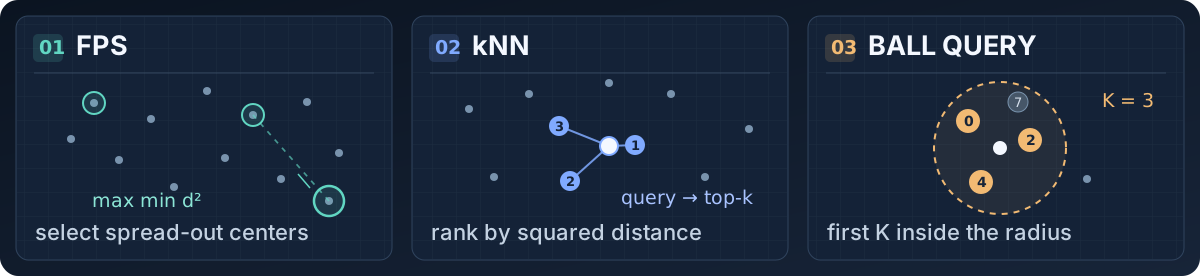
| Ball Query | First K inside a strict radius, in input order | Squared distances, int64 indices; -1 padding |
For a query $q_i$ and reference point $x_j$, the shared distance is $s_{ij}=\sum_{d=0}^{2}(q_{id}-x_{jd})^2$; each operator selects indices by a different rule. The equations give the full selection and gradient formulas. On MPS, Ball Query supports coordinate gradients for its squared distances; FPS and kNN do not implement backward.
Current source measured on one M5 Pro, with 100k randomly ordered reference points: FPS 6.5×, kNN 4.2×, and dense Ball Query 13.7× faster than the fastest tested CPU library for each operation. With spatially sorted points, dense Ball Query measured 2.9 ms versus SciPy's 20.6 ms. The benchmark states the setup and links the raw results and source hashes. The PyTorch3D-style adapter is available separately from the timed dense API.
For existing CUDA-oriented imports, call mps_pointops.compat.install()
before importing pointnet2_ops, knn_cuda, or torch_cluster:
import mps_pointops.compat
mps_pointops.compat.install()

from pointnet2_ops import pointnet2_utils
from knn_cuda import KNN
from torch_cluster import fps, knn as flat_knn, radius
The native API is dense and batched. The flat API in mps_pointops.flat
supports sorted batch vectors and global indices. See
Compatibility for the stand-ins' behavior and
License for component notices.
Why
Point-MAE based 3D anomaly detection, such as the
MulSen-AD baseline, groups points with
pointnet2_ops.furthest_point_sample and knn_cuda.KNN. Both are CUDA only, so
the code does not run on a Mac at all. The usual workaround is to rewrite them
in plain PyTorch and run on MPS. That works, but it is slow, and a 48 GB M5 Pro
ends up slower than its own CPU.
The goal of this project is drop-in Metal kernels for these ops that beat the best CPU implementations on the same machine.
Real data: a MulSen-AD 3D detector gives the same results as on CUDA
The Point-MAE 3D-only anomaly detector from the MulSen-AD baseline (MulSen-AD's
released feature extractor, coreset memory bank and object score) was fit and
scored on the Mac GPU with compat.install() providing pointnet2_ops and
knn_cuda, and compared with the same runs made earlier on CUDA with the real
extensions (Windows, RTX 2080, PyTorch 2.9.1 + CUDA 13).
- 45 runs: 15 MulSen-AD categories x 3 seeds, fit on normal samples of a frozen research split and scored on its validation samples. The same sample IDs and labels were used on both machines.
- Object AUROC, object AP, 3D-label AUROC and 3D-label AP: identical to the CUDA runs in all 45 runs.
- Per-sample anomaly scores: largest relative difference 9.85e-5, and the same ranking of samples in every run.
This is a validation-set comparison from a separate research project, so the split, scores and runner scripts are not part of this repository. Setup: Apple M5 Pro, macOS 26.5.2, PyTorch 2.14.1, this package at commit 80bbca5.
Real data: MulSen-AD grouping
examples/mulsen_grouping.py loads MulSen-AD
point clouds the way MulSen-AD's dataset code does (open3d, duplicate vertices
removed, centered) and runs MulSen-AD's own models.models.Group(num_group=1024, group_size=128), unmodified, on MPS with compat.install().
30 clouds, 2 from each of the 15 classes, 21,168 to 117,259 points, Apple M5 Pro:
These are earlier real-data measurements, separate from the current-source synthetic benchmark below. None of these clouds reaches the new 500,000-point FPS automatic-switch threshold.
| min | median | max | |
|---|---|---|---|
MulSen Group on MPS with mps-pointops (FPS + gather + kNN + indexing) | 10.5 ms | 36.0 ms | 49.1 ms |
| Best CPU libraries (fpsample FPS + scipy cKDTree kNN, nothing else) | 40.1 ms | 163.4 ms | 221.9 ms |
Plain PyTorch on MPS (FPS loop + cdist/topk) | 131.1 ms | 330.6 ms | 423.7 ms |
- mps-pointops is 3.0x to 5.0x faster than the CPU libraries (median 4.5x) and 7.6x to 13x faster than plain PyTorch on MPS (median 9.2x).
- FPS centers match the pointnet2_ops-contract reference and neighbors match an exact float32 oracle: 0 mismatches in all 30 clouds.
- None of these clouds has points within the near-origin cutoff that pointnet2_ops skips (see Compatibility), so that rule did not come into play here.
Per-cloud numbers: examples/results/mulsen_grouping.json. The full MulSen-AD pipeline also needs pretrained DINO ViT-B/8 and Point-MAE weights and has not been run yet.
Benchmark
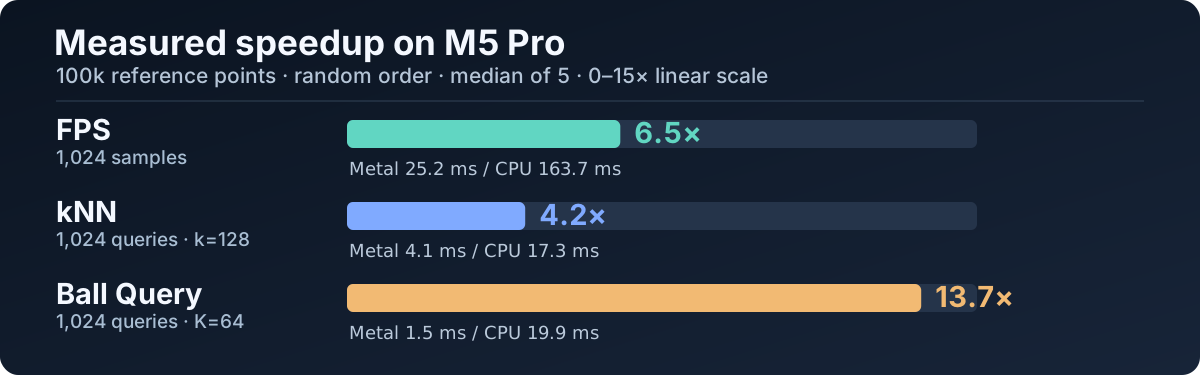
The chart compares the October 1 measured Metal source snapshot with the fastest tested CPU
library for that operation on the same M5 Pro. It uses batch 1, 100,000
reference points, 1,024 samples or queries, random input order, and the median
of five runs, with MPS fallback disabled and Fast Math unset. SciPy times
include KD-tree construction; device transfer is excluded. The chart is
generated from the committed
random-order JSON
by this script. The JSON records SHA-256 for
the benchmark, operator dispatch, reference code, and all three timed kernels.
The benchmark script and three timed Metal kernels still match those hashes;
the shared dispatch and reference code have since changed, so these are
snapshot timings rather than a current-release benchmark. The Ball Query row
times the dense mps_pointops.ball_query API, without the optional PyTorch3D adapter's
neighbor gathering. Displayed times are rounded to 0.1 ms; the speedups use
unrounded medians in the JSON.
The synthetic points lie near a unit sphere and use MulSen-AD scale. Full result tables: October 1 random order and October 1 x-sorted Ball Query. The v0.3.0 Ball Query results remain archived as a separate release baseline.
October 1 source snapshot, Apple M5 Pro, 48 GB, macOS 26.5.2, torch 2.14.1, random point order:
| op | points | mps-pointops (Metal) | torch on MPS | torch on CPU | best CPU library |
|---|---|---|---|---|---|
| FPS (1024 samples) | 20,000 | 5.6 ms | 43.1 ms | 102.0 ms | 33.1 ms (fpsample) |
| 100,000 | 25.2 ms | 84.7 ms | 270.6 ms | 163.7 ms (fpsample) | |
| kNN (1024 queries, k=128) | 20,000 | 2.1 ms | 9.5 ms | 10.2 ms | 4.8 ms (scipy cKDTree) |
| 100,000 | 4.1 ms | 70.9 ms | 38.8 ms | 17.3 ms (scipy cKDTree) | |
| Ball query (1024 queries, K=64, r=0.1) | 20,000 | 1.1 ms | 25.6 ms | 30.7 ms | 4.8 ms (scipy cKDTree) |
| 100,000 | 1.5 ms | 157.2 ms | 155.0 ms | 19.9 ms (scipy cKDTree) |
What this shows:
- The Metal kernels beat the tested CPU libraries on these inputs: FPS is 5.9× to 6.5× faster than fpsample, kNN is 2.2× to 4.2× faster than SciPy's KD-tree, and Ball Query is 4.5× to 13.7× faster than SciPy including its tree build. Against plain PyTorch on MPS, FPS is 3.4× to 7.7× faster and kNN is 4.5× to 17.3× faster.
- Plain PyTorch FPS on MPS grows much slower than the work. 5x the points took it from 43.1 ms to 84.7 ms. Our hypothesis is a fixed cost per step (1024 sequential steps of several small kernels each: dispatch, scheduling, synchronization). This has not been profiled. The Metal kernel runs all 1024 steps in one dispatch.
- Plain PyTorch kNN is not exact.
cdistuses a matrix multiply here, so distances are off by up to 4.9e-4 and 40 to 242 neighbors land in the wrong position; at 100k points 1 to 2 of the 131,072 true neighbors are missing. - Ball Query keeps input order while scanning in SIMD blocks. At 100k
random points it measured 1.5 ms versus SciPy's 19.9 ms including tree
construction. With points sorted by x, the separate source-snapshot run
measured 2.9 ms versus SciPy's 20.6 ms. Input order still affects its
runtime because each query stops after its first
Khits.
Timings move by a few ms, sometimes more, between runs. Inputs are already
resident on each implementation's device; transfer time is outside the timer.
The scipy times include building the KD-tree. fpsample's QuickFPS
(bucket_fps_kdline_sampling) is absent because in fpsample 1.0.2 it ignores
start_idx and returns a different, sorted sample set.
Dense Ball Query SIMD ablation
The current source assigns one SIMD group to each dense Ball Query and ranks
matches with an exclusive prefix scan, retaining the first K point indices
in input order. On the same M5 Pro, a paired Safe Math ablation compiled the
v0.3.0 dense kernel and the SIMD kernel in one process. It alternated their
execution order, used 3 warmups and 12 timed runs per kernel, and synchronized
MPS immediately before and after each dispatch. Both used resident float32
inputs, 1,024 queries, K=64, and r=0.1; allocation, transfer, and shader
compilation were outside the timer.
| Input order | Points | v0.3.0 dense median | SIMD median | Speedup |
|---|---|---|---|---|
| x-sorted | 20,000 | 4.28 ms | 1.08 ms | 3.96× |
| x-sorted | 100,000 | 21.43 ms | 2.91 ms | 7.37× |
| random | 20,000 | 4.24 ms | 1.06 ms | 4.01× |
| random | 100,000 | 7.66 ms | 1.40 ms | 5.48× |
For those four inputs, the two kernels produced byte-identical int64
indices and float32 squared distances, including padding. This is an
observed baseline-to-SIMD result, not a general promise of bitwise agreement
with a CPU implementation near floating-point boundaries. The
paired benchmark and
raw results
record the source hashes, inputs, and individual timings. The chart and table
above use a new full-benchmark run of the current source. This paired ablation
isolates the old and new shader dispatches, so its timings have a different
scope and do not measure SciPy.
The new full benchmark measured the current SIMD kernel against SciPy cKDTree
build plus query: 2.9 versus 20.6 ms on x-sorted 100k points and 1.5
versus 19.9 ms on randomly ordered 100k points. Both runs had 0 mismatched
indices out of 65,536 against the CPU first-K reference; the largest reported
squared-distance difference was 1.9e-9. These SciPy numbers come from the
separate sorted
and random
JSON runs, not the paired old-versus-new ablation above.
For output completeness, a separate differential checker
passed 48 Safe and 40 Fast Math cases using output buffers prefilled with
sentinel values. It compared every output byte with the previous Metal
kernel and compared first-K int64 indices with an independent CPU oracle.
It covered both coordinate dtypes, lengths, empty references, 32-lane and
8-query dispatch boundaries, K=1/31/33/65, and a small-radius path. Safe
Math also included NaN and Inf inputs. Its Safe
and Fast
JSON files identify the exact inputs and shader hashes.
Large single-cloud FPS path
The source tree also provides a multi-threadgroup FPS kernel
for batch size 1. It divides a cloud into 4,096-point chunks and uses a second
dispatch to reduce their partial maxima after each sampling step. The
strategy="auto" policy selects it only on the tested M5 Pro for at least
500,000 points and two samples. Other Apple GPUs and all multi-cloud batches
keep the original single-threadgroup path by default; callers can compare
strategy="single" and strategy="multigroup" on their own hardware.
The earlier size sweep found a crossover between 32,768 and 65,536 points on this M5 Pro. The 500,000 point automatic cutoff is deliberately above that measured crossover. A production-kernel spot check at 1,024 samples measured:
- 500,000 points: 193.08 → 29.37 ms (6.57× faster).
- 1,000,000 points: 421.69 → 49.39 ms (8.54× faster).
Output indices matched in every paired iteration. The JSON records capture
commit 27cdbe9 with dirty=true; that commit does not resolve in this
checkout, so the commit alone cannot reconstruct the measured tree. Its
benchmark script and both FPS shader SHA-256 values match the current files.
The recorded ops.py hash matches the merged large-cloud FPS commit,
but not current main: a later feature-space kNN change modified ops.py
without changing its FPS dispatch. The JSON provenance fields were not
rewritten after the merge. These timings include
host dispatch overhead and are bracketed by torch.mps.synchronize(); they
do not establish a crossover on other Apple GPUs. This FPS spot check uses
standard-normal points, while the 20k–100k chart uses synthetic sphere-shell
points, so the two timing sets should be read separately.
Correctness checks
Each benchmark row records counts, not percentages, so a single mismatch stays visible:
- FPS: indices that differ from the PyTorch CPU reference.
- kNN: against an exact float32 oracle (squared distances rounded like the kernel, sorted by distance then index): true neighbors missing, neighbors in the wrong position, and the largest distance error.
- Ball query: indices and squared distances that differ from the PyTorch3D-contract reference on CPU.
On the listed synthetic inputs, the Metal kernels had 0 index mismatches.
Ball Query's maximum squared-distance error against the separate-operation
CPU reference was 1.9e-9; FPS indices matched and kNN reported no distance
error.
These are observations on one M5 Pro, not a guarantee for every input, GPU or
compiler. The v0.4.0 release source, including the large-cloud FPS path and
PyTorch3D-style adapter, reported 201 passed, 12 skipped in separate
Safe and
Fast processes under
PyTorch 2.14.1 with MPS fallback disabled. Seven skips are existing kNN
k > n cases and five are PyG 2.8 tests whose optional pyg-lib dependency
is absent from this local environment. The PyTorch3D adapter tests are
included in the 201 passes. Earlier test logs remain under docs/ as
historical evidence for their respective commits.
Run it
uv venv --python 3.12 && uv pip install torch numpy scipy fpsample pytest
PYTORCH_ENABLE_MPS_FALLBACK=0 .venv/bin/python bench/bench_pointops.py \
  --sizes 20000 100000 --ops fps knn ball_query --warmup 2 --repeat 5 \
  --order random --out bench/results/local
PYTORCH_ENABLE_MPS_FALLBACK=0 .venv/bin/python bench/bench_pointops.py \
  --sizes 100000 --ops ball_query --warmup 2 --repeat 5 \
  --order sorted --out bench/results/local
PYTORCH_ENABLE_MPS_FALLBACK=0 .venv/bin/python bench/bench_fps_production.py \
  --sizes 500000 1000000 --samples 1024 \
  --output bench/results/local/fps-production.json
PYTORCH_ENABLE_MPS_FALLBACK=0 PYTORCH_MPS_FAST_MATH=0 \
  .venv/bin/python bench/bench_v050_ops.py \
  --output bench/results/local/v050-safe.json
PYTORCH_ENABLE_MPS_FALLBACK=0 PYTORCH_MPS_FAST_MATH=1 \
  .venv/bin/python bench/bench_v050_ops.py \
  --output bench/results/local/v050-fast.json
.venv/bin/python -m pytest tests

# MulSen-AD grouping on real data (needs open3d and timm too)
.venv/bin/python examples/mulsen_grouping.py \
    --mulsen-code path/to/MulSen-AD --data path/to/MulSen_AD --per-class 2
Experimental v0.5.0 operator timings
The new operators were measured on an Apple M5 Pro (48 GB, macOS 26.5.2,
PyTorch 2.14.1) with float32 inputs already on MPS. Each public forward or
backward call was bracketed by torch.mps.synchronize(); medians use four
warmups and 20 timed calls. Safe and Fast Math ran in separate processes with
MPS fallback disabled. Times include Python validation, allocation, dispatch,
and autograd, rather than isolated shader execution. Chamfer uses the default
bidirectional squared-L2 point and batch means without lengths, normals, or
weights.
| Operator and shape | Safe forward | Safe backward | Fast forward | Fast backward |
|---|---|---|---|---|
three_nn, B=2, N=512, M=1,024 | 0.352 ms | — | 0.333 ms | — |
three_nn, B=2, N=2,048, M=4,096 | 0.822 ms | — | 0.598 ms | — |
three_interpolate, B=2, C=32, M=512, N=2,048 | 0.402 ms | 0.265 ms | 0.366 ms | 0.241 ms |
three_interpolate, B=2, C=64, M=2,048, N=8,192 | 0.644 ms | 0.877 ms | 0.629 ms | 0.837 ms |
| bidirectional Chamfer, B=2, P=Q=256 | 0.987 ms | 0.465 ms | 0.927 ms | 0.436 ms |
| bidirectional Chamfer, B=2, P=Q=1,024 | 1.041 ms | 0.560 ms | 1.406 ms | 0.686 ms |
The benchmark script and final
Safe JSON,
Fast JSON,
Safe table, and
Fast table retain
all samples, source commit 7c1406e, and SHA-256 hashes of the measured code.
The inputs are seeded synthetic data. These absolute timings do not establish
a CPU or CUDA speedup, and Fast Math was slower for the larger Chamfer case in
this run. See each operator's contract and the direct upstream comparisons
above for accuracy and supported inputs.
Results from other Apple Silicon chips are welcome as pull requests.
Compatibility
mps_pointops.compat.install() registers pointnet2_ops,
pointnet2_ops.pointnet2_utils, knn_cuda and torch_cluster in
sys.modules, unless a real package with that name is already importable.
Call it before importing code that uses those names. force=True replaces an
already loaded or importable package; the default preserves it.
| stand-in | behavior |
|---|---|
pointnet2_utils.furthest_point_sample(xyz, npoint) | Metal kernel. int32 output, starts at index 0, and never picks points with x² + y² + z² <= 1e-3, as pointnet2_ops does |
pointnet2_utils.gather_operation, grouping_operation | torch.gather, differentiable |
pointnet2_utils.ball_query(radius, nsample, xyz, new_xyz) | Metal on MPS. int32, empty slots repeat the first neighbor, no neighbor gives all zeros |
knn_cuda.KNN(k, transpose_mode) | Metal kernel. Same layouts as knn_cuda, Euclidean distances, no gradients |
PyTorch3D-style Ball Query
mps_pointops.pytorch3d.ball_query accepts the PyTorch3D Ball Query
argument order and defaults, including lengths1, lengths2, return_nn,
and skip_points_outside_cube. It returns KNN(dists, idx, knn), with zero
coordinates in knn where idx = -1 and knn=None when return_nn=False.
from mps_pointops.pytorch3d import ball_query

result = ball_query(centers, xyz, K=64, radius=0.1, return_nn=True)
neighbor_indices = result.idx
neighbor_coordinates = result.knn
This is an explicit adapter and does not replace an installed PyTorch3D package. It supports three-dimensional float32 coordinates. The cube flag is accepted as a result-preserving optimization hint; the current Metal kernel does not run a cube prefilter. General coordinate dimensions and bitwise agreement at all floating-point boundaries remain outside its contract.
Flat torch_cluster subset
mps_pointops.flat exposes fps and radius for flat (N, 3) point
coordinates and knn for (N, D) coordinates or features with D >= 1.
Batch vectors must be sorted, such as [0, 0, 1, 1, 1]; missing
batch IDs represent empty clouds. A separate offset array is built for the
reference and query sets, which may have different sizes. All returned indices
are global indices into the corresponding flat input.
import torch
from mps_pointops import flat

x = torch.tensor([[0., 0, 0], [2., 0, 0], [10., 0, 0]], device="mps")
batch_x = torch.tensor([0, 0, 1], device="mps")
y = torch.tensor([[1., 0, 0], [11., 0, 0]], device="mps")
batch_y = torch.tensor([0, 1], device="mps")

centers = flat.fps(x, batch_x, ratio=0.5, random_start=False)
knn_edges = flat.knn(x, y, 2, batch_x, batch_y)
radius_edges = flat.radius(x, y, 1.1, batch_x, batch_y, max_num_neighbors=32)
fps returns int64 sampled point indices (ratio=None means 0.5;
random_start=True by default). A Python ratio is converted to the dtype of
x; a tensor ratio keeps its dtype and shape. The count follows
torch_cluster 1.6.3's device-specific arithmetic: CPU computes
ceil(float32(N_b) * ratio), while MPS follows the CUDA path
ceil(cast(N_b, ratio.dtype) * ratio). In float32, 25 points at ratio 0.6
give 16 samples, not 15. A scalar tensor and a length-one tensor can also
promote the CPU product differently when the ratio is float64.
It also accepts an explicit ptr offset array. knn and radius return
int64 edge_index tensors of shape [2, E]: row 0 is a query index into
y and row 1 is a reference index into x. kNN is ordered by squared distance,
then reference index; if a batch has fewer than k references, it emits only
the available edges. For float32 coordinates, radius search uses strict
distance² < fl32(r * r), with r * r computed in double precision as
torch_cluster does (the dense Ball Query uses the PyTorch3D threshold
fl32(fl32(r) * fl32(r)) instead; the two can differ by one float32 ULP).
For very small radii, MPS uses the native Ball Query's normalized comparison,
so near-boundary bits may differ. It takes up to max_num_neighbors matches in
reference input order, like torch_cluster's CUDA kernel; torch_cluster on
CPU keeps an arbitrary subset when there are more matches. Padded internal slots
are removed before returning the edge tensor. CPU inputs use PyTorch; MPS
inputs use Metal for supported sizes. Dense, flat, and PyG kNN raise an explicit
error when the effective MPS neighbor count exceeds 256; there is no implicit
slow PyTorch search. For flat/PyG calls the effective count is min(k, len(x));
knn_graph requests one extra neighbor when loop=False. Use CPU explicitly
for larger counts. The feature-space contract and DGCNN evidence
explain direct dimension accumulation, numerical limits, and model scope.
On MPS, FPS and kNN require float32; radius accepts float32 or float16 and
the same positive-radius lower bound as the native Ball Query contract. The
float16 radius path computes distances and the threshold in float32; it does
not promise bitwise parity with torch_cluster's half-precision CUDA kernel.
Flat FPS uses one threadgroup per cloud and scans only that cloud's
offset range. Very uneven batch sizes can still leave a long-running group;
splitting one FPS sequence across groups would need synchronization after each
selected point and remains a performance task.
The public flat FPS, kNN, and radius calls were measured on one physical
Apple M5 Pro (48 GiB, macOS 26.5.2, PyTorch 2.14.1) with 1,024 or 4,096
randomly ordered dyadic 3D reference points across uneven batches, 32 or 128
queries, k=16, and 16-neighbor radius limits. CPU/MPS outputs matched
exactly in all cases. Values below are median synchronized, preloaded-input
public-call milliseconds; each cell has 20 raw samples. CPU is this package's
PyTorch path, not an optimized CPU library.
| Math mode | References / queries | FPS CPU / MPS | kNN CPU / MPS | Radius CPU / MPS |
|---|---|---|---|---|
| Safe | 1,024 / 32 | 0.212 / 2.607 | 1.152 / 3.901 | 0.456 / 2.819 |
| Safe | 4,096 / 128 | 1.447 / 2.312 | 19.665 / 4.377 | 3.102 / 4.297 |
| Fast | 1,024 / 32 | 0.220 / 1.216 | 1.116 / 4.048 | 0.444 / 2.911 |
| Fast | 4,096 / 128 | 1.453 / 1.865 | 19.851 / 3.896 | 3.083 / 3.485 |
The reproduction method and limits,
Safe raw samples,
and Fast raw samples
record source commit 584f4580b2ff899d2e73e4a2dcdaf0bf490912be, file hashes,
environment, and timing spread. Only the 4,096-point kNN fixture beat the
tested CPU reference in both modes; the measurements do not establish a
general flat API speedup.
The shim follows the fps, knn, radius, nearest, grid_cluster,
graclus_cluster, and random_walk call signatures of
torch_cluster 1.6.3
for three-dimensional FPS/radius coordinates and arbitrary-dimensional kNN
features. Cosine kNN and ignore_same_index=True are
unsupported and raise an error. The shim also provides knn_graph and
radius_graph using these searches, including loop and flow. It also
exposes an experimental 3D float32 grid_cluster
CPU/MPS path. The
torch_cluster.nearest(x, y, batch_x, batch_y) shim returns one global index
into y for each x row. It accepts one-dimensional or (N, D) float32 MPS
inputs, including ragged batches with empty ID gaps. Its source-level CUDA
threshold, error choices, and cross-backend limits are in the
nearest contract. The experimental
graclus_cluster CPU/MPS path follows the
legacy matching contract. Experimental
random_walk uses PyTorch CPU/MPS tensor
operations for the documented int64 COO inputs. With the same CPU RNG state,
uniform walks can match the pinned upstream CPU sampler; biased walks
approximate its transition distribution, with
device-specific random draws. The pinned CUDA source has a different biased
rejection-loop state update, so CUDA biased-path parity is not claimed. This
is not a native Metal performance path. PyG 2.8 Node2Vec
calls the separate
torch.ops.pyg.random_walk operator; the legacy shim does not register it.
PyG 2.7.0
calls these torch_cluster functions directly. Its fps, knn, radius,
knn_graph, and radius_graph entry points were exercised with MPS tensors
on an M5 Pro. In contrast,
PyG 2.8.0
calls separate torch.ops.pyg operators. For that version, use the MPS
registration below. The torch_cluster shim has the separately documented
legacy API subsets listed above; it does not register PyG's pyg-lib
operators.
PyG 2.8 MPS operator registration
PyG 2.8 checks for pyg-lib>=0.6 before calling its fps, knn, radius,
and grid_cluster operators. Install a pyg-lib wheel matching your PyTorch version
from PyG's wheel index. For example, this is the
tested Apple Silicon combination (PyTorch 2.12.0, PyG 2.8.0, pyg-lib 0.7.0):
python -m pip install "torch==2.12.0" "torch-geometric==2.8.0" mps-pointops
python -m pip install --no-index \
  --find-links 'https://data.pyg.org/whl/torch-2.12.0+cpu.html' \
  'pyg-lib==0.7.0+pt212'
Register the MPS implementations before using PyG's pool functions:
from mps_pointops.pyg import register_mps
register_mps()

from torch_geometric.nn import fps, knn, radius, knn_graph, radius_graph, voxel_grid
This adds MPS dispatch for pyg-lib's existing pyg::fps, pyg::knn,
pyg::radius, and pyg::grid_cluster schemas; it does not replace pyg-lib's
CPU or CUDA kernels. voxel_grid support
currently covers finite float32 1D–3D spatial coordinates and returns
mixed-radix voxel IDs. The grid operator does not pool features. The pinned
PyG 2.8.0 and pyg-lib 0.7.0 M5 Pro
Safe and
Fast full-suite runs passed
327/326 tests respectively, with 9/10 skips, on the branch rebased onto
c3c7cc73bab1b2181815ba38a7d16bf6c0332601.
The PyG 2.8 voxel_grid → avg_pool_x feature path
also runs on MPS after registration. PyG itself performs the mean reduction
with PyTorch scatter_add_; this project supplies the grid-ID dispatch and
tests the pooled features and gradients. For finite float32 positions and
features:
import torch
from mps_pointops.pyg import register_mps
from torch_geometric.nn import avg_pool_x, voxel_grid

register_mps()
pos = torch.tensor([[0.0, 0.0], [0.2, 0.0], [1.0, 1.0]], device="mps")
batch = torch.zeros(3, dtype=torch.long, device="mps")
x = torch.tensor([[1.0], [3.0], [5.0]], device="mps", requires_grad=True)
cluster = voxel_grid(pos, size=1.0, batch=batch, start=0.0, end=2.0)
pooled_x, pooled_batch = avg_pool_x(cluster, x, batch)
The pinned M5 Pro full-suite Safe
and Fast runs passed
352/351 tests, with 9/10 skips, on source revision 0c3a62d82f94128886df1ce725428f704e67bd49
based on main commit 94398da77fb305039c9648380182d55747609ad1.
The model fixture uses a bias-free projection; a hosted Torch 2.12 MPS
nn.Linear bias discrepancy is documented
separately with an independent reproduction probe.
The pinned PyG 2.8 graph avg_pool path
also runs on MPS for the tested finite float32 graph fixtures. PyG's native
tensor operations coarsen edge_index, sum duplicate edge_attr, average
node x and pos, and preserve valid batch labels. The tested
voxel_grid -> avg_pool composition includes x, pos, and edge_attr
backward parity. This project adds regression coverage and a synchronized
coarsening benchmark, not a replacement avg_pool kernel or a speedup claim.
Compact voxel downsampling API
The experimental voxel API accepts flat
float32 1D–3D points and optional int64 batch IDs on CPU or MPS. It returns
compact voxel rows sorted by (batch, cell coordinates), point-to-voxel
inverse indices, voxel-to-point point_order/ptr maps, counts, mean
positions, and optional mean or sum features. For example:
import torch
from mps_pointops.voxel import voxel_downsample

pos = torch.tensor([[-0.5], [0.25], [0.75]], device="mps")
batch = torch.tensor([0, 2, 2], device="mps")
x = torch.tensor([[2.0], [4.0], [6.0]], device="mps", requires_grad=True)
result = voxel_downsample(pos, size=1.0, batch=batch, features=x)
assert result.voxels.inverse.tolist() == [0, 1, 1]
assert result.voxels.ptr.tolist() == [0, 1, 3]
assert result.features is not None
result.features.sum().backward()
This API uses floor for negative cell coordinates and compact labels. PyG
voxel_grid and legacy torch_cluster.grid_cluster use different raw ID
contracts; this submodule does not replace their signatures or implement
PyG graph avg_pool. The default pool_backend="index_add" uses native
PyTorch reductions. On MPS, experimental pool_backend="fused_csr" pools
positions and features in one Metal dispatch after constructing the same
CSR map. The numerical contract documents an
expected severe-cancellation difference from MPS index_add_; this opt-in
prototype has mixed full-call results and no
general speedup claim. Both paths currently synchronize MPS
for input validation and data-dependent compact output shape.
PyG's graph wrappers use those same operators. The MPS path supports flat
three-dimensional coordinates for FPS/radius and arbitrary positive feature
dimension for float32 kNN; radius accepts float32 or float16. It returns
global [query, reference] edges. radius_graph(loop=False) excludes
equal global index numbers before applying max_num_neighbors, matching
pyg-lib. Cosine kNN is not supported. Near ties and radius boundaries may
differ across Metal and CUDA arithmetic. The float16 radius path computes
distance and threshold in float32, so it can disagree with pyg-lib's half
arithmetic at the boundary. Registration also bridges PyG 2.8's
batch-to-pointer conversion on MPS with torch.searchsorted, because the
index2ptr path reaches a PyTorch CSR conversion without an MPS kernel.
CPU conversion continues to use PyG's original function.
Near ties can resolve differently from the CUDA packages. FPS and kNN round their squared distances without FMA; Ball Query uses explicit FMA. The CUDA kernels use their own arithmetic and reduction order.
The native API (mps_pointops.furthest_point_sample, mps_pointops.knn,
mps_pointops.ball_query) returns int64 indices; native FPS does not skip
points near the origin. FPS and Ball Query use dense (B, N, 3) tensors;
native kNN also accepts (B, N, D) for any positive D. The flat API uses
(N, 3) for FPS/radius and (N, D) for kNN, plus optional batch vectors.
Pointcept PTv1 subset (experimental)
An opt-in pointops shim covers the five
calls used by Pointcept v1.2.1 Point Transformer V1 Seg26. Register it
before importing the model:
from mps_pointops.compat import install

install(pointcept=True)
import pointops
This accepts flat float32 3D coordinates with cumulative int32/int64 batch
offsets. Call install before importing Pointcept; if an existing importable
pointops package must deliberately be replaced, use
install(force=True, pointcept=True). The force flag also installs stand-ins
over existing pointnet2_ops, knn_cuda, and torch_cluster modules. This
shim does not provide Pointcept's other model families or full CUDA
pointops compatibility. The pinned Seg26 model still contains one hardcoded
torch.cuda.IntTensor construction; the M5 Pro forward/backward probe
uses one explicit temporary device-aware substitution and leaves the official
checkout unchanged. The probe records source hashes, output and gradient
tolerances, and a zero-gradient counterexample that the current gate rejects.
The operators in equations
For batch b, let q[b, i] be query i, where 0 ≤ i < Q, and let
x[b, j] be reference point j, where 0 ≤ j < P. For the geometric FPS
and Ball Query operators both have three coordinates, indexed by
d = 0, 1, 2. The mathematical squared distance is
$$ s_{bij} = \sum_{d=0}^{2}\bigl(q_{bid}-x_{bjd}\bigr)^2. $$
Feature-space kNN uses the same sum with upper bound D - 1 for matching
feature dimension D >= 1; its float32 accumulation order is specified in
the feature-space contract.
Farthest point sampling
Starting at c₀ = start_idx, keep each point's distance to its closest
already selected center, then choose the farthest (smaller index on a tie):
$$ m_j^{(t)} = \min_{0\le u\le t} \sum_{d=0}^{2}(x_{bjd}-x_{b,c_u,d})^2, \qquad c_{t+1} = \min{j:m_j^{(t)}=\max_{\ell}m_{\ell}^{(t)}}. $$
The outer minimum makes the smaller input index win a tie. This is the native FPS rule for finite coordinates; degenerate clouds can select an index more than once. The PointNet2 stand-in also skips points near the origin except for its initial center.
k nearest neighbors
For each query, sort candidate indices by squared distance and then input index. The returned distance is Euclidean, while sorting uses its square:
$$ \pi_{bi}=\mathrm{argsort}{j}\bigl(s{bij},j\bigr), \qquad I_{bik}=\pi_{bi}[k], \qquad D_{bik}=\sqrt{s_{bi,I_{bik}}}. $$
The MPS kernel uses this tie rule; the CPU fallback uses
torch.cdist(...).topk(...) and can resolve near ties differently.
Ball Query: first K within a radius
The radius is rounded to float32 before it is squared, matching the
PyTorch3D threshold construction:
$$ R_2=\mathrm{fl}{32}\left( \mathrm{fl}{32}(r)\cdot\mathrm{fl}{32}(r) \right),\qquad J{bi}=\bigl[j\in{0,\ldots,P-1}:s_{bij}<R_2\bigr]_{\text{input order}}. $$
$$ (I_{bik},S_{bik})= \begin{cases} \bigl(J_{bi}[k],s_{bi,J_{bi}[k]}\bigr), & k<\min(K,|J_{bi}|),\ (-1,0), & \text{otherwise}. \end{cases} $$
These equations give the selection contract. The Metal kernel accumulates
the distance with explicit FMA operations and uses a normalized comparison
at very small radii; near a floating-point boundary, its result can differ
from evaluating the real-valued s above. See the
numerical contract for the exact policy.
The boundary is strict (<), and first K in input order is different
from the k nearest points. A zero squared distance can be a real match:
check I >= 0 to detect padding. On MPS, S is float32, I is
int64, and the inputs can be float32 or float16.
For a fixed selected index, let G[b,i,k] = ∂L/∂S[b,i,k]. The squared-distance
gradient first gives
∂s/∂q[b,i,d] = 2(q[b,i,d] - x[b,j,d]) and
∂s/∂x[b,j,d] = -2(q[b,i,d] - x[b,j,d]). The chain rule then propagates
to both coordinate tensors:
$$ \frac{\partial L}{\partial q_{bid}} =2\sum_{k:I_{bik}\ge0}G_{bik} \bigl(q_{bid}-x_{b,I_{bik},d}\bigr), \qquad \frac{\partial L}{\partial x_{bjd}} =2\sum_{i,k:I_{bik}=j}G_{bik} \bigl(x_{bjd}-q_{bid}\bigr). $$
Indices and the Python scalar radius have no gradient. The equations describe the selected squared-distance function, not differentiation through the discrete neighbor choice or float32 rounding. At tiny radii the Metal kernel uses a normalized comparison, and FMA/flush behavior can change boundary bits; the detailed contract gives its precise policy, derivation, tests, and limitations. The formulas state established geometric operations; the provenance note separates paper concepts, external implementation contracts, and this project's code.
How the kernels work
The operator kernels are in mps_pointops/kernels/ and are
compiled at runtime with torch.mps.compile_shader. FPS and kNN turn off FMA
contraction and sum squared distances as ((dx² + dy²) + dz²). Ball Query uses
an explicit FMA sequence and a documented policy for very small radii.
FPS (single-group kernel, multi-group kernel)
- One threadgroup of 1024 threads per point cloud runs all
npointsteps, so sampling is a single dispatch instead of thousands of small ones. - Each thread owns every 1024th point and keeps its running minimum squared distance to the sampled set.
- Each step finds the farthest point with a
simd_max/simd_minreduction inside simdgroups, then across simdgroups through threadgroup memory. Ties go to the smaller index, liketorch.argmax. - A batch of B clouds uses B threadgroups. Batch 1 therefore launches only one threadgroup, which limits device-wide parallelism; this does not establish that exactly one GPU core is busy.
- For one large cloud, the alternate kernel updates 4,096-point chunks in parallel threadgroups. One reduction dispatch chooses the next center. The two dispatches repeat for each remaining sample, preserving the same minimum-distance and smaller-index tie rule. Its additional launches pay off only when a cloud is large enough on the tested hardware.
kNN (knn.metal)
- One simdgroup of 32 threads per query. The lanes compute distances to 32 reference points at a time.
- Each query keeps its current k nearest points in threadgroup memory, sorted by (squared distance, index). A point is inserted only if it beats the current k-th entry. After the list fills up that is rare, so most of the work is computing distances.
- Chunks of 32 points are visited in a scrambled order: a stride near 0.618 x the chunk count, coprime to it, so every chunk is visited once. In storage order, a spatially sorted scan walks toward each query and nearly every point becomes a new nearest one, which made the kernel 6x to 8x slower. The result does not depend on the order, since the list is sorted by (distance, index).
FPS, kNN, and dense Ball Query assume 32-wide simdgroups. The first call checks the width on the GPU and raises an error if it is different.
Ball Query (ball_query.metal)
- One simdgroup scans reference points for each query in consecutive 32-point blocks. An exclusive prefix rank within each block preserves the first K matches in input order, and the scan stops once K are found.
- The native output is squared distance plus
int64index with-1padding. The PointNet2 stand-in converts indices toint32and repeats the first neighbor for padding. The Metal kernel supports float32/float16 coordinates and coordinate gradients. - Math and floating-point contract records the radius-square rounding, subnormal behavior, boundary policy and backward equations. The PyTorch3D-style adapter covers the optional call arguments for 3D float32 inputs; general D and bitwise PyTorch3D CPU/CUDA parity remain outside the contract.
Contracts
The pure PyTorch versions in mps_pointops/reference.py provide CPU fallbacks and benchmark baselines. MPS boundary arithmetic for Ball Query is specified separately in the numerical contract.
furthest_point_sample(xyz, npoint, start_idx=0, skip_near_origin=False, *, strategy="auto"): starts atstart_idx, ties go to the smaller index, and once every point is taken the remaining slots repeat index 0. Float32 only on MPS.strategyaccepts"auto","single", or"multigroup"; the last requires B=1 when sampling more than one point.knn(query, ref, k): accepts matching(B,M,D)and(B,N,D)shapes forD >= 1; Euclidean distances and indices are sorted by squared distance and then by index.k <= N, andk <= 256on MPS. Float32 only on MPS.D=3retains the original kernel;D != 3uses direct per-dimension accumulation. The latter discards non-finite squared distances, so too few valid references leave dense slots(inf, -1); overflowing float32 squares can cause this even from finite features. Fast Math NaN/Inf behavior is not part of the validated contract. See feature-space kNN for the rounding policy and model comparison. The CPUcdist/topkreference is a baseline, not a bitwise oracle near ties. On the M5 Pro at Q=N=1,024 and k=20, synchronized Safe Math native medians in one final run were 0.822 ms for D=64 and 1.577 ms for D=128; MPScdist+topktook 0.770 ms and 0.782 ms respectively. The raw Safe/Fast samples have substantial timing spread; no general speedup is claimed, and the direct D=128 path remains a performance follow-up. The final M5 Pro full suite recorded 284 passed, 13 skipped in Safe Math and 283 passed, 14 skipped in Fast Math; PyG packages were unavailable in that local environment and are covered by the separate pinned PyG CI job.ball_query(query, ref, radius, K): PyTorch3D-style first-K contract. It returns the firstKpoints in input order satisfying strict radius membership, with index-1and distance0padding. The threshold isfl32(fl32(radius) * fl32(radius)). MPS uses an explicit FMA accumulation and a small-radius normalization policy, so boundary decisions and final distance bits can differ from the separate-operation CPU reference. See the numerical contract.
Roadmap: Standard 3D, Point-Cloud and Graph Operators for Apple Silicon
This project aims to be the standard operator library for 3D, point-cloud and graph deep learning on Apple Silicon: code written for CUDA-only extensions should run on PyTorch MPS without changes and give the same results.
An operator counts as complete for a release after these four checks:
- Contract: ordering, padding, tie-breaking and floating-point boundary behavior, written down.
- PyTorch reference: a plain implementation that defines the contract.
- Upstream parity tests: compare with the original implementation in CI where its CPU build is available, and compare CUDA results where available. Near ties and float boundaries can differ as documented.
- Reproducible benchmarks: raw results, environment and counterexamples.
Status marks: [x] complete or verified on main for the stated scope,
[~] merged but still experimental or otherwise incomplete, [ ] planned.
In Verified models, [x] means the stated fixture was validated, regardless
of package release status; it does not imply dataset accuracy. A [~] item
may appear in a release without completing its phase. Version numbers are
targets, not promises.
Verified models
Each phase adds models that run end to end on MPS and are compared with the original implementation.
- Point-MAE grouping on MulSen-AD point clouds (FPS + kNN): 30 clouds, no mismatches
- MulSen-AD 3D-only anomaly detector: 45 runs, same metrics as the CUDA runs
- DGCNN classification, synthetic 64-point fixture: pinned author PyTorch model, CPU vs MPS forward/backward and 4,096 neighbor indices (scope and raw evidence); dataset accuracy and original CUDA parity remain untested.
- PointNet++ SSG semantic segmentation, fixed synthetic cloud: eval
forward and cross-entropy backward on M5 Pro; logits, loss, input and
parameter gradients match the pinned original CUDA extension within
atol=rtol=1e-4. A self-contained CPU/MPS integration test runs in CI. FPS ties change some intermediate local indices; real labeled dataset accuracy is untested (scope and raw evidence). - PyG example models on representative graphs and data (Phase 3)
- [~] Pointcept v1.2.1 PTv1 Seg26, fixed synthetic two-cloud eval fixture: M5 Pro Safe/Fast forward and first-order backward compared with CPU after one documented CUDA constructor substitution. Other Point Transformer models and training-mode convergence are open.
- [~] OpenPCDet
VoxelBackBone8xandUNetV2, fixed synthetic 13-voxel diagnostic fixture: private adapter CPU–MPS forward and first gradients passed on M5 Pro with pinned upstream model source. No trained model, official CUDA model comparison, or publicspconvimport replacement is claimed (scope and raw evidence).
Phase 1: Core precision and parity (0.4.0)
- Dense Ball Query with an order-preserving SIMD prefix scan (#7). Done when: faster than the best CPU library on sorted and random input.
- PyTorch3D signature adapter:
lengths1/2,return_nn,skip_points_outside_cube(#8). Done when: matches PyTorch3D's CPUball_queryon the parity suite. - Large-cloud FPS for a single cloud (batch 1): a multi-threadgroup kernel,
chosen automatically from 500,000 points on a validated GPU or with
strategy="multigroup"(#8). On an M5 Pro, 1,024 samples from 1,000,000 points went from 421.69 ms to 49.39 ms with identical indices.
Phase 1 follow-ups (after 0.4.0)
- Multi-threadgroup FPS for multi-cloud batches, including uneven cloud
sizes: use
ptroffsets to keep each cloud independent, reduce partial maxima within each cloud, then select that cloud's global argmax. Measure whether the segmented schedule removes long-running groups without increasing per-sample synchronization costs. Validate any automatic switch separately on other Apple GPUs. - [~] kNN with
k > 256on Metal. Dense, flat, and PyG MPS calls now raise explicitly for unsupported effective widths; CPU remains available for larger requests. Tiled top-k merging and its memory/speed comparison with CPU remain open. The currentMAX_K=256is a kernel constant, not a hardware limit. - Public flat FPS, kNN, and radius benchmarks on a physical M5 Pro for the recorded synthetic cases, with exact CPU/MPS output checks and Safe/Fast raw samples. Other hardware and input distributions remain unmeasured.
- [~] Physical Apple M1 Safe/Fast validation and operator benchmarks are recorded. M2–M4 real-hardware coverage remains open; the M1 Virtual CI runner is a separate environment.
Phase 2: Feature-space and propagation operators (started in 0.5.0)
- [~] Experimental kNN in arbitrary positive dimension for feature-space neighbor search. A direct dimension-by-dimension Metal baseline covers dense, flat, and PyG-compatible kNN without changing the D=3 kernel. A pinned original DGCNN classification model passed one synthetic forward/backward fixture on MPS; contract and evidence. Dataset validation, CUDA parity, and a faster tiled path remain open.
- [~] Experimental
three_nnandthree_interpolatefor PointNet++ feature propagation (introduced in 0.5.0; #16). The first returns Euclidean distances and three indices. The second accepts externally computed weights and accumulates backward gradients into input features. See the contract and differential tests. - Validate synthetic PointNet++ SSG segmentation eval forward and loss backward on MPS against the original CUDA extension within the stated numerical tolerance. The model-level report records the FPS tie and order-dependent neighbor cutoff; labeled-data accuracy and training convergence remain to be tested.
- Ask upstream maintainers whether and how they would accept MPS support: pyg-lib #733, torch_cluster #172, and PyTorch3D #2049. These are requests for guidance; no upstream acceptance or integration is claimed.
Phase 3: Graph and grid infrastructure (target 0.6.0 to 0.7.0)
Release claims follow the pinned compatibility matrix:
PyG 2.8's pyg-lib operator path, native graph aggregation, and the legacy
torch_cluster shim are checked separately. “No failures” refers only to the
listed versions, devices, models, and inputs that have passing logs.
The dated result matrix links each tested
surface to its source revision and raw logs.
The physical M1 report adds Safe/Fast
correctness and timing evidence without extending claims to M2–M4.
- [~] Initial PyG operator survey (#17): GCN, GraphSAGE, and GAT forward and
backward passed on a fixed synthetic 12-node graph with PyG 2.8.0,
PyTorch 2.14.1, and an M5 Pro, with
PYTORCH_ENABLE_MPS_FALLBACK=0and no optional pyg-lib/torch-scatter packages. No missing operator was observed in this tested configuration. - Profile native
scatter_add_andscatter_reduce_and record the current implementation decision. Synchronized GCN, GraphSAGE, and GAT runs on M5 Pro synthetic 4,096/32,768-node uniform and hub graphs, plus separate physical M1 fan-in probes, support retaining native PyTorch for the documented workloads. The cross-device decision and limits identify concentrated destinations as a candidate for a controlled segmented-reduction ablation; they do not establish a Metal-atomic cause or a model-level speedup. A separate backward probe records native PyTorch's zero-extremum gradient behavior before any replacement contract is chosen. - Core scatter reductions on Metal: sum, mean, max, min, with argmax and
argmin. Check floating-point atomic support on each device at runtime
instead of inferring it from the MSL version. Use a reproducible segmented
reduction as the safe baseline; add device-specific atomic paths only
where supported and measured. A
torch_scatterstand-in follows demand. - [~] Experimental grid IDs: the float32 3D legacy
grid_clusterCPU/MPS shim (#30) has its own contract; the separate PyG 2.8voxel_gridMPS registration has a pinned operator contract. Both cover finite inputs and produce IDs; grid IDs alone do not pool features. - [~] Finite float32 voxel feature mean pooling through PyG 2.8
avg_pool_xaftervoxel_grid, with a pinned forward/backward contract. - [~] Experimental compact voxelization and downsampling API: batched floor-based cells, exact inverse/CSR maps and counts, mean positions, and mean/sum features with first-order gradients on CPU/MPS. The physical M1 Safe/Fast full suites passed the 20 voxel tests before the opt-in fused backend was added. Separate Safe and Fast M1 focused runs each passed 12 fused tests with one expected failure. M2–M4 and wider dtype coverage remain unverified.
- [~] PyG 2.8 graph
avg_poolon finite float32 synthetic graphs: the coarsening contract and synchronized measurement cover topology, duplicate edges, self-loops, batch labels, pooled values, and first-order gradients. General PyG model coverage remains open. - [~] Measured speed of the separate compact voxel-downsampling API on a physical M5 Pro and M1 across 20k/100k/500k points, uniform/ragged batches, and dense/sparse cells. The report keeps stage timings separate from the full forward/backward call and labels MPS allocator readings as current values, not memory peaks. These device-specific measurements do not establish a universal crossover.
- [~] An opt-in fused Metal CSR pooling prototype
retains the exact integer cell/inverse/CSR maps and matches bounded
mean/sum and first-order gradient fixtures. It reduces position and
feature values in one dispatch after map construction. Severe
cancellation can exceed the tolerance against MPS
index_add_, so it remains opt in. The M5 Pro full-call ablation has mixed wins and losses, with no general speedup or lower-peak-memory claim. - [~] Legacy
torch_cluster.nearestCPU/MPS float32 shim. The contract and source-pinned comparison cover finite well-separated examples, ragged batches, and the CUDA source's 1024-lane tie priority; CUDA binary parity remains untested. - [~] Experimental legacy
torch_cluster.graclus_clusterCPU/MPS greedy matching subset; see its contract and original CPU comparison. The Metal decision is serial and has no speedup claim. - Legacy
torch_cluster.random_walkCPU/MPS tensor path is implemented for the documented int64 COO contract, with noNotImplementedErrorfor its supported arguments. The pinned upstream CPU comparison covers exact uniform walks under the same RNG state and biased transition distributions within tolerance. This does not register PyG 2.8torch.ops.pyg.random_walkforNode2Vecor establish CUDA-biased parity or a performance gain.
Phase 4: Geometry losses and large-scale search (bounded v1.0 paths)
The proposed v0.9.0 spatial-search/Chamfer and v0.10.0 sparse milestones were planning targets, not published tags. This bounded v1.0.0 release includes their tested public subsets while keeping incomplete items experimental or private. Their original gates remain in the v0.9–v1.0 acceptance plan.
-
[~] Experimental bidirectional Chamfer distance: squared-L2 was introduced in 0.5.0 (#18), and an L1 search/backward path is included as a bounded experimental v1.0 scope. Metal returns nearest indices and distances; PyTorch's native
scatter_add_accumulates both backward directions. Supportedlengthsmask padding in forward and backward, and point/batch reductions scale gradients according to the contract. For the un-reduced sum, leta(i)be the nearest point inxtoq[i], andb(j)the nearest point inqtox[j]. Then the gradient includes both directions:$$L = \sum_i \lVert q_i-x_{a(i)}\rVert_2^2 + \sum_j \lVert x_j-q_{b(j)}\rVert_2^2,$$ $$\frac{\partial L}{\partial q_i} = 2(q_i-x_{a(i)}) + 2\sum_{j:b(j)=i}(q_i-x_j).$$ In the synchronized M5 Pro [Safe](bench/results/2026-10-01-apple-m5-pro-chamfer-contention-safe.md) and [Fast](bench/results/2026-10-01-apple-m5-pro-chamfer-contention-fast.md) runs (`single_directional=True`, batch 4, 256–16,384 points per cloud), concentrated selection did not consistently slow backward versus uniform selection. This supports the current PyTorch scatter path for the tested sizes only. On a [physical M1](docs/phase3-physical-m1-2026-10-02.md), the same type of concentrated selection slowed backward at B=1,N=2,048, while a separate random bidirectional Chamfer fixture had a faster MPS forward than this package's CPU reference at N=1,024 and 4,096. These input families have different nearest-neighbor distributions. A later [physical M5 Pro and M1 large bidirectional study](docs/chamfer-large-contention-2026-10-02.md) tested 32,768 and 65,536 points with in-order, random one-to-one, and concentrated maps using matching input hashes. At 65,536 points, the paired concentrated/uniform full-call ratios were 1.00×/1.03× on M5 Pro and 4.19×/4.23× on M1 in Safe/Fast Math. The M1 backward ratios were 189.98×/172.27×. These results prioritize a dedicated M1 reduction ablation; native PyTorch scatter remains the default until a same-input full-call comparison includes grouping and gradient work. Hardware and PyTorch versions differ between devices. -
Compare the supported squared-L2 Chamfer values and first-order gradients directly with the pinned PyTorch3D 0.7.9 CPU oracle in dedicated MPS CI. Separate Safe/Fast runs passed 160 cases and 1,080 output/gradient checks each, including
lengths, weights, and supported point/batch reductions. This does not cover normals orPointcloudsinputs. The new L1 development path passed 480 cases and 3,240 checks per CPU/MPS target, including ties and coincident-point subgradients. It has not yet been promoted to the release CI gate. -
[~] Extend the Chamfer contention study: physical M5 Pro and M1 Safe/Fast large bidirectional cases cover up to 65,536 points with synchronized full-loss and native scatter controls. M2–M4 devices, real workloads, GPU tracing, and a dedicated reduction ablation remain open.
-
[~] Opt-in Pointcept PTv1 Seg26
pointopssubset: FPS, kNN query, grouping, query-and-group, and interpolation on CPU/MPS. Pinned synthetic model forward/backward passed on M5 Pro with one temporary CUDA-constructor substitution; broader Pointcept signatures, unchanged upstream imports, and CUDA binary parity remain open. -
[~] Spatial acceleration structures (uniform grid or BVH) for clouds of 1M+ points. Done when: exact API semantics and memory bounds pass the v0.9 gate, and synchronized build-plus-query timings beat a CPU KD-tree on a specified 1M-point workload on both M5 Pro and a physical M1. A private two-level BVH now performs exact kNN and first-K Ball Query under bounded Safe Math; SpatialIndex exposes it as an opt-in single-cloud path. M5 Pro query-count and distribution tests, PyTorch allocator peaks, Instruments Metal allocation and process-memory observations, and bounded physical M1 correctness and timing fixtures are recorded. Total GPU physical-memory peak, public flat/batched routing, and cross-device build-plus-query superiority remain open.
-
Stretch: approximate optimal transport via entropic regularization (Sinkhorn). Specify its numerical contract separately from exact Earth Mover's Distance.
Phase 5: Sparse 3D and upstream convergence (private research paths)
- [~] Private sparse tensor/rulebook, Metal
SubMConv3d, ordinary stridedSparseConv3d, and saved-keySparseInverseConv3dprototypes with bounded first-order gradients. SubM has an integrated sorted MPS rulebook; strided/inverse still build coordinates on CPU. A pinnedspconv2.3.8 CUDA probe passed three toy fixtures against the private CPU reference, and the local OpenPCDet adapter passed a fixed synthetic CPU–MPS forward/backward fixture. A clean-source physical M1 archive passed 92 targeted tests in each math mode. There is no publicspconvshim or general CUDA model parity;SparseConvTranspose3dis separate and unimplemented. See the private sparse scope, CUDA toy comparison, and model fixture. - Pull requests upstream, following the Phase 2 discussions.
- Freeze the documented, tested public API subset in v1.0.0. Private sparse modules and experimental backends are outside that freeze; their supported limits remain explicit in the reference documentation.
Across all phases
- Upstream parity checks run in CI, not only by hand.
- Release benchmarks are recorded on real hardware; hosted runners are virtualized and too noisy for timing.
- A documentation site with the API reference and per-operator contracts.
- A stated policy for supported PyTorch and macOS versions.
- Every release records its exact scope and evidence. The untagged v0.9.0 and v0.10.0 plans are combined in v1.0.0 without marking unfinished phases done.
Contributing
See CONTRIBUTING.md for issue and pull request guidance,
local Safe/Fast Math tests, and the seven required CI checks for main.
Citation
For the methods and evidence study, see the Zenodo preprint, mps-pointops: Numerically Specified Point-Cloud Operators and Adaptive Spatial Search on Apple Silicon (2026). This preprint has not been peer reviewed.
For v1.0.0, cite its archived version DOI (10.5281/zenodo.23107348). CITATION.cff records the same version and DOI. For results using v0.8.0, cite its archived version DOI (10.5281/zenodo.23092167). For results using v0.7.0, cite its archived version DOI (10.5281/zenodo.23087369). For results using v0.6.0, cite its archived version DOI (10.5281/zenodo.23086417). For results using v0.5.0, cite its archived version DOI (10.5281/zenodo.23080506). For results using v0.4.0, cite its archived version DOI (10.5281/zenodo.23078860). For results using v0.3.0, cite its archived version DOI (10.5281/zenodo.23076058). The badge above points to the concept DOI for the version series. CITATION.cff supplies the current version's citation metadata and author ORCID to GitHub's citation menu.
License
Apache-2.0 covers the repository's new code. The Ball Query kernel, Python implementation, contract tests, numerical documentation and probe were ported from an earlier MIT-licensed local prototype. Its numerical radius helpers are also adapted in the flat search and experimental BVH shaders; the MIT notice applies to those portions and is retained in LICENSES/MIT-ball-query.txt. No PyTorch3D or PointNet++ source was copied into those files. See the provenance note.
Similar repos


Point cloud ops (FPS, kNN, ball query) for PyTorch on Apple Silicon (MPS)
Python
1
213 commits
updated Oct 3, 2026
See what people are saying
README
mps-pointops
Point-cloud operators for PyTorch on Apple Silicon. Native Metal kernels
run farthest point sampling, k nearest neighbors, and Ball Query on MPS.
Version 1.0.0 freezes the documented, tested public API subset. It includes
PointNet++ feature propagation, feature-space kNN, graph/grid interfaces, a
bounded opt-in Pointcept PTv1 compatibility subset, and an experimental
reusable spatial index. Chamfer has a tested squared-L2 subset and additional
experimental metrics and inputs.
Compatibility stand-ins cover supported pointnet2_ops, knn_cuda, and
torch_cluster call sites; CPU tensors use PyTorch reference implementations.
Interactive explainer · API reference · Preprint · Quick start · Results · Equations · Compatibility · Numerical contract · Citation
Quick start
Native Metal execution requires an Apple Silicon Mac, Python 3.10 or later, PyTorch 2.7 or later, and an available MPS device. On other systems the package can be installed and CPU tensors use the PyTorch reference implementations; requesting an unavailable MPS device does not silently switch to CPU. The Metal kernels compile on first use.
Install
python -m pip install mps-pointops
Version 1.0.0 includes dense SIMD Ball Query, the PyTorch3D-style Ball Query
adapter, and the large-cloud FPS path for a single cloud. The available
three_nn, three_interpolate, feature-space kNN, graph, voxel, and Chamfer
interfaces have bounded input contracts. Compact voxel downsampling includes
an experimental opt-in Metal CSR pooling prototype. The supported
propagation and loss inputs and their differences from upstream are in the
PointNet++ propagation and
Chamfer contracts.
The supported squared-L2 Chamfer subset is checked against a pinned official
PyTorch3D CPU oracle in dedicated MPS CI, and an
opt-in Pointcept PTv1 Seg26 subset covers one
documented synthetic model path.
The L1,
normal-vector and Pointclouds,
and variable-dimension Chamfer paths
remain experimental beyond the tested upstream subsets. The opt-in
reusable spatial index exposes a bounded two-level
Morton BVH; ordinary dense and flat calls retain their established kernels.
Private sparse convolution modules and the local OpenPCDet adapter are not a
public spconv replacement. See the v1.0 release scope.
Direct comparisons against the
original PointNet++ CUDA extension and
PyTorch3D Chamfer record the tested
inputs, output and gradient errors, build adjustments, and source hashes.
Minimal example
import torch
from mps_pointops import ball_query, furthest_point_sample, knn

if not torch.backends.mps.is_available():
    raise SystemExit("PyTorch MPS is unavailable; use CPU tensors for the reference path")

xyz = torch.tensor(
    [[[0., 0., 0.], [1., 0., 0.], [0., 1., 0.], [1., 1., 0.]]],
    device="mps",
)
centers_idx = furthest_point_sample(xyz, 2, start_idx=0)
centers = xyz.gather(1, centers_idx[..., None].expand(-1, -1, 3))
distance, neighbor_idx = knn(centers, xyz, 2)
distance2, radius_idx = ball_query(centers, xyz, 1.1, 2)

assert centers_idx.tolist() == [[0, 3]]
assert neighbor_idx.tolist() == [[[0, 1], [3, 1]]]
assert radius_idx.tolist() == [[[0, 1], [1, 2]]]
print("MPS point ops OK")
Reusable spatial index (experimental opt-in)
The opt-in SpatialIndex borrows one [N,3] reference cloud and can reuse a
Metal BVH across queries. Existing dense and flat calls retain their kernels.
Set Safe Math before starting Python to force the research BVH path:
PYTORCH_ENABLE_MPS_FALLBACK=0 PYTORCH_MPS_FAST_MATH=0 python your_script.py
from mps_pointops import SpatialIndex

index = SpatialIndex(xyz[0], backend="bvh")
dist, neighbors = index.knn(centers[0], 2)       # Euclidean distance
dist2, first = index.ball_query(centers[0], 1.1, 2)  # squared distance
backend="auto" selects BVH only for a measured M5 Pro 1M-point, k=16,
large-query kNN case after a small density check; it keeps the existing scan
for radius search, Fast Math, M1, and other inputs. The forced BVH supports
single-cloud MPS float32, N<=1M, K<=32 and a bounded finite coordinate
domain. See the API and dispatch contract and
the synchronized M5 Pro kNN dispatch,
Ball Query, and
allocator-memory and
Instruments studies. The proposed v0.9.0
milestone was folded into this bounded v1.0.0 release; its unfinished research
goals remain open.
The PointNet++ and Chamfer operators introduced in v0.5.0 can be called directly:
import torch
from mps_pointops import chamfer_distance, three_interpolate, three_nn

xyz = torch.tensor(
    [[[0., 0., 0.], [1., 0., 0.], [0., 1., 0.]]], device="mps"
)
distances, indices = three_nn(xyz[:, :2], xyz[:, :3])
weights = torch.full_like(distances, 1.0 / 3.0)
features = torch.ones((1, 2, 3), device="mps", requires_grad=True)
interpolated = three_interpolate(features, indices, weights)
loss, _ = chamfer_distance(xyz[:, :2], xyz[:, :3])
print(interpolated.shape, loss.item())
| Operator | Selection rule | Native result |
|---|---|---|
| FPS | Farthest from the already selected centers | int64 center indices |
| kNN | Nearest k, sorted by squared distance then index | Euclidean distances, int64 indices |
| Ball Query | First K inside a strict radius, in input order | Squared distances, int64 indices; -1 padding |
For a query $q_i$ and reference point $x_j$, the shared distance is $s_{ij}=\sum_{d=0}^{2}(q_{id}-x_{jd})^2$; each operator selects indices by a different rule. The equations give the full selection and gradient formulas. On MPS, Ball Query supports coordinate gradients for its squared distances; FPS and kNN do not implement backward.
Current source measured on one M5 Pro, with 100k randomly ordered reference points: FPS 6.5×, kNN 4.2×, and dense Ball Query 13.7× faster than the fastest tested CPU library for each operation. With spatially sorted points, dense Ball Query measured 2.9 ms versus SciPy's 20.6 ms. The benchmark states the setup and links the raw results and source hashes. The PyTorch3D-style adapter is available separately from the timed dense API.
For existing CUDA-oriented imports, call mps_pointops.compat.install()
before importing pointnet2_ops, knn_cuda, or torch_cluster:
import mps_pointops.compat
mps_pointops.compat.install()

from pointnet2_ops import pointnet2_utils
from knn_cuda import KNN
from torch_cluster import fps, knn as flat_knn, radius
The native API is dense and batched. The flat API in mps_pointops.flat
supports sorted batch vectors and global indices. See
Compatibility for the stand-ins' behavior and
License for component notices.
Why
Point-MAE based 3D anomaly detection, such as the
MulSen-AD baseline, groups points with
pointnet2_ops.furthest_point_sample and knn_cuda.KNN. Both are CUDA only, so
the code does not run on a Mac at all. The usual workaround is to rewrite them
in plain PyTorch and run on MPS. That works, but it is slow, and a 48 GB M5 Pro
ends up slower than its own CPU.
The goal of this project is drop-in Metal kernels for these ops that beat the best CPU implementations on the same machine.
Real data: a MulSen-AD 3D detector gives the same results as on CUDA
The Point-MAE 3D-only anomaly detector from the MulSen-AD baseline (MulSen-AD's
released feature extractor, coreset memory bank and object score) was fit and
scored on the Mac GPU with compat.install() providing pointnet2_ops and
knn_cuda, and compared with the same runs made earlier on CUDA with the real
extensions (Windows, RTX 2080, PyTorch 2.9.1 + CUDA 13).
- 45 runs: 15 MulSen-AD categories x 3 seeds, fit on normal samples of a frozen research split and scored on its validation samples. The same sample IDs and labels were used on both machines.
- Object AUROC, object AP, 3D-label AUROC and 3D-label AP: identical to the CUDA runs in all 45 runs.
- Per-sample anomaly scores: largest relative difference 9.85e-5, and the same ranking of samples in every run.
This is a validation-set comparison from a separate research project, so the split, scores and runner scripts are not part of this repository. Setup: Apple M5 Pro, macOS 26.5.2, PyTorch 2.14.1, this package at commit 80bbca5.
Real data: MulSen-AD grouping
examples/mulsen_grouping.py loads MulSen-AD
point clouds the way MulSen-AD's dataset code does (open3d, duplicate vertices
removed, centered) and runs MulSen-AD's own models.models.Group(num_group=1024, group_size=128), unmodified, on MPS with compat.install().
30 clouds, 2 from each of the 15 classes, 21,168 to 117,259 points, Apple M5 Pro:
These are earlier real-data measurements, separate from the current-source synthetic benchmark below. None of these clouds reaches the new 500,000-point FPS automatic-switch threshold.
| min | median | max | |
|---|---|---|---|
MulSen Group on MPS with mps-pointops (FPS + gather + kNN + indexing) | 10.5 ms | 36.0 ms | 49.1 ms |
| Best CPU libraries (fpsample FPS + scipy cKDTree kNN, nothing else) | 40.1 ms | 163.4 ms | 221.9 ms |
Plain PyTorch on MPS (FPS loop + cdist/topk) | 131.1 ms | 330.6 ms | 423.7 ms |
- mps-pointops is 3.0x to 5.0x faster than the CPU libraries (median 4.5x) and 7.6x to 13x faster than plain PyTorch on MPS (median 9.2x).
- FPS centers match the pointnet2_ops-contract reference and neighbors match an exact float32 oracle: 0 mismatches in all 30 clouds.
- None of these clouds has points within the near-origin cutoff that pointnet2_ops skips (see Compatibility), so that rule did not come into play here.
Per-cloud numbers: examples/results/mulsen_grouping.json. The full MulSen-AD pipeline also needs pretrained DINO ViT-B/8 and Point-MAE weights and has not been run yet.
Benchmark
The chart compares the October 1 measured Metal source snapshot with the fastest tested CPU
library for that operation on the same M5 Pro. It uses batch 1, 100,000
reference points, 1,024 samples or queries, random input order, and the median
of five runs, with MPS fallback disabled and Fast Math unset. SciPy times
include KD-tree construction; device transfer is excluded. The chart is
generated from the committed
random-order JSON
by this script. The JSON records SHA-256 for
the benchmark, operator dispatch, reference code, and all three timed kernels.
The benchmark script and three timed Metal kernels still match those hashes;
the shared dispatch and reference code have since changed, so these are
snapshot timings rather than a current-release benchmark. The Ball Query row
times the dense mps_pointops.ball_query API, without the optional PyTorch3D adapter's
neighbor gathering. Displayed times are rounded to 0.1 ms; the speedups use
unrounded medians in the JSON.
The synthetic points lie near a unit sphere and use MulSen-AD scale. Full result tables: October 1 random order and October 1 x-sorted Ball Query. The v0.3.0 Ball Query results remain archived as a separate release baseline.
October 1 source snapshot, Apple M5 Pro, 48 GB, macOS 26.5.2, torch 2.14.1, random point order:
| op | points | mps-pointops (Metal) | torch on MPS | torch on CPU | best CPU library |
|---|---|---|---|---|---|
| FPS (1024 samples) | 20,000 | 5.6 ms | 43.1 ms | 102.0 ms | 33.1 ms (fpsample) |
| 100,000 | 25.2 ms | 84.7 ms | 270.6 ms | 163.7 ms (fpsample) | |
| kNN (1024 queries, k=128) | 20,000 | 2.1 ms | 9.5 ms | 10.2 ms | 4.8 ms (scipy cKDTree) |
| 100,000 | 4.1 ms | 70.9 ms | 38.8 ms | 17.3 ms (scipy cKDTree) | |
| Ball query (1024 queries, K=64, r=0.1) | 20,000 | 1.1 ms | 25.6 ms | 30.7 ms | 4.8 ms (scipy cKDTree) |
| 100,000 | 1.5 ms | 157.2 ms | 155.0 ms | 19.9 ms (scipy cKDTree) |
What this shows:
- The Metal kernels beat the tested CPU libraries on these inputs: FPS is 5.9× to 6.5× faster than fpsample, kNN is 2.2× to 4.2× faster than SciPy's KD-tree, and Ball Query is 4.5× to 13.7× faster than SciPy including its tree build. Against plain PyTorch on MPS, FPS is 3.4× to 7.7× faster and kNN is 4.5× to 17.3× faster.
- Plain PyTorch FPS on MPS grows much slower than the work. 5x the points took it from 43.1 ms to 84.7 ms. Our hypothesis is a fixed cost per step (1024 sequential steps of several small kernels each: dispatch, scheduling, synchronization). This has not been profiled. The Metal kernel runs all 1024 steps in one dispatch.
- Plain PyTorch kNN is not exact.
cdistuses a matrix multiply here, so distances are off by up to 4.9e-4 and 40 to 242 neighbors land in the wrong position; at 100k points 1 to 2 of the 131,072 true neighbors are missing. - Ball Query keeps input order while scanning in SIMD blocks. At 100k
random points it measured 1.5 ms versus SciPy's 19.9 ms including tree
construction. With points sorted by x, the separate source-snapshot run
measured 2.9 ms versus SciPy's 20.6 ms. Input order still affects its
runtime because each query stops after its first
Khits.
Timings move by a few ms, sometimes more, between runs. Inputs are already
resident on each implementation's device; transfer time is outside the timer.
The scipy times include building the KD-tree. fpsample's QuickFPS
(bucket_fps_kdline_sampling) is absent because in fpsample 1.0.2 it ignores
start_idx and returns a different, sorted sample set.
Dense Ball Query SIMD ablation
The current source assigns one SIMD group to each dense Ball Query and ranks
matches with an exclusive prefix scan, retaining the first K point indices
in input order. On the same M5 Pro, a paired Safe Math ablation compiled the
v0.3.0 dense kernel and the SIMD kernel in one process. It alternated their
execution order, used 3 warmups and 12 timed runs per kernel, and synchronized
MPS immediately before and after each dispatch. Both used resident float32
inputs, 1,024 queries, K=64, and r=0.1; allocation, transfer, and shader
compilation were outside the timer.
| Input order | Points | v0.3.0 dense median | SIMD median | Speedup |
|---|---|---|---|---|
| x-sorted | 20,000 | 4.28 ms | 1.08 ms | 3.96× |
| x-sorted | 100,000 | 21.43 ms | 2.91 ms | 7.37× |
| random | 20,000 | 4.24 ms | 1.06 ms | 4.01× |
| random | 100,000 | 7.66 ms | 1.40 ms | 5.48× |
For those four inputs, the two kernels produced byte-identical int64
indices and float32 squared distances, including padding. This is an
observed baseline-to-SIMD result, not a general promise of bitwise agreement
with a CPU implementation near floating-point boundaries. The
paired benchmark and
raw results
record the source hashes, inputs, and individual timings. The chart and table
above use a new full-benchmark run of the current source. This paired ablation
isolates the old and new shader dispatches, so its timings have a different
scope and do not measure SciPy.
The new full benchmark measured the current SIMD kernel against SciPy cKDTree
build plus query: 2.9 versus 20.6 ms on x-sorted 100k points and 1.5
versus 19.9 ms on randomly ordered 100k points. Both runs had 0 mismatched
indices out of 65,536 against the CPU first-K reference; the largest reported
squared-distance difference was 1.9e-9. These SciPy numbers come from the
separate sorted
and random
JSON runs, not the paired old-versus-new ablation above.
For output completeness, a separate differential checker
passed 48 Safe and 40 Fast Math cases using output buffers prefilled with
sentinel values. It compared every output byte with the previous Metal
kernel and compared first-K int64 indices with an independent CPU oracle.
It covered both coordinate dtypes, lengths, empty references, 32-lane and
8-query dispatch boundaries, K=1/31/33/65, and a small-radius path. Safe
Math also included NaN and Inf inputs. Its Safe
and Fast
JSON files identify the exact inputs and shader hashes.
Large single-cloud FPS path
The source tree also provides a multi-threadgroup FPS kernel
for batch size 1. It divides a cloud into 4,096-point chunks and uses a second
dispatch to reduce their partial maxima after each sampling step. The
strategy="auto" policy selects it only on the tested M5 Pro for at least
500,000 points and two samples. Other Apple GPUs and all multi-cloud batches
keep the original single-threadgroup path by default; callers can compare
strategy="single" and strategy="multigroup" on their own hardware.
The earlier size sweep found a crossover between 32,768 and 65,536 points on this M5 Pro. The 500,000 point automatic cutoff is deliberately above that measured crossover. A production-kernel spot check at 1,024 samples measured:
- 500,000 points: 193.08 → 29.37 ms (6.57× faster).
- 1,000,000 points: 421.69 → 49.39 ms (8.54× faster).
Output indices matched in every paired iteration. The JSON records capture
commit 27cdbe9 with dirty=true; that commit does not resolve in this
checkout, so the commit alone cannot reconstruct the measured tree. Its
benchmark script and both FPS shader SHA-256 values match the current files.
The recorded ops.py hash matches the merged large-cloud FPS commit,
but not current main: a later feature-space kNN change modified ops.py
without changing its FPS dispatch. The JSON provenance fields were not
rewritten after the merge. These timings include
host dispatch overhead and are bracketed by torch.mps.synchronize(); they
do not establish a crossover on other Apple GPUs. This FPS spot check uses
standard-normal points, while the 20k–100k chart uses synthetic sphere-shell
points, so the two timing sets should be read separately.
Correctness checks
Each benchmark row records counts, not percentages, so a single mismatch stays visible:
- FPS: indices that differ from the PyTorch CPU reference.
- kNN: against an exact float32 oracle (squared distances rounded like the kernel, sorted by distance then index): true neighbors missing, neighbors in the wrong position, and the largest distance error.
- Ball query: indices and squared distances that differ from the PyTorch3D-contract reference on CPU.
On the listed synthetic inputs, the Metal kernels had 0 index mismatches.
Ball Query's maximum squared-distance error against the separate-operation
CPU reference was 1.9e-9; FPS indices matched and kNN reported no distance
error.
These are observations on one M5 Pro, not a guarantee for every input, GPU or
compiler. The v0.4.0 release source, including the large-cloud FPS path and
PyTorch3D-style adapter, reported 201 passed, 12 skipped in separate
Safe and
Fast processes under
PyTorch 2.14.1 with MPS fallback disabled. Seven skips are existing kNN
k > n cases and five are PyG 2.8 tests whose optional pyg-lib dependency
is absent from this local environment. The PyTorch3D adapter tests are
included in the 201 passes. Earlier test logs remain under docs/ as
historical evidence for their respective commits.
Run it
uv venv --python 3.12 && uv pip install torch numpy scipy fpsample pytest
PYTORCH_ENABLE_MPS_FALLBACK=0 .venv/bin/python bench/bench_pointops.py \
  --sizes 20000 100000 --ops fps knn ball_query --warmup 2 --repeat 5 \
  --order random --out bench/results/local
PYTORCH_ENABLE_MPS_FALLBACK=0 .venv/bin/python bench/bench_pointops.py \
  --sizes 100000 --ops ball_query --warmup 2 --repeat 5 \
  --order sorted --out bench/results/local
PYTORCH_ENABLE_MPS_FALLBACK=0 .venv/bin/python bench/bench_fps_production.py \
  --sizes 500000 1000000 --samples 1024 \
  --output bench/results/local/fps-production.json
PYTORCH_ENABLE_MPS_FALLBACK=0 PYTORCH_MPS_FAST_MATH=0 \
  .venv/bin/python bench/bench_v050_ops.py \
  --output bench/results/local/v050-safe.json
PYTORCH_ENABLE_MPS_FALLBACK=0 PYTORCH_MPS_FAST_MATH=1 \
  .venv/bin/python bench/bench_v050_ops.py \
  --output bench/results/local/v050-fast.json
.venv/bin/python -m pytest tests

# MulSen-AD grouping on real data (needs open3d and timm too)
.venv/bin/python examples/mulsen_grouping.py \
    --mulsen-code path/to/MulSen-AD --data path/to/MulSen_AD --per-class 2
Experimental v0.5.0 operator timings
The new operators were measured on an Apple M5 Pro (48 GB, macOS 26.5.2,
PyTorch 2.14.1) with float32 inputs already on MPS. Each public forward or
backward call was bracketed by torch.mps.synchronize(); medians use four
warmups and 20 timed calls. Safe and Fast Math ran in separate processes with
MPS fallback disabled. Times include Python validation, allocation, dispatch,
and autograd, rather than isolated shader execution. Chamfer uses the default
bidirectional squared-L2 point and batch means without lengths, normals, or
weights.
| Operator and shape | Safe forward | Safe backward | Fast forward | Fast backward |
|---|---|---|---|---|
three_nn, B=2, N=512, M=1,024 | 0.352 ms | — | 0.333 ms | — |
three_nn, B=2, N=2,048, M=4,096 | 0.822 ms | — | 0.598 ms | — |
three_interpolate, B=2, C=32, M=512, N=2,048 | 0.402 ms | 0.265 ms | 0.366 ms | 0.241 ms |
three_interpolate, B=2, C=64, M=2,048, N=8,192 | 0.644 ms | 0.877 ms | 0.629 ms | 0.837 ms |
| bidirectional Chamfer, B=2, P=Q=256 | 0.987 ms | 0.465 ms | 0.927 ms | 0.436 ms |
| bidirectional Chamfer, B=2, P=Q=1,024 | 1.041 ms | 0.560 ms | 1.406 ms | 0.686 ms |
The benchmark script and final
Safe JSON,
Fast JSON,
Safe table, and
Fast table retain
all samples, source commit 7c1406e, and SHA-256 hashes of the measured code.
The inputs are seeded synthetic data. These absolute timings do not establish
a CPU or CUDA speedup, and Fast Math was slower for the larger Chamfer case in
this run. See each operator's contract and the direct upstream comparisons
above for accuracy and supported inputs.
Results from other Apple Silicon chips are welcome as pull requests.
Compatibility
mps_pointops.compat.install() registers pointnet2_ops,
pointnet2_ops.pointnet2_utils, knn_cuda and torch_cluster in
sys.modules, unless a real package with that name is already importable.
Call it before importing code that uses those names. force=True replaces an
already loaded or importable package; the default preserves it.
| stand-in | behavior |
|---|---|
pointnet2_utils.furthest_point_sample(xyz, npoint) | Metal kernel. int32 output, starts at index 0, and never picks points with x² + y² + z² <= 1e-3, as pointnet2_ops does |
pointnet2_utils.gather_operation, grouping_operation | torch.gather, differentiable |
pointnet2_utils.ball_query(radius, nsample, xyz, new_xyz) | Metal on MPS. int32, empty slots repeat the first neighbor, no neighbor gives all zeros |
knn_cuda.KNN(k, transpose_mode) | Metal kernel. Same layouts as knn_cuda, Euclidean distances, no gradients |
PyTorch3D-style Ball Query
mps_pointops.pytorch3d.ball_query accepts the PyTorch3D Ball Query
argument order and defaults, including lengths1, lengths2, return_nn,
and skip_points_outside_cube. It returns KNN(dists, idx, knn), with zero
coordinates in knn where idx = -1 and knn=None when return_nn=False.
from mps_pointops.pytorch3d import ball_query

result = ball_query(centers, xyz, K=64, radius=0.1, return_nn=True)
neighbor_indices = result.idx
neighbor_coordinates = result.knn
This is an explicit adapter and does not replace an installed PyTorch3D package. It supports three-dimensional float32 coordinates. The cube flag is accepted as a result-preserving optimization hint; the current Metal kernel does not run a cube prefilter. General coordinate dimensions and bitwise agreement at all floating-point boundaries remain outside its contract.
Flat torch_cluster subset
mps_pointops.flat exposes fps and radius for flat (N, 3) point
coordinates and knn for (N, D) coordinates or features with D >= 1.
Batch vectors must be sorted, such as [0, 0, 1, 1, 1]; missing
batch IDs represent empty clouds. A separate offset array is built for the
reference and query sets, which may have different sizes. All returned indices
are global indices into the corresponding flat input.
import torch
from mps_pointops import flat

x = torch.tensor([[0., 0, 0], [2., 0, 0], [10., 0, 0]], device="mps")
batch_x = torch.tensor([0, 0, 1], device="mps")
y = torch.tensor([[1., 0, 0], [11., 0, 0]], device="mps")
batch_y = torch.tensor([0, 1], device="mps")

centers = flat.fps(x, batch_x, ratio=0.5, random_start=False)
knn_edges = flat.knn(x, y, 2, batch_x, batch_y)
radius_edges = flat.radius(x, y, 1.1, batch_x, batch_y, max_num_neighbors=32)
fps returns int64 sampled point indices (ratio=None means 0.5;
random_start=True by default). A Python ratio is converted to the dtype of
x; a tensor ratio keeps its dtype and shape. The count follows
torch_cluster 1.6.3's device-specific arithmetic: CPU computes
ceil(float32(N_b) * ratio), while MPS follows the CUDA path
ceil(cast(N_b, ratio.dtype) * ratio). In float32, 25 points at ratio 0.6
give 16 samples, not 15. A scalar tensor and a length-one tensor can also
promote the CPU product differently when the ratio is float64.
It also accepts an explicit ptr offset array. knn and radius return
int64 edge_index tensors of shape [2, E]: row 0 is a query index into
y and row 1 is a reference index into x. kNN is ordered by squared distance,
then reference index; if a batch has fewer than k references, it emits only
the available edges. For float32 coordinates, radius search uses strict
distance² < fl32(r * r), with r * r computed in double precision as
torch_cluster does (the dense Ball Query uses the PyTorch3D threshold
fl32(fl32(r) * fl32(r)) instead; the two can differ by one float32 ULP).
For very small radii, MPS uses the native Ball Query's normalized comparison,
so near-boundary bits may differ. It takes up to max_num_neighbors matches in
reference input order, like torch_cluster's CUDA kernel; torch_cluster on
CPU keeps an arbitrary subset when there are more matches. Padded internal slots
are removed before returning the edge tensor. CPU inputs use PyTorch; MPS
inputs use Metal for supported sizes. Dense, flat, and PyG kNN raise an explicit
error when the effective MPS neighbor count exceeds 256; there is no implicit
slow PyTorch search. For flat/PyG calls the effective count is min(k, len(x));
knn_graph requests one extra neighbor when loop=False. Use CPU explicitly
for larger counts. The feature-space contract and DGCNN evidence
explain direct dimension accumulation, numerical limits, and model scope.
On MPS, FPS and kNN require float32; radius accepts float32 or float16 and
the same positive-radius lower bound as the native Ball Query contract. The
float16 radius path computes distances and the threshold in float32; it does
not promise bitwise parity with torch_cluster's half-precision CUDA kernel.
Flat FPS uses one threadgroup per cloud and scans only that cloud's
offset range. Very uneven batch sizes can still leave a long-running group;
splitting one FPS sequence across groups would need synchronization after each
selected point and remains a performance task.
The public flat FPS, kNN, and radius calls were measured on one physical
Apple M5 Pro (48 GiB, macOS 26.5.2, PyTorch 2.14.1) with 1,024 or 4,096
randomly ordered dyadic 3D reference points across uneven batches, 32 or 128
queries, k=16, and 16-neighbor radius limits. CPU/MPS outputs matched
exactly in all cases. Values below are median synchronized, preloaded-input
public-call milliseconds; each cell has 20 raw samples. CPU is this package's
PyTorch path, not an optimized CPU library.
| Math mode | References / queries | FPS CPU / MPS | kNN CPU / MPS | Radius CPU / MPS |
|---|---|---|---|---|
| Safe | 1,024 / 32 | 0.212 / 2.607 | 1.152 / 3.901 | 0.456 / 2.819 |
| Safe | 4,096 / 128 | 1.447 / 2.312 | 19.665 / 4.377 | 3.102 / 4.297 |
| Fast | 1,024 / 32 | 0.220 / 1.216 | 1.116 / 4.048 | 0.444 / 2.911 |
| Fast | 4,096 / 128 | 1.453 / 1.865 | 19.851 / 3.896 | 3.083 / 3.485 |
The reproduction method and limits,
Safe raw samples,
and Fast raw samples
record source commit 584f4580b2ff899d2e73e4a2dcdaf0bf490912be, file hashes,
environment, and timing spread. Only the 4,096-point kNN fixture beat the
tested CPU reference in both modes; the measurements do not establish a
general flat API speedup.
The shim follows the fps, knn, radius, nearest, grid_cluster,
graclus_cluster, and random_walk call signatures of
torch_cluster 1.6.3
for three-dimensional FPS/radius coordinates and arbitrary-dimensional kNN
features. Cosine kNN and ignore_same_index=True are
unsupported and raise an error. The shim also provides knn_graph and
radius_graph using these searches, including loop and flow. It also
exposes an experimental 3D float32 grid_cluster
CPU/MPS path. The
torch_cluster.nearest(x, y, batch_x, batch_y) shim returns one global index
into y for each x row. It accepts one-dimensional or (N, D) float32 MPS
inputs, including ragged batches with empty ID gaps. Its source-level CUDA
threshold, error choices, and cross-backend limits are in the
nearest contract. The experimental
graclus_cluster CPU/MPS path follows the
legacy matching contract. Experimental
random_walk uses PyTorch CPU/MPS tensor
operations for the documented int64 COO inputs. With the same CPU RNG state,
uniform walks can match the pinned upstream CPU sampler; biased walks
approximate its transition distribution, with
device-specific random draws. The pinned CUDA source has a different biased
rejection-loop state update, so CUDA biased-path parity is not claimed. This
is not a native Metal performance path. PyG 2.8 Node2Vec
calls the separate
torch.ops.pyg.random_walk operator; the legacy shim does not register it.
PyG 2.7.0
calls these torch_cluster functions directly. Its fps, knn, radius,
knn_graph, and radius_graph entry points were exercised with MPS tensors
on an M5 Pro. In contrast,
PyG 2.8.0
calls separate torch.ops.pyg operators. For that version, use the MPS
registration below. The torch_cluster shim has the separately documented
legacy API subsets listed above; it does not register PyG's pyg-lib
operators.
PyG 2.8 MPS operator registration
PyG 2.8 checks for pyg-lib>=0.6 before calling its fps, knn, radius,
and grid_cluster operators. Install a pyg-lib wheel matching your PyTorch version
from PyG's wheel index. For example, this is the
tested Apple Silicon combination (PyTorch 2.12.0, PyG 2.8.0, pyg-lib 0.7.0):
python -m pip install "torch==2.12.0" "torch-geometric==2.8.0" mps-pointops
python -m pip install --no-index \
  --find-links 'https://data.pyg.org/whl/torch-2.12.0+cpu.html' \
  'pyg-lib==0.7.0+pt212'
Register the MPS implementations before using PyG's pool functions:
from mps_pointops.pyg import register_mps
register_mps()

from torch_geometric.nn import fps, knn, radius, knn_graph, radius_graph, voxel_grid
This adds MPS dispatch for pyg-lib's existing pyg::fps, pyg::knn,
pyg::radius, and pyg::grid_cluster schemas; it does not replace pyg-lib's
CPU or CUDA kernels. voxel_grid support
currently covers finite float32 1D–3D spatial coordinates and returns
mixed-radix voxel IDs. The grid operator does not pool features. The pinned
PyG 2.8.0 and pyg-lib 0.7.0 M5 Pro
Safe and
Fast full-suite runs passed
327/326 tests respectively, with 9/10 skips, on the branch rebased onto
c3c7cc73bab1b2181815ba38a7d16bf6c0332601.
The PyG 2.8 voxel_grid → avg_pool_x feature path
also runs on MPS after registration. PyG itself performs the mean reduction
with PyTorch scatter_add_; this project supplies the grid-ID dispatch and
tests the pooled features and gradients. For finite float32 positions and
features:
import torch
from mps_pointops.pyg import register_mps
from torch_geometric.nn import avg_pool_x, voxel_grid

register_mps()
pos = torch.tensor([[0.0, 0.0], [0.2, 0.0], [1.0, 1.0]], device="mps")
batch = torch.zeros(3, dtype=torch.long, device="mps")
x = torch.tensor([[1.0], [3.0], [5.0]], device="mps", requires_grad=True)
cluster = voxel_grid(pos, size=1.0, batch=batch, start=0.0, end=2.0)
pooled_x, pooled_batch = avg_pool_x(cluster, x, batch)
The pinned M5 Pro full-suite Safe
and Fast runs passed
352/351 tests, with 9/10 skips, on source revision 0c3a62d82f94128886df1ce725428f704e67bd49
based on main commit 94398da77fb305039c9648380182d55747609ad1.
The model fixture uses a bias-free projection; a hosted Torch 2.12 MPS
nn.Linear bias discrepancy is documented
separately with an independent reproduction probe.
The pinned PyG 2.8 graph avg_pool path
also runs on MPS for the tested finite float32 graph fixtures. PyG's native
tensor operations coarsen edge_index, sum duplicate edge_attr, average
node x and pos, and preserve valid batch labels. The tested
voxel_grid -> avg_pool composition includes x, pos, and edge_attr
backward parity. This project adds regression coverage and a synchronized
coarsening benchmark, not a replacement avg_pool kernel or a speedup claim.
Compact voxel downsampling API
The experimental voxel API accepts flat
float32 1D–3D points and optional int64 batch IDs on CPU or MPS. It returns
compact voxel rows sorted by (batch, cell coordinates), point-to-voxel
inverse indices, voxel-to-point point_order/ptr maps, counts, mean
positions, and optional mean or sum features. For example:
import torch
from mps_pointops.voxel import voxel_downsample

pos = torch.tensor([[-0.5], [0.25], [0.75]], device="mps")
batch = torch.tensor([0, 2, 2], device="mps")
x = torch.tensor([[2.0], [4.0], [6.0]], device="mps", requires_grad=True)
result = voxel_downsample(pos, size=1.0, batch=batch, features=x)
assert result.voxels.inverse.tolist() == [0, 1, 1]
assert result.voxels.ptr.tolist() == [0, 1, 3]
assert result.features is not None
result.features.sum().backward()
This API uses floor for negative cell coordinates and compact labels. PyG
voxel_grid and legacy torch_cluster.grid_cluster use different raw ID
contracts; this submodule does not replace their signatures or implement
PyG graph avg_pool. The default pool_backend="index_add" uses native
PyTorch reductions. On MPS, experimental pool_backend="fused_csr" pools
positions and features in one Metal dispatch after constructing the same
CSR map. The numerical contract documents an
expected severe-cancellation difference from MPS index_add_; this opt-in
prototype has mixed full-call results and no
general speedup claim. Both paths currently synchronize MPS
for input validation and data-dependent compact output shape.
PyG's graph wrappers use those same operators. The MPS path supports flat
three-dimensional coordinates for FPS/radius and arbitrary positive feature
dimension for float32 kNN; radius accepts float32 or float16. It returns
global [query, reference] edges. radius_graph(loop=False) excludes
equal global index numbers before applying max_num_neighbors, matching
pyg-lib. Cosine kNN is not supported. Near ties and radius boundaries may
differ across Metal and CUDA arithmetic. The float16 radius path computes
distance and threshold in float32, so it can disagree with pyg-lib's half
arithmetic at the boundary. Registration also bridges PyG 2.8's
batch-to-pointer conversion on MPS with torch.searchsorted, because the
index2ptr path reaches a PyTorch CSR conversion without an MPS kernel.
CPU conversion continues to use PyG's original function.
Near ties can resolve differently from the CUDA packages. FPS and kNN round their squared distances without FMA; Ball Query uses explicit FMA. The CUDA kernels use their own arithmetic and reduction order.
The native API (mps_pointops.furthest_point_sample, mps_pointops.knn,
mps_pointops.ball_query) returns int64 indices; native FPS does not skip
points near the origin. FPS and Ball Query use dense (B, N, 3) tensors;
native kNN also accepts (B, N, D) for any positive D. The flat API uses
(N, 3) for FPS/radius and (N, D) for kNN, plus optional batch vectors.
Pointcept PTv1 subset (experimental)
An opt-in pointops shim covers the five
calls used by Pointcept v1.2.1 Point Transformer V1 Seg26. Register it
before importing the model:
from mps_pointops.compat import install

install(pointcept=True)
import pointops
This accepts flat float32 3D coordinates with cumulative int32/int64 batch
offsets. Call install before importing Pointcept; if an existing importable
pointops package must deliberately be replaced, use
install(force=True, pointcept=True). The force flag also installs stand-ins
over existing pointnet2_ops, knn_cuda, and torch_cluster modules. This
shim does not provide Pointcept's other model families or full CUDA
pointops compatibility. The pinned Seg26 model still contains one hardcoded
torch.cuda.IntTensor construction; the M5 Pro forward/backward probe
uses one explicit temporary device-aware substitution and leaves the official
checkout unchanged. The probe records source hashes, output and gradient
tolerances, and a zero-gradient counterexample that the current gate rejects.
The operators in equations
For batch b, let q[b, i] be query i, where 0 ≤ i < Q, and let
x[b, j] be reference point j, where 0 ≤ j < P. For the geometric FPS
and Ball Query operators both have three coordinates, indexed by
d = 0, 1, 2. The mathematical squared distance is
$$ s_{bij} = \sum_{d=0}^{2}\bigl(q_{bid}-x_{bjd}\bigr)^2. $$
Feature-space kNN uses the same sum with upper bound D - 1 for matching
feature dimension D >= 1; its float32 accumulation order is specified in
the feature-space contract.
Farthest point sampling
Starting at c₀ = start_idx, keep each point's distance to its closest
already selected center, then choose the farthest (smaller index on a tie):
$$ m_j^{(t)} = \min_{0\le u\le t} \sum_{d=0}^{2}(x_{bjd}-x_{b,c_u,d})^2, \qquad c_{t+1} = \min{j:m_j^{(t)}=\max_{\ell}m_{\ell}^{(t)}}. $$
The outer minimum makes the smaller input index win a tie. This is the native FPS rule for finite coordinates; degenerate clouds can select an index more than once. The PointNet2 stand-in also skips points near the origin except for its initial center.
k nearest neighbors
For each query, sort candidate indices by squared distance and then input index. The returned distance is Euclidean, while sorting uses its square:
$$ \pi_{bi}=\mathrm{argsort}{j}\bigl(s{bij},j\bigr), \qquad I_{bik}=\pi_{bi}[k], \qquad D_{bik}=\sqrt{s_{bi,I_{bik}}}. $$
The MPS kernel uses this tie rule; the CPU fallback uses
torch.cdist(...).topk(...) and can resolve near ties differently.
Ball Query: first K within a radius
The radius is rounded to float32 before it is squared, matching the
PyTorch3D threshold construction:
$$ R_2=\mathrm{fl}{32}\left( \mathrm{fl}{32}(r)\cdot\mathrm{fl}{32}(r) \right),\qquad J{bi}=\bigl[j\in{0,\ldots,P-1}:s_{bij}<R_2\bigr]_{\text{input order}}. $$
$$ (I_{bik},S_{bik})= \begin{cases} \bigl(J_{bi}[k],s_{bi,J_{bi}[k]}\bigr), & k<\min(K,|J_{bi}|),\ (-1,0), & \text{otherwise}. \end{cases} $$
These equations give the selection contract. The Metal kernel accumulates
the distance with explicit FMA operations and uses a normalized comparison
at very small radii; near a floating-point boundary, its result can differ
from evaluating the real-valued s above. See the
numerical contract for the exact policy.
The boundary is strict (<), and first K in input order is different
from the k nearest points. A zero squared distance can be a real match:
check I >= 0 to detect padding. On MPS, S is float32, I is
int64, and the inputs can be float32 or float16.
For a fixed selected index, let G[b,i,k] = ∂L/∂S[b,i,k]. The squared-distance
gradient first gives
∂s/∂q[b,i,d] = 2(q[b,i,d] - x[b,j,d]) and
∂s/∂x[b,j,d] = -2(q[b,i,d] - x[b,j,d]). The chain rule then propagates
to both coordinate tensors:
$$ \frac{\partial L}{\partial q_{bid}} =2\sum_{k:I_{bik}\ge0}G_{bik} \bigl(q_{bid}-x_{b,I_{bik},d}\bigr), \qquad \frac{\partial L}{\partial x_{bjd}} =2\sum_{i,k:I_{bik}=j}G_{bik} \bigl(x_{bjd}-q_{bid}\bigr). $$
Indices and the Python scalar radius have no gradient. The equations describe the selected squared-distance function, not differentiation through the discrete neighbor choice or float32 rounding. At tiny radii the Metal kernel uses a normalized comparison, and FMA/flush behavior can change boundary bits; the detailed contract gives its precise policy, derivation, tests, and limitations. The formulas state established geometric operations; the provenance note separates paper concepts, external implementation contracts, and this project's code.
How the kernels work
The operator kernels are in mps_pointops/kernels/ and are
compiled at runtime with torch.mps.compile_shader. FPS and kNN turn off FMA
contraction and sum squared distances as ((dx² + dy²) + dz²). Ball Query uses
an explicit FMA sequence and a documented policy for very small radii.
FPS (single-group kernel, multi-group kernel)
- One threadgroup of 1024 threads per point cloud runs all
npointsteps, so sampling is a single dispatch instead of thousands of small ones. - Each thread owns every 1024th point and keeps its running minimum squared distance to the sampled set.
- Each step finds the farthest point with a
simd_max/simd_minreduction inside simdgroups, then across simdgroups through threadgroup memory. Ties go to the smaller index, liketorch.argmax. - A batch of B clouds uses B threadgroups. Batch 1 therefore launches only one threadgroup, which limits device-wide parallelism; this does not establish that exactly one GPU core is busy.
- For one large cloud, the alternate kernel updates 4,096-point chunks in parallel threadgroups. One reduction dispatch chooses the next center. The two dispatches repeat for each remaining sample, preserving the same minimum-distance and smaller-index tie rule. Its additional launches pay off only when a cloud is large enough on the tested hardware.
kNN (knn.metal)
- One simdgroup of 32 threads per query. The lanes compute distances to 32 reference points at a time.
- Each query keeps its current k nearest points in threadgroup memory, sorted by (squared distance, index). A point is inserted only if it beats the current k-th entry. After the list fills up that is rare, so most of the work is computing distances.
- Chunks of 32 points are visited in a scrambled order: a stride near 0.618 x the chunk count, coprime to it, so every chunk is visited once. In storage order, a spatially sorted scan walks toward each query and nearly every point becomes a new nearest one, which made the kernel 6x to 8x slower. The result does not depend on the order, since the list is sorted by (distance, index).
FPS, kNN, and dense Ball Query assume 32-wide simdgroups. The first call checks the width on the GPU and raises an error if it is different.
Ball Query (ball_query.metal)
- One simdgroup scans reference points for each query in consecutive 32-point blocks. An exclusive prefix rank within each block preserves the first K matches in input order, and the scan stops once K are found.
- The native output is squared distance plus
int64index with-1padding. The PointNet2 stand-in converts indices toint32and repeats the first neighbor for padding. The Metal kernel supports float32/float16 coordinates and coordinate gradients. - Math and floating-point contract records the radius-square rounding, subnormal behavior, boundary policy and backward equations. The PyTorch3D-style adapter covers the optional call arguments for 3D float32 inputs; general D and bitwise PyTorch3D CPU/CUDA parity remain outside the contract.
Contracts
The pure PyTorch versions in mps_pointops/reference.py provide CPU fallbacks and benchmark baselines. MPS boundary arithmetic for Ball Query is specified separately in the numerical contract.
furthest_point_sample(xyz, npoint, start_idx=0, skip_near_origin=False, *, strategy="auto"): starts atstart_idx, ties go to the smaller index, and once every point is taken the remaining slots repeat index 0. Float32 only on MPS.strategyaccepts"auto","single", or"multigroup"; the last requires B=1 when sampling more than one point.knn(query, ref, k): accepts matching(B,M,D)and(B,N,D)shapes forD >= 1; Euclidean distances and indices are sorted by squared distance and then by index.k <= N, andk <= 256on MPS. Float32 only on MPS.D=3retains the original kernel;D != 3uses direct per-dimension accumulation. The latter discards non-finite squared distances, so too few valid references leave dense slots(inf, -1); overflowing float32 squares can cause this even from finite features. Fast Math NaN/Inf behavior is not part of the validated contract. See feature-space kNN for the rounding policy and model comparison. The CPUcdist/topkreference is a baseline, not a bitwise oracle near ties. On the M5 Pro at Q=N=1,024 and k=20, synchronized Safe Math native medians in one final run were 0.822 ms for D=64 and 1.577 ms for D=128; MPScdist+topktook 0.770 ms and 0.782 ms respectively. The raw Safe/Fast samples have substantial timing spread; no general speedup is claimed, and the direct D=128 path remains a performance follow-up. The final M5 Pro full suite recorded 284 passed, 13 skipped in Safe Math and 283 passed, 14 skipped in Fast Math; PyG packages were unavailable in that local environment and are covered by the separate pinned PyG CI job.ball_query(query, ref, radius, K): PyTorch3D-style first-K contract. It returns the firstKpoints in input order satisfying strict radius membership, with index-1and distance0padding. The threshold isfl32(fl32(radius) * fl32(radius)). MPS uses an explicit FMA accumulation and a small-radius normalization policy, so boundary decisions and final distance bits can differ from the separate-operation CPU reference. See the numerical contract.
Roadmap: Standard 3D, Point-Cloud and Graph Operators for Apple Silicon
This project aims to be the standard operator library for 3D, point-cloud and graph deep learning on Apple Silicon: code written for CUDA-only extensions should run on PyTorch MPS without changes and give the same results.
An operator counts as complete for a release after these four checks:
- Contract: ordering, padding, tie-breaking and floating-point boundary behavior, written down.
- PyTorch reference: a plain implementation that defines the contract.
- Upstream parity tests: compare with the original implementation in CI where its CPU build is available, and compare CUDA results where available. Near ties and float boundaries can differ as documented.
- Reproducible benchmarks: raw results, environment and counterexamples.
Status marks: [x] complete or verified on main for the stated scope,
[~] merged but still experimental or otherwise incomplete, [ ] planned.
In Verified models, [x] means the stated fixture was validated, regardless
of package release status; it does not imply dataset accuracy. A [~] item
may appear in a release without completing its phase. Version numbers are
targets, not promises.
Verified models
Each phase adds models that run end to end on MPS and are compared with the original implementation.
- Point-MAE grouping on MulSen-AD point clouds (FPS + kNN): 30 clouds, no mismatches
- MulSen-AD 3D-only anomaly detector: 45 runs, same metrics as the CUDA runs
- DGCNN classification, synthetic 64-point fixture: pinned author PyTorch model, CPU vs MPS forward/backward and 4,096 neighbor indices (scope and raw evidence); dataset accuracy and original CUDA parity remain untested.
- PointNet++ SSG semantic segmentation, fixed synthetic cloud: eval
forward and cross-entropy backward on M5 Pro; logits, loss, input and
parameter gradients match the pinned original CUDA extension within
atol=rtol=1e-4. A self-contained CPU/MPS integration test runs in CI. FPS ties change some intermediate local indices; real labeled dataset accuracy is untested (scope and raw evidence). - PyG example models on representative graphs and data (Phase 3)
- [~] Pointcept v1.2.1 PTv1 Seg26, fixed synthetic two-cloud eval fixture: M5 Pro Safe/Fast forward and first-order backward compared with CPU after one documented CUDA constructor substitution. Other Point Transformer models and training-mode convergence are open.
- [~] OpenPCDet
VoxelBackBone8xandUNetV2, fixed synthetic 13-voxel diagnostic fixture: private adapter CPU–MPS forward and first gradients passed on M5 Pro with pinned upstream model source. No trained model, official CUDA model comparison, or publicspconvimport replacement is claimed (scope and raw evidence).
Phase 1: Core precision and parity (0.4.0)
- Dense Ball Query with an order-preserving SIMD prefix scan (#7). Done when: faster than the best CPU library on sorted and random input.
- PyTorch3D signature adapter:
lengths1/2,return_nn,skip_points_outside_cube(#8). Done when: matches PyTorch3D's CPUball_queryon the parity suite. - Large-cloud FPS for a single cloud (batch 1): a multi-threadgroup kernel,
chosen automatically from 500,000 points on a validated GPU or with
strategy="multigroup"(#8). On an M5 Pro, 1,024 samples from 1,000,000 points went from 421.69 ms to 49.39 ms with identical indices.
Phase 1 follow-ups (after 0.4.0)
- Multi-threadgroup FPS for multi-cloud batches, including uneven cloud
sizes: use
ptroffsets to keep each cloud independent, reduce partial maxima within each cloud, then select that cloud's global argmax. Measure whether the segmented schedule removes long-running groups without increasing per-sample synchronization costs. Validate any automatic switch separately on other Apple GPUs. - [~] kNN with
k > 256on Metal. Dense, flat, and PyG MPS calls now raise explicitly for unsupported effective widths; CPU remains available for larger requests. Tiled top-k merging and its memory/speed comparison with CPU remain open. The currentMAX_K=256is a kernel constant, not a hardware limit. - Public flat FPS, kNN, and radius benchmarks on a physical M5 Pro for the recorded synthetic cases, with exact CPU/MPS output checks and Safe/Fast raw samples. Other hardware and input distributions remain unmeasured.
- [~] Physical Apple M1 Safe/Fast validation and operator benchmarks are recorded. M2–M4 real-hardware coverage remains open; the M1 Virtual CI runner is a separate environment.
Phase 2: Feature-space and propagation operators (started in 0.5.0)
- [~] Experimental kNN in arbitrary positive dimension for feature-space neighbor search. A direct dimension-by-dimension Metal baseline covers dense, flat, and PyG-compatible kNN without changing the D=3 kernel. A pinned original DGCNN classification model passed one synthetic forward/backward fixture on MPS; contract and evidence. Dataset validation, CUDA parity, and a faster tiled path remain open.
- [~] Experimental
three_nnandthree_interpolatefor PointNet++ feature propagation (introduced in 0.5.0; #16). The first returns Euclidean distances and three indices. The second accepts externally computed weights and accumulates backward gradients into input features. See the contract and differential tests. - Validate synthetic PointNet++ SSG segmentation eval forward and loss backward on MPS against the original CUDA extension within the stated numerical tolerance. The model-level report records the FPS tie and order-dependent neighbor cutoff; labeled-data accuracy and training convergence remain to be tested.
- Ask upstream maintainers whether and how they would accept MPS support: pyg-lib #733, torch_cluster #172, and PyTorch3D #2049. These are requests for guidance; no upstream acceptance or integration is claimed.
Phase 3: Graph and grid infrastructure (target 0.6.0 to 0.7.0)
Release claims follow the pinned compatibility matrix:
PyG 2.8's pyg-lib operator path, native graph aggregation, and the legacy
torch_cluster shim are checked separately. “No failures” refers only to the
listed versions, devices, models, and inputs that have passing logs.
The dated result matrix links each tested
surface to its source revision and raw logs.
The physical M1 report adds Safe/Fast
correctness and timing evidence without extending claims to M2–M4.
- [~] Initial PyG operator survey (#17): GCN, GraphSAGE, and GAT forward and
backward passed on a fixed synthetic 12-node graph with PyG 2.8.0,
PyTorch 2.14.1, and an M5 Pro, with
PYTORCH_ENABLE_MPS_FALLBACK=0and no optional pyg-lib/torch-scatter packages. No missing operator was observed in this tested configuration. - Profile native
scatter_add_andscatter_reduce_and record the current implementation decision. Synchronized GCN, GraphSAGE, and GAT runs on M5 Pro synthetic 4,096/32,768-node uniform and hub graphs, plus separate physical M1 fan-in probes, support retaining native PyTorch for the documented workloads. The cross-device decision and limits identify concentrated destinations as a candidate for a controlled segmented-reduction ablation; they do not establish a Metal-atomic cause or a model-level speedup. A separate backward probe records native PyTorch's zero-extremum gradient behavior before any replacement contract is chosen. - Core scatter reductions on Metal: sum, mean, max, min, with argmax and
argmin. Check floating-point atomic support on each device at runtime
instead of inferring it from the MSL version. Use a reproducible segmented
reduction as the safe baseline; add device-specific atomic paths only
where supported and measured. A
torch_scatterstand-in follows demand. - [~] Experimental grid IDs: the float32 3D legacy
grid_clusterCPU/MPS shim (#30) has its own contract; the separate PyG 2.8voxel_gridMPS registration has a pinned operator contract. Both cover finite inputs and produce IDs; grid IDs alone do not pool features. - [~] Finite float32 voxel feature mean pooling through PyG 2.8
avg_pool_xaftervoxel_grid, with a pinned forward/backward contract. - [~] Experimental compact voxelization and downsampling API: batched floor-based cells, exact inverse/CSR maps and counts, mean positions, and mean/sum features with first-order gradients on CPU/MPS. The physical M1 Safe/Fast full suites passed the 20 voxel tests before the opt-in fused backend was added. Separate Safe and Fast M1 focused runs each passed 12 fused tests with one expected failure. M2–M4 and wider dtype coverage remain unverified.
- [~] PyG 2.8 graph
avg_poolon finite float32 synthetic graphs: the coarsening contract and synchronized measurement cover topology, duplicate edges, self-loops, batch labels, pooled values, and first-order gradients. General PyG model coverage remains open. - [~] Measured speed of the separate compact voxel-downsampling API on a physical M5 Pro and M1 across 20k/100k/500k points, uniform/ragged batches, and dense/sparse cells. The report keeps stage timings separate from the full forward/backward call and labels MPS allocator readings as current values, not memory peaks. These device-specific measurements do not establish a universal crossover.
- [~] An opt-in fused Metal CSR pooling prototype
retains the exact integer cell/inverse/CSR maps and matches bounded
mean/sum and first-order gradient fixtures. It reduces position and
feature values in one dispatch after map construction. Severe
cancellation can exceed the tolerance against MPS
index_add_, so it remains opt in. The M5 Pro full-call ablation has mixed wins and losses, with no general speedup or lower-peak-memory claim. - [~] Legacy
torch_cluster.nearestCPU/MPS float32 shim. The contract and source-pinned comparison cover finite well-separated examples, ragged batches, and the CUDA source's 1024-lane tie priority; CUDA binary parity remains untested. - [~] Experimental legacy
torch_cluster.graclus_clusterCPU/MPS greedy matching subset; see its contract and original CPU comparison. The Metal decision is serial and has no speedup claim. - Legacy
torch_cluster.random_walkCPU/MPS tensor path is implemented for the documented int64 COO contract, with noNotImplementedErrorfor its supported arguments. The pinned upstream CPU comparison covers exact uniform walks under the same RNG state and biased transition distributions within tolerance. This does not register PyG 2.8torch.ops.pyg.random_walkforNode2Vecor establish CUDA-biased parity or a performance gain.
Phase 4: Geometry losses and large-scale search (bounded v1.0 paths)
The proposed v0.9.0 spatial-search/Chamfer and v0.10.0 sparse milestones were planning targets, not published tags. This bounded v1.0.0 release includes their tested public subsets while keeping incomplete items experimental or private. Their original gates remain in the v0.9–v1.0 acceptance plan.
-
[~] Experimental bidirectional Chamfer distance: squared-L2 was introduced in 0.5.0 (#18), and an L1 search/backward path is included as a bounded experimental v1.0 scope. Metal returns nearest indices and distances; PyTorch's native
scatter_add_accumulates both backward directions. Supportedlengthsmask padding in forward and backward, and point/batch reductions scale gradients according to the contract. For the un-reduced sum, leta(i)be the nearest point inxtoq[i], andb(j)the nearest point inqtox[j]. Then the gradient includes both directions:$$L = \sum_i \lVert q_i-x_{a(i)}\rVert_2^2 + \sum_j \lVert x_j-q_{b(j)}\rVert_2^2,$$ $$\frac{\partial L}{\partial q_i} = 2(q_i-x_{a(i)}) + 2\sum_{j:b(j)=i}(q_i-x_j).$$ In the synchronized M5 Pro [Safe](bench/results/2026-10-01-apple-m5-pro-chamfer-contention-safe.md) and [Fast](bench/results/2026-10-01-apple-m5-pro-chamfer-contention-fast.md) runs (`single_directional=True`, batch 4, 256–16,384 points per cloud), concentrated selection did not consistently slow backward versus uniform selection. This supports the current PyTorch scatter path for the tested sizes only. On a [physical M1](docs/phase3-physical-m1-2026-10-02.md), the same type of concentrated selection slowed backward at B=1,N=2,048, while a separate random bidirectional Chamfer fixture had a faster MPS forward than this package's CPU reference at N=1,024 and 4,096. These input families have different nearest-neighbor distributions. A later [physical M5 Pro and M1 large bidirectional study](docs/chamfer-large-contention-2026-10-02.md) tested 32,768 and 65,536 points with in-order, random one-to-one, and concentrated maps using matching input hashes. At 65,536 points, the paired concentrated/uniform full-call ratios were 1.00×/1.03× on M5 Pro and 4.19×/4.23× on M1 in Safe/Fast Math. The M1 backward ratios were 189.98×/172.27×. These results prioritize a dedicated M1 reduction ablation; native PyTorch scatter remains the default until a same-input full-call comparison includes grouping and gradient work. Hardware and PyTorch versions differ between devices. -
Compare the supported squared-L2 Chamfer values and first-order gradients directly with the pinned PyTorch3D 0.7.9 CPU oracle in dedicated MPS CI. Separate Safe/Fast runs passed 160 cases and 1,080 output/gradient checks each, including
lengths, weights, and supported point/batch reductions. This does not cover normals orPointcloudsinputs. The new L1 development path passed 480 cases and 3,240 checks per CPU/MPS target, including ties and coincident-point subgradients. It has not yet been promoted to the release CI gate. -
[~] Extend the Chamfer contention study: physical M5 Pro and M1 Safe/Fast large bidirectional cases cover up to 65,536 points with synchronized full-loss and native scatter controls. M2–M4 devices, real workloads, GPU tracing, and a dedicated reduction ablation remain open.
-
[~] Opt-in Pointcept PTv1 Seg26
pointopssubset: FPS, kNN query, grouping, query-and-group, and interpolation on CPU/MPS. Pinned synthetic model forward/backward passed on M5 Pro with one temporary CUDA-constructor substitution; broader Pointcept signatures, unchanged upstream imports, and CUDA binary parity remain open. -
[~] Spatial acceleration structures (uniform grid or BVH) for clouds of 1M+ points. Done when: exact API semantics and memory bounds pass the v0.9 gate, and synchronized build-plus-query timings beat a CPU KD-tree on a specified 1M-point workload on both M5 Pro and a physical M1. A private two-level BVH now performs exact kNN and first-K Ball Query under bounded Safe Math; SpatialIndex exposes it as an opt-in single-cloud path. M5 Pro query-count and distribution tests, PyTorch allocator peaks, Instruments Metal allocation and process-memory observations, and bounded physical M1 correctness and timing fixtures are recorded. Total GPU physical-memory peak, public flat/batched routing, and cross-device build-plus-query superiority remain open.
-
Stretch: approximate optimal transport via entropic regularization (Sinkhorn). Specify its numerical contract separately from exact Earth Mover's Distance.
Phase 5: Sparse 3D and upstream convergence (private research paths)
- [~] Private sparse tensor/rulebook, Metal
SubMConv3d, ordinary stridedSparseConv3d, and saved-keySparseInverseConv3dprototypes with bounded first-order gradients. SubM has an integrated sorted MPS rulebook; strided/inverse still build coordinates on CPU. A pinnedspconv2.3.8 CUDA probe passed three toy fixtures against the private CPU reference, and the local OpenPCDet adapter passed a fixed synthetic CPU–MPS forward/backward fixture. A clean-source physical M1 archive passed 92 targeted tests in each math mode. There is no publicspconvshim or general CUDA model parity;SparseConvTranspose3dis separate and unimplemented. See the private sparse scope, CUDA toy comparison, and model fixture. - Pull requests upstream, following the Phase 2 discussions.
- Freeze the documented, tested public API subset in v1.0.0. Private sparse modules and experimental backends are outside that freeze; their supported limits remain explicit in the reference documentation.
Across all phases
- Upstream parity checks run in CI, not only by hand.
- Release benchmarks are recorded on real hardware; hosted runners are virtualized and too noisy for timing.
- A documentation site with the API reference and per-operator contracts.
- A stated policy for supported PyTorch and macOS versions.
- Every release records its exact scope and evidence. The untagged v0.9.0 and v0.10.0 plans are combined in v1.0.0 without marking unfinished phases done.
Contributing
See CONTRIBUTING.md for issue and pull request guidance,
local Safe/Fast Math tests, and the seven required CI checks for main.
Citation
For the methods and evidence study, see the Zenodo preprint, mps-pointops: Numerically Specified Point-Cloud Operators and Adaptive Spatial Search on Apple Silicon (2026). This preprint has not been peer reviewed.
For v1.0.0, cite its archived version DOI (10.5281/zenodo.23107348). CITATION.cff records the same version and DOI. For results using v0.8.0, cite its archived version DOI (10.5281/zenodo.23092167). For results using v0.7.0, cite its archived version DOI (10.5281/zenodo.23087369). For results using v0.6.0, cite its archived version DOI (10.5281/zenodo.23086417). For results using v0.5.0, cite its archived version DOI (10.5281/zenodo.23080506). For results using v0.4.0, cite its archived version DOI (10.5281/zenodo.23078860). For results using v0.3.0, cite its archived version DOI (10.5281/zenodo.23076058). The badge above points to the concept DOI for the version series. CITATION.cff supplies the current version's citation metadata and author ORCID to GitHub's citation menu.
License
Apache-2.0 covers the repository's new code. The Ball Query kernel, Python implementation, contract tests, numerical documentation and probe were ported from an earlier MIT-licensed local prototype. Its numerical radius helpers are also adapted in the flat search and experimental BVH shaders; the MIT notice applies to those portions and is retained in LICENSES/MIT-ball-query.txt. No PyTorch3D or PointNet++ source was copied into those files. See the provenance note.