Dataset repository of our survey paper "A Survey of Datasets for Information Diffusion Tasks".
38
29 commits
updated Jun 13, 2025
This is a collection of datasets for information diffusion tasks for A Survey of Datasets for Information Diffusion Tasks. The paper can be downloaded here.
We survey a systematic taxonomy of information diffusion tasks and datasets based on the "5W Model" framework.
We categorize the information diffusion tasks into ten subtasks with definitions, datasets analysis and representative methodologies, from three main tasks of information diffusion prediction, social bot detection, and misinformation detection.
We collect the publicly available dataset repository of information diffusion tasks with the available links and compare them based on six attributes affiliated to users and content: user information, social network, bot label, propagation content, propagation network, and veracity label.
We discuss the limitations and future directions of current datasets and research topics to advance the future development of information diffusion.
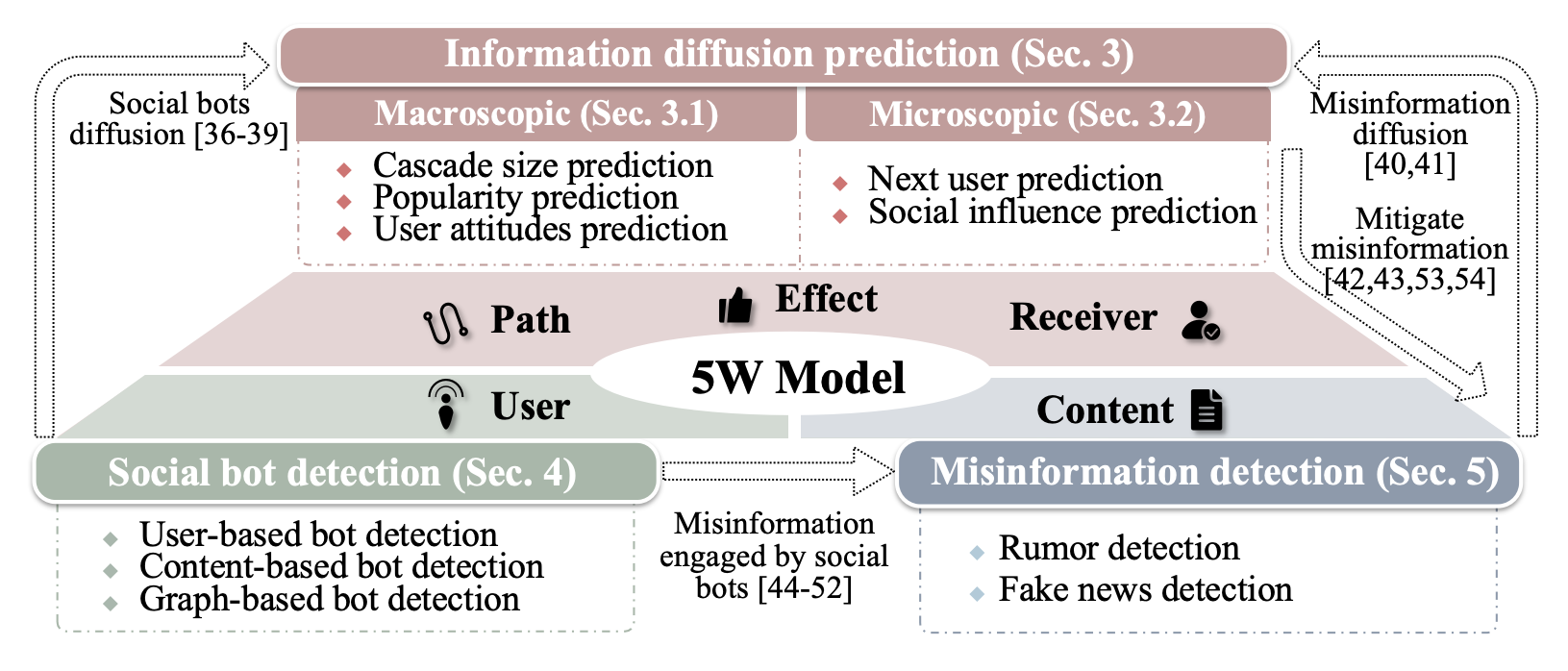
Figure 1: Categorization of information diffusion tasks under the "5W Model" framework includes information diffusion prediction, social bot detection and misinformation detection, along with their respective subtasks and interrelationships.
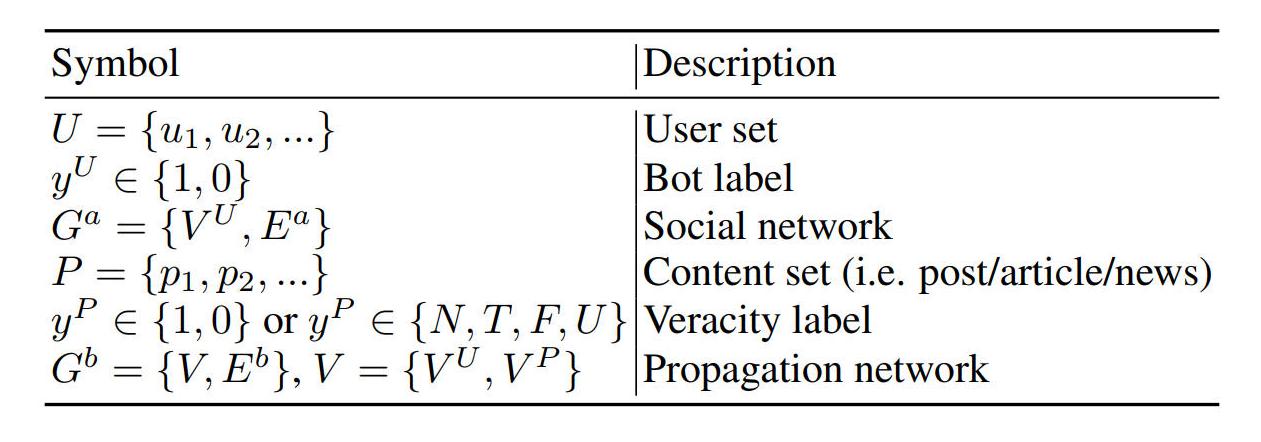
Attributes for user:
Attributes for content:
NB: Propagation network edges $E^b$ can be further divided into the following three types based on whether nodes represent users or contents in different tasks.
For user-to-user interactions in information diffusion prediction, the edges $E^{b1}$ represent the interaction relationships (click/like/repost/comment/citation) between two users $u \in V^U$ who publish the propagation content.
For content-to-content interactions in rumor detection, the edges $E^{b2}$ represent the interaction relationships (repost/comment/citation) between a post $p \in V^P$ and its repost/comment or between two reposts/comments.
For content-to-user interactions in fake news detection, the edges $E^{b3}$ represent the engagement relationships (click/like/repost/comment) between a news item $p \in V^P$ and its engagement elements such as users or between two engagement elements.
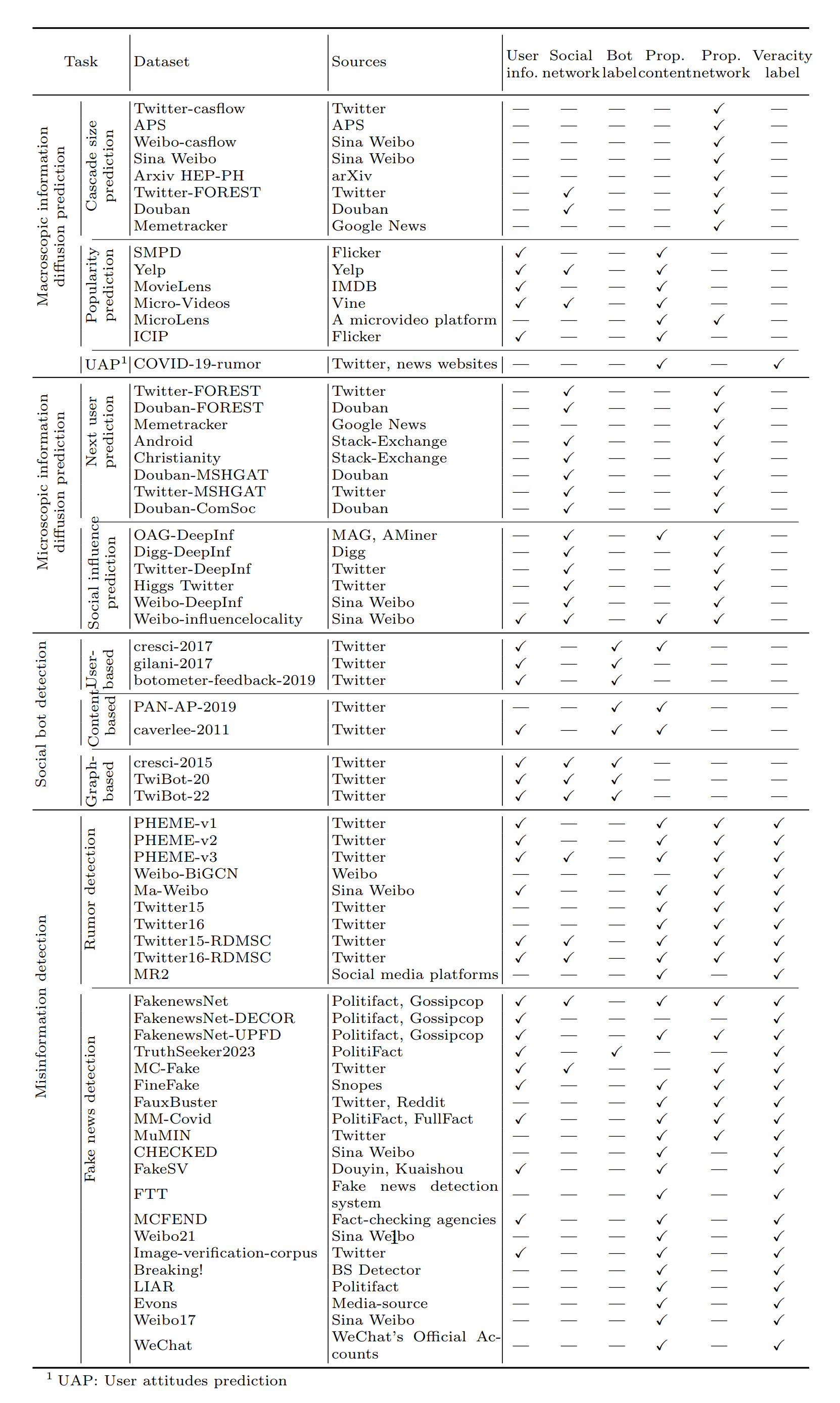
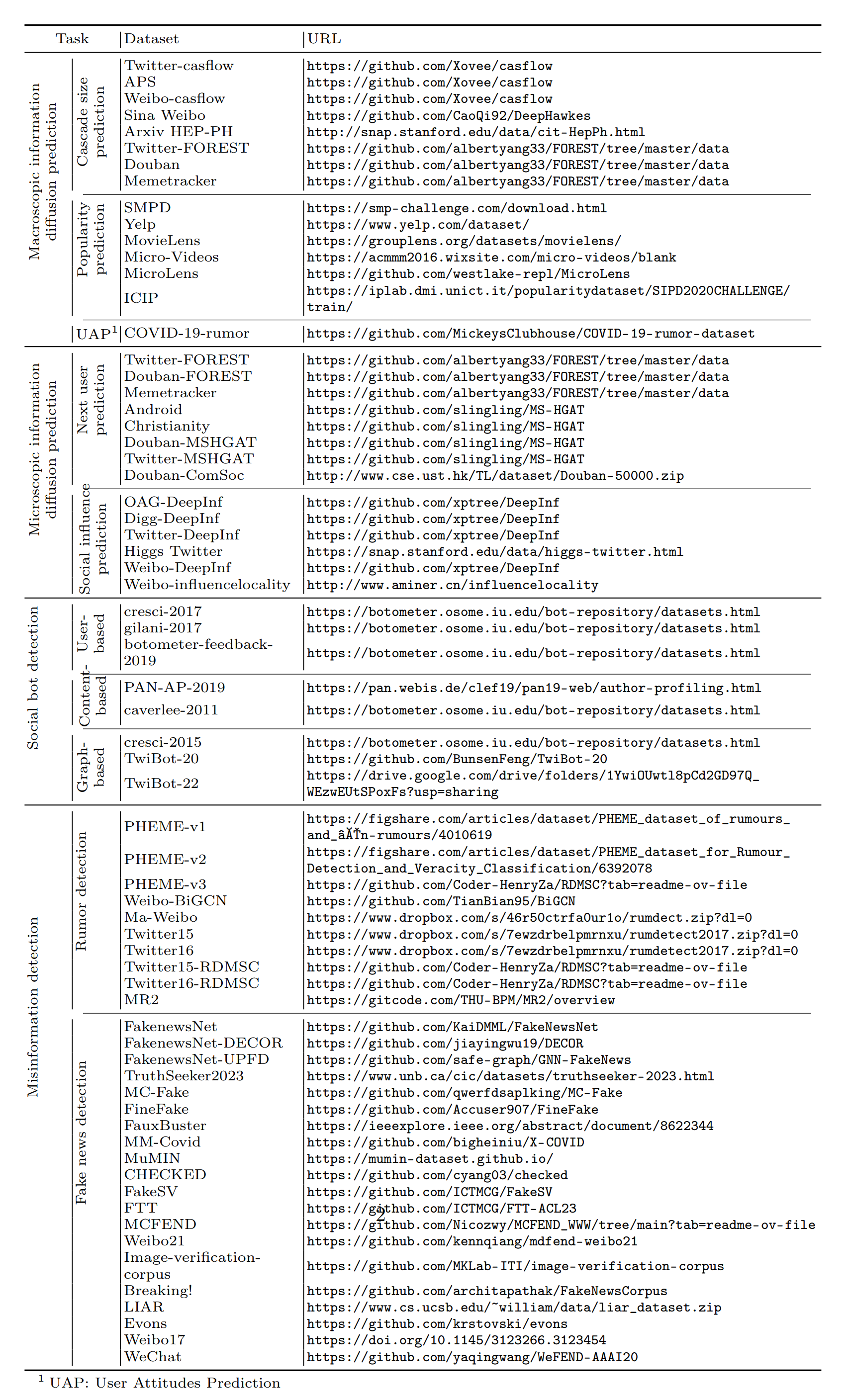
In terms of the classification of tasks and the six attributes of data, we collect sixty-five publicly available datasets used in current works for each subtask, as shown in Table 2. Additionally, the available URLs for these datasets are provided in Table 3.
Format:
- **Dataset name**
  - Source platforms of the dataset.
  - Click to download the dataset.
  - Paper: Source paper of the dataset.
  - Time horizon (if any)
Twitter-casflow
APS
Weibo-casflow
Sina-Weibo-DeepHawkes
HEP-PH
Twitter-FOREST
Douban-FOREST
Memetracker
SMPD
Yelp
MovieLens
Micro-Videos
MicroLens
ICIP
Twitter-FOREST
Douban-FOREST
Memetracker
Android
Christianity
Douban-MSHGAT
Twitter-MSHGAT
Douban-ComSoc
OAG-DeepInf
Digg-DeepInf
Twitter-DeepInf
Higgs Twitter
Weibo-DeepInf
Weibo-influencelocality
cresci-2017
gilani-2017
botometer-feedback-2019
PAN-AP-2019
caverlee-2011
cresci-2015
TwiBot-20
TwiBot-22
PHEME-v1
PHEME-v2
PHEME-v3
Weibo-BiGCN
Ma-Weibo
Twitter15
Twitter16
Twitter15-RDMSC
Twitter16-RDMSC
MR2
FakenewsNet
FakeNewsNet-DECOR
FakeNewsNet-UPFD
TruthSeeker2023
MC-Fake
FineFake
FauxBuster
MM-Covid
MuMIN
CHECKED
FakeSV
FTT
MCFEND
Weibo21
Image-verification-corpus
Breaking!
LIAR
Evons
Weibo17
Our survey paper is "A Survey of Datasets for Information Diffusion Tasks" at arXiv, which includes more detailed discussions and we will continuously update it as well. The latest version was updated on July 6, 2024.
If you find our repo is helpful, please consider cite it.
@misc{guo2024survey,
      title={A Survey of Datasets for Information Diffusion Tasks},
      author={Fuxia Guo and Xiaowen Wang and Yanwei Xie and Zehao Wang and Jingqiu Li and Lanjun Wang},
      year={2024},
      eprint={2407.05161},
      archivePrefix={arXiv},
      primaryClass={cs.SI},
      url={https://arxiv.org/abs/2407.05161},
}
Datasets for Information Diffusion Tasks is released under the Apache 2.0 license.
Dataset repository of our survey paper "A Survey of Datasets for Information Diffusion Tasks".
38
29 commits
updated Jun 13, 2025
This is a collection of datasets for information diffusion tasks for A Survey of Datasets for Information Diffusion Tasks. The paper can be downloaded here.
We survey a systematic taxonomy of information diffusion tasks and datasets based on the "5W Model" framework.
We categorize the information diffusion tasks into ten subtasks with definitions, datasets analysis and representative methodologies, from three main tasks of information diffusion prediction, social bot detection, and misinformation detection.
We collect the publicly available dataset repository of information diffusion tasks with the available links and compare them based on six attributes affiliated to users and content: user information, social network, bot label, propagation content, propagation network, and veracity label.
We discuss the limitations and future directions of current datasets and research topics to advance the future development of information diffusion.
Figure 1: Categorization of information diffusion tasks under the "5W Model" framework includes information diffusion prediction, social bot detection and misinformation detection, along with their respective subtasks and interrelationships.
Attributes for user:
Attributes for content:
NB: Propagation network edges $E^b$ can be further divided into the following three types based on whether nodes represent users or contents in different tasks.
For user-to-user interactions in information diffusion prediction, the edges $E^{b1}$ represent the interaction relationships (click/like/repost/comment/citation) between two users $u \in V^U$ who publish the propagation content.
For content-to-content interactions in rumor detection, the edges $E^{b2}$ represent the interaction relationships (repost/comment/citation) between a post $p \in V^P$ and its repost/comment or between two reposts/comments.
For content-to-user interactions in fake news detection, the edges $E^{b3}$ represent the engagement relationships (click/like/repost/comment) between a news item $p \in V^P$ and its engagement elements such as users or between two engagement elements.
In terms of the classification of tasks and the six attributes of data, we collect sixty-five publicly available datasets used in current works for each subtask, as shown in Table 2. Additionally, the available URLs for these datasets are provided in Table 3.
Format:
- **Dataset name**
  - Source platforms of the dataset.
  - Click to download the dataset.
  - Paper: Source paper of the dataset.
  - Time horizon (if any)
Twitter-casflow
APS
Weibo-casflow
Sina-Weibo-DeepHawkes
HEP-PH
Twitter-FOREST
Douban-FOREST
Memetracker
SMPD
Yelp
MovieLens
Micro-Videos
MicroLens
ICIP
Twitter-FOREST
Douban-FOREST
Memetracker
Android
Christianity
Douban-MSHGAT
Twitter-MSHGAT
Douban-ComSoc
OAG-DeepInf
Digg-DeepInf
Twitter-DeepInf
Higgs Twitter
Weibo-DeepInf
Weibo-influencelocality
cresci-2017
gilani-2017
botometer-feedback-2019
PAN-AP-2019
caverlee-2011
cresci-2015
TwiBot-20
TwiBot-22
PHEME-v1
PHEME-v2
PHEME-v3
Weibo-BiGCN
Ma-Weibo
Twitter15
Twitter16
Twitter15-RDMSC
Twitter16-RDMSC
MR2
FakenewsNet
FakeNewsNet-DECOR
FakeNewsNet-UPFD
TruthSeeker2023
MC-Fake
FineFake
FauxBuster
MM-Covid
MuMIN
CHECKED
FakeSV
FTT
MCFEND
Weibo21
Image-verification-corpus
Breaking!
LIAR
Evons
Weibo17
Our survey paper is "A Survey of Datasets for Information Diffusion Tasks" at arXiv, which includes more detailed discussions and we will continuously update it as well. The latest version was updated on July 6, 2024.
If you find our repo is helpful, please consider cite it.
@misc{guo2024survey,
      title={A Survey of Datasets for Information Diffusion Tasks},
      author={Fuxia Guo and Xiaowen Wang and Yanwei Xie and Zehao Wang and Jingqiu Li and Lanjun Wang},
      year={2024},
      eprint={2407.05161},
      archivePrefix={arXiv},
      primaryClass={cs.SI},
      url={https://arxiv.org/abs/2407.05161},
}
Datasets for Information Diffusion Tasks is released under the Apache 2.0 license.



