A music generator built on Gradio, generating music based on users' prompts and their choice of genres, themes and moods
Python
5
26 commits
updated Sep 16, 2025

MiloMusic is an innovative platform that leverages multiple AI models to democratize music creation. Whether you're a seasoned musician or have zero musical training, MiloMusic enables you to create high-quality, lyrics-focused music through natural language conversation.
A platform for everyone - regardless of musical training at the intersection of AI and creative expression.
Try MiloMusic online: Hugging Face Space
The demo is deployed on Nvidia 1 ✖ L40S with 62GB RAM and 48GB VRAM.
Note: Local deployment references deepbeepmeep/YuEGP, while the Hugging Face Space deployment references multimodal-art-projection/YuE.
Important: The files requirements_space.txt, README_SPACES.md, app_space.py, and packages.txt are configuration files specifically for YuEGP's Hugging Face Space deployment and are not used in this project. They are also not applicable to HugMilo/MiloMusic since it is based on YuE rather than YuEGP.
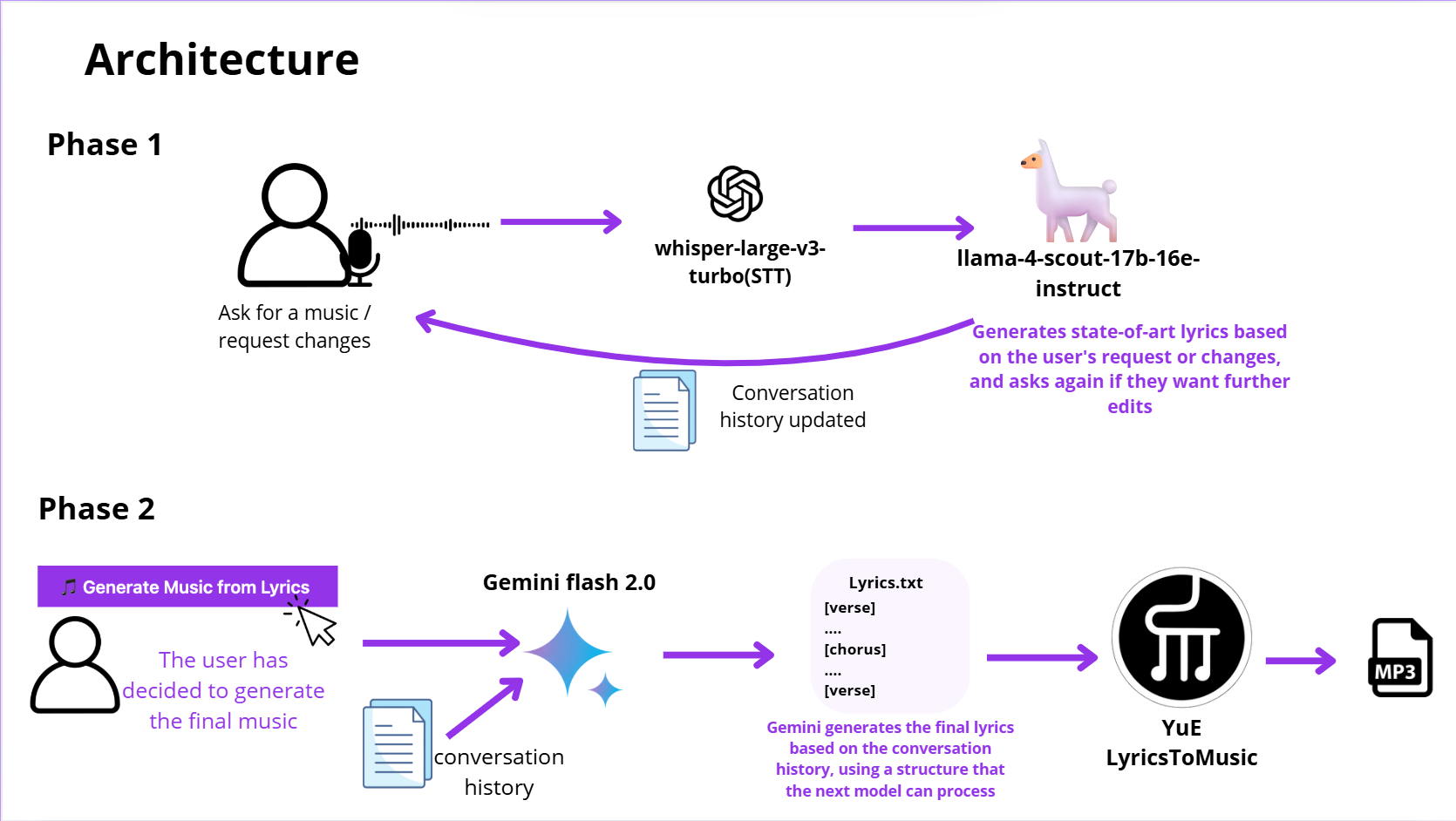
MiloMusic employs a sophisticated multi-model pipeline to deliver a seamless music creation experience:
whisper-large-v3-turbo(STT)llama-4-scout-17b-16e-instruct handles the creative conversation, generates lyrics based on user requests, and allows for iterative refinementGemini flash 2.0 processes the conversation history and structures the final lyrics for music generationYuE (乐) transforms the structured lyrics into complete songs with vocals and instrumentationwhisper-large-v3-turbo(STT) - For speech-to-text conversionllama-4-scout-17b-16e-instruct - For creative conversation and lyrics generationGemini flash 2.0 - For lyrics structuringYuE - For music generationpyproject.toml# Clone the repository
git clone https://github.com/futurespyhi/MiloMusic.git
cd MiloMusic
# Install dependencies using uv
uv sync --index-strategy unsafe-best-match
# Install flash-attn separately (due to ABI compatibility issues with PyTorch)
uv pip install --no-build-isolation --no-cache-dir flash-attn
# Run the application
uv run python app.py
MiloMusic can run in two configurations:
| Challenge | Solution |
|---|---|
| Multi-model & multi-API setup | Implemented seamless integration between different AI models and APIs |
| Compatibility issues | Developed custom adapters for model interoperability |
| Gradio limitations | Extended Gradio code to overcome structural design issues |
| Computational constraints | Implemented model quantization to support consumer GPUs |
Contributions are welcome! Please feel free to submit a Pull Request.
This project is licensed under the BSD 3-Clause License - see the LICENSE file for details.
Special thanks to the following projects that made MiloMusic possible:
Made with ❤️ and 🦙 (LLaMA)
A music generator built on Gradio, generating music based on users' prompts and their choice of genres, themes and moods
Python
5
26 commits
updated Sep 16, 2025
MiloMusic is an innovative platform that leverages multiple AI models to democratize music creation. Whether you're a seasoned musician or have zero musical training, MiloMusic enables you to create high-quality, lyrics-focused music through natural language conversation.
A platform for everyone - regardless of musical training at the intersection of AI and creative expression.
Try MiloMusic online: Hugging Face Space
The demo is deployed on Nvidia 1 ✖ L40S with 62GB RAM and 48GB VRAM.
Note: Local deployment references deepbeepmeep/YuEGP, while the Hugging Face Space deployment references multimodal-art-projection/YuE.
Important: The files requirements_space.txt, README_SPACES.md, app_space.py, and packages.txt are configuration files specifically for YuEGP's Hugging Face Space deployment and are not used in this project. They are also not applicable to HugMilo/MiloMusic since it is based on YuE rather than YuEGP.
MiloMusic employs a sophisticated multi-model pipeline to deliver a seamless music creation experience:
whisper-large-v3-turbo(STT)llama-4-scout-17b-16e-instruct handles the creative conversation, generates lyrics based on user requests, and allows for iterative refinementGemini flash 2.0 processes the conversation history and structures the final lyrics for music generationYuE (乐) transforms the structured lyrics into complete songs with vocals and instrumentationwhisper-large-v3-turbo(STT) - For speech-to-text conversionllama-4-scout-17b-16e-instruct - For creative conversation and lyrics generationGemini flash 2.0 - For lyrics structuringYuE - For music generationpyproject.toml# Clone the repository
git clone https://github.com/futurespyhi/MiloMusic.git
cd MiloMusic
# Install dependencies using uv
uv sync --index-strategy unsafe-best-match
# Install flash-attn separately (due to ABI compatibility issues with PyTorch)
uv pip install --no-build-isolation --no-cache-dir flash-attn
# Run the application
uv run python app.py
MiloMusic can run in two configurations:
| Challenge | Solution |
|---|---|
| Multi-model & multi-API setup | Implemented seamless integration between different AI models and APIs |
| Compatibility issues | Developed custom adapters for model interoperability |
| Gradio limitations | Extended Gradio code to overcome structural design issues |
| Computational constraints | Implemented model quantization to support consumer GPUs |
Contributions are welcome! Please feel free to submit a Pull Request.
This project is licensed under the BSD 3-Clause License - see the LICENSE file for details.
Special thanks to the following projects that made MiloMusic possible:
Made with ❤️ and 🦙 (LLaMA)