
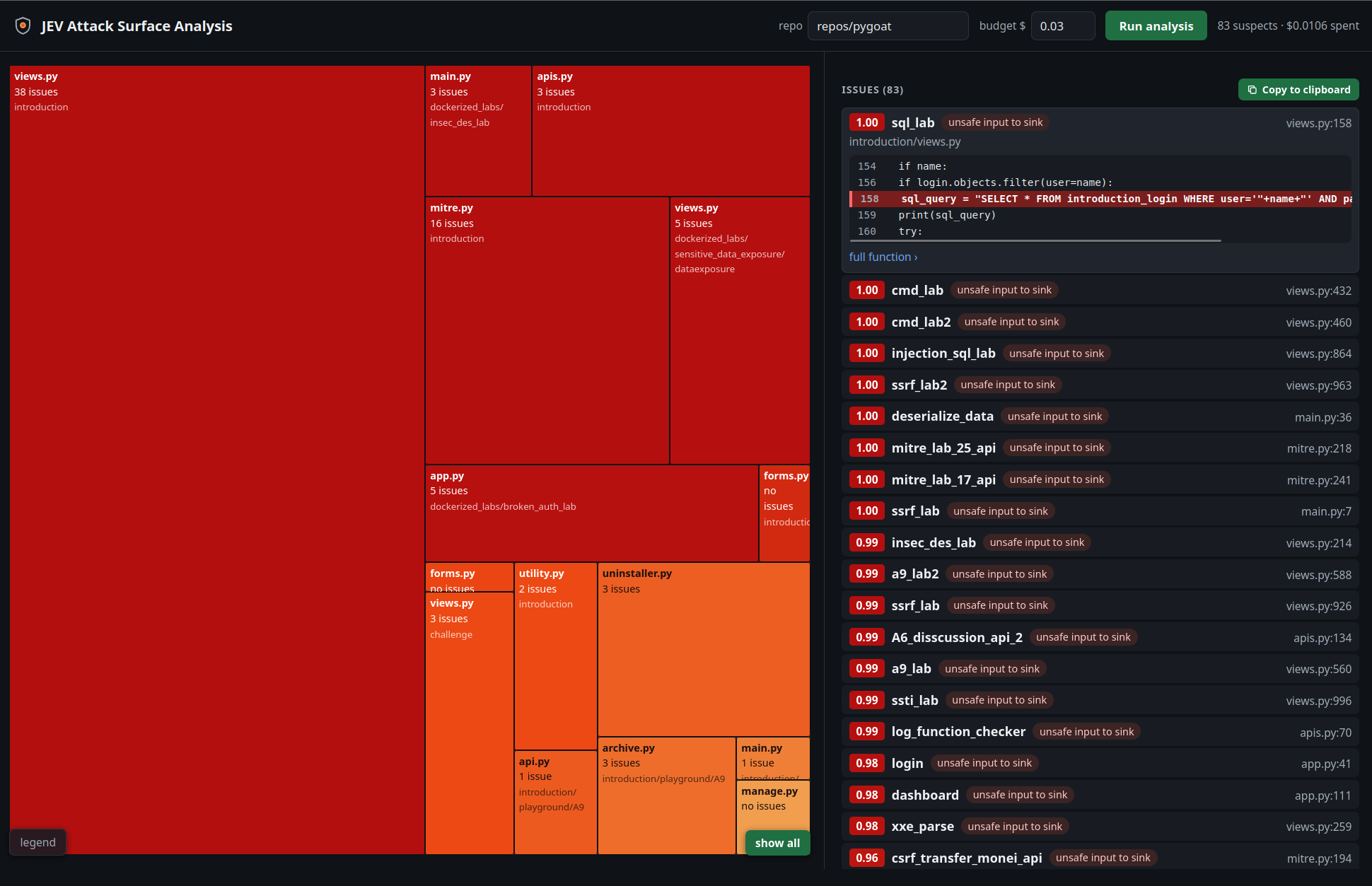
Attack surface heatmap of a Python or JS Ts codebase, ranked top-down by the jev classifier on a fixed budget
Python
0
5 commits
updated Oct 2, 2026
See what people are saying
README
JEV Attack Surface Analysis
Maps the attack surface of a backend codebase and flags likely vulnerabilities, down to the suspicious line, for about one cent per repo.
Try it without installing anything: https://franciscocarloserra.github.io/jev-attack-surface-analysis/ (read-only results on PyGoat and NodeGoat).
What it does
You give it a repo (Python, JavaScript or TypeScript) and a budget in dollars. You get:
- a map of the codebase, one block per file, colored by how suspicious it is;
- a ranked list of potential vulnerabilities, each pointing to the exact line
(e.g. user input reaching SQL,
eval, a shell or an outbound request); - a copy button (or
print_issues.py) that hands that list to an AI agent, with the instruction to validate each issue, not to fix it.
No LLM is involved. Plain Python reads the code; jev, a classifier that answers fixed questions with probabilities in under a second and at about $42 per billion input tokens, does all the judging.
How it works
Like a magnifying glass: it looks at the whole repo coarsely, then zooms into the suspicious parts only. At each level jev rates every item, and only the hot ones are opened at the next level.
repo
 │
 ▼  1. directories   jev reads names only            → drops tests, docs, migrations
 │
 ▼  2. files         jev reads imports + signatures  → exposure: none / low / medium / high
 │
 ▼  3. functions     jev reads the code              → does external input reach a dangerous operation?
 │
 ▼  4. lines         jev picks one of the function's lines → where the vulnerability happens
 │
 ▼
ranked issues ──► viewer / copy ──► your agent validates them
- Heat (0 to 1): how suspicious an item is, computed from jev's probabilities.
- Budget: each level gets a share; what one level does not spend passes to the next. The hottest items go first, so if money runs out, what is left out is the least suspicious.
Results so far
Tested only against two apps that are vulnerable on purpose (measured 2026-10-02):
| Repo | Language | Cost | Top issues found |
|---|---|---|---|
| PyGoat | Python / Django | $0.010 | SQL injection, eval, pickle.loads, SSRF |
| NodeGoat | JavaScript / Express | $0.007 | eval on request body, open redirect, SSRF, NoSQL $where injection |
Run it
You need a TypeSafe API key for jev.
python3 -m venv .venv && .venv/bin/pip install -r requirements.txt
export TYPESAFE_API_KEY=...
git clone --depth 1 https://github.com/adeyosemanputra/pygoat repos/pygoat

python3 viewer_server.py        # open http://localhost:7801/heatmap_viewer.html
In the viewer pick the repo, set a budget (max $0.05 per run) and press Run analysis. From the shell instead:
.venv/bin/python attack_surface_scan.py repos/pygoat --budget 0.03
python3 print_issues.py examples/pygoat/scan_result.json --top 10
Every run is saved in examples/<repo>/runs/<run id>.json (with date, scanner version and
settings hash) and the latest one in examples/<repo>/scan_result.json.
Agents: see AGENTS.md for the commands and the result format.
Files
| File | What it is |
|---|---|
attack_surface_scan.py | the scanner |
classification_levels.json | every setting: questions to jev, categories, thresholds, budget shares, languages |
heatmap_viewer.html + viewer_server.py | the viewer, and the small server that lets it start runs |
print_issues.py | issue list as text, for agents |
examples/ | saved runs |
Adapt it
- Ask different questions or change thresholds: edit
classification_levels.json. - Add a language: add an entry to
languagesin the same file (file extensions and the parser's names for imports, functions and classes). - Add a level (e.g. HTTP routes): write one
extract_<unit>function inattack_surface_scan.py, register it inUNIT_EXTRACTORSand add the level to the JSON.
Limits
- It ranks candidates for review; it does not prove a vulnerability exists.
- Each function is judged on its own, so a flaw spread across several functions can be missed.
Similar repos


Languages
Python
51.7%
HTML
48.3%
Attack surface heatmap of a Python or JS Ts codebase, ranked top-down by the jev classifier on a fixed budget
Python
0
5 commits
updated Oct 2, 2026
See what people are saying
README
JEV Attack Surface Analysis
Maps the attack surface of a backend codebase and flags likely vulnerabilities, down to the suspicious line, for about one cent per repo.
Try it without installing anything: https://franciscocarloserra.github.io/jev-attack-surface-analysis/ (read-only results on PyGoat and NodeGoat).
What it does
You give it a repo (Python, JavaScript or TypeScript) and a budget in dollars. You get:
- a map of the codebase, one block per file, colored by how suspicious it is;
- a ranked list of potential vulnerabilities, each pointing to the exact line
(e.g. user input reaching SQL,
eval, a shell or an outbound request); - a copy button (or
print_issues.py) that hands that list to an AI agent, with the instruction to validate each issue, not to fix it.
No LLM is involved. Plain Python reads the code; jev, a classifier that answers fixed questions with probabilities in under a second and at about $42 per billion input tokens, does all the judging.
How it works
Like a magnifying glass: it looks at the whole repo coarsely, then zooms into the suspicious parts only. At each level jev rates every item, and only the hot ones are opened at the next level.
repo
 │
 ▼  1. directories   jev reads names only            → drops tests, docs, migrations
 │
 ▼  2. files         jev reads imports + signatures  → exposure: none / low / medium / high
 │
 ▼  3. functions     jev reads the code              → does external input reach a dangerous operation?
 │
 ▼  4. lines         jev picks one of the function's lines → where the vulnerability happens
 │
 ▼
ranked issues ──► viewer / copy ──► your agent validates them
- Heat (0 to 1): how suspicious an item is, computed from jev's probabilities.
- Budget: each level gets a share; what one level does not spend passes to the next. The hottest items go first, so if money runs out, what is left out is the least suspicious.
Results so far
Tested only against two apps that are vulnerable on purpose (measured 2026-10-02):
| Repo | Language | Cost | Top issues found |
|---|---|---|---|
| PyGoat | Python / Django | $0.010 | SQL injection, eval, pickle.loads, SSRF |
| NodeGoat | JavaScript / Express | $0.007 | eval on request body, open redirect, SSRF, NoSQL $where injection |
Run it
You need a TypeSafe API key for jev.
python3 -m venv .venv && .venv/bin/pip install -r requirements.txt
export TYPESAFE_API_KEY=...
git clone --depth 1 https://github.com/adeyosemanputra/pygoat repos/pygoat

python3 viewer_server.py        # open http://localhost:7801/heatmap_viewer.html
In the viewer pick the repo, set a budget (max $0.05 per run) and press Run analysis. From the shell instead:
.venv/bin/python attack_surface_scan.py repos/pygoat --budget 0.03
python3 print_issues.py examples/pygoat/scan_result.json --top 10
Every run is saved in examples/<repo>/runs/<run id>.json (with date, scanner version and
settings hash) and the latest one in examples/<repo>/scan_result.json.
Agents: see AGENTS.md for the commands and the result format.
Files
| File | What it is |
|---|---|
attack_surface_scan.py | the scanner |
classification_levels.json | every setting: questions to jev, categories, thresholds, budget shares, languages |
heatmap_viewer.html + viewer_server.py | the viewer, and the small server that lets it start runs |
print_issues.py | issue list as text, for agents |
examples/ | saved runs |
Adapt it
- Ask different questions or change thresholds: edit
classification_levels.json. - Add a language: add an entry to
languagesin the same file (file extensions and the parser's names for imports, functions and classes). - Add a level (e.g. HTTP routes): write one
extract_<unit>function inattack_surface_scan.py, register it inUNIT_EXTRACTORSand add the level to the JSON.
Limits
- It ranks candidates for review; it does not prove a vulnerability exists.
- Each function is judged on its own, so a flaw spread across several functions can be missed.
Similar repos
Languages
Python
51.7%
HTML
48.3%