Interactive semantic map of all 9,110 accepted NeurIPS 2026 papers using SPECTER2, UMAP and HDBSCAN.
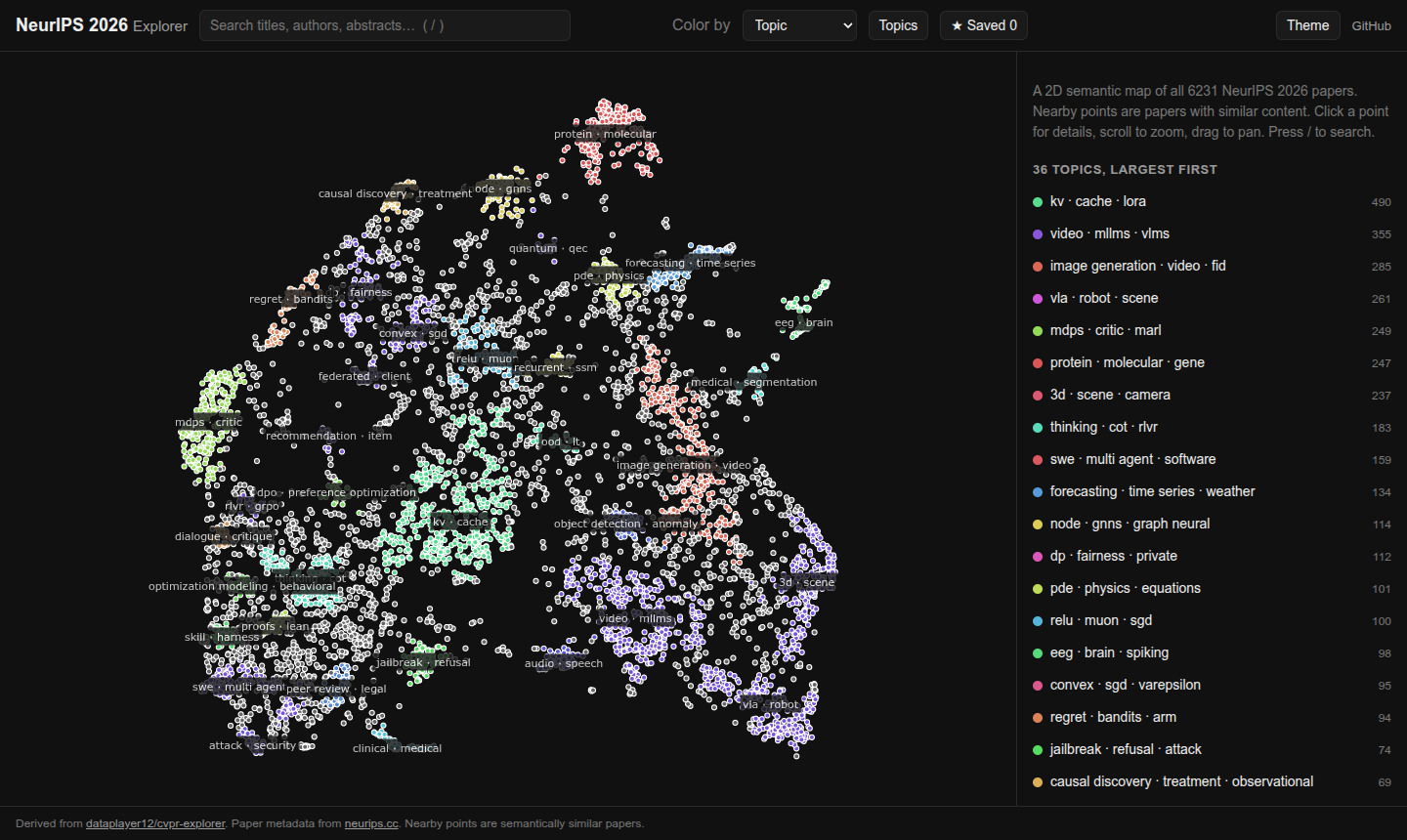
See the codeA 2D semantic map of the accepted NeurIPS 2026 papers, built from SPECTER2 embeddings of titles and abstracts. Nearby points are semantically similar papers, so a cluster is a topic.
Live site: https://flecomet.github.io/neurips-explorer/
Derived from flecomet/cvpr-explorer. See Credits.
The repository contains paper metadata, embeddings, and a generated map layout for 9,110
distinct paper titles supported by the virtual site. This is source coverage, not an independently
verified acceptance total. The Pages workflow builds the browser payloads and publishes site/.
The 11 October data refresh removed 56 duplicate records from a 9,167-record scrape and excluded one previous record whose paper page returned HTTP 404. It retains 126 alternative identifiers so saved papers and shared paper links resolve to the corresponding current paper. Text vectors were reused for 8,693 identical model inputs from the completed refresh and recomputed for 417 papers. Input hashes and the excluded record are in the refresh provenance.
public_submissions = false,
and every 2026 query returns 0 notes while 2025 returns papers). It also answers scripts running
on GitHub's servers with a human-verification challenge. scrape.py (OpenReview) is kept for
when the papers are published./static/virtual/data/neurips-2026-orals-posters.json and ...-abstracts.json), which
scrape_site.py downloads. The abstract extraction from a paper page was checked against the real
site. The layout of the two JSON files was not known when the parser was written, so field names
are looked up from lists of likely candidates, and every run prints the structure it found.
python scrape_site.py --probe prints that structure without writing anything.
Papers absent from the listing are recovered from their pages. Previous identifiers become
aliases for matching titles; a previous-only title is retained only after its page and abstract
are verified. The site build rejects duplicate titles and conflicting aliases.?p=<paper id>, ?q=<search>, ?c=<topic>, ?location=Atlanta&location=Paris&presentation=oral,
?track=Position&location=Paris,
and ?scope=authors&author-id=neurips:149508. Name-only selections use author-id=name:<normalized name>.
Legacy author=<name> links select every account and unverified name group with that full name.
Author selections persist when opening or saving papers./ search, Esc clear), usable on a phone.data.json, a few hundred KB gzipped) loads first, abstracts
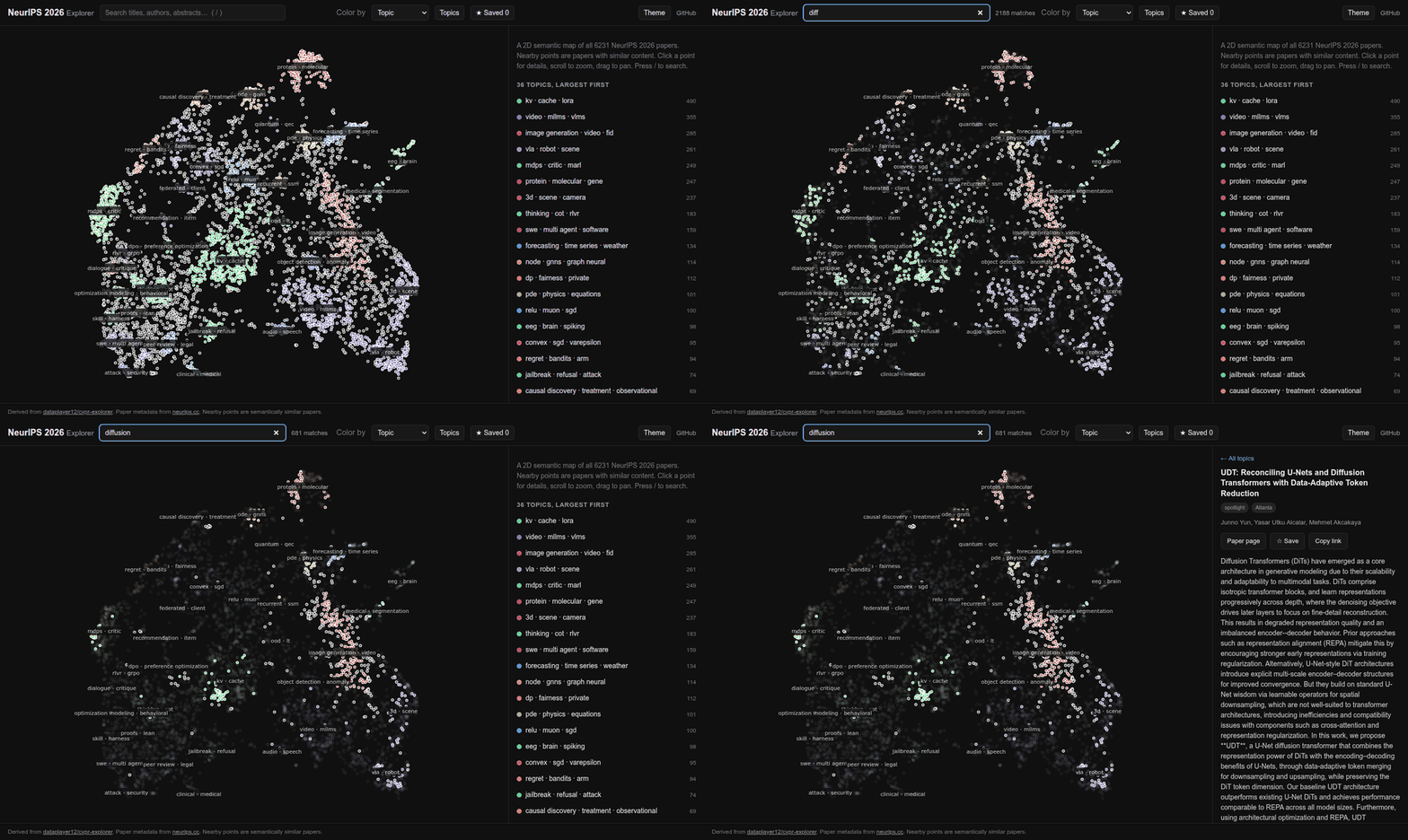
(details.json) load afterwards.Each point is one paper. Position comes from the title and abstract: papers with similar text land close together. Colours mark topics, and topic names are drawn on the map. Papers that fit no topic share one neutral colour and are listed as "unclustered".
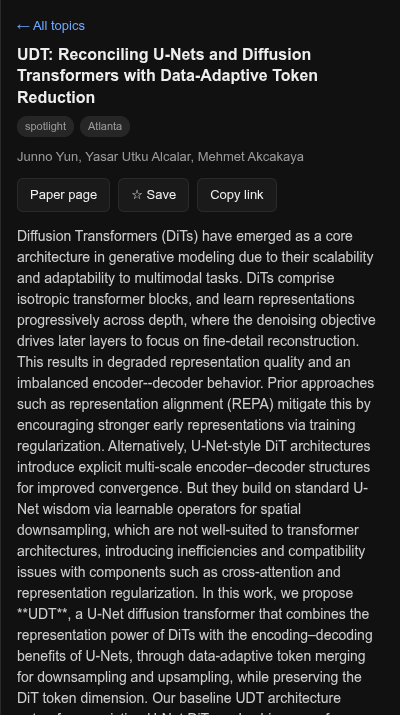
Clicking a point opens the paper panel, shown here.
Author groups are assembled manually. For 5,815 of the 9,110 papers, author identities and institutions come from the public NeurIPS listing. Publications are grouped by NeurIPS account identifier, so accounts sharing a name stay separate. Selecting an account excludes papers whose authors have no identifier. An account identifier identifies a NeurIPS account; one person may have several accounts.
The remaining 3,295 papers use name-only groups marked "identity not verified". Identical full names can combine papers across people within these groups, while spelling variants remain separate. Name matching ignores case, Unicode representation, and extra whitespace, but preserves accents and punctuation.
The author enrichment matched both the title and the complete ordered author list before attaching identifiers. One further title matched the source, but its local author list contains a repeated name and was left unverified. The enrichment provenance records coverage and preservation checks.
Track labels come from the listing's sourceurl, which identifies the OpenReview submission venue or a journal
track spreadsheet. The 12 October enrichment combined three downloaded listings from 11 and 12 October,
matching the title plus either an event identifier or the complete author list. Conflicting assignments remain
Unknown. Of the 9,110 papers, 7,803 are Main, 967 E&D, 136 Position, 85 Journal, and 119 Unknown.
The track enrichment provenance records source hashes and preservation checks.
Distances are approximate. UMAP, the 2D projection method, preserves local neighbourhoods better than global distances. Read "these two papers are close" as meaningful, and "this topic is twice as far away as that one" as unreliable.
The pipeline finds 59 topics. A further 3,758 of the 9,110 papers (41%) belong to none of them. Topic names are generated automatically from the paper text.
| Papers | Topic name |
|---|---|
| 386 | mdps · critic · multi agent |
| 354 | protein · molecular · gene |
| 243 | 3d · scene · camera |
| 238 | muon · relu · recurrent |
| 200 | thinking · cot · thought |
| 191 | gnns · graph neural · subgraph |
| 185 | image generation · pixel · dit |
| 168 | debate · social · moral |
The pipeline is offline and the site is static (no backend, no API keys at serve time).
| Step | Script | Output |
|---|---|---|
| Fetch accepted papers from neurips.cc (or OpenReview) | scrape_site.py (scrape.py) | data/neurips_2026_papers.json |
| Embed title + abstract with SPECTER2 | embed.py | data/neurips_2026_specter2.npy (float16) |
| UMAP to 2D, HDBSCAN clusters, TF-IDF topic names, nearest neighbours | layout.py | data/neurips_2026_layout.json |
| Merge into the site payload | build_site.py | site/data.json, site/details.json |
layout.py runs UMAP on the cosine-normalised embeddings, then HDBSCAN, a density-based
clustering method, on the 2D coordinates. Topic names use TF-IDF: terms score high when they
are frequent in one topic and rare in the others.
templates/index.html is the page template. build_site.py writes it to site/index.html,
which renders the payload client-side with plotly.js.
main.data/neurips_2026_layout.json is present, run Deploy site to GitHub Pages in the
Actions tab. To generate or refresh the data, run Refresh data with source neurips.cc.
It runs the whole pipeline on a GitHub runner, commits data/, and starts the Pages
deployment. Embedding on a CPU takes tens of minutes. The Probe neurips.cc step prints
what the site returned; if scraping fails, that output shows what the parser needs to change.committed uses data/neurips_2026_papers.json as it is in the repository.
openreview does not work from GitHub runners (human-verification challenge). Once OpenReview
publishes the papers, scrape from your own machine with python scrape.py. Commit the data
and run the workflow with source committed. The venue ids are in config.py.When paper metadata, text vectors, and layout are already regenerated together, merging them
to main starts the Pages deployment. No new scrape or Refresh data run is required. For the
11 October cleaned dataset, use the integration pull request instead of the earlier data-only
refresh pull request, which still contains duplicate records.
To view the committed paper data and map layout, build the browser payloads and serve them:
python build_site.py
python -m http.server --directory site 8000
Open http://localhost:8000/. Opening site/index.html directly as a local file prevents the
browser from fetching the paper data. site/data.json and site/details.json are generated
files and are rebuilt after cloning or updating the repository.
To add author identifiers to existing paper metadata, download the public NeurIPS listing JSON and use it as a local snapshot. This updates author metadata while preserving paper order, titles, abstracts, embeddings, and map layout. Rebuild the site afterwards; the embedding and layout stages do not need to run.
python scrape_site.py --enrich-authors /path/to/neurips-2026-orals-posters.json
python build_site.py
Track enrichment also works from downloaded listing JSON files. Multiple snapshots improve coverage when the
live listing omits previously published papers. Only track metadata changes; paper order and map layout remain
unchanged. A repeated --enrich-tracks combines snapshots before checking for conflicting assignments.
python scrape_site.py --enrich-tracks /path/to/listing.json --enrich-tracks /path/to/earlier-listing.json
python build_site.py
To regenerate the paper data, embeddings, and layout:
pip install -r requirements-pipeline.txt
python scrape_site.py   # neurips.cc; for OpenReview: python scrape.py
python embed.py         # GPU recommended, CPU works
python layout.py        # --min-cluster-size 25 --n-neighbors 15
python build_site.py
python -m http.server -d site 8000   # http://localhost:8000
Tests: pip install -r requirements-dev.txt && python -m pytest.
layout.py is deterministic for fixed inputs (UMAP random_state=42) so reruns keep the map
stable. Changing the embeddings or paper set changes the map.--min-cluster-size 25. Lower it for
more, smaller topics.This repository is the template source for the sister explorers, currently
cvpr-explorer. The files listed in SHARED in
sync_template.py read every conference-specific value from config.py, and
build_site.py renders templates/index.html into site/index.html. Edit shared files
here, then copy them across:
python sync_template.py ../cvpr-explorer --test    # run its tests with these files
python sync_template.py ../cvpr-explorer --check   # list differing files
python sync_template.py ../cvpr-explorer           # copy them
python sync_template.py ../cvpr-explorer --commit  # copy and commit in a clean checkout
The "Sister explorers" workflow tests both repositories on pushes and pull requests.
After successful checks on main, it copies the shared files to the sister repository,
commits changes, and pushes its main branch. Manual workflow runs on main also sync.
Conference data, configuration, and README files remain specific to each repository.
The commit uses the source commit's author identity, and creates no commit when files match.
Automatic synchronization requires a repository Actions secret named SISTER_SYNC_TOKEN
in this repository. Use a fine-grained GitHub personal access token restricted to
flecomet/cvpr-explorer, with Contents and Workflows read and write permissions.
Workflows permission is required because the shared files include workflow definitions.
The token also lets the sister push trigger its tests and Pages deployment.
Without this secret, the sync job fails with a setup message; compatibility tests still run.
Sister branch protection must permit the token owner to push to main.
Derived from flecomet/cvpr-explorer, itself a fork of dataplayer12/cvpr-explorer. The original idea and design are by @dataplayer12. Same licence as upstream, see LICENSE.
Interactive semantic map of all 9,110 accepted NeurIPS 2026 papers using SPECTER2, UMAP and HDBSCAN.
See the codeA 2D semantic map of the accepted NeurIPS 2026 papers, built from SPECTER2 embeddings of titles and abstracts. Nearby points are semantically similar papers, so a cluster is a topic.
Live site: https://flecomet.github.io/neurips-explorer/
Derived from flecomet/cvpr-explorer. See Credits.
The repository contains paper metadata, embeddings, and a generated map layout for 9,110
distinct paper titles supported by the virtual site. This is source coverage, not an independently
verified acceptance total. The Pages workflow builds the browser payloads and publishes site/.
The 11 October data refresh removed 56 duplicate records from a 9,167-record scrape and excluded one previous record whose paper page returned HTTP 404. It retains 126 alternative identifiers so saved papers and shared paper links resolve to the corresponding current paper. Text vectors were reused for 8,693 identical model inputs from the completed refresh and recomputed for 417 papers. Input hashes and the excluded record are in the refresh provenance.
public_submissions = false,
and every 2026 query returns 0 notes while 2025 returns papers). It also answers scripts running
on GitHub's servers with a human-verification challenge. scrape.py (OpenReview) is kept for
when the papers are published./static/virtual/data/neurips-2026-orals-posters.json and ...-abstracts.json), which
scrape_site.py downloads. The abstract extraction from a paper page was checked against the real
site. The layout of the two JSON files was not known when the parser was written, so field names
are looked up from lists of likely candidates, and every run prints the structure it found.
python scrape_site.py --probe prints that structure without writing anything.
Papers absent from the listing are recovered from their pages. Previous identifiers become
aliases for matching titles; a previous-only title is retained only after its page and abstract
are verified. The site build rejects duplicate titles and conflicting aliases.?p=<paper id>, ?q=<search>, ?c=<topic>, ?location=Atlanta&location=Paris&presentation=oral,
?track=Position&location=Paris,
and ?scope=authors&author-id=neurips:149508. Name-only selections use author-id=name:<normalized name>.
Legacy author=<name> links select every account and unverified name group with that full name.
Author selections persist when opening or saving papers./ search, Esc clear), usable on a phone.data.json, a few hundred KB gzipped) loads first, abstracts
(details.json) load afterwards.Each point is one paper. Position comes from the title and abstract: papers with similar text land close together. Colours mark topics, and topic names are drawn on the map. Papers that fit no topic share one neutral colour and are listed as "unclustered".
Clicking a point opens the paper panel, shown here.
Author groups are assembled manually. For 5,815 of the 9,110 papers, author identities and institutions come from the public NeurIPS listing. Publications are grouped by NeurIPS account identifier, so accounts sharing a name stay separate. Selecting an account excludes papers whose authors have no identifier. An account identifier identifies a NeurIPS account; one person may have several accounts.
The remaining 3,295 papers use name-only groups marked "identity not verified". Identical full names can combine papers across people within these groups, while spelling variants remain separate. Name matching ignores case, Unicode representation, and extra whitespace, but preserves accents and punctuation.
The author enrichment matched both the title and the complete ordered author list before attaching identifiers. One further title matched the source, but its local author list contains a repeated name and was left unverified. The enrichment provenance records coverage and preservation checks.
Track labels come from the listing's sourceurl, which identifies the OpenReview submission venue or a journal
track spreadsheet. The 12 October enrichment combined three downloaded listings from 11 and 12 October,
matching the title plus either an event identifier or the complete author list. Conflicting assignments remain
Unknown. Of the 9,110 papers, 7,803 are Main, 967 E&D, 136 Position, 85 Journal, and 119 Unknown.
The track enrichment provenance records source hashes and preservation checks.
Distances are approximate. UMAP, the 2D projection method, preserves local neighbourhoods better than global distances. Read "these two papers are close" as meaningful, and "this topic is twice as far away as that one" as unreliable.
The pipeline finds 59 topics. A further 3,758 of the 9,110 papers (41%) belong to none of them. Topic names are generated automatically from the paper text.
| Papers | Topic name |
|---|---|
| 386 | mdps · critic · multi agent |
| 354 | protein · molecular · gene |
| 243 | 3d · scene · camera |
| 238 | muon · relu · recurrent |
| 200 | thinking · cot · thought |
| 191 | gnns · graph neural · subgraph |
| 185 | image generation · pixel · dit |
| 168 | debate · social · moral |
The pipeline is offline and the site is static (no backend, no API keys at serve time).
| Step | Script | Output |
|---|---|---|
| Fetch accepted papers from neurips.cc (or OpenReview) | scrape_site.py (scrape.py) | data/neurips_2026_papers.json |
| Embed title + abstract with SPECTER2 | embed.py | data/neurips_2026_specter2.npy (float16) |
| UMAP to 2D, HDBSCAN clusters, TF-IDF topic names, nearest neighbours | layout.py | data/neurips_2026_layout.json |
| Merge into the site payload | build_site.py | site/data.json, site/details.json |
layout.py runs UMAP on the cosine-normalised embeddings, then HDBSCAN, a density-based
clustering method, on the 2D coordinates. Topic names use TF-IDF: terms score high when they
are frequent in one topic and rare in the others.
templates/index.html is the page template. build_site.py writes it to site/index.html,
which renders the payload client-side with plotly.js.
main.data/neurips_2026_layout.json is present, run Deploy site to GitHub Pages in the
Actions tab. To generate or refresh the data, run Refresh data with source neurips.cc.
It runs the whole pipeline on a GitHub runner, commits data/, and starts the Pages
deployment. Embedding on a CPU takes tens of minutes. The Probe neurips.cc step prints
what the site returned; if scraping fails, that output shows what the parser needs to change.committed uses data/neurips_2026_papers.json as it is in the repository.
openreview does not work from GitHub runners (human-verification challenge). Once OpenReview
publishes the papers, scrape from your own machine with python scrape.py. Commit the data
and run the workflow with source committed. The venue ids are in config.py.When paper metadata, text vectors, and layout are already regenerated together, merging them
to main starts the Pages deployment. No new scrape or Refresh data run is required. For the
11 October cleaned dataset, use the integration pull request instead of the earlier data-only
refresh pull request, which still contains duplicate records.
To view the committed paper data and map layout, build the browser payloads and serve them:
python build_site.py
python -m http.server --directory site 8000
Open http://localhost:8000/. Opening site/index.html directly as a local file prevents the
browser from fetching the paper data. site/data.json and site/details.json are generated
files and are rebuilt after cloning or updating the repository.
To add author identifiers to existing paper metadata, download the public NeurIPS listing JSON and use it as a local snapshot. This updates author metadata while preserving paper order, titles, abstracts, embeddings, and map layout. Rebuild the site afterwards; the embedding and layout stages do not need to run.
python scrape_site.py --enrich-authors /path/to/neurips-2026-orals-posters.json
python build_site.py
Track enrichment also works from downloaded listing JSON files. Multiple snapshots improve coverage when the
live listing omits previously published papers. Only track metadata changes; paper order and map layout remain
unchanged. A repeated --enrich-tracks combines snapshots before checking for conflicting assignments.
python scrape_site.py --enrich-tracks /path/to/listing.json --enrich-tracks /path/to/earlier-listing.json
python build_site.py
To regenerate the paper data, embeddings, and layout:
pip install -r requirements-pipeline.txt
python scrape_site.py   # neurips.cc; for OpenReview: python scrape.py
python embed.py         # GPU recommended, CPU works
python layout.py        # --min-cluster-size 25 --n-neighbors 15
python build_site.py
python -m http.server -d site 8000   # http://localhost:8000
Tests: pip install -r requirements-dev.txt && python -m pytest.
layout.py is deterministic for fixed inputs (UMAP random_state=42) so reruns keep the map
stable. Changing the embeddings or paper set changes the map.--min-cluster-size 25. Lower it for
more, smaller topics.This repository is the template source for the sister explorers, currently
cvpr-explorer. The files listed in SHARED in
sync_template.py read every conference-specific value from config.py, and
build_site.py renders templates/index.html into site/index.html. Edit shared files
here, then copy them across:
python sync_template.py ../cvpr-explorer --test    # run its tests with these files
python sync_template.py ../cvpr-explorer --check   # list differing files
python sync_template.py ../cvpr-explorer           # copy them
python sync_template.py ../cvpr-explorer --commit  # copy and commit in a clean checkout
The "Sister explorers" workflow tests both repositories on pushes and pull requests.
After successful checks on main, it copies the shared files to the sister repository,
commits changes, and pushes its main branch. Manual workflow runs on main also sync.
Conference data, configuration, and README files remain specific to each repository.
The commit uses the source commit's author identity, and creates no commit when files match.
Automatic synchronization requires a repository Actions secret named SISTER_SYNC_TOKEN
in this repository. Use a fine-grained GitHub personal access token restricted to
flecomet/cvpr-explorer, with Contents and Workflows read and write permissions.
Workflows permission is required because the shared files include workflow definitions.
The token also lets the sister push trigger its tests and Pages deployment.
Without this secret, the sync job fails with a setup message; compatibility tests still run.
Sister branch protection must permit the token owner to push to main.
Derived from flecomet/cvpr-explorer, itself a fork of dataplayer12/cvpr-explorer. The original idea and design are by @dataplayer12. Same licence as upstream, see LICENSE.



