
Run open-source Cardputer apps on Android: plug an ESP32-S3 over USB-OTG and the phone is the screen, keyboard, GPS and flasher. Apps are rebuilt on demand from GitHub against a display/keyboard shim.
Kotlin
2
154 commits
updated Sep 16, 2026
README
Droidputter
Plug an ESP32-S3 into an Android phone. The phone becomes the Cardputer.
Open-source Cardputer apps, rebuilt on demand from GitHub against a display and keyboard shim,
flashed from the phone, mirrored on the phone, driven from the phone's keyboard and GPS.
The ESP32-S3 runs the app; the phone adds screen, keys, location and a flasher. No display needed on the board.
How to use · Ways to flash · Under the hood · Tested boards · Releases






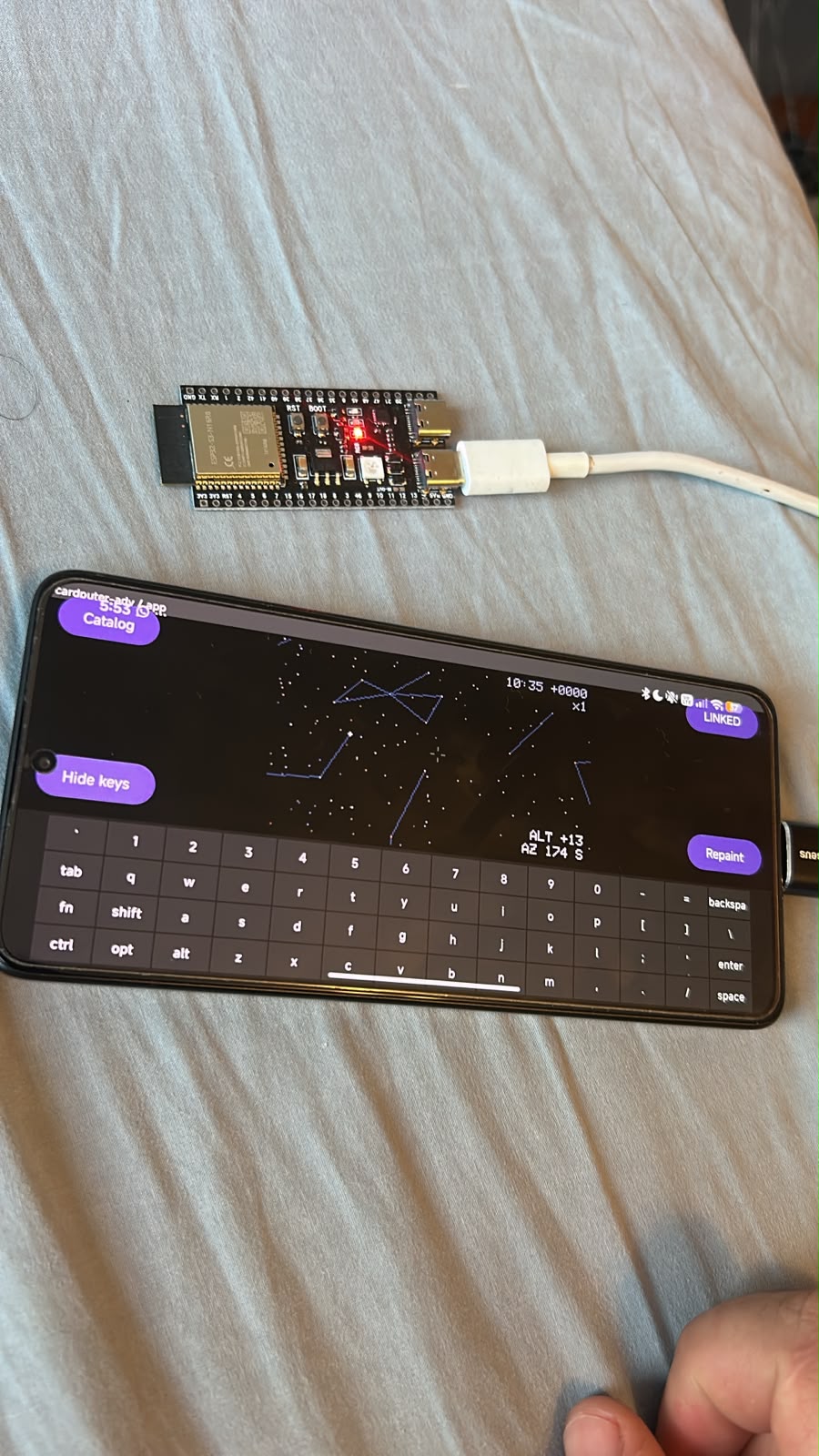 | 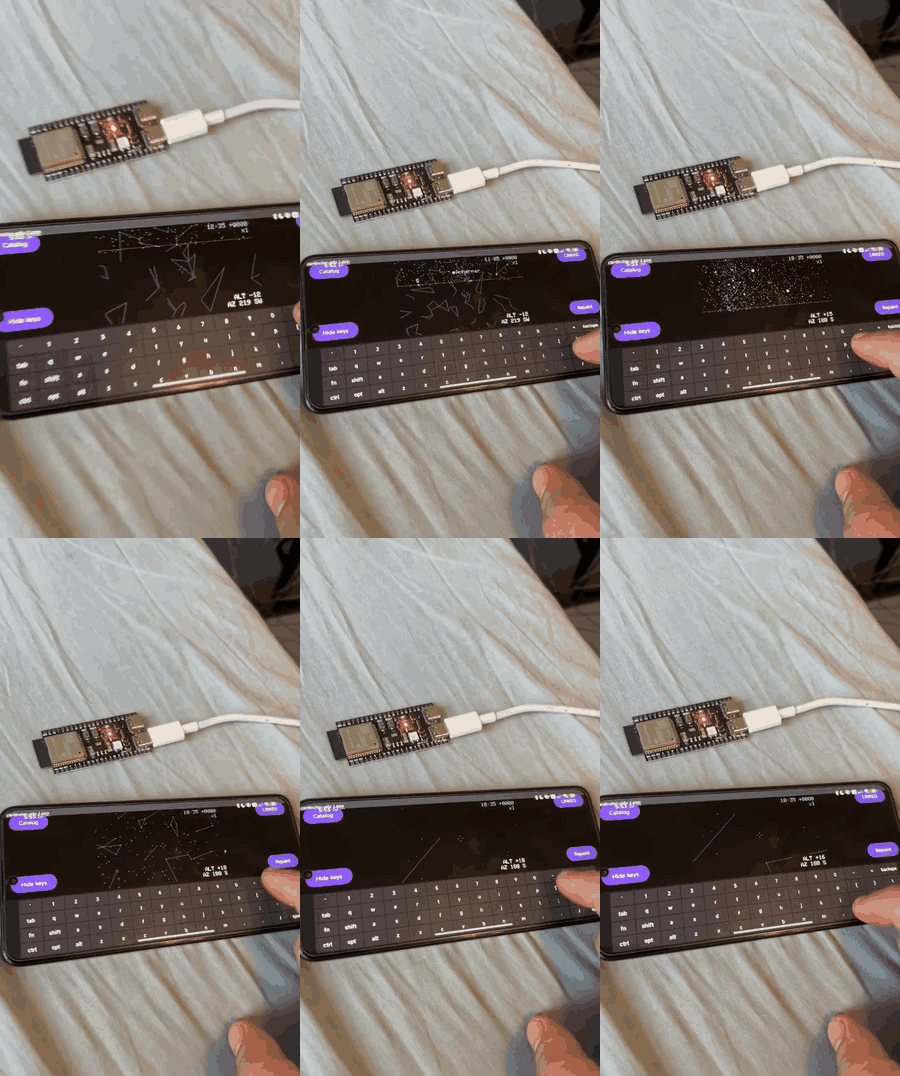 |
A bare ESP32-S3-N16R8 devkit, an OTG cable, a phone. wisnc/stellar-map built from GitHub on demand, flashed from the phone, mirrored and driven from the phone. No display on the board.
What it is
Any open-source Cardputer app, rebuilt unchanged against a patched M5GFX 0.2.27 / M5Cardputer 1.1.1 shim, becomes a phone app: the shim tees every pixel write over the ESP32-S3's native USB-CDC and merges the phone's KEY and GPS frames into the app's keyboard and serial. Builds happen on GitHub Actions through a small proxy, the phone flashes the result itself, and the same phone is then the display, keyboard, GPS and app launcher. A real Cardputer ADV is only used in development because its own TFT shows the same frames next to the phone.
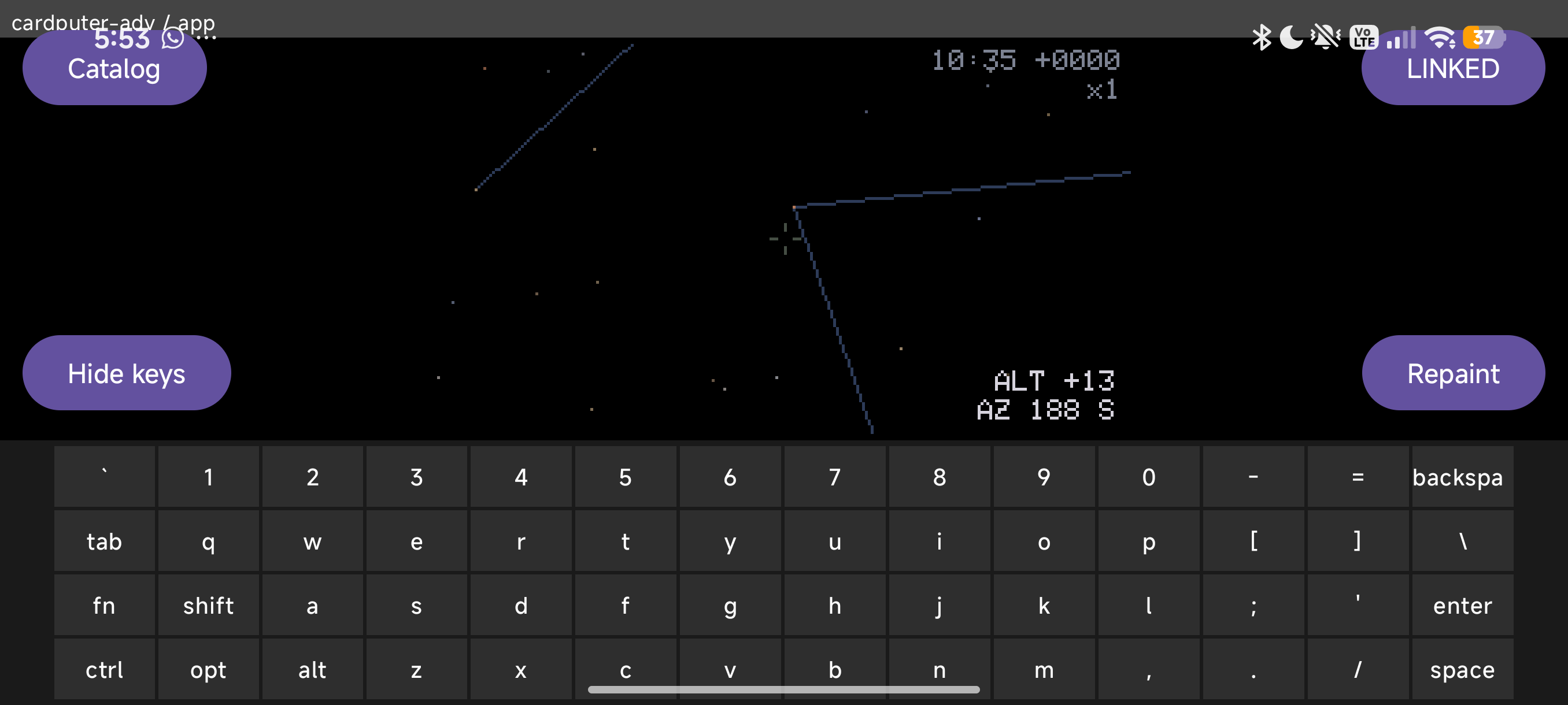 The soft keyboard is the Cardputer's own 4x14 matrix, fn and shift layers included. | 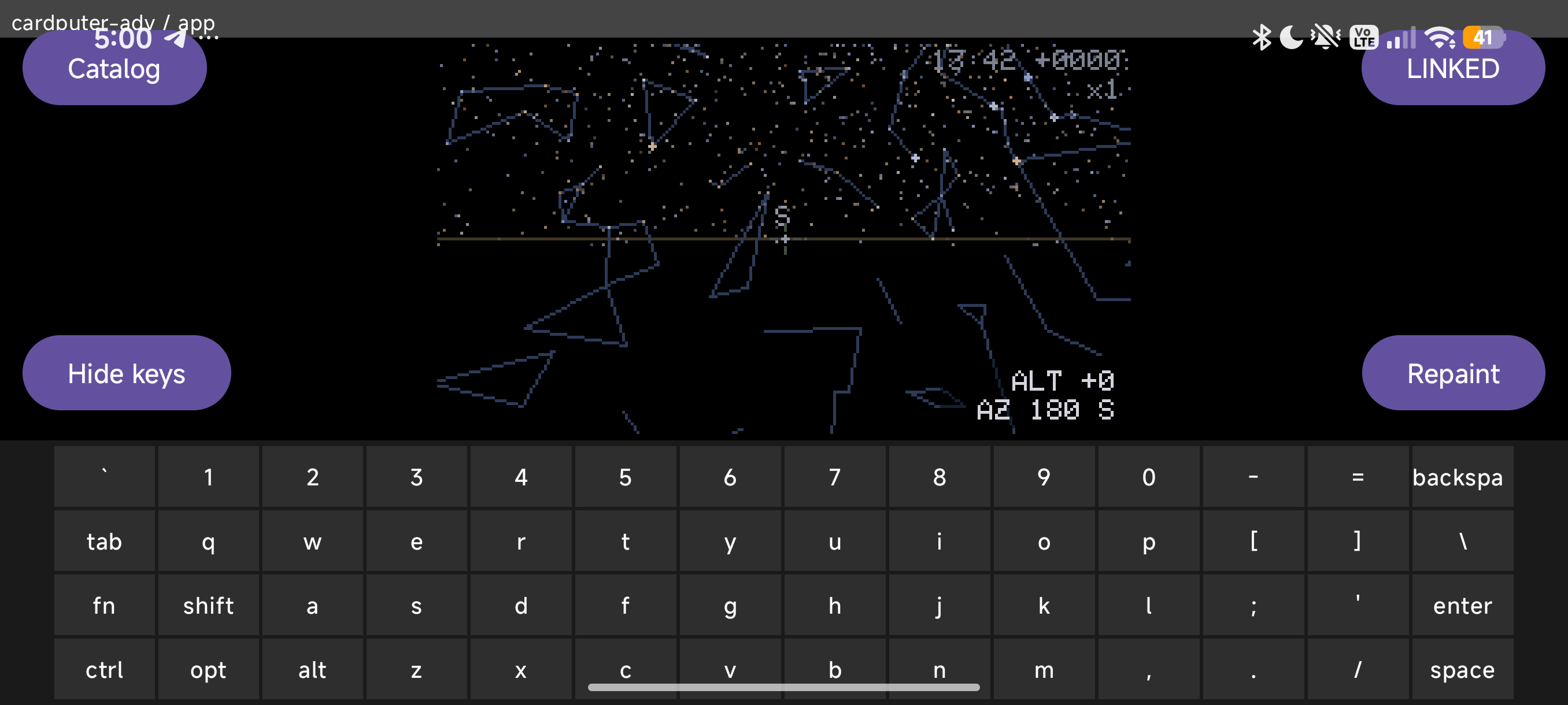 Same app, panned from the phone. Nothing on the board but the chip. |
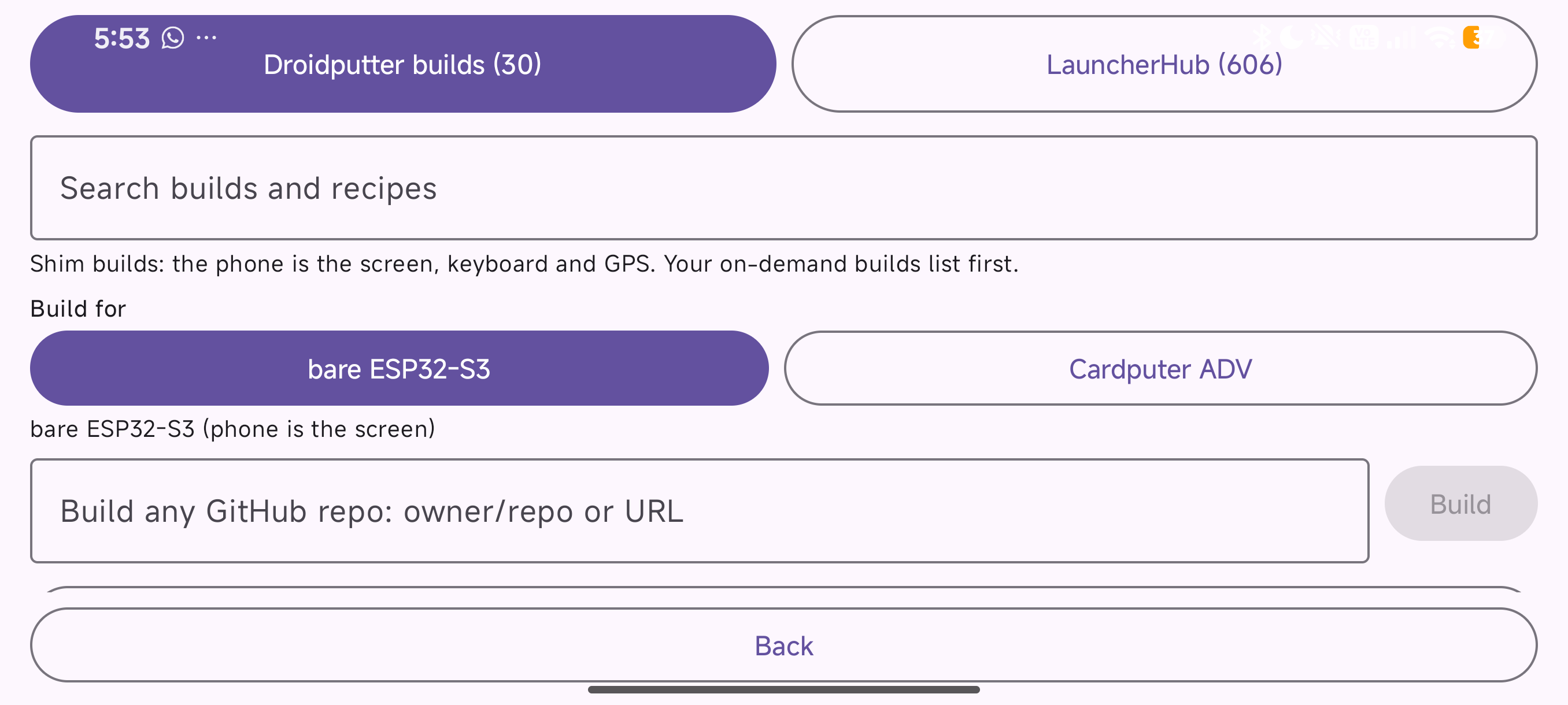 Catalog: pick the target, a recipe, any GitHub repo, or a LauncherHub prebuilt. | 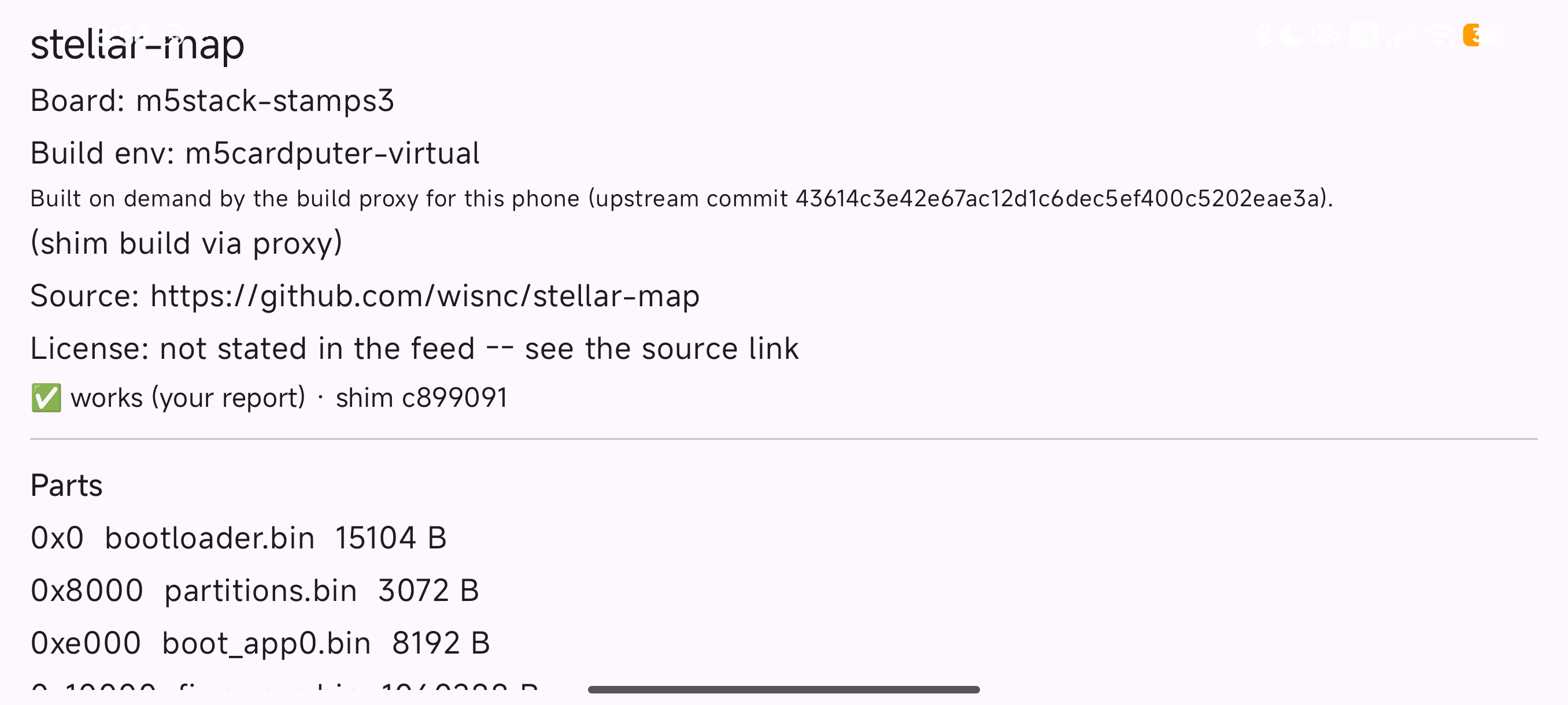 A finished on-demand build: parts, offsets, hashes, verdicts. |
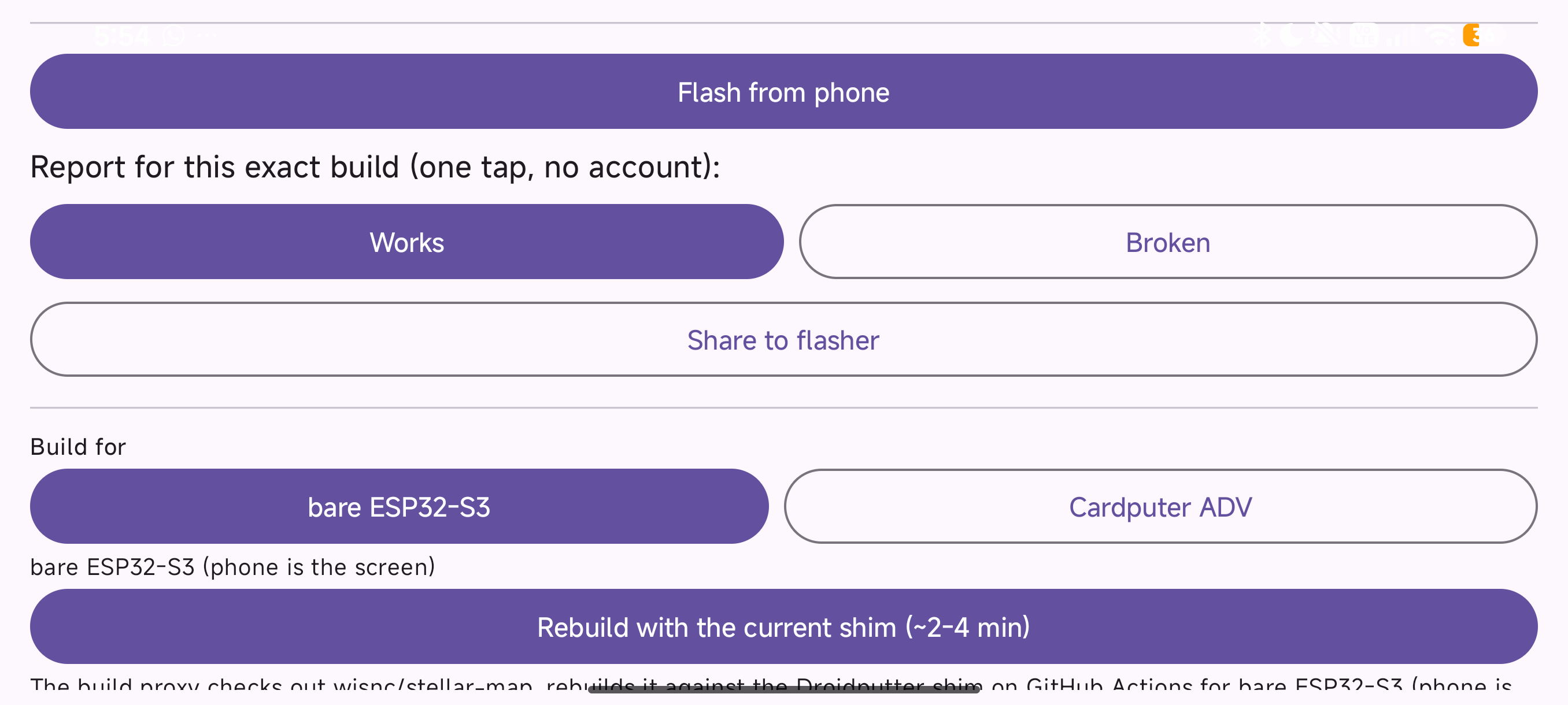 Flash from phone, then one tap files the works / broken verdict. | 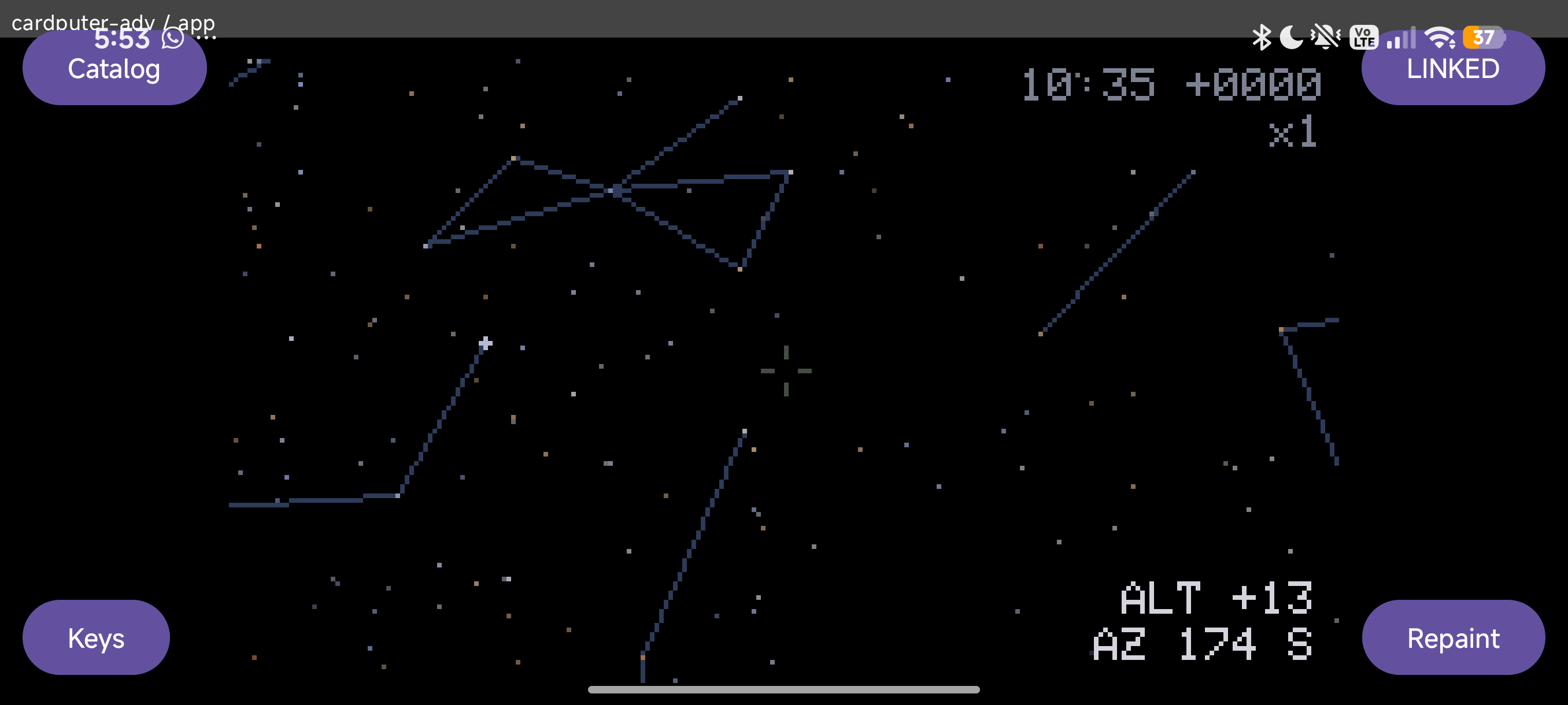 Hide keys: the mirror takes the whole phone screen. |
How to use
- Install the release APK from https://github.com/fcavalcantirj/droidputter/releases
(
adb install droidputter-<tag>.apk, e.g.droidputter-v0.0.1.apk, or open the file on the phone). Android 8+ with USB-OTG host support. - Plug an ESP32-S3 into the phone's USB-C port with an OTG cable, into the board's native USB port. Use a known-good data cable: one cable gave "no Type-C partner" (2026-09-02).
- Answer "Allow Droidputter to access USB JTAG/serial debug unit?" once. The top-right button shows the link state (DETACHED, LINKED, ...) and opens the Connection screen.
- Tap Catalog (top left). Two sources: Droidputter builds (your own proxy builds first,
then the
apps/recipes) and LauncherHub (prebuilt M5Burner bins, flash only). - Under Build for, pick the target: bare ESP32-S3 (the phone is the only screen; the default) or Cardputer ADV (the board's own TFT is teed to the phone).
- Pick an app: a recipe entry, any GitHub repo pasted as
owner/repoor a URL into "Build any GitHub repo", or a LauncherHub prebuilt (no build step: skip to 8). - Tap Build mirror version (~2-4 min) (Rebuild with the current shim on one of your own builds). The status line goes "asking the build proxy…" then "queued (0:05 elapsed)" then "building… (run , 1:23 elapsed)" then "Ready: flash it from the Droidputter builds tab". Measured 2 min 4 s warm, 4 min 8 s cold (2026-09-04). A build the proxy already has (same repo, ref, target and shim, under 24 h) answers "the proxy already has this build, fetching its parts" at once (3 s on 2026-09-16).
- Tap Flash from phone. You see "downloading firmware.bin 1.0 MB (43%)", "stopping the link, opening the port", "resetting into the ROM bootloader", one erase line and one write line per part with a percentage, ": verified (md5 ...)", "all parts verified, rebooting the ESP", then "done: flashed and verified". Reset-to-verified: 8 s for 467 KB and 15 s for 1.07 MB (2026-09-16), 14.7 s for 1.1 MB compressed (2026-09-03); the link is back 190-330 ms after the reset (2026-09-16).
- Use it: the ESP's screen is the phone's screen. The soft keyboard is the Cardputer's 4x14 matrix; fn and shift latch on a tap (the key caps switch to the fn or shifted legends) until tapped again; Hide keys / Keys gives the mirror the whole screen.
- A Bluetooth or USB keyboard attached to the phone works too: every key with a Cardputer position is passed through (key repeats swallowed); the rest reach Android as usual.
- GPS: open the Connection screen and tap Start GPS feed; grant location once. The phone's
NMEA sentences reach the app like a serial GPS (
droidputter_gps(), ~28 sentences/s on 2026-09-05); the link's foreground service keeps them flowing with the screen off. - Repaint (bottom right) re-sends HELLO_ACK and the ESP redraws its whole screen into the phone; Reconnect on the Connection screen re-probes the port and asks for permission again.
- Verdict: 20 s after the flash the app decides works / broken from the link evidence (boot
report, HELLO, frames) or asks "Works or Broken?". One tap on Works / Broken files a
GitHub issue through the proxy ("verdict sent (#N) — thank you"); an Action folds it into
apps/verdicts.json, which every phone reads back.
┌─────────┐  POST /api/build   ┌───────────────┐  workflow_dispatch  ┌────────────────┐
│  phone  │ ─────────────────▶ │  build proxy  │ ──────────────────▶ │ GitHub Actions │
│ Catalog │ ◀───────────────── │   (Vercel)    │ ◀────────────────── │ build-app.yml  │
└────┬────┘  parts + sha256    └───────────────┘  run artifact (zip) └────────────────┘
     │ USB-OTG: reset into the ROM, 4 parts written + MD5-verified, hard reset
     ▼
┌──────────┐
│ ESP32-S3 │  relinks 190-330 ms after the reset: HELLO, then frames = the phone is the screen
└──────────┘
First flash gotchas
- BOOT button for software-CDC firmwares. A board still running UiFlow2 / MicroPython (a TinyUSB software CDC) ignores the phone's DTR/RTS reset; the status line says "no ROM bootloader yet -- if the board stays quiet, hold its BOOT button and replug it now (waiting 90 s)". Hold BOOT while plugging it back in: the ROM enumerates as "USB JTAG/serial debug unit" and the flash continues. Once a Droidputter build is on the board, the phone resets it alone (2026-09-05, StickS3).
- The UART/COM port of a devkit never works. The shim only speaks over the S3's native USB-Serial/JTAG; a CH9102 or CH343 bridge shows up as "USB Single Serial" and never carries the link (2026-09-05, 2026-09-16), and any other UART bridge (CP210x, ...) is no different. Use the port labeled USB.
- Wrong chip = refused, nothing written. The flasher reads the chip magic before touching the flash (ESP32-S3 = 0x9); an ESP32-C5 stopped at "FAILED: not an ESP32-S3 ROM (chip magic 0x30e1706f)" with its firmware intact (2026-09-16). A classic ESP32 cannot run the S3 build either.
- Debug APK vs release APK. They are signed with different keys: a debug build (
android.ymlor a localassembleDebug) cannot be installed over the release APK, nor the reverse. Uninstall first (2026-09-16).
Ways to flash
| # | Path | Mirror | Pick it when |
|---|---|---|---|
| a | In-app: build on demand via the proxy | yes | the app is on GitHub (M5GFX/M5Unified) |
| b | In-app: LauncherHub / M5Burner prebuilt | no | a stock bin on the board's own screen |
| c | In-app: Share to flasher | as the parts | the parts must leave the phone (share sheet) |
| d | Computer: esptool + a build-app.yml artifact | yes | batch flashing, or no phone at hand |
| e | Computer: PlatformIO from a recipe dir | yes | you are developing the shim or an overlay |
| f | Manual BOOT bootstrap (with any path) | n/a | the board's firmware ignores the USB reset |
(a) in-app proxy build    ─┐
(b) LauncherHub prebuilt  ─┴─▶ Flash from phone (in-app esptool) ──┐
(c) Share to flasher      ───▶ another flasher app (phone) ────────┼──▶ ┌──────────────────┐
(d) esptool, run artifact ─┐                                       │    │ ESP32-S3 on its  │
(e) pio run -t upload     ─┴─▶ computer, esptool / pio ────────────┘    │ native USB port  │
                                                                        └──────────────────┘
(f) hold BOOT while plugging in, once, before any path when the old firmware is a software CDC
(a) In-app, on-demand shim build via the proxy. You need the phone, network and an ESP32-S3 on
OTG. Tap "Build mirror version" on any entry with a GitHub source, or paste owner/repo into "Build
any GitHub repo" after picking the target. The phone POSTs to the build proxy (proxy/, five
Vercel functions holding a repo-scoped token), which dispatches .github/workflows/build-app.yml:
tools/overlay.py clones the app, writes the overlay, shim/apply.sh patches M5GFX 0.2.27 and
M5Cardputer 1.1.1, PlatformIO builds it, and the proxy streams the four parts (sha256 from the run's
SHA256SUMS) out of the <name>-<env> artifact. Mirror: yes. Limits: 6 builds in flight, a
successful run under 24 h for the same repo@ref, env and shim is reused, artifacts live 7 days.
Proven end to end from GitHub source to a StickS3 with its own screen dark (2026-09-16, the current
virtual env) and to a bare ESP32-S3-N16R8 devkit (2026-09-16, with the proxy's 2026-09-05 build).
(b) In-app, LauncherHub / M5Burner prebuilt. You need the phone and network once: the ~3 MB feed
from api.launcherhub.net is cached and refreshed at most daily (606 entries on 2026-09-16). Every
Cardputer/StampS3 entry on the S3 chip with an install format is listed: merged images flash at
0x0, app images at 0x10000 (that keeps the board's bootloader and partition table; any Droidputter
or Arduino 8 MB build leaves a compatible one). Flash-only: the bin carries no shim, so no phone
mirror, keyboard or GPS; the app runs on the Cardputer's own screen and keys. The hash is computed
after download; the verdict is yours ("Works or Broken?"): the phone only flags a crash loop (a
panic or 3+ resets in 20 s) on the status line. Any such entry with a GitHub source can be rebuilt
with the shim from its detail ("Build mirror version"). Same download + flasher code as (a), but
[UNVERIFIED] on hardware: the journal records no LauncherHub bin flashed from the phone yet (the
Ultimate Remote flash "still awaits Felipe's taps", 2026-09-04).
(c) In-app "Share to flasher". The app downloads the parts and hands them to the Android share
sheet as content:// streams plus a text blob listing offset, size and sha256 per part. Mirror:
whatever the parts are (a shim build yes, a LauncherHub bin no). ESP32_Flasher
(com.esp_flash.esp_flash_app) does NOT appear in that sheet: it registers no SEND/SEND_MULTIPLE
intent (2026-09-03), so share the parts to an app that saves files, then pick them in ESP32_Flasher
(chip ESP32S3, Bootloader Auto ON, each file at its offset). That flasher's own auto-reset entered
the ROM on a freshly plugged Cardputer ADV (2026-09-02: 504,176 B firmware in 19.39 s) but not on a
board that had been running a shim app for an hour (2026-09-03). Pick it when the files must leave
the phone.
(d) From a computer with esptool, from a build-app.yml run artifact. You need gh with access
to the repo, esptool, and a cable to the board's native USB port.
gh workflow run build-app.yml -f repo=wisnc/stellar-map -f name=stellar-map \
    -f env=m5cardputer-virtual
gh run list --workflow build-app.yml                       # the run id
gh run download <run-id> -n stellar-map-m5cardputer-virtual -D dist
cd dist && sha256sum -c SHA256SUMS
esptool.py --chip esp32s3 write_flash 0x0 bootloader.bin 0x8000 partitions.bin \
    0xE000 boot_app0.bin 0x10000 firmware.bin
| File | Offset |
|---|---|
bootloader.bin | 0x0 |
partitions.bin | 0x8000 |
boot_app0.bin | 0xE000 |
firmware.bin | 0x10000 |
The artifact holds the four parts, build.json and SHA256SUMS; retention is 7 days (the
<name>-<env>-elf artifact beside it is the ELF for addr2line, not for flashing). env is
m5cardputer (Cardputer ADV, the default) or m5cardputer-virtual (bare ESP32-S3). Mirror: yes.
Pick it when there is no phone at hand, for batch flashing, or when the board needs the ROM entered
by hand anyway.
(e) From a computer with PlatformIO, from a recipe dir. You need PlatformIO Core (CI pins
6.1.19), the app's source (recipes written by tools/overlay.py point at apps/_src/<name>, which
is git-ignored, so clone first) and the board on /dev/cu.usbmodem*. One command clones, writes the
overlay, runs shim/apply.sh, builds and uploads:
python3 tools/overlay.py wisnc/stellar-map --name stellar-map \
    --env m5cardputer-virtual --build --upload
Or, inside an existing recipe, after shim/apply.sh apps/<name> once (without it the build either
fails on a fresh clone, M5Cardputer.h: No such file, 2026-09-03, or silently produces a firmware
whose tee never fires, 2026-09-02):
cd apps/<name> && pio run -e m5cardputer -t upload           # Cardputer ADV, its TFT teed
cd apps/<name> && pio run -e m5cardputer-virtual -t upload   # bare ESP32-S3, phone only
Upload runs at 460800 baud. Mirror: yes. Pick it when working on the shim or an overlay, or when a
build must never leave your machine (pense-bem's source is a local path, so it has no proxy build).
The committed overlay.py recipes carry both envs, but their m5cardputer-virtual env is the older
one (StampS3 variant, M5GFX board hint 24) that a StickS3 refused (2026-09-05/16); regenerate the
recipe with tools/overlay.py to get the current virtual env (esp32-s3-devkitc-1, hint 26,
qio_opi + PSRAM), which the proxy always does on the runner.
(f) The manual BOOT bootstrap. Not a path of its own but the entry step any of the above may need: a board whose current firmware drives USB as a software CDC (UiFlow2, MicroPython, TinyUSB) never forwards DTR/RTS to the reset logic, so neither the phone flasher nor esptool can enter the ROM. Hold BOOT while plugging the board in; the ROM enumerates as "USB JTAG/serial debug unit". The phone waits 90 s for exactly that re-enumeration and then continues the flash; otherwise it ends with "FAILED: ROM bootloader did not come back on USB (hold BOOT while plugging the board in, then Flash again)". Once a Droidputter build (arduino HWCDC) is on the board, every later flash resets it from the phone alone (2026-09-05, StickS3; 2026-09-16, StickS3 and the bare devkit, whose previous firmware was also an arduino HWCDC build). Mirror: n/a.
Under the hood
Four mechanisms, each read off the code it names. Every number below comes from the source file in
parentheses or from progress.txt on the date given.
The link
┌─────────────────────────────┐                                  ┌─────────────────────────────┐
│ Android phone (OTG host)    │  ESP32-S3 ──▶ phone              │ ESP32-S3 (USB-Serial/JTAG)  │
│                             │  HELLO 0x01 w,h,rot,bpp,board,app│ DroidputterShim             │
│ UsbDpTransport              │  FILL 0x02 x,y,w,h,color 10 B    │  dp_link task every 16 ms   │
│  CDC-ACM 0x303A:0x1001      │  RECT 0x03 raw RGB565 rows       │   (DP_LINK_TASK_MS): poll,  │
│  16 KB USB reads            │  RECT_RLE 0x04 runs n u8,c u16   │   STATS, watchdog, flush    │
│  Framer: D7 50 type len16   │  STATS 0x05 1/s   LOG 0x07       │  HWCDC TX ring 32,768 B     │
│   payload crc8 (poly 0x07)  │  PING 0x06 answers PING_IN       │   (DROIDPUTTER_TXBUF)       │
│  decodeDpMessage            │◀──────────────────────────────── │  shadow fb 240x135, 64,800 B│
│  ScreenCanvas paints        │ ────────────────────────────────▶│  dirty row band -> RECT_RLE │
│                             │  phone ──▶ ESP32-S3              │   (or RECT), whole rows that│
│ SoftKeyboard                │  HELLO_ACK 0x84 phone w,h        │   fit the ring's free space │
│ GpsFeed (OnNmeaMessage)     │  KEY 0x81 row,col,down|up        │  rx[128]: inbound <= 120 B  │
│ LinkStateMachine            │  GPS_NMEA 0x82 one sentence      │  16 key slots, 1 KB GPS ring│
│  PING_IN probe 1/s to link  │  PING_IN 0x83 probe/keepalive    │  LOG: boot / watchdog report│
└─────────────────────────────┘                                  └─────────────────────────────┘
One byte stream in each direction over the ESP32-S3's native USB-Serial/JTAG (HWCDC Serial;
the phone enumerates it as CDC-ACM 0x303A:0x1001, UsbLinkManager.kt). Every frame is
D7 50 | type u8 | length u16 LE | payload | crc8 (poly 0x07 over type+length+payload,
docs/PROTOCOL.md, core/protocol/Framer.kt); a bad crc drops only the sync pair and rescans.
ESP to phone: HELLO (55 B: geometry, bpp 16, board, app -- the board string is always
cardputer-adv today, sendHello in droidputter.cpp), FILL, RECT (raw big-endian RGB565
rows), RECT_RLE (runs of count u8, color u16), STATS once a second, PING, LOG
("boot rst=.. wd=.." and watchdog reports). Phone to ESP: HELLO_ACK (the phone's w,h -- the
tee sends nothing before it), KEY (row, col, down/up on the 4x14 matrix), GPS_NMEA (one sentence,
no CRLF), PING_IN.
The phone reads the port in 16 KB requests (USB_READ_BUFFER, android/app/build.gradle.kts):
with the library's 64 B default the reader took 1,670 chunks/s, the framer resynced 116 times in
70 s and the app sat at 93% CPU; at 16 KB it is 54 chunks/s, 0 resyncs, 62% CPU, key echo
19.5 ms median (2026-09-05). On the ESP the shim runs its own FreeRTOS task, dp_link, every
16 ms (DP_LINK_TASK_MS, droidputter.cpp): it parses inbound frames, emits STATS, drives the
TX watchdog and flushes the shadow, so an app that never calls M5Cardputer.update() still links.
Outbound frames go whole-or-nothing into the 32,768 B HWCDC TX ring (DROIDPUTTER_TXBUF); a
full 240x135 frame is 64,800 B raw, so a flush sends as many whole dirty rows as the ring has room
for (capped by a 32 KB RLE stage), RLE when that is shorter than raw, and leaves the rest dirty
for the next tick (dp_display.cpp, band splitting since 2026-09-04). Inbound frames are capped
at 120 B of payload (rx[128]); held keys live in 16 slots, NMEA in a 1 KB ring.
Measured: the raw ceiling is 13.8 fps / 873 KB/s of uncompressed full frames (2026-09-02; the
TX-ring sweep gave 11.0 fps at 8 KB, 14.7 fps at 64 KB, so the ceiling is USB full speed, not the
ring). wisnc/stellar-map mirrored on the Poco X7 Pro at 14 fps / 131.6 KB/s median with 15
governor deferrals/s before band splitting (2026-09-04), then 29.6 fps / 101.3 KB/s with 0 dropped
frames -- the app's own draw rate, not the link, is the limit -- and 59.6 fps / 166.8 KB/s median
in a busier draw state of the same app, on the 64 B-read build (2026-09-05). After a hard reset
the phone's HELLO_ACK lands 300 ms later (2026-09-03, 2026-09-05) and 190-330 ms across the four
2026-09-16 flashes; a fresh plug links in 230 ms (2026-09-04). A LinkForegroundService keeps the
reader and the GPS feed (about 28 sentences/s, 2026-09-05) alive with the screen off. The link
drops on a USB detach or a reader IOException and comes back on the next attach intent
(UsbLinkManager.kt); LinkStateMachine's three-missed-PING rule (MAX_MISSED_PINGS) has no
timer feeding it yet, so PING_IN is a probe: once when the port opens, then every second for 30 s
until the ESP's HELLO arrives (PROBE_INTERVAL_MS, PROBE_ATTEMPTS, MainActivity.kt).
The shim
                 app code: M5.Display.fillRect / drawString / pushSprite ... (unchanged)
                                                 │
                                                 ▼
                      LovyanGFX write path (LGFXBase -> Panel), then one of two panels
                        ┌────────────────────────┴─────────────────────────┐
                        ▼                                                  ▼
┌──────────────────────────────────────┐                ┌────────────────────────────────────────┐
│env m5cardputer (Cardputer ADV)       │                │env m5cardputer-virtual (bare ESP32-S3) │
│Panel_LCD (ST7789) with 8 dp:: hooks  │                │Panel_Droidputter (dp_panel.h) picked by│
│(M5GFX-0.2.27-droidputter.patch):     │                │the patched M5GFX::init_impl when built │
│  setWindow  writePixels  writeBlock  │                │with -DDROIDPUTTER_VIRTUAL=1: autodetect│
│  writeImage  writeFillRectPreclipped │                │skipped, no bus, no SPI, no TFT. Same   │
│  drawPixelPreclipped  write_bytes    │                │six overrides on Panel_FrameBufferBase  │
│        │              │              │                │(+ writeImageARGB, copyRect -> teeRect) │
│        ▼              ▼              │                │                  │                     │
│  SPI bus -> TFT   dp:: tee           │                │                  ▼                     │
│                       │              │                │             dp:: tee only              │
└───────────────────────┬──────────────┘                └──────────────────┬─────────────────────┘
                        └────────────────────────┬─────────────────────────┘
                                                 ▼
         dp::window / bytes / repeat / fill / pixel / pixelsConv  (dp_display.cpp), lazy dp::begin
                                                 │
                                                 ▼
         shadow framebuffer 240x135 RGB565 in wire order + dirty row band  (dp_shadow.h, static)
                                                 │  flushDirty each 16 ms, only after HELLO_ACK
                                                 ▼
         RECT_RLE (or RECT) of as many whole rows as the HWCDC ring can take -> USB -> phone

  keys: phone KEY 0x81 -> dp_keys_push (16 held slots) -> Keyboard_Class::updateKeyList (patched,
        M5Cardputer-1.1.1-droidputter.patch) merges the held (row,col) set into
        KeyboardReader::mutableKeyList -> M5Cardputer.Keyboard.keysState() as if pressed
  GPS:  phone GPS_NMEA 0x82 -> dp_gps_push -> 1 KB ring (whole sentences + CRLF) ->
        droidputter_gps(), an Arduino Stream the app reads exactly like its GPS UART
The app is compiled unchanged; only the libraries under it change. shim/patches/M5GFX-0.2.27- droidputter.patch adds eight dp:: calls to lgfx/v1/panel/Panel_LCD.cpp -- setWindow,
drawPixelPreclipped, writeFillRectPreclipped, writeBlock, writePixels (both the raw and
the converting branch), writeImage (inside its DMA-queue loop) and write_bytes -- so every
pixel that reaches the ST7789 bus is also copied into the shim. On the Cardputer ADV the TFT keeps
drawing and the phone mirrors it (env m5cardputer: m5stack-stamps3, espressif32@6.12.0,
8 MB, tools/overlay.py ENV_TEMPLATE). On a bare ESP32-S3 (env m5cardputer-virtual:
esp32-s3-devkitc-1, octal PSRAM, -DDROIDPUTTER_VIRTUAL=1 -DM5GFX_BOARD=26) the same patch's
hook near the top of M5GFX::init_impl (right after the already-initialised check, before the
NVS/autodetect) constructs Panel_Droidputter (dp_panel.h), a Panel_FrameBufferBase over a
static 240x135 buffer with no bus at all, and returns before the I2C/SPI autodetect ever runs; its
overrides of the same six write functions plus writeImageARGB and copyRect feed only the shim
(writeImage, writeImageARGB and copyRect tee the rect after the base class has placed it,
teeRect), and its setRotation is pinned so the app's setRotation(1) never resizes the static
buffer. Either way the tee lands in the shadow framebuffer from the very first write, linked or
not; dp::begin() runs lazily from the first setWindow, opens Serial, sizes the ring, sends
HELLO, starts the link task and sends the boot LOG. HELLO_ACK (and the phone's Repaint button)
answers from memory: mark every row dirty and flush. A full Pense-Bem screen is one RECT_RLE of
9,956 B instead of 64,800 B raw (docs/PROTOCOL.md, 2026-09-02).
Keys never touch the app either: M5Cardputer-1.1.1-droidputter.patch makes
Keyboard_Class::updateKeyList call dp::poll() and then merge the shim's held (row,col) set
into KeyboardReader::mutableKeyList -- the same vector the physical TCA8418 scan fills -- adding
keys the phone holds and removing the ones it released (a tap stays visible for at least two
updates, DP_KEYS_MIN_SEEN). GPS is the one place an app opts in: the phone's
OnNmeaMessageListener sentences arrive as GPS_NMEA frames, dp_gps_push queues whole sentences
plus CRLF in a 1 KB ring, and the app reads droidputter_gps() -- an Arduino Stream -- exactly
where it would read its GPS UART (apps/gps-demo).
Build on demand
 phone                        proxy (Vercel, Node 22)             GitHub fcavalcantirj/droidputter
┌─────────────────────┐       ┌───────────────────────────┐       ┌────────────────────────────────┐
│ Catalog: "Build     │       │ POST /api/build           │       │ workflow_dispatch build-app.yml│
│  mirror version" or │──────▶│  {repo, ref, name, env}   │──────▶│  run-name: build <repo>@<ref>  │
│  "Build any GitHub  │       │  identity = repo@ref + env│       │   env=<env> shim=<sha> req=<id>│
│  repo", target =    │       │   + shim commit (newest   │       │  tools/overlay.py --build:     │
│  bare ESP32-S3 |    │       │   of shim/, tools/        │       │   clone, write platformio.ini  │
│  Cardputer ADV      │       │   overlay.py; 60 s cache) │       │   shim/apply.sh patches M5GFX  │
│                     │       │  200 cached (success<24 h)│       │    + M5Cardputer, pio run -e   │
│ BuildFlow polls     │──────▶│  202 joined (in flight)   │       │  artifact <name>-<env>:        │
│  GET every 5 s      │       │  202 dispatched (uuid)    │       │   4 .bin + build.json          │
│                     │       │  429 at 6 in flight       │       │   + SHA256SUMS, kept 7 d       │
│ ready -> my_builds  │◀──────│ GET /api/build/{id}       │◀──────│  artifact <name>-<env>-elf     │
│  entry: parts by    │       │  run found by req=<id>,   │       │   (the ELF, never served)      │
│  url + sha256       │       │  zip unzipped in memory   │       │                                │
│                     │       │  (fflate), 8 runs cached  │       │                                │
│ BinStore: download, │◀──────│ GET /api/artifact/        │       │                                │
│  sha256 check,      │       │  {run}/{file} -> bytes,   │       │                                │
│  filesDir/bins      │       │  ETag = sha256, immutable │       │                                │
│ PhoneFlasher        │       │                           │       │                                │
└─────────────────────┘       └───────────────────────────┘       └────────────────────────────────┘
 verdict loop
┌─────────────────────┐       ┌───────────────────────────┐       ┌────────────────────────────────┐
│ 20 s after a flash: │──────▶│ POST /api/verdict         │──────▶│ issue "[verdict] <name>/<env>  │
│  auto works | broken│       │  validate, 20/h per IP,   │       │  <result> on <board> (<sha12>)"│
│  (or one tap)       │       │  4 KB max, files the      │       │  label verdict -> verdicts.yml │
│                     │       │  GitHub issue itself      │       │  -> tools/fold_verdict.py ->   │
│ VerdictRepository   │       │                           │       │  apps/verdicts.json on main,   │
│  reads verdicts.json│       │                           │       │  issue commented + closed      │
└─────────────────────┘       └───────────────────────────┘       └─┬──────────────────────────────┘
                      ◀─────────────────────────────────────────────┘
                        every phone reads raw.githubusercontent.com/.../main/apps/verdicts.json
Nothing is pre-built or hosted. The phone POSTs {repo, ref?, name?, env?} to /api/build
(proxy/api/build.js, validated by proxy/lib/validate.js; the name defaults to the repo's tail
lowercased). The proxy is five Vercel functions holding one fine-grained token scoped to
fcavalcantirj/droidputter (Actions read/write, Contents read, Issues read/write; proxy/api/ shim.js). A build's identity is repo@ref + env + the shim commit, the short sha of the newest
commit on main touching shim/ or tools/overlay.py (SHIM_PATHS, proxy/lib/github.js,
cached 60 s), so editing the overlay template invalidates every cached build. A successful run
younger than 24 h with that identity answers 200 cached; an identical run still queued or
running is joined (202 with its request id); at 6 builds in flight the proxy answers 429 with
Retry-After: 60; otherwise it dispatches build-app.yml with a uuid that becomes part of the
run name, which is how the run is found again (proxy/lib/builds.js).
The workflow clones the upstream repo at ref, tools/overlay.py --build writes the overlay's
platformio.ini (both envs, from ENV_TEMPLATE), shim/apply.sh copies pristine M5GFX 0.2.27 +
M5Cardputer 1.1.1 into lib/ and applies the two patches, and pio run -e <env> builds on a
GitHub runner with ~/.platformio cached (.github/workflows/build-app.yml). The parts --
bootloader.bin 0x0, partitions.bin 0x8000, boot_app0.bin 0xE000, firmware.bin 0x10000,
plus build.json and SHA256SUMS -- are uploaded as the artifact <name>-<env>, kept 7 days
(retention-days); the 20-40 MB ELF rides in <name>-<env>-elf, which the proxy never serves.
GET /api/build/{id} polls the run by its req= tag, and once it is ready downloads the zip,
unzips it in memory (fflate, 8 runs cached per warm instance) and returns each part's offset,
size, sha256 and a GET /api/artifact/{run}/{file} URL served immutable with the sha256 as
ETag (proxy/lib/artifact.js, proxy/api/artifact/[run]/[file].js). The phone polls every 5 s
(BuildProxy.POLL_INTERVAL_MS, up to 20 min), saves a ready build as a catalog entry in
my_builds.json, and BinStore downloads each part into filesDir/bins/<sha256>.bin, verifying
the hash; a cached part is served with no network. Measured on 2026-09-04: 88.7 s from dispatch
to a successful run (about 92 s tap-to-hash-verified parts) for a repo nobody had built before
(geo-tp/M5Cardputer-GPS-Logger), 2 min 4 s warm vs 4 min 8 s cold for stellar-map, 169.3 s to
verified parts for Ultimate-Remote's 3,276,784 B firmware; a cached answer came back in 3 s
(2026-09-16).
The verdict loop closes the same way. 20 s after a flash the phone decides works / broken from the
link (see below) or asks for one tap, then POSTs the record to /api/verdict (proxy/api/ verdict.js: 20 per address per hour, 4 KB max). The proxy files the GitHub issue itself
([verdict] <name>/<env> <result> on <board> (<sha12>), label verdict); verdicts.yml runs on
every such issue, tools/fold_verdict.py validates and de-duplicates it into apps/verdicts.json,
the workflow commits to main and comments and closes the issue. VerdictRepository reads that
file back from raw.githubusercontent.com on every Catalog open and resends any verdict that
was stored on the phone while offline.
Flash from phone
   phone: PhoneFlasher + core/esptool (Kotlin)              ESP32-S3 over USB-OTG
   ───────────────────────────────────────────────────      ─────────────────────────────────
 1 link stands down: UsbLinkManager.beginRawSession,        app firmware running
   port reopened raw (parts already in BinStore)
 2 DTR/RTS dance (esptool UsbJtagSerialReset):         ──▶  EN low while IO0 low -> ROM
   DTR=1,RTS=0 / RTS=1,DTR=0 / both 0; wait 300 ms          bootloader; the USB-Serial/JTAG
                                                            enumeration survives (same port)
 3 SLIP 0xC0..0xC0: SYNC 0x08, 5 tries, same port      ──▶
   (else wait 90 s for a re-enumeration: BOOT button)  ◀──  SYNC echoes (drained for 200 ms)
 4 READ_REG 0x40001000 must be 0x9 (ESP32-S3)          ◀─▶  chip magic; C5 0x30e1706f refused
 5 SPI_ATTACH, SPI_SET_PARAMS (8 MB flash)             ──▶
 6 per part: FLASH_DEFL_BEGIN (zlib level 9) +         ──▶  erase region, inflate, write
   FLASH_DEFL_DATA in 1 KB blocks (raw fallback)            (esptool's ROM encodings)
     bootloader.bin 0x0      partitions.bin 0x8000
     boot_app0.bin  0xE000   firmware.bin   0x10000
 7 then per part: SPI_FLASH_MD5 == MD5 of the bytes    ◀─▶  md5 of the flashed region
   sent (no FLASH_END: it would run the app early)
 8 hard reset: DTR=0, RTS=1, 100 ms, RTS=0             ──▶  new app boots
 9 endRawSession -> relink: PING_IN, ACK the HELLO     ◀──  LOG "boot rst=..", HELLO, frames
   SEND_HELLO_ACK 190-330 ms after the reset
10 20 s window: boots / hello / frames ->              ◀──  LOG boot reports, HELLO, RECTs
   auto-verdict works | broken | ask
PhoneFlasher.kt plus the pure-Kotlin core/esptool package (Slip.kt, RomProtocol.kt,
EspFlasher.kt) is esptool's write_flash --no-stub for the ESP32-S3 ROM, byte-exact with
esptool's encodings (4 status bytes per response, the extra word in FLASH_BEGIN and SPI_ATTACH,
1 KB write blocks). The parts are downloaded first, so a missing network never takes the link down.
Then UsbLinkManager.beginRawSession parks the state machine and hands the port over; the DTR/RTS
sequence of UsbRomLink.resetIntoBootloader maps onto GPIO0/EN the way a serial adapter's would,
and because the USB-Serial/JTAG peripheral keeps its enumeration across the chip reset the ROM
answers SYNC on the same port (2026-09-03). The chip magic at 0x40001000 must read 0x9: an
ESP32-C5 (0x30e1706f) is refused before anything is written (2026-09-16). Each part goes through
FLASH_DEFL_BEGIN/FLASH_DEFL_DATA as a zlib level-9 stream the ROM inflates, with a raw fallback if
the ROM refuses, and no FLASH_END (on the ROM loader it would boot the chip early); once every
part is written, every region is read back as MD5 and compared. A 1,113,008 B firmware went over
the wire as 658,816 B in 11.3 s (12.9 s raw), reset-to-verified 14.7 s (2026-09-03); the board
table above lists 13 s for 1.1 MB on the ADV, 8 s for 470 KB on the StickS3 (467,456 B,
2026-09-16) and 15 s for 1.07 MB on the bare devkit (2026-09-16).
hardReset pulses EN with GPIO0 released, endRawSession re-probes the device, and the normal
link comes back on its own: PING_IN, the ESP's HELLO, the phone's HELLO_ACK about 300 ms after the
reset (2026-09-05; 190-330 ms on 2026-09-16), LOG "boot rst=0" and the first frames. For the
next 20 s (OBSERVE_AFTER_FLASH_MS, MainActivity.kt) the phone counts boot LOGs, whether a HELLO
arrived and how many draw frames flowed: three or more boots or no HELLO is broken, at most one
boot with frames is works, anything else asks -- and the verdict is posted as described above. A
prebuilt LauncherHub bin carries no shim, so for it the phone only watches the ROM banner and panic
lines on the raw stream (PanicSniffer): a crash loop is flagged, a quiet boot is left to you. The
exception on the way in is a board whose current firmware speaks USB through a software CDC
(UiFlow2, MicroPython, TinyUSB): it never forwards DTR/RTS to the reset logic, so nothing happens.
The flasher then waits 90 s (REENUMERATE_WAIT_MS) for the ROM to appear on a re-enumeration and
tells you to hold BOOT while replugging; once an Arduino HWCDC build is on the chip the phone
resets it alone (StickS3, 2026-09-05 and 2026-09-16).
Build a shim overlay for your own app
Full recipe: docs/PORTING.md. Short version — three ingredients on top of your app's unmodified source:
[platformio]
src_dir = /path/to/the/unmodified/app/src
lib_extra_dirs = ../../shim/lib

[env:m5cardputer]
lib_deps =
    m5stack/M5Unified@0.2.20
    symlink://../../shim/lib/DroidputterShim
build_flags =
    -DDROIDPUTTER=1
    -I ../../shim/lib/DroidputterShim/src
shim/apply.sh apps/<your-app> /path/to/m5cardputer/libdeps   # materialises patched lib/M5GFX + lib/M5Cardputer
cd apps/<your-app> && pio run -e m5cardputer
See apps/pense-bem/ (a private app, unmodified) and apps/m5-example/
(the M5Cardputer library's own upstream example) for two working overlays.
Tested boards and phones
Every row is a hardware result from the journal (progress.txt), with the date it was last seen working. "Flash from phone" = the
Droidputter app wrote and md5-verified the parts itself over USB-OTG; "link" = the shim's HELLO arrived and frames flowed to
the phone's screen. Build env = the PlatformIO env the proxy builds (m5cardputer = the board's own TFT is teed to the phone,
m5cardputer-virtual = no display driver at all, the phone is the only screen).
| Board | Chip / module | Build env | Flash from phone | Link + screen + keys | Last [REAL] | Notes |
|---|---|---|---|---|---|---|
| M5Stack Cardputer ADV | ESP32-S3 (StampS3, no PSRAM) | m5cardputer | yes (13 s for 1.1 MB, compressed) | yes, plus GPS feed | 2026-09-05 | Desk oracle: its own TFT shows the same frames. 19 recipes + any GitHub Cardputer app via the proxy. |
| M5Stack StickS3 | ESP32-S3-PICO-1 (octal PSRAM) | m5cardputer-virtual | yes (8 s for 470 KB) | yes, own screen dark | 2026-09-16 | Pense-Bem and stellar-map played from the phone. First flash over a UiFlow2/MicroPython firmware needs BOOT held while replugging (software CDC ignores the DTR/RTS reset); afterwards the phone resets it alone. |
| Bare ESP32-S3-N16R8 devkit (ESP32-S3-DevKitC-1) | ESP32-S3-WROOM-1 (octal PSRAM) | m5cardputer-virtual | yes (15 s for 1.07 MB) | yes, no display at all | 2026-09-16 | stellar-map built by the proxy from GitHub, star map on the phone. Use the USB-labeled port (native USB-Serial/JTAG), never the COM/UART bridge port (shows as "USB Single Serial"). |
| ESP32-C5-DevKitC-1 | ESP32-C5 (RISC-V) | — | refused | — | 2026-09-16 | The phone flasher reads the chip magic (0x30e1706f) and stops before writing: S3 only. |
| LilyGO / any board on a CH9102, CH343 or CP210x bridge | ESP32 or ESP32-S3 | — | no | no | 2026-09-05 (tried) | The shim links over the S3's native USB-Serial/JTAG only; a UART bridge never carries it, and a classic ESP32 cannot run the S3 build. |
| Phone | OS | Role | Last [REAL] | Notes |
|---|---|---|---|---|
| Poco X7 Pro | Android 16 / HyperOS | screen, keyboard, GPS, flasher | 2026-09-16 | 16 KB USB reads; the link's foreground service keeps GPS flowing with the screen off. Wireless debugging for triage (the USB-C port is the ESP's). |
Rule learned on the StickS3: a virtual build must use the generic esp32-s3-devkitc-1 variant, the octal-PSRAM memory type and
the M5GFX board hint 26 (board_M5StickS3); with the StampS3 variant and the Cardputer ADV hint the same app booted to the
ROM banner and hung before any console. tools/overlay.py writes that env for every recipe.
Repo layout
shim/ (PlatformIO library: patched M5GFX + M5Cardputer + USB framing),
tools/ (host-side Python receiver/renderer/catalog scripts), fixtures/
(captured real streams, committed), apps/ (build recipes per app +
catalog.json), android/ (Gradle project: core pure-JVM Kotlin +
app Android/Compose shell), docs/.
Ground rules and golden rules: docs/GROUND_RULES.md. Roadmap: SPEC.md.
Further reading
- docs/PROTOCOL.md: framing, frame types, bandwidth budget, measured throughput.
- shim/README.md: which functions are patched and why, the overlay recipe, the virtual panel, version pins.
- docs/FLASHING.md: offsets, the ROM protocol subset the phone speaks.
- fixtures/README.md: captured real USB streams replayed by the Kotlin tests and the app's offline demo mode.
- progress.txt: the append-only build journal every number in this README comes from.
Credits and license
Droidputter is MIT licensed (see LICENSE). It stands on:
- M5GFX / LovyanGFX and M5Cardputer / M5Unified by M5Stack (MIT / FreeBSD): the shim is a set of patches on their write path and keyboard reader.
- usb-serial-for-android (MIT) for the phone side of the link.
- The ESP32-S3 ROM serial protocol as documented by esptool (the in-app flasher is a Kotlin reimplementation of the parts it needs).
- PlatformIO and arduino-esp32 on GitHub Actions for every on-demand build.
- The apps in the screenshots belong to their authors: wisnc/stellar-map and the other repos named in apps/catalog.json. Each keeps its own license; the catalog flags the ones that declare none.
Cardputer, StickS3 and M5Burner are M5Stack names; Droidputter is an independent community project.
Contributors

141 commits

13 commits
See what people are saying
Similar repos


Languages
Kotlin
52.6%
JavaScript
19.3%
C++
12.1%
Python
10.4%
Shell
5.3%
Run open-source Cardputer apps on Android: plug an ESP32-S3 over USB-OTG and the phone is the screen, keyboard, GPS and flasher. Apps are rebuilt on demand from GitHub against a display/keyboard shim.
Kotlin
2
154 commits
updated Sep 16, 2026
README
Droidputter
Plug an ESP32-S3 into an Android phone. The phone becomes the Cardputer.
Open-source Cardputer apps, rebuilt on demand from GitHub against a display and keyboard shim,
flashed from the phone, mirrored on the phone, driven from the phone's keyboard and GPS.
The ESP32-S3 runs the app; the phone adds screen, keys, location and a flasher. No display needed on the board.
How to use · Ways to flash · Under the hood · Tested boards · Releases
| |
A bare ESP32-S3-N16R8 devkit, an OTG cable, a phone. wisnc/stellar-map built from GitHub on demand, flashed from the phone, mirrored and driven from the phone. No display on the board.
What it is
Any open-source Cardputer app, rebuilt unchanged against a patched M5GFX 0.2.27 / M5Cardputer 1.1.1 shim, becomes a phone app: the shim tees every pixel write over the ESP32-S3's native USB-CDC and merges the phone's KEY and GPS frames into the app's keyboard and serial. Builds happen on GitHub Actions through a small proxy, the phone flashes the result itself, and the same phone is then the display, keyboard, GPS and app launcher. A real Cardputer ADV is only used in development because its own TFT shows the same frames next to the phone.
The soft keyboard is the Cardputer's own 4x14 matrix, fn and shift layers included. | Same app, panned from the phone. Nothing on the board but the chip. |
Catalog: pick the target, a recipe, any GitHub repo, or a LauncherHub prebuilt. | A finished on-demand build: parts, offsets, hashes, verdicts. |
Flash from phone, then one tap files the works / broken verdict. | Hide keys: the mirror takes the whole phone screen. |
How to use
- Install the release APK from https://github.com/fcavalcantirj/droidputter/releases
(
adb install droidputter-<tag>.apk, e.g.droidputter-v0.0.1.apk, or open the file on the phone). Android 8+ with USB-OTG host support. - Plug an ESP32-S3 into the phone's USB-C port with an OTG cable, into the board's native USB port. Use a known-good data cable: one cable gave "no Type-C partner" (2026-09-02).
- Answer "Allow Droidputter to access USB JTAG/serial debug unit?" once. The top-right button shows the link state (DETACHED, LINKED, ...) and opens the Connection screen.
- Tap Catalog (top left). Two sources: Droidputter builds (your own proxy builds first,
then the
apps/recipes) and LauncherHub (prebuilt M5Burner bins, flash only). - Under Build for, pick the target: bare ESP32-S3 (the phone is the only screen; the default) or Cardputer ADV (the board's own TFT is teed to the phone).
- Pick an app: a recipe entry, any GitHub repo pasted as
owner/repoor a URL into "Build any GitHub repo", or a LauncherHub prebuilt (no build step: skip to 8). - Tap Build mirror version (~2-4 min) (Rebuild with the current shim on one of your own builds). The status line goes "asking the build proxy…" then "queued (0:05 elapsed)" then "building… (run , 1:23 elapsed)" then "Ready: flash it from the Droidputter builds tab". Measured 2 min 4 s warm, 4 min 8 s cold (2026-09-04). A build the proxy already has (same repo, ref, target and shim, under 24 h) answers "the proxy already has this build, fetching its parts" at once (3 s on 2026-09-16).
- Tap Flash from phone. You see "downloading firmware.bin 1.0 MB (43%)", "stopping the link, opening the port", "resetting into the ROM bootloader", one erase line and one write line per part with a percentage, ": verified (md5 ...)", "all parts verified, rebooting the ESP", then "done: flashed and verified". Reset-to-verified: 8 s for 467 KB and 15 s for 1.07 MB (2026-09-16), 14.7 s for 1.1 MB compressed (2026-09-03); the link is back 190-330 ms after the reset (2026-09-16).
- Use it: the ESP's screen is the phone's screen. The soft keyboard is the Cardputer's 4x14 matrix; fn and shift latch on a tap (the key caps switch to the fn or shifted legends) until tapped again; Hide keys / Keys gives the mirror the whole screen.
- A Bluetooth or USB keyboard attached to the phone works too: every key with a Cardputer position is passed through (key repeats swallowed); the rest reach Android as usual.
- GPS: open the Connection screen and tap Start GPS feed; grant location once. The phone's
NMEA sentences reach the app like a serial GPS (
droidputter_gps(), ~28 sentences/s on 2026-09-05); the link's foreground service keeps them flowing with the screen off. - Repaint (bottom right) re-sends HELLO_ACK and the ESP redraws its whole screen into the phone; Reconnect on the Connection screen re-probes the port and asks for permission again.
- Verdict: 20 s after the flash the app decides works / broken from the link evidence (boot
report, HELLO, frames) or asks "Works or Broken?". One tap on Works / Broken files a
GitHub issue through the proxy ("verdict sent (#N) — thank you"); an Action folds it into
apps/verdicts.json, which every phone reads back.
┌─────────┐  POST /api/build   ┌───────────────┐  workflow_dispatch  ┌────────────────┐
│  phone  │ ─────────────────▶ │  build proxy  │ ──────────────────▶ │ GitHub Actions │
│ Catalog │ ◀───────────────── │   (Vercel)    │ ◀────────────────── │ build-app.yml  │
└────┬────┘  parts + sha256    └───────────────┘  run artifact (zip) └────────────────┘
     │ USB-OTG: reset into the ROM, 4 parts written + MD5-verified, hard reset
     ▼
┌──────────┐
│ ESP32-S3 │  relinks 190-330 ms after the reset: HELLO, then frames = the phone is the screen
└──────────┘
First flash gotchas
- BOOT button for software-CDC firmwares. A board still running UiFlow2 / MicroPython (a TinyUSB software CDC) ignores the phone's DTR/RTS reset; the status line says "no ROM bootloader yet -- if the board stays quiet, hold its BOOT button and replug it now (waiting 90 s)". Hold BOOT while plugging it back in: the ROM enumerates as "USB JTAG/serial debug unit" and the flash continues. Once a Droidputter build is on the board, the phone resets it alone (2026-09-05, StickS3).
- The UART/COM port of a devkit never works. The shim only speaks over the S3's native USB-Serial/JTAG; a CH9102 or CH343 bridge shows up as "USB Single Serial" and never carries the link (2026-09-05, 2026-09-16), and any other UART bridge (CP210x, ...) is no different. Use the port labeled USB.
- Wrong chip = refused, nothing written. The flasher reads the chip magic before touching the flash (ESP32-S3 = 0x9); an ESP32-C5 stopped at "FAILED: not an ESP32-S3 ROM (chip magic 0x30e1706f)" with its firmware intact (2026-09-16). A classic ESP32 cannot run the S3 build either.
- Debug APK vs release APK. They are signed with different keys: a debug build (
android.ymlor a localassembleDebug) cannot be installed over the release APK, nor the reverse. Uninstall first (2026-09-16).
Ways to flash
| # | Path | Mirror | Pick it when |
|---|---|---|---|
| a | In-app: build on demand via the proxy | yes | the app is on GitHub (M5GFX/M5Unified) |
| b | In-app: LauncherHub / M5Burner prebuilt | no | a stock bin on the board's own screen |
| c | In-app: Share to flasher | as the parts | the parts must leave the phone (share sheet) |
| d | Computer: esptool + a build-app.yml artifact | yes | batch flashing, or no phone at hand |
| e | Computer: PlatformIO from a recipe dir | yes | you are developing the shim or an overlay |
| f | Manual BOOT bootstrap (with any path) | n/a | the board's firmware ignores the USB reset |
(a) in-app proxy build    ─┐
(b) LauncherHub prebuilt  ─┴─▶ Flash from phone (in-app esptool) ──┐
(c) Share to flasher      ───▶ another flasher app (phone) ────────┼──▶ ┌──────────────────┐
(d) esptool, run artifact ─┐                                       │    │ ESP32-S3 on its  │
(e) pio run -t upload     ─┴─▶ computer, esptool / pio ────────────┘    │ native USB port  │
                                                                        └──────────────────┘
(f) hold BOOT while plugging in, once, before any path when the old firmware is a software CDC
(a) In-app, on-demand shim build via the proxy. You need the phone, network and an ESP32-S3 on
OTG. Tap "Build mirror version" on any entry with a GitHub source, or paste owner/repo into "Build
any GitHub repo" after picking the target. The phone POSTs to the build proxy (proxy/, five
Vercel functions holding a repo-scoped token), which dispatches .github/workflows/build-app.yml:
tools/overlay.py clones the app, writes the overlay, shim/apply.sh patches M5GFX 0.2.27 and
M5Cardputer 1.1.1, PlatformIO builds it, and the proxy streams the four parts (sha256 from the run's
SHA256SUMS) out of the <name>-<env> artifact. Mirror: yes. Limits: 6 builds in flight, a
successful run under 24 h for the same repo@ref, env and shim is reused, artifacts live 7 days.
Proven end to end from GitHub source to a StickS3 with its own screen dark (2026-09-16, the current
virtual env) and to a bare ESP32-S3-N16R8 devkit (2026-09-16, with the proxy's 2026-09-05 build).
(b) In-app, LauncherHub / M5Burner prebuilt. You need the phone and network once: the ~3 MB feed
from api.launcherhub.net is cached and refreshed at most daily (606 entries on 2026-09-16). Every
Cardputer/StampS3 entry on the S3 chip with an install format is listed: merged images flash at
0x0, app images at 0x10000 (that keeps the board's bootloader and partition table; any Droidputter
or Arduino 8 MB build leaves a compatible one). Flash-only: the bin carries no shim, so no phone
mirror, keyboard or GPS; the app runs on the Cardputer's own screen and keys. The hash is computed
after download; the verdict is yours ("Works or Broken?"): the phone only flags a crash loop (a
panic or 3+ resets in 20 s) on the status line. Any such entry with a GitHub source can be rebuilt
with the shim from its detail ("Build mirror version"). Same download + flasher code as (a), but
[UNVERIFIED] on hardware: the journal records no LauncherHub bin flashed from the phone yet (the
Ultimate Remote flash "still awaits Felipe's taps", 2026-09-04).
(c) In-app "Share to flasher". The app downloads the parts and hands them to the Android share
sheet as content:// streams plus a text blob listing offset, size and sha256 per part. Mirror:
whatever the parts are (a shim build yes, a LauncherHub bin no). ESP32_Flasher
(com.esp_flash.esp_flash_app) does NOT appear in that sheet: it registers no SEND/SEND_MULTIPLE
intent (2026-09-03), so share the parts to an app that saves files, then pick them in ESP32_Flasher
(chip ESP32S3, Bootloader Auto ON, each file at its offset). That flasher's own auto-reset entered
the ROM on a freshly plugged Cardputer ADV (2026-09-02: 504,176 B firmware in 19.39 s) but not on a
board that had been running a shim app for an hour (2026-09-03). Pick it when the files must leave
the phone.
(d) From a computer with esptool, from a build-app.yml run artifact. You need gh with access
to the repo, esptool, and a cable to the board's native USB port.
gh workflow run build-app.yml -f repo=wisnc/stellar-map -f name=stellar-map \
    -f env=m5cardputer-virtual
gh run list --workflow build-app.yml                       # the run id
gh run download <run-id> -n stellar-map-m5cardputer-virtual -D dist
cd dist && sha256sum -c SHA256SUMS
esptool.py --chip esp32s3 write_flash 0x0 bootloader.bin 0x8000 partitions.bin \
    0xE000 boot_app0.bin 0x10000 firmware.bin
| File | Offset |
|---|---|
bootloader.bin | 0x0 |
partitions.bin | 0x8000 |
boot_app0.bin | 0xE000 |
firmware.bin | 0x10000 |
The artifact holds the four parts, build.json and SHA256SUMS; retention is 7 days (the
<name>-<env>-elf artifact beside it is the ELF for addr2line, not for flashing). env is
m5cardputer (Cardputer ADV, the default) or m5cardputer-virtual (bare ESP32-S3). Mirror: yes.
Pick it when there is no phone at hand, for batch flashing, or when the board needs the ROM entered
by hand anyway.
(e) From a computer with PlatformIO, from a recipe dir. You need PlatformIO Core (CI pins
6.1.19), the app's source (recipes written by tools/overlay.py point at apps/_src/<name>, which
is git-ignored, so clone first) and the board on /dev/cu.usbmodem*. One command clones, writes the
overlay, runs shim/apply.sh, builds and uploads:
python3 tools/overlay.py wisnc/stellar-map --name stellar-map \
    --env m5cardputer-virtual --build --upload
Or, inside an existing recipe, after shim/apply.sh apps/<name> once (without it the build either
fails on a fresh clone, M5Cardputer.h: No such file, 2026-09-03, or silently produces a firmware
whose tee never fires, 2026-09-02):
cd apps/<name> && pio run -e m5cardputer -t upload           # Cardputer ADV, its TFT teed
cd apps/<name> && pio run -e m5cardputer-virtual -t upload   # bare ESP32-S3, phone only
Upload runs at 460800 baud. Mirror: yes. Pick it when working on the shim or an overlay, or when a
build must never leave your machine (pense-bem's source is a local path, so it has no proxy build).
The committed overlay.py recipes carry both envs, but their m5cardputer-virtual env is the older
one (StampS3 variant, M5GFX board hint 24) that a StickS3 refused (2026-09-05/16); regenerate the
recipe with tools/overlay.py to get the current virtual env (esp32-s3-devkitc-1, hint 26,
qio_opi + PSRAM), which the proxy always does on the runner.
(f) The manual BOOT bootstrap. Not a path of its own but the entry step any of the above may need: a board whose current firmware drives USB as a software CDC (UiFlow2, MicroPython, TinyUSB) never forwards DTR/RTS to the reset logic, so neither the phone flasher nor esptool can enter the ROM. Hold BOOT while plugging the board in; the ROM enumerates as "USB JTAG/serial debug unit". The phone waits 90 s for exactly that re-enumeration and then continues the flash; otherwise it ends with "FAILED: ROM bootloader did not come back on USB (hold BOOT while plugging the board in, then Flash again)". Once a Droidputter build (arduino HWCDC) is on the board, every later flash resets it from the phone alone (2026-09-05, StickS3; 2026-09-16, StickS3 and the bare devkit, whose previous firmware was also an arduino HWCDC build). Mirror: n/a.
Under the hood
Four mechanisms, each read off the code it names. Every number below comes from the source file in
parentheses or from progress.txt on the date given.
The link
┌─────────────────────────────┐                                  ┌─────────────────────────────┐
│ Android phone (OTG host)    │  ESP32-S3 ──▶ phone              │ ESP32-S3 (USB-Serial/JTAG)  │
│                             │  HELLO 0x01 w,h,rot,bpp,board,app│ DroidputterShim             │
│ UsbDpTransport              │  FILL 0x02 x,y,w,h,color 10 B    │  dp_link task every 16 ms   │
│  CDC-ACM 0x303A:0x1001      │  RECT 0x03 raw RGB565 rows       │   (DP_LINK_TASK_MS): poll,  │
│  16 KB USB reads            │  RECT_RLE 0x04 runs n u8,c u16   │   STATS, watchdog, flush    │
│  Framer: D7 50 type len16   │  STATS 0x05 1/s   LOG 0x07       │  HWCDC TX ring 32,768 B     │
│   payload crc8 (poly 0x07)  │  PING 0x06 answers PING_IN       │   (DROIDPUTTER_TXBUF)       │
│  decodeDpMessage            │◀──────────────────────────────── │  shadow fb 240x135, 64,800 B│
│  ScreenCanvas paints        │ ────────────────────────────────▶│  dirty row band -> RECT_RLE │
│                             │  phone ──▶ ESP32-S3              │   (or RECT), whole rows that│
│ SoftKeyboard                │  HELLO_ACK 0x84 phone w,h        │   fit the ring's free space │
│ GpsFeed (OnNmeaMessage)     │  KEY 0x81 row,col,down|up        │  rx[128]: inbound <= 120 B  │
│ LinkStateMachine            │  GPS_NMEA 0x82 one sentence      │  16 key slots, 1 KB GPS ring│
│  PING_IN probe 1/s to link  │  PING_IN 0x83 probe/keepalive    │  LOG: boot / watchdog report│
└─────────────────────────────┘                                  └─────────────────────────────┘
One byte stream in each direction over the ESP32-S3's native USB-Serial/JTAG (HWCDC Serial;
the phone enumerates it as CDC-ACM 0x303A:0x1001, UsbLinkManager.kt). Every frame is
D7 50 | type u8 | length u16 LE | payload | crc8 (poly 0x07 over type+length+payload,
docs/PROTOCOL.md, core/protocol/Framer.kt); a bad crc drops only the sync pair and rescans.
ESP to phone: HELLO (55 B: geometry, bpp 16, board, app -- the board string is always
cardputer-adv today, sendHello in droidputter.cpp), FILL, RECT (raw big-endian RGB565
rows), RECT_RLE (runs of count u8, color u16), STATS once a second, PING, LOG
("boot rst=.. wd=.." and watchdog reports). Phone to ESP: HELLO_ACK (the phone's w,h -- the
tee sends nothing before it), KEY (row, col, down/up on the 4x14 matrix), GPS_NMEA (one sentence,
no CRLF), PING_IN.
The phone reads the port in 16 KB requests (USB_READ_BUFFER, android/app/build.gradle.kts):
with the library's 64 B default the reader took 1,670 chunks/s, the framer resynced 116 times in
70 s and the app sat at 93% CPU; at 16 KB it is 54 chunks/s, 0 resyncs, 62% CPU, key echo
19.5 ms median (2026-09-05). On the ESP the shim runs its own FreeRTOS task, dp_link, every
16 ms (DP_LINK_TASK_MS, droidputter.cpp): it parses inbound frames, emits STATS, drives the
TX watchdog and flushes the shadow, so an app that never calls M5Cardputer.update() still links.
Outbound frames go whole-or-nothing into the 32,768 B HWCDC TX ring (DROIDPUTTER_TXBUF); a
full 240x135 frame is 64,800 B raw, so a flush sends as many whole dirty rows as the ring has room
for (capped by a 32 KB RLE stage), RLE when that is shorter than raw, and leaves the rest dirty
for the next tick (dp_display.cpp, band splitting since 2026-09-04). Inbound frames are capped
at 120 B of payload (rx[128]); held keys live in 16 slots, NMEA in a 1 KB ring.
Measured: the raw ceiling is 13.8 fps / 873 KB/s of uncompressed full frames (2026-09-02; the
TX-ring sweep gave 11.0 fps at 8 KB, 14.7 fps at 64 KB, so the ceiling is USB full speed, not the
ring). wisnc/stellar-map mirrored on the Poco X7 Pro at 14 fps / 131.6 KB/s median with 15
governor deferrals/s before band splitting (2026-09-04), then 29.6 fps / 101.3 KB/s with 0 dropped
frames -- the app's own draw rate, not the link, is the limit -- and 59.6 fps / 166.8 KB/s median
in a busier draw state of the same app, on the 64 B-read build (2026-09-05). After a hard reset
the phone's HELLO_ACK lands 300 ms later (2026-09-03, 2026-09-05) and 190-330 ms across the four
2026-09-16 flashes; a fresh plug links in 230 ms (2026-09-04). A LinkForegroundService keeps the
reader and the GPS feed (about 28 sentences/s, 2026-09-05) alive with the screen off. The link
drops on a USB detach or a reader IOException and comes back on the next attach intent
(UsbLinkManager.kt); LinkStateMachine's three-missed-PING rule (MAX_MISSED_PINGS) has no
timer feeding it yet, so PING_IN is a probe: once when the port opens, then every second for 30 s
until the ESP's HELLO arrives (PROBE_INTERVAL_MS, PROBE_ATTEMPTS, MainActivity.kt).
The shim
                 app code: M5.Display.fillRect / drawString / pushSprite ... (unchanged)
                                                 │
                                                 ▼
                      LovyanGFX write path (LGFXBase -> Panel), then one of two panels
                        ┌────────────────────────┴─────────────────────────┐
                        ▼                                                  ▼
┌──────────────────────────────────────┐                ┌────────────────────────────────────────┐
│env m5cardputer (Cardputer ADV)       │                │env m5cardputer-virtual (bare ESP32-S3) │
│Panel_LCD (ST7789) with 8 dp:: hooks  │                │Panel_Droidputter (dp_panel.h) picked by│
│(M5GFX-0.2.27-droidputter.patch):     │                │the patched M5GFX::init_impl when built │
│  setWindow  writePixels  writeBlock  │                │with -DDROIDPUTTER_VIRTUAL=1: autodetect│
│  writeImage  writeFillRectPreclipped │                │skipped, no bus, no SPI, no TFT. Same   │
│  drawPixelPreclipped  write_bytes    │                │six overrides on Panel_FrameBufferBase  │
│        │              │              │                │(+ writeImageARGB, copyRect -> teeRect) │
│        ▼              ▼              │                │                  │                     │
│  SPI bus -> TFT   dp:: tee           │                │                  ▼                     │
│                       │              │                │             dp:: tee only              │
└───────────────────────┬──────────────┘                └──────────────────┬─────────────────────┘
                        └────────────────────────┬─────────────────────────┘
                                                 ▼
         dp::window / bytes / repeat / fill / pixel / pixelsConv  (dp_display.cpp), lazy dp::begin
                                                 │
                                                 ▼
         shadow framebuffer 240x135 RGB565 in wire order + dirty row band  (dp_shadow.h, static)
                                                 │  flushDirty each 16 ms, only after HELLO_ACK
                                                 ▼
         RECT_RLE (or RECT) of as many whole rows as the HWCDC ring can take -> USB -> phone

  keys: phone KEY 0x81 -> dp_keys_push (16 held slots) -> Keyboard_Class::updateKeyList (patched,
        M5Cardputer-1.1.1-droidputter.patch) merges the held (row,col) set into
        KeyboardReader::mutableKeyList -> M5Cardputer.Keyboard.keysState() as if pressed
  GPS:  phone GPS_NMEA 0x82 -> dp_gps_push -> 1 KB ring (whole sentences + CRLF) ->
        droidputter_gps(), an Arduino Stream the app reads exactly like its GPS UART
The app is compiled unchanged; only the libraries under it change. shim/patches/M5GFX-0.2.27- droidputter.patch adds eight dp:: calls to lgfx/v1/panel/Panel_LCD.cpp -- setWindow,
drawPixelPreclipped, writeFillRectPreclipped, writeBlock, writePixels (both the raw and
the converting branch), writeImage (inside its DMA-queue loop) and write_bytes -- so every
pixel that reaches the ST7789 bus is also copied into the shim. On the Cardputer ADV the TFT keeps
drawing and the phone mirrors it (env m5cardputer: m5stack-stamps3, espressif32@6.12.0,
8 MB, tools/overlay.py ENV_TEMPLATE). On a bare ESP32-S3 (env m5cardputer-virtual:
esp32-s3-devkitc-1, octal PSRAM, -DDROIDPUTTER_VIRTUAL=1 -DM5GFX_BOARD=26) the same patch's
hook near the top of M5GFX::init_impl (right after the already-initialised check, before the
NVS/autodetect) constructs Panel_Droidputter (dp_panel.h), a Panel_FrameBufferBase over a
static 240x135 buffer with no bus at all, and returns before the I2C/SPI autodetect ever runs; its
overrides of the same six write functions plus writeImageARGB and copyRect feed only the shim
(writeImage, writeImageARGB and copyRect tee the rect after the base class has placed it,
teeRect), and its setRotation is pinned so the app's setRotation(1) never resizes the static
buffer. Either way the tee lands in the shadow framebuffer from the very first write, linked or
not; dp::begin() runs lazily from the first setWindow, opens Serial, sizes the ring, sends
HELLO, starts the link task and sends the boot LOG. HELLO_ACK (and the phone's Repaint button)
answers from memory: mark every row dirty and flush. A full Pense-Bem screen is one RECT_RLE of
9,956 B instead of 64,800 B raw (docs/PROTOCOL.md, 2026-09-02).
Keys never touch the app either: M5Cardputer-1.1.1-droidputter.patch makes
Keyboard_Class::updateKeyList call dp::poll() and then merge the shim's held (row,col) set
into KeyboardReader::mutableKeyList -- the same vector the physical TCA8418 scan fills -- adding
keys the phone holds and removing the ones it released (a tap stays visible for at least two
updates, DP_KEYS_MIN_SEEN). GPS is the one place an app opts in: the phone's
OnNmeaMessageListener sentences arrive as GPS_NMEA frames, dp_gps_push queues whole sentences
plus CRLF in a 1 KB ring, and the app reads droidputter_gps() -- an Arduino Stream -- exactly
where it would read its GPS UART (apps/gps-demo).
Build on demand
 phone                        proxy (Vercel, Node 22)             GitHub fcavalcantirj/droidputter
┌─────────────────────┐       ┌───────────────────────────┐       ┌────────────────────────────────┐
│ Catalog: "Build     │       │ POST /api/build           │       │ workflow_dispatch build-app.yml│
│  mirror version" or │──────▶│  {repo, ref, name, env}   │──────▶│  run-name: build <repo>@<ref>  │
│  "Build any GitHub  │       │  identity = repo@ref + env│       │   env=<env> shim=<sha> req=<id>│
│  repo", target =    │       │   + shim commit (newest   │       │  tools/overlay.py --build:     │
│  bare ESP32-S3 |    │       │   of shim/, tools/        │       │   clone, write platformio.ini  │
│  Cardputer ADV      │       │   overlay.py; 60 s cache) │       │   shim/apply.sh patches M5GFX  │
│                     │       │  200 cached (success<24 h)│       │    + M5Cardputer, pio run -e   │
│ BuildFlow polls     │──────▶│  202 joined (in flight)   │       │  artifact <name>-<env>:        │
│  GET every 5 s      │       │  202 dispatched (uuid)    │       │   4 .bin + build.json          │
│                     │       │  429 at 6 in flight       │       │   + SHA256SUMS, kept 7 d       │
│ ready -> my_builds  │◀──────│ GET /api/build/{id}       │◀──────│  artifact <name>-<env>-elf     │
│  entry: parts by    │       │  run found by req=<id>,   │       │   (the ELF, never served)      │
│  url + sha256       │       │  zip unzipped in memory   │       │                                │
│                     │       │  (fflate), 8 runs cached  │       │                                │
│ BinStore: download, │◀──────│ GET /api/artifact/        │       │                                │
│  sha256 check,      │       │  {run}/{file} -> bytes,   │       │                                │
│  filesDir/bins      │       │  ETag = sha256, immutable │       │                                │
│ PhoneFlasher        │       │                           │       │                                │
└─────────────────────┘       └───────────────────────────┘       └────────────────────────────────┘
 verdict loop
┌─────────────────────┐       ┌───────────────────────────┐       ┌────────────────────────────────┐
│ 20 s after a flash: │──────▶│ POST /api/verdict         │──────▶│ issue "[verdict] <name>/<env>  │
│  auto works | broken│       │  validate, 20/h per IP,   │       │  <result> on <board> (<sha12>)"│
│  (or one tap)       │       │  4 KB max, files the      │       │  label verdict -> verdicts.yml │
│                     │       │  GitHub issue itself      │       │  -> tools/fold_verdict.py ->   │
│ VerdictRepository   │       │                           │       │  apps/verdicts.json on main,   │
│  reads verdicts.json│       │                           │       │  issue commented + closed      │
└─────────────────────┘       └───────────────────────────┘       └─┬──────────────────────────────┘
                      ◀─────────────────────────────────────────────┘
                        every phone reads raw.githubusercontent.com/.../main/apps/verdicts.json
Nothing is pre-built or hosted. The phone POSTs {repo, ref?, name?, env?} to /api/build
(proxy/api/build.js, validated by proxy/lib/validate.js; the name defaults to the repo's tail
lowercased). The proxy is five Vercel functions holding one fine-grained token scoped to
fcavalcantirj/droidputter (Actions read/write, Contents read, Issues read/write; proxy/api/ shim.js). A build's identity is repo@ref + env + the shim commit, the short sha of the newest
commit on main touching shim/ or tools/overlay.py (SHIM_PATHS, proxy/lib/github.js,
cached 60 s), so editing the overlay template invalidates every cached build. A successful run
younger than 24 h with that identity answers 200 cached; an identical run still queued or
running is joined (202 with its request id); at 6 builds in flight the proxy answers 429 with
Retry-After: 60; otherwise it dispatches build-app.yml with a uuid that becomes part of the
run name, which is how the run is found again (proxy/lib/builds.js).
The workflow clones the upstream repo at ref, tools/overlay.py --build writes the overlay's
platformio.ini (both envs, from ENV_TEMPLATE), shim/apply.sh copies pristine M5GFX 0.2.27 +
M5Cardputer 1.1.1 into lib/ and applies the two patches, and pio run -e <env> builds on a
GitHub runner with ~/.platformio cached (.github/workflows/build-app.yml). The parts --
bootloader.bin 0x0, partitions.bin 0x8000, boot_app0.bin 0xE000, firmware.bin 0x10000,
plus build.json and SHA256SUMS -- are uploaded as the artifact <name>-<env>, kept 7 days
(retention-days); the 20-40 MB ELF rides in <name>-<env>-elf, which the proxy never serves.
GET /api/build/{id} polls the run by its req= tag, and once it is ready downloads the zip,
unzips it in memory (fflate, 8 runs cached per warm instance) and returns each part's offset,
size, sha256 and a GET /api/artifact/{run}/{file} URL served immutable with the sha256 as
ETag (proxy/lib/artifact.js, proxy/api/artifact/[run]/[file].js). The phone polls every 5 s
(BuildProxy.POLL_INTERVAL_MS, up to 20 min), saves a ready build as a catalog entry in
my_builds.json, and BinStore downloads each part into filesDir/bins/<sha256>.bin, verifying
the hash; a cached part is served with no network. Measured on 2026-09-04: 88.7 s from dispatch
to a successful run (about 92 s tap-to-hash-verified parts) for a repo nobody had built before
(geo-tp/M5Cardputer-GPS-Logger), 2 min 4 s warm vs 4 min 8 s cold for stellar-map, 169.3 s to
verified parts for Ultimate-Remote's 3,276,784 B firmware; a cached answer came back in 3 s
(2026-09-16).
The verdict loop closes the same way. 20 s after a flash the phone decides works / broken from the
link (see below) or asks for one tap, then POSTs the record to /api/verdict (proxy/api/ verdict.js: 20 per address per hour, 4 KB max). The proxy files the GitHub issue itself
([verdict] <name>/<env> <result> on <board> (<sha12>), label verdict); verdicts.yml runs on
every such issue, tools/fold_verdict.py validates and de-duplicates it into apps/verdicts.json,
the workflow commits to main and comments and closes the issue. VerdictRepository reads that
file back from raw.githubusercontent.com on every Catalog open and resends any verdict that
was stored on the phone while offline.
Flash from phone
   phone: PhoneFlasher + core/esptool (Kotlin)              ESP32-S3 over USB-OTG
   ───────────────────────────────────────────────────      ─────────────────────────────────
 1 link stands down: UsbLinkManager.beginRawSession,        app firmware running
   port reopened raw (parts already in BinStore)
 2 DTR/RTS dance (esptool UsbJtagSerialReset):         ──▶  EN low while IO0 low -> ROM
   DTR=1,RTS=0 / RTS=1,DTR=0 / both 0; wait 300 ms          bootloader; the USB-Serial/JTAG
                                                            enumeration survives (same port)
 3 SLIP 0xC0..0xC0: SYNC 0x08, 5 tries, same port      ──▶
   (else wait 90 s for a re-enumeration: BOOT button)  ◀──  SYNC echoes (drained for 200 ms)
 4 READ_REG 0x40001000 must be 0x9 (ESP32-S3)          ◀─▶  chip magic; C5 0x30e1706f refused
 5 SPI_ATTACH, SPI_SET_PARAMS (8 MB flash)             ──▶
 6 per part: FLASH_DEFL_BEGIN (zlib level 9) +         ──▶  erase region, inflate, write
   FLASH_DEFL_DATA in 1 KB blocks (raw fallback)            (esptool's ROM encodings)
     bootloader.bin 0x0      partitions.bin 0x8000
     boot_app0.bin  0xE000   firmware.bin   0x10000
 7 then per part: SPI_FLASH_MD5 == MD5 of the bytes    ◀─▶  md5 of the flashed region
   sent (no FLASH_END: it would run the app early)
 8 hard reset: DTR=0, RTS=1, 100 ms, RTS=0             ──▶  new app boots
 9 endRawSession -> relink: PING_IN, ACK the HELLO     ◀──  LOG "boot rst=..", HELLO, frames
   SEND_HELLO_ACK 190-330 ms after the reset
10 20 s window: boots / hello / frames ->              ◀──  LOG boot reports, HELLO, RECTs
   auto-verdict works | broken | ask
PhoneFlasher.kt plus the pure-Kotlin core/esptool package (Slip.kt, RomProtocol.kt,
EspFlasher.kt) is esptool's write_flash --no-stub for the ESP32-S3 ROM, byte-exact with
esptool's encodings (4 status bytes per response, the extra word in FLASH_BEGIN and SPI_ATTACH,
1 KB write blocks). The parts are downloaded first, so a missing network never takes the link down.
Then UsbLinkManager.beginRawSession parks the state machine and hands the port over; the DTR/RTS
sequence of UsbRomLink.resetIntoBootloader maps onto GPIO0/EN the way a serial adapter's would,
and because the USB-Serial/JTAG peripheral keeps its enumeration across the chip reset the ROM
answers SYNC on the same port (2026-09-03). The chip magic at 0x40001000 must read 0x9: an
ESP32-C5 (0x30e1706f) is refused before anything is written (2026-09-16). Each part goes through
FLASH_DEFL_BEGIN/FLASH_DEFL_DATA as a zlib level-9 stream the ROM inflates, with a raw fallback if
the ROM refuses, and no FLASH_END (on the ROM loader it would boot the chip early); once every
part is written, every region is read back as MD5 and compared. A 1,113,008 B firmware went over
the wire as 658,816 B in 11.3 s (12.9 s raw), reset-to-verified 14.7 s (2026-09-03); the board
table above lists 13 s for 1.1 MB on the ADV, 8 s for 470 KB on the StickS3 (467,456 B,
2026-09-16) and 15 s for 1.07 MB on the bare devkit (2026-09-16).
hardReset pulses EN with GPIO0 released, endRawSession re-probes the device, and the normal
link comes back on its own: PING_IN, the ESP's HELLO, the phone's HELLO_ACK about 300 ms after the
reset (2026-09-05; 190-330 ms on 2026-09-16), LOG "boot rst=0" and the first frames. For the
next 20 s (OBSERVE_AFTER_FLASH_MS, MainActivity.kt) the phone counts boot LOGs, whether a HELLO
arrived and how many draw frames flowed: three or more boots or no HELLO is broken, at most one
boot with frames is works, anything else asks -- and the verdict is posted as described above. A
prebuilt LauncherHub bin carries no shim, so for it the phone only watches the ROM banner and panic
lines on the raw stream (PanicSniffer): a crash loop is flagged, a quiet boot is left to you. The
exception on the way in is a board whose current firmware speaks USB through a software CDC
(UiFlow2, MicroPython, TinyUSB): it never forwards DTR/RTS to the reset logic, so nothing happens.
The flasher then waits 90 s (REENUMERATE_WAIT_MS) for the ROM to appear on a re-enumeration and
tells you to hold BOOT while replugging; once an Arduino HWCDC build is on the chip the phone
resets it alone (StickS3, 2026-09-05 and 2026-09-16).
Build a shim overlay for your own app
Full recipe: docs/PORTING.md. Short version — three ingredients on top of your app's unmodified source:
[platformio]
src_dir = /path/to/the/unmodified/app/src
lib_extra_dirs = ../../shim/lib

[env:m5cardputer]
lib_deps =
    m5stack/M5Unified@0.2.20
    symlink://../../shim/lib/DroidputterShim
build_flags =
    -DDROIDPUTTER=1
    -I ../../shim/lib/DroidputterShim/src
shim/apply.sh apps/<your-app> /path/to/m5cardputer/libdeps   # materialises patched lib/M5GFX + lib/M5Cardputer
cd apps/<your-app> && pio run -e m5cardputer
See apps/pense-bem/ (a private app, unmodified) and apps/m5-example/
(the M5Cardputer library's own upstream example) for two working overlays.
Tested boards and phones
Every row is a hardware result from the journal (progress.txt), with the date it was last seen working. "Flash from phone" = the
Droidputter app wrote and md5-verified the parts itself over USB-OTG; "link" = the shim's HELLO arrived and frames flowed to
the phone's screen. Build env = the PlatformIO env the proxy builds (m5cardputer = the board's own TFT is teed to the phone,
m5cardputer-virtual = no display driver at all, the phone is the only screen).
| Board | Chip / module | Build env | Flash from phone | Link + screen + keys | Last [REAL] | Notes |
|---|---|---|---|---|---|---|
| M5Stack Cardputer ADV | ESP32-S3 (StampS3, no PSRAM) | m5cardputer | yes (13 s for 1.1 MB, compressed) | yes, plus GPS feed | 2026-09-05 | Desk oracle: its own TFT shows the same frames. 19 recipes + any GitHub Cardputer app via the proxy. |
| M5Stack StickS3 | ESP32-S3-PICO-1 (octal PSRAM) | m5cardputer-virtual | yes (8 s for 470 KB) | yes, own screen dark | 2026-09-16 | Pense-Bem and stellar-map played from the phone. First flash over a UiFlow2/MicroPython firmware needs BOOT held while replugging (software CDC ignores the DTR/RTS reset); afterwards the phone resets it alone. |
| Bare ESP32-S3-N16R8 devkit (ESP32-S3-DevKitC-1) | ESP32-S3-WROOM-1 (octal PSRAM) | m5cardputer-virtual | yes (15 s for 1.07 MB) | yes, no display at all | 2026-09-16 | stellar-map built by the proxy from GitHub, star map on the phone. Use the USB-labeled port (native USB-Serial/JTAG), never the COM/UART bridge port (shows as "USB Single Serial"). |
| ESP32-C5-DevKitC-1 | ESP32-C5 (RISC-V) | — | refused | — | 2026-09-16 | The phone flasher reads the chip magic (0x30e1706f) and stops before writing: S3 only. |
| LilyGO / any board on a CH9102, CH343 or CP210x bridge | ESP32 or ESP32-S3 | — | no | no | 2026-09-05 (tried) | The shim links over the S3's native USB-Serial/JTAG only; a UART bridge never carries it, and a classic ESP32 cannot run the S3 build. |
| Phone | OS | Role | Last [REAL] | Notes |
|---|---|---|---|---|
| Poco X7 Pro | Android 16 / HyperOS | screen, keyboard, GPS, flasher | 2026-09-16 | 16 KB USB reads; the link's foreground service keeps GPS flowing with the screen off. Wireless debugging for triage (the USB-C port is the ESP's). |
Rule learned on the StickS3: a virtual build must use the generic esp32-s3-devkitc-1 variant, the octal-PSRAM memory type and
the M5GFX board hint 26 (board_M5StickS3); with the StampS3 variant and the Cardputer ADV hint the same app booted to the
ROM banner and hung before any console. tools/overlay.py writes that env for every recipe.
Repo layout
shim/ (PlatformIO library: patched M5GFX + M5Cardputer + USB framing),
tools/ (host-side Python receiver/renderer/catalog scripts), fixtures/
(captured real streams, committed), apps/ (build recipes per app +
catalog.json), android/ (Gradle project: core pure-JVM Kotlin +
app Android/Compose shell), docs/.
Ground rules and golden rules: docs/GROUND_RULES.md. Roadmap: SPEC.md.
Further reading
- docs/PROTOCOL.md: framing, frame types, bandwidth budget, measured throughput.
- shim/README.md: which functions are patched and why, the overlay recipe, the virtual panel, version pins.
- docs/FLASHING.md: offsets, the ROM protocol subset the phone speaks.
- fixtures/README.md: captured real USB streams replayed by the Kotlin tests and the app's offline demo mode.
- progress.txt: the append-only build journal every number in this README comes from.
Credits and license
Droidputter is MIT licensed (see LICENSE). It stands on:
- M5GFX / LovyanGFX and M5Cardputer / M5Unified by M5Stack (MIT / FreeBSD): the shim is a set of patches on their write path and keyboard reader.
- usb-serial-for-android (MIT) for the phone side of the link.
- The ESP32-S3 ROM serial protocol as documented by esptool (the in-app flasher is a Kotlin reimplementation of the parts it needs).
- PlatformIO and arduino-esp32 on GitHub Actions for every on-demand build.
- The apps in the screenshots belong to their authors: wisnc/stellar-map and the other repos named in apps/catalog.json. Each keeps its own license; the catalog flags the ones that declare none.
Cardputer, StickS3 and M5Burner are M5Stack names; Droidputter is an independent community project.
See what people are saying
Similar repos
Contributors
141 commits
13 commits
Languages
Kotlin
52.6%
JavaScript
19.3%
C++
12.1%
Python
10.4%
Shell
5.3%