
A Claude Code skill that designs a brand identity as one system: logo, typography and colour palette built together from one brief, measured, compared as identity cards, and delivered as a brand guidelines kit.
Python
3
9 commits
updated Oct 4, 2026
See what people are saying
README

brand-identity


A skill for Claude Code that designs a brand identity as one system: logo, typography and colour palette built together from one idea, measured, shown side by side as identity cards, and handed over as a brand guidelines kit for the set you pick.
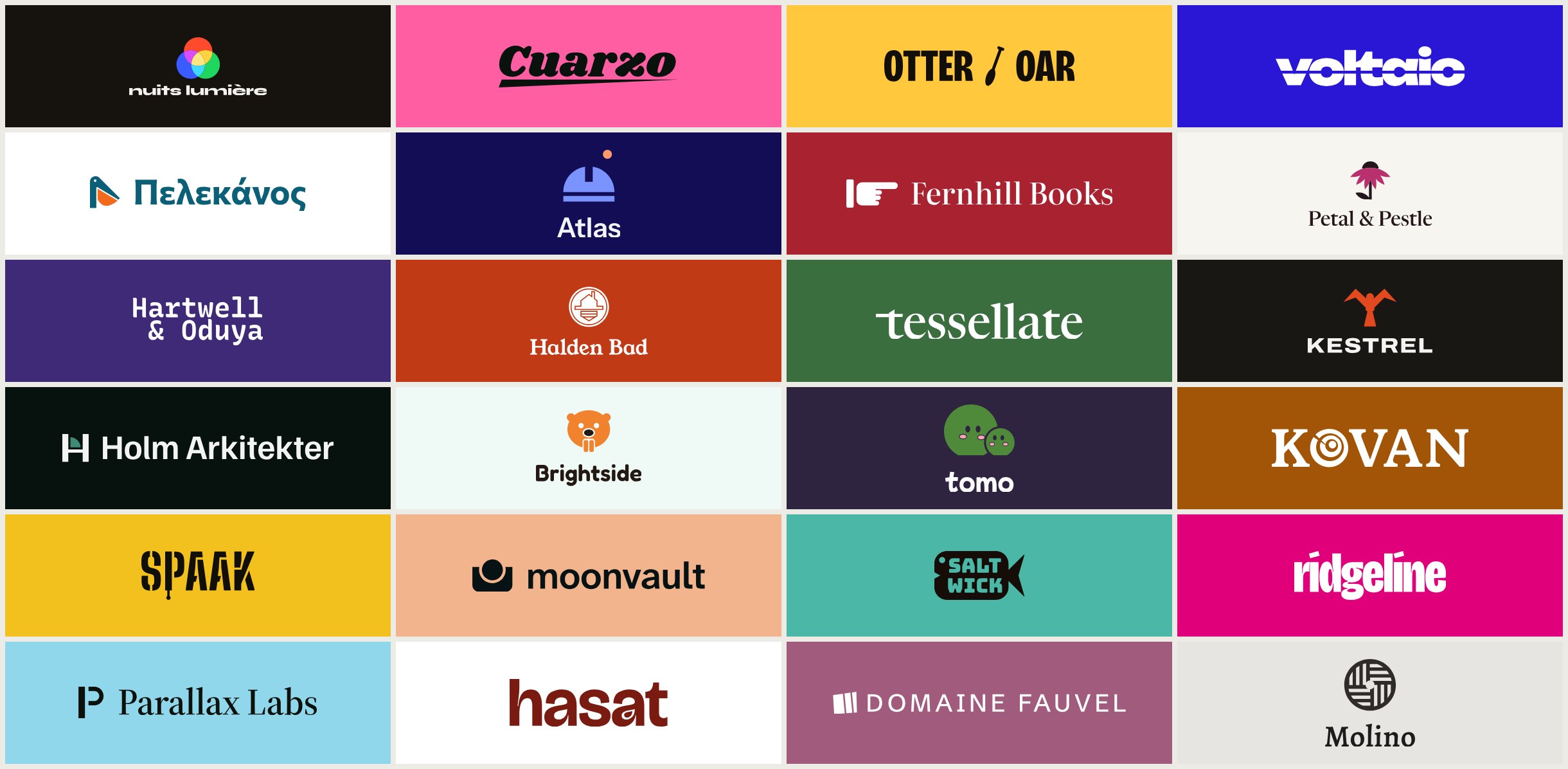
Twenty-four briefs, one direction shown from each: a light festival in Lyon, a taquería in Mexico City, a pharmacy in Athens, a techno label in Berlin, a floating sauna in Oslo, a children's dentist, a weeding-robot start-up, a honey co-op on the Black Sea and more. Mascots, emblems, monograms, stencils and plain wordmarks; every mark, typeface and colour above came out of a run of this skill.
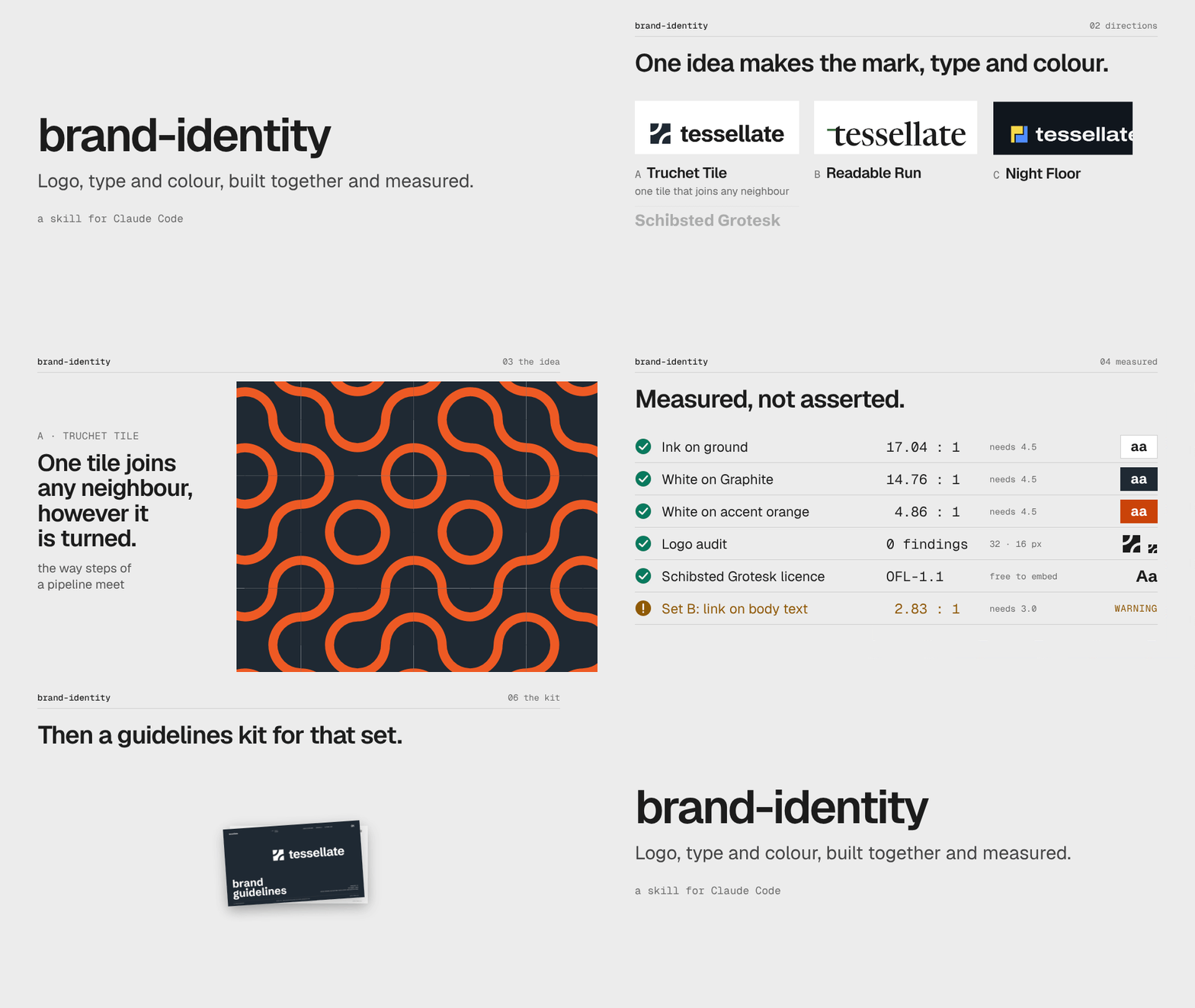
What you get · Examples · Install · Use · How it works · Network and privacy · Develop
What you get
- Three (up to four) identity sets, each built around a single mechanism that produces the mark, the type choice and the palette at once, so the parts belong together instead of being picked separately.
- Measured, not asserted. Contrast (WCAG 2 and APCA), colour-blindness simulation, glyph coverage for the languages the brand writes in, font licences, tabular figures, and the logo rendered at 16 and 32 px. A failed measurement is a gate the set must pass; a heuristic is labelled as a warning; taste is labelled as judgement.
- Sets that don't look like every other AI brand. The skill knows what plain models reach for and asks for a reason from the brief whenever a set uses it (below).
- A brand guidelines kit for the chosen set: an 8-page PDF (cover, idea, logo, variations, logo on colour and
misuse drawn for this mark, colours, typography, applications;
--fulladds grid, dark mode, accessibility, iconography and imagery for 13), logo files (SVG and PNG: full colour, one colour, reversed, app icon, favicon), design tokens (CSS, SCSS, Tailwind, DTCG JSON) and a font sheet with embed code. - Your site, restyled. Give it a URL and it reads the current logo, type and colours, then previews each set on
your own pages. Keep the parts you like (
keep), evolve others (refresh). - Any part on its own: just a logo, just a type system, a palette for an existing logo, or a critique of an identity you already have.
Examples
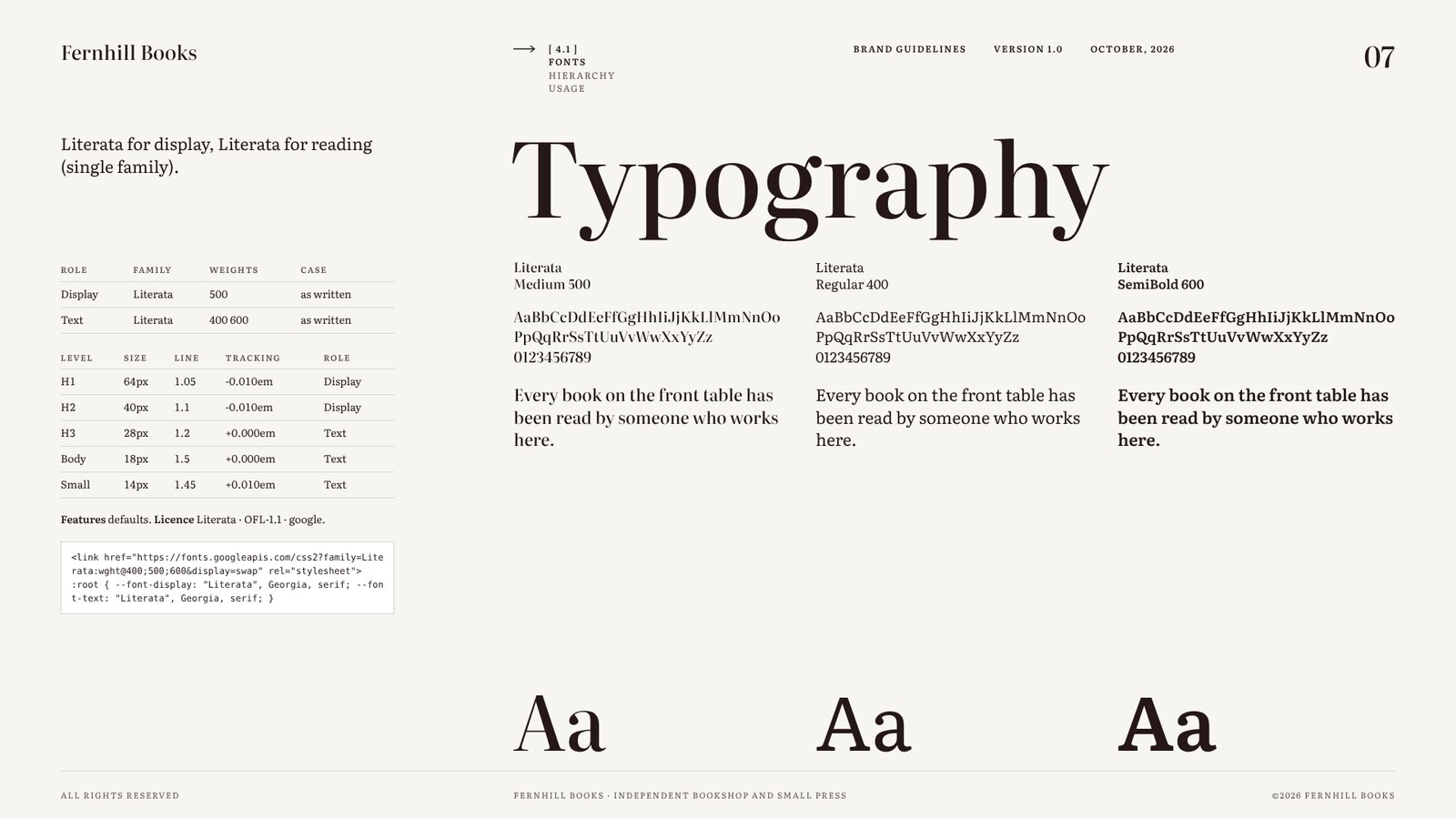
Fernhill Books: an independent bookshop and small press in Edinburgh
Brief: literate, unhurried, wry. Competitors: a national chain in navy and white, a second-hand shop with a gilt sign, an online marketplace.
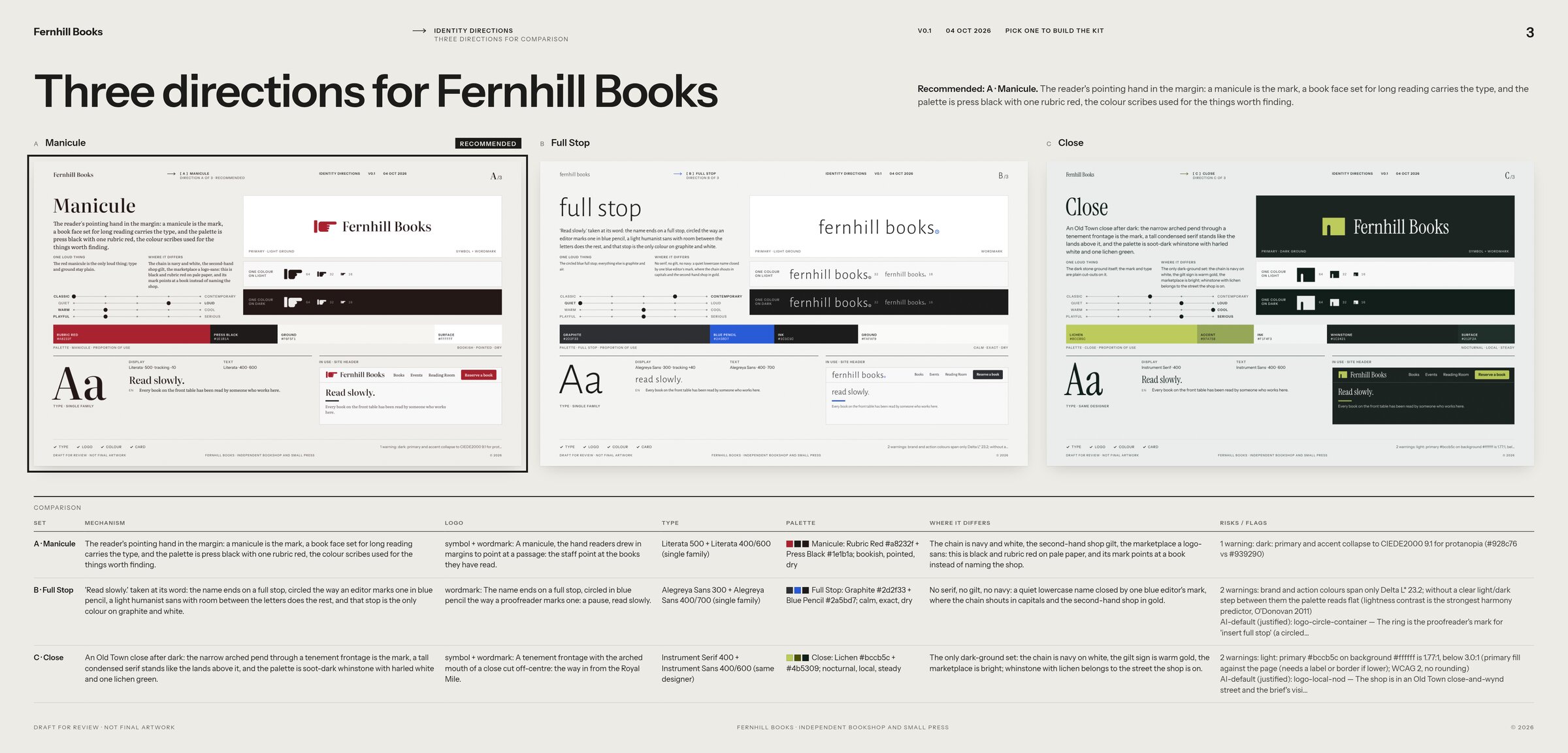
A · Manicule (recommended, picked): the pointing hand readers drew in margins is the mark, Literata carries both display and text, and the palette is press black with one rubric red. B · Full Stop: a quiet lowercase name that ends on a blue proofreader's full stop. C · Close: an Old Town passage under a tenement, on a dark ground.
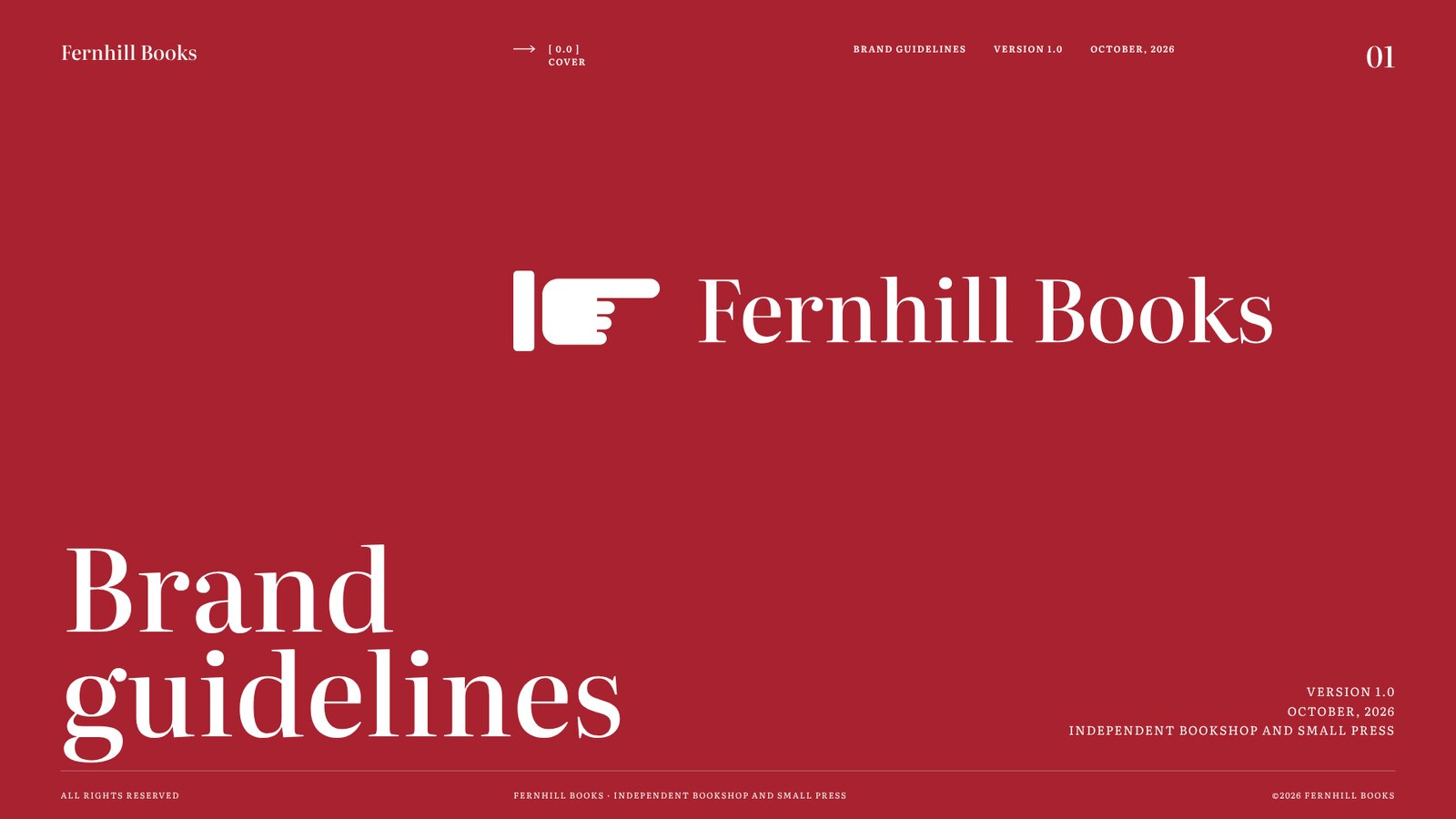
| Kit: cover | Kit: typography |
|---|---|
 |  |
Tessellate: an open-source data pipeline orchestrator
Brief: precise, calm, candid; the product shows run times and costs, so figures must be tabular. Competitors: an established scheduler with a pinwheel logo, two start-ups in purple and teal.
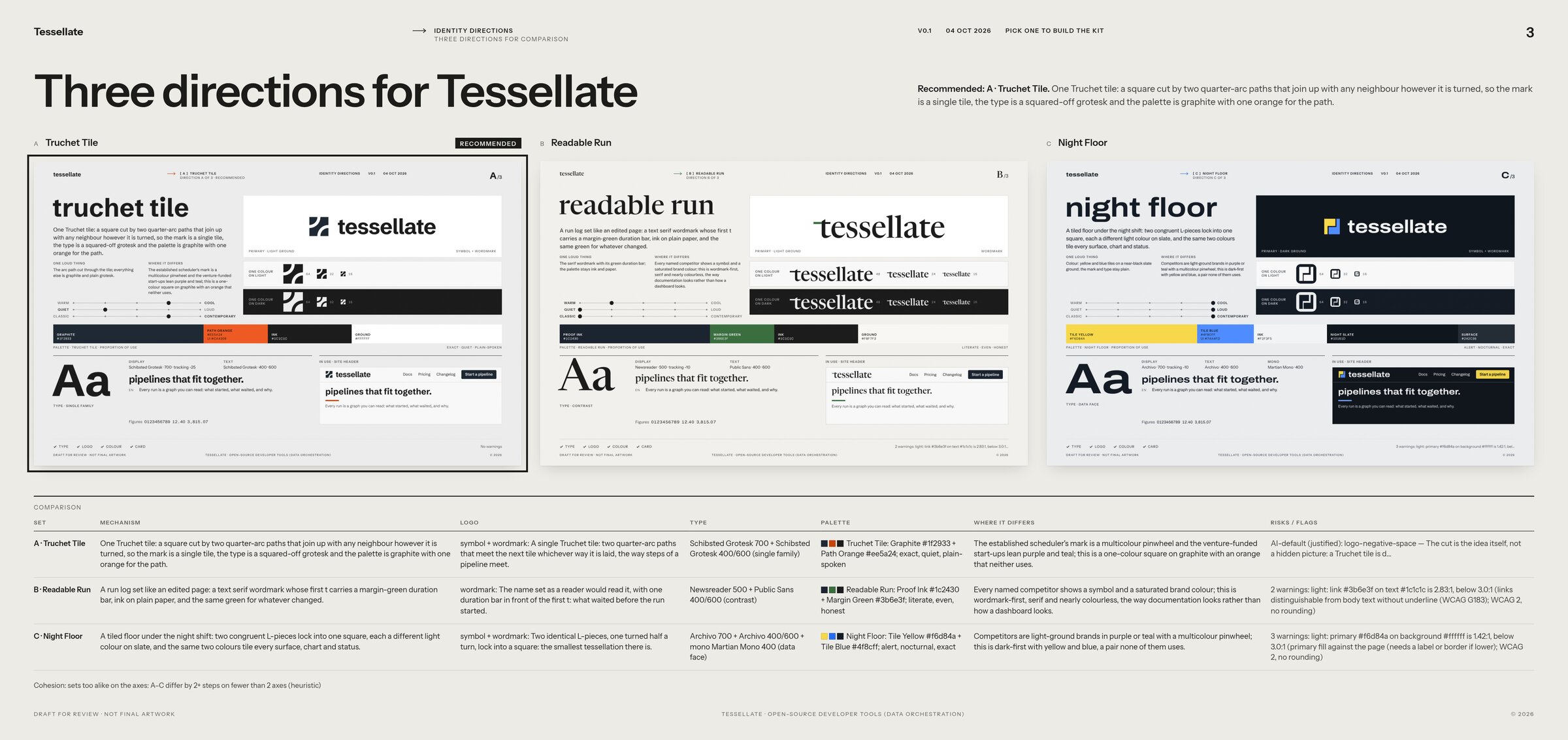
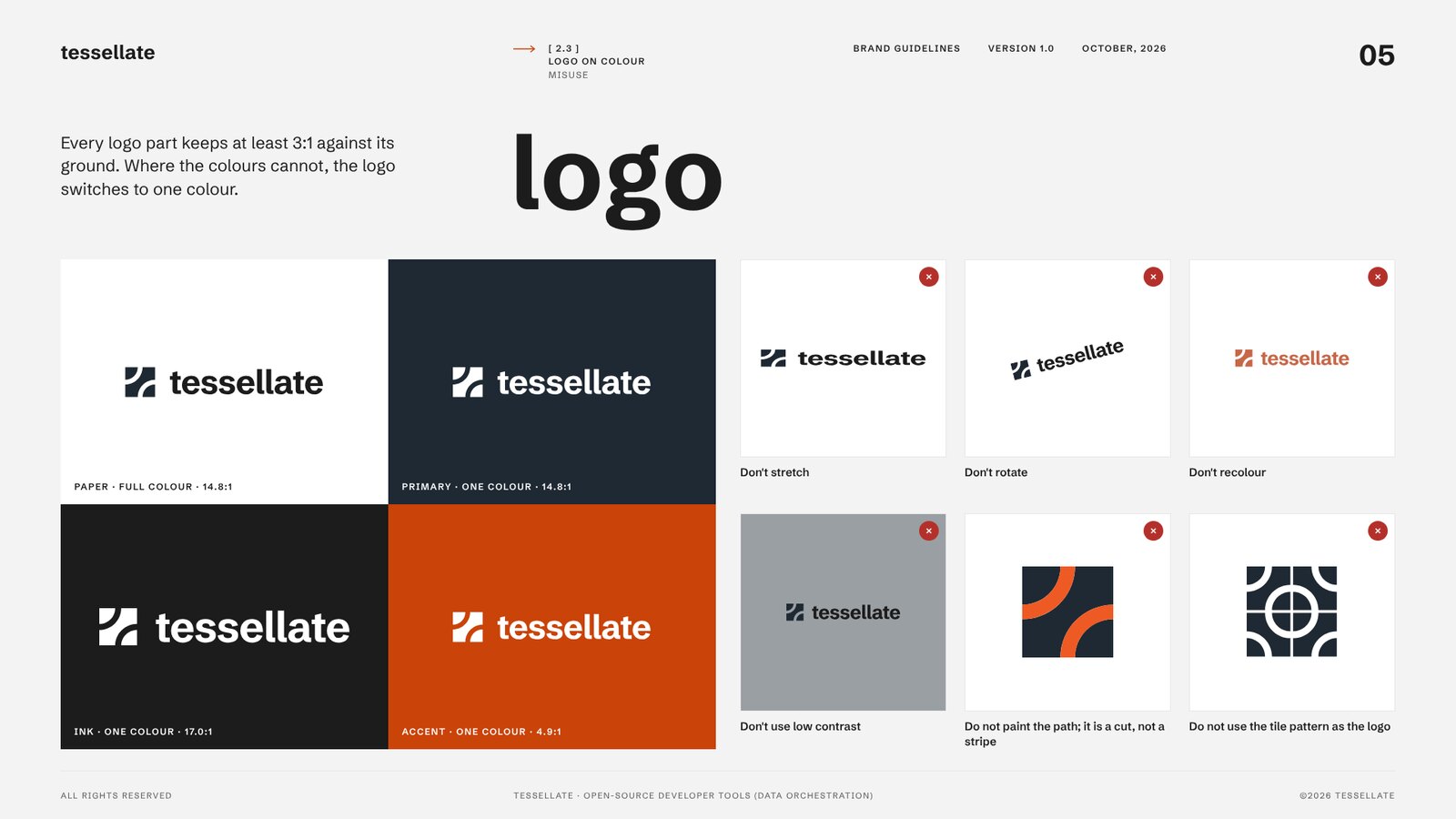
A · Truchet Tile (recommended, picked): one tile cut by two quarter arcs that join any neighbour however it is turned, the way steps of a pipeline meet. B · Readable Run: a text serif wordmark whose first t carries a duration bar. C · Night Floor: two L-pieces lock into one square, dark-first.
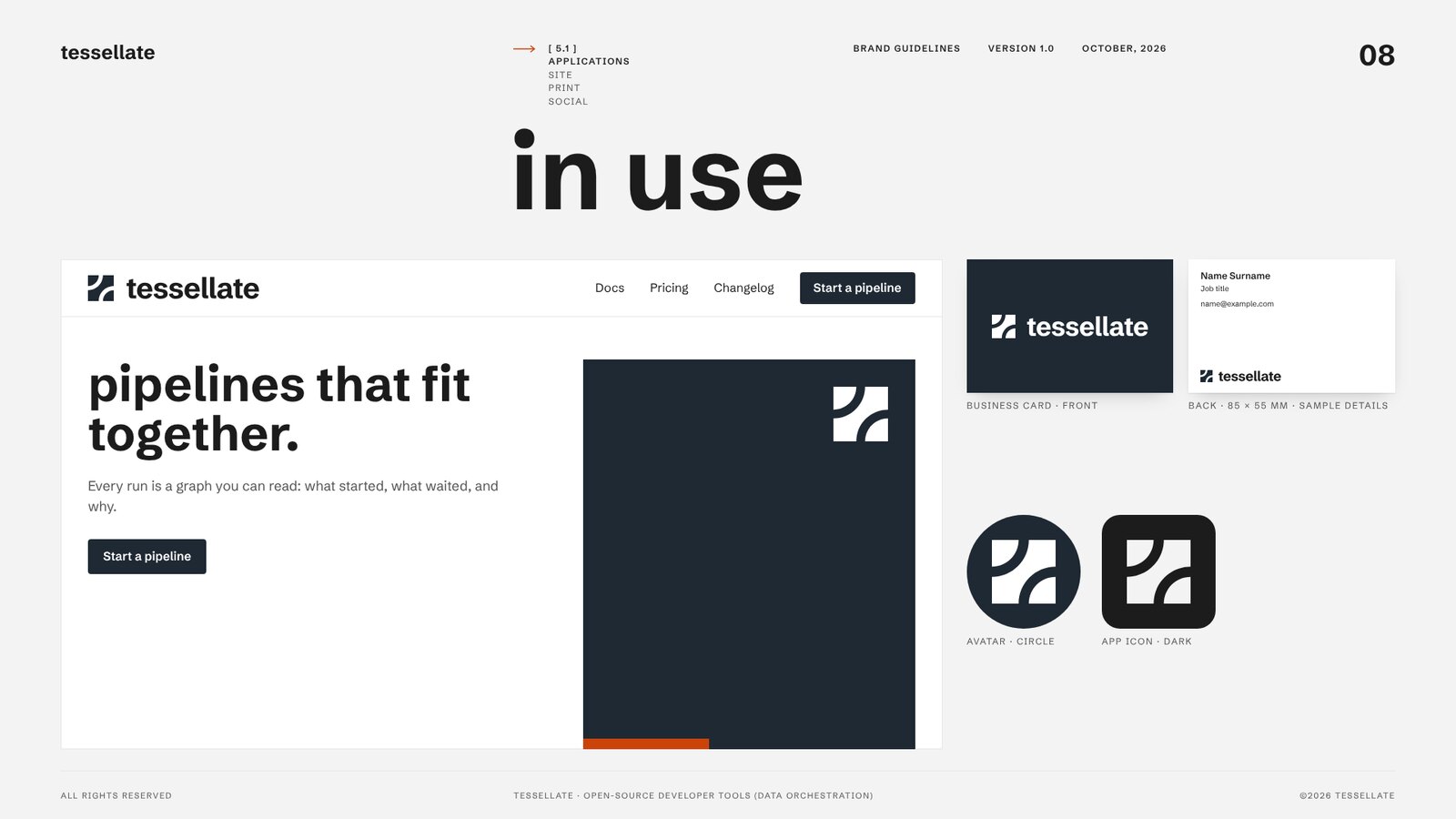
| Kit: logo on colour, and misuse specific to this mark | Kit: applications |
|---|---|
 |  |
More runs
| Brief | Languages | Directions (recommended first) |
|---|---|---|
 Molino Coffee, a specialty coffee shop in Lisbon Molino Coffee, a specialty coffee shop in Lisbon | en, pt | Vizinho · Mó · Bloco |
 Hartwell & Oduya, a commercial law firm in London Hartwell & Oduya, a commercial law firm in London | en | The Bar Between · Equal Measure · Counterparts |
 Parallax Labs, AI planning agents for supply chains Parallax Labs, AI planning agents for supply chains | en | Depth Field · Parallax Error · Computation Pad |
 Domaine Fauvel, a natural wine estate in Burgundy Domaine Fauvel, a natural wine estate in Burgundy | en, fr | La Taille · Climat · Fauve |
 Moonvault, a self-custody crypto wallet Moonvault, a self-custody crypto wallet | en | Held Moon · Two O's · Lamp Arcade |
 Hasat, a Turkish breakfast restaurant in Istanbul Hasat, a Turkish breakfast restaurant in Istanbul | tr, en | Tepeleme · Demli · Uzun Sofra |
Install
Claude Code plugin (recommended):
/plugin marketplace add fatihaydost/brand-identity-skill
/plugin install brand-identity@brand-identity-skill
Or as a plain skill, from the brand-identity.zip of the
latest release (unzip it into
~/.claude/skills/), or from a clone:
git clone https://github.com/fatihaydost/brand-identity-skill
mkdir -p ~/.claude/skills
ln -s "$PWD/brand-identity-skill/skills/brand-identity" ~/.claude/skills/brand-identity
Requirements: Python 3.10+, a Chromium-based browser (Chrome, Chromium, Edge or Brave) and, ideally,
uv. With uv the scripts install their own Python packages (fonttools, uharfbuzz,
skia-pathops) into a cached environment on first use; nothing to pip install. Run
python3 skills/brand-identity/scripts/brand.py check to see what is missing. Tested end to end on Linux, including
a clean container; unit tests run in CI on Linux, macOS and Windows.
Other hosts. The skill is a standard SKILL.md folder, so agents that read Agent Skills can load
skills/brand-identity; it is tested end to end in Claude Code. In claude.ai chat the code sandbox does not allow
Google Fonts by default, so type measurement and rendering fail there; use Claude Code.
Use
Ask Claude Code in plain words:
- "Logo, fonts and colours for a specialty coffee roaster in Lisbon."
- "New type and palette for https://example.com, keep the logo."
- "Just a type system for my newsletter."
- "Critique our brand identity."
It asks one round of questions (what to make, how many sets, languages, competitors), builds the sets, shows the board and stops for you to pick. It never picks for you. Then it builds the kit for your choice, or for a mix ("logo from A, palette from B").
A full run to the board takes about 40 agent turns and roughly 0.9 M billed-input-equivalent tokens (measured on six briefs; see testing).
Why the sets don't look like every other AI brand
Asked for a brand identity, plain models converge: cream ground, terracotta, a gold accent, Fraunces headings, Inter body text, a logo that hides a letter in a circle. The skill knows these defaults and asks for a reason from the brief whenever a set uses one; at least one set per run uses none. On the same six briefs:
| AI-default hits (type and palette) | sets with none | |
|---|---|---|
| Plain model, 24 answers | 4.38 per answer | 0 of 24 |
| brand-identity, 18 sets | 0.28 per set | 13 of 18 |
Method and data: docs/testing.md.
How it works
flowchart LR
  Q[One round of questions] --> S[sets.json<br/>mechanism, mark, type, palette seeds]
  S --> L[logos<br/>contact sheet at 16 and 32 px]
  L -->|fix one defect per mark, twice| S
  S --> B[build<br/>palette roles, audits, cards, board]
  B -->|a gate failed| S
  B --> P{You pick}
  P --> K[kit<br/>PDF, logo files, tokens, font sheet]
The agent designs; the scripts measure. Gates (contrast, licence, glyph coverage, file validity, renders) stop a set
until it is fixed; warnings are heuristics and say so. Architecture: docs/architecture.md.
Tests (unit, smoke, rendered-output probes, end-to-end runs): docs/testing.md.
Network and privacy
The skill runs locally. It contacts:
- Google Fonts (
fonts.googleapis.com,fonts.gstatic.com) and the google/fonts repository onraw.githubusercontent.com, to download fonts and their metadata and licences for measurement and rendering; - PyPI, through uv, once, for its Python packages;
- your site and the competitor sites you name, opened in a headless browser, only when you give their URLs.
No telemetry; nothing is uploaded. The brand's fonts are never subset or redistributed: the kit links to them and gives embed code. Licences are checked per family (OFL by default; Fontshare and commercial faces get a licence note).
Develop
pip install -r requirements-dev.txt     # requirements.txt + gflanguages (checks the bundled language data)
python3 -m unittest discover -s tests
python3 tools/smoke_test.py
python3 tools/package_skill.py          # dist/brand-identity.zip
skills/brand-identity/   the skill: SKILL.md, references/, scripts/, templates/, assets/
tools/                   smoke test, packager, run measurement, AI-defaults experiment, catalogue builders
tests/                   unit tests
evals/                   behaviour evals and fixtures
docs/                    architecture, testing, images
Licence
MIT, see LICENSE. Adapted code and bundled data: THIRD_PARTY_NOTICES.md. Brand names and measured site colours belong to their owners: TRADEMARKS.md. The example briefs in this README were invented for it; any likeness to a real business is coincidental.
Similar repos


Languages
Python
56.8%
HTML
38.1%
JavaScript
3.8%
CSS
1.2%
A Claude Code skill that designs a brand identity as one system: logo, typography and colour palette built together from one brief, measured, compared as identity cards, and delivered as a brand guidelines kit.
Python
3
9 commits
updated Oct 4, 2026
See what people are saying
README
brand-identity
A skill for Claude Code that designs a brand identity as one system: logo, typography and colour palette built together from one idea, measured, shown side by side as identity cards, and handed over as a brand guidelines kit for the set you pick.
Twenty-four briefs, one direction shown from each: a light festival in Lyon, a taquería in Mexico City, a pharmacy in Athens, a techno label in Berlin, a floating sauna in Oslo, a children's dentist, a weeding-robot start-up, a honey co-op on the Black Sea and more. Mascots, emblems, monograms, stencils and plain wordmarks; every mark, typeface and colour above came out of a run of this skill.
What you get · Examples · Install · Use · How it works · Network and privacy · Develop
What you get
- Three (up to four) identity sets, each built around a single mechanism that produces the mark, the type choice and the palette at once, so the parts belong together instead of being picked separately.
- Measured, not asserted. Contrast (WCAG 2 and APCA), colour-blindness simulation, glyph coverage for the languages the brand writes in, font licences, tabular figures, and the logo rendered at 16 and 32 px. A failed measurement is a gate the set must pass; a heuristic is labelled as a warning; taste is labelled as judgement.
- Sets that don't look like every other AI brand. The skill knows what plain models reach for and asks for a reason from the brief whenever a set uses it (below).
- A brand guidelines kit for the chosen set: an 8-page PDF (cover, idea, logo, variations, logo on colour and
misuse drawn for this mark, colours, typography, applications;
--fulladds grid, dark mode, accessibility, iconography and imagery for 13), logo files (SVG and PNG: full colour, one colour, reversed, app icon, favicon), design tokens (CSS, SCSS, Tailwind, DTCG JSON) and a font sheet with embed code. - Your site, restyled. Give it a URL and it reads the current logo, type and colours, then previews each set on
your own pages. Keep the parts you like (
keep), evolve others (refresh). - Any part on its own: just a logo, just a type system, a palette for an existing logo, or a critique of an identity you already have.
Examples
Fernhill Books: an independent bookshop and small press in Edinburgh
Brief: literate, unhurried, wry. Competitors: a national chain in navy and white, a second-hand shop with a gilt sign, an online marketplace.
A · Manicule (recommended, picked): the pointing hand readers drew in margins is the mark, Literata carries both display and text, and the palette is press black with one rubric red. B · Full Stop: a quiet lowercase name that ends on a blue proofreader's full stop. C · Close: an Old Town passage under a tenement, on a dark ground.
| Kit: cover | Kit: typography |
|---|---|
| |
Tessellate: an open-source data pipeline orchestrator
Brief: precise, calm, candid; the product shows run times and costs, so figures must be tabular. Competitors: an established scheduler with a pinwheel logo, two start-ups in purple and teal.
A · Truchet Tile (recommended, picked): one tile cut by two quarter arcs that join any neighbour however it is turned, the way steps of a pipeline meet. B · Readable Run: a text serif wordmark whose first t carries a duration bar. C · Night Floor: two L-pieces lock into one square, dark-first.
| Kit: logo on colour, and misuse specific to this mark | Kit: applications |
|---|---|
| |
More runs
| Brief | Languages | Directions (recommended first) |
|---|---|---|
| Molino Coffee, a specialty coffee shop in Lisbon | en, pt | Vizinho · Mó · Bloco |
| Hartwell & Oduya, a commercial law firm in London | en | The Bar Between · Equal Measure · Counterparts |
| Parallax Labs, AI planning agents for supply chains | en | Depth Field · Parallax Error · Computation Pad |
| Domaine Fauvel, a natural wine estate in Burgundy | en, fr | La Taille · Climat · Fauve |
| Moonvault, a self-custody crypto wallet | en | Held Moon · Two O's · Lamp Arcade |
| Hasat, a Turkish breakfast restaurant in Istanbul | tr, en | Tepeleme · Demli · Uzun Sofra |
Install
Claude Code plugin (recommended):
/plugin marketplace add fatihaydost/brand-identity-skill
/plugin install brand-identity@brand-identity-skill
Or as a plain skill, from the brand-identity.zip of the
latest release (unzip it into
~/.claude/skills/), or from a clone:
git clone https://github.com/fatihaydost/brand-identity-skill
mkdir -p ~/.claude/skills
ln -s "$PWD/brand-identity-skill/skills/brand-identity" ~/.claude/skills/brand-identity
Requirements: Python 3.10+, a Chromium-based browser (Chrome, Chromium, Edge or Brave) and, ideally,
uv. With uv the scripts install their own Python packages (fonttools, uharfbuzz,
skia-pathops) into a cached environment on first use; nothing to pip install. Run
python3 skills/brand-identity/scripts/brand.py check to see what is missing. Tested end to end on Linux, including
a clean container; unit tests run in CI on Linux, macOS and Windows.
Other hosts. The skill is a standard SKILL.md folder, so agents that read Agent Skills can load
skills/brand-identity; it is tested end to end in Claude Code. In claude.ai chat the code sandbox does not allow
Google Fonts by default, so type measurement and rendering fail there; use Claude Code.
Use
Ask Claude Code in plain words:
- "Logo, fonts and colours for a specialty coffee roaster in Lisbon."
- "New type and palette for https://example.com, keep the logo."
- "Just a type system for my newsletter."
- "Critique our brand identity."
It asks one round of questions (what to make, how many sets, languages, competitors), builds the sets, shows the board and stops for you to pick. It never picks for you. Then it builds the kit for your choice, or for a mix ("logo from A, palette from B").
A full run to the board takes about 40 agent turns and roughly 0.9 M billed-input-equivalent tokens (measured on six briefs; see testing).
Why the sets don't look like every other AI brand
Asked for a brand identity, plain models converge: cream ground, terracotta, a gold accent, Fraunces headings, Inter body text, a logo that hides a letter in a circle. The skill knows these defaults and asks for a reason from the brief whenever a set uses one; at least one set per run uses none. On the same six briefs:
| AI-default hits (type and palette) | sets with none | |
|---|---|---|
| Plain model, 24 answers | 4.38 per answer | 0 of 24 |
| brand-identity, 18 sets | 0.28 per set | 13 of 18 |
Method and data: docs/testing.md.
How it works
flowchart LR
  Q[One round of questions] --> S[sets.json<br/>mechanism, mark, type, palette seeds]
  S --> L[logos<br/>contact sheet at 16 and 32 px]
  L -->|fix one defect per mark, twice| S
  S --> B[build<br/>palette roles, audits, cards, board]
  B -->|a gate failed| S
  B --> P{You pick}
  P --> K[kit<br/>PDF, logo files, tokens, font sheet]
The agent designs; the scripts measure. Gates (contrast, licence, glyph coverage, file validity, renders) stop a set
until it is fixed; warnings are heuristics and say so. Architecture: docs/architecture.md.
Tests (unit, smoke, rendered-output probes, end-to-end runs): docs/testing.md.
Network and privacy
The skill runs locally. It contacts:
- Google Fonts (
fonts.googleapis.com,fonts.gstatic.com) and the google/fonts repository onraw.githubusercontent.com, to download fonts and their metadata and licences for measurement and rendering; - PyPI, through uv, once, for its Python packages;
- your site and the competitor sites you name, opened in a headless browser, only when you give their URLs.
No telemetry; nothing is uploaded. The brand's fonts are never subset or redistributed: the kit links to them and gives embed code. Licences are checked per family (OFL by default; Fontshare and commercial faces get a licence note).
Develop
pip install -r requirements-dev.txt     # requirements.txt + gflanguages (checks the bundled language data)
python3 -m unittest discover -s tests
python3 tools/smoke_test.py
python3 tools/package_skill.py          # dist/brand-identity.zip
skills/brand-identity/   the skill: SKILL.md, references/, scripts/, templates/, assets/
tools/                   smoke test, packager, run measurement, AI-defaults experiment, catalogue builders
tests/                   unit tests
evals/                   behaviour evals and fixtures
docs/                    architecture, testing, images
Licence
MIT, see LICENSE. Adapted code and bundled data: THIRD_PARTY_NOTICES.md. Brand names and measured site colours belong to their owners: TRADEMARKS.md. The example briefs in this README were invented for it; any likeness to a real business is coincidental.
Similar repos
Languages
Python
56.8%
HTML
38.1%
JavaScript
3.8%
CSS
1.2%