GLM-5.3-Flash standard EXL3 + native MTP on 2x DGX Spark/GB10 with TensorFold TP2: matched llama-benchy depth sweep, raw data, graphs and historical comparisons
Python
0
3 commits
updated Oct 17, 2026
Standard GLM-5.3-Flash EXL3 weights with native MTP, served by Jay's TensorFold fork across two NVIDIA GB10 / DGX Spark nodes (TP2). No modified/abliterated checkpoint or DFlash2 drafter.
Measured 2026-10-17 on the already-running service, without restart, cache flush or tuning. The same 14-point depth grid and llama-benchy parameters as the Qwen3.5 and Laguna studies were used.
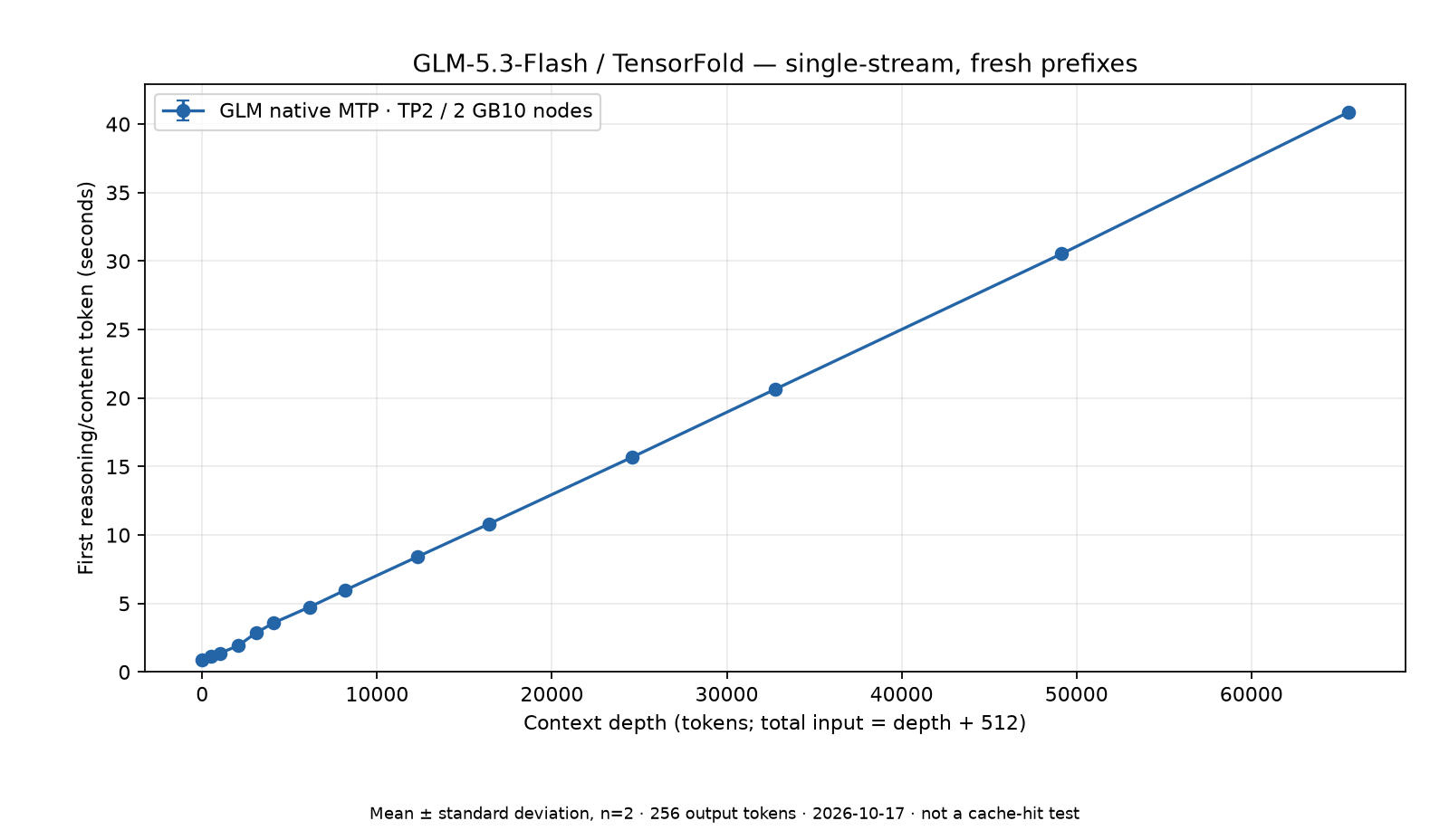
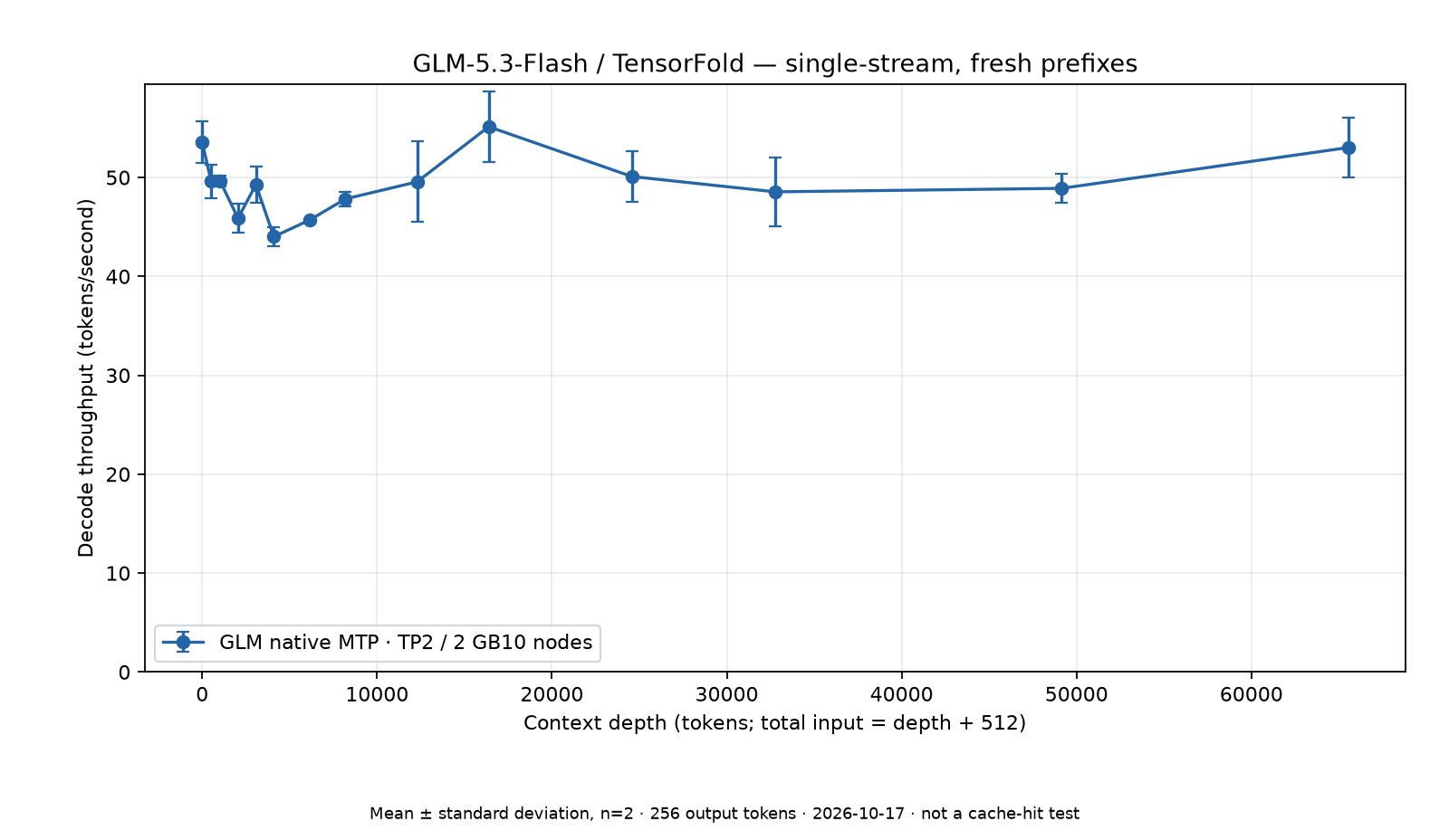
Result: first-token latency rises from 0.89 s at depth 0 to 40.86 s at depth 65,536; mean single-stream decode is 44–55 tokens/s across the grid. All 28 measured requests produced exactly 256 tokens. This run reused zero cached tokens: the client selects random book prefixes. It measures fresh-prefix speed, not conversation-cache effectiveness.
| Item | Recorded configuration |
|---|---|
| Model | Mia-AiLab/GLM-5.3-Flash-EXL3-4bpw-TensorFold, revision 078455ffe6472f9a52fbc1139f58b9db2881b25c |
| Quantization | Standard EXL3 expert weights, q4mse dense, FP8 latent KV |
| Engine | TensorFold 2f8e514b0b7d615df7c971627ce3c0fb7e55d93a, Jay recipe f79bf9c72968f79bc8f1dc788ddb48ac974d2858 plus pinned local contract patch |
| Hardware | Two NVIDIA GB10 / DGX Spark-class UMA nodes, TP2, 200G fabric |
| Drafting | Native checkpoint MTP; deployed adaptive policy unchanged |
| Serving lanes | Four enabled; original study c1, later mixed-load matrix c1/c2/c4 |
| Context | 1048576 per-request declaration; shared pool, page-rounded1048832 tokens—not four full1M caches |
| Session store | 2GiB per rank; disk session tier disabled; prepared-weight cache separate |
| Client | llama-benchy0.4.0; actual installed module hashes recorded |
| Original benchmark | --pp 512 --tg 256 --exact-tg --runs 2 --latency-mode generation --concurrency 1 |
| Concurrent follow-up | --concurrency 1 2 4, same other parameters; extra work was present |
| Depths | 0 512 1024 2048 3072 4096 6144 8192 12288 16384 24576 32768 49152 65536 |
Exact image ID, source pins, tokenizer/corpus hashes and validation scope are in
results/methodology.json. Current deployment procedures live in the
lab serving guide, not this frozen result repo.
comparison.md: all 14 points, historical Qwen/Laguna checkpoints and limitations.dataset.csv / dataset.json: original single-stream results.dataset-concurrency.csv / dataset-concurrency.json:
later observed matrix, per-stream and batch-window rates, TTFT spread and interference labels.results/: original report, allowlisted methodology and verified historical reference reports.graphs/: plots generated from the raw GLM report; error bars are standard deviation, not confidence intervals.scripts/: client-only reproduction, aggregation/plotting and offline tests.SHA256SUMS: frozen reports, datasets and plots.You need an already-running authorized service. A run consumes inference capacity and changes cache contents naturally. The runner does not deploy, restart, clear caches, change clocks or download model weights. It does not certify available memory or service safety. Choose an appropriate quiet window yourself.
python3 -m venv .venv
.venv/bin/pip install -r requirements.txt
.venv/bin/python scripts/run_benchmark.py \
  --base-url "$SPARK_BASE_URL" \
  --tokenizer "$GLM_TOKENIZER_PATH" \
  --api-key-file "$SPARK_API_KEY_FILE" \
  --output results/local-runs/new-run.json

# Offline: regenerate published datasets/plots, without running inference.
.venv/bin/python scripts/aggregate_and_plot.py
.venv/bin/python scripts/analyze_concurrency.py
.venv/bin/python -m unittest discover -s scripts -p 'test_*.py' -v
sha256sum -c SHA256SUMS
For a separate concurrency sweep, add --concurrency 1 2 4 and choose a new output file.
That requests the same 14 depths at each level: 42 grid points and 196 measured requests, plus
warmups/probes. The default remains concurrency 1; the original published dataset is unchanged.
The endpoint should include /v1; tokenizer points to the exact checkpoint's tokenizer directory
or tokenizer.json. Credentials stay in a private file or OPENAI_API_KEY, never this repository.
The reproduction script is a portable example, not the original host controller. Version0.4.0
alone does not establish byte-identical client source: compare recorded module hashes if required.
prefix_caching_enabled=false describes special context-load test mode, not the server.
Server caching stayed enabled. Original sweep reuse was zero; later global cache counters include
additional traffic and cannot establish the matrix's own hit rate. Neither is a conversation-cache test.Original execution evidence is linked from the methodology record. Private host configuration, credentials and raw generated snippets are intentionally excluded. No model weights are distributed; model, engine and dependency licences remain separate.
GLM-5.3-Flash standard EXL3 + native MTP on 2x DGX Spark/GB10 with TensorFold TP2: matched llama-benchy depth sweep, raw data, graphs and historical comparisons
Python
0
3 commits
updated Oct 17, 2026
Standard GLM-5.3-Flash EXL3 weights with native MTP, served by Jay's TensorFold fork across two NVIDIA GB10 / DGX Spark nodes (TP2). No modified/abliterated checkpoint or DFlash2 drafter.
Measured 2026-10-17 on the already-running service, without restart, cache flush or tuning. The same 14-point depth grid and llama-benchy parameters as the Qwen3.5 and Laguna studies were used.
Result: first-token latency rises from 0.89 s at depth 0 to 40.86 s at depth 65,536; mean single-stream decode is 44–55 tokens/s across the grid. All 28 measured requests produced exactly 256 tokens. This run reused zero cached tokens: the client selects random book prefixes. It measures fresh-prefix speed, not conversation-cache effectiveness.
| Item | Recorded configuration |
|---|---|
| Model | Mia-AiLab/GLM-5.3-Flash-EXL3-4bpw-TensorFold, revision 078455ffe6472f9a52fbc1139f58b9db2881b25c |
| Quantization | Standard EXL3 expert weights, q4mse dense, FP8 latent KV |
| Engine | TensorFold 2f8e514b0b7d615df7c971627ce3c0fb7e55d93a, Jay recipe f79bf9c72968f79bc8f1dc788ddb48ac974d2858 plus pinned local contract patch |
| Hardware | Two NVIDIA GB10 / DGX Spark-class UMA nodes, TP2, 200G fabric |
| Drafting | Native checkpoint MTP; deployed adaptive policy unchanged |
| Serving lanes | Four enabled; original study c1, later mixed-load matrix c1/c2/c4 |
| Context | 1048576 per-request declaration; shared pool, page-rounded1048832 tokens—not four full1M caches |
| Session store | 2GiB per rank; disk session tier disabled; prepared-weight cache separate |
| Client | llama-benchy0.4.0; actual installed module hashes recorded |
| Original benchmark | --pp 512 --tg 256 --exact-tg --runs 2 --latency-mode generation --concurrency 1 |
| Concurrent follow-up | --concurrency 1 2 4, same other parameters; extra work was present |
| Depths | 0 512 1024 2048 3072 4096 6144 8192 12288 16384 24576 32768 49152 65536 |
Exact image ID, source pins, tokenizer/corpus hashes and validation scope are in
results/methodology.json. Current deployment procedures live in the
lab serving guide, not this frozen result repo.
comparison.md: all 14 points, historical Qwen/Laguna checkpoints and limitations.dataset.csv / dataset.json: original single-stream results.dataset-concurrency.csv / dataset-concurrency.json:
later observed matrix, per-stream and batch-window rates, TTFT spread and interference labels.results/: original report, allowlisted methodology and verified historical reference reports.graphs/: plots generated from the raw GLM report; error bars are standard deviation, not confidence intervals.scripts/: client-only reproduction, aggregation/plotting and offline tests.SHA256SUMS: frozen reports, datasets and plots.You need an already-running authorized service. A run consumes inference capacity and changes cache contents naturally. The runner does not deploy, restart, clear caches, change clocks or download model weights. It does not certify available memory or service safety. Choose an appropriate quiet window yourself.
python3 -m venv .venv
.venv/bin/pip install -r requirements.txt
.venv/bin/python scripts/run_benchmark.py \
  --base-url "$SPARK_BASE_URL" \
  --tokenizer "$GLM_TOKENIZER_PATH" \
  --api-key-file "$SPARK_API_KEY_FILE" \
  --output results/local-runs/new-run.json

# Offline: regenerate published datasets/plots, without running inference.
.venv/bin/python scripts/aggregate_and_plot.py
.venv/bin/python scripts/analyze_concurrency.py
.venv/bin/python -m unittest discover -s scripts -p 'test_*.py' -v
sha256sum -c SHA256SUMS
For a separate concurrency sweep, add --concurrency 1 2 4 and choose a new output file.
That requests the same 14 depths at each level: 42 grid points and 196 measured requests, plus
warmups/probes. The default remains concurrency 1; the original published dataset is unchanged.
The endpoint should include /v1; tokenizer points to the exact checkpoint's tokenizer directory
or tokenizer.json. Credentials stay in a private file or OPENAI_API_KEY, never this repository.
The reproduction script is a portable example, not the original host controller. Version0.4.0
alone does not establish byte-identical client source: compare recorded module hashes if required.
prefix_caching_enabled=false describes special context-load test mode, not the server.
Server caching stayed enabled. Original sweep reuse was zero; later global cache counters include
additional traffic and cannot establish the matrix's own hit rate. Neither is a conversation-cache test.Original execution evidence is linked from the methodology record. Private host configuration, credentials and raw generated snippets are intentionally excluded. No model weights are distributed; model, engine and dependency licences remain separate.



