
This repositories contains the reference implementation for the Sparse Delta Memory paper.More precisely, it contains the model definition as well as triton and cuda kernels for the Sparse Delta Memory layer.
Python
40
1 commits
updated Jul 9, 2026
README
Sparse-Delta-Memory (SDM)




Reference implementation of Sparse-Delta-Memory — a sparse memory bank with deltanet-style gating (the Gated Memory Controller from the paper). SDM is a sequence mixer that reads from and writes to a large sparse memory via product keys, with gated (forget/input) delta-rule updates.
This repository is a fork of Meta Lingua;
the SDM-specific code lives under lingua/sparse_delta_memory/. For everything
else (data prep, training/eval scaffolding, stool), refer to the
Meta Lingua README.
Results
Results from the paper. All models use sliding-window attention (SWA) as the local layer and vary the global layer; SDM and GDN are matched in FLOPs and (non-memory) parameters.
Perplexity by token position (code, 1M-token documents)
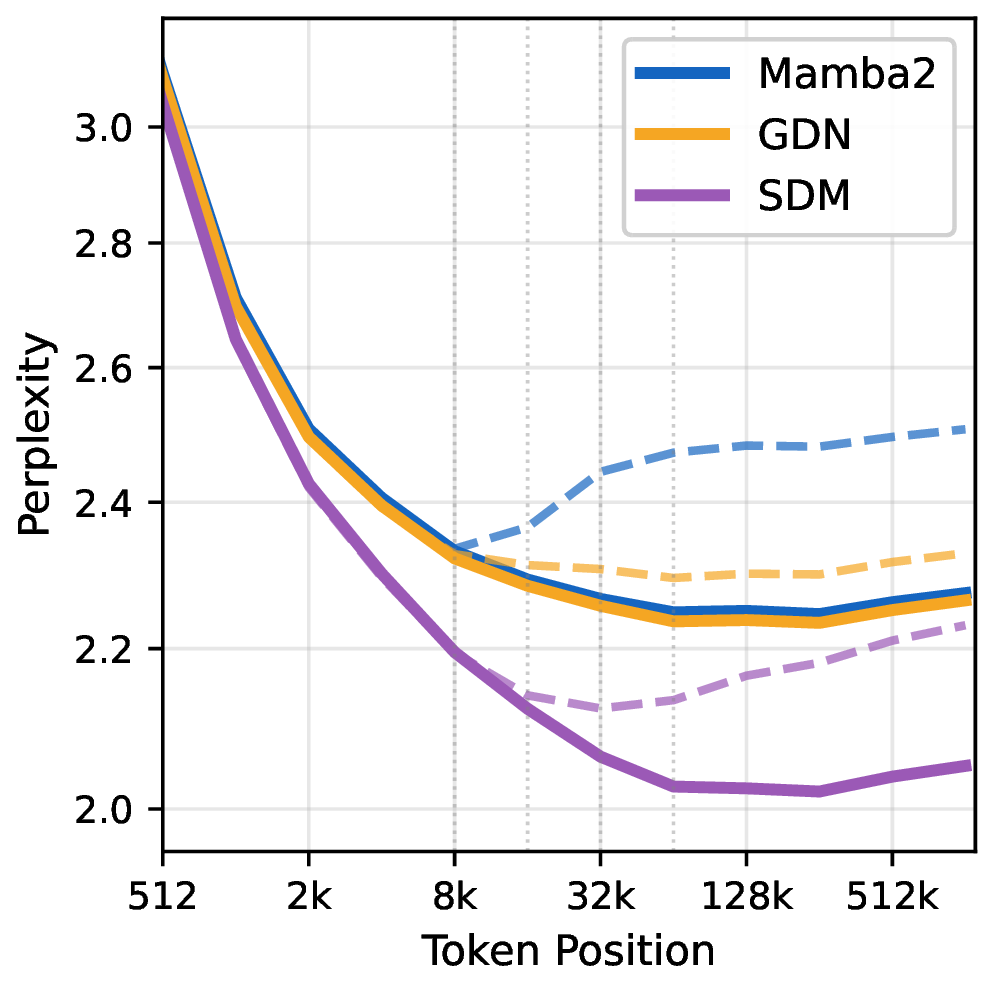
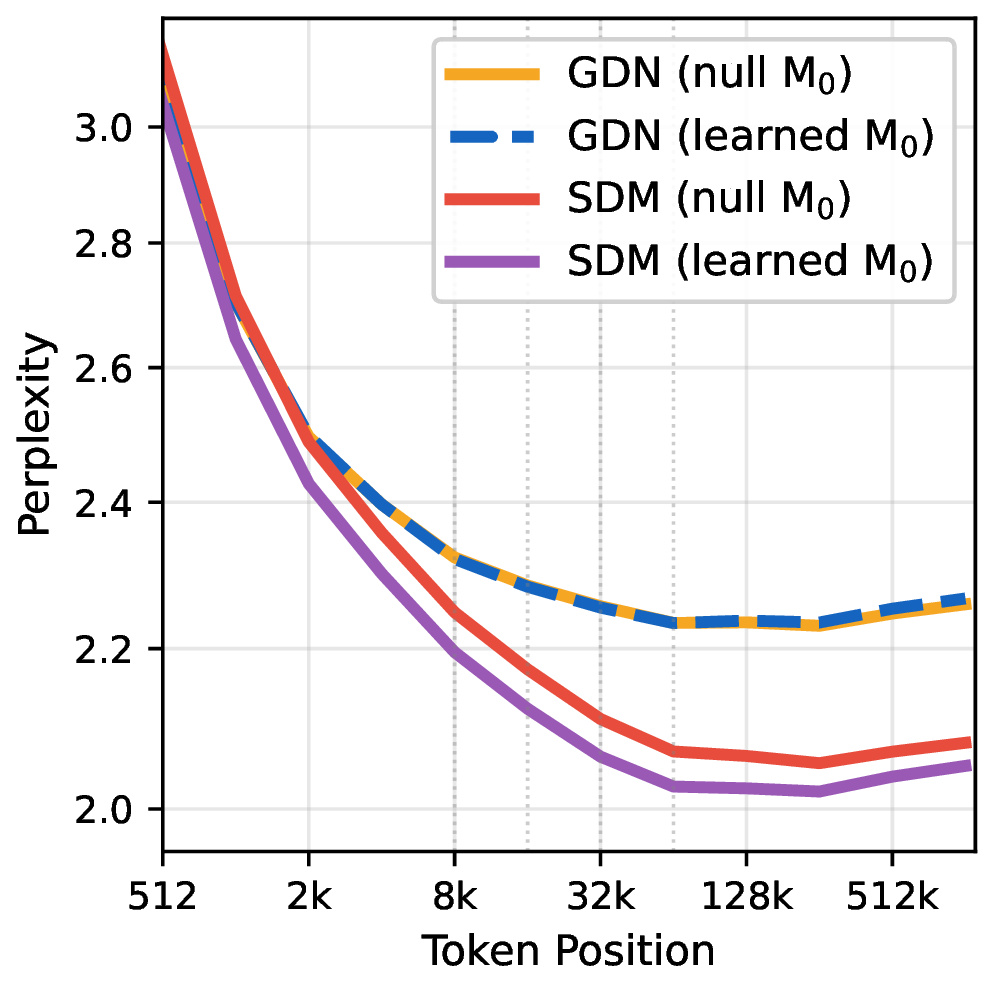
Left (Fig. 4): perplexity by token position on code data (1.4B; solid = 128k long-context finetuned, dashed = pre-trained). SDM reaches lower perplexity than Mamba2/GDN — already at short context (a benefit of the learned initial state) and increasingly at long context. Right (Fig. 5): learned-initial-state ($\mathbf{M_0}$) ablation — learning $\mathbf{M_0}$ helps SDM but not GDN.
Long-context retrieval (RULER)
Exact-match accuracy, averaged over sequence lengths 4k–131k. Δ = SDM − GDN (iso-FLOP); $\color{green}{\textsf{green}}$ = SDM better, $\color{red}{\textsf{red}}$ = worse.
1.4B (L08)
| RULER task | FullAttn | Mamba2 | GDN | SDM | Δ (SDM−GDN) |
|---|---|---|---|---|---|
| single_1 | 64.2 | 53.8 | 99.9 | 100.0 | $\color{green}{+0.1}$ |
| single_2 | 53.1 | 19.2 | 20.7 | 70.8 | $\color{green}{+50.1}$ |
| single_3 | 41.1 | 8.0 | 12.1 | 46.3 | $\color{green}{+34.2}$ |
| multikey_1 | 44.0 | 14.7 | 13.6 | 35.0 | $\color{green}{+21.4}$ |
| multikey_2 | 25.3 | 1.0 | 0.7 | 0.8 | $\color{green}{+0.1}$ |
| multikey_3 | 8.6 | 0.2 | 0.1 | 0.2 | $\color{green}{+0.1}$ |
| multivalue | 39.8 | 17.5 | 11.7 | 37.4 | $\color{green}{+25.7}$ |
| multiquery | 39.0 | 10.5 | 11.8 | 41.1 | $\color{green}{+29.3}$ |
| vt | 32.1 | 8.6 | 16.6 | 23.7 | $\color{green}{+7.1}$ |
| cwe | 5.8 | 3.6 | 6.6 | 8.7 | $\color{green}{+2.1}$ |
| fwe | 30.9 | 37.5 | 35.6 | 12.3 | $\color{red}{-23.2}$ |
| qa_1 | 19.3 | 11.5 | 13.3 | 13.3 | $\color{green}{+0.0}$ |
| qa_2 | 20.9 | 18.5 | 18.3 | 18.0 | $\color{red}{-0.3}$ |
| Average | 32.5 | 17.9 | 20.0 | 31.2 | $\color{green}{\mathbf{+11.2}}$ |
8B (L13)
| RULER task | FullAttn | GDN | SDM | Δ (SDM−GDN) |
|---|---|---|---|---|
| single_1 | 99.3 | 100.0 | 100.0 | $\color{green}{+0.0}$ |
| single_2 | 89.4 | 45.1 | 71.5 | $\color{green}{+26.4}$ |
| single_3 | 70.1 | 32.6 | 74.9 | $\color{green}{+42.3}$ |
| multikey_1 | 75.3 | 32.9 | 59.3 | $\color{green}{+26.4}$ |
| multikey_2 | 58.0 | 1.0 | 4.7 | $\color{green}{+3.7}$ |
| multikey_3 | 29.8 | 0.1 | 1.2 | $\color{green}{+1.1}$ |
| multivalue | 74.3 | 31.1 | 66.1 | $\color{green}{+35.0}$ |
| multiquery | 73.0 | 31.2 | 68.6 | $\color{green}{+37.4}$ |
| vt | 67.2 | 46.2 | 72.3 | $\color{green}{+26.1}$ |
| cwe | 5.5 | 11.4 | 12.8 | $\color{green}{+1.5}$ |
| fwe | 77.8 | 62.7 | 65.0 | $\color{green}{+2.4}$ |
| qa_1 | 39.0 | 23.6 | 27.2 | $\color{green}{+3.6}$ |
| qa_2 | 38.4 | 28.2 | 30.4 | $\color{green}{+2.3}$ |
| Average | 61.2 | 34.2 | 50.2 | $\color{green}{\mathbf{+16.0}}$ |
Quick start
git clone https://github.com/facebookresearch/sparse-delta-memory
cd sparse-delta-memory

# Create the environment (SLURM optional). Installs torch, triton, einops, ninja.
# Tip: if /tmp is small (often a tiny tmpfs), point scratch at a roomy disk first — the
# torch wheel + JIT kernel builds need a couple GB:  export TMPDIR=$HOME/tmp; mkdir -p $TMPDIR
bash setup/create_env.sh          # or: sbatch setup/create_env.sh
conda activate lingua_<date>
Fastest check — no data, no downloads, no distributed. Exercises the CUDA/Triton kernels (they JIT-compile on first use, ~90 s) with a forward+backward across all flag configs:
PYTHONPATH=. python tests/smoke_sdm.py
# full test suite (self-contained; pytest optional): pip install -r requirements-dev.txt && pytest tests/
Smallest "does it train" run — still zero downloads. The bytes tokenizer needs no vocab
file, so a few synthetic JSONL chunks are enough:
mkdir -p data/shuffled/dclm_baseline_1.0
python - <<'PY'
import json, random
random.seed(0); w = "the quick brown fox sparse delta memory attention window".split()
with open("data/shuffled/dclm_baseline_1.0/dclm_baseline_1.0.chunk.00.jsonl", "w") as f:
    for _ in range(4000):
        f.write(json.dumps({"text": " ".join(random.choice(w) for _ in range(random.randint(40, 120)))}) + "\n")
PY

# Single GPU. debug_sdm.yaml uses FSDP, which does an NCCL init collective even on 1 GPU —
# on a node with no/mismatched NIC naming, force loopback:
NCCL_SOCKET_IFNAME=lo NCCL_IB_DISABLE=1 NCCL_P2P_DISABLE=1 \
  torchrun --nproc-per-node 1 -m apps.main.train config=apps/main/configs/debug_sdm.yaml \
  dump_dir=/tmp/sdm_debug data.root_dir=data/shuffled
On a real filesystem, not tmpfs — DCP checkpoint saving fails on tmpfs
dump_dir.
For real training, download data + a tokenizer (see the Meta Lingua README for options):
python setup/download_prepare_hf_data.py fineweb_edu <MEMORY> --data_dir ./data --seed 42
python setup/download_tokenizer.py llama3 <SAVE_PATH> --api_key <HF_TOKEN>
The provided configs are templates — set dump_dir, data.root_dir, and
data.tokenizer.path before launching.
# Multi-GPU locally  (add the NCCL_* vars above if your node lacks a routable NIC)
torchrun --nproc-per-node 8 -m apps.main.train config=apps/main/configs/sdm_flagship.yaml

# SLURM
python -m lingua.stool script=apps.main.train config=apps/main/configs/sdm_flagship.yaml nodes=8 partition=<partition>
CUDA kernels: the SDM kernels JIT-compile on first use via
torch.utils.cpp_extension.load_inline(cached inTORCH_EXTENSIONS_DIR). This requires torch ≥ 2.8 (triton ≥ 3.4) — the kernels use bf16atomic_add, which triton 3.3 (torch 2.7) does not support — plus a CUDA toolkit (nvcc) and a hostg++at runtime, and an SM 80+ GPU (Ampere/Hopper) for the async gather and bf16 atomics. On SLURM, pointTORCH_EXTENSIONS_DIR(andTMPDIR) at a node-local writable path to avoid cross-rank build races and small-/tmpfailures.
Project overview
lingua/sparse_delta_memory/
 ┣ layer.py         # SparseDeltaMemory (the layer) + SparseDeltaMemoryArgs
 ┣ memory_ops.py    # Triton kernels: sparse inner product, product-key top-k, fused decay/scatter, WY phase-2
 ┣ triton_argsort.py
 ┣ cache.py         # inference/decode state
 ┗ cuda/            # CUDA kernels (JIT via load_inline): sparse_ip, warp_cooperative_gather, ...
Every layer is assigned an explicit type via three lists in the model config —
attn_at (full attention), swa_at (sliding-window attention), and sdm_at (SDM) —
each either "all" or a list of layer indices, together covering all n_layers exactly
once. SWA and full attention are distinct layer types with independent head configs
(swa_n_heads / swa_n_kv_heads / swa_head_dim, swa_window). The SDM memory size is
configured per head via sdm_args.slots_per_head (bank = num_heads * slots_per_head
slots, learned when backprop_on_memory=true).
Wiring into the base library is minimal: lingua/transformer.py (per-layer
mixer selection), lingua/optim.py (no-weight-decay on the gating parameters),
and apps/main/transformer.py (tensor-parallel skips SDM layers).
See lingua/sparse_delta_memory/README.md and SNAPSHOT_QUANT.md for kernel
design notes.
Configuration
Example configs under apps/main/configs/. Each SDM config pairs with an iso-backbone
attention baseline (SWA local layers; SDM vs. full attention in the global slot):
| Config | What |
|---|---|
debug_sdm.yaml | small, single-GPU smoke run |
debug_hybrid.yaml | small 3-way SWA + attn + SDM hybrid |
sdm_flagship.yaml | 1.4B, 3:1 SWA:SDM hybrid |
baseline_1.4B.yaml | 1.4B A/B control (SWA + full attention) |
sdm_7B.yaml | 7B, 3:1 SWA:SDM hybrid |
baseline_7B.yaml | 7B A/B control (SWA + full attention) |
Acknowledgements
SDM combines two prior ideas — sparse product-key memory and the gated delta rule.
Original ideas (papers):
- Product-key memory — Large Memory Layers with Product Keys (Lample et al., 2019)
- Gated delta rule — Gated Delta Networks: Improving Mamba2 with Delta Rule (Yang et al., 2025)
Implementations we referred to (code):
- Memory Layers at Scale — for the product-key memory
- flash-linear-attention (FLA) — for the gated delta-rule update (whose
A/dtinitialization we match)
This repository is a fork of Meta Lingua (BSD-3-Clause); refer to its README for the general training/eval workflow.
Citation
@misc{sparse_delta_memory,
  author = {Lo{\"i}c Cabannes and Pierre-Emmanuel Mazar{\'e} and Gergely Szilvasy and Matthijs Douze and Maria Lomeli and Ilze Amanda Auzina and Justin Carpentier and Gabriel Synnaeve and Herv{\'e} J{\'e}gou},
  title  = {{Sparse Delta Memory: Scaling the State of Linear RNNs through Sparsity}},
  year   = {2026},
  eprint = {2607.07386},
  archivePrefix = {arXiv},
  primaryClass = {cs.LG},
  url    = {https://arxiv.org/abs/2607.07386}
}
License
Sparse-Delta-Memory is licensed under CC-BY-NC 4.0 — see the LICENSE file.
This code is derived from Meta Lingua, which is BSD-3-Clause licensed.
Similar repos





Languages
Python
99.6%
This repositories contains the reference implementation for the Sparse Delta Memory paper.More precisely, it contains the model definition as well as triton and cuda kernels for the Sparse Delta Memory layer.
Python
40
1 commits
updated Jul 9, 2026
README
Sparse-Delta-Memory (SDM)
Reference implementation of Sparse-Delta-Memory — a sparse memory bank with deltanet-style gating (the Gated Memory Controller from the paper). SDM is a sequence mixer that reads from and writes to a large sparse memory via product keys, with gated (forget/input) delta-rule updates.
This repository is a fork of Meta Lingua;
the SDM-specific code lives under lingua/sparse_delta_memory/. For everything
else (data prep, training/eval scaffolding, stool), refer to the
Meta Lingua README.
Results
Results from the paper. All models use sliding-window attention (SWA) as the local layer and vary the global layer; SDM and GDN are matched in FLOPs and (non-memory) parameters.
Perplexity by token position (code, 1M-token documents)
Left (Fig. 4): perplexity by token position on code data (1.4B; solid = 128k long-context finetuned, dashed = pre-trained). SDM reaches lower perplexity than Mamba2/GDN — already at short context (a benefit of the learned initial state) and increasingly at long context. Right (Fig. 5): learned-initial-state ($\mathbf{M_0}$) ablation — learning $\mathbf{M_0}$ helps SDM but not GDN.
Long-context retrieval (RULER)
Exact-match accuracy, averaged over sequence lengths 4k–131k. Δ = SDM − GDN (iso-FLOP); $\color{green}{\textsf{green}}$ = SDM better, $\color{red}{\textsf{red}}$ = worse.
1.4B (L08)
| RULER task | FullAttn | Mamba2 | GDN | SDM | Δ (SDM−GDN) |
|---|---|---|---|---|---|
| single_1 | 64.2 | 53.8 | 99.9 | 100.0 | $\color{green}{+0.1}$ |
| single_2 | 53.1 | 19.2 | 20.7 | 70.8 | $\color{green}{+50.1}$ |
| single_3 | 41.1 | 8.0 | 12.1 | 46.3 | $\color{green}{+34.2}$ |
| multikey_1 | 44.0 | 14.7 | 13.6 | 35.0 | $\color{green}{+21.4}$ |
| multikey_2 | 25.3 | 1.0 | 0.7 | 0.8 | $\color{green}{+0.1}$ |
| multikey_3 | 8.6 | 0.2 | 0.1 | 0.2 | $\color{green}{+0.1}$ |
| multivalue | 39.8 | 17.5 | 11.7 | 37.4 | $\color{green}{+25.7}$ |
| multiquery | 39.0 | 10.5 | 11.8 | 41.1 | $\color{green}{+29.3}$ |
| vt | 32.1 | 8.6 | 16.6 | 23.7 | $\color{green}{+7.1}$ |
| cwe | 5.8 | 3.6 | 6.6 | 8.7 | $\color{green}{+2.1}$ |
| fwe | 30.9 | 37.5 | 35.6 | 12.3 | $\color{red}{-23.2}$ |
| qa_1 | 19.3 | 11.5 | 13.3 | 13.3 | $\color{green}{+0.0}$ |
| qa_2 | 20.9 | 18.5 | 18.3 | 18.0 | $\color{red}{-0.3}$ |
| Average | 32.5 | 17.9 | 20.0 | 31.2 | $\color{green}{\mathbf{+11.2}}$ |
8B (L13)
| RULER task | FullAttn | GDN | SDM | Δ (SDM−GDN) |
|---|---|---|---|---|
| single_1 | 99.3 | 100.0 | 100.0 | $\color{green}{+0.0}$ |
| single_2 | 89.4 | 45.1 | 71.5 | $\color{green}{+26.4}$ |
| single_3 | 70.1 | 32.6 | 74.9 | $\color{green}{+42.3}$ |
| multikey_1 | 75.3 | 32.9 | 59.3 | $\color{green}{+26.4}$ |
| multikey_2 | 58.0 | 1.0 | 4.7 | $\color{green}{+3.7}$ |
| multikey_3 | 29.8 | 0.1 | 1.2 | $\color{green}{+1.1}$ |
| multivalue | 74.3 | 31.1 | 66.1 | $\color{green}{+35.0}$ |
| multiquery | 73.0 | 31.2 | 68.6 | $\color{green}{+37.4}$ |
| vt | 67.2 | 46.2 | 72.3 | $\color{green}{+26.1}$ |
| cwe | 5.5 | 11.4 | 12.8 | $\color{green}{+1.5}$ |
| fwe | 77.8 | 62.7 | 65.0 | $\color{green}{+2.4}$ |
| qa_1 | 39.0 | 23.6 | 27.2 | $\color{green}{+3.6}$ |
| qa_2 | 38.4 | 28.2 | 30.4 | $\color{green}{+2.3}$ |
| Average | 61.2 | 34.2 | 50.2 | $\color{green}{\mathbf{+16.0}}$ |
Quick start
git clone https://github.com/facebookresearch/sparse-delta-memory
cd sparse-delta-memory

# Create the environment (SLURM optional). Installs torch, triton, einops, ninja.
# Tip: if /tmp is small (often a tiny tmpfs), point scratch at a roomy disk first — the
# torch wheel + JIT kernel builds need a couple GB:  export TMPDIR=$HOME/tmp; mkdir -p $TMPDIR
bash setup/create_env.sh          # or: sbatch setup/create_env.sh
conda activate lingua_<date>
Fastest check — no data, no downloads, no distributed. Exercises the CUDA/Triton kernels (they JIT-compile on first use, ~90 s) with a forward+backward across all flag configs:
PYTHONPATH=. python tests/smoke_sdm.py
# full test suite (self-contained; pytest optional): pip install -r requirements-dev.txt && pytest tests/
Smallest "does it train" run — still zero downloads. The bytes tokenizer needs no vocab
file, so a few synthetic JSONL chunks are enough:
mkdir -p data/shuffled/dclm_baseline_1.0
python - <<'PY'
import json, random
random.seed(0); w = "the quick brown fox sparse delta memory attention window".split()
with open("data/shuffled/dclm_baseline_1.0/dclm_baseline_1.0.chunk.00.jsonl", "w") as f:
    for _ in range(4000):
        f.write(json.dumps({"text": " ".join(random.choice(w) for _ in range(random.randint(40, 120)))}) + "\n")
PY

# Single GPU. debug_sdm.yaml uses FSDP, which does an NCCL init collective even on 1 GPU —
# on a node with no/mismatched NIC naming, force loopback:
NCCL_SOCKET_IFNAME=lo NCCL_IB_DISABLE=1 NCCL_P2P_DISABLE=1 \
  torchrun --nproc-per-node 1 -m apps.main.train config=apps/main/configs/debug_sdm.yaml \
  dump_dir=/tmp/sdm_debug data.root_dir=data/shuffled
On a real filesystem, not tmpfs — DCP checkpoint saving fails on tmpfs
dump_dir.
For real training, download data + a tokenizer (see the Meta Lingua README for options):
python setup/download_prepare_hf_data.py fineweb_edu <MEMORY> --data_dir ./data --seed 42
python setup/download_tokenizer.py llama3 <SAVE_PATH> --api_key <HF_TOKEN>
The provided configs are templates — set dump_dir, data.root_dir, and
data.tokenizer.path before launching.
# Multi-GPU locally  (add the NCCL_* vars above if your node lacks a routable NIC)
torchrun --nproc-per-node 8 -m apps.main.train config=apps/main/configs/sdm_flagship.yaml

# SLURM
python -m lingua.stool script=apps.main.train config=apps/main/configs/sdm_flagship.yaml nodes=8 partition=<partition>
CUDA kernels: the SDM kernels JIT-compile on first use via
torch.utils.cpp_extension.load_inline(cached inTORCH_EXTENSIONS_DIR). This requires torch ≥ 2.8 (triton ≥ 3.4) — the kernels use bf16atomic_add, which triton 3.3 (torch 2.7) does not support — plus a CUDA toolkit (nvcc) and a hostg++at runtime, and an SM 80+ GPU (Ampere/Hopper) for the async gather and bf16 atomics. On SLURM, pointTORCH_EXTENSIONS_DIR(andTMPDIR) at a node-local writable path to avoid cross-rank build races and small-/tmpfailures.
Project overview
lingua/sparse_delta_memory/
 ┣ layer.py         # SparseDeltaMemory (the layer) + SparseDeltaMemoryArgs
 ┣ memory_ops.py    # Triton kernels: sparse inner product, product-key top-k, fused decay/scatter, WY phase-2
 ┣ triton_argsort.py
 ┣ cache.py         # inference/decode state
 ┗ cuda/            # CUDA kernels (JIT via load_inline): sparse_ip, warp_cooperative_gather, ...
Every layer is assigned an explicit type via three lists in the model config —
attn_at (full attention), swa_at (sliding-window attention), and sdm_at (SDM) —
each either "all" or a list of layer indices, together covering all n_layers exactly
once. SWA and full attention are distinct layer types with independent head configs
(swa_n_heads / swa_n_kv_heads / swa_head_dim, swa_window). The SDM memory size is
configured per head via sdm_args.slots_per_head (bank = num_heads * slots_per_head
slots, learned when backprop_on_memory=true).
Wiring into the base library is minimal: lingua/transformer.py (per-layer
mixer selection), lingua/optim.py (no-weight-decay on the gating parameters),
and apps/main/transformer.py (tensor-parallel skips SDM layers).
See lingua/sparse_delta_memory/README.md and SNAPSHOT_QUANT.md for kernel
design notes.
Configuration
Example configs under apps/main/configs/. Each SDM config pairs with an iso-backbone
attention baseline (SWA local layers; SDM vs. full attention in the global slot):
| Config | What |
|---|---|
debug_sdm.yaml | small, single-GPU smoke run |
debug_hybrid.yaml | small 3-way SWA + attn + SDM hybrid |
sdm_flagship.yaml | 1.4B, 3:1 SWA:SDM hybrid |
baseline_1.4B.yaml | 1.4B A/B control (SWA + full attention) |
sdm_7B.yaml | 7B, 3:1 SWA:SDM hybrid |
baseline_7B.yaml | 7B A/B control (SWA + full attention) |
Acknowledgements
SDM combines two prior ideas — sparse product-key memory and the gated delta rule.
Original ideas (papers):
- Product-key memory — Large Memory Layers with Product Keys (Lample et al., 2019)
- Gated delta rule — Gated Delta Networks: Improving Mamba2 with Delta Rule (Yang et al., 2025)
Implementations we referred to (code):
- Memory Layers at Scale — for the product-key memory
- flash-linear-attention (FLA) — for the gated delta-rule update (whose
A/dtinitialization we match)
This repository is a fork of Meta Lingua (BSD-3-Clause); refer to its README for the general training/eval workflow.
Citation
@misc{sparse_delta_memory,
  author = {Lo{\"i}c Cabannes and Pierre-Emmanuel Mazar{\'e} and Gergely Szilvasy and Matthijs Douze and Maria Lomeli and Ilze Amanda Auzina and Justin Carpentier and Gabriel Synnaeve and Herv{\'e} J{\'e}gou},
  title  = {{Sparse Delta Memory: Scaling the State of Linear RNNs through Sparsity}},
  year   = {2026},
  eprint = {2607.07386},
  archivePrefix = {arXiv},
  primaryClass = {cs.LG},
  url    = {https://arxiv.org/abs/2607.07386}
}
License
Sparse-Delta-Memory is licensed under CC-BY-NC 4.0 — see the LICENSE file.
This code is derived from Meta Lingua, which is BSD-3-Clause licensed.
Similar repos
Languages
Python
99.6%