
README
Fastgen
High-throughput inference from dense transformers.
Fastgen is an LLM inference library featuring state-of-the-art techniques: batched inference, cuda graphs, paged attention, chunked prefills, host-side kv-cache, tensor parallelism, cpu/gpu profiling.
You can see it as a mini (~3kloc) vLLM that is easily imported into larger systems such as RL loops or synthetic data generation pipelines.
The following HuggingFace models are known to be supported: Llama 3.1 8B, Mistral 7B, Ministral 8B, R1-Llama 8B and 70B, R1-Qwen 14B, Qwen2.5 7B and 14B; more may work.
Benchmarks
| Fastgen | vLLM (0.8.4) | |
|---|---|---|
| Mistral 7B / 1x H100 | 3430 toks/s | 3390 toks/s |
| Qwen2.5 14B / 1x H100 | 1700 toks/s | 1700 toks/s |
| Llama 70B / 8x H100 | 2260 toks/s | 2230 toks/s |
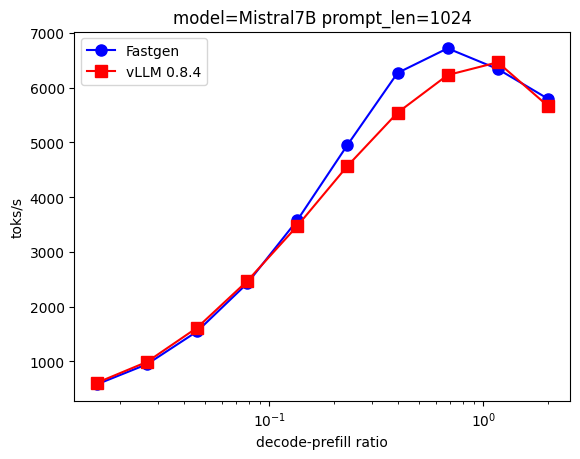
The throughputs presented in this table were collected using
fgserve (see below) and vllm serve with a load of 128
decoding steps for 512 prompts of 1024 tokens. The figure
below shows more detailed results for the Mistral 7B model
across a range of generation loads.
[!NOTE] When running tests against
fgserveyou might observe reduced performance for short prompts. This lower performance is due to the unoptimized threaded HTTP serving code and causes Fastgen to run on small (inefficient) batches. Production applications using Fastgen should adopt process-based parallelism.
Demo Tools
The library comes with two tools: fgchat and fgserve.
The first tool is a basic demo implementing a command-line
chat; the second one serves a bare-bones OpenAI chat API.
fgchat
$ # on an RTX A5000
$ # accelerate inference with '--tensor-parallel N' if you have N GPUs
$ fgchat mistralai/Mistral-7B-Instruct-v0.3
loading: 100%|███████████████████████▉| 14.5G/14.5G [00:00<00:00, 75.9GB/s]
Ready to chat!
  Available commands:
    /r <N> -- reset conversation before round N
    /m     -- input a multiline message, end your input
              with a single line containing '.'
    /q     -- quit

---
1> hello
Hello! How can I help you today? [...]
--- [33 tokens, 26.554toks/s]
2> can you give me some makeup advice?
Of course! Here are some general makeup tips that might be helpful:

[...]
--- [489 tokens, 34.715toks/s]
3> /q
fgserve
$ fgserve mistralai/Mistral-7B-Instruct-v0.3
...
$ cat test.py
from openai import OpenAI
client = OpenAI(base_url="http://localhost:5678", api_key="foo")

completion = client.chat.completions.create(
    model="gpt-4o-mini",
    messages=[
        {"role": "system", "content": "You are a helpful assistant."},
    ] + [
        {
            "role": "user",
            "content": "Write a haiku about recursion in programming."
        }
    ]
)
print(completion.choices[0].message.content)

$ python test.py
Code dives within,
Echoes of self repeat,
Solving the unseen.
Acknowledgements
Thanks to:
- The vLLM project for inspiration and for most of the innovations (paged attention, chunked prefills, ...) leveraged in Fastgen.
- Daniel Haziza (@danthe3rd) for constructive initial design discussions as well as continued advice on achieving high GPU utilization.
License
Fastgen is BSD 3-Clause licensed, as found in the LICENSE file.
Contributors

2 commits
Similar repos


Languages
Python
100.0%
README
Fastgen
High-throughput inference from dense transformers.
Fastgen is an LLM inference library featuring state-of-the-art techniques: batched inference, cuda graphs, paged attention, chunked prefills, host-side kv-cache, tensor parallelism, cpu/gpu profiling.
You can see it as a mini (~3kloc) vLLM that is easily imported into larger systems such as RL loops or synthetic data generation pipelines.
The following HuggingFace models are known to be supported: Llama 3.1 8B, Mistral 7B, Ministral 8B, R1-Llama 8B and 70B, R1-Qwen 14B, Qwen2.5 7B and 14B; more may work.
Benchmarks
| Fastgen | vLLM (0.8.4) | |
|---|---|---|
| Mistral 7B / 1x H100 | 3430 toks/s | 3390 toks/s |
| Qwen2.5 14B / 1x H100 | 1700 toks/s | 1700 toks/s |
| Llama 70B / 8x H100 | 2260 toks/s | 2230 toks/s |
The throughputs presented in this table were collected using
fgserve (see below) and vllm serve with a load of 128
decoding steps for 512 prompts of 1024 tokens. The figure
below shows more detailed results for the Mistral 7B model
across a range of generation loads.
[!NOTE] When running tests against
fgserveyou might observe reduced performance for short prompts. This lower performance is due to the unoptimized threaded HTTP serving code and causes Fastgen to run on small (inefficient) batches. Production applications using Fastgen should adopt process-based parallelism.
Demo Tools
The library comes with two tools: fgchat and fgserve.
The first tool is a basic demo implementing a command-line
chat; the second one serves a bare-bones OpenAI chat API.
fgchat
$ # on an RTX A5000
$ # accelerate inference with '--tensor-parallel N' if you have N GPUs
$ fgchat mistralai/Mistral-7B-Instruct-v0.3
loading: 100%|███████████████████████▉| 14.5G/14.5G [00:00<00:00, 75.9GB/s]
Ready to chat!
  Available commands:
    /r <N> -- reset conversation before round N
    /m     -- input a multiline message, end your input
              with a single line containing '.'
    /q     -- quit

---
1> hello
Hello! How can I help you today? [...]
--- [33 tokens, 26.554toks/s]
2> can you give me some makeup advice?
Of course! Here are some general makeup tips that might be helpful:

[...]
--- [489 tokens, 34.715toks/s]
3> /q
fgserve
$ fgserve mistralai/Mistral-7B-Instruct-v0.3
...
$ cat test.py
from openai import OpenAI
client = OpenAI(base_url="http://localhost:5678", api_key="foo")

completion = client.chat.completions.create(
    model="gpt-4o-mini",
    messages=[
        {"role": "system", "content": "You are a helpful assistant."},
    ] + [
        {
            "role": "user",
            "content": "Write a haiku about recursion in programming."
        }
    ]
)
print(completion.choices[0].message.content)

$ python test.py
Code dives within,
Echoes of self repeat,
Solving the unseen.
Acknowledgements
Thanks to:
- The vLLM project for inspiration and for most of the innovations (paged attention, chunked prefills, ...) leveraged in Fastgen.
- Daniel Haziza (@danthe3rd) for constructive initial design discussions as well as continued advice on achieving high GPU utilization.
License
Fastgen is BSD 3-Clause licensed, as found in the LICENSE file.
Similar repos
Contributors
2 commits
Languages
Python
100.0%