
See what people are saying
README
todobem
A flight recorder for AI coding agents.
Check what your agents did while you were sleeping.




Quick start · What you get · Why trust the numbers · Fleet · Architecture
Your agent ran for nine hours overnight. How much of that was the model thinking, how much was builds and tests, how much was a retry loop, and how much was it waiting for you?
todobem is a local, single-binary wall-clock profiler for agent sessions. It reads the logs OpenAI Codex CLI and Claude Code already write, replays every thread — the main agent and each sub-agent — as a lane on one timeline, and accounts for every minute and every token: model generation, builds, tests, retries, waits for workers, waits for you — and, labelled as such, the time it cannot classify. Then it groups where the time went by the habits of your harness (prompts, delegation, skills, rules, models, effort settings), with the evidence one click away.
curl -fsSL https://github.com/extractumio/todobem/releases/latest/download/install.sh | sh
No account, no cloud, no telemetry. Your sessions never leave your machine.
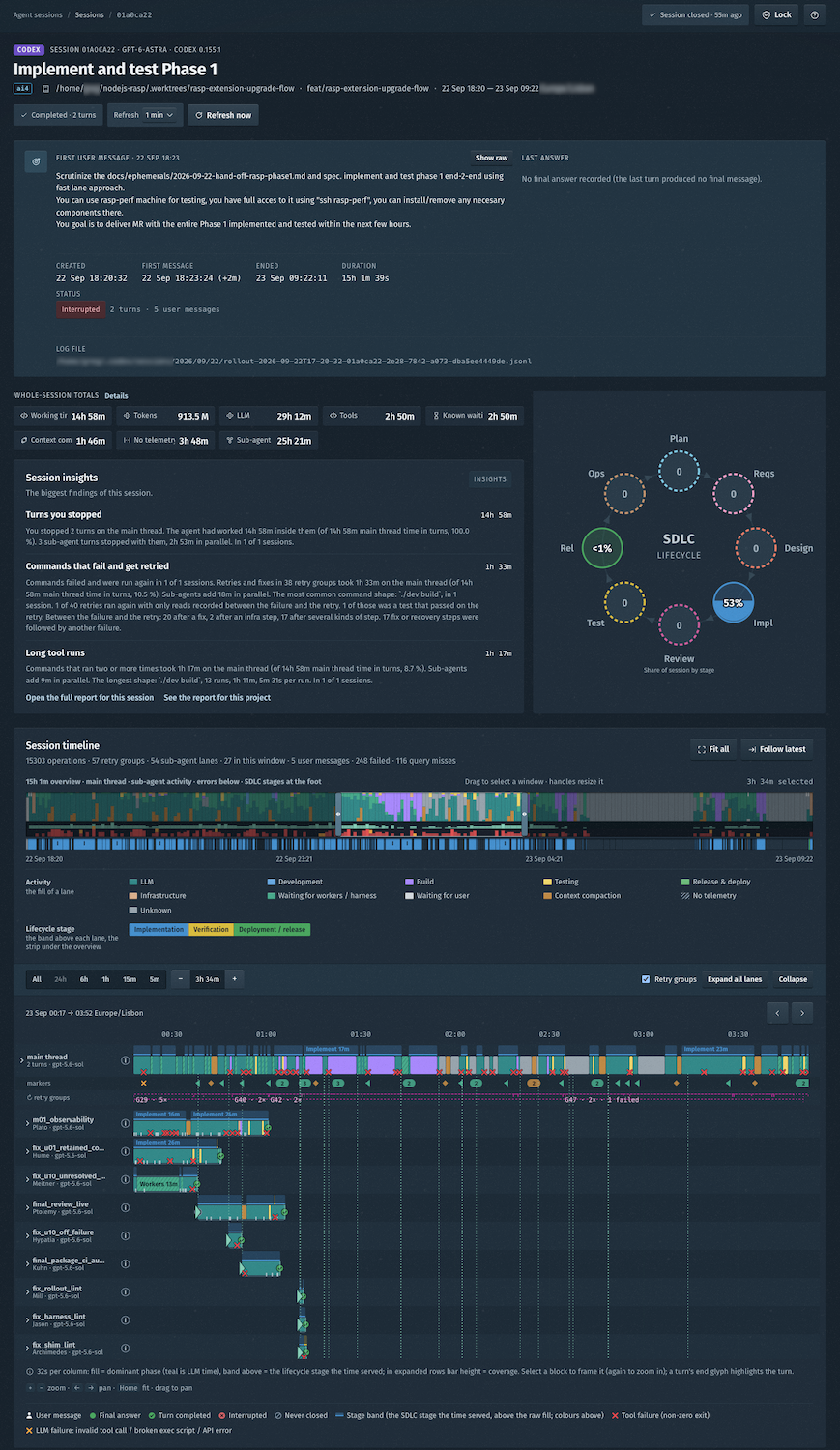 | 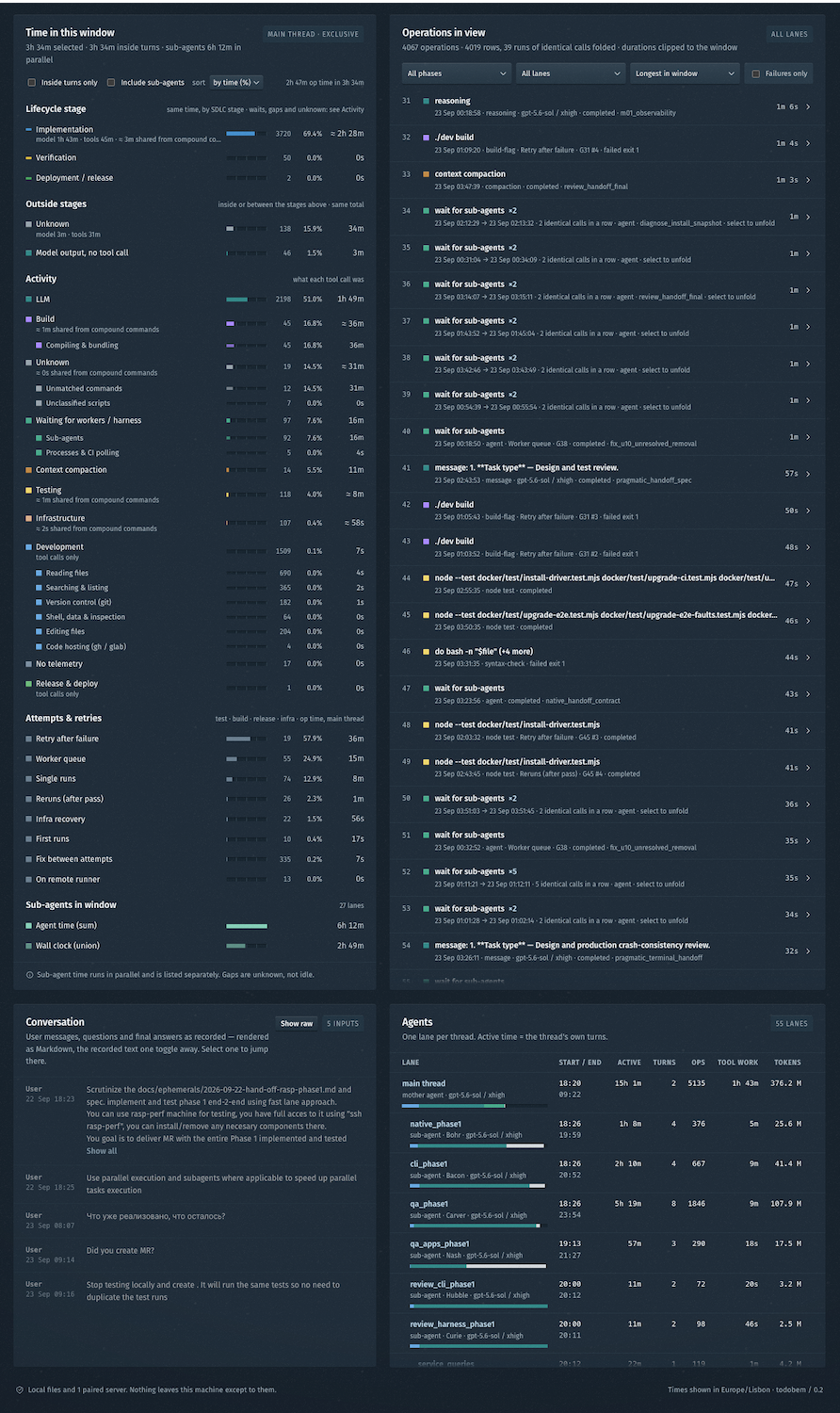 |
| Session — 15 h, 54 sub-agents, 57 retry groups on one timeline | Breakdown — where a 3.5-hour window went, by stage and by activity |
Why
An agent session runs for hours, spawns sub-agents, retries tests, waits for you, compacts its context, and hands you a result and a bill. What it does not hand you is an explanation. Which hour was the model thinking? Which was a test loop? Which was the agent waiting for a reply you never saw? Which was three sub-agents running one after another instead of in parallel?
The harness is the part you control — and exactly the part nobody measures. todobem measures it, from logs you already have.
What you get
🎞 Inspect — the flight recorder. One lane per agent thread, phases coloured by what each tool call was, markers for your messages, the agent's questions, final answers and compactions. Zoom to a single operation and see its command, exit code, the rule that classified it and the raw source event. Read the conversation as recorded. Follow a running session live.
⏱ Profile — where the hours and the tokens went. An exclusive partition of the wall clock that adds up to the elapsed time: LLM, development, build, test, release, infrastructure, waiting for workers, waiting for you, compaction, no telemetry. A second partition of the same minutes by SDLC stage — plan, implement, review, test, release, operate. Retry groups and the fixes between attempts, background processes, sub-agent time in parallel, per-thread token usage.
💡 Improve — Insights. A report over a period and a project, in groups you can act on: You and the agent, Sub-agents, Verification loop, Failures and retries, Tool calls, Long tool runs, Context size, Models and effort, Not measured. Every card is one deterministic detector that states what happened, its denominator, what to do — and links to the sessions, lanes and intervals it came from. It surfaces things like:
- how long the agent sat waiting for your answer, and what the break cost in cache to rebuild;
- sub-agents that ran serially while the main thread idled;
- commands that fail and get retried, failed edits, invalid tool calls;
- the longest tool runs by command shape, and processes left running after their turn;
- how large the context grows and what compaction pauses add up to;
- which model and effort level served which stage;
- what could not be measured — named, not hidden.
The loop: measure a period → change one thing in the harness → measure the next period. Every finding links to its sessions, so the change is argued from evidence and the next report shows whether it worked.
Quick start
One binary for macOS (Apple Silicon) and Linux (x86-64); no Go, no sudo, nothing else:
curl -fsSL https://github.com/extractumio/todobem/releases/latest/download/install.sh | sh
todobem                 # serves http://127.0.0.1:7788 and opens it, logged in (macOS, Linux)
todobem token           # a one-time login link, for any other browser or platform
The installer puts the binary at ~/.todobem/bin/todobem after checking it against the
release's SHA256SUMS, and prints the PATH line to add; an exact version:
… | TODOBEM_VERSION=v0.1.0 sh. Later versions install over it:
todobem upgrade check       # the installed and the latest version
todobem upgrade             # download, check, install; restart todobem to use it
todobem upgrade rollback    # back to the previous version (stop todobem first)
An upgrade that changes the format of the files in ~/.todobem migrates them on the first
start, after a backup, and a rollback restores that backup. todobem upgrade goes online only
when you run it, to this repository's releases, and sends nothing about you. To uninstall: rm -rf ~/.todobem (the settings,
keys and cache go with it).
Or build from source (Go 1.22+): go install github.com/extractumio/todobem/cmd/todobem@latest
— a build that todobem upgrade never replaces. From a clone, running in the background:
git clone https://github.com/extractumio/todobem && cd todobem
./scripts/deploy.sh     # builds, starts on 127.0.0.1:7788, prints a login link
./scripts/deploy.sh status | stop | run   # run = foreground, for systemd
deploy.sh takes its options from the environment: ADDR=, CODEX= / CLAUDE=, RULES=,
AUTH=off, AGENT=1 (agent mode, see Fleet).
By default it reads ~/.codex and ~/.claude. Point it elsewhere from the Settings page
— several folders per source (a tree copied from a laptop, a collected tree on a server), saved
to ~/.todobem/settings.json and applied live. Each entry is a home: the folder that contains
sessions/ (Codex) or projects/ (Claude Code); an empty list turns that source off. Or pin a
run on the command line, which makes the Settings page read-only:
todobem -codex /srv/rollouts/codex          # exactly this Codex home; Claude Code off
todobem -codex ~/.codex -claude ~/.claude   # both, pinned
todobem -addr 127.0.0.1:9000 -open=false
Other flags: -settings <file>, -rules <file> (see below), -cache=off, -auth=off.
On a remote host, keep the loopback bind and tunnel: ssh -L 7788:127.0.0.1:7788 <host>.
Browser cookies are not port-scoped, so give a tunnelled and a local todobem different ports.
Why the numbers can be trusted
- Nothing is inferred from a duration. A long operation is listed, never explained.
- Classification is a rule table over the literal command text — deterministic and
inspectable (
/api/rules, the in-app guide). No similarity, no models. - Unknown is honest. A command no rule matches is
unknown; an interval without events isno telemetry. Neither is folded into something that looks better. - Every total is an exclusive partition of the wall clock; the parts add up to the elapsed time. Sub-agent time is reported in parallel, never added. Raw sums are shown beside it.
- No "goal achieved" score. Your messages and the agent's answers are shown as recorded.
- Every insight has evidence. A card with no session, lane or interval to open is not shown. No savings estimates.
Teach it your project
Your project has commands no built-in rule has seen — an in-house CI wrapper, a deploy script. A
user overlay (~/.todobem/rules.json) adds them, along with your review and planning skill
names, reviewer agent roles and design-document paths. The overlay is part of the cache key, so
every session re-parses under the new rules by itself.
todobem unknown -since 7d                      # unmatched commands across recent sessions, by time
todobem unknown -explain 'scripts/gen-sdk.sh'  # what the rules say about one command
todobem unknown -rules draft.json -since 7d    # dry-run a draft overlay before installing it
Or let an agent do it: the bundled resolve-unknown skill
(.claude/skills/resolve-unknown/, also under .codex/skills/) takes the unknown table top-down,
establishes what each command does from evidence — the script, its --help, what it spawns —
writes the narrowest rule that covers it, dry-runs it and reports what was reclaimed.
Private by design
Sessions contain whatever your agents read and wrote, so todobem treats them that way:
- Loopback by default. The UI binds to
127.0.0.1:7788; keep it there and tunnel. - Locked UI. Every API route needs a session opened with a one-time token minted in a
terminal on the same machine (
todobem token). The key lives in~/.todobem/auth.key(0600);todobem token -revokelogs everyone out immediately. - Read-only. The session logs are never written to; todobem writes only under
~/.todobem/(settings, key, cache). - No outbound calls, no telemetry — the exceptions are a fleet you pair yourself (below) and
todobem upgrade, which fetches release files from GitHub when you run it and sends nothing.
Access commands
todobem token             # a login link (one use, valid 5 min) and the bare token
todobem token -ttl 12h    # the browser stays logged in for 12 h (default 30 days)
todobem token -revoke     # rotate the key: every session and token stops working now
todobem cache -prune      # drop cached sessions the configured folders no longer list
The session is an HttpOnly, SameSite=Strict cookie scoped to /api. -auth=off leaves the UI
open, and the server says so at start.
Fleet: many machines, one dashboard
Agents running on build servers? Run the same binary headless on each of them and read them all
from your laptop. An agent (todobem -agent) parses its host's sessions and answers a
hub — any ordinary todobem — over TLS with a certificate pinned at pairing and a bearer on
every request. It never connects anywhere; the hub dials only the agents it paired with.
# on each server
todobem -agent                         # TLS on :7789, every interface, no UI; prints a pairing string
todobem agent pair                     # another pairing string later (one use, 5 min)

# on the hub
todobem hub add 'todobem-agent://…'    # pair (-name web-01 -addr 10.0.0.5:7789 before the string)
todobem hub list                       # every agent, its build and session count
todobem hub doctor -all                # health of every agent, in parallel
todobem hub rotate web-01              # a new bearer; the old one retires on first use of the new
todobem hub remove -revoke web-01      # forget it, and revoke its bearer
The agent listens on every interface; firewall :7789 to the hub. Upgrade each host on its own
(todobem upgrade, then restart); a hub and an agent of different releases keep listing each
other's sessions, and models open when both have the same cache version (the release notes
say when it changes).
Remote sessions join the list with a host chip; Insights filter by host; a remote session opens
as if it were local. Design and wire protocol: docs/AGENT-MODE.md.
systemd unit for an agent
[Unit]
Description=todobem agent
After=network-online.target

[Service]
User=ci
ExecStart=/home/ci/.todobem/bin/todobem -agent
Restart=on-failure
RestartSec=5

[Install]
WantedBy=multi-user.target
Supported sources
| Source | Reads | Verified |
|---|---|---|
| OpenAI Codex CLI | ~/.codex/sessions/, archived_sessions/ (rollout-*.jsonl) | 0.134 → 0.154 |
| Claude Code | ~/.claude/projects/<project>/*.jsonl and each session's sub-agents | 2.1.226 → 2.1.270 |
Codex CLI 0.144+ stores inter-agent messages encrypted, so for those sessions a sub-agent's card says so instead of showing the prompt it was spawned with.
The model is source-agnostic (internal/model); both sources share one session list, one
timeline and one Insights report. A new source is one package implementing source.Source — see
docs/ARCHITECTURE.md §12.
How it works
session logs ──▶ source adapters ──▶ classify ──▶ derive ──▶ cache ──▶ JSON API ──▶ web UI
 (jsonl, tailed)   (Codex, Claude)    (rule table)  (partitions,   (gzip,     (loopback,   (vanilla JS
                                                     stages,        on disk)   token-gated)  + SVG)
                                                     retry groups)
Logs are read incrementally by byte offset, so a live session is followed without re-parsing it. Parsed sessions are cached to disk; a 354 MB session opens in ~0.16 s from cache instead of ~3.7 s cold, and a rule change or a grown file re-parses automatically. Go standard library only; the UI is plain JavaScript and SVG embedded in the binary.
Everything — the schema, log formats, classification, the partitions, stage detection, Insights
and the validation protocol — is in docs/ARCHITECTURE.md.
Development
make test                          # gofmt, go vet, go test, and the JS tests (node --test)
go run ./cmd/dump <session-id>     # totals, per-lane partition check, retry groups, unknown heads
./scripts/deploy.sh                # rebuild and replace the running instance on :7788
Contributor rules and the repository map: CLAUDE.md (AGENTS.md links to it).
License
todobem is dual-licensed — see LICENSING.md:
- AGPL-3.0 (
LICENSE) — personal, research and non-commercial use, and any project that meets the AGPL's copyleft obligations. - Commercial license — for use without those obligations (proprietary products, hosted services). Contact info@extractum.io.
Contributions are accepted under the terms in LICENSING.md.
Similar repos


See what people are saying
README
todobem
A flight recorder for AI coding agents.
Check what your agents did while you were sleeping.
Quick start · What you get · Why trust the numbers · Fleet · Architecture
Your agent ran for nine hours overnight. How much of that was the model thinking, how much was builds and tests, how much was a retry loop, and how much was it waiting for you?
todobem is a local, single-binary wall-clock profiler for agent sessions. It reads the logs OpenAI Codex CLI and Claude Code already write, replays every thread — the main agent and each sub-agent — as a lane on one timeline, and accounts for every minute and every token: model generation, builds, tests, retries, waits for workers, waits for you — and, labelled as such, the time it cannot classify. Then it groups where the time went by the habits of your harness (prompts, delegation, skills, rules, models, effort settings), with the evidence one click away.
curl -fsSL https://github.com/extractumio/todobem/releases/latest/download/install.sh | sh
No account, no cloud, no telemetry. Your sessions never leave your machine.
| |
| Session — 15 h, 54 sub-agents, 57 retry groups on one timeline | Breakdown — where a 3.5-hour window went, by stage and by activity |
Why
An agent session runs for hours, spawns sub-agents, retries tests, waits for you, compacts its context, and hands you a result and a bill. What it does not hand you is an explanation. Which hour was the model thinking? Which was a test loop? Which was the agent waiting for a reply you never saw? Which was three sub-agents running one after another instead of in parallel?
The harness is the part you control — and exactly the part nobody measures. todobem measures it, from logs you already have.
What you get
🎞 Inspect — the flight recorder. One lane per agent thread, phases coloured by what each tool call was, markers for your messages, the agent's questions, final answers and compactions. Zoom to a single operation and see its command, exit code, the rule that classified it and the raw source event. Read the conversation as recorded. Follow a running session live.
⏱ Profile — where the hours and the tokens went. An exclusive partition of the wall clock that adds up to the elapsed time: LLM, development, build, test, release, infrastructure, waiting for workers, waiting for you, compaction, no telemetry. A second partition of the same minutes by SDLC stage — plan, implement, review, test, release, operate. Retry groups and the fixes between attempts, background processes, sub-agent time in parallel, per-thread token usage.
💡 Improve — Insights. A report over a period and a project, in groups you can act on: You and the agent, Sub-agents, Verification loop, Failures and retries, Tool calls, Long tool runs, Context size, Models and effort, Not measured. Every card is one deterministic detector that states what happened, its denominator, what to do — and links to the sessions, lanes and intervals it came from. It surfaces things like:
- how long the agent sat waiting for your answer, and what the break cost in cache to rebuild;
- sub-agents that ran serially while the main thread idled;
- commands that fail and get retried, failed edits, invalid tool calls;
- the longest tool runs by command shape, and processes left running after their turn;
- how large the context grows and what compaction pauses add up to;
- which model and effort level served which stage;
- what could not be measured — named, not hidden.
The loop: measure a period → change one thing in the harness → measure the next period. Every finding links to its sessions, so the change is argued from evidence and the next report shows whether it worked.
Quick start
One binary for macOS (Apple Silicon) and Linux (x86-64); no Go, no sudo, nothing else:
curl -fsSL https://github.com/extractumio/todobem/releases/latest/download/install.sh | sh
todobem                 # serves http://127.0.0.1:7788 and opens it, logged in (macOS, Linux)
todobem token           # a one-time login link, for any other browser or platform
The installer puts the binary at ~/.todobem/bin/todobem after checking it against the
release's SHA256SUMS, and prints the PATH line to add; an exact version:
… | TODOBEM_VERSION=v0.1.0 sh. Later versions install over it:
todobem upgrade check       # the installed and the latest version
todobem upgrade             # download, check, install; restart todobem to use it
todobem upgrade rollback    # back to the previous version (stop todobem first)
An upgrade that changes the format of the files in ~/.todobem migrates them on the first
start, after a backup, and a rollback restores that backup. todobem upgrade goes online only
when you run it, to this repository's releases, and sends nothing about you. To uninstall: rm -rf ~/.todobem (the settings,
keys and cache go with it).
Or build from source (Go 1.22+): go install github.com/extractumio/todobem/cmd/todobem@latest
— a build that todobem upgrade never replaces. From a clone, running in the background:
git clone https://github.com/extractumio/todobem && cd todobem
./scripts/deploy.sh     # builds, starts on 127.0.0.1:7788, prints a login link
./scripts/deploy.sh status | stop | run   # run = foreground, for systemd
deploy.sh takes its options from the environment: ADDR=, CODEX= / CLAUDE=, RULES=,
AUTH=off, AGENT=1 (agent mode, see Fleet).
By default it reads ~/.codex and ~/.claude. Point it elsewhere from the Settings page
— several folders per source (a tree copied from a laptop, a collected tree on a server), saved
to ~/.todobem/settings.json and applied live. Each entry is a home: the folder that contains
sessions/ (Codex) or projects/ (Claude Code); an empty list turns that source off. Or pin a
run on the command line, which makes the Settings page read-only:
todobem -codex /srv/rollouts/codex          # exactly this Codex home; Claude Code off
todobem -codex ~/.codex -claude ~/.claude   # both, pinned
todobem -addr 127.0.0.1:9000 -open=false
Other flags: -settings <file>, -rules <file> (see below), -cache=off, -auth=off.
On a remote host, keep the loopback bind and tunnel: ssh -L 7788:127.0.0.1:7788 <host>.
Browser cookies are not port-scoped, so give a tunnelled and a local todobem different ports.
Why the numbers can be trusted
- Nothing is inferred from a duration. A long operation is listed, never explained.
- Classification is a rule table over the literal command text — deterministic and
inspectable (
/api/rules, the in-app guide). No similarity, no models. - Unknown is honest. A command no rule matches is
unknown; an interval without events isno telemetry. Neither is folded into something that looks better. - Every total is an exclusive partition of the wall clock; the parts add up to the elapsed time. Sub-agent time is reported in parallel, never added. Raw sums are shown beside it.
- No "goal achieved" score. Your messages and the agent's answers are shown as recorded.
- Every insight has evidence. A card with no session, lane or interval to open is not shown. No savings estimates.
Teach it your project
Your project has commands no built-in rule has seen — an in-house CI wrapper, a deploy script. A
user overlay (~/.todobem/rules.json) adds them, along with your review and planning skill
names, reviewer agent roles and design-document paths. The overlay is part of the cache key, so
every session re-parses under the new rules by itself.
todobem unknown -since 7d                      # unmatched commands across recent sessions, by time
todobem unknown -explain 'scripts/gen-sdk.sh'  # what the rules say about one command
todobem unknown -rules draft.json -since 7d    # dry-run a draft overlay before installing it
Or let an agent do it: the bundled resolve-unknown skill
(.claude/skills/resolve-unknown/, also under .codex/skills/) takes the unknown table top-down,
establishes what each command does from evidence — the script, its --help, what it spawns —
writes the narrowest rule that covers it, dry-runs it and reports what was reclaimed.
Private by design
Sessions contain whatever your agents read and wrote, so todobem treats them that way:
- Loopback by default. The UI binds to
127.0.0.1:7788; keep it there and tunnel. - Locked UI. Every API route needs a session opened with a one-time token minted in a
terminal on the same machine (
todobem token). The key lives in~/.todobem/auth.key(0600);todobem token -revokelogs everyone out immediately. - Read-only. The session logs are never written to; todobem writes only under
~/.todobem/(settings, key, cache). - No outbound calls, no telemetry — the exceptions are a fleet you pair yourself (below) and
todobem upgrade, which fetches release files from GitHub when you run it and sends nothing.
Access commands
todobem token             # a login link (one use, valid 5 min) and the bare token
todobem token -ttl 12h    # the browser stays logged in for 12 h (default 30 days)
todobem token -revoke     # rotate the key: every session and token stops working now
todobem cache -prune      # drop cached sessions the configured folders no longer list
The session is an HttpOnly, SameSite=Strict cookie scoped to /api. -auth=off leaves the UI
open, and the server says so at start.
Fleet: many machines, one dashboard
Agents running on build servers? Run the same binary headless on each of them and read them all
from your laptop. An agent (todobem -agent) parses its host's sessions and answers a
hub — any ordinary todobem — over TLS with a certificate pinned at pairing and a bearer on
every request. It never connects anywhere; the hub dials only the agents it paired with.
# on each server
todobem -agent                         # TLS on :7789, every interface, no UI; prints a pairing string
todobem agent pair                     # another pairing string later (one use, 5 min)

# on the hub
todobem hub add 'todobem-agent://…'    # pair (-name web-01 -addr 10.0.0.5:7789 before the string)
todobem hub list                       # every agent, its build and session count
todobem hub doctor -all                # health of every agent, in parallel
todobem hub rotate web-01              # a new bearer; the old one retires on first use of the new
todobem hub remove -revoke web-01      # forget it, and revoke its bearer
The agent listens on every interface; firewall :7789 to the hub. Upgrade each host on its own
(todobem upgrade, then restart); a hub and an agent of different releases keep listing each
other's sessions, and models open when both have the same cache version (the release notes
say when it changes).
Remote sessions join the list with a host chip; Insights filter by host; a remote session opens
as if it were local. Design and wire protocol: docs/AGENT-MODE.md.
systemd unit for an agent
[Unit]
Description=todobem agent
After=network-online.target

[Service]
User=ci
ExecStart=/home/ci/.todobem/bin/todobem -agent
Restart=on-failure
RestartSec=5

[Install]
WantedBy=multi-user.target
Supported sources
| Source | Reads | Verified |
|---|---|---|
| OpenAI Codex CLI | ~/.codex/sessions/, archived_sessions/ (rollout-*.jsonl) | 0.134 → 0.154 |
| Claude Code | ~/.claude/projects/<project>/*.jsonl and each session's sub-agents | 2.1.226 → 2.1.270 |
Codex CLI 0.144+ stores inter-agent messages encrypted, so for those sessions a sub-agent's card says so instead of showing the prompt it was spawned with.
The model is source-agnostic (internal/model); both sources share one session list, one
timeline and one Insights report. A new source is one package implementing source.Source — see
docs/ARCHITECTURE.md §12.
How it works
session logs ──▶ source adapters ──▶ classify ──▶ derive ──▶ cache ──▶ JSON API ──▶ web UI
 (jsonl, tailed)   (Codex, Claude)    (rule table)  (partitions,   (gzip,     (loopback,   (vanilla JS
                                                     stages,        on disk)   token-gated)  + SVG)
                                                     retry groups)
Logs are read incrementally by byte offset, so a live session is followed without re-parsing it. Parsed sessions are cached to disk; a 354 MB session opens in ~0.16 s from cache instead of ~3.7 s cold, and a rule change or a grown file re-parses automatically. Go standard library only; the UI is plain JavaScript and SVG embedded in the binary.
Everything — the schema, log formats, classification, the partitions, stage detection, Insights
and the validation protocol — is in docs/ARCHITECTURE.md.
Development
make test                          # gofmt, go vet, go test, and the JS tests (node --test)
go run ./cmd/dump <session-id>     # totals, per-lane partition check, retry groups, unknown heads
./scripts/deploy.sh                # rebuild and replace the running instance on :7788
Contributor rules and the repository map: CLAUDE.md (AGENTS.md links to it).
License
todobem is dual-licensed — see LICENSING.md:
- AGPL-3.0 (
LICENSE) — personal, research and non-commercial use, and any project that meets the AGPL's copyleft obligations. - Commercial license — for use without those obligations (proprietary products, hosted services). Contact info@extractum.io.
Contributions are accepted under the terms in LICENSING.md.