
Music of the spheres: a live orrery where each planet sings a tone that follows its speed around the Sun, as Kepler described in Harmonices Mundi, played with Web Audio.
See the codeSee what people are saying
README
Music-of-the-Spheres
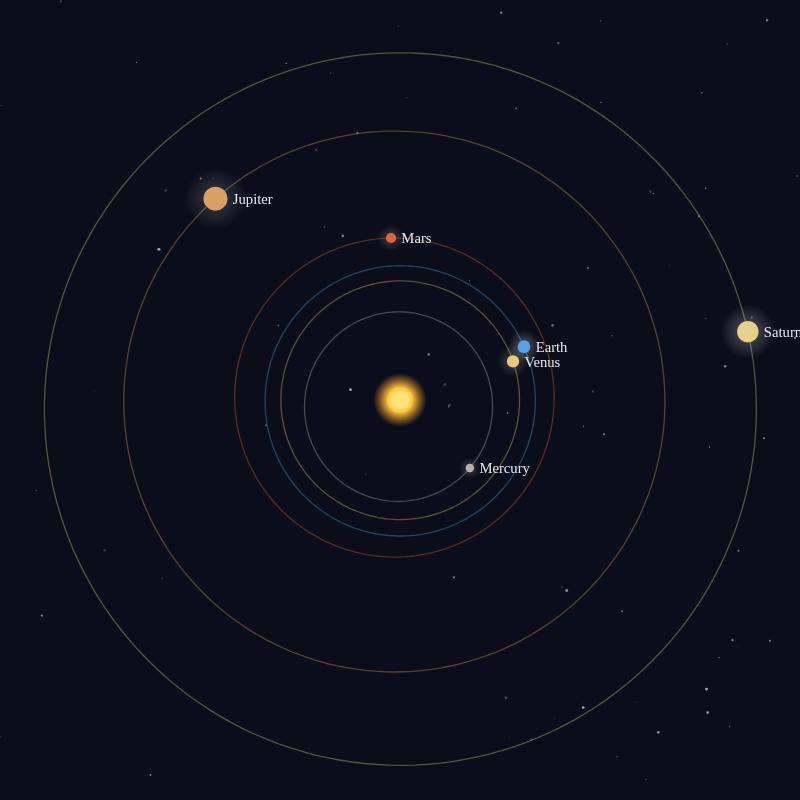
Hear the planets sing. A live orrery moves the planets on their real orbits, starting from today, and gives each one a voice that rises as it speeds up near the Sun and falls as it slows down far from it, the way Johannes Kepler imagined in Harmonices Mundi (1619). No sign-up and no libraries.
What it does
- Listen: press Listen and the planets sing together, each sliding over its own interval once per orbit. Pause or speed up time (from a day to 20 years per second), change the volume, and pick a timbre (pure, organ or soft).
- The choir: each planet's current note, in Hz and as the nearest note name, and where it is between its slowest (aphelion) and fastest (perihelion).
- Planets: Kepler's six, plus Uranus and Neptune if you like.
- View: a compressed or a true distance scale, planet names, perihelion and aphelion.
- Kepler's intervals: a table of the ratio between each planet's fastest and slowest speed, the nearest musical interval, and the interval Kepler heard.
How the sound works
A planet's angular speed around the Sun, and so its pitch, is proportional to (1 + e cos ν)², where e is the eccentricity of the orbit and ν the planet's angle from perihelion. The real speeds are far too slow to hear, so each planet is moved up by whole octaves into its own register, as Kepler did: that keeps its interval exact while putting Saturn in the bass and Mercury in the treble. Orbital elements are from NASA JPL's Approximate Positions of the Planets; the tilt of the orbits is ignored.
How it is built
The pages are plain HTML, CSS and JavaScript, with no dependencies and no build step. Just open index.html. The sound is made with the Web Audio API. It is also a small installable web app: add it to your home screen or desktop and it works offline.
- The planet data is in js/spheres-data.js, and the orbits, drawing and sound are in js/spheres.js.
- Three color themes (dark, light and blue) are shared with my other projects.
- Your settings are kept in the browser's local storage.
Music-of-the-Spheres is open source at GitHub with MIT license.
Had fun browsing the app? Buy me a coffee by becoming a sponsor.
You may also be interested in my other sound projects Healing-Frequencies (demo) and Tibetan-Singing-Bowls (demo). For more mystic arts as small web apps, see Esoterica.
Copyright (c) 2026 Olivier Giulieri.
Contributors

1 commits
Similar repos


Languages
JavaScript
36.5%
CSS
33.9%
HTML
29.6%
Music of the spheres: a live orrery where each planet sings a tone that follows its speed around the Sun, as Kepler described in Harmonices Mundi, played with Web Audio.
See the codeSee what people are saying
README
Music-of-the-Spheres
Hear the planets sing. A live orrery moves the planets on their real orbits, starting from today, and gives each one a voice that rises as it speeds up near the Sun and falls as it slows down far from it, the way Johannes Kepler imagined in Harmonices Mundi (1619). No sign-up and no libraries.
What it does
- Listen: press Listen and the planets sing together, each sliding over its own interval once per orbit. Pause or speed up time (from a day to 20 years per second), change the volume, and pick a timbre (pure, organ or soft).
- The choir: each planet's current note, in Hz and as the nearest note name, and where it is between its slowest (aphelion) and fastest (perihelion).
- Planets: Kepler's six, plus Uranus and Neptune if you like.
- View: a compressed or a true distance scale, planet names, perihelion and aphelion.
- Kepler's intervals: a table of the ratio between each planet's fastest and slowest speed, the nearest musical interval, and the interval Kepler heard.
How the sound works
A planet's angular speed around the Sun, and so its pitch, is proportional to (1 + e cos ν)², where e is the eccentricity of the orbit and ν the planet's angle from perihelion. The real speeds are far too slow to hear, so each planet is moved up by whole octaves into its own register, as Kepler did: that keeps its interval exact while putting Saturn in the bass and Mercury in the treble. Orbital elements are from NASA JPL's Approximate Positions of the Planets; the tilt of the orbits is ignored.
How it is built
The pages are plain HTML, CSS and JavaScript, with no dependencies and no build step. Just open index.html. The sound is made with the Web Audio API. It is also a small installable web app: add it to your home screen or desktop and it works offline.
- The planet data is in js/spheres-data.js, and the orbits, drawing and sound are in js/spheres.js.
- Three color themes (dark, light and blue) are shared with my other projects.
- Your settings are kept in the browser's local storage.
Music-of-the-Spheres is open source at GitHub with MIT license.
Had fun browsing the app? Buy me a coffee by becoming a sponsor.
You may also be interested in my other sound projects Healing-Frequencies (demo) and Tibetan-Singing-Bowls (demo). For more mystic arts as small web apps, see Esoterica.
Copyright (c) 2026 Olivier Giulieri.
Similar repos
Contributors
1 commits
Languages
JavaScript
36.5%
CSS
33.9%
HTML
29.6%