
Generate square, circular, triangular and heart-shaped mazes with seven algorithms (backtracker, Prim, Kruskal, Wilson, hunt-and-kill, growing tree, Aldous-Broder), solve them with the keyboard or a finger, and export them as SVG or PNG.
See the codeSee what people are saying
README
Maze-Maker
Make a maze right in your browser: square, round, triangular, hexagonal, star or heart-shaped, with long winding corridors or a thicket of short dead ends. Then find your way through it with the arrow keys or a finger, or watch the solution draw itself, and save it as an SVG or a PNG, or print it. No sign-up and no libraries.
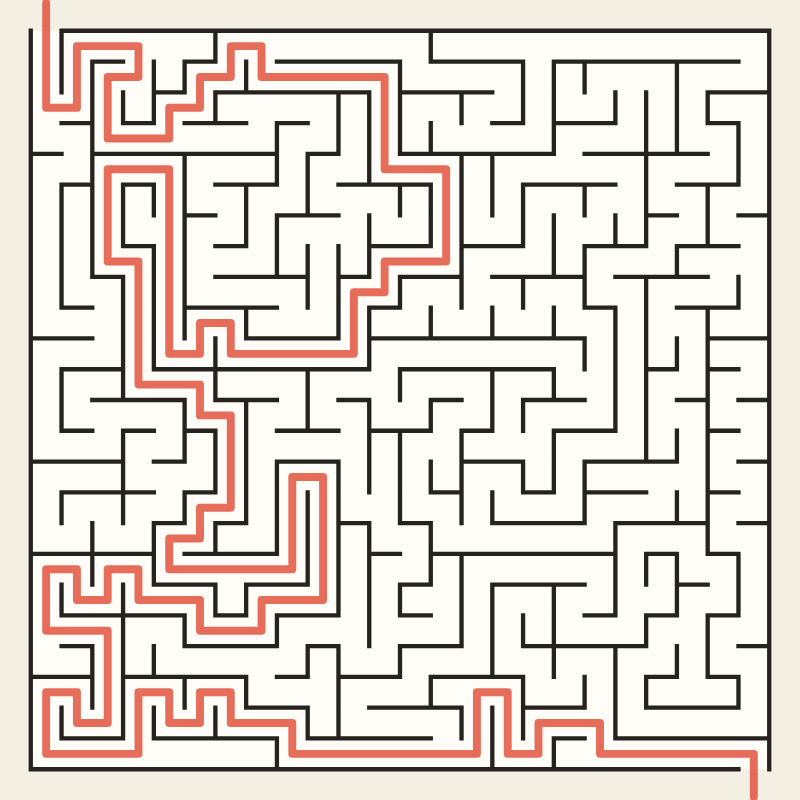
What it does
A maze is a puzzle: it has branches and dead ends, and a way through. (A labyrinth has a single path and no choices; for those, see Labyrinth-Maker.)
- Shapes:
- Square: a grid, entered at the top left and left at the bottom right.
- Circle: rings of cells, entered from the outside with the goal at the center.
- Triangle: a big triangle cut into small triangular cells, entered and left at the bottom corners.
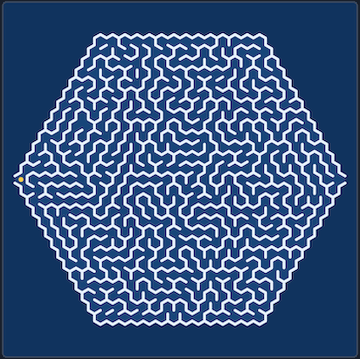
- Hexagon: a honeycomb of hexagonal cells, each with up to six neighbors, entered on the left corner and left on the right one.
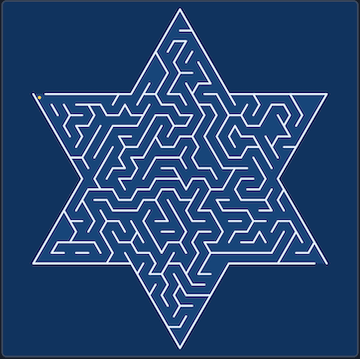
- Star: a six-pointed star cut from the triangle grid, so its edges stay straight, entered at the top of the upper left point and left under the lower right point.
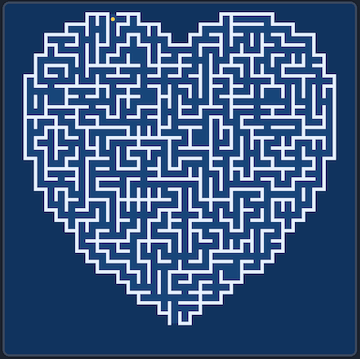
- Heart: a square grid cut to the shape of a heart, entered at the top of the left lobe and left at the tip.
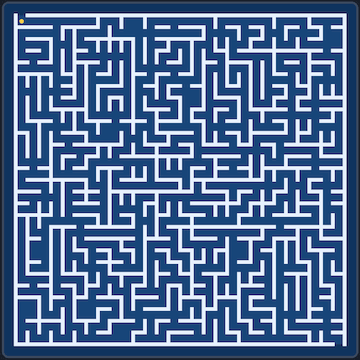
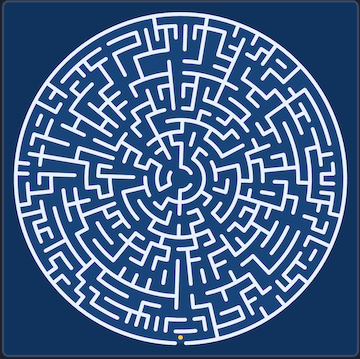
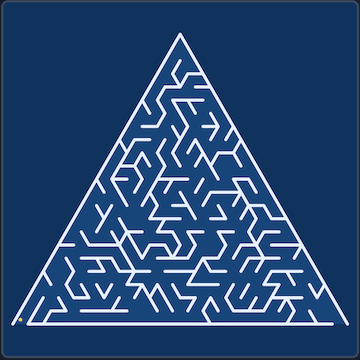
- Algorithms: recursive backtracker, Prim, Kruskal, Wilson, Hunt & Kill, Growing Tree and Aldous-Broder. Each one gives mazes of a different texture.
- Size and loops: from 6 to 60 cells across. Loops opens a share of the dead ends, so there is more than one way through.
- Solution length: Any, Short, Medium or Long. The app makes a dozen mazes from the seeds that follow and keeps the one with the shortest, the middle or the longest way through.
- Seed: every maze comes from a number. The same settings and seed always give the same maze, and the page address keeps them, so a link brings back the same maze.
- Solve it: move with the arrow keys or WASD, or drag the dot. Backing up erases your trail. Show solution draws the shortest way through.
- Look: five color schemes (paper, blueprint, hedge, stone, night), wall thickness, and coloring by distance from the entrance.
- Save: Download PNG (2000 pixels square), Download SVG, or Print (black on white, maze only).
How the mazes are made
Start with every wall standing, and knock walls down until every cell can be reached, but never so many that a loop appears: in graph terms, a spanning tree of the grid. The result is a perfect maze, with exactly one path between any two cells. The algorithms differ in the order they pick walls:
- Backtracker (depth-first search) carves as far as it can before backing up: long corridors, few dead ends.
- Prim grows the maze out from one cell: many short dead ends.
- Kruskal joins random regions anywhere on the grid: an even texture.
- Wilson uses loop-erased random walks, so every possible maze is equally likely.
- Hunt & Kill walks like the backtracker, but when stuck it hunts for a new cell next to the maze instead of backing up.
- Growing Tree grows from the newest cell half of the time and a random one otherwise: between the backtracker and Prim.
- Aldous-Broder is a pure random walk: the simplest, the slowest, and unbiased like Wilson.
The solution is found with a breadth-first search, which also gives each cell's distance from the entrance.
How it is built
The pages are plain HTML, CSS and JavaScript, with no dependencies and no build step. Just open index.html. It is also a small installable web app: add it to your home screen or desktop and it works offline.
- The maze is one SVG, and all the geometry, the algorithms and the app logic are in js/maze.js.
- Three color themes (dark, light and blue) are shared with my other projects.
- Your settings are kept in the browser's local storage.
Maze-Maker is open source at GitHub with MIT license.
Had fun browsing the app? Buy me a coffee by becoming a sponsor.
You may also be interested in my other projects Labyrinth-Maker (demo), Mandala-Maker (demo), Harmonograph-Maker (demo) and Sacred-Geometry (demo). For more mystic arts as small web apps, see Esoterica.
Copyright (c) 2026 Olivier Giulieri.
Contributors

4 commits
Similar repos


Languages
JavaScript
52.3%
HTML
25.6%
CSS
22.1%
Generate square, circular, triangular and heart-shaped mazes with seven algorithms (backtracker, Prim, Kruskal, Wilson, hunt-and-kill, growing tree, Aldous-Broder), solve them with the keyboard or a finger, and export them as SVG or PNG.
See the codeSee what people are saying
README
Maze-Maker
Make a maze right in your browser: square, round, triangular, hexagonal, star or heart-shaped, with long winding corridors or a thicket of short dead ends. Then find your way through it with the arrow keys or a finger, or watch the solution draw itself, and save it as an SVG or a PNG, or print it. No sign-up and no libraries.
What it does
A maze is a puzzle: it has branches and dead ends, and a way through. (A labyrinth has a single path and no choices; for those, see Labyrinth-Maker.)
- Shapes:
- Square: a grid, entered at the top left and left at the bottom right.
- Circle: rings of cells, entered from the outside with the goal at the center.
- Triangle: a big triangle cut into small triangular cells, entered and left at the bottom corners.
- Hexagon: a honeycomb of hexagonal cells, each with up to six neighbors, entered on the left corner and left on the right one.
- Star: a six-pointed star cut from the triangle grid, so its edges stay straight, entered at the top of the upper left point and left under the lower right point.
- Heart: a square grid cut to the shape of a heart, entered at the top of the left lobe and left at the tip.
- Algorithms: recursive backtracker, Prim, Kruskal, Wilson, Hunt & Kill, Growing Tree and Aldous-Broder. Each one gives mazes of a different texture.
- Size and loops: from 6 to 60 cells across. Loops opens a share of the dead ends, so there is more than one way through.
- Solution length: Any, Short, Medium or Long. The app makes a dozen mazes from the seeds that follow and keeps the one with the shortest, the middle or the longest way through.
- Seed: every maze comes from a number. The same settings and seed always give the same maze, and the page address keeps them, so a link brings back the same maze.
- Solve it: move with the arrow keys or WASD, or drag the dot. Backing up erases your trail. Show solution draws the shortest way through.
- Look: five color schemes (paper, blueprint, hedge, stone, night), wall thickness, and coloring by distance from the entrance.
- Save: Download PNG (2000 pixels square), Download SVG, or Print (black on white, maze only).
How the mazes are made
Start with every wall standing, and knock walls down until every cell can be reached, but never so many that a loop appears: in graph terms, a spanning tree of the grid. The result is a perfect maze, with exactly one path between any two cells. The algorithms differ in the order they pick walls:
- Backtracker (depth-first search) carves as far as it can before backing up: long corridors, few dead ends.
- Prim grows the maze out from one cell: many short dead ends.
- Kruskal joins random regions anywhere on the grid: an even texture.
- Wilson uses loop-erased random walks, so every possible maze is equally likely.
- Hunt & Kill walks like the backtracker, but when stuck it hunts for a new cell next to the maze instead of backing up.
- Growing Tree grows from the newest cell half of the time and a random one otherwise: between the backtracker and Prim.
- Aldous-Broder is a pure random walk: the simplest, the slowest, and unbiased like Wilson.
The solution is found with a breadth-first search, which also gives each cell's distance from the entrance.
How it is built
The pages are plain HTML, CSS and JavaScript, with no dependencies and no build step. Just open index.html. It is also a small installable web app: add it to your home screen or desktop and it works offline.
- The maze is one SVG, and all the geometry, the algorithms and the app logic are in js/maze.js.
- Three color themes (dark, light and blue) are shared with my other projects.
- Your settings are kept in the browser's local storage.
Maze-Maker is open source at GitHub with MIT license.
Had fun browsing the app? Buy me a coffee by becoming a sponsor.
You may also be interested in my other projects Labyrinth-Maker (demo), Mandala-Maker (demo), Harmonograph-Maker (demo) and Sacred-Geometry (demo). For more mystic arts as small web apps, see Esoterica.
Copyright (c) 2026 Olivier Giulieri.
Similar repos
Contributors
4 commits
Languages
JavaScript
52.3%
HTML
25.6%
CSS
22.1%