
Always-on AI plan quota strips for SketchyBar, Zellij, and tmux, driven by CodexBar.
Shell
20
213 commits
updated Sep 27, 2026
README
showy-quota
Always-on AI plan quota strips for SketchyBar, Zellij, and tmux, driven by CodexBar.
Beautiful, themeable, minimal.
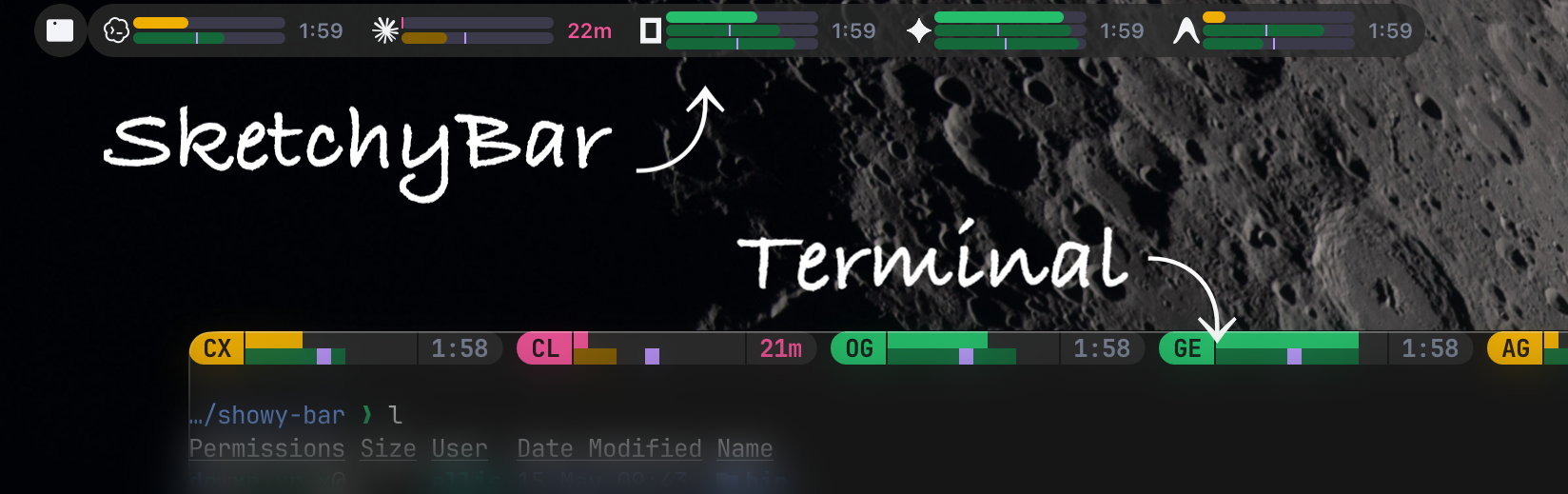
showy-quota running across SketchyBar and a Zellij terminal on macOS
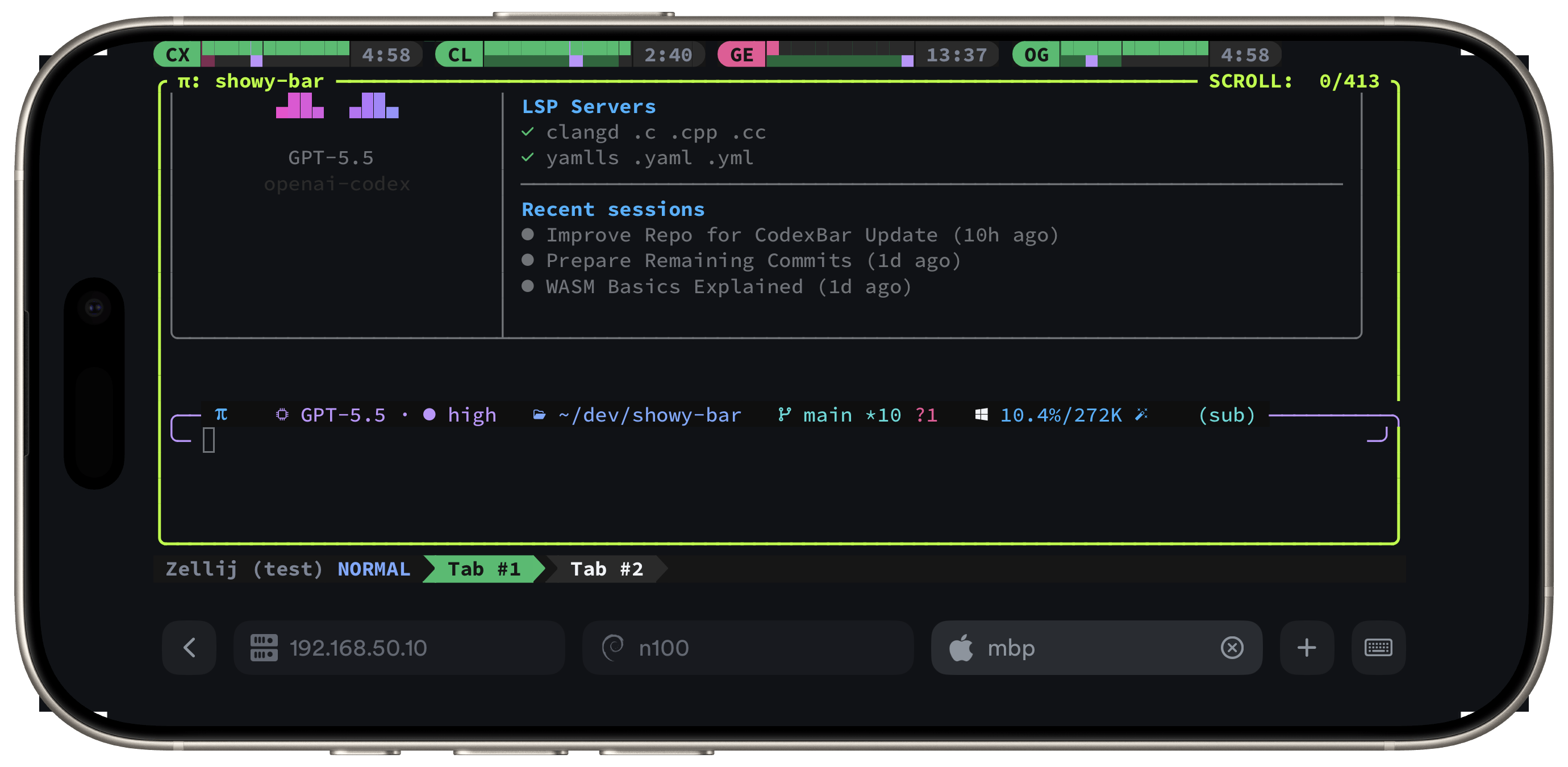
showy-quota's Zellij strip on an iPhone — four AI providers, real quotas, mid-session
codexbar serve → http://127.0.0.1:8080/health + /usage
       ▲
       │ auto-started by plugin/fetcher when absent
       │
       ├──► showy-quota-zellij.wasm              (standalone Zellij plugin)
       │
       ▼
bin/showy-quota-fetch     ←  shared cache envelope + flock + last-known-good
       │  ~/.cache/showy-quota/usage.json (envelope: source + providers)
       ├──► bin/showy-quota-state                 (stable provider/layout state JSON)
       ├──► adapters/sketchybar/plugins/showy_quota.sh    (native SketchyBar rows/rings + icons)
       ├──► bin/showy-quota-tmux-bar             (tmux #[…] markup for status-right)
       ├──► bin/showy-quota-zellij-bar           (advanced zjstatus pipe segment)
       └──► adapters/agent-cli/showy-quota-statusline  (agent-CLI status line strip)
Features
- Zero auth/config: Relies entirely on CodexBar for credentials and parsing.
- Provider status (SketchyBar): Icons automatically tint yellow (minor/maintenance) or red (major/critical) during an outage. Clicking a degraded icon opens the provider's official status page.
- Pacing & thresholds: Renders proportional pacing markers where the surface supports them and color-codes usage (good/warn/bad) based on configurable remaining-quota and time thresholds.
- Themeable: Ships with Catppuccin, Nord, Dracula, Tokyo Night, and others.
- Low overhead: Host bars share one cached fetcher; Zellij can use a single WASM artifact.
- Ring mode (SketchyBar, optional): One ring per model family with the provider logo inside, stacked bars for shorter windows, and a hover popup per provider. Rows stay the default; ring mode needs the SketchyBar fork (see SketchyBar wiring).
Quickstart
-
Install and enable CodexBar. It is the only thing that talks to providers.
brew install --cask steipete/tap/codexbar          # macOS
# CLI tarball / Linux: https://github.com/steipete/CodexBar/releases
codexbar usage --format json | jq length           # should print 1 or more
On macOS, cookie-based providers also need Full Disk Access for CodexBar in System Settings → Privacy & Security. If
jq lengthprints0, fix CodexBar before continuing — showy-quota has nothing to paint without it. -
Install showy-quota.
Recommended release tarball path for shell integrations (SketchyBar, tmux, and the advanced Zellij/zjstatus driver):
# Pick the asset for your platform: macos-arm64, macos-x86_64, or linux-x86_64.
VERSION=$(curl -fsSL https://api.github.com/repos/enieuwy/showy-quota/releases/latest | jq -r '.tag_name | sub("^v"; "")')
TARGET=macos-arm64
curl -LO "https://github.com/enieuwy/showy-quota/releases/download/v${VERSION}/showy-quota-${VERSION}-${TARGET}.tar.gz"
curl -LO "https://github.com/enieuwy/showy-quota/releases/download/v${VERSION}/showy-quota-${VERSION}-${TARGET}.tar.gz.sha256"
shasum -a 256 -c "showy-quota-${VERSION}-${TARGET}.tar.gz.sha256"
# If your system uses GNU coreutils, use:
# sha256sum -c "showy-quota-${VERSION}-${TARGET}.tar.gz.sha256"
tar xzf "showy-quota-${VERSION}-${TARGET}.tar.gz"
cd "showy-quota-${VERSION}"
make install-copy             # copies runtime files into ~/.local/share/showy-quota
Per-platform tarballs include the prebuilt native
showy-quota-renderbinary beside the shell entry points, so installing from a release does not require Rust or Cargo.Developer/source mode keeps symlinks into your checkout:
git clone https://github.com/enieuwy/showy-quota && cd showy-quota
make doctor                   # bash 4+, jq 1.6+, codexbar present
make install                  # symlinks bin/* into ~/.local/bin
Zellij's standalone plugin can still be installed by downloading
showy-quota-zellij.wasm; seedocs/plugin.md. From source,make install-pluginbuilds and installs it.make install-copy,make install, andmake install-pluginrefuse to clobber existing files unless you run withFORCE=1.Shell completions (Bash, zsh, fish) for
showy-quota,showy-quota-fetch, andshowy-quota-state:make install-completions(also part ofmake install-all). For zsh, add${XDG_DATA_HOME:-$HOME/.local/share}/zsh/site-functionstofpathbeforecompinit. -
Wire a UI. Pick the UI(s) you use:
- SketchyBar:
make install-copy-sketchybarfor a release/copy install (ormake install-sketchybarfor dev symlinks), then addsource "$ITEM_DIR/showy_quota.sh"to yoursketchybarrcand reload. - tmux: use the TPM wrapper or paste the snippet in
tmux wiring into
~/.tmux.conf. - Zellij: install
showy-quota-zellij.wasm, paste the layout fragment. Seedocs/zellij.mdanddocs/plugin.md. - Agent CLI statusline: point Claude Code (or any command-backed status
line) at
adapters/agent-cli/showy-quota-statusline; seedocs/statusline.md.
- SketchyBar:
SketchyBar wiring
Install the SketchyBar item/plugin, then add the item declaration to
~/.config/sketchybar/sketchybarrc after ITEM_DIR and PLUGIN_DIR are
defined:
make install-sketchybar
source "$ITEM_DIR/showy_quota.sh"
Then reload SketchyBar (sketchybar --reload or quit + relaunch) once to
load the trigger item. One icon + bar + label triple appears per provider
currently fetching usage data; later provider adds/removals land on the next
plugin tick without another reload.
Set SHOWY_QUOTA_SKETCHYBAR_BODY=ring for one ring per model family instead
of rows, with hover popups per window (see
docs/sketchybar.md "Strip body: rows or ring"). Ring
mode needs the SketchyBar fork
github.com/enieuwy/SketchyBar — the
ring item (upstream PR #817)
and the badges (upstream PR #816),
neither merged upstream yet. Build the fork's local/v2.24-integration
branch (its master tracks upstream and has no ring); on stock SketchyBar the
plugin falls back to rows.

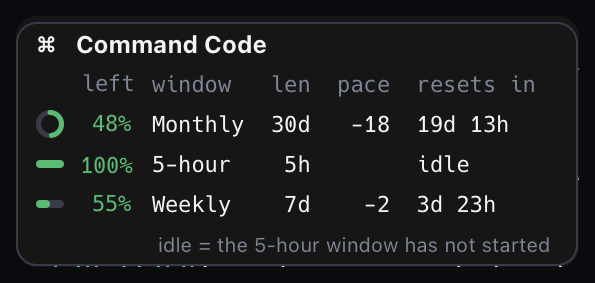
Ring mode: the strip, and the popup when you point at a provider
Zellij wiring
Two pieces:
- Plugin pane — install
showy-quota-zellij.wasmand pasteadapters/zellij/layout-pane.kdl.fragmentinto your default layout. It declares one visible standalone plugin pane; nozjstatusor feeder loop is needed. - Detail keybind — paste
adapters/zellij/detail-pane.kdl.fragmentinto your keybinds block. Default isAlt /.
Reload Zellij to pick up the new layout/keybind. Advanced users who want
showy-quota inside an existing multi-widget zjstatus row can keep using
showy-quota-zellij-pipe; see docs/zellij.md.
tmux wiring
TPM users can install the wrapper directly:
set -g @plugin 'enieuwy/showy-quota'

# Optional: bind the detail popup. Pick any prefix-relative key you prefer.
set -g @showy-quota-popup-key '/'
The TPM wrapper adds the existing bin/showy-quota-tmux-bar renderer to
status-right; it does not introduce a second tmux implementation. Without
TPM, wire the same renderer manually:
# Use the absolute path — tmux's PATH at server start typically lacks ~/.local/bin.
CB_BIN="$HOME/.local/bin"
cat >> ~/.tmux.conf <<TMUX
set -g status-right-length 300
if -F '#{m:*showy-quota-tmux-bar*,#{status-right}}' '' 'set -ag status-right " #(${CB_BIN}/showy-quota-tmux-bar)"'
bind-key "/" display-popup -E -h 36 -w 92 -T "CodexBar usage" 'config="\${XDG_CONFIG_HOME:-\$HOME/.config}/showy-quota/config.env"; [ -r "\$config" ] && . "\$config"; while :; do clear; "\${SHOWY_QUOTA_CODEXBAR_BIN:-codexbar}" usage; sleep 30; done'
TMUX
tmux source ~/.tmux.conf
No watch(1) dependency — the popup uses a tiny shell loop so this works on a
stock macOS install.
Terminal rendering modes
Terminal strips default to an auto mode that picks a body layout per
provider:
dual(default for most providers): a primary-over-secondary half-block layout. Each window is colored by its remaining-quota severity and dimmed when it is a weekly/monthly cap; both rows show a pacing marker (theelapsedcolor tints the upper half for the primary window and the lower half for the secondary). Body width is 12 cells.
mono3(default forgemini,cursor): packs primary, secondary, and tertiary into a single sextant cell per column with top/middle/bottom rows. Uses a single provider-level foreground color andmono_markerspacing separators. Providers whose windows share one billing cycle (same reset and window length, e.g. Cursor's Total/Auto/API) stay at full brightness and show a single pacing marker.
mono4(opt-in): packs four per-pool windows (e.g. Antigravity's Gemini and Claude+GPT session/weekly pools, fromextraRateWindows) into a single octant cell per column. Likemono3but four lanes — requires an octant-capable terminal (Ghostty, kitty, WezTerm); runpython3 docs/scripts/preview-quad-octants.pyto test yours.
dual2(auto-detected for model-pooled providers likeantigravity): splits the provider into one standalonedualper pool (AGᴳfor Gemini,AGᶜfor Claude+GPT), each fromextraRateWindowsand rendered by the normal half-blockdualpath. Half-blocks render in every terminal (unlikemono4).autoengages the split when a provider's extras carry all its positional slots; a single pool stays one plaindual(Antigravity via OAuth reports only Gemini). Force the split per provider withSHOWY_QUOTA_PROVIDER_MODES=<provider>=dual2.
Customize terminal layout with SHOWY_QUOTA_TERMINAL_BAR_MODE=dual|dual2|mono3|mono4.
For per-provider auto-mode selection and marker behavior, use
SHOWY_QUOTA_PROVIDER_MODES (e.g. antigravity=mono4),
SHOWY_QUOTA_MONO_COLOR_MODE, and SHOWY_QUOTA_MONO_MARKERS.
Stuck? bin/showy-quota --diagnose (or make diagnose) prints exactly the
state a bug report needs; bin/showy-quota --diagnose --json emits the same
diagnostic surface as stable machine-readable JSON. Both include your absolute
paths and serve URL, so add --redact before pasting anywhere public: it
collapses each path to its basename and hides URL hosts while keeping ports,
versions and provider counts, and sets "redacted": true in the JSON.
Automation & prompts
These subcommands read the same provider metrics the bars use — see
docs/automation.md for the full reference (exit codes,
--json schema, hook/cron/at/systemd recipes, and prompt snippets for
starship, powerlevel10k, and plain PS1).
-
showy-quota guardgates CI, cron, and agent hooks on quota thresholds with stable exit codes (0pass,1breach,2unusable data,3usage):# Fail (exit 1) if codex or claude drops below 15% remaining showy-quota guard --provider codex,claude --min-remaining 15Agent hooks can add
--no-fetchto evaluate a warm cache without starting provider collection. -
showy-quota promptprints a one-line segment (CX 92% 3:02) for the worst-remaining provider. It reads the cache as-is, so it never blocks a shell. In starship:# ~/.config/starship.toml [custom.showy_quota] command = 'showy-quota prompt' when = true shell = ['bash', '--noprofile', '--norc'] format = '[$output]($style) ' style = 'bold yellow' -
showy-quota run [guard options] -- <command>runs a command only when its guard passes and forwards its exit code;--wait-maxwaits for known resets instead of failing.showy-quota next-resetprints the seconds until a window refills, forat, cron, and systemd timers. -
showy-quota pickprints the provider with the most remaining quota, for routing work between models. -
showy-quota refreshforces a cache refresh and repaints the SketchyBar, tmux, and shell Zellij bars that are running. -
showy-quota serve status|restart|stopinspects or controls the managedcodexbar serve; status only reads/health. -
showy-quota --check-configlists config values that were rejected or clamped, and unknownSHOWY_QUOTA_*keys. -
showy-quota-state --explainsays why each provider is shown or hidden.
Requirements
- macOS for SketchyBar. Zellij/tmux bars also work on Linux when CodexBar can fetch your chosen providers.
- A CodexBar data source:
- Zellij plugin:
codexbaron the Zellij serverPATH; the plugin startscodexbar serveby default, uses/health+/usage, and visibly marks CLI fallback as⚠cli; - shell integrations: same managed serve path via
showy-quota-fetch, with visible⚠clifallback. CodexBar's web-backed providers remain macOS-only; CLI/OAuth/API/local providers work where CodexBar supports them.
- Zellij plugin:
- Shell integrations need
bash4+,jq1.6+, and adatethat understands either-j -f(BSD/macOS) or-d(GNU coreutils).make check-depsasserts thebashandjqfloors and is the same check CI runs, so a passing local install and a passing CI leg mean the same thing. The standalone Zellij plugin does not need the shell scripts,bash, orjq. - SketchyBar integration also needs
sketchybaron the PATH. Font icon mode needssketchybar-app-font; SVG fallback icons need ImageMagick 7.1.1+ (magick), which renders third-party provider SVGs. Native usage rows do not needmagick. - The Zellij/tmux renderers wrap each provider chunk in Powerline-Extra end
caps (U+E0B6 / U+E0B4). Any Nerd Font ships these. For the standalone
Zellij plugin with a non-Nerd font, set
cap_left ""andcap_right ""in the plugin KDL; for tmux or advanced zjstatus, setSHOWY_QUOTA_CAP_LEFT=/SHOWY_QUOTA_CAP_RIGHT=. Terminal sextant modes have additional font notes indocs/zellij.mdanddocs/tmux.md. - Optional:
flockfor inter-process locking; falls back to an owner-scopedmkdirlock when missing. - Development/install commands are written for GNU-compatible
make; on systems with a non-GNU default make, usegmakeor invoke the scripts directly.
Configuration
The shell integrations (SketchyBar, tmux, and the Zellij shell renderers) read
optional overrides from ~/.config/showy-quota/config.env. The standalone Zellij WASM plugin is configured with
KDL keys instead (the same names without the SHOWY_QUOTA_ prefix, lowercased);
see docs/plugin.md.
Config is optional; create it only for values you want to override. The full environment surface lives in
share/config.env.example — most users only need these:
| Variable | Effect |
|---|---|
SHOWY_QUOTA_THEME | Load a named built-in or user palette. default=unset (default palette) |
SHOWY_QUOTA_PROVIDERS | Ordered provider allow-list; empty renders CodexBar's enabled providers. default=empty |
SHOWY_QUOTA_PROVIDERS_EXCLUDE | Provider deny-list applied after the allow-list. default=empty |
SHOWY_QUOTA_PROVIDER_ORDER | Stable render order without filtering. default=codex,claude,copilot,opencode,gemini |
SHOWY_QUOTA_REFRESH_SECONDS | Freshness contract: full-refresh cadence and CLI-fallback interval. Serve collection and /usage-poll defaults derive from it. default=120 |
SHOWY_QUOTA_MANAGE_SERVE | Start codexbar serve automatically before CLI fallback; set 0 to disable. default=1 |
SHOWY_QUOTA_CODEXBAR_SERVE_URL | Local codexbar serve base URL; also sets the managed serve --port, so probing and startup always agree. Set empty to skip HTTP probing. default=http://127.0.0.1:8080 |
SHOWY_QUOTA_CODEXBAR_SERVE_TIMEOUT_SECONDS | Bounded positive timeout for local /health probes. configured default=10 |
SHOWY_QUOTA_CODEXBAR_SERVE_USAGE_TIMEOUT_SECONDS | Bounded positive timeout for local /usage probes. default=30 |
SHOWY_QUOTA_CODEXBAR_SERVE_REFRESH_INTERVAL_SECONDS | Collection cadence for a managed codexbar serve. default=SHOWY_QUOTA_REFRESH_SECONDS |
SHOWY_QUOTA_CODEXBAR_SERVE_REFRESH_SECONDS | /usage re-read cadence when codexbar serve is available. default=SHOWY_QUOTA_REFRESH_SECONDS / 2 |
SHOWY_QUOTA_TIME_WARN_MINUTES | Urgent countdown threshold. default=30 |
SHOWY_QUOTA_SKETCHYBAR_CLICK | Default SketchyBar click action; degraded icons open provider status URLs. default=open -b com.steipete.codexbar |
SHOWY_QUOTA_VERTICAL_BAR_WIDTH | Bar width in cells for each --emit vertical line. default=16 |
SHOWY_QUOTA_VERTICAL_SORT | --emit vertical line order: provider keeps CodexBar's blocks, urgency puts the window closest to running out first (ties keep provider order). default=provider |
SHOWY_QUOTA_VERTICAL_RESET_CLOCK | Append each window's local reset clock to its --emit vertical line; 0 trades it back for six columns. default=1 |
Palette overrides use role-first primary keys such as
SHOWY_QUOTA_PALETTE_PRIMARY_*; long-horizon windows are dimmed from the
primary palette with SHOWY_QUOTA_PALETTE_DIM_SCALE after
SHOWY_QUOTA_DIM_WINDOW_MINUTES. There are no separate secondary/tertiary
palette overrides; see share/config.env.example for the full palette surface.
Theme gallery
| theme name | SketchyBar image | terminal / Zellij image |
|---|---|---|
carbonfox |  |  |
catppuccin-frappe |  |  |
catppuccin-latte |  |  |
catppuccin-macchiato |  |  |
catppuccin-mocha |  |  |
catppuccin-mocha-blue |  |  |
default |  |  |
dracula |  |  |
gruvbox-dark |  |  |
nord |  |  |
tokyonight |  |  |
Verification
make doctor      # check runtime prerequisites
make test        # smoke tests over JSON fixtures
make plugin      # build showy-quota-zellij.wasm
make diagnose    # printable bug-report state (`bin/showy-quota --diagnose --json` for JSON)
Cache lives at ${XDG_CACHE_HOME:-~/.cache}/showy-quota/usage.json.
If that file is corrupt, the fetcher moves it aside as
usage.json.corrupt.<epoch>.<pid> and keeps only the newest few quarantine
files for diagnostics. make clean clears cache artifacts.
How it stays cheap
- tmux, SketchyBar, and advanced zjstatus share one cached fetcher. It prefers
codexbar serve, starts it when absent, and marks CLI fallback as⚠cli. - The standalone Zellij plugin uses the same serve-first shape and keeps in-memory last-known-good output per pane.
License
MIT — same as CodexBar.
Credits
CodexBar by Peter Steinberger does all the real work. This repo just paints its output onto status bars.
Similar repos


Languages
Shell
49.7%
Rust
48.5%
Makefile
1.6%
Always-on AI plan quota strips for SketchyBar, Zellij, and tmux, driven by CodexBar.
Shell
20
213 commits
updated Sep 27, 2026
README
showy-quota
Always-on AI plan quota strips for SketchyBar, Zellij, and tmux, driven by CodexBar.
Beautiful, themeable, minimal.
showy-quota running across SketchyBar and a Zellij terminal on macOS
showy-quota's Zellij strip on an iPhone — four AI providers, real quotas, mid-session
codexbar serve → http://127.0.0.1:8080/health + /usage
       ▲
       │ auto-started by plugin/fetcher when absent
       │
       ├──► showy-quota-zellij.wasm              (standalone Zellij plugin)
       │
       ▼
bin/showy-quota-fetch     ←  shared cache envelope + flock + last-known-good
       │  ~/.cache/showy-quota/usage.json (envelope: source + providers)
       ├──► bin/showy-quota-state                 (stable provider/layout state JSON)
       ├──► adapters/sketchybar/plugins/showy_quota.sh    (native SketchyBar rows/rings + icons)
       ├──► bin/showy-quota-tmux-bar             (tmux #[…] markup for status-right)
       ├──► bin/showy-quota-zellij-bar           (advanced zjstatus pipe segment)
       └──► adapters/agent-cli/showy-quota-statusline  (agent-CLI status line strip)
Features
- Zero auth/config: Relies entirely on CodexBar for credentials and parsing.
- Provider status (SketchyBar): Icons automatically tint yellow (minor/maintenance) or red (major/critical) during an outage. Clicking a degraded icon opens the provider's official status page.
- Pacing & thresholds: Renders proportional pacing markers where the surface supports them and color-codes usage (good/warn/bad) based on configurable remaining-quota and time thresholds.
- Themeable: Ships with Catppuccin, Nord, Dracula, Tokyo Night, and others.
- Low overhead: Host bars share one cached fetcher; Zellij can use a single WASM artifact.
- Ring mode (SketchyBar, optional): One ring per model family with the provider logo inside, stacked bars for shorter windows, and a hover popup per provider. Rows stay the default; ring mode needs the SketchyBar fork (see SketchyBar wiring).
Quickstart
-
Install and enable CodexBar. It is the only thing that talks to providers.
brew install --cask steipete/tap/codexbar          # macOS
# CLI tarball / Linux: https://github.com/steipete/CodexBar/releases
codexbar usage --format json | jq length           # should print 1 or more
On macOS, cookie-based providers also need Full Disk Access for CodexBar in System Settings → Privacy & Security. If
jq lengthprints0, fix CodexBar before continuing — showy-quota has nothing to paint without it. -
Install showy-quota.
Recommended release tarball path for shell integrations (SketchyBar, tmux, and the advanced Zellij/zjstatus driver):
# Pick the asset for your platform: macos-arm64, macos-x86_64, or linux-x86_64.
VERSION=$(curl -fsSL https://api.github.com/repos/enieuwy/showy-quota/releases/latest | jq -r '.tag_name | sub("^v"; "")')
TARGET=macos-arm64
curl -LO "https://github.com/enieuwy/showy-quota/releases/download/v${VERSION}/showy-quota-${VERSION}-${TARGET}.tar.gz"
curl -LO "https://github.com/enieuwy/showy-quota/releases/download/v${VERSION}/showy-quota-${VERSION}-${TARGET}.tar.gz.sha256"
shasum -a 256 -c "showy-quota-${VERSION}-${TARGET}.tar.gz.sha256"
# If your system uses GNU coreutils, use:
# sha256sum -c "showy-quota-${VERSION}-${TARGET}.tar.gz.sha256"
tar xzf "showy-quota-${VERSION}-${TARGET}.tar.gz"
cd "showy-quota-${VERSION}"
make install-copy             # copies runtime files into ~/.local/share/showy-quota
Per-platform tarballs include the prebuilt native
showy-quota-renderbinary beside the shell entry points, so installing from a release does not require Rust or Cargo.Developer/source mode keeps symlinks into your checkout:
git clone https://github.com/enieuwy/showy-quota && cd showy-quota
make doctor                   # bash 4+, jq 1.6+, codexbar present
make install                  # symlinks bin/* into ~/.local/bin
Zellij's standalone plugin can still be installed by downloading
showy-quota-zellij.wasm; seedocs/plugin.md. From source,make install-pluginbuilds and installs it.make install-copy,make install, andmake install-pluginrefuse to clobber existing files unless you run withFORCE=1.Shell completions (Bash, zsh, fish) for
showy-quota,showy-quota-fetch, andshowy-quota-state:make install-completions(also part ofmake install-all). For zsh, add${XDG_DATA_HOME:-$HOME/.local/share}/zsh/site-functionstofpathbeforecompinit. -
Wire a UI. Pick the UI(s) you use:
- SketchyBar:
make install-copy-sketchybarfor a release/copy install (ormake install-sketchybarfor dev symlinks), then addsource "$ITEM_DIR/showy_quota.sh"to yoursketchybarrcand reload. - tmux: use the TPM wrapper or paste the snippet in
tmux wiring into
~/.tmux.conf. - Zellij: install
showy-quota-zellij.wasm, paste the layout fragment. Seedocs/zellij.mdanddocs/plugin.md. - Agent CLI statusline: point Claude Code (or any command-backed status
line) at
adapters/agent-cli/showy-quota-statusline; seedocs/statusline.md.
- SketchyBar:
SketchyBar wiring
Install the SketchyBar item/plugin, then add the item declaration to
~/.config/sketchybar/sketchybarrc after ITEM_DIR and PLUGIN_DIR are
defined:
make install-sketchybar
source "$ITEM_DIR/showy_quota.sh"
Then reload SketchyBar (sketchybar --reload or quit + relaunch) once to
load the trigger item. One icon + bar + label triple appears per provider
currently fetching usage data; later provider adds/removals land on the next
plugin tick without another reload.
Set SHOWY_QUOTA_SKETCHYBAR_BODY=ring for one ring per model family instead
of rows, with hover popups per window (see
docs/sketchybar.md "Strip body: rows or ring"). Ring
mode needs the SketchyBar fork
github.com/enieuwy/SketchyBar — the
ring item (upstream PR #817)
and the badges (upstream PR #816),
neither merged upstream yet. Build the fork's local/v2.24-integration
branch (its master tracks upstream and has no ring); on stock SketchyBar the
plugin falls back to rows.
Ring mode: the strip, and the popup when you point at a provider
Zellij wiring
Two pieces:
- Plugin pane — install
showy-quota-zellij.wasmand pasteadapters/zellij/layout-pane.kdl.fragmentinto your default layout. It declares one visible standalone plugin pane; nozjstatusor feeder loop is needed. - Detail keybind — paste
adapters/zellij/detail-pane.kdl.fragmentinto your keybinds block. Default isAlt /.
Reload Zellij to pick up the new layout/keybind. Advanced users who want
showy-quota inside an existing multi-widget zjstatus row can keep using
showy-quota-zellij-pipe; see docs/zellij.md.
tmux wiring
TPM users can install the wrapper directly:
set -g @plugin 'enieuwy/showy-quota'

# Optional: bind the detail popup. Pick any prefix-relative key you prefer.
set -g @showy-quota-popup-key '/'
The TPM wrapper adds the existing bin/showy-quota-tmux-bar renderer to
status-right; it does not introduce a second tmux implementation. Without
TPM, wire the same renderer manually:
# Use the absolute path — tmux's PATH at server start typically lacks ~/.local/bin.
CB_BIN="$HOME/.local/bin"
cat >> ~/.tmux.conf <<TMUX
set -g status-right-length 300
if -F '#{m:*showy-quota-tmux-bar*,#{status-right}}' '' 'set -ag status-right " #(${CB_BIN}/showy-quota-tmux-bar)"'
bind-key "/" display-popup -E -h 36 -w 92 -T "CodexBar usage" 'config="\${XDG_CONFIG_HOME:-\$HOME/.config}/showy-quota/config.env"; [ -r "\$config" ] && . "\$config"; while :; do clear; "\${SHOWY_QUOTA_CODEXBAR_BIN:-codexbar}" usage; sleep 30; done'
TMUX
tmux source ~/.tmux.conf
No watch(1) dependency — the popup uses a tiny shell loop so this works on a
stock macOS install.
Terminal rendering modes
Terminal strips default to an auto mode that picks a body layout per
provider:
dual(default for most providers): a primary-over-secondary half-block layout. Each window is colored by its remaining-quota severity and dimmed when it is a weekly/monthly cap; both rows show a pacing marker (theelapsedcolor tints the upper half for the primary window and the lower half for the secondary). Body width is 12 cells.mono3(default forgemini,cursor): packs primary, secondary, and tertiary into a single sextant cell per column with top/middle/bottom rows. Uses a single provider-level foreground color andmono_markerspacing separators. Providers whose windows share one billing cycle (same reset and window length, e.g. Cursor's Total/Auto/API) stay at full brightness and show a single pacing marker.mono4(opt-in): packs four per-pool windows (e.g. Antigravity's Gemini and Claude+GPT session/weekly pools, fromextraRateWindows) into a single octant cell per column. Likemono3but four lanes — requires an octant-capable terminal (Ghostty, kitty, WezTerm); runpython3 docs/scripts/preview-quad-octants.pyto test yours.dual2(auto-detected for model-pooled providers likeantigravity): splits the provider into one standalonedualper pool (AGᴳfor Gemini,AGᶜfor Claude+GPT), each fromextraRateWindowsand rendered by the normal half-blockdualpath. Half-blocks render in every terminal (unlikemono4).autoengages the split when a provider's extras carry all its positional slots; a single pool stays one plaindual(Antigravity via OAuth reports only Gemini). Force the split per provider withSHOWY_QUOTA_PROVIDER_MODES=<provider>=dual2.
Customize terminal layout with SHOWY_QUOTA_TERMINAL_BAR_MODE=dual|dual2|mono3|mono4.
For per-provider auto-mode selection and marker behavior, use
SHOWY_QUOTA_PROVIDER_MODES (e.g. antigravity=mono4),
SHOWY_QUOTA_MONO_COLOR_MODE, and SHOWY_QUOTA_MONO_MARKERS.
Stuck? bin/showy-quota --diagnose (or make diagnose) prints exactly the
state a bug report needs; bin/showy-quota --diagnose --json emits the same
diagnostic surface as stable machine-readable JSON. Both include your absolute
paths and serve URL, so add --redact before pasting anywhere public: it
collapses each path to its basename and hides URL hosts while keeping ports,
versions and provider counts, and sets "redacted": true in the JSON.
Automation & prompts
These subcommands read the same provider metrics the bars use — see
docs/automation.md for the full reference (exit codes,
--json schema, hook/cron/at/systemd recipes, and prompt snippets for
starship, powerlevel10k, and plain PS1).
-
showy-quota guardgates CI, cron, and agent hooks on quota thresholds with stable exit codes (0pass,1breach,2unusable data,3usage):# Fail (exit 1) if codex or claude drops below 15% remaining showy-quota guard --provider codex,claude --min-remaining 15Agent hooks can add
--no-fetchto evaluate a warm cache without starting provider collection. -
showy-quota promptprints a one-line segment (CX 92% 3:02) for the worst-remaining provider. It reads the cache as-is, so it never blocks a shell. In starship:# ~/.config/starship.toml [custom.showy_quota] command = 'showy-quota prompt' when = true shell = ['bash', '--noprofile', '--norc'] format = '[$output]($style) ' style = 'bold yellow' -
showy-quota run [guard options] -- <command>runs a command only when its guard passes and forwards its exit code;--wait-maxwaits for known resets instead of failing.showy-quota next-resetprints the seconds until a window refills, forat, cron, and systemd timers. -
showy-quota pickprints the provider with the most remaining quota, for routing work between models. -
showy-quota refreshforces a cache refresh and repaints the SketchyBar, tmux, and shell Zellij bars that are running. -
showy-quota serve status|restart|stopinspects or controls the managedcodexbar serve; status only reads/health. -
showy-quota --check-configlists config values that were rejected or clamped, and unknownSHOWY_QUOTA_*keys. -
showy-quota-state --explainsays why each provider is shown or hidden.
Requirements
- macOS for SketchyBar. Zellij/tmux bars also work on Linux when CodexBar can fetch your chosen providers.
- A CodexBar data source:
- Zellij plugin:
codexbaron the Zellij serverPATH; the plugin startscodexbar serveby default, uses/health+/usage, and visibly marks CLI fallback as⚠cli; - shell integrations: same managed serve path via
showy-quota-fetch, with visible⚠clifallback. CodexBar's web-backed providers remain macOS-only; CLI/OAuth/API/local providers work where CodexBar supports them.
- Zellij plugin:
- Shell integrations need
bash4+,jq1.6+, and adatethat understands either-j -f(BSD/macOS) or-d(GNU coreutils).make check-depsasserts thebashandjqfloors and is the same check CI runs, so a passing local install and a passing CI leg mean the same thing. The standalone Zellij plugin does not need the shell scripts,bash, orjq. - SketchyBar integration also needs
sketchybaron the PATH. Font icon mode needssketchybar-app-font; SVG fallback icons need ImageMagick 7.1.1+ (magick), which renders third-party provider SVGs. Native usage rows do not needmagick. - The Zellij/tmux renderers wrap each provider chunk in Powerline-Extra end
caps (U+E0B6 / U+E0B4). Any Nerd Font ships these. For the standalone
Zellij plugin with a non-Nerd font, set
cap_left ""andcap_right ""in the plugin KDL; for tmux or advanced zjstatus, setSHOWY_QUOTA_CAP_LEFT=/SHOWY_QUOTA_CAP_RIGHT=. Terminal sextant modes have additional font notes indocs/zellij.mdanddocs/tmux.md. - Optional:
flockfor inter-process locking; falls back to an owner-scopedmkdirlock when missing. - Development/install commands are written for GNU-compatible
make; on systems with a non-GNU default make, usegmakeor invoke the scripts directly.
Configuration
The shell integrations (SketchyBar, tmux, and the Zellij shell renderers) read
optional overrides from ~/.config/showy-quota/config.env. The standalone Zellij WASM plugin is configured with
KDL keys instead (the same names without the SHOWY_QUOTA_ prefix, lowercased);
see docs/plugin.md.
Config is optional; create it only for values you want to override. The full environment surface lives in
share/config.env.example — most users only need these:
| Variable | Effect |
|---|---|
SHOWY_QUOTA_THEME | Load a named built-in or user palette. default=unset (default palette) |
SHOWY_QUOTA_PROVIDERS | Ordered provider allow-list; empty renders CodexBar's enabled providers. default=empty |
SHOWY_QUOTA_PROVIDERS_EXCLUDE | Provider deny-list applied after the allow-list. default=empty |
SHOWY_QUOTA_PROVIDER_ORDER | Stable render order without filtering. default=codex,claude,copilot,opencode,gemini |
SHOWY_QUOTA_REFRESH_SECONDS | Freshness contract: full-refresh cadence and CLI-fallback interval. Serve collection and /usage-poll defaults derive from it. default=120 |
SHOWY_QUOTA_MANAGE_SERVE | Start codexbar serve automatically before CLI fallback; set 0 to disable. default=1 |
SHOWY_QUOTA_CODEXBAR_SERVE_URL | Local codexbar serve base URL; also sets the managed serve --port, so probing and startup always agree. Set empty to skip HTTP probing. default=http://127.0.0.1:8080 |
SHOWY_QUOTA_CODEXBAR_SERVE_TIMEOUT_SECONDS | Bounded positive timeout for local /health probes. configured default=10 |
SHOWY_QUOTA_CODEXBAR_SERVE_USAGE_TIMEOUT_SECONDS | Bounded positive timeout for local /usage probes. default=30 |
SHOWY_QUOTA_CODEXBAR_SERVE_REFRESH_INTERVAL_SECONDS | Collection cadence for a managed codexbar serve. default=SHOWY_QUOTA_REFRESH_SECONDS |
SHOWY_QUOTA_CODEXBAR_SERVE_REFRESH_SECONDS | /usage re-read cadence when codexbar serve is available. default=SHOWY_QUOTA_REFRESH_SECONDS / 2 |
SHOWY_QUOTA_TIME_WARN_MINUTES | Urgent countdown threshold. default=30 |
SHOWY_QUOTA_SKETCHYBAR_CLICK | Default SketchyBar click action; degraded icons open provider status URLs. default=open -b com.steipete.codexbar |
SHOWY_QUOTA_VERTICAL_BAR_WIDTH | Bar width in cells for each --emit vertical line. default=16 |
SHOWY_QUOTA_VERTICAL_SORT | --emit vertical line order: provider keeps CodexBar's blocks, urgency puts the window closest to running out first (ties keep provider order). default=provider |
SHOWY_QUOTA_VERTICAL_RESET_CLOCK | Append each window's local reset clock to its --emit vertical line; 0 trades it back for six columns. default=1 |
Palette overrides use role-first primary keys such as
SHOWY_QUOTA_PALETTE_PRIMARY_*; long-horizon windows are dimmed from the
primary palette with SHOWY_QUOTA_PALETTE_DIM_SCALE after
SHOWY_QUOTA_DIM_WINDOW_MINUTES. There are no separate secondary/tertiary
palette overrides; see share/config.env.example for the full palette surface.
Theme gallery
| theme name | SketchyBar image | terminal / Zellij image |
|---|---|---|
carbonfox | | |
catppuccin-frappe | | |
catppuccin-latte | | |
catppuccin-macchiato | | |
catppuccin-mocha | | |
catppuccin-mocha-blue | | |
default | | |
dracula | | |
gruvbox-dark | | |
nord | | |
tokyonight | | |
Verification
make doctor      # check runtime prerequisites
make test        # smoke tests over JSON fixtures
make plugin      # build showy-quota-zellij.wasm
make diagnose    # printable bug-report state (`bin/showy-quota --diagnose --json` for JSON)
Cache lives at ${XDG_CACHE_HOME:-~/.cache}/showy-quota/usage.json.
If that file is corrupt, the fetcher moves it aside as
usage.json.corrupt.<epoch>.<pid> and keeps only the newest few quarantine
files for diagnostics. make clean clears cache artifacts.
How it stays cheap
- tmux, SketchyBar, and advanced zjstatus share one cached fetcher. It prefers
codexbar serve, starts it when absent, and marks CLI fallback as⚠cli. - The standalone Zellij plugin uses the same serve-first shape and keeps in-memory last-known-good output per pane.
License
MIT — same as CodexBar.
Credits
CodexBar by Peter Steinberger does all the real work. This repo just paints its output onto status bars.
Similar repos
Languages
Shell
49.7%
Rust
48.5%
Makefile
1.6%