
Issue triage that stays quiet when it isn't sure. Calibrated labels, spam and duplicate detection — with abstention.
JavaScript
0
3 commits
updated Sep 20, 2026
See what people are saying (1)
README
hush
Issue triage that stays quiet when it isn't sure.



A GitHub Action that reads every new issue and labels it — but only when it can say how sure it is. When it can't, it does nothing and tells you why.
■ "Crash on save when filename is very long"
  bug            100% ≥ 80%, confidence 100%     → applied `bug`
  duplicate       97% ≥ 85%                      → applied `possible-duplicate`
  spam             3% < 90%                      → stayed quiet
  needs info      14% < 85%                      → stayed quiet

■ "🔥 BUY CHEAP FOLLOWERS 🔥"
  spam            99% ≥ 90%                      → applied `spam`
  label          best fit was "none" (100%)      → stayed quiet
Real output, 202–530 ms per issue.
And the part that matters, from its own first issue — a report that could reasonably be a bug or a documentation problem:
label | stayed quiet | bug 72% / confidence 63% — below 80% / 60%
It had an answer. It wasn't sure enough. So it said nothing.
Why another triage bot
Because the others talk when they shouldn't.
LLM triage bots return prose with no calibrated notion of certainty, so a 55% hunch and a 99% read look identical coming out. You get confident-sounding labels on issues the model never understood, and after the third wrong one you turn it off.
hush runs on Jev, a decision model that returns a probability instead of a sentence. Every verdict comes with the number that produced it, and every threshold is yours:
label-threshold: 0.80        # how likely the label must be
label-confidence-threshold: 0.60  # and how much the model must trust its own read
spam-threshold: 0.90
needs-info-threshold: 0.85
duplicate-threshold: 0.85
Below the line, it abstains. Silence is the default behaviour, not the failure mode.
It is also cheap enough to leave on: one request per issue, around $0.00002. Ten thousand issues cost about twenty cents.
Install
# .github/workflows/triage.yml
name: triage
on:
  issues:
    types: [opened, edited, reopened]

permissions:
  issues: write

jobs:
  hush:
    runs-on: ubuntu-latest
    steps:
      - uses: emreozyoruk/hush@v1
        with:
          typesafe-api-key: ${{ secrets.TYPESAFE_API_KEY }}
          apply: false   # watch it first
Get a key at console.typesafe.ai/keys and add it as a repository secret.
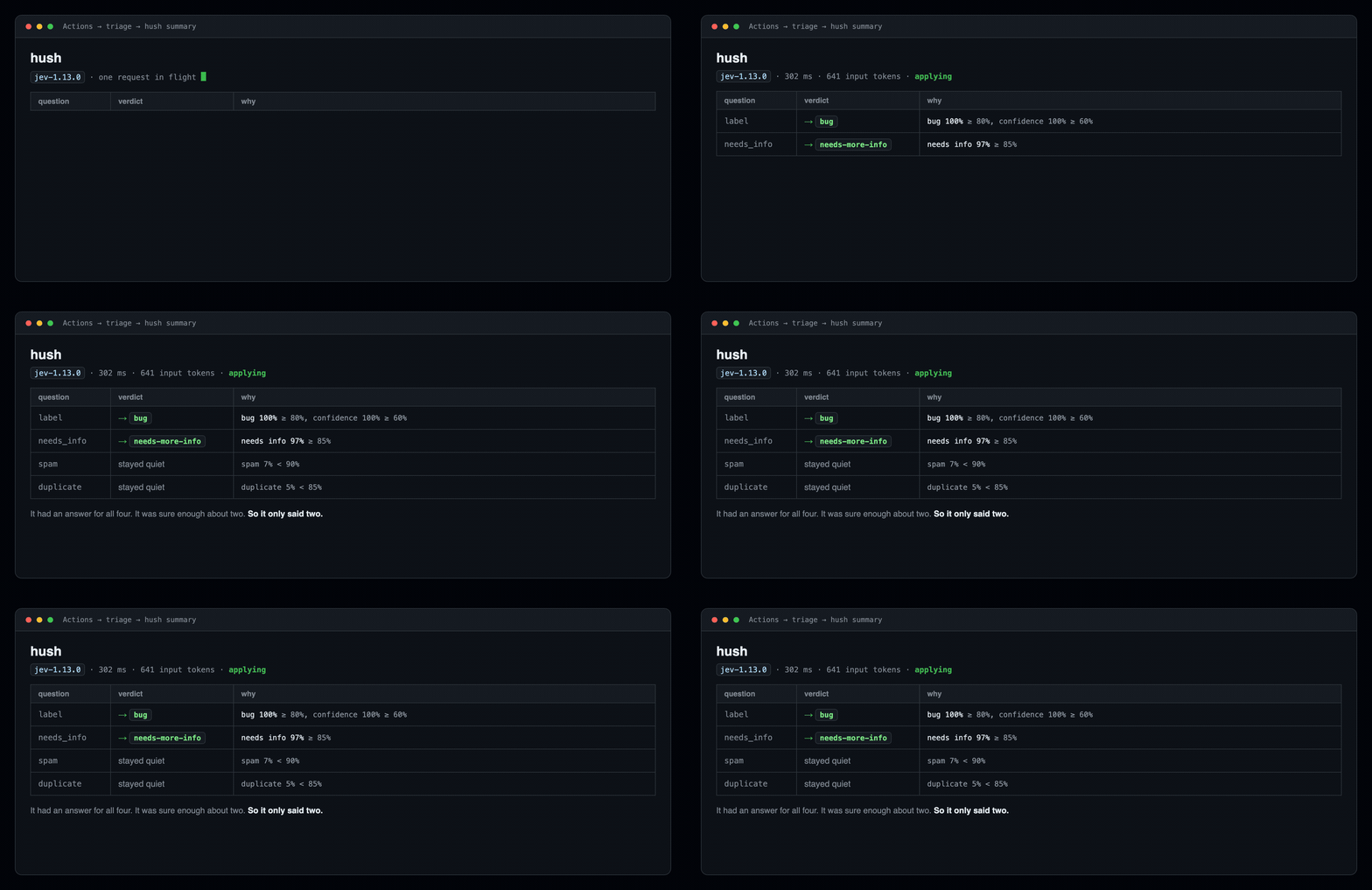
Start with apply: false. hush writes a table into the job summary of every
run showing what it would have done. Read a week of those, move your thresholds,
then set apply: true.
Your labels, your words
The default set is bug, feature, docs, question. Replace it with your own —
the description is what the model judges against, so write it the way you would
explain the label to a new maintainer:
- uses: emreozyoruk/hush@v1
  with:
    typesafe-api-key: ${{ secrets.TYPESAFE_API_KEY }}
    apply: true
    comment: true
    labels: |
      {
        "bug": "A defect: the library does something other than what the docs say.",
        "performance": "It works, but it is too slow or uses too much memory.",
        "platform/windows": "Specific to Windows; does not reproduce on Linux or macOS.",
        "good first issue": "Small, well-understood, and does not need project context."
      }
A label is only ever applied if it already exists in the repository. hush never creates labels, never removes one, and never touches a label a human added.
What it decides
| question | type | what it does |
|---|---|---|
| label | one of yours, or none | Applies the category when both the probability and the model's confidence clear your thresholds. |
| spam | yes/no | Applies spam. |
| needs more info | yes/no | Applies needs-more-info when a maintainer would have to ask before acting. |
| duplicate | yes/no | Compares against the 40 most recent open issues and applies possible-duplicate. |
All four travel in one request, which is why triage costs a fraction of a cent and finishes before the page reloads.
Inputs
| input | default | |
|---|---|---|
typesafe-api-key | — | Required. |
github-token | ${{ github.token }} | Needs issues: write to apply anything. |
apply | false | Act, rather than only report. |
comment | false | Explain the labels in a comment. |
labels | the four above | JSON object of name → meaning. |
check-duplicates | true | Compare against other open issues. |
label-threshold | 0.80 | |
label-confidence-threshold | 0.60 | |
spam-threshold | 0.90 | |
needs-info-threshold | 0.85 | |
duplicate-threshold | 0.85 |
What it will not do
- Close, lock, delete or edit anything. It labels, and optionally comments.
- Apply a label that does not already exist in your repository.
- Remove or overwrite a label a person set.
- Act at all while
applyis false.
Where it is unsure, it leaves the issue exactly as it found it. That is the entire idea.
Development
npm test # the decision layer is pure; the thresholds are tested offline
No build step and no dependencies — the action runs the files in src/ directly
on Node 20.
Licence
MIT
Contributors

3 commits
Similar repos


Languages
JavaScript
100.0%
Issue triage that stays quiet when it isn't sure. Calibrated labels, spam and duplicate detection — with abstention.
JavaScript
0
3 commits
updated Sep 20, 2026
See what people are saying (1)
README
hush
Issue triage that stays quiet when it isn't sure.
A GitHub Action that reads every new issue and labels it — but only when it can say how sure it is. When it can't, it does nothing and tells you why.
■ "Crash on save when filename is very long"
  bug            100% ≥ 80%, confidence 100%     → applied `bug`
  duplicate       97% ≥ 85%                      → applied `possible-duplicate`
  spam             3% < 90%                      → stayed quiet
  needs info      14% < 85%                      → stayed quiet

■ "🔥 BUY CHEAP FOLLOWERS 🔥"
  spam            99% ≥ 90%                      → applied `spam`
  label          best fit was "none" (100%)      → stayed quiet
Real output, 202–530 ms per issue.
And the part that matters, from its own first issue — a report that could reasonably be a bug or a documentation problem:
label | stayed quiet | bug 72% / confidence 63% — below 80% / 60%
It had an answer. It wasn't sure enough. So it said nothing.
Why another triage bot
Because the others talk when they shouldn't.
LLM triage bots return prose with no calibrated notion of certainty, so a 55% hunch and a 99% read look identical coming out. You get confident-sounding labels on issues the model never understood, and after the third wrong one you turn it off.
hush runs on Jev, a decision model that returns a probability instead of a sentence. Every verdict comes with the number that produced it, and every threshold is yours:
label-threshold: 0.80        # how likely the label must be
label-confidence-threshold: 0.60  # and how much the model must trust its own read
spam-threshold: 0.90
needs-info-threshold: 0.85
duplicate-threshold: 0.85
Below the line, it abstains. Silence is the default behaviour, not the failure mode.
It is also cheap enough to leave on: one request per issue, around $0.00002. Ten thousand issues cost about twenty cents.
Install
# .github/workflows/triage.yml
name: triage
on:
  issues:
    types: [opened, edited, reopened]

permissions:
  issues: write

jobs:
  hush:
    runs-on: ubuntu-latest
    steps:
      - uses: emreozyoruk/hush@v1
        with:
          typesafe-api-key: ${{ secrets.TYPESAFE_API_KEY }}
          apply: false   # watch it first
Get a key at console.typesafe.ai/keys and add it as a repository secret.
Start with apply: false. hush writes a table into the job summary of every
run showing what it would have done. Read a week of those, move your thresholds,
then set apply: true.
Your labels, your words
The default set is bug, feature, docs, question. Replace it with your own —
the description is what the model judges against, so write it the way you would
explain the label to a new maintainer:
- uses: emreozyoruk/hush@v1
  with:
    typesafe-api-key: ${{ secrets.TYPESAFE_API_KEY }}
    apply: true
    comment: true
    labels: |
      {
        "bug": "A defect: the library does something other than what the docs say.",
        "performance": "It works, but it is too slow or uses too much memory.",
        "platform/windows": "Specific to Windows; does not reproduce on Linux or macOS.",
        "good first issue": "Small, well-understood, and does not need project context."
      }
A label is only ever applied if it already exists in the repository. hush never creates labels, never removes one, and never touches a label a human added.
What it decides
| question | type | what it does |
|---|---|---|
| label | one of yours, or none | Applies the category when both the probability and the model's confidence clear your thresholds. |
| spam | yes/no | Applies spam. |
| needs more info | yes/no | Applies needs-more-info when a maintainer would have to ask before acting. |
| duplicate | yes/no | Compares against the 40 most recent open issues and applies possible-duplicate. |
All four travel in one request, which is why triage costs a fraction of a cent and finishes before the page reloads.
Inputs
| input | default | |
|---|---|---|
typesafe-api-key | — | Required. |
github-token | ${{ github.token }} | Needs issues: write to apply anything. |
apply | false | Act, rather than only report. |
comment | false | Explain the labels in a comment. |
labels | the four above | JSON object of name → meaning. |
check-duplicates | true | Compare against other open issues. |
label-threshold | 0.80 | |
label-confidence-threshold | 0.60 | |
spam-threshold | 0.90 | |
needs-info-threshold | 0.85 | |
duplicate-threshold | 0.85 |
What it will not do
- Close, lock, delete or edit anything. It labels, and optionally comments.
- Apply a label that does not already exist in your repository.
- Remove or overwrite a label a person set.
- Act at all while
applyis false.
Where it is unsure, it leaves the issue exactly as it found it. That is the entire idea.
Development
npm test # the decision layer is pure; the thresholds are tested offline
No build step and no dependencies — the action runs the files in src/ directly
on Node 20.
Licence
MIT
Similar repos
Contributors
3 commits
Languages
JavaScript
100.0%