
Stress-test your off-road segmentation model: 165 labelled frames under dust, night, fog, rain and mud, plus the scoring script.
See the codeSee what people are saying
README
Off-road segmentation stress test
Find out which conditions break your off-road perception model, and how badly — in about ten minutes.
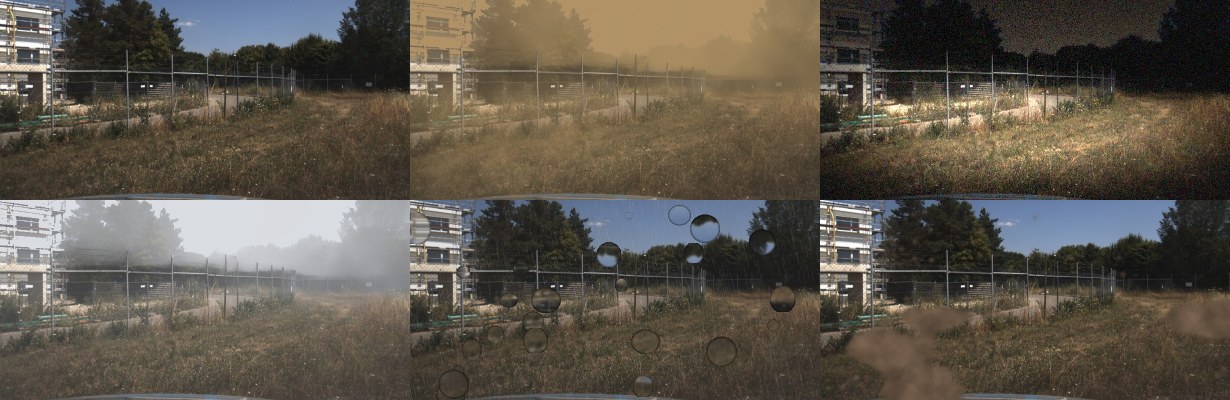
165 labelled frames: 10 real off-road scenes rendered under dust, night, fog, rain on the lens and mud on the lens
at three severities each, plus 5 real rain and snow frames. Run your model over them, run evaluate.py, and you
get a failure map: mIoU per condition and severity, the drop against clear weather, traversable-ground IoU, and the
classes that fail first.
This repository is the free sample of the Siltframe stress-test pack. Everything here — images, labels, the scoring script — is yours to use, including commercially.
Run it in your browser, nothing to install: Kaggle notebook — it scores a public segmentation model over all 165 frames in about seven seconds and prints the failure map. Copy it, swap in your model, done.
Also on Hugging Face and as a Kaggle dataset.
Quick start
git clone https://github.com/egeizgi/siltframe-stress-test
cd siltframe-stress-test
pip install numpy pillow
Write one prediction PNG per image, at the same relative path, each pixel holding a class id from classes.csv:
import csv, numpy as np
from pathlib import Path
from PIL import Image

for r in csv.DictReader(open("manifest.csv")):
    img = np.array(Image.open(r["image"]))
    pred_ids = your_model(img)                  # H x W array of class ids
    out = Path("pred") / Path(r["image"]).with_suffix(".png")
    out.parent.mkdir(parents=True, exist_ok=True)
    Image.fromarray(pred_ids.astype(np.uint8)).save(out)
python evaluate.py --pred pred
Different class set? Map yours onto the 19 in classes.csv (RELLIS-3D ontology). Fewer classes is fine — anything you
don't predict simply scores 0 and the mean is taken over the classes present in the labels.
What the reference models do on these frames
Measured by the same evaluate.py, included under baselines/. Mean mIoU loss against clear weather:
| clean mIoU | night | dust | rain on lens | fog | mud on lens | |
|---|---|---|---|---|---|---|
| SegFormer-B0 (RELLIS-3D only) | 14.5 | −69% | −43% | −23% | −23% | −10% |
| SegFormer-B0 (+ GOOSE) | 52.5 | −61% | −43% | −41% | −20% | −20% |
| Mask2Former Swin-T (+ GOOSE) | 58.1 | −56% | −35% | −41% | −16% | −19% |
Two things worth noticing, and they are the reason this test exists:
Night is the universal failure. Every model we have measured loses more than half its mIoU, and no architecture escapes it. If your validation set is daytime and dry, your number is not the number you will get in the field.
A model that scores badly can still be the robust one. SegFormer-B0 trained on RELLIS-3D alone has the smallest drop under rain and mud — because at 14.5 mIoU it had little left to lose. Relative drops have to be read next to the clear-weather score, never alone.
Why conditions, not just a single score
We ran this protocol across six architectures and found that dataset coverage beats augmentation. Adding real frames from a dataset that contained forest tracks lifted real-adverse-weather accuracy by 26–35 points, while weather augmentation on top of that coverage was within noise on real weather. We traced one failure specifically: models trained only on open terrain call overhead tree canopy "sky" — 80 % of tree pixels in one real forest-road frame. Adding the right real frames took that to 0 %.
So the useful question is not "how robust is my model" but "which condition is my data missing". That is what a failure map answers. The write-ups are at siltframe.com/blog.
The full pack
This sample is 10 scenes. The full pack is 2,460 labelled images — 150 scenes under the same 5 conditions × 3 severities, plus 60 real rain and snow frames, with reference results from three models. One purchase, no subscription.
If you would rather have this run on your model and your footage, that is what we do: siltframe.com.
Licence and attribution
- Images and labels: CC BY-SA 4.0. Derived from the GOOSE dataset (Fraunhofer IOSB, CC BY-SA 4.0) — German outdoor and off-road scenes. Degradations and label mapping by Siltframe. Share-alike applies: if you redistribute these images or derivatives, keep them under CC BY-SA 4.0 and keep the attribution.
evaluate.py: MIT.
The frames come from the GOOSE validation split, which none of the reference models was trained on.
Similar repos





Languages
Python
100.0%
Stress-test your off-road segmentation model: 165 labelled frames under dust, night, fog, rain and mud, plus the scoring script.
See the codeSee what people are saying
README
Off-road segmentation stress test
Find out which conditions break your off-road perception model, and how badly — in about ten minutes.
165 labelled frames: 10 real off-road scenes rendered under dust, night, fog, rain on the lens and mud on the lens
at three severities each, plus 5 real rain and snow frames. Run your model over them, run evaluate.py, and you
get a failure map: mIoU per condition and severity, the drop against clear weather, traversable-ground IoU, and the
classes that fail first.
This repository is the free sample of the Siltframe stress-test pack. Everything here — images, labels, the scoring script — is yours to use, including commercially.
Run it in your browser, nothing to install: Kaggle notebook — it scores a public segmentation model over all 165 frames in about seven seconds and prints the failure map. Copy it, swap in your model, done.
Also on Hugging Face and as a Kaggle dataset.
Quick start
git clone https://github.com/egeizgi/siltframe-stress-test
cd siltframe-stress-test
pip install numpy pillow
Write one prediction PNG per image, at the same relative path, each pixel holding a class id from classes.csv:
import csv, numpy as np
from pathlib import Path
from PIL import Image

for r in csv.DictReader(open("manifest.csv")):
    img = np.array(Image.open(r["image"]))
    pred_ids = your_model(img)                  # H x W array of class ids
    out = Path("pred") / Path(r["image"]).with_suffix(".png")
    out.parent.mkdir(parents=True, exist_ok=True)
    Image.fromarray(pred_ids.astype(np.uint8)).save(out)
python evaluate.py --pred pred
Different class set? Map yours onto the 19 in classes.csv (RELLIS-3D ontology). Fewer classes is fine — anything you
don't predict simply scores 0 and the mean is taken over the classes present in the labels.
What the reference models do on these frames
Measured by the same evaluate.py, included under baselines/. Mean mIoU loss against clear weather:
| clean mIoU | night | dust | rain on lens | fog | mud on lens | |
|---|---|---|---|---|---|---|
| SegFormer-B0 (RELLIS-3D only) | 14.5 | −69% | −43% | −23% | −23% | −10% |
| SegFormer-B0 (+ GOOSE) | 52.5 | −61% | −43% | −41% | −20% | −20% |
| Mask2Former Swin-T (+ GOOSE) | 58.1 | −56% | −35% | −41% | −16% | −19% |
Two things worth noticing, and they are the reason this test exists:
Night is the universal failure. Every model we have measured loses more than half its mIoU, and no architecture escapes it. If your validation set is daytime and dry, your number is not the number you will get in the field.
A model that scores badly can still be the robust one. SegFormer-B0 trained on RELLIS-3D alone has the smallest drop under rain and mud — because at 14.5 mIoU it had little left to lose. Relative drops have to be read next to the clear-weather score, never alone.
Why conditions, not just a single score
We ran this protocol across six architectures and found that dataset coverage beats augmentation. Adding real frames from a dataset that contained forest tracks lifted real-adverse-weather accuracy by 26–35 points, while weather augmentation on top of that coverage was within noise on real weather. We traced one failure specifically: models trained only on open terrain call overhead tree canopy "sky" — 80 % of tree pixels in one real forest-road frame. Adding the right real frames took that to 0 %.
So the useful question is not "how robust is my model" but "which condition is my data missing". That is what a failure map answers. The write-ups are at siltframe.com/blog.
The full pack
This sample is 10 scenes. The full pack is 2,460 labelled images — 150 scenes under the same 5 conditions × 3 severities, plus 60 real rain and snow frames, with reference results from three models. One purchase, no subscription.
If you would rather have this run on your model and your footage, that is what we do: siltframe.com.
Licence and attribution
- Images and labels: CC BY-SA 4.0. Derived from the GOOSE dataset (Fraunhofer IOSB, CC BY-SA 4.0) — German outdoor and off-road scenes. Degradations and label mapping by Siltframe. Share-alike applies: if you redistribute these images or derivatives, keep them under CC BY-SA 4.0 and keep the attribution.
evaluate.py: MIT.
The frames come from the GOOSE validation split, which none of the reference models was trained on.
Similar repos
Languages
Python
100.0%