
A llama.cpp fork for Dynamic Attention Masking
See the codeSee what people are saying
README
focus-llama
focus-llama: 256k context, ~64k of VRAM, and up to ~35% faster decode than vanilla llama.cpp at the same context depth, by decoupling the physical KV buffer from the context window, offloading old chunks to a store, and recalling them on demand.
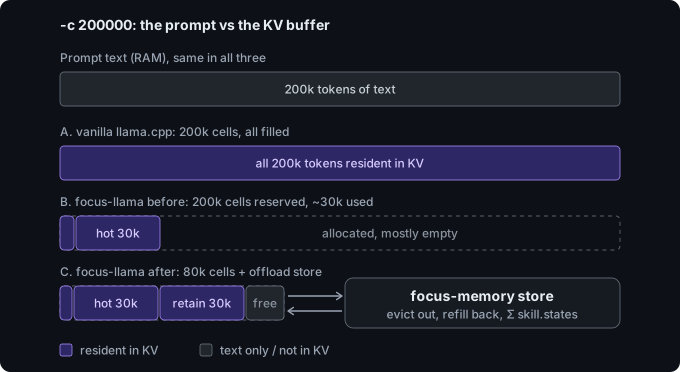
KV buffer for a 200k-token prompt (-c 200000). The prompt text is identical in all three cases and lives in RAM. (A) Vanilla llama.cpp allocates 200k KV cells and fills all of them. (B) Before buffer decoupling, focus-llama still reserves 200k cells, but only the ~30k-token hot window is resident, so most of the allocation sits empty. (C) After decoupling, the physical buffer is capped at 80k cells: the 30k hot window plus 30k of retained headroom and free cells. Evicted text moves to the focus-memory store, is refilled on demand, and its session state is kept as Σ skill.state.
How it works
Vanilla llama.cpp allocates a contiguous KV buffer for the full -c (VRAM), and every decode step attends over all tokens currently in context, so per-token cost grows roughly linearly with context length (only the attention part; the weights matmul is constant). The two problems are separate: the allocation wastes VRAM, and the growing context slows decoding.
focus-llama attacks both: the physical buffer is capped (~85k cells) so VRAM is bounded, and since the number of resident cells can't exceed the buffer, per-step attention cost is bounded by the buffer size instead of the logical context length. It based on 2 techniques declarative attention and skill.state, introduced by google deepmind.
Build
Same as upstream llama.cpp. Build the server, plus llama-bench if you want the depth benchmarks:
git clone https://github.com/edwardyoon/focus-llama.git
cd focus-llama

# CUDA (set the architecture of your GPU; "120" below is only an example)
cmake -B build -DGGML_CUDA=ON -DCMAKE_CUDA_ARCHITECTURES="120" -DCMAKE_BUILD_TYPE=Release

# Metal (macOS) or CPU-only
# cmake -B build -DCMAKE_BUILD_TYPE=Release

cmake --build build --config Release -j --target llama-server llama-cli llama-bench
Smoke tests
The smoke tests are quick checks that the server-side mechanisms behave as intended on one prompt. They are not benchmarks and say nothing about accuracy or speed.
All scripts need a server built from this fork. An older llama-server silently ignores the extra
request fields, which is why the scripts include checks that fail in that case.
1. KV-range removal (da_rm)
da_rm drops token ranges from the KV cache of a request. With da_rm_at the removal is applied
mid-prefill, so the tokens after the boundary (the question) are prefilled without the removed range.
Without da_rm_at it is applied after prefill.
./build/bin/llama-server -m <model>.gguf
python3 da-probe/da_server_smoke.py http://127.0.0.1:8080 [--hybrid]
Use --hybrid for models with recurrent / linear-attention layers (e.g. Gated DeltaNet). On those models
the text of the fact-removed runs is informational only.
Runs (all use stop=["\n"], exact-match verdicts, and first-token logprobs):
| Run | Request | What it shows |
|---|---|---|
| baseline | no da_rm | answers exactly ZEBRA-42 |
| strict | fact range, da_rm_at = question start | removal applied mid-prefill |
| paper | fact range, no da_rm_at | removal applied after prefill (decode-time restriction) |
| masked-all | whole document, da_rm_at | removal changes the computation |
| control | unrelated section, da_rm_at | answer stays ZEBRA-42 (selectivity) |
Example summary (trimmed):
baseline         : PASS (exact 'ZEBRA-42')
mechanism (Δlp)  : baseline vs masked-all first-token Δlp=0.6217 - different prefill computation (mid-prefill removal ran)
selectivity      : PASS (exact 'ZEBRA-42')
path divergence  : strict vs paper first-token Δlp=0.9256 - different prefill paths
OVERALL          : PASS
- mechanism - first-token logprobs of baseline and masked-all differ, so the removal really changed
the prefill. Identical values mean it was not applied mid-prefill (check the server log for
da_rm:lines). - path divergence -
strictandpapermust differ, otherwise both took the same path. - selectivity - removing an unrelated section leaves the answer intact.
2. Two-stream backend B (da_b)
Backend B copies the kept prefix (scaffold + focus) into a reserved second sequence and decodes there. The original sequence stays intact, so a later return to global attention would not need a re-prefill (the return path itself is not implemented yet).
Requirements:
--kv-unifiedis required. A partial-rangeseq_cpaborts on a non-unified pool, so without it the server falls back to logical removal (da_rm) and logs a WARN. The answers would still pass, which is why the server log is the real evidence.--parallel 2is only needed for the cache-integrity phase (phase 2 below).- Add
-vto see the per-step read-set lines.
./build/bin/llama-server -m <model>.gguf --kv-unified --parallel 2 -v
python3 da-probe/da_b_smoke.py http://127.0.0.1:8080 [--hybrid] [--runs k1,k2,...] [--skip-cache]
Options:
--hybrid- same meaning as above.--runs- run a subset of phase-1 keys:baseline,bkeep,bnofact,logical,bkeep2.--skip-cache- skip phase 2.
Phase 1 (one ZEBRA prompt, cache_prompt=false):
- mechanism -
baselinevsbkeepfirst-token logprobs must diverge. Identical values mean the B switch did not run (old binary, missing flags, or fallback). - B equals A -
bnofact(B) andlogical(A,seq_rm) apply the same removal by different means, so their first-token logprobs must agree within 5e-3 (0.0003 in one run on a local Bonsai-8B). A large difference points at a wrong keep set. - answers -
baseline,bkeepandbkeep2must answer exactlyZEBRA-42.bkeep2is a second, consecutiveda_brequest and checks that the reserved sequence id can be reused after the first one finished.
Phase 2 (cache integrity, needs --parallel 2): a request caches prompt P1 on one slot, a da_b
request runs on the other slot, then P1 is sent again. It must land back on the first slot with its
cache untouched, i.e. a B switch does not destroy another slot's cached prompt.
3. Tag parser (da_chunks) - the model decides the removal
Instead of the client choosing the ranges, the client sends the chunk layout and the model's own
<focus magic_chunks="N"> tag decides what gets removed:
da_chunks- the prompt token ranges of the document chunks, a list of[lo, hi)pairs. IndexN-1is chunkN(the tag's number is 1-based).da_filler- the[lo, hi)range of a filler segment, removed together with the non-kept chunks. Omit it (or the server treats it as absent) when the layout has no filler.
When the first complete tag appears in the generated text, the server removes every chunk except the
named one, plus the filler, exactly once - via backend B if da_b is also set, else backend A. The
removal boundary is the current decode position, so in B mode the already-generated tokens are part of
the kept set. da_chunks supersedes a static da_rm in the same request. A model that never emits a
complete tag simply runs with full attention - no removal is applied.
The mechanism is per-request opt-in: a request without da_* fields runs exactly as before and
produces no da_* log lines. To use it, the client must build the prompt, tokenize it (e.g. with
/tokenize), and attach the resulting layout to the /v1/completions body:
{
  "prompt": "<scaffold>\n[Chunk 1] ...\n[Chunk 2] ...\n...\n[Chunk 5] ...\n<filler>\n<instruction>",
  "da_chunks": [[8, 96], [96, 184], [184, 272], [272, 360], [360, 448]],
  "da_filler": [448, 520],
  "da_b": true,
  "max_tokens": 64
}
da_chunks[i] is the [lo, hi) prompt token range of chunk i+1 (1-based, matching the tag's
magic_chunks number). Only the client that assembled the prompt knows these ranges - the server
cannot derive them from the text.
./build/bin/llama-server -m <model>.gguf --kv-unified --parallel 2 -v
python3 da-probe/da_tag_smoke.py http://127.0.0.1:8080 [--hybrid]
The smoke test builds a 5-chunk document (one codeword per chunk) plus filler and instruction. All
three runs (baseline, tag_a, tag_b) must emit <focus magic_chunks="4"> before answering exactly
ZEBRA-42, and the server journal must show the tag close and the removal (da_tag: lines).
Note on tag emission: the script prompts raw (no chat template) and primes the model with an empty closed thinking block (`
`), which makes small thinking models (e.g. Bonsai-8B) emit the tag instead of answering straight. On a larger model with the proper chat template this priming should not be needed.
4. DA survives auto-compaction (da_e2e_compaction)
The end-to-end check for the production failure mode: a DA session that gets
auto-compacted (the conversation replaced by a summary) must keep retrieving.
The driver sends the real focus-memory hook block shape (a verbatim port of
buildDaBlock) and simulates a compaction by replacing the history with a
summary that carries a dead marker block, then a new turn with a live
block. The marker scanner must tail-anchor to the last user message, ignore
the dead block, and validate the live one.
./build/bin/llama-server -m <model>.gguf --da-prompt-scan --parallel 1 -c 8192 -v
python3 da-probe/da_e2e_compaction.py http://127.0.0.1:8086 --log /tmp/da_e2e.log
Three phases (A: 3 live-block turns, B: summary with a dead block + a new live
block, C: a post-compact turn). PASS requires all five answers CORRECT, 5/5
da_scan: journal lines with chunk ranges 1..5 → 21..25, and 0 fail-open
lines. The Phase B line is the money check: the compacted prompt was scanned
(not failed open) and the live block won over the dead summary block.
Reading the server log
grep 'da_b:' <server log>                 # or: journalctl -u <service> | grep 'da_b:'
grep 'da_tag:' <server log>               # tag parser: request start + tag close / removal
grep 'falling back to logical removal' <server log>    # must be empty for B runs
Per B request the server logs:
da_b: switched decode to seq N (...) - logical read set now X of Y prefix token(s) (Z removed, -P%)- one
da_b: keep [lo, hi) n token(s)line per kept range - with
-v, per-stepda_b: decode #p: logical read set X of Y ...lines - a final
da_b: finished on seq N - final logical read set ...summary
These numbers are logical, not measured reads. In the unified KV pool the removed cells stay in place and are masked, so the attention still scans the same cell range. Whether fully masked chunks are actually skipped depends on the backend and the attention kernel (for example, single-token decode on CUDA does not skip them), and no byte count is logged. Treat the percentage as the size of the attended token set, not as a speed-up; the measured physical read reduction is in Verified: physical KV read reduction above.
Relationship to focus-memory
focus-memory chunks and indexes long-term context. focus-llama is the inference-side counterpart: it lets the model read a compact index in global mode and then commit attention to specific chunks. It requires a kv chunks store as a hard dependency - the external, storage-only KV store (the focus-memory one, reached via --focus-memory-host) that receives evicted chunk text and serves it back verbatim on refill.
There are two ways to get a chunk layout onto the wire:
- Marker path (
--da-prompt-scan+ client markers). focus-memory assembles the prompt from its own chunks and wraps them in[[da:N]]...[[da:layout:N]]markers (the legacy<da:N>form is accepted as well; the hook emits the bracket form because angle brackets get mangled by markdown/HTML escaping between the hook and the rendered prompt). The server scans the rendered prompt, maps the markers to token ranges, and the model's<focus magic_chunks="N">tag decides which chunk the next tokens attend to. The marker block sits at the prompt tail, so DA only touches the injected memory index - the rest of the conversation is untouched. The scanner tail-anchors to the last user-message boundary, so a marker block that a compaction summary reproduces in the history is ignored (fail-open) and a DA session keeps working after auto-compaction - see Verified: DA survives auto-compaction. Because it never touches the conversation (only the injected index), it cannot corrupt the session - but it also cannot reduce the conversation's KV, so it is an index-scoped complement to the auto path, not a replacement for it. - Auto-chunking (
--da-auto, the production path for physical reduction). The server splits the rendered chat prompt itself into ~--da-chunk-tokensmagic chunks (hard cap 5/4 × target), packing across message boundaries and falling back paragraph → line → sentence → clause → word when a message has too few boundaries, so the client sends a plain request with nothing extra. Because it re-chunks the entire conversation (system + history + tool I/O) on every turn once the prompt passes--da-min-ctx, it is the path that produces conversation-level, physical KV read reduction - the marker path only ever scopes the injected index. It requires--kv-unified(backend B) since the A path is irreversible. Known limitations, observed in production and under stabilization (seeplans/focus-llama-da-stabilization.md):- Tag-quote hijack. The tag state machine operates on the model's whole output stream; when
the model quotes a DA tag in its reasoning (debugging DA, quoting a commit message), the
parser can consume the quote as a control tag, causing an unintended mode switch and a gap in
the output text. Fixed in v1.0 (line-start-only entry tags,
632e31c20): a tag quoted mid-line is data, not a control tag. - Bigger blast radius than the marker path. A misfired tag restricts the session's own conversation, not just the injected index.
- Tag-quote hijack. The tag state machine operates on the model's whole output stream; when
the model quotes a DA tag in its reasoning (debugging DA, quoting a commit message), the
parser can consume the quote as a control tag, causing an unintended mode switch and a gap in
the output text. Fixed in v1.0 (line-start-only entry tags,
The two paths coexist (marker layout wins when present; auto takes over otherwise - see Production launch). Without either, requests run with full attention - the two projects remain independently usable.
kv-offload (lossless evict/recall, auto-compaction alternative)
--fm-offload provides a lossless evict/recall cycle backed by an external store (the
focus-memory storage-only KV store) as the alternative to
the client's lossy auto-compaction: it does not disable the client's compaction, it changes
what an eviction costs (a 1-token re-prefill) and how a chunk comes back (the original text,
not a summary). When a rendered prompt exceeds --kv-offload-threshold tokens, the engine
evicts the oldest middle messages (never the system message or the last user message) before
--da-auto re-chunks: each evicted message's text is PUT to the store. Two modes control what
"evict" does to the KV:
--kv-offload-holes(production path) - the evicted text stays in the prompt; the engine cuts its KV out of the main sequence (seq_rmholes, positions not re-based) once the prefix is known to exist. The client keeps sending the full prompt, so every re-request re-matches atn_past = fulland re-prefills 1 token instead of the evicted tail (~64 s → ~2 s at production scale). Holes are applied per range (disjoint, validatedhi <= n_past),release()keeps the prompt cache, and the generic KQ -inf mask covers the holes - the same physical state the DA A path runs in production. The R1 gate (an MROPE mid-sequence hole behaves like -inf masking) passed on the production 27B with answer-token Δlogprob +0.000 nats. Mid-sequence holes are legal on non-MROPE models too - the batch position check only requires the next token atseq_max + 1, so a hole in the middle does not break contiguity (verified in the local smoke, Verified section above).- default - the evicted range is removed from the prompt and the segment becomes a
virtual chunk numbered
M+1..M+K(after theMactive chunks) listed in the DA instruction; when the model emits<focus magic_chunks="N">for an offloaded chunk, the engine GETs its text back and re-prefills it at the tail of the sequence (get-on-focus) so the model reads the original content - not a compaction summary.
Any store error fails open (the segment stays in the prompt), so a downed store degrades to a
normal DA session, never to data loss. The cycle is complementary to both DA layout paths: it
decides which middle messages leave the KV and how to bring one back on demand; --da-auto
still owns the re-chunking. It requires --da-auto + --kv-unified (the eviction runs inside
the auto-chunk gate) and a store reachable at --focus-memory-host.
Status: verified (v2.0) - see Verified: lossless evict/recall above.
Running in production (qwen3.8-27B MROPE, -c 200000 --kv-offload-threshold 38672,
since 09-26) with --kv-offload-holes: evictions PUT to the store and holes cut the KV on
every turn of a live session.
Flag naming. The engine flag is
--fm-offload(envLLAMA_ARG_FM_OFFLOAD), not--kv-offload: the stock llama.cpp-kvo/--kv-offloadflag (KV-cache offloading) already owns that name and theLLAMA_ARG_KV_OFFLOADenv var, so a--kv-offloadhere would be silently consumed by the stock flag and eviction would never engage.
Production launch (recommended options)
The production node runs the DA inference service - qwen3.8, multimodal - behind the
focus-memory backend. The recommended llama-server launch line is:
llama-server \
  --parallel 1 \
  --metrics \
  --da-auto \
  --kv-unified \
  --da-min-ctx 2048 \
  --da-chunk-tokens 4096 \
  --sparse-gate-threshold 60 \
  --spec-type draft-mtp-adaptive \
  --spec-draft-n-max 4 \
  --spec-draft-ngl all \
  --kv-cache-size 85536 \
  --fm-offload \
  --kv-offload-holes \
  --kv-offload-threshold 38672 \
  --kv-retain-tokens 6000 \
  --focus-memory-host http://<store-host>:3900 \
  --focus-memory-token <CONTEXT_API_TOKEN>
(--da-auto is the production path: it re-chunks the whole rendered prompt, so DA restricts
attention over the entire conversation - which is what makes the physical KV read reduction
real (see Scope of the effect below). It requires --kv-unified (backend B): the A path is
irreversible, so a wrong focus would permanently delete the answer chunk. The
post-compaction drift item (tag-quote hijack) was fixed in v1.0 (line-start-only entry
tags); residual items are tracked in plans/focus-llama-da-stabilization.md. A client that
also injects focus-memory markers can add
--da-prompt-scan; the marker layout then wins per request when present.)
(--parallel 1 keeps the node single-tenant; with --kv-unified present it runs backend B - see
Backend A vs B below.)
| Option | What it does | Why it is on |
|---|---|---|
--metrics | Exposes Prometheus metrics on the server port | Observability for a long-running service |
--da-auto | Auto-chunking: when a rendered prompt has no client layout markers and is at least --da-min-ctx tokens, the server splits it into magic chunks by message boundaries so the model's <focus magic_chunks="N"> tags can restrict attention over the whole conversation | Production path for physical KV read reduction - re-chunks system + history + tool I/O, not just an injected index |
--kv-unified | Enables backend B (reversible two-stream KV) | Required by --da-auto: the A path (seq_rm) is irreversible, a wrong focus permanently deletes the answer chunk |
--da-min-ctx 2048 | Minimum prompt length (tokens) before auto-chunking engages | Short prompts stay full-attention (no DA overhead); default is 0 (always) |
--da-chunk-tokens 4096 | Target magic-chunk size (tokens); hard cap 5/4 × target | Production chunk size (default 2048); larger = fewer, coarser spans |
--sparse-gate-threshold 60 | DA sparse FA gate: the sparse (gather) attention path is used only while the finite KV rows are at most 60% of the cache, dense below that (1-100, default 50) | Default 50 would run dense in the production steady state (threshold + retain ≈ 44.7K of 85536, ~52%); 60 keeps the sparse path engaged there, and it still flips to dense once finite rows pass 60%, where the gather overhead would not pay off |
--spec-type draft-mtp | Speculative decoding with the model's MTP draft head | Speed-up on top of DA. Spec and DA coexist: while a slot is in DA mode (da_seq active) spec is paused automatically and resumes on the return to global attention - so spec stays ON without breaking DA |
--spec-draft-n-max 4 | Up to 4 draft tokens per step | Enough to overlap decode with drafting, without so many that rejections waste work |
--spec-draft-ngl all | Puts the whole draft model on the GPU | The draft model is small; keeping it fully on-GPU avoids CPU round-trips that would erase the spec gain |
--kv-cache-size 85536 | Physical KV buffer size in cells; decoupled from the logical position range - cells wrap while positions extend to -c (0 = default: n_ctx_seq) | Sized at threshold + retain + 16384 headroom with slack (38672 + 6000 + 16384 = 61056 ≤ 85536): eviction keeps the resident cells inside the buffer, and an over-buffer request is rejected before a find_slot failure |
--fm-offload | kv-offload: evict the oldest middle messages to the focus-memory store once the prompt exceeds --kv-offload-threshold, and re-prefill them on demand when the model focuses an offloaded chunk | Replaces lossy auto-compaction with a lossless evict/refill cycle (see kv-offload above). Optional - off by default |
--kv-offload-threshold 38672 | Token count at which kv-offload eviction engages | Size it at ~8-9 × --da-chunk-tokens (4096 → 38672): high enough that short sessions never evict, low enough that eviction engages long before the client's auto-compaction point, so the prompt stays a few chunks over the threshold instead of ballooning |
--kv-retain-tokens 6000 | kv-offload: minimum recent tokens kept in the KV cache beyond --kv-offload-threshold when evicting (0 = evict down to the threshold only; default 0) | Keeps the active tail resident after each eviction so the hottest context never goes to the store; the buffer is sized to honor it, so retain is never clamped (see --kv-cache-size) |
--focus-memory-host | Base URL of the focus-memory KV store (PUT/GET /v1/kv-offload/chunk) | Empty = kv-offload disabled even with --fm-offload on (fail-open) |
--focus-memory-token | Bearer token for the store API (CONTEXT_API_TOKEN) | Empty = no auth header; set it to match the store |
Scope of the effect. The two paths are not two settings of the same effect. The marker
path restricts attention only over the client-declared marker region (the focus-memory index
at the prompt tail); the rest of the conversation - system, history, tool I/O - is scaffold
and always keeps full attention. Its read reduction is therefore bounded by the size of the
injected index, and a prompt with no markers gets no DA at all (fail-open, full attention).
--da-auto is the opposite: it re-chunks the whole rendered prompt (system + history + tool
I/O) and can attend to a single chunk of it - which is why the recommended line above runs it,
and why it is the path that produces conversation-level, physical KV read reduction.
Two layout paths, one priority. --da-prompt-scan (marker path) and --da-auto (server path)
are independent and can both be on. Per request the server first scans for a client-provided marker
block; if that yields a valid layout it wins, and auto-chunking is skipped for that request. If the
scan finds nothing (no markers, or malformed markers that fail open), auto-chunking takes over for
prompts at or above --da-min-ctx. So a node can serve both marker-aware clients and plain
OpenAI-compatible clients with the same launch line.
Both paths fail open to vanilla (full attention) on any mismatch - a wrong layout must never restrict attention to the wrong ranges. The auto path tolerates bounded tokenizer drift (up to 1% of the text length) when mapping the headers it inserted itself, because large rendered prompts (50K+ tokens with repeated content) do not round-trip tokenization exactly; drift beyond that still fails open.
Backend A vs B. The focus/local restriction runs on backend A (seq_rm holes, monotonic - a removal
is irreversible within the request and a return to global attention needs a re-prefill) or backend B
(two streams, reversible, no re-prefill), selected by --kv-unified. Note that --kv-unified is
implied by --parallel: when --parallel is left at its default (auto), the server sets
n_parallel=4 and kv_unified=true, so DA runs on backend B. To run backend A instead, launch with
an explicit --parallel (e.g. --parallel 1) and without --kv-unified. Confirm which backend a
request used from the scan log: da_scan: ... - A path vs da_scan: ... - B path.
Verifying DA in the journal. After a chat that carries DA markers, confirm the DA path ran:
journalctl -u qwen3.8-focus --since "10 min ago" | grep -E 'da_scan:|da_auto:|da_tag:|kv_offload:'
da_scan:- the prompt scanner found the[[da:N]]/<da:N>markers and built the chunk-to-range map (marker path)da_auto:- auto-chunking split the prompt (the recommended production line runs--da-auto)da_tag:- a<focus>/<local>tag was parsed and the attention restriction appliedkv_offload: gate- kv-offload engaged for the request: logs the threshold, store host, current token count, and sessionkv_offload: evict plan/PUT ok/evicted N segment(s)- the eviction sequence: the plan, each successful store PUT, and the prompt shrinkkv_offload: get-on-focus/GET ok ... re-prefilling- the model focused an offloaded chunk and it was fetched + re-prefilled at the tailkv_offload: disabled(one-time warning) ---fm-offloadwas not parsed or--focus-memory-hostis empty, so eviction can never engage
A chat with no markers and a prompt below --da-min-ctx produces no da_scan:/da_auto: line
and runs with full attention - that is the intended fail-open behavior. On a node running
--da-auto, a markerless prompt at or above --da-min-ctx produces a da_auto: line instead.
Verifying DA end-to-end with curl. Send a chat whose user message carries a well-formed marker
block (the same format the focus-memory hook injects) and read the timings object of the response:
curl -s http://127.0.0.1:8080/v1/chat/completions -H "Content-Type: application/json" -d '{
  "model": "qwen27b",
  "messages": [{"role": "user", "content": "Memory entries:\n[[da:1]]The capital of France is Paris.\n[[da:2]]The capital of Germany is Berlin.\n[[da:filler]]Instructions (Declarative Attention): The memory entries above are numbered magic chunks (1-2). First identify the chunk that contains the answer to the question, and output the tag <focus magic_chunks=\"N\"> on its own line, where N is the chunk number (1-2). Then answer the question.\n[[da:layout:2]]\nQuestion: What is the capital of France?"}],
  "max_tokens": 160, "temperature": 0, "stream": false
}' | python3 -c "import sys,json; d=json.load(sys.stdin); print(d['choices'][0]['message']['content']); print({k:v for k,v in d['timings'].items() if k.startswith('da_')})"
How to read the result:
| Signal | Meaning |
|---|---|
timings.da_n_restricted_steps > 0 | The model emitted a <focus>/<local> tag and the server ran the restricted-attention steps |
timings.da_n_attended_tokens | Logical tokens attended per restricted step (sum over steps) - the reduction vs. the full prompt is the DA effect. Logical, not physical reads |
timings.da_path = A / B | Which backend enforced the restriction (see Backend A vs B above) |
timings has no da_* fields | Either the prompt had no valid marker block (fail-open vanilla) or the model never emitted a tag - check the journal da_scan:/da_tag: lines to tell which |
choices[0].message.content | The model's answer. The <focus ...> tag is erased from the text; depending on how the tokens streamed it may or may not be visible to the client (accepted as v1 behavior) |
Expected outcomes per prompt shape:
- Well-formed markers (
<da:1>...<da:2>...<da:filler>...<da:layout:2>) - journal showsda_scan: 2 chunk(s) numbered 1..2 + filler ... - A pathfollowed byda_tag: request start - 2 chunk(s), and (if the model commits to a chunk)da_tag: <focus magic_chunks="N"> closed at generated token ... - A removal, ... range(s). A 500 /substrexception after ada_tag:line means the text-accounting broke - that is a bug. - No markers - no
da_scan:line at all, noda_*intimings, output identical to a vanilla server. This is the regression guard: unmarked traffic must be untouched. - Malformed markers (e.g. footer says 3 but only 2
<da:N>markers) - journal WARNda_scan: last block has 2 chunk marker(s) but the footer says 3 - failing open to vanilla, noda_*intimings.
The system_fingerprint in the response carries the server's git short hash
(b11090-88db36bc5 = commit 88db36bc5) - use it to confirm which binary a node actually runs.
License
MIT, following upstream llama.cpp.
Similar repos


A llama.cpp fork for Dynamic Attention Masking
See the codeSee what people are saying
README
focus-llama
focus-llama: 256k context, ~64k of VRAM, and up to ~35% faster decode than vanilla llama.cpp at the same context depth, by decoupling the physical KV buffer from the context window, offloading old chunks to a store, and recalling them on demand.
KV buffer for a 200k-token prompt (-c 200000). The prompt text is identical in all three cases and lives in RAM. (A) Vanilla llama.cpp allocates 200k KV cells and fills all of them. (B) Before buffer decoupling, focus-llama still reserves 200k cells, but only the ~30k-token hot window is resident, so most of the allocation sits empty. (C) After decoupling, the physical buffer is capped at 80k cells: the 30k hot window plus 30k of retained headroom and free cells. Evicted text moves to the focus-memory store, is refilled on demand, and its session state is kept as Σ skill.state.
How it works
Vanilla llama.cpp allocates a contiguous KV buffer for the full -c (VRAM), and every decode step attends over all tokens currently in context, so per-token cost grows roughly linearly with context length (only the attention part; the weights matmul is constant). The two problems are separate: the allocation wastes VRAM, and the growing context slows decoding.
focus-llama attacks both: the physical buffer is capped (~85k cells) so VRAM is bounded, and since the number of resident cells can't exceed the buffer, per-step attention cost is bounded by the buffer size instead of the logical context length. It based on 2 techniques declarative attention and skill.state, introduced by google deepmind.
Build
Same as upstream llama.cpp. Build the server, plus llama-bench if you want the depth benchmarks:
git clone https://github.com/edwardyoon/focus-llama.git
cd focus-llama

# CUDA (set the architecture of your GPU; "120" below is only an example)
cmake -B build -DGGML_CUDA=ON -DCMAKE_CUDA_ARCHITECTURES="120" -DCMAKE_BUILD_TYPE=Release

# Metal (macOS) or CPU-only
# cmake -B build -DCMAKE_BUILD_TYPE=Release

cmake --build build --config Release -j --target llama-server llama-cli llama-bench
Smoke tests
The smoke tests are quick checks that the server-side mechanisms behave as intended on one prompt. They are not benchmarks and say nothing about accuracy or speed.
All scripts need a server built from this fork. An older llama-server silently ignores the extra
request fields, which is why the scripts include checks that fail in that case.
1. KV-range removal (da_rm)
da_rm drops token ranges from the KV cache of a request. With da_rm_at the removal is applied
mid-prefill, so the tokens after the boundary (the question) are prefilled without the removed range.
Without da_rm_at it is applied after prefill.
./build/bin/llama-server -m <model>.gguf
python3 da-probe/da_server_smoke.py http://127.0.0.1:8080 [--hybrid]
Use --hybrid for models with recurrent / linear-attention layers (e.g. Gated DeltaNet). On those models
the text of the fact-removed runs is informational only.
Runs (all use stop=["\n"], exact-match verdicts, and first-token logprobs):
| Run | Request | What it shows |
|---|---|---|
| baseline | no da_rm | answers exactly ZEBRA-42 |
| strict | fact range, da_rm_at = question start | removal applied mid-prefill |
| paper | fact range, no da_rm_at | removal applied after prefill (decode-time restriction) |
| masked-all | whole document, da_rm_at | removal changes the computation |
| control | unrelated section, da_rm_at | answer stays ZEBRA-42 (selectivity) |
Example summary (trimmed):
baseline         : PASS (exact 'ZEBRA-42')
mechanism (Δlp)  : baseline vs masked-all first-token Δlp=0.6217 - different prefill computation (mid-prefill removal ran)
selectivity      : PASS (exact 'ZEBRA-42')
path divergence  : strict vs paper first-token Δlp=0.9256 - different prefill paths
OVERALL          : PASS
- mechanism - first-token logprobs of baseline and masked-all differ, so the removal really changed
the prefill. Identical values mean it was not applied mid-prefill (check the server log for
da_rm:lines). - path divergence -
strictandpapermust differ, otherwise both took the same path. - selectivity - removing an unrelated section leaves the answer intact.
2. Two-stream backend B (da_b)
Backend B copies the kept prefix (scaffold + focus) into a reserved second sequence and decodes there. The original sequence stays intact, so a later return to global attention would not need a re-prefill (the return path itself is not implemented yet).
Requirements:
--kv-unifiedis required. A partial-rangeseq_cpaborts on a non-unified pool, so without it the server falls back to logical removal (da_rm) and logs a WARN. The answers would still pass, which is why the server log is the real evidence.--parallel 2is only needed for the cache-integrity phase (phase 2 below).- Add
-vto see the per-step read-set lines.
./build/bin/llama-server -m <model>.gguf --kv-unified --parallel 2 -v
python3 da-probe/da_b_smoke.py http://127.0.0.1:8080 [--hybrid] [--runs k1,k2,...] [--skip-cache]
Options:
--hybrid- same meaning as above.--runs- run a subset of phase-1 keys:baseline,bkeep,bnofact,logical,bkeep2.--skip-cache- skip phase 2.
Phase 1 (one ZEBRA prompt, cache_prompt=false):
- mechanism -
baselinevsbkeepfirst-token logprobs must diverge. Identical values mean the B switch did not run (old binary, missing flags, or fallback). - B equals A -
bnofact(B) andlogical(A,seq_rm) apply the same removal by different means, so their first-token logprobs must agree within 5e-3 (0.0003 in one run on a local Bonsai-8B). A large difference points at a wrong keep set. - answers -
baseline,bkeepandbkeep2must answer exactlyZEBRA-42.bkeep2is a second, consecutiveda_brequest and checks that the reserved sequence id can be reused after the first one finished.
Phase 2 (cache integrity, needs --parallel 2): a request caches prompt P1 on one slot, a da_b
request runs on the other slot, then P1 is sent again. It must land back on the first slot with its
cache untouched, i.e. a B switch does not destroy another slot's cached prompt.
3. Tag parser (da_chunks) - the model decides the removal
Instead of the client choosing the ranges, the client sends the chunk layout and the model's own
<focus magic_chunks="N"> tag decides what gets removed:
da_chunks- the prompt token ranges of the document chunks, a list of[lo, hi)pairs. IndexN-1is chunkN(the tag's number is 1-based).da_filler- the[lo, hi)range of a filler segment, removed together with the non-kept chunks. Omit it (or the server treats it as absent) when the layout has no filler.
When the first complete tag appears in the generated text, the server removes every chunk except the
named one, plus the filler, exactly once - via backend B if da_b is also set, else backend A. The
removal boundary is the current decode position, so in B mode the already-generated tokens are part of
the kept set. da_chunks supersedes a static da_rm in the same request. A model that never emits a
complete tag simply runs with full attention - no removal is applied.
The mechanism is per-request opt-in: a request without da_* fields runs exactly as before and
produces no da_* log lines. To use it, the client must build the prompt, tokenize it (e.g. with
/tokenize), and attach the resulting layout to the /v1/completions body:
{
  "prompt": "<scaffold>\n[Chunk 1] ...\n[Chunk 2] ...\n...\n[Chunk 5] ...\n<filler>\n<instruction>",
  "da_chunks": [[8, 96], [96, 184], [184, 272], [272, 360], [360, 448]],
  "da_filler": [448, 520],
  "da_b": true,
  "max_tokens": 64
}
da_chunks[i] is the [lo, hi) prompt token range of chunk i+1 (1-based, matching the tag's
magic_chunks number). Only the client that assembled the prompt knows these ranges - the server
cannot derive them from the text.
./build/bin/llama-server -m <model>.gguf --kv-unified --parallel 2 -v
python3 da-probe/da_tag_smoke.py http://127.0.0.1:8080 [--hybrid]
The smoke test builds a 5-chunk document (one codeword per chunk) plus filler and instruction. All
three runs (baseline, tag_a, tag_b) must emit <focus magic_chunks="4"> before answering exactly
ZEBRA-42, and the server journal must show the tag close and the removal (da_tag: lines).
Note on tag emission: the script prompts raw (no chat template) and primes the model with an empty closed thinking block (`
`), which makes small thinking models (e.g. Bonsai-8B) emit the tag instead of answering straight. On a larger model with the proper chat template this priming should not be needed.
4. DA survives auto-compaction (da_e2e_compaction)
The end-to-end check for the production failure mode: a DA session that gets
auto-compacted (the conversation replaced by a summary) must keep retrieving.
The driver sends the real focus-memory hook block shape (a verbatim port of
buildDaBlock) and simulates a compaction by replacing the history with a
summary that carries a dead marker block, then a new turn with a live
block. The marker scanner must tail-anchor to the last user message, ignore
the dead block, and validate the live one.
./build/bin/llama-server -m <model>.gguf --da-prompt-scan --parallel 1 -c 8192 -v
python3 da-probe/da_e2e_compaction.py http://127.0.0.1:8086 --log /tmp/da_e2e.log
Three phases (A: 3 live-block turns, B: summary with a dead block + a new live
block, C: a post-compact turn). PASS requires all five answers CORRECT, 5/5
da_scan: journal lines with chunk ranges 1..5 → 21..25, and 0 fail-open
lines. The Phase B line is the money check: the compacted prompt was scanned
(not failed open) and the live block won over the dead summary block.
Reading the server log
grep 'da_b:' <server log>                 # or: journalctl -u <service> | grep 'da_b:'
grep 'da_tag:' <server log>               # tag parser: request start + tag close / removal
grep 'falling back to logical removal' <server log>    # must be empty for B runs
Per B request the server logs:
da_b: switched decode to seq N (...) - logical read set now X of Y prefix token(s) (Z removed, -P%)- one
da_b: keep [lo, hi) n token(s)line per kept range - with
-v, per-stepda_b: decode #p: logical read set X of Y ...lines - a final
da_b: finished on seq N - final logical read set ...summary
These numbers are logical, not measured reads. In the unified KV pool the removed cells stay in place and are masked, so the attention still scans the same cell range. Whether fully masked chunks are actually skipped depends on the backend and the attention kernel (for example, single-token decode on CUDA does not skip them), and no byte count is logged. Treat the percentage as the size of the attended token set, not as a speed-up; the measured physical read reduction is in Verified: physical KV read reduction above.
Relationship to focus-memory
focus-memory chunks and indexes long-term context. focus-llama is the inference-side counterpart: it lets the model read a compact index in global mode and then commit attention to specific chunks. It requires a kv chunks store as a hard dependency - the external, storage-only KV store (the focus-memory one, reached via --focus-memory-host) that receives evicted chunk text and serves it back verbatim on refill.
There are two ways to get a chunk layout onto the wire:
- Marker path (
--da-prompt-scan+ client markers). focus-memory assembles the prompt from its own chunks and wraps them in[[da:N]]...[[da:layout:N]]markers (the legacy<da:N>form is accepted as well; the hook emits the bracket form because angle brackets get mangled by markdown/HTML escaping between the hook and the rendered prompt). The server scans the rendered prompt, maps the markers to token ranges, and the model's<focus magic_chunks="N">tag decides which chunk the next tokens attend to. The marker block sits at the prompt tail, so DA only touches the injected memory index - the rest of the conversation is untouched. The scanner tail-anchors to the last user-message boundary, so a marker block that a compaction summary reproduces in the history is ignored (fail-open) and a DA session keeps working after auto-compaction - see Verified: DA survives auto-compaction. Because it never touches the conversation (only the injected index), it cannot corrupt the session - but it also cannot reduce the conversation's KV, so it is an index-scoped complement to the auto path, not a replacement for it. - Auto-chunking (
--da-auto, the production path for physical reduction). The server splits the rendered chat prompt itself into ~--da-chunk-tokensmagic chunks (hard cap 5/4 × target), packing across message boundaries and falling back paragraph → line → sentence → clause → word when a message has too few boundaries, so the client sends a plain request with nothing extra. Because it re-chunks the entire conversation (system + history + tool I/O) on every turn once the prompt passes--da-min-ctx, it is the path that produces conversation-level, physical KV read reduction - the marker path only ever scopes the injected index. It requires--kv-unified(backend B) since the A path is irreversible. Known limitations, observed in production and under stabilization (seeplans/focus-llama-da-stabilization.md):- Tag-quote hijack. The tag state machine operates on the model's whole output stream; when
the model quotes a DA tag in its reasoning (debugging DA, quoting a commit message), the
parser can consume the quote as a control tag, causing an unintended mode switch and a gap in
the output text. Fixed in v1.0 (line-start-only entry tags,
632e31c20): a tag quoted mid-line is data, not a control tag. - Bigger blast radius than the marker path. A misfired tag restricts the session's own conversation, not just the injected index.
- Tag-quote hijack. The tag state machine operates on the model's whole output stream; when
the model quotes a DA tag in its reasoning (debugging DA, quoting a commit message), the
parser can consume the quote as a control tag, causing an unintended mode switch and a gap in
the output text. Fixed in v1.0 (line-start-only entry tags,
The two paths coexist (marker layout wins when present; auto takes over otherwise - see Production launch). Without either, requests run with full attention - the two projects remain independently usable.
kv-offload (lossless evict/recall, auto-compaction alternative)
--fm-offload provides a lossless evict/recall cycle backed by an external store (the
focus-memory storage-only KV store) as the alternative to
the client's lossy auto-compaction: it does not disable the client's compaction, it changes
what an eviction costs (a 1-token re-prefill) and how a chunk comes back (the original text,
not a summary). When a rendered prompt exceeds --kv-offload-threshold tokens, the engine
evicts the oldest middle messages (never the system message or the last user message) before
--da-auto re-chunks: each evicted message's text is PUT to the store. Two modes control what
"evict" does to the KV:
--kv-offload-holes(production path) - the evicted text stays in the prompt; the engine cuts its KV out of the main sequence (seq_rmholes, positions not re-based) once the prefix is known to exist. The client keeps sending the full prompt, so every re-request re-matches atn_past = fulland re-prefills 1 token instead of the evicted tail (~64 s → ~2 s at production scale). Holes are applied per range (disjoint, validatedhi <= n_past),release()keeps the prompt cache, and the generic KQ -inf mask covers the holes - the same physical state the DA A path runs in production. The R1 gate (an MROPE mid-sequence hole behaves like -inf masking) passed on the production 27B with answer-token Δlogprob +0.000 nats. Mid-sequence holes are legal on non-MROPE models too - the batch position check only requires the next token atseq_max + 1, so a hole in the middle does not break contiguity (verified in the local smoke, Verified section above).- default - the evicted range is removed from the prompt and the segment becomes a
virtual chunk numbered
M+1..M+K(after theMactive chunks) listed in the DA instruction; when the model emits<focus magic_chunks="N">for an offloaded chunk, the engine GETs its text back and re-prefills it at the tail of the sequence (get-on-focus) so the model reads the original content - not a compaction summary.
Any store error fails open (the segment stays in the prompt), so a downed store degrades to a
normal DA session, never to data loss. The cycle is complementary to both DA layout paths: it
decides which middle messages leave the KV and how to bring one back on demand; --da-auto
still owns the re-chunking. It requires --da-auto + --kv-unified (the eviction runs inside
the auto-chunk gate) and a store reachable at --focus-memory-host.
Status: verified (v2.0) - see Verified: lossless evict/recall above.
Running in production (qwen3.8-27B MROPE, -c 200000 --kv-offload-threshold 38672,
since 09-26) with --kv-offload-holes: evictions PUT to the store and holes cut the KV on
every turn of a live session.
Flag naming. The engine flag is
--fm-offload(envLLAMA_ARG_FM_OFFLOAD), not--kv-offload: the stock llama.cpp-kvo/--kv-offloadflag (KV-cache offloading) already owns that name and theLLAMA_ARG_KV_OFFLOADenv var, so a--kv-offloadhere would be silently consumed by the stock flag and eviction would never engage.
Production launch (recommended options)
The production node runs the DA inference service - qwen3.8, multimodal - behind the
focus-memory backend. The recommended llama-server launch line is:
llama-server \
  --parallel 1 \
  --metrics \
  --da-auto \
  --kv-unified \
  --da-min-ctx 2048 \
  --da-chunk-tokens 4096 \
  --sparse-gate-threshold 60 \
  --spec-type draft-mtp-adaptive \
  --spec-draft-n-max 4 \
  --spec-draft-ngl all \
  --kv-cache-size 85536 \
  --fm-offload \
  --kv-offload-holes \
  --kv-offload-threshold 38672 \
  --kv-retain-tokens 6000 \
  --focus-memory-host http://<store-host>:3900 \
  --focus-memory-token <CONTEXT_API_TOKEN>
(--da-auto is the production path: it re-chunks the whole rendered prompt, so DA restricts
attention over the entire conversation - which is what makes the physical KV read reduction
real (see Scope of the effect below). It requires --kv-unified (backend B): the A path is
irreversible, so a wrong focus would permanently delete the answer chunk. The
post-compaction drift item (tag-quote hijack) was fixed in v1.0 (line-start-only entry
tags); residual items are tracked in plans/focus-llama-da-stabilization.md. A client that
also injects focus-memory markers can add
--da-prompt-scan; the marker layout then wins per request when present.)
(--parallel 1 keeps the node single-tenant; with --kv-unified present it runs backend B - see
Backend A vs B below.)
| Option | What it does | Why it is on |
|---|---|---|
--metrics | Exposes Prometheus metrics on the server port | Observability for a long-running service |
--da-auto | Auto-chunking: when a rendered prompt has no client layout markers and is at least --da-min-ctx tokens, the server splits it into magic chunks by message boundaries so the model's <focus magic_chunks="N"> tags can restrict attention over the whole conversation | Production path for physical KV read reduction - re-chunks system + history + tool I/O, not just an injected index |
--kv-unified | Enables backend B (reversible two-stream KV) | Required by --da-auto: the A path (seq_rm) is irreversible, a wrong focus permanently deletes the answer chunk |
--da-min-ctx 2048 | Minimum prompt length (tokens) before auto-chunking engages | Short prompts stay full-attention (no DA overhead); default is 0 (always) |
--da-chunk-tokens 4096 | Target magic-chunk size (tokens); hard cap 5/4 × target | Production chunk size (default 2048); larger = fewer, coarser spans |
--sparse-gate-threshold 60 | DA sparse FA gate: the sparse (gather) attention path is used only while the finite KV rows are at most 60% of the cache, dense below that (1-100, default 50) | Default 50 would run dense in the production steady state (threshold + retain ≈ 44.7K of 85536, ~52%); 60 keeps the sparse path engaged there, and it still flips to dense once finite rows pass 60%, where the gather overhead would not pay off |
--spec-type draft-mtp | Speculative decoding with the model's MTP draft head | Speed-up on top of DA. Spec and DA coexist: while a slot is in DA mode (da_seq active) spec is paused automatically and resumes on the return to global attention - so spec stays ON without breaking DA |
--spec-draft-n-max 4 | Up to 4 draft tokens per step | Enough to overlap decode with drafting, without so many that rejections waste work |
--spec-draft-ngl all | Puts the whole draft model on the GPU | The draft model is small; keeping it fully on-GPU avoids CPU round-trips that would erase the spec gain |
--kv-cache-size 85536 | Physical KV buffer size in cells; decoupled from the logical position range - cells wrap while positions extend to -c (0 = default: n_ctx_seq) | Sized at threshold + retain + 16384 headroom with slack (38672 + 6000 + 16384 = 61056 ≤ 85536): eviction keeps the resident cells inside the buffer, and an over-buffer request is rejected before a find_slot failure |
--fm-offload | kv-offload: evict the oldest middle messages to the focus-memory store once the prompt exceeds --kv-offload-threshold, and re-prefill them on demand when the model focuses an offloaded chunk | Replaces lossy auto-compaction with a lossless evict/refill cycle (see kv-offload above). Optional - off by default |
--kv-offload-threshold 38672 | Token count at which kv-offload eviction engages | Size it at ~8-9 × --da-chunk-tokens (4096 → 38672): high enough that short sessions never evict, low enough that eviction engages long before the client's auto-compaction point, so the prompt stays a few chunks over the threshold instead of ballooning |
--kv-retain-tokens 6000 | kv-offload: minimum recent tokens kept in the KV cache beyond --kv-offload-threshold when evicting (0 = evict down to the threshold only; default 0) | Keeps the active tail resident after each eviction so the hottest context never goes to the store; the buffer is sized to honor it, so retain is never clamped (see --kv-cache-size) |
--focus-memory-host | Base URL of the focus-memory KV store (PUT/GET /v1/kv-offload/chunk) | Empty = kv-offload disabled even with --fm-offload on (fail-open) |
--focus-memory-token | Bearer token for the store API (CONTEXT_API_TOKEN) | Empty = no auth header; set it to match the store |
Scope of the effect. The two paths are not two settings of the same effect. The marker
path restricts attention only over the client-declared marker region (the focus-memory index
at the prompt tail); the rest of the conversation - system, history, tool I/O - is scaffold
and always keeps full attention. Its read reduction is therefore bounded by the size of the
injected index, and a prompt with no markers gets no DA at all (fail-open, full attention).
--da-auto is the opposite: it re-chunks the whole rendered prompt (system + history + tool
I/O) and can attend to a single chunk of it - which is why the recommended line above runs it,
and why it is the path that produces conversation-level, physical KV read reduction.
Two layout paths, one priority. --da-prompt-scan (marker path) and --da-auto (server path)
are independent and can both be on. Per request the server first scans for a client-provided marker
block; if that yields a valid layout it wins, and auto-chunking is skipped for that request. If the
scan finds nothing (no markers, or malformed markers that fail open), auto-chunking takes over for
prompts at or above --da-min-ctx. So a node can serve both marker-aware clients and plain
OpenAI-compatible clients with the same launch line.
Both paths fail open to vanilla (full attention) on any mismatch - a wrong layout must never restrict attention to the wrong ranges. The auto path tolerates bounded tokenizer drift (up to 1% of the text length) when mapping the headers it inserted itself, because large rendered prompts (50K+ tokens with repeated content) do not round-trip tokenization exactly; drift beyond that still fails open.
Backend A vs B. The focus/local restriction runs on backend A (seq_rm holes, monotonic - a removal
is irreversible within the request and a return to global attention needs a re-prefill) or backend B
(two streams, reversible, no re-prefill), selected by --kv-unified. Note that --kv-unified is
implied by --parallel: when --parallel is left at its default (auto), the server sets
n_parallel=4 and kv_unified=true, so DA runs on backend B. To run backend A instead, launch with
an explicit --parallel (e.g. --parallel 1) and without --kv-unified. Confirm which backend a
request used from the scan log: da_scan: ... - A path vs da_scan: ... - B path.
Verifying DA in the journal. After a chat that carries DA markers, confirm the DA path ran:
journalctl -u qwen3.8-focus --since "10 min ago" | grep -E 'da_scan:|da_auto:|da_tag:|kv_offload:'
da_scan:- the prompt scanner found the[[da:N]]/<da:N>markers and built the chunk-to-range map (marker path)da_auto:- auto-chunking split the prompt (the recommended production line runs--da-auto)da_tag:- a<focus>/<local>tag was parsed and the attention restriction appliedkv_offload: gate- kv-offload engaged for the request: logs the threshold, store host, current token count, and sessionkv_offload: evict plan/PUT ok/evicted N segment(s)- the eviction sequence: the plan, each successful store PUT, and the prompt shrinkkv_offload: get-on-focus/GET ok ... re-prefilling- the model focused an offloaded chunk and it was fetched + re-prefilled at the tailkv_offload: disabled(one-time warning) ---fm-offloadwas not parsed or--focus-memory-hostis empty, so eviction can never engage
A chat with no markers and a prompt below --da-min-ctx produces no da_scan:/da_auto: line
and runs with full attention - that is the intended fail-open behavior. On a node running
--da-auto, a markerless prompt at or above --da-min-ctx produces a da_auto: line instead.
Verifying DA end-to-end with curl. Send a chat whose user message carries a well-formed marker
block (the same format the focus-memory hook injects) and read the timings object of the response:
curl -s http://127.0.0.1:8080/v1/chat/completions -H "Content-Type: application/json" -d '{
  "model": "qwen27b",
  "messages": [{"role": "user", "content": "Memory entries:\n[[da:1]]The capital of France is Paris.\n[[da:2]]The capital of Germany is Berlin.\n[[da:filler]]Instructions (Declarative Attention): The memory entries above are numbered magic chunks (1-2). First identify the chunk that contains the answer to the question, and output the tag <focus magic_chunks=\"N\"> on its own line, where N is the chunk number (1-2). Then answer the question.\n[[da:layout:2]]\nQuestion: What is the capital of France?"}],
  "max_tokens": 160, "temperature": 0, "stream": false
}' | python3 -c "import sys,json; d=json.load(sys.stdin); print(d['choices'][0]['message']['content']); print({k:v for k,v in d['timings'].items() if k.startswith('da_')})"
How to read the result:
| Signal | Meaning |
|---|---|
timings.da_n_restricted_steps > 0 | The model emitted a <focus>/<local> tag and the server ran the restricted-attention steps |
timings.da_n_attended_tokens | Logical tokens attended per restricted step (sum over steps) - the reduction vs. the full prompt is the DA effect. Logical, not physical reads |
timings.da_path = A / B | Which backend enforced the restriction (see Backend A vs B above) |
timings has no da_* fields | Either the prompt had no valid marker block (fail-open vanilla) or the model never emitted a tag - check the journal da_scan:/da_tag: lines to tell which |
choices[0].message.content | The model's answer. The <focus ...> tag is erased from the text; depending on how the tokens streamed it may or may not be visible to the client (accepted as v1 behavior) |
Expected outcomes per prompt shape:
- Well-formed markers (
<da:1>...<da:2>...<da:filler>...<da:layout:2>) - journal showsda_scan: 2 chunk(s) numbered 1..2 + filler ... - A pathfollowed byda_tag: request start - 2 chunk(s), and (if the model commits to a chunk)da_tag: <focus magic_chunks="N"> closed at generated token ... - A removal, ... range(s). A 500 /substrexception after ada_tag:line means the text-accounting broke - that is a bug. - No markers - no
da_scan:line at all, noda_*intimings, output identical to a vanilla server. This is the regression guard: unmarked traffic must be untouched. - Malformed markers (e.g. footer says 3 but only 2
<da:N>markers) - journal WARNda_scan: last block has 2 chunk marker(s) but the footer says 3 - failing open to vanilla, noda_*intimings.
The system_fingerprint in the response carries the server's git short hash
(b11090-88db36bc5 = commit 88db36bc5) - use it to confirm which binary a node actually runs.
License
MIT, following upstream llama.cpp.