Linear-probe robustness of pathology foundation models to blur, JPEG compression and stain shift.
TeX
0
2 commits
updated Oct 5, 2026
Acquisition-artifact robustness of pathology foundation models under linear probing.
Report: doi.org/10.5281/zenodo.23162508 (PDF also in paper/)
Pathology foundation models are usually tested for robustness by training a linear probe on clean images and testing it on degraded ones. This repository asks how much of the measured accuracy drop belongs to the frozen encoder and how much to the probe.
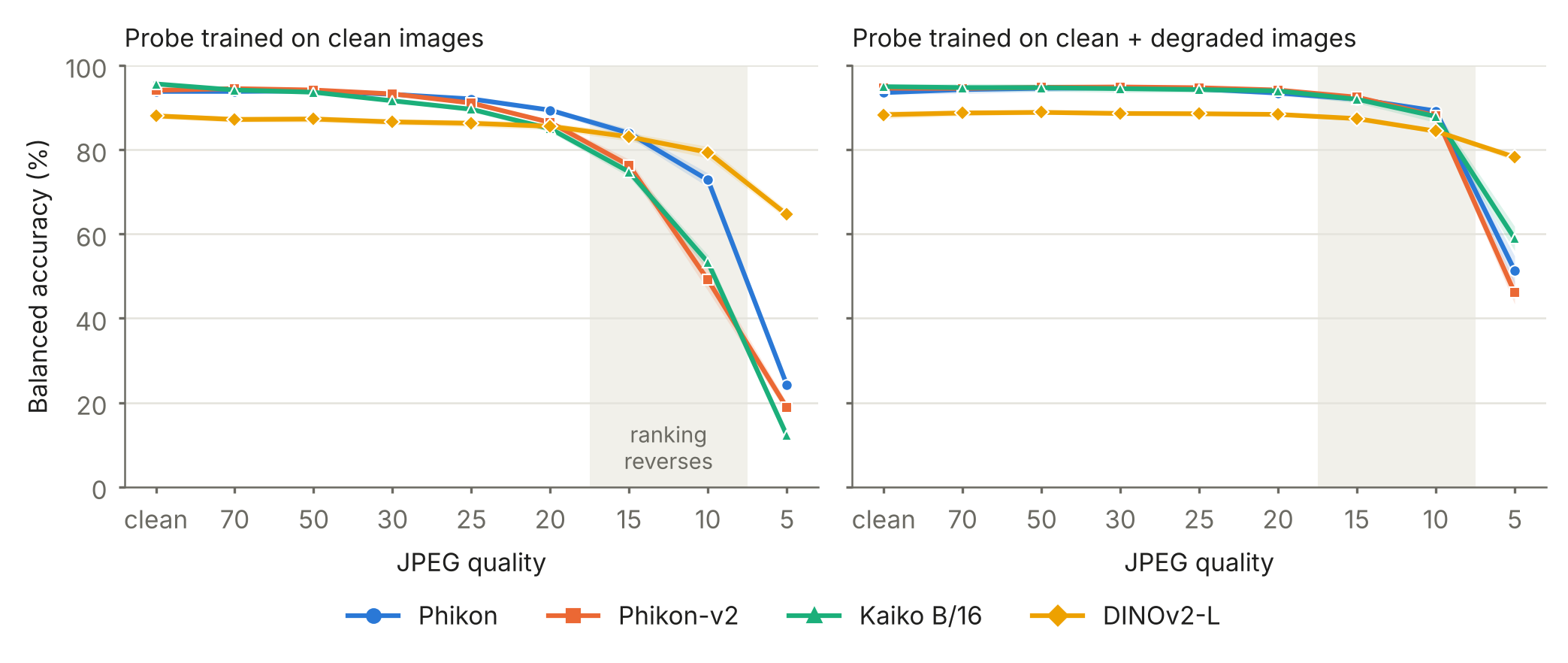
Short answer: a large part belongs to the probe. Letting the probe see some degraded images during training, with the encoder still frozen, recovers most of the accuracy lost to JPEG compression and stain shift, and changes which encoder looks most robust.
| Encoders | Phikon (ViT-B/16), Phikon-v2 (ViT-L/16), Kaiko ViT-B/16, DINOv2-L (ViT-L/14, natural images) |
| Datasets | NCT-CRC-HE (9 tissue classes), PatchCamelyon (tumour vs normal) |
| Degradations | Gaussian blur (sigma 0.5 to 6), JPEG (quality 70 to 5), stain shift (alpha 0.1 to 0.5) |
| Probes | Logistic regression on standardised embeddings, at C = 1 and C = 0.001 |
| Repeats | 5 seeds, each on a random 80% of the training images |
Two probes are compared. The clean probe is trained on clean images only. The mixed probe draws each training image at random from its clean version and five degraded versions (blur sigma 2 and 4, JPEG quality 30 and 15, stain alpha 0.3), so both probes see the same number of training images.
Balanced accuracy in %, mean of five seeds, C = 1. Each cell is clean probe → mixed probe.
NCT-CRC-HE
| Condition | Phikon | Phikon-v2 | Kaiko B/16 | DINOv2-L |
|---|---|---|---|---|
| Clean | 93.8 → 93.6 | 94.1 → 94.6 | 95.6 → 95.0 | 88.0 → 88.3 |
| JPEG quality 15 | 84.0 → 92.0 | 76.3 → 92.5 | 74.8 → 92.0 | 83.1 → 87.4 |
| JPEG quality 10 (never seen in training) | 72.8 → 89.2 | 49.1 → 88.1 | 53.3 → 87.9 | 79.4 → 84.4 |
| Blur sigma 4 | 67.4 → 91.4 | 82.6 → 92.5 | 59.0 → 90.7 | 54.5 → 81.6 |
| Stain alpha 0.5 | 86.9 → 90.6 | 86.1 → 91.9 | 92.2 → 93.6 | 86.9 → 88.0 |
PatchCamelyon
| Condition | Phikon | Phikon-v2 | Kaiko B/16 | DINOv2-L |
|---|---|---|---|---|
| Clean | 81.3 → 82.9 | 80.5 → 82.3 | 80.2 → 82.5 | 80.2 → 82.6 |
| JPEG quality 15 | 53.7 → 79.5 | 49.9 → 75.8 | 50.1 → 79.2 | 66.8 → 77.5 |
| Blur sigma 4 | 51.3 → 70.5 | 55.0 → 67.2 | 50.3 → 71.4 | 58.9 → 67.9 |
What these show:
All numbers, including standard deviations and both regularisation strengths, are in the results_* folders.
degradations.py         blur, JPEG and stain-shift functions and their levels
prepare_subset.py       builds the NCT-CRC-HE manifests
prepare_pcam.py         unpacks a PatchCamelyon subset and builds its manifests
extract_embeddings.py   extracts frozen CLS embeddings for every condition
probe_sanity.py         regularisation sweep and learning curve on clean data
mitigation.py           clean, mixed and single-artifact probes over seeds
failure_analysis.py     embedding drift, flip rate and per-class recall over seeds
make_figures.py         the three summary figures

*_manifest.csv          the exact images used (path, label)
results_nct_c1/         NCT-CRC-HE, C = 1
results_nct_c001/       NCT-CRC-HE, C = 0.001
results_pcam_c1/        PatchCamelyon, C = 1
results_pcam_c001/      PatchCamelyon, C = 0.001
paper_figures/          summary figures (PNG and PDF)
paper/                  the report (PDF and LaTeX source)
Each results folder holds mitigation.csv, drift.csv, per_class.csv and per-encoder plots.
The datasets and the extracted embeddings are not in the repository. Everything was run on a laptop with a 4 GB NVIDIA RTX 3050.
Two environments are used, because timm needs torchvision and installing it alongside transformers can change the preprocessing of the other encoders.
python -m venv .venv
.venv\Scripts\activate
pip install torch==2.11.0 --index-url https://download.pytorch.org/whl/cu128
pip install -r requirements.txt
python -m venv .venv-timm
.venv-timm\Scripts\activate
pip install torch==2.11.0 torchvision==0.26.0 --index-url https://download.pytorch.org/whl/cu128
pip install -r requirements-timm.txt
On Linux or macOS, activate with source .venv/bin/activate. Results were produced with Python 3.14.8.
NCT-CRC-HE-100K.zip and CRC-VAL-HE-7K.zip from Zenodo record 1214456 and unzip both into data/.valid and test files listed at the top of prepare_pcam.py from Zenodo record 2546921 into data/pcam/, then run python prepare_pcam.py.The committed manifests already list the images used: 9,000 training and 7,180 test images for NCT-CRC-HE, and 9,000 training and 6,000 test images for PatchCamelyon. Keep them to reproduce the reported numbers. prepare_subset.py and prepare_pcam.py rebuild them with seed 0.
In .venv, for each of phikon, phikon-v2 and dinov2-l:
python extract_embeddings.py --model phikon --train-conditions blur:2 blur:4 jpeg:30 jpeg:15 stain:0.3
python extract_embeddings.py --model phikon --dataset pcam --train-conditions blur:2 blur:4 jpeg:30 jpeg:15 stain:0.3
In .venv-timm, the same two commands with --model kaiko-b16.
Extraction skips conditions that are already saved, so it can be stopped and restarted.
In .venv:
python mitigation.py --models phikon phikon-v2 kaiko-b16 dinov2-l --out-dir results_nct_c1
python mitigation.py --models phikon phikon-v2 kaiko-b16 dinov2-l --C 0.001 --out-dir results_nct_c001
python mitigation.py --models phikon phikon-v2 kaiko-b16 dinov2-l --emb-dir embeddings/pcam --out-dir results_pcam_c1
python mitigation.py --models phikon phikon-v2 kaiko-b16 dinov2-l --emb-dir embeddings/pcam --C 0.001 --out-dir results_pcam_c001
Run failure_analysis.py with the same four sets of arguments, then:
python make_figures.py
No evaluation slide appears in the published pretraining data of any encoder. Phikon and the Kaiko encoder were pretrained on TCGA. The Phikon-v2 paper lists every pretraining cohort; Camelyon16 and the NCT-CRC-HE source slides are not among them. The tissue types are represented: all three pathology encoders saw TCGA colorectal slides. Four of the Phikon-v2 cohorts are private and cannot be inspected.
The code and result files in this repository are released under the MIT licence (see LICENSE). That licence does not cover the models or datasets, which keep their own terms:
| Resource | Source | Terms |
|---|---|---|
| Phikon, Phikon-v2 | owkin/phikon, owkin/phikon-v2 | Owkin non-commercial licence |
| Kaiko ViT-B/16 | 1aurent/vit_base_patch16_224.kaiko_ai_towards_large_pathology_fms | Non-commercial licence |
| DINOv2-L | facebook/dinov2-large | Apache 2.0 |
| NCT-CRC-HE-100K, CRC-VAL-HE-7K | Kather, Halama and Marx (2018), Zenodo 1214456 | CC BY 4.0 |
| PatchCamelyon | Veeling et al. (2018), from Camelyon16 | CC0 |
This work is non-commercial research. Check each model card before any other use.
Pathakota, D. (2026). Is It the Encoder or the Probe? Acquisition-Artifact Robustness of
Pathology Foundation Models. Zenodo. https://doi.org/10.5281/zenodo.23162508
Dinakar Pathakota, independent researcher, Hyderabad, India. Questions and corrections are welcome through GitHub issues.
AI assistance: Claude (Anthropic) was used to help write the code and to check the analysis. The experiments were run by the author.
Linear-probe robustness of pathology foundation models to blur, JPEG compression and stain shift.
TeX
0
2 commits
updated Oct 5, 2026
Acquisition-artifact robustness of pathology foundation models under linear probing.
Report: doi.org/10.5281/zenodo.23162508 (PDF also in paper/)
Pathology foundation models are usually tested for robustness by training a linear probe on clean images and testing it on degraded ones. This repository asks how much of the measured accuracy drop belongs to the frozen encoder and how much to the probe.
Short answer: a large part belongs to the probe. Letting the probe see some degraded images during training, with the encoder still frozen, recovers most of the accuracy lost to JPEG compression and stain shift, and changes which encoder looks most robust.
| Encoders | Phikon (ViT-B/16), Phikon-v2 (ViT-L/16), Kaiko ViT-B/16, DINOv2-L (ViT-L/14, natural images) |
| Datasets | NCT-CRC-HE (9 tissue classes), PatchCamelyon (tumour vs normal) |
| Degradations | Gaussian blur (sigma 0.5 to 6), JPEG (quality 70 to 5), stain shift (alpha 0.1 to 0.5) |
| Probes | Logistic regression on standardised embeddings, at C = 1 and C = 0.001 |
| Repeats | 5 seeds, each on a random 80% of the training images |
Two probes are compared. The clean probe is trained on clean images only. The mixed probe draws each training image at random from its clean version and five degraded versions (blur sigma 2 and 4, JPEG quality 30 and 15, stain alpha 0.3), so both probes see the same number of training images.
Balanced accuracy in %, mean of five seeds, C = 1. Each cell is clean probe → mixed probe.
NCT-CRC-HE
| Condition | Phikon | Phikon-v2 | Kaiko B/16 | DINOv2-L |
|---|---|---|---|---|
| Clean | 93.8 → 93.6 | 94.1 → 94.6 | 95.6 → 95.0 | 88.0 → 88.3 |
| JPEG quality 15 | 84.0 → 92.0 | 76.3 → 92.5 | 74.8 → 92.0 | 83.1 → 87.4 |
| JPEG quality 10 (never seen in training) | 72.8 → 89.2 | 49.1 → 88.1 | 53.3 → 87.9 | 79.4 → 84.4 |
| Blur sigma 4 | 67.4 → 91.4 | 82.6 → 92.5 | 59.0 → 90.7 | 54.5 → 81.6 |
| Stain alpha 0.5 | 86.9 → 90.6 | 86.1 → 91.9 | 92.2 → 93.6 | 86.9 → 88.0 |
PatchCamelyon
| Condition | Phikon | Phikon-v2 | Kaiko B/16 | DINOv2-L |
|---|---|---|---|---|
| Clean | 81.3 → 82.9 | 80.5 → 82.3 | 80.2 → 82.5 | 80.2 → 82.6 |
| JPEG quality 15 | 53.7 → 79.5 | 49.9 → 75.8 | 50.1 → 79.2 | 66.8 → 77.5 |
| Blur sigma 4 | 51.3 → 70.5 | 55.0 → 67.2 | 50.3 → 71.4 | 58.9 → 67.9 |
What these show:
All numbers, including standard deviations and both regularisation strengths, are in the results_* folders.
degradations.py         blur, JPEG and stain-shift functions and their levels
prepare_subset.py       builds the NCT-CRC-HE manifests
prepare_pcam.py         unpacks a PatchCamelyon subset and builds its manifests
extract_embeddings.py   extracts frozen CLS embeddings for every condition
probe_sanity.py         regularisation sweep and learning curve on clean data
mitigation.py           clean, mixed and single-artifact probes over seeds
failure_analysis.py     embedding drift, flip rate and per-class recall over seeds
make_figures.py         the three summary figures

*_manifest.csv          the exact images used (path, label)
results_nct_c1/         NCT-CRC-HE, C = 1
results_nct_c001/       NCT-CRC-HE, C = 0.001
results_pcam_c1/        PatchCamelyon, C = 1
results_pcam_c001/      PatchCamelyon, C = 0.001
paper_figures/          summary figures (PNG and PDF)
paper/                  the report (PDF and LaTeX source)
Each results folder holds mitigation.csv, drift.csv, per_class.csv and per-encoder plots.
The datasets and the extracted embeddings are not in the repository. Everything was run on a laptop with a 4 GB NVIDIA RTX 3050.
Two environments are used, because timm needs torchvision and installing it alongside transformers can change the preprocessing of the other encoders.
python -m venv .venv
.venv\Scripts\activate
pip install torch==2.11.0 --index-url https://download.pytorch.org/whl/cu128
pip install -r requirements.txt
python -m venv .venv-timm
.venv-timm\Scripts\activate
pip install torch==2.11.0 torchvision==0.26.0 --index-url https://download.pytorch.org/whl/cu128
pip install -r requirements-timm.txt
On Linux or macOS, activate with source .venv/bin/activate. Results were produced with Python 3.14.8.
NCT-CRC-HE-100K.zip and CRC-VAL-HE-7K.zip from Zenodo record 1214456 and unzip both into data/.valid and test files listed at the top of prepare_pcam.py from Zenodo record 2546921 into data/pcam/, then run python prepare_pcam.py.The committed manifests already list the images used: 9,000 training and 7,180 test images for NCT-CRC-HE, and 9,000 training and 6,000 test images for PatchCamelyon. Keep them to reproduce the reported numbers. prepare_subset.py and prepare_pcam.py rebuild them with seed 0.
In .venv, for each of phikon, phikon-v2 and dinov2-l:
python extract_embeddings.py --model phikon --train-conditions blur:2 blur:4 jpeg:30 jpeg:15 stain:0.3
python extract_embeddings.py --model phikon --dataset pcam --train-conditions blur:2 blur:4 jpeg:30 jpeg:15 stain:0.3
In .venv-timm, the same two commands with --model kaiko-b16.
Extraction skips conditions that are already saved, so it can be stopped and restarted.
In .venv:
python mitigation.py --models phikon phikon-v2 kaiko-b16 dinov2-l --out-dir results_nct_c1
python mitigation.py --models phikon phikon-v2 kaiko-b16 dinov2-l --C 0.001 --out-dir results_nct_c001
python mitigation.py --models phikon phikon-v2 kaiko-b16 dinov2-l --emb-dir embeddings/pcam --out-dir results_pcam_c1
python mitigation.py --models phikon phikon-v2 kaiko-b16 dinov2-l --emb-dir embeddings/pcam --C 0.001 --out-dir results_pcam_c001
Run failure_analysis.py with the same four sets of arguments, then:
python make_figures.py
No evaluation slide appears in the published pretraining data of any encoder. Phikon and the Kaiko encoder were pretrained on TCGA. The Phikon-v2 paper lists every pretraining cohort; Camelyon16 and the NCT-CRC-HE source slides are not among them. The tissue types are represented: all three pathology encoders saw TCGA colorectal slides. Four of the Phikon-v2 cohorts are private and cannot be inspected.
The code and result files in this repository are released under the MIT licence (see LICENSE). That licence does not cover the models or datasets, which keep their own terms:
| Resource | Source | Terms |
|---|---|---|
| Phikon, Phikon-v2 | owkin/phikon, owkin/phikon-v2 | Owkin non-commercial licence |
| Kaiko ViT-B/16 | 1aurent/vit_base_patch16_224.kaiko_ai_towards_large_pathology_fms | Non-commercial licence |
| DINOv2-L | facebook/dinov2-large | Apache 2.0 |
| NCT-CRC-HE-100K, CRC-VAL-HE-7K | Kather, Halama and Marx (2018), Zenodo 1214456 | CC BY 4.0 |
| PatchCamelyon | Veeling et al. (2018), from Camelyon16 | CC0 |
This work is non-commercial research. Check each model card before any other use.
Pathakota, D. (2026). Is It the Encoder or the Probe? Acquisition-Artifact Robustness of
Pathology Foundation Models. Zenodo. https://doi.org/10.5281/zenodo.23162508
Dinakar Pathakota, independent researcher, Hyderabad, India. Questions and corrections are welcome through GitHub issues.
AI assistance: Claude (Anthropic) was used to help write the code and to check the analysis. The experiments were run by the author.



