
README
Salmon: a tray icon and desktop alerts for failing systemd services and anything else
Salmon is a simple monitoring utility which checks the health of your local Linux machine and/or remote server(s), and helps you notice timely if something is wrong.
Project history and naming
I use Syncthing to sync important data across multiple machines. It works so well so after I've set it up, after some time I obviously just got used to it working all the time. And then one day I noticed that apparently some stuff didn't get synced. So I checked around, and found out that the Syncthing systemd service got broken a couple weeks ago for some reason, without me noticing it, and so nothing was synced during this time. That was really annoying: it means that the synced data on the machines that I use could have get diverged if I changed it on both of them, and if it's binary data, then merging the changes will likely be a challenge.
And what's even more annoying is that an incident like a systemd service failure totally should have been communicated to me somehow, and yet I didn't know about it until I noticed a side effect of this failure.
It wasn't the first time when I got frustrated about the OS being too silent about failures like that (both locally and on the servers), and so after this Syncthing incident, I finally resolved to implement a utility which would help me notice systemd service failures, at least by showing a simple icon in tray, just like a green/red dot.
So the first idea was to make it sort of "systemd monitoring". However, after a short while I realized that I actually want to reuse the same tray icon for monitoring things other than systemd services; a trivial example is to just check if we're not running out of disk space. Most desktop environments do perform this check for us, but when it comes to the servers, we're on our own; and it happened to me multiple times in the past that a server runs out of disk space and it takes a while to find that out and fix. So the next idea was, in addition to monitoring systemd services health, to also support running some arbitrary command periodically, and notify when the exit code is not what we want. This way, we can implement "polling" of literally anything that can be checked from the shell. This check is not as realtime as with systemd, since we probably shouldn't poll things more frequently than once per minute, but for things like checking disk space, it should be good enough.
Anyway, so then the name became something like "systemd et al monitoring". Which, if I take some random letters out of it: "Systemd et AL MONitoring", becomes "salmon".
Overview
This project has two main parts:
salmon, a background service written in Go: runs on a machine, checks its health, and serves the current incidents via simple read-only WebSocket API;salmon-watch, a desktop app written in Rust + Slint: connects to one or moresalmons, receives data from them, shows a tray icon, sends desktop notifications, and provides a native GUI.
So salmon is a server (which can run locally too), and salmon-watch is a
client which runs on e.g. a laptop. If we have a laptop and two servers, a
typical setup looks like this:
flowchart LR
    subgraph laptop["Laptop"]
        localSalmon["salmon"] --> salmonWatch["salmon-watch"]
    end

    subgraph server1["Server 1"]
        server1Salmon["salmon"]
    end

    subgraph server2["Server 2"]
        server2Salmon["salmon"]
    end

    server1Salmon --> salmonWatch
    server2Salmon --> salmonWatch
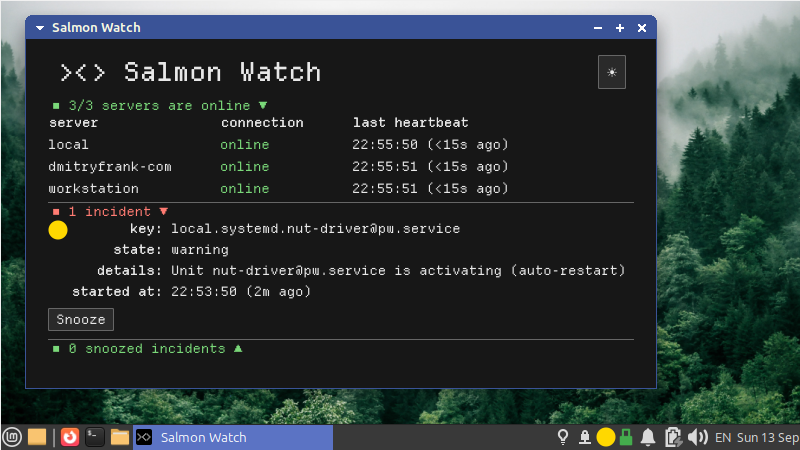
Salmon reports incidents, each of them has:
- A key, like
systemd.my-serviceorfree-space.exec-result - A state:
warningorerror
These incidents are generated accordingly to the Salmon configuration. For details on that, see Configuring Salmon.
Salmon-Watch combines these incidents. For each incident, it also prefixes the
keys with the ID for that particular Salmon like my-server (that you specify
in the Salmon-Watch config) so the key becomes like
my-server.systemd.myservice.
For details about Salmon-Watch configuration, see Configuring Salmon-Watch.
If an incident happens and we want to just acknowledge it but worry about it later, we can snooze it in the UI, so the icon stops being annoying but it'll get unsnoozed again later.
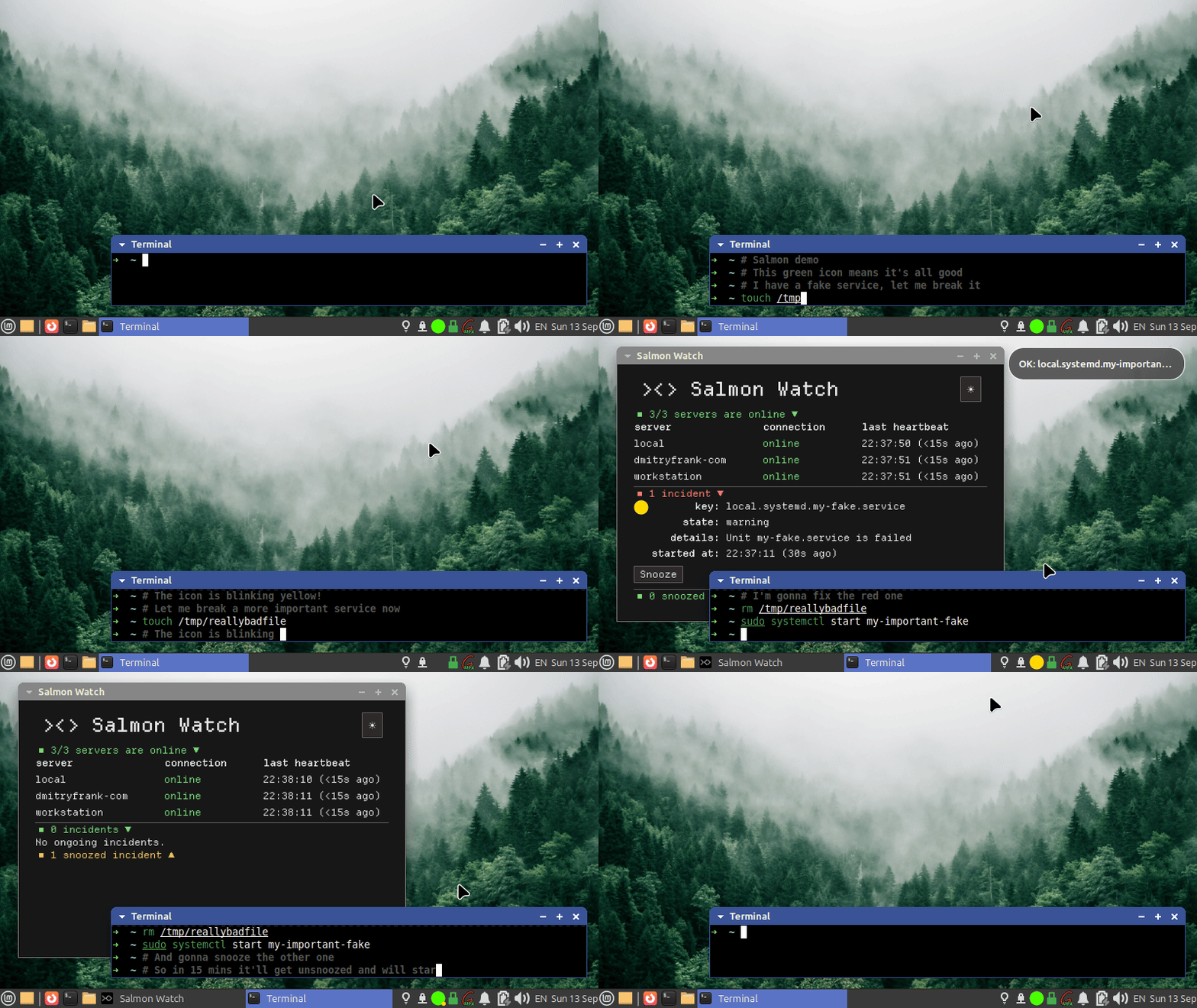
The tray icon shows the worst current non-snoozed state:
- Gray: the initial state isn't known yet;
- Green: everything is OK;
- Magenta blinking: Salmon-Watch itself has an internal connection or tunnel error;
- Yellow blinking: at least one warning;
- Red blinking: at least one error.
Installation Quick Start (Linux)
Monitoring local machine
The easiest way to install both salmon and salmon-watch to monitor local
machine health is as follows:
First, download the latest prebuilt binaries from GitHub,
like salmon-x.y.z_linux_amd64.tar.gz and salmon-watch-x.y.z_linux_amd64.tar.gz,
and unpack them. You'll get two binaries: salmon and salmon-watch.
Then:
# Install both binaries system-wide:
sudo install -m 755 salmon /usr/local/bin/salmon
sudo install -m 755 salmon-watch /usr/local/bin/salmon-watch

# Let it create default configs, systemd service, desktop autostart entry,
# and application launcher.
sudo salmon setup
salmon-watch setup

# Start both:
sudo systemctl start salmon.service
salmon-watch
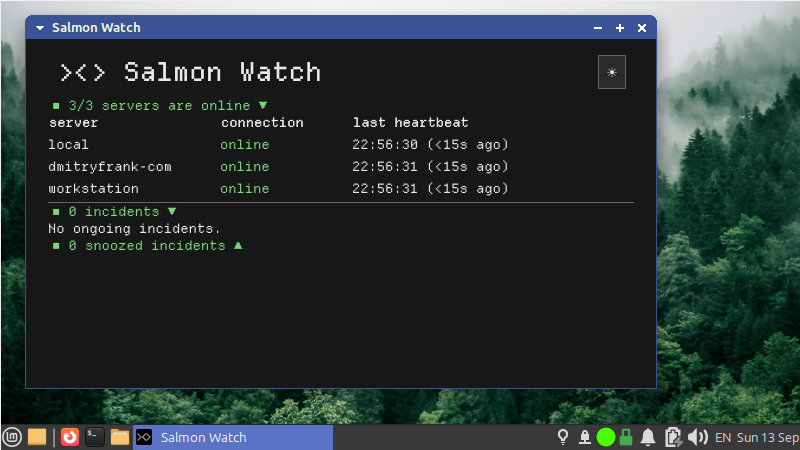
You should now see a tray icon, and if you click on it, you'll see the UI. When you reboot, it will start automatically.
Monitoring remote machines
If you have e.g. a personal server which you also want to monitor using the
same interface on your desktop, then on each such remote machine follow the
same steps as above, but only for salmon (no need to install salmon-watch
on the servers).
Having salmon running on your server, we need to point our local
salmon-watch to it, which by default only listens on 127.0.0.1 (so we can't
reach it directly from a laptop).
Presumably you have ssh access to your server with public key authentication
(i.e. you can ssh there without a password), so the easiest way forward here is
to establish an ssh tunnel, and salmon-watch has a convenient support for it:
open the config file ~/.config/salmon-watch/salmon-watch.yml, and add one
more entry to the wsClient.servers array, like that (adjusting at least your
server hostname and username). There is no addr in this entry: for a
structured SSH tunnel, salmon-watch automatically allocates an available port
on 127.0.0.1. You may still set an explicit loopback addr with a port of
your choice when a fixed local forwarding port is useful.
    - id: myserver # Arbitrary but unique ID for this server.
      tunnel:
        ssh:
          host: myserver.com  # TODO: your actual server hostname
          user: myuser        # TODO: your actual ssh user
          port: 22            # Change if using non-default ssh port
          remoteSalmonAddr: 127.0.0.1:41990
And restart salmon-watch (right-click on the tray icon -> "Restart and reload
configuration"). Open the UI and verify that the list of servers now includes
your newly added remote server as well.
SSH tunnel is not the only way to access remote servers; salmon also supports TLS and bearer token authentication. For details, see docs on Security.
Configuration
The default config (which sudo salmon setup writes to /etc/salmon.yml) is
as follows: if any systemd service is failing, it's a warning (the tray icon
will be blinking yellow). If there's less than 100 MiB of free space in the
root partition, it's an error (the tray icon will be blinking red). Otherwise,
it's all good (the tray icon is green).
The config includes comments and examples, so take a look and experiment with
it; and also check the Configuring Salmon docs. For
instance, I like to explicitly list services I particularly care about, such as
Syncthing, and configure any state other than active as an error rather than
a warning. That includes services stopped manually - if it was manually stopped
for some reason, I want to be annoyed by the blinking icon until the service is
running again. And I have some more custom exec checks as well.
Don't forget to restart the salmon systemd service to apply the changes:
sudo systemctl restart salmon.service
Non-Linux OS support
So far Salmon was only tested on Linux. Nevertheless, the client
(salmon-watch) should work on Windows and MacOS as well, so you can run it
there and monitor your remote Linux servers, but not so much the local machine.
Even salmon can technically run on non-Linux, but obviously the systemd is
irrelevant there, and then the only useful check there is exec: just polling
some script periodically, so we lose the out-of-the-box system-wide system
service monitoring, and thus the usefulness is limited. Would be cool to
implement systemd-like checks for Windows and MacOS, but I don't use these so
hard to test. PRs are welcome.
Development
Building
You need Go 1.26 and Rust 1.92 or newer.
On Ubuntu, install the native dependencies used to build and run
salmon-watch:
sudo apt-get install -y gcc libfontconfig-dev libxkbcommon-x11-0
gcc compiles native Rust dependencies, libfontconfig-dev provides the
Fontconfig development files required by Slint's font stack, and
libxkbcommon-x11-0 is loaded by Slint/winit when the application runs under
X11.
Having that, to build both salmon and salmon-watch:
make
To build only one of them:
make salmon
make salmon-watch
To install built binaries under /usr/local/bin:
sudo install-salmon
sudo install-salmon-watch
The legacy Go client (serving local web ui) is not part of the default build.
Building it with make salmon-watch-legacy additionally requires
libgtk-3-dev and libayatana-appindicator3-dev on Ubuntu.
Running tests
The test suite uses the same Go and Rust build requirements described above.
It also requires a current Node.js LTS release for the
legacy client's JavaScript tests. Because go test ./... compiles the legacy
GTK client, its native dependencies are required on Ubuntu too:
sudo apt-get install -y libgtk-3-dev libayatana-appindicator3-dev
Then:
make test
To run only the salmon-watch Rust tests:
cargo test --manifest-path cmd/salmon-watch/Cargo.toml
Two native window-geometry tests are ignored by the regular suite because they require a real X11 session and window manager. A headless environment cannot accurately test window positioning, maximizing, hiding, and restoring. Run them explicitly, as separate commands:
cargo test --manifest-path cmd/salmon-watch/Cargo.toml native_startup_restores_geometry_and_maximized_state -- --ignored
cargo test --manifest-path cmd/salmon-watch/Cargo.toml native_hide_show_preserves_normal_geometry_while_maximized -- --ignored
They must run separately because Slint's GUI platform can be initialized only once per test process. Running both together would make the second test fail for a platform-initialization reason rather than a geometry problem.
Screenshots
Documentation
Contributors

221 commits

2 commits
See what people are saying
Similar repos


Languages
Go
52.9%
Rust
40.7%
JavaScript
3.0%
Slint
2.4%
README
Salmon: a tray icon and desktop alerts for failing systemd services and anything else
Salmon is a simple monitoring utility which checks the health of your local Linux machine and/or remote server(s), and helps you notice timely if something is wrong.
Project history and naming
I use Syncthing to sync important data across multiple machines. It works so well so after I've set it up, after some time I obviously just got used to it working all the time. And then one day I noticed that apparently some stuff didn't get synced. So I checked around, and found out that the Syncthing systemd service got broken a couple weeks ago for some reason, without me noticing it, and so nothing was synced during this time. That was really annoying: it means that the synced data on the machines that I use could have get diverged if I changed it on both of them, and if it's binary data, then merging the changes will likely be a challenge.
And what's even more annoying is that an incident like a systemd service failure totally should have been communicated to me somehow, and yet I didn't know about it until I noticed a side effect of this failure.
It wasn't the first time when I got frustrated about the OS being too silent about failures like that (both locally and on the servers), and so after this Syncthing incident, I finally resolved to implement a utility which would help me notice systemd service failures, at least by showing a simple icon in tray, just like a green/red dot.
So the first idea was to make it sort of "systemd monitoring". However, after a short while I realized that I actually want to reuse the same tray icon for monitoring things other than systemd services; a trivial example is to just check if we're not running out of disk space. Most desktop environments do perform this check for us, but when it comes to the servers, we're on our own; and it happened to me multiple times in the past that a server runs out of disk space and it takes a while to find that out and fix. So the next idea was, in addition to monitoring systemd services health, to also support running some arbitrary command periodically, and notify when the exit code is not what we want. This way, we can implement "polling" of literally anything that can be checked from the shell. This check is not as realtime as with systemd, since we probably shouldn't poll things more frequently than once per minute, but for things like checking disk space, it should be good enough.
Anyway, so then the name became something like "systemd et al monitoring". Which, if I take some random letters out of it: "Systemd et AL MONitoring", becomes "salmon".
Overview
This project has two main parts:
salmon, a background service written in Go: runs on a machine, checks its health, and serves the current incidents via simple read-only WebSocket API;salmon-watch, a desktop app written in Rust + Slint: connects to one or moresalmons, receives data from them, shows a tray icon, sends desktop notifications, and provides a native GUI.
So salmon is a server (which can run locally too), and salmon-watch is a
client which runs on e.g. a laptop. If we have a laptop and two servers, a
typical setup looks like this:
flowchart LR
    subgraph laptop["Laptop"]
        localSalmon["salmon"] --> salmonWatch["salmon-watch"]
    end

    subgraph server1["Server 1"]
        server1Salmon["salmon"]
    end

    subgraph server2["Server 2"]
        server2Salmon["salmon"]
    end

    server1Salmon --> salmonWatch
    server2Salmon --> salmonWatch
Salmon reports incidents, each of them has:
- A key, like
systemd.my-serviceorfree-space.exec-result - A state:
warningorerror
These incidents are generated accordingly to the Salmon configuration. For details on that, see Configuring Salmon.
Salmon-Watch combines these incidents. For each incident, it also prefixes the
keys with the ID for that particular Salmon like my-server (that you specify
in the Salmon-Watch config) so the key becomes like
my-server.systemd.myservice.
For details about Salmon-Watch configuration, see Configuring Salmon-Watch.
If an incident happens and we want to just acknowledge it but worry about it later, we can snooze it in the UI, so the icon stops being annoying but it'll get unsnoozed again later.
The tray icon shows the worst current non-snoozed state:
- Gray: the initial state isn't known yet;
- Green: everything is OK;
- Magenta blinking: Salmon-Watch itself has an internal connection or tunnel error;
- Yellow blinking: at least one warning;
- Red blinking: at least one error.
Installation Quick Start (Linux)
Monitoring local machine
The easiest way to install both salmon and salmon-watch to monitor local
machine health is as follows:
First, download the latest prebuilt binaries from GitHub,
like salmon-x.y.z_linux_amd64.tar.gz and salmon-watch-x.y.z_linux_amd64.tar.gz,
and unpack them. You'll get two binaries: salmon and salmon-watch.
Then:
# Install both binaries system-wide:
sudo install -m 755 salmon /usr/local/bin/salmon
sudo install -m 755 salmon-watch /usr/local/bin/salmon-watch

# Let it create default configs, systemd service, desktop autostart entry,
# and application launcher.
sudo salmon setup
salmon-watch setup

# Start both:
sudo systemctl start salmon.service
salmon-watch
You should now see a tray icon, and if you click on it, you'll see the UI. When you reboot, it will start automatically.
Monitoring remote machines
If you have e.g. a personal server which you also want to monitor using the
same interface on your desktop, then on each such remote machine follow the
same steps as above, but only for salmon (no need to install salmon-watch
on the servers).
Having salmon running on your server, we need to point our local
salmon-watch to it, which by default only listens on 127.0.0.1 (so we can't
reach it directly from a laptop).
Presumably you have ssh access to your server with public key authentication
(i.e. you can ssh there without a password), so the easiest way forward here is
to establish an ssh tunnel, and salmon-watch has a convenient support for it:
open the config file ~/.config/salmon-watch/salmon-watch.yml, and add one
more entry to the wsClient.servers array, like that (adjusting at least your
server hostname and username). There is no addr in this entry: for a
structured SSH tunnel, salmon-watch automatically allocates an available port
on 127.0.0.1. You may still set an explicit loopback addr with a port of
your choice when a fixed local forwarding port is useful.
    - id: myserver # Arbitrary but unique ID for this server.
      tunnel:
        ssh:
          host: myserver.com  # TODO: your actual server hostname
          user: myuser        # TODO: your actual ssh user
          port: 22            # Change if using non-default ssh port
          remoteSalmonAddr: 127.0.0.1:41990
And restart salmon-watch (right-click on the tray icon -> "Restart and reload
configuration"). Open the UI and verify that the list of servers now includes
your newly added remote server as well.
SSH tunnel is not the only way to access remote servers; salmon also supports TLS and bearer token authentication. For details, see docs on Security.
Configuration
The default config (which sudo salmon setup writes to /etc/salmon.yml) is
as follows: if any systemd service is failing, it's a warning (the tray icon
will be blinking yellow). If there's less than 100 MiB of free space in the
root partition, it's an error (the tray icon will be blinking red). Otherwise,
it's all good (the tray icon is green).
The config includes comments and examples, so take a look and experiment with
it; and also check the Configuring Salmon docs. For
instance, I like to explicitly list services I particularly care about, such as
Syncthing, and configure any state other than active as an error rather than
a warning. That includes services stopped manually - if it was manually stopped
for some reason, I want to be annoyed by the blinking icon until the service is
running again. And I have some more custom exec checks as well.
Don't forget to restart the salmon systemd service to apply the changes:
sudo systemctl restart salmon.service
Non-Linux OS support
So far Salmon was only tested on Linux. Nevertheless, the client
(salmon-watch) should work on Windows and MacOS as well, so you can run it
there and monitor your remote Linux servers, but not so much the local machine.
Even salmon can technically run on non-Linux, but obviously the systemd is
irrelevant there, and then the only useful check there is exec: just polling
some script periodically, so we lose the out-of-the-box system-wide system
service monitoring, and thus the usefulness is limited. Would be cool to
implement systemd-like checks for Windows and MacOS, but I don't use these so
hard to test. PRs are welcome.
Development
Building
You need Go 1.26 and Rust 1.92 or newer.
On Ubuntu, install the native dependencies used to build and run
salmon-watch:
sudo apt-get install -y gcc libfontconfig-dev libxkbcommon-x11-0
gcc compiles native Rust dependencies, libfontconfig-dev provides the
Fontconfig development files required by Slint's font stack, and
libxkbcommon-x11-0 is loaded by Slint/winit when the application runs under
X11.
Having that, to build both salmon and salmon-watch:
make
To build only one of them:
make salmon
make salmon-watch
To install built binaries under /usr/local/bin:
sudo install-salmon
sudo install-salmon-watch
The legacy Go client (serving local web ui) is not part of the default build.
Building it with make salmon-watch-legacy additionally requires
libgtk-3-dev and libayatana-appindicator3-dev on Ubuntu.
Running tests
The test suite uses the same Go and Rust build requirements described above.
It also requires a current Node.js LTS release for the
legacy client's JavaScript tests. Because go test ./... compiles the legacy
GTK client, its native dependencies are required on Ubuntu too:
sudo apt-get install -y libgtk-3-dev libayatana-appindicator3-dev
Then:
make test
To run only the salmon-watch Rust tests:
cargo test --manifest-path cmd/salmon-watch/Cargo.toml
Two native window-geometry tests are ignored by the regular suite because they require a real X11 session and window manager. A headless environment cannot accurately test window positioning, maximizing, hiding, and restoring. Run them explicitly, as separate commands:
cargo test --manifest-path cmd/salmon-watch/Cargo.toml native_startup_restores_geometry_and_maximized_state -- --ignored
cargo test --manifest-path cmd/salmon-watch/Cargo.toml native_hide_show_preserves_normal_geometry_while_maximized -- --ignored
They must run separately because Slint's GUI platform can be initialized only once per test process. Running both together would make the second test fail for a platform-initialization reason rather than a geometry problem.
Screenshots
Documentation
See what people are saying
Similar repos
Contributors
221 commits
2 commits
Languages
Go
52.9%
Rust
40.7%
JavaScript
3.0%
Slint
2.4%