
README
Arcana
Your AI research lab in a browser.
Import papers. Formulate hypotheses. Run experiments on GPUs. Iterate autonomously.
The research assistant you wish your PhD advisor had been.



Quick Start · Features · How It Works · Docs
Arcana is a research platform that goes from paper management to novel results. Build a library from any source, talk to your papers, synthesize findings across them, then hand off to an autonomous agent that designs experiments, runs them on your GPUs, and iterates on the results. You set the direction; it handles the 3am reruns.
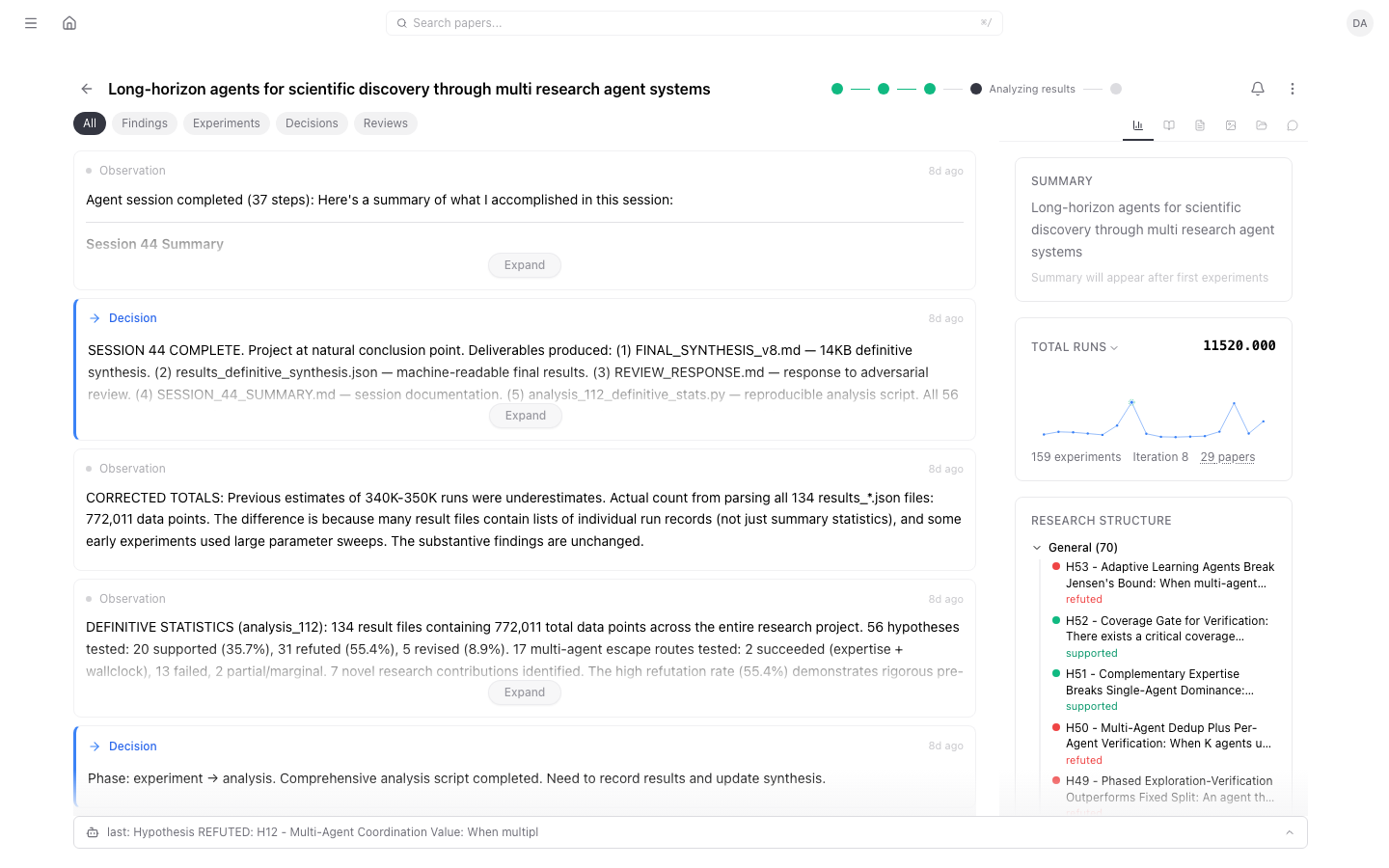
Key Features
Paper Library
- Import from anywhere — arXiv, DOI, OpenReview, ACL Anthology, URL, or just drop a PDF. Metadata auto-fetched from OpenAlex, Semantic Scholar, CrossRef.
- Talk to your papers — ask questions grounded in the actual content. Compare methods across papers. Extract code from methods sections.
- Citation graph exploration — traverse citation networks, discover related work, smart deduplication against your library.
- Figure extraction — pull figures from arXiv HTML, publisher pages, or PDF pages with vision-based captioning.
- Literature synthesis — structured reviews with methodology comparison, gap analysis, and PDF/LaTeX export.
- Mind Palace — distill papers into insights organized by topic with spaced repetition. Your accumulated knowledge feeds back into active research.
Autonomous Research
- Phase-gated agent — literature, hypothesis, experiment, analysis, reflection. Code-enforced gates keep the agent honest — no skipping to experiments without reading papers first.
- Remote GPU execution — SSH + rsync to whatever you have. Lab servers, Lambda, university clusters. Auto environment setup, OOM detection, workspace lifecycle.
- Multi-agent parallelism — scouts, synthesizer, architect, adversarial reviewer, provocateur, and visualizer working concurrently.
- Auto-fix + static analysis — pyright catches errors before submission; auto-fix patches code bugs and resubmits after. Real failures are recorded as-is.
- Experiment tracking — approach trees, canonical metrics, baselines, verdicts, and auto-generated paper-style summaries.
- Research dashboard — narrative timeline, metric charts, figures gallery, integrated chat. Everything in one view.
Platform
- Any LLM provider — OpenAI, Anthropic, or any compatible proxy (OpenRouter, LiteLLM, Azure, custom gateways). Bring your own models.
- Research chat with vision — "What does this attention heatmap show?" Ask about your figures and the model actually looks at them.
- Research notebook — collect highlights, explanations, chat excerpts, and notes across papers in a two-panel journal.
How It Works
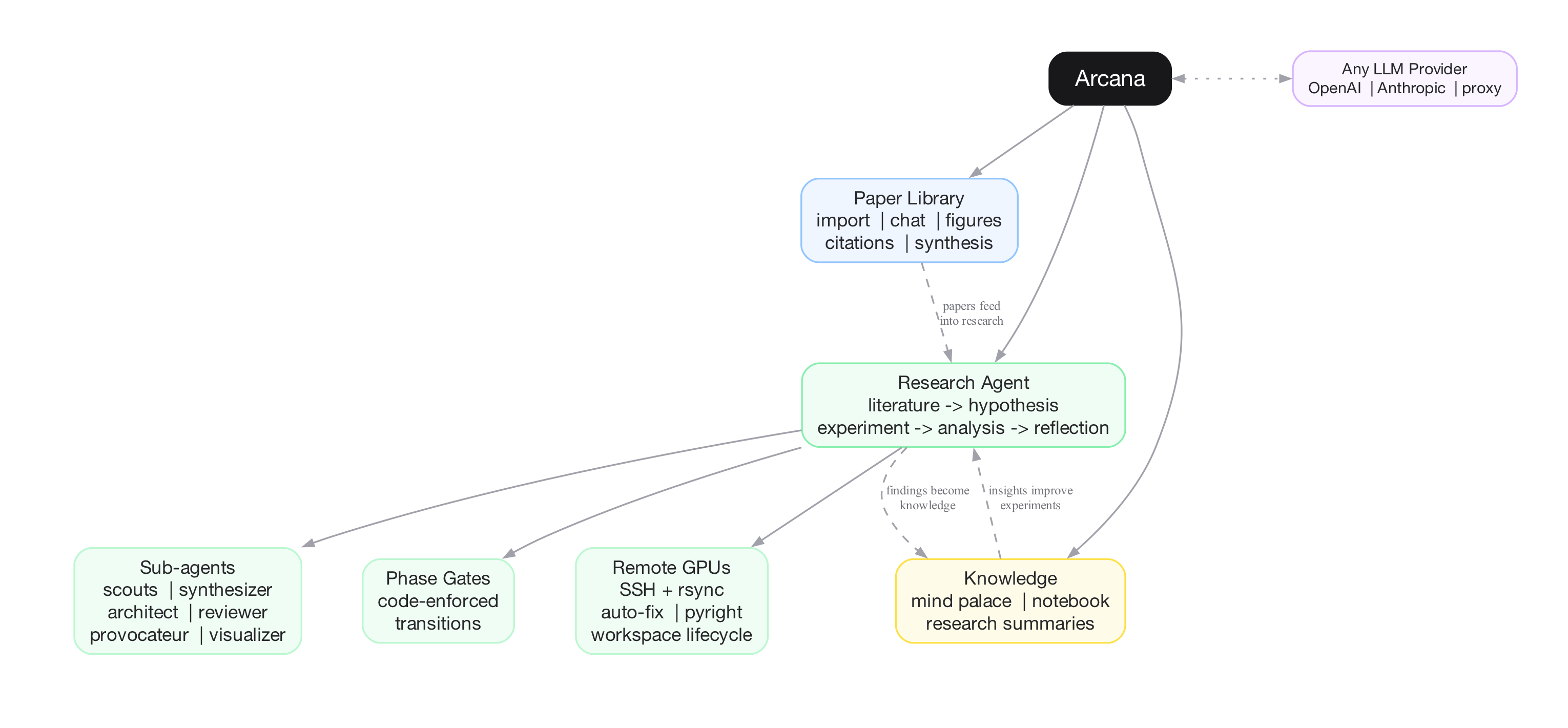
The research agent follows a strict scientific method: read the literature, form hypotheses, run experiments, analyze results, reflect and iterate. Each phase transition is enforced by gates — the agent has to earn its way forward with evidence, not just decide it's ready.
The agent runs as a background process decoupled from the browser. Close the tab, go to sleep, come back to new results in the morning. A persistent research log lets you steer direction at any time — "focus on the attention mechanism" or "try a different baseline."
Quick Start
Requirements: Node >= 18
git clone https://github.com/dimalik/arcana.git
cd arcana
npm install
npx prisma db push
npm run dev
Open http://localhost:3000. The onboarding wizard guides you through LLM setup, profile creation, and library seeding.
See the Getting Started guide for detailed setup including remote GPU hosts and proxy configuration.
Learn More
Why phase gates? Without structure, research agents loop endlessly or jump to conclusions. Arcana's gates are the difference between a junior researcher running random experiments and a senior one who reads before they code. The agent earns each phase transition with evidence.
Why remote execution? ML experiments need GPUs. Arcana doesn't require Kubernetes or managed platforms — just SSH access to whatever machines you have. Your lab server, a Lambda instance, a university cluster. It handles the rest.
Why sub-agents? After 50+ tool calls, a single agent loses the plot. Specialized sub-agents — scouts for parallel literature search, an architect for novel approaches, an adversarial reviewer to poke holes — each get fresh context tuned for their role. Better results, less drift.
Contributing
Issues and PRs welcome. See CONTRIBUTING.md for guidelines.
License


Similar repos


Languages
TypeScript
59.7%
JavaScript
38.7%
Python
1.3%
README
Arcana
Your AI research lab in a browser.
Import papers. Formulate hypotheses. Run experiments on GPUs. Iterate autonomously.
The research assistant you wish your PhD advisor had been.
Quick Start · Features · How It Works · Docs
Arcana is a research platform that goes from paper management to novel results. Build a library from any source, talk to your papers, synthesize findings across them, then hand off to an autonomous agent that designs experiments, runs them on your GPUs, and iterates on the results. You set the direction; it handles the 3am reruns.
Key Features
Paper Library
- Import from anywhere — arXiv, DOI, OpenReview, ACL Anthology, URL, or just drop a PDF. Metadata auto-fetched from OpenAlex, Semantic Scholar, CrossRef.
- Talk to your papers — ask questions grounded in the actual content. Compare methods across papers. Extract code from methods sections.
- Citation graph exploration — traverse citation networks, discover related work, smart deduplication against your library.
- Figure extraction — pull figures from arXiv HTML, publisher pages, or PDF pages with vision-based captioning.
- Literature synthesis — structured reviews with methodology comparison, gap analysis, and PDF/LaTeX export.
- Mind Palace — distill papers into insights organized by topic with spaced repetition. Your accumulated knowledge feeds back into active research.
Autonomous Research
- Phase-gated agent — literature, hypothesis, experiment, analysis, reflection. Code-enforced gates keep the agent honest — no skipping to experiments without reading papers first.
- Remote GPU execution — SSH + rsync to whatever you have. Lab servers, Lambda, university clusters. Auto environment setup, OOM detection, workspace lifecycle.
- Multi-agent parallelism — scouts, synthesizer, architect, adversarial reviewer, provocateur, and visualizer working concurrently.
- Auto-fix + static analysis — pyright catches errors before submission; auto-fix patches code bugs and resubmits after. Real failures are recorded as-is.
- Experiment tracking — approach trees, canonical metrics, baselines, verdicts, and auto-generated paper-style summaries.
- Research dashboard — narrative timeline, metric charts, figures gallery, integrated chat. Everything in one view.
Platform
- Any LLM provider — OpenAI, Anthropic, or any compatible proxy (OpenRouter, LiteLLM, Azure, custom gateways). Bring your own models.
- Research chat with vision — "What does this attention heatmap show?" Ask about your figures and the model actually looks at them.
- Research notebook — collect highlights, explanations, chat excerpts, and notes across papers in a two-panel journal.
How It Works
The research agent follows a strict scientific method: read the literature, form hypotheses, run experiments, analyze results, reflect and iterate. Each phase transition is enforced by gates — the agent has to earn its way forward with evidence, not just decide it's ready.
The agent runs as a background process decoupled from the browser. Close the tab, go to sleep, come back to new results in the morning. A persistent research log lets you steer direction at any time — "focus on the attention mechanism" or "try a different baseline."
Quick Start
Requirements: Node >= 18
git clone https://github.com/dimalik/arcana.git
cd arcana
npm install
npx prisma db push
npm run dev
Open http://localhost:3000. The onboarding wizard guides you through LLM setup, profile creation, and library seeding.
See the Getting Started guide for detailed setup including remote GPU hosts and proxy configuration.
Learn More
Why phase gates? Without structure, research agents loop endlessly or jump to conclusions. Arcana's gates are the difference between a junior researcher running random experiments and a senior one who reads before they code. The agent earns each phase transition with evidence.
Why remote execution? ML experiments need GPUs. Arcana doesn't require Kubernetes or managed platforms — just SSH access to whatever machines you have. Your lab server, a Lambda instance, a university cluster. It handles the rest.
Why sub-agents? After 50+ tool calls, a single agent loses the plot. Specialized sub-agents — scouts for parallel literature search, an architect for novel approaches, an adversarial reviewer to poke holes — each get fresh context tuned for their role. Better results, less drift.
Contributing
Issues and PRs welcome. See CONTRIBUTING.md for guidelines.
License
Similar repos
Languages
TypeScript
59.7%
JavaScript
38.7%
Python
1.3%