One-command recipe to serve nvidia/Qwen3.8-Flash-Next-FP4-Local on a single NVIDIA DGX Spark with vLLM (OpenAI-compatible API).
See the codeon one DGX Spark
by Alfonso Fortunato / @devopsfortunato



Serve nvidia/Qwen3.8-Flash-Next-FP4-Local from one NVIDIA DGX Spark through an OpenAI-compatible API.
The server is vLLM, in the container eugr/spark-vllm-b12x:latest, with the DGX Spark flags from the
NVIDIA model card: PLE (n-gram) tables on disk,
--load-format b12x, --quantization modelopt_mixed, and FP8 KV cache. MTP drafts 3 tokens, not the model
card's 4: on a Spark it decodes as fast and leaves 4-9% more KV cache (see Benchmarks).
Activations follow the model card by default (PRECISION=fast). PRECISION=quality is opt-in. It adds a
second FP4 term for the prefill MoE rounding residual and keeps BF16 activations in the dense NVFP4/MXFP8
layers. Token by token it tracks a full-precision run about twice as closely, at about 21% less prefill speed.
Both pass the same quality gate. On the task benchmarks fast matches quality: sixcat 92.1 vs 91.7, tool-eval
89 vs 90. So the faster setting is the default (see Precision).
The checkpoint is about 96 GiB on disk. NVIDIA's model card says a DGX Spark can run it with or without PLE
offload, and reports 1M tokens of FP8 KV cache with PLE offload. This recipe follows the model card's Spark
command: VLLM_PLE_TABLE_MEMORY=disk and a 262,144-token window.
./start.sh prepares the machine on the first run and starts the server. ./stop.sh stops it.
Status: tested on one DGX Spark (GB10, 121 GB unified memory). At a 128k prose context: prefill 1,990 t/s, decode 39 t/s, TTFT 66 s (
PRECISION=quality: 1,515 t/s, 38 t/s, 86 s). 1,365,333 tokens of FP8 KV cache, five full 262k requests at once. sixcat 92.1, tool-eval 89/100. See Benchmarks.
git clone https://github.com/devopsfortunato/Qwen3.8-Flash-Next-FP4-Local-DGX-Spark.git
cd Qwen3.8-Flash-Next-FP4-Local-DGX-Spark
./start.sh
The first run pulls the image and downloads the checkpoint into ~/.cache/huggingface if it is not there yet.
Later starts load the weights. start.sh waits until /v1/models answers, runs a smoke test, prints
nvidia/Qwen3.8-Flash-Next-FP4-Local is now LIVE! on port 8000, and returns you to the shell.
Accept the model terms on the Hugging Face page first. If the Hub asks for a token, put it in the environment
or in .env (see .env.example):
HF_TOKEN=hf_... ./start.sh
curl -s http://<spark-address>:8000/v1/models

curl -s http://<spark-address>:8000/v1/chat/completions \
  -H 'Content-Type: application/json' \
  -d '{
    "model": "nvidia/Qwen3.8-Flash-Next-FP4-Local",
    "messages": [{"role": "user", "content": "Write a Python fibonacci function."}],
    "max_tokens": 1000
  }'
Any OpenAI client works with base_url = "http://<spark-address>:8000/v1" and the model
nvidia/Qwen3.8-Flash-Next-FP4-Local. The recipe enables the Qwen3 reasoning parser and the qwen3_xml tool-call
parser, so streaming, tool calls, and reasoning content are the vLLM Qwen3 paths. The model thinks before it
answers; give replies enough max_tokens. "chat_template_kwargs": {"enable_thinking": false} answers without
a thinking pass.
./start.sh restart
./stop.sh
DRY_RUN=1 ./start.sh
docker logs -f qwen38-flash-next-fp4
DRY_RUN=1 prints the docker run command and does not pull, download, stop, or start anything.
HF_TOKEN is passed into the container by name, so the dry-run line does not contain the token.
start.sh wants about 90 GiB
MemAvailable before launch (MEM_NEED_GIB). MEM_CHECK=0 turns that into a warning.docker group.HF_CACHE and space for the image under
Docker's root. scripts/prepare.sh checks both (MIN_FREE_GB 120 when the snapshot is absent,
IMAGE_FREE_GB 30 when the image is not local).hf CLI on the host. Without it, prepare.sh downloads from inside the container.
A Hugging Face token in HF_TOKEN or ~/.cache/huggingface/token when the Hub requires one.start.sh and scripts/prepare.sh doscripts/prepare.sh when the image or the checkpoint is not the one these settings name.PORT or MTP_TOKENS does not stop a server that is
already up. ./start.sh restart then stops the previous container, and only after that checks that
the port is free and that MemAvailable covers MEM_NEED_GIB. Start, restart, and stop share a lock
(flock on STATE_DIR/lifecycle.lock). ./stop.sh waits up to STOP_LOCK_WAIT seconds (30) for
that lock and then exits without stopping anything.docker run with --network host, --gpus all, the model-card environment, and vllm serve./v1/models answers. The container is stopped if MemAvailable stays below
MEM_FLOOR_GIB (8 GiB) for MEM_FLOOR_GRACE seconds (30), or falls below MEM_HARD_FLOOR_GIB (2 GiB).
Every load dips to about 4 GiB for up to 10 seconds while vLLM repacks the loaded weights; the grace
lets that pass.FOREGROUND=1 ./start.sh stays attached to the container log and skips the wait. Extra arguments are appended
to vllm serve (./start.sh restart --max-model-len 131072).
scripts/prepare.sh:
docker pull of IMAGE (PULL=0 uses a local image and does not pull).HF_CACHE.qwen4_exp, ModelOpt MIXED_PRECISION, and that every shard named by the index is present.scripts/prepare.sh
PREPARE=1 ./start.sh restart
PULL=0 scripts/prepare.sh
Every setting lives in scripts/config.sh. Override it from the environment (PORT=9000 ./start.sh) or from
.env next to start.sh (KEY=value; the environment wins). .env is read as data. It is not executed.
| Variable | Default | Meaning |
|---|---|---|
MODEL_ID | nvidia/Qwen3.8-Flash-Next-FP4-Local | Hugging Face checkpoint |
IMAGE | eugr/spark-vllm-b12x:latest | vLLM container with the B12X kernels |
PORT / HOST | 8000 / 0.0.0.0 | where the API listens |
SERVED_NAME | the model id | id returned by /v1/models |
MAX_MODEL_LEN | 262144 | prompt + reply window (--max-model-len) |
MAX_NUM_SEQS | 5 | requests decoded together; five full windows fit the default KV pool |
MAX_NUM_BATCHED_TOKENS | 4096 | chunked-prefill token cap |
GPU_MEMORY_UTILIZATION | 0.8 | fraction of GPU memory vLLM may use; sizes the KV pool only when KV_CACHE_MEMORY_BYTES is empty |
KV_CACHE_MEMORY_BYTES | 27000000000 | KV pool in bytes (--kv-cache-memory-bytes): 1,365,333 FP8 tokens. Empty uses GPU_MEMORY_UTILIZATION |
YARN_FACTOR | empty | YaRN rope scaling past 262,144 positions; 4 allows a 1,048,576 window |
PROFILE | empty | opt-in launch profile from profiles/ (see Profiles) |
PRECISION | fast | activation precision; fast is the model card's, quality is closer to full precision (see Precision) |
B12X_W4A16_A4_PREFILL_TERMS | 1 (quality: 2) | FP4 terms for prefill MoE activations |
VLLM_B12X_DENSE_ACTIVATION_MODE | auto (quality: a16) | activations of the dense NVFP4/MXFP8 layers |
KV_CACHE_DTYPE | fp8 | KV cache dtype |
QUANTIZATION | modelopt_mixed | --quantization |
LOAD_FORMAT | b12x | --load-format |
MTP_TOKENS | 3 | MTP draft tokens; 0 omits --speculative-config |
BLOCK_SIZE | 16 | KV block size |
DTYPE | bfloat16 | model dtype |
VLLM_PLE_TABLE_MEMORY | disk | n-gram table on disk, as on the model card |
B12X_DISK_BACKEND | io_uring | how that table is read |
CUTE_DSL_ARCH | sm_121a | GB10 architecture for the CuTe DSL kernels |
HF_CACHE | ~/.cache/huggingface | where the checkpoint is stored |
MEM_NEED_GIB | 90 | MemAvailable start.sh asks for before launch |
MEM_FLOOR_GIB | 8 | stop the load if free memory stays below this for MEM_FLOOR_GRACE (30 s) |
MEM_HARD_FLOOR_GIB | 2 | stop the load at once below this |
MIN_FREE_GB | 120 | disk prepare.sh asks for when the snapshot is absent |
IMAGE_FREE_GB | 30 | disk asked for when the image is not local |
CONTAINER_NAME | qwen38-flash-next-fp4 | docker name |
WAIT_TIMEOUT | 1800 | seconds to wait for /v1/models |
PREPARE | auto | 1 always runs prepare, 0 skips it |
PULL | 1 | docker pull during prepare |
HF_HUB_OFFLINE | 1 | serve container; prepare turns it off for the download |
The container also receives the rest of the model-card Spark environment:
SAFETENSORS_FAST_GPU=1, VLLM_WORKER_MULTIPROC_METHOD=spawn, VLLM_SSM_CONV_STATE_LAYOUT=DS,
VLLM_USE_AOT_COMPILE=1, VLLM_USE_MEGA_AOT_ARTIFACT=1, VLLM_USE_V2_MODEL_RUNNER=1,
B12X_POLICY_MODE=auto, VLLM_MXFP8_LM_HEAD=1, VLLM_B12X_MOE_FP4_LAYER_MAX_INPUT_SCALE=w13,
VLLM_B12X_MOE_FP4_FORCE_A16=1, B12X_W4A16_A4_PREFILL=1. B12X_W4A16_A4_PREFILL_TERMS and
VLLM_B12X_DENSE_ACTIVATION_MODE come from PRECISION.
vllm serve is started with --enable-prefix-caching, --enable-chunked-prefill,
--mamba-cache-mode align, --gdn-decode-kernel b12x, --linear-backend b12x, --moe-backend b12x,
--no-enable-flashinfer-autotune, --mm-encoder-tp-mode data, --reasoning-parser qwen3,
--tool-call-parser qwen3_xml, --enable-auto-tool-choice, and
--compilation-config '{"pass_config":{"fuse_act_quant":true}}'.
DRY_RUN=1 ./start.sh prints the exact docker run line for the current settings.
A profile is a profiles/NAME.env file of KEY=value lines, loaded with PROFILE=NAME ./start.sh. It is
read as data, and .env and the environment still win over it. The default needs no profile.
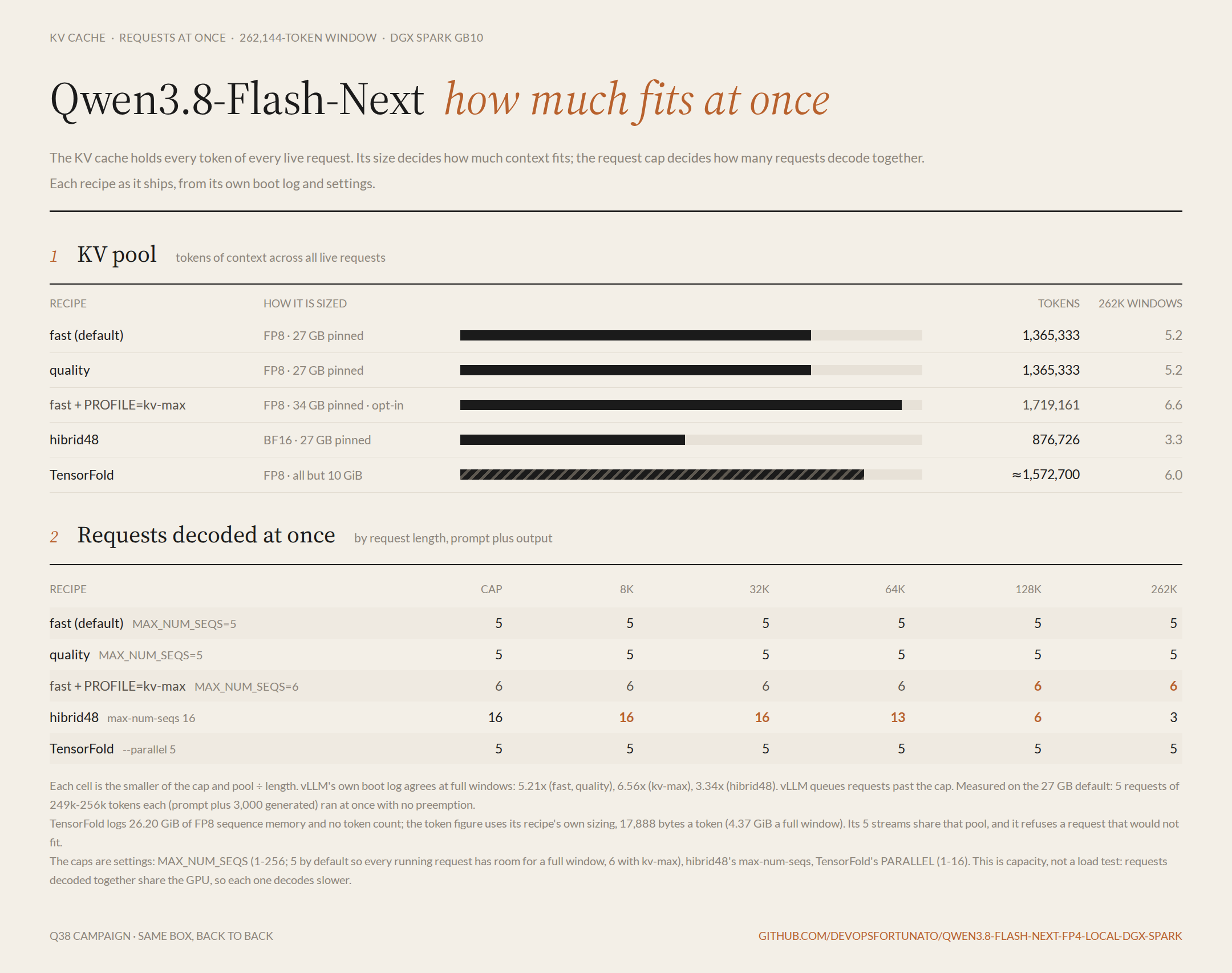
| Profile | Window | KV pool | FP8 KV tokens | Full windows at once | Notes |
|---|---|---|---|---|---|
| none | 262,144 | 27 GB | 1,365,333 | 5.2 | the default; cap 5; lowest MemAvailable while serving 11.4 GiB |
kv-max | 262,144 | 34 GB | 1,719,161 | 6.6 | cap 6; lowest MemAvailable while serving 4.4 GiB; floor 4 GiB |
1m | 1,048,576 | 30 GB | 1,931,132 | 1.8 | test profile: YaRN 4x, floor 4 GiB |
The default pool is pinned at 27 GB, so five full 262,144-token requests decode at once, and the request cap is
5 to match: every running request has room to reach the full window, and a sixth waits for a free slot. The
pool used to be sized at 0.8 of memory (1.05-1.10M tokens, 4 full windows, drifting by about 0.7 GiB between
boots) with a cap of 8. An empty KV_CACHE_MEMORY_BYTES= brings that sizing back, and MAX_NUM_SEQS=8 the old
cap. Checks on the 27 GB pool, still with the cap of 8:
MemAvailable 12.4 GiB.MemAvailable 11.4 GiB, during a 96k-token prompt.Checks on the cap of 5, same pool:
MemAvailable 11.4 GiB again.kv-max changes only the pool size and the cap. It costs no quality: its perplexity stays within 0.1% of the
default (fresh text 2.2039 against 2.2061, all text 1.0897 against 1.0892), measured with the cap at 5 to reuse
the kernels; the cap of 6 has not been booted yet. It costs memory: MemAvailable went down to 4.4 GiB during a
96k-token prompt, close to its 4 GiB floor. Leave nothing else big running on the Spark with it, or lower
KV_CACHE_MEMORY_BYTES.
1m stretches the checkpoint's 262,144 positions 4x with YaRN, which changes every answer, short ones included.
A needle hidden in 524,288 and in 1,040,000 tokens of text was found 5 times out of 5 at each length.
tool-eval-bench 2.7.1 scored 89 (default on the same version: 89 and 91), and perplexity on fresh text rose from
2.205 to 2.248. These 1m numbers were measured with PRECISION=fast, the default. Use it when a window past
262,144 matters more than the last bit of quality.
PRECISION=fast (the default) sets B12X_W4A16_A4_PREFILL_TERMS=1 and VLLM_B12X_DENSE_ACTIVATION_MODE=auto,
the model card's values. PRECISION=quality sets 2 and a16. Either variable set directly wins over
PRECISION.
PRECISION=quality ./start.sh
Each setting was compared token by token with the most precise run the image allows: BF16 KV cache, BF16 prefill activations, BF16 dense activations, and a BF16 LM head. The texts are book prose, code, a 96k-token book and two fresh 2026 texts the model cannot have seen, 156,000 tokens in all. That run's own repeat-to-repeat difference is 0.024, because its BF16 kernels are not deterministic.
| Setting | Mean |Δ logprob| | Top-1 agreement | Repeat runs | Prefill t/s |
|---|---|---|---|---|
fast (default, model card) | 0.039 | 98.59% | bit-identical | 1,718 |
quality | 0.020 | 99.23% | bit-identical | 1,362 |
B12X_W4A16_A4_PREFILL_TERMS=2 alone | 0.028 | 98.93% | bit-identical | 1,665 |
BF16 prefill activations (B12X_W4A16_A4_PREFILL=0) | 0.028 | 98.92% | differ | 1,625 |
VLLM_B12X_DENSE_ACTIVATION_MODE=a16 alone | 0.037 | 98.67% | bit-identical | 1,386 |
BF16 LM head (VLLM_MXFP8_LM_HEAD=0) | 0.039 | 98.63% | bit-identical | decode -6% |
quality is about twice as close to the precise run token by token. Measured as a shipping default on the same
image, that does not carry over to the task benchmarks:
fast (default) | quality | |
|---|---|---|
| tool-eval-bench 2.8.1, 97 scenarios, two runs | 89 · 89 | 91 · 89 |
| sixcat-eval 0.8.3, 884 items | 92.1 | 91.7 |
| Perplexity, fresh 2026 texts (20k tokens) | 2.205 | 2.227 |
| Perplexity, book prose and code (40k tokens) | 1.0902 | 1.0849 |
| Perplexity, 96k-token book | 1.0470 | 1.0418 |
| Decode, geometric mean, 0.5k-128k | 45.8 t/s | 44.4 t/s |
| Prefill, geometric mean | 1,717 t/s | 1,362 t/s |
| Time to first token, 128k prose | 65.5 s | 86.0 s |
| KV cache, default 27 GB pool | 1,365,333 | 1,365,333 |
What fast gives up is about 0.5% perplexity on book prose and code. What it gains is 26% more prefill and
20 s less wait at 128k, with sixcat a little higher. Pick quality when token-level fidelity to full precision
matters more than prefill time.
On the fresh texts quality is token by token closer to the precise run too, but its perplexity there is 1%
higher than fast's (the precise run: 2.198). On book prose and code it sits at the precise run's level.
Tried and left out:
KV_CACHE_DTYPE=bfloat16): no measurable gain over FP8, and 38% less KV (656,801 tokens).VLLM_B12X_MOE_FP4_LAYER_MAX_INPUT_SCALE=0: bit-identical output. It changes nothing on this checkpoint.MTP_TOKENS=4 ./start.sh --speculative-config '{"method":"mtp","num_speculative_tokens":4,"rejection_sample_method":"block","draft_sample_method":"probabilistic"}'):
5-9% faster decode, but one tool-eval-bench 2.7.1 run with it scored 87, under this recipe's bar of 88. Try it if speed
matters more to you.B12X_W4A16_SMALL_M_OCCUPANCY=2, VLLM_B12X_BF16_GEMV=1, B12X_W4A16_A4_PREFILL_WARPS=16,
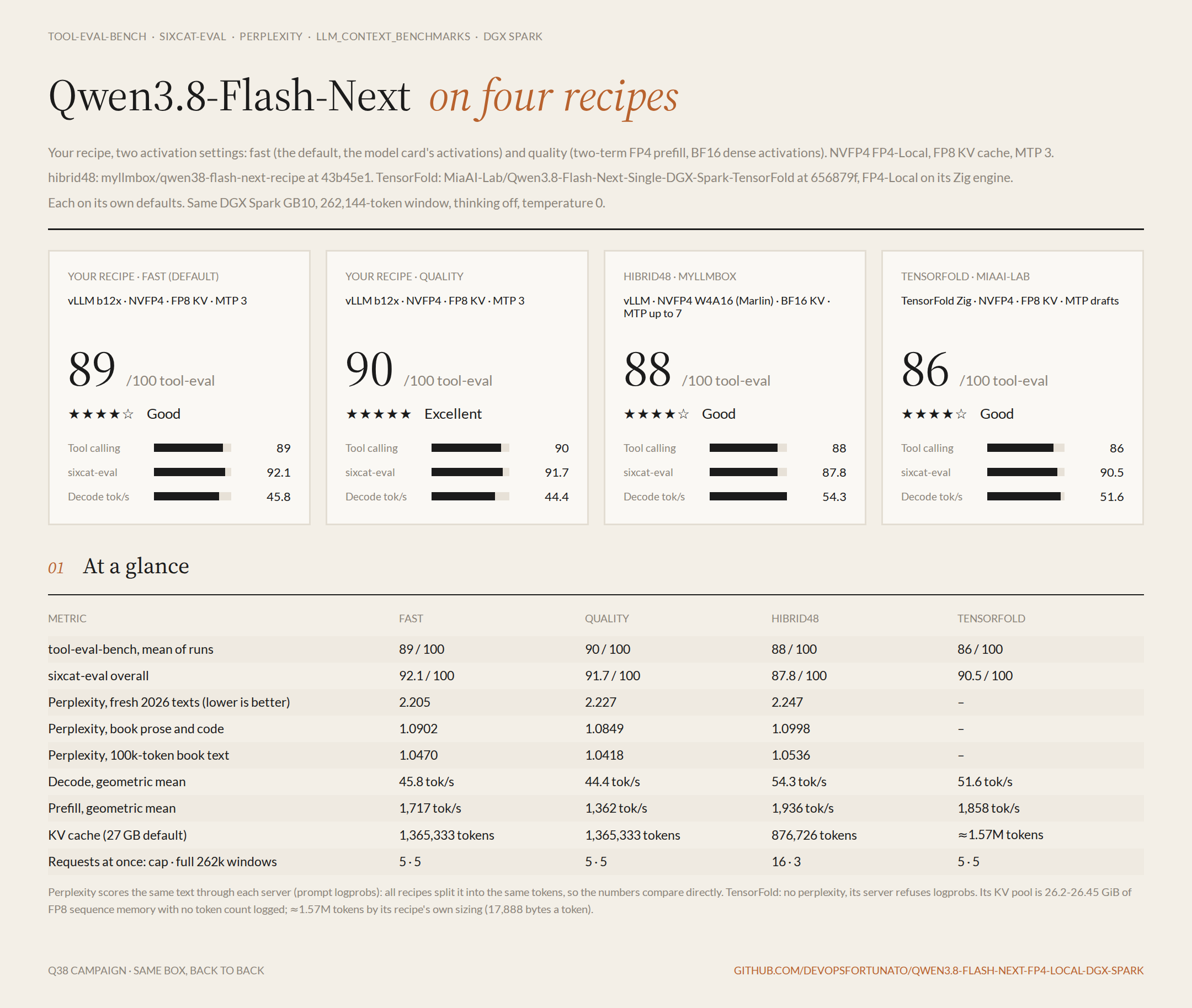
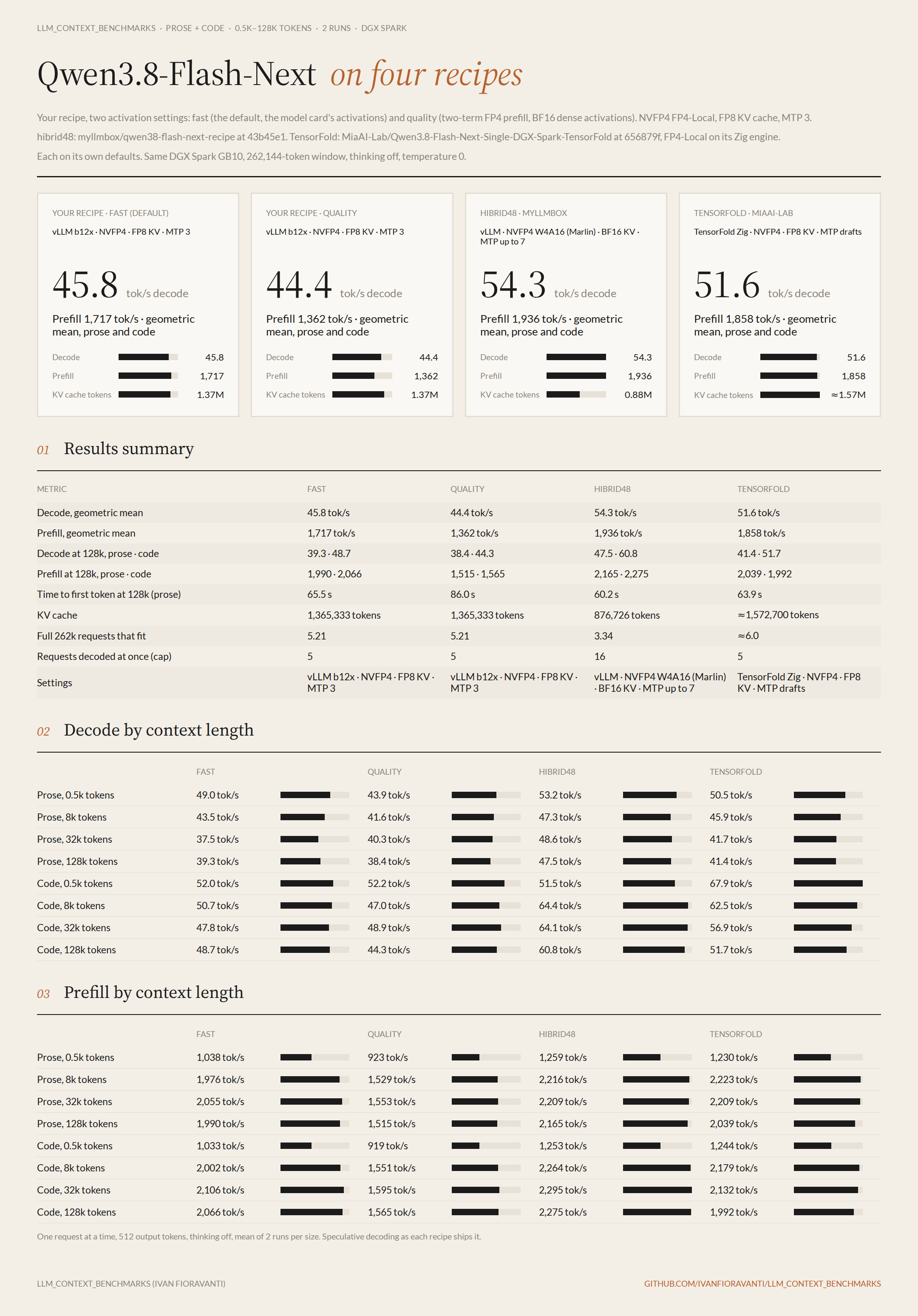
--gdn-prefill-backend flashinfer): within run-to-run noise, slower, less KV, or worse perplexity.Four ways to serve the same model, on the same Spark, back to back. Each runs on its own defaults, with a 262,144-token window, thinking off and temperature 0.
| Recipe | Engine | Weights | KV cache | Speculative decoding |
|---|---|---|---|---|
This recipe, fast (default) | vLLM b12x | NVIDIA FP4-Local (NVFP4) | FP8 | MTP 3 |
This recipe, quality | vLLM b12x | NVIDIA FP4-Local (NVFP4) | FP8 | MTP 3 |
hibrid48 at 43b45e1 | vLLM, Marlin W4A16 MoE | myllmbox hibrid48 (NVFP4) | BF16 | MTP up to 7 |
TensorFold at 656879f | TensorFold Zig engine (zig-db28187) | NVIDIA FP4-Local (NVFP4) | FP8 | MTP drafts |
This recipe ran on eugr/spark-vllm-b12x nightly-20261015 (digest 03a956544e9f), which was still latest
on 2026-10-18. TensorFold serves the same checkpoint revision as this recipe (b9ce18a6), on an image
built locally from its repository.
| Fast (default) | Quality | hibrid48 | TensorFold | |
|---|---|---|---|---|
| tool-eval-bench 2.8.1, 97 scenarios, mean of two runs | 89 | 90 | 88 | 86 |
| sixcat-eval 0.8.3, 884 items | 92.1 | 91.7 | 87.8 | 90.5 |
| Perplexity, fresh 2026 texts | 2.205 | 2.227 | 2.247 | – |
| Perplexity, book prose and code | 1.0902 | 1.0849 | 1.0998 | – |
| Perplexity, 96k-token book | 1.0470 | 1.0418 | 1.0536 | – |
| Decode, geometric mean, 0.5k-128k | 45.8 t/s | 44.4 t/s | 54.3 t/s | 51.6 t/s |
| Prefill, geometric mean | 1,717 t/s | 1,362 t/s | 1,936 t/s | 1,858 t/s |
| Time to first token, 128k prose | 65.5 s | 86.0 s | 60.2 s | 63.9 s |
| KV cache | 1,365,333 tokens | 1,365,333 tokens | 876,726 tokens | ≈1.57M tokens (26.45 GiB) |
| Full 262k requests at once | 5 | 5 | 3 | 5 (its cap) |
| Requests decoded at once (cap) | 5 | 5 | 16 | 5 |
What the numbers say:
fast is highest (92.1) and
hibrid48 lowest (87.8), mostly because of its Tools category (70 against 85-90).fast (54.3 against 45.8 t/s,
geometric means) and prefills 13% faster, with MTP up to 7 and Marlin kernels. TensorFold is second (51.6 t/s,
1,858 t/s) and the fastest of all on short code (67.9 t/s at 0.5k). All four stay above 38 t/s at 128k.PROFILE=kv-max gives this recipe
the largest pool, 1.72M tokens, and a cap of 6: 6 full windows.quality is the most precise, not the most useful. It tracks a full-precision run twice as closely and
has the lowest perplexity on book prose and code, but scores within noise of fast on both task benchmarks
and prefills 21% slower.response_format with HTTP 400. Same
checkpoint as this recipe, but 6/12 on Structured Output against 10/12 (see Tool eval).Perplexity scores the same texts through each server with prompt logprobs, and the vLLM recipes split them
into the same tokens, so those numbers compare directly. TensorFold's server refuses logprobs, so it has no
perplexity. Its server logs 26.2-26.45 GiB of FP8 sequence memory shared by 5 requests and no token count; its
recipe sizes a token at 17,888 bytes (4.37 GiB a full window), so the pool holds about 1.57M tokens. One sixcat answer each of fast and quality ran past sixcat's
token budget and was left unscored; it counts as wrong here.
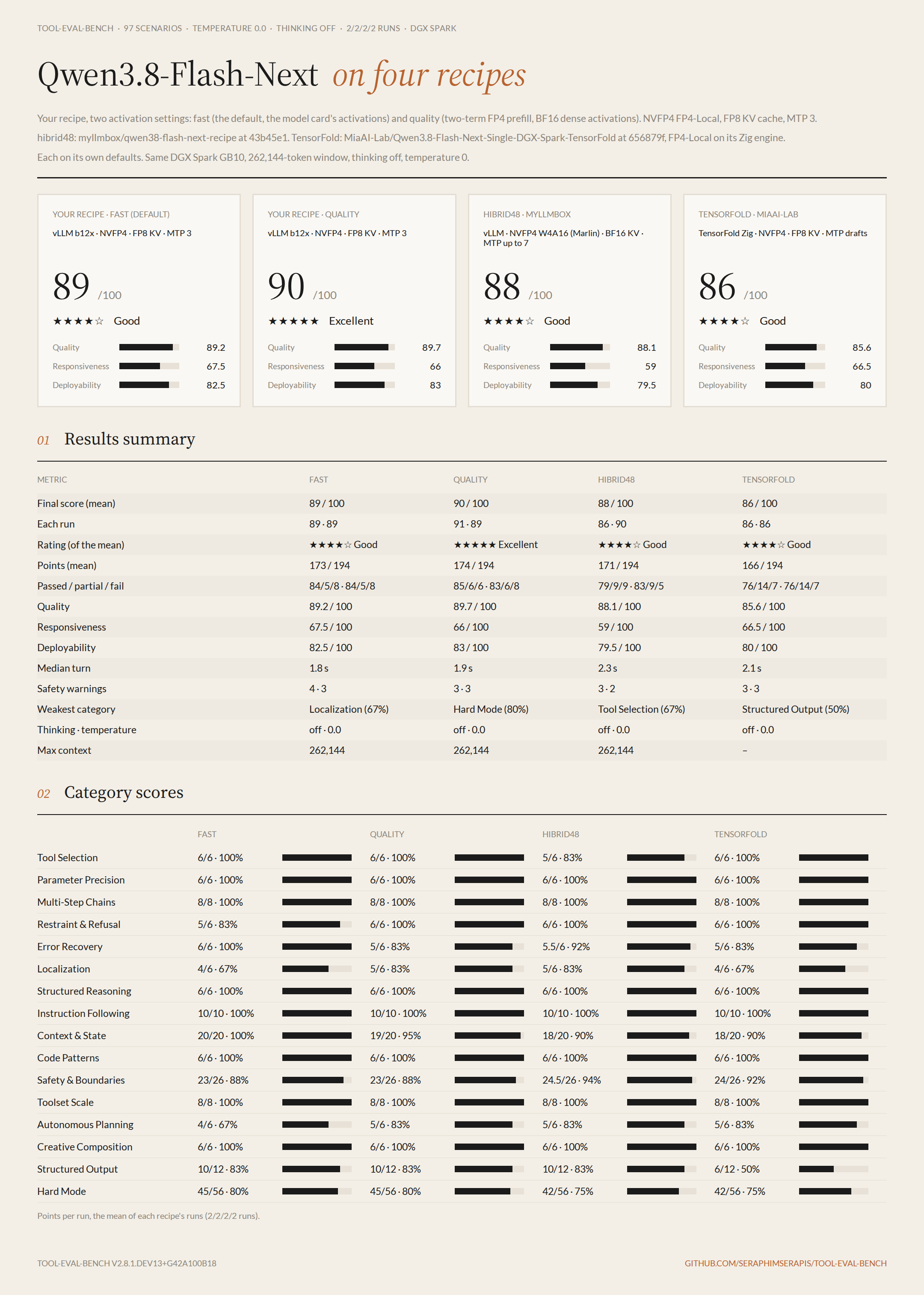
tool-eval-bench 2.8.1.dev13 (42a100b), all 97 scenarios
including Hard Mode, seed 42, temperature 0, thinking off, two runs per recipe. Category points are the mean of
the two runs.
| Fast (default) | Quality | hibrid48 | TensorFold | |
|---|---|---|---|---|
| Final score, mean | 89 / 100 | 90 / 100 | 88 / 100 | 86 / 100 |
| Each run | 89 · 89 | 91 · 89 | 86 · 90 | 86 · 86 |
| Points, mean | 173 / 194 | 174 / 194 | 171 / 194 | 166 / 194 |
| Passed / partial / fail | 84/5/8 · 84/5/8 | 85/6/6 · 83/6/8 | 79/9/9 · 83/9/5 | 76/14/7 · 76/14/7 |
| Responsiveness | 67.5 | 66 | 59 | 66.5 |
| Median turn | 1.8 s | 1.9 s | 2.3 s | 2.1 s |
| Weakest category | Localization, 67% | Hard Mode, 80% | Tool Selection, 67% | Structured Output, 50% |
| Category | Fast (default) | Quality | hibrid48 | TensorFold |
|---|---|---|---|---|
| Tool Selection | 6/6 | 6/6 | 5/6 | 6/6 |
| Parameter Precision | 6/6 | 6/6 | 6/6 | 6/6 |
| Multi-Step Chains | 8/8 | 8/8 | 8/8 | 8/8 |
| Restraint & Refusal | 5/6 | 6/6 | 6/6 | 6/6 |
| Error Recovery | 6/6 | 5/6 | 5.5/6 | 5/6 |
| Localization | 4/6 | 5/6 | 5/6 | 4/6 |
| Structured Reasoning | 6/6 | 6/6 | 6/6 | 6/6 |
| Instruction Following | 10/10 | 10/10 | 10/10 | 10/10 |
| Context & State | 20/20 | 19/20 | 18/20 | 18/20 |
| Code Patterns | 6/6 | 6/6 | 6/6 | 6/6 |
| Safety & Boundaries | 23/26 | 23/26 | 24.5/26 | 24/26 |
| Toolset Scale | 8/8 | 8/8 | 8/8 | 8/8 |
| Autonomous Planning | 4/6 | 5/6 | 5/6 | 5/6 |
| Creative Composition | 6/6 | 6/6 | 6/6 | 6/6 |
| Structured Output | 10/12 | 10/12 | 10/12 | 6/12 |
| Hard Mode | 45/56 | 45/56 | 42/56 | 42/56 |
TensorFold and structured output. TensorFold's engine (zig-db28187) answers every request that carries
response_format with HTTP 400: "structured output (response_format and the guided_* fields) is not supported
by this engine yet". tool-eval-bench 2.8.1 then retries without the schema and grades the model on the schema
that each prompt already contains. With the prompt alone TensorFold passes TC-64, which asks for JSON
directly. In TC-65 to TC-69 the JSON has to come after a tool call, and there the model answers in prose
("Here's the current weather in Berlin: ..."). The vLLM recipes accept response_format without a fallback,
and constrained decoding keeps those answers valid JSON. The weights are the same, so the gap is the engine.
Against tool-eval-bench 2.7.1. The earlier version had 92 scenarios and looser grading: quality 90 · 91,
fast 89 · 91 and 89 · 89, hibrid48 91 · 91, TensorFold 86 · 86 (TC-64 excluded as a server error). 2.8.1 adds
five document-workflow Hard Mode scenarios and fixes grading in many others. hibrid48 moved most, and mostly
in its first run (86), which also called run_code in TC-03 and TC-17 when the task did not ask for it. Its
second run passed both. TC-17 flips between runs for quality too, so one run is not enough to rank recipes
2 points apart.
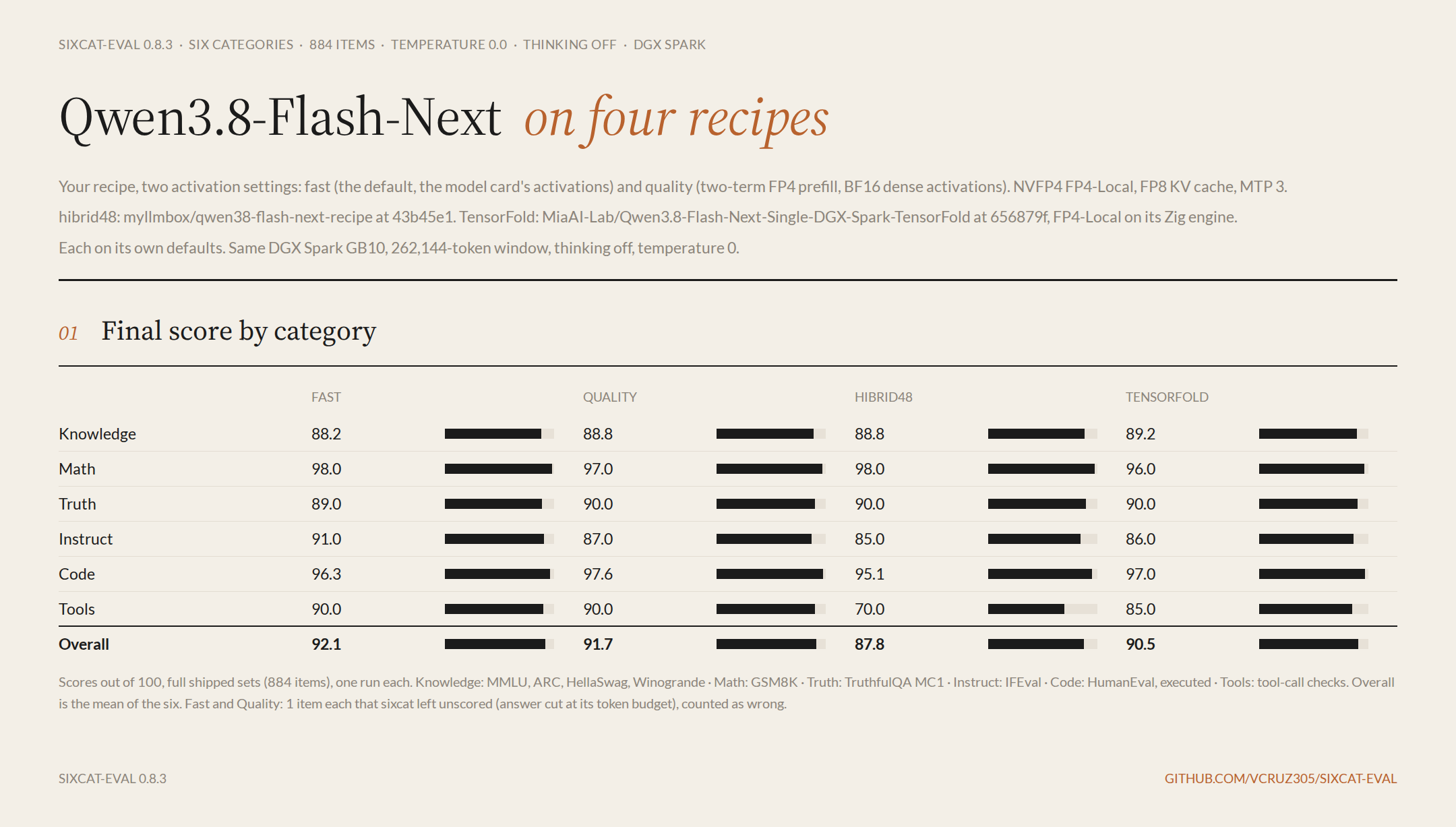
Full shipped sets, 884 items, one run each. Overall is the mean of the six categories.
| Category | Fast (default) | Quality | hibrid48 | TensorFold |
|---|---|---|---|---|
| Knowledge (MMLU, ARC, HellaSwag, Winogrande) | 88.2 | 88.8 | 88.8 | 89.2 |
| Math (GSM8K) | 98.0 | 97.0 | 98.0 | 96.0 |
| Truth (TruthfulQA MC1) | 89.0 | 90.0 | 90.0 | 90.0 |
| Instruct (IFEval) | 91.0 | 87.0 | 85.0 | 86.0 |
| Code (HumanEval, executed) | 96.3 | 97.6 | 95.1 | 97.0 |
| Tools | 90.0 | 90.0 | 70.0 | 85.0 |
| Overall | 92.1 | 91.7 | 87.8 | 90.5 |
llm_context_benchmarks, prose and code, one request at a time, 512 output tokens, mean of 2 runs per size. Speculative decoding as each recipe ships it.
| Decode t/s | Fast (default) | Quality | hibrid48 | TensorFold |
|---|---|---|---|---|
| Prose, 0.5k | 49.0 | 43.9 | 53.2 | 50.5 |
| Prose, 8k | 43.5 | 41.6 | 47.3 | 45.9 |
| Prose, 32k | 37.5 | 40.3 | 48.6 | 41.7 |
| Prose, 128k | 39.3 | 38.4 | 47.5 | 41.4 |
| Code, 0.5k | 52.0 | 52.2 | 51.5 | 67.9 |
| Code, 8k | 50.7 | 47.0 | 64.4 | 62.5 |
| Code, 32k | 47.8 | 48.9 | 64.1 | 56.9 |
| Code, 128k | 48.7 | 44.3 | 60.8 | 51.7 |
| Prefill t/s | Fast (default) | Quality | hibrid48 | TensorFold |
|---|---|---|---|---|
| Prose, 0.5k | 1,038 | 923 | 1,259 | 1,230 |
| Prose, 8k | 1,976 | 1,529 | 2,216 | 2,223 |
| Prose, 32k | 2,055 | 1,553 | 2,209 | 2,209 |
| Prose, 128k | 1,990 | 1,515 | 2,165 | 2,039 |
| Code, 0.5k | 1,033 | 919 | 1,253 | 1,244 |
| Code, 8k | 2,002 | 1,551 | 2,264 | 2,179 |
| Code, 32k | 2,106 | 1,595 | 2,295 | 2,132 |
| Code, 128k | 2,066 | 1,565 | 2,275 | 1,992 |
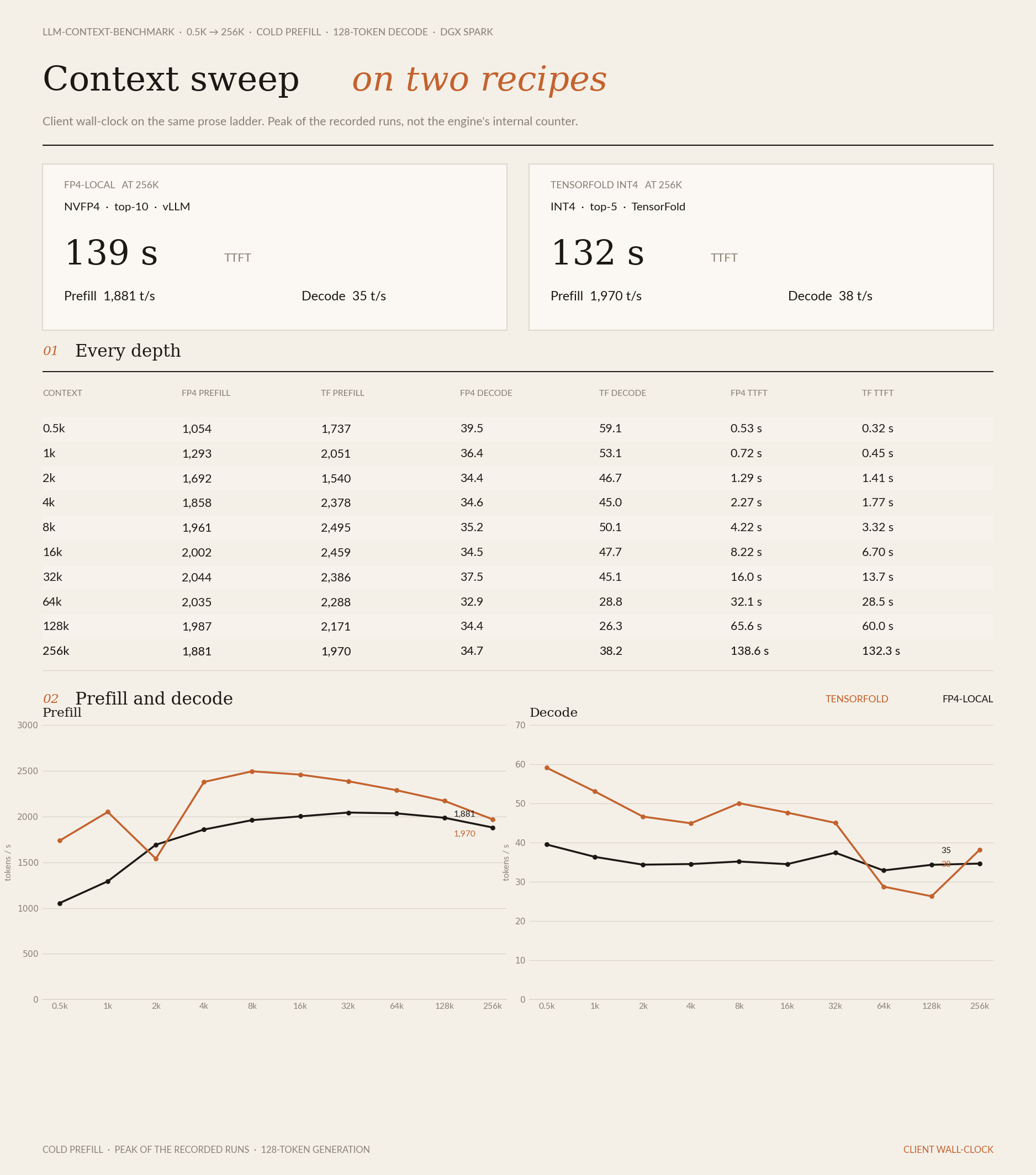
PRECISION=fast today), an older b12x image, tool-eval-bench 2.7.1, and TensorFold serving its INT4 checkpoint.One GB10 (121 GB unified memory), 262,144-token window, cold prefill, 128-token decode, measured as client wall-clock on the same prose ladder. Each value is the peak of the recorded runs.
| Context | FP4 prefill t/s | TF prefill t/s | FP4 decode t/s | TF decode t/s | FP4 TTFT | TF TTFT |
|---|---|---|---|---|---|---|
| 0.5k | 1,054 | 1,737 | 39.5 | 59.1 | 0.53 s | 0.32 s |
| 1k | 1,293 | 2,051 | 36.4 | 53.1 | 0.72 s | 0.45 s |
| 2k | 1,692 | 1,540 | 34.4 | 46.7 | 1.29 s | 1.41 s |
| 4k | 1,858 | 2,378 | 34.6 | 45.0 | 2.27 s | 1.77 s |
| 8k | 1,961 | 2,495 | 35.2 | 50.1 | 4.22 s | 3.32 s |
| 16k | 2,002 | 2,459 | 34.5 | 47.7 | 8.22 s | 6.70 s |
| 32k | 2,044 | 2,386 | 37.5 | 45.1 | 16.0 s | 13.7 s |
| 64k | 2,035 | 2,288 | 32.9 | 28.8 | 32.1 s | 28.5 s |
| 128k | 1,987 | 2,171 | 34.4 | 26.3 | 65.6 s | 60.0 s |
| 256k | 1,881 | 1,970 | 34.7 | 38.2 | 138.6 s | 132.3 s |
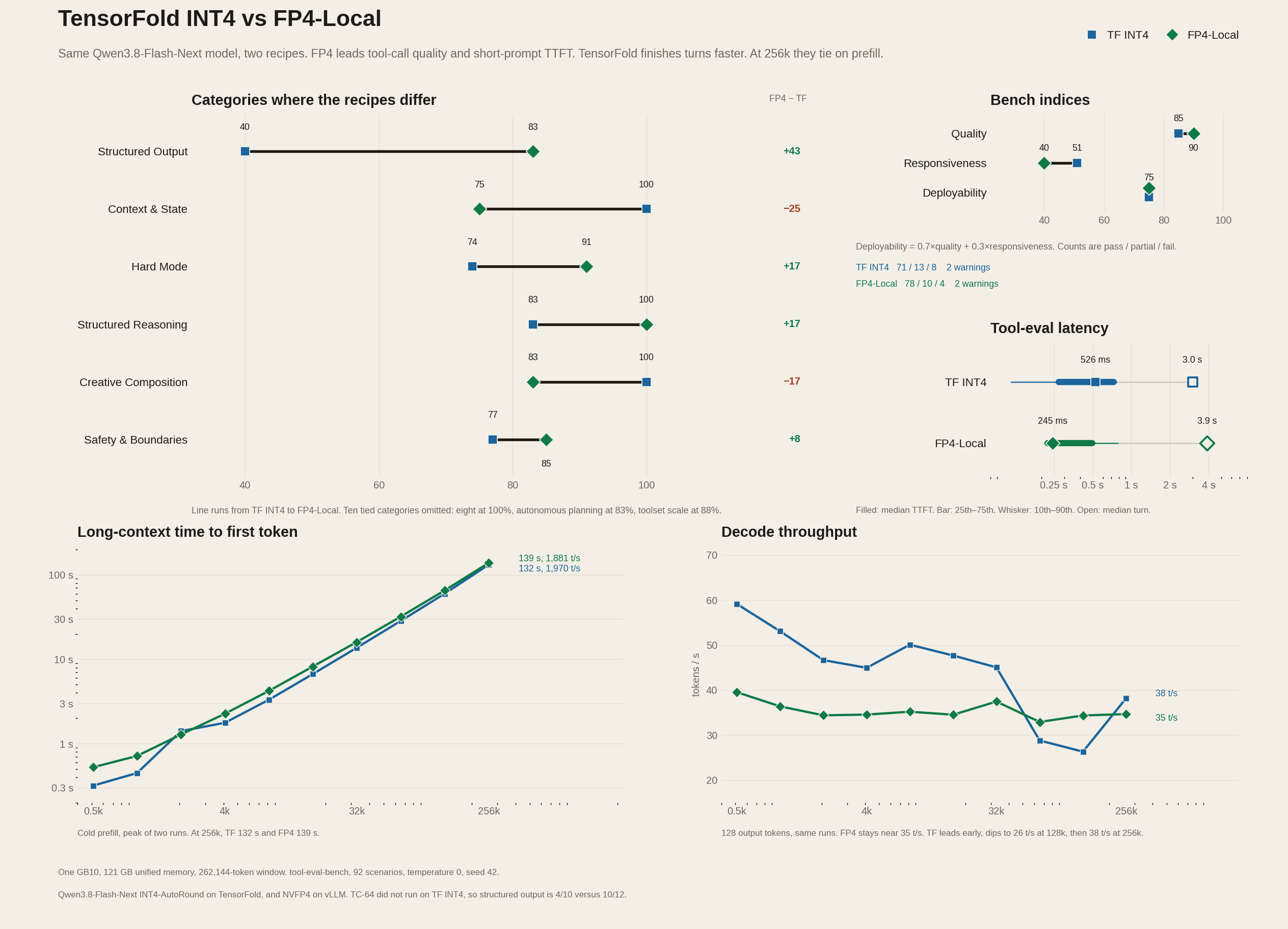
tool-eval-bench 2.7.1.dev14, 92 scenarios, temperature 0, one run. TensorFold INT4 is the healed top-5 cut, not a second quant of the FP4-Local checkpoint.
| Metric | FP4-Local | TensorFold INT4 |
|---|---|---|
| Final score | 90 / 100 (Excellent) | 85 / 100 (Good) |
| Points | 166 / 184 | 155 / 182 |
| Passed / partial / fail | 78 / 10 / 4 | 71 / 13 / 8 |
| Median scenario TTFT | 245 ms | 526 ms |
| Excluded (infrastructure) | 0 | 1 (TC-64) |
| Structured Output | 10/12 (83%) | 4/10 (40%) |
| Hard Mode | 42/46 (91%) | 34/46 (74%) |
HF_TOKEN.MemAvailable too low. Stop other containers or models (docker ps), drop page cache with
sudo sync && echo 3 | sudo tee /proc/sys/vm/drop_caches, or run with MEM_CHECK=0 to only warn.PORT=9000 ./start.sh, or ./start.sh restart if it is this recipe's container.KV_CACHE_MEMORY_BYTES (for example 22000000000, about 4 full
windows) or MAX_MODEL_LEN (131072).MAX_NUM_SEQS rebuilds part of the kernel cache on the next start, about 5 minutes. Follow it with
docker logs -f qwen38-flash-next-fp4.eugr/spark-vllm-b12x; upstream vLLM cannot read this
checkpoint's NVFP4 scales yet. Keep the default IMAGE.scripts/test_config.sh checks the defaults, .env versus the environment, and build_docker_cmd. It does
not need Docker, a GPU, or the network.
./scripts/test_config.sh
start.sh                 prepare if needed, then serve
stop.sh                  stop and remove the container
scripts/config.sh        settings and build_docker_cmd
scripts/prepare.sh       pull the image, download the checkpoint
scripts/test_config.sh   config checks
profiles/                opt-in launch profiles (kv-max, 1m)
docs/                    benchmark charts
.env.example             commented overrides
CREDITS.md               what this builds on
NOTICE                   third-party notices
LICENSE                  MIT
MIT, Copyright 2026 Alfonso Fortunato. See LICENSE. The MIT license covers this repository's scripts and
documentation.
The checkpoint downloaded by scripts/prepare.sh is not part of this repository.
nvidia/Qwen3.8-Flash-Next-FP4-Local.
https://www.nvidia.com/en-us/agreements/enterprise-software/nvidia-open-model-license/The container eugr/spark-vllm-b12x:latest is pulled, not built here. Its NVIDIA software and vLLM build stay
under their own licenses. See NOTICE.
The full list is in CREDITS.md.
One-command recipe to serve nvidia/Qwen3.8-Flash-Next-FP4-Local on a single NVIDIA DGX Spark with vLLM (OpenAI-compatible API).
See the codeon one DGX Spark
by Alfonso Fortunato / @devopsfortunato
Serve nvidia/Qwen3.8-Flash-Next-FP4-Local from one NVIDIA DGX Spark through an OpenAI-compatible API.
The server is vLLM, in the container eugr/spark-vllm-b12x:latest, with the DGX Spark flags from the
NVIDIA model card: PLE (n-gram) tables on disk,
--load-format b12x, --quantization modelopt_mixed, and FP8 KV cache. MTP drafts 3 tokens, not the model
card's 4: on a Spark it decodes as fast and leaves 4-9% more KV cache (see Benchmarks).
Activations follow the model card by default (PRECISION=fast). PRECISION=quality is opt-in. It adds a
second FP4 term for the prefill MoE rounding residual and keeps BF16 activations in the dense NVFP4/MXFP8
layers. Token by token it tracks a full-precision run about twice as closely, at about 21% less prefill speed.
Both pass the same quality gate. On the task benchmarks fast matches quality: sixcat 92.1 vs 91.7, tool-eval
89 vs 90. So the faster setting is the default (see Precision).
The checkpoint is about 96 GiB on disk. NVIDIA's model card says a DGX Spark can run it with or without PLE
offload, and reports 1M tokens of FP8 KV cache with PLE offload. This recipe follows the model card's Spark
command: VLLM_PLE_TABLE_MEMORY=disk and a 262,144-token window.
./start.sh prepares the machine on the first run and starts the server. ./stop.sh stops it.
Status: tested on one DGX Spark (GB10, 121 GB unified memory). At a 128k prose context: prefill 1,990 t/s, decode 39 t/s, TTFT 66 s (
PRECISION=quality: 1,515 t/s, 38 t/s, 86 s). 1,365,333 tokens of FP8 KV cache, five full 262k requests at once. sixcat 92.1, tool-eval 89/100. See Benchmarks.
git clone https://github.com/devopsfortunato/Qwen3.8-Flash-Next-FP4-Local-DGX-Spark.git
cd Qwen3.8-Flash-Next-FP4-Local-DGX-Spark
./start.sh
The first run pulls the image and downloads the checkpoint into ~/.cache/huggingface if it is not there yet.
Later starts load the weights. start.sh waits until /v1/models answers, runs a smoke test, prints
nvidia/Qwen3.8-Flash-Next-FP4-Local is now LIVE! on port 8000, and returns you to the shell.
Accept the model terms on the Hugging Face page first. If the Hub asks for a token, put it in the environment
or in .env (see .env.example):
HF_TOKEN=hf_... ./start.sh
curl -s http://<spark-address>:8000/v1/models

curl -s http://<spark-address>:8000/v1/chat/completions \
  -H 'Content-Type: application/json' \
  -d '{
    "model": "nvidia/Qwen3.8-Flash-Next-FP4-Local",
    "messages": [{"role": "user", "content": "Write a Python fibonacci function."}],
    "max_tokens": 1000
  }'
Any OpenAI client works with base_url = "http://<spark-address>:8000/v1" and the model
nvidia/Qwen3.8-Flash-Next-FP4-Local. The recipe enables the Qwen3 reasoning parser and the qwen3_xml tool-call
parser, so streaming, tool calls, and reasoning content are the vLLM Qwen3 paths. The model thinks before it
answers; give replies enough max_tokens. "chat_template_kwargs": {"enable_thinking": false} answers without
a thinking pass.
./start.sh restart
./stop.sh
DRY_RUN=1 ./start.sh
docker logs -f qwen38-flash-next-fp4
DRY_RUN=1 prints the docker run command and does not pull, download, stop, or start anything.
HF_TOKEN is passed into the container by name, so the dry-run line does not contain the token.
start.sh wants about 90 GiB
MemAvailable before launch (MEM_NEED_GIB). MEM_CHECK=0 turns that into a warning.docker group.HF_CACHE and space for the image under
Docker's root. scripts/prepare.sh checks both (MIN_FREE_GB 120 when the snapshot is absent,
IMAGE_FREE_GB 30 when the image is not local).hf CLI on the host. Without it, prepare.sh downloads from inside the container.
A Hugging Face token in HF_TOKEN or ~/.cache/huggingface/token when the Hub requires one.start.sh and scripts/prepare.sh doscripts/prepare.sh when the image or the checkpoint is not the one these settings name.PORT or MTP_TOKENS does not stop a server that is
already up. ./start.sh restart then stops the previous container, and only after that checks that
the port is free and that MemAvailable covers MEM_NEED_GIB. Start, restart, and stop share a lock
(flock on STATE_DIR/lifecycle.lock). ./stop.sh waits up to STOP_LOCK_WAIT seconds (30) for
that lock and then exits without stopping anything.docker run with --network host, --gpus all, the model-card environment, and vllm serve./v1/models answers. The container is stopped if MemAvailable stays below
MEM_FLOOR_GIB (8 GiB) for MEM_FLOOR_GRACE seconds (30), or falls below MEM_HARD_FLOOR_GIB (2 GiB).
Every load dips to about 4 GiB for up to 10 seconds while vLLM repacks the loaded weights; the grace
lets that pass.FOREGROUND=1 ./start.sh stays attached to the container log and skips the wait. Extra arguments are appended
to vllm serve (./start.sh restart --max-model-len 131072).
scripts/prepare.sh:
docker pull of IMAGE (PULL=0 uses a local image and does not pull).HF_CACHE.qwen4_exp, ModelOpt MIXED_PRECISION, and that every shard named by the index is present.scripts/prepare.sh
PREPARE=1 ./start.sh restart
PULL=0 scripts/prepare.sh
Every setting lives in scripts/config.sh. Override it from the environment (PORT=9000 ./start.sh) or from
.env next to start.sh (KEY=value; the environment wins). .env is read as data. It is not executed.
| Variable | Default | Meaning |
|---|---|---|
MODEL_ID | nvidia/Qwen3.8-Flash-Next-FP4-Local | Hugging Face checkpoint |
IMAGE | eugr/spark-vllm-b12x:latest | vLLM container with the B12X kernels |
PORT / HOST | 8000 / 0.0.0.0 | where the API listens |
SERVED_NAME | the model id | id returned by /v1/models |
MAX_MODEL_LEN | 262144 | prompt + reply window (--max-model-len) |
MAX_NUM_SEQS | 5 | requests decoded together; five full windows fit the default KV pool |
MAX_NUM_BATCHED_TOKENS | 4096 | chunked-prefill token cap |
GPU_MEMORY_UTILIZATION | 0.8 | fraction of GPU memory vLLM may use; sizes the KV pool only when KV_CACHE_MEMORY_BYTES is empty |
KV_CACHE_MEMORY_BYTES | 27000000000 | KV pool in bytes (--kv-cache-memory-bytes): 1,365,333 FP8 tokens. Empty uses GPU_MEMORY_UTILIZATION |
YARN_FACTOR | empty | YaRN rope scaling past 262,144 positions; 4 allows a 1,048,576 window |
PROFILE | empty | opt-in launch profile from profiles/ (see Profiles) |
PRECISION | fast | activation precision; fast is the model card's, quality is closer to full precision (see Precision) |
B12X_W4A16_A4_PREFILL_TERMS | 1 (quality: 2) | FP4 terms for prefill MoE activations |
VLLM_B12X_DENSE_ACTIVATION_MODE | auto (quality: a16) | activations of the dense NVFP4/MXFP8 layers |
KV_CACHE_DTYPE | fp8 | KV cache dtype |
QUANTIZATION | modelopt_mixed | --quantization |
LOAD_FORMAT | b12x | --load-format |
MTP_TOKENS | 3 | MTP draft tokens; 0 omits --speculative-config |
BLOCK_SIZE | 16 | KV block size |
DTYPE | bfloat16 | model dtype |
VLLM_PLE_TABLE_MEMORY | disk | n-gram table on disk, as on the model card |
B12X_DISK_BACKEND | io_uring | how that table is read |
CUTE_DSL_ARCH | sm_121a | GB10 architecture for the CuTe DSL kernels |
HF_CACHE | ~/.cache/huggingface | where the checkpoint is stored |
MEM_NEED_GIB | 90 | MemAvailable start.sh asks for before launch |
MEM_FLOOR_GIB | 8 | stop the load if free memory stays below this for MEM_FLOOR_GRACE (30 s) |
MEM_HARD_FLOOR_GIB | 2 | stop the load at once below this |
MIN_FREE_GB | 120 | disk prepare.sh asks for when the snapshot is absent |
IMAGE_FREE_GB | 30 | disk asked for when the image is not local |
CONTAINER_NAME | qwen38-flash-next-fp4 | docker name |
WAIT_TIMEOUT | 1800 | seconds to wait for /v1/models |
PREPARE | auto | 1 always runs prepare, 0 skips it |
PULL | 1 | docker pull during prepare |
HF_HUB_OFFLINE | 1 | serve container; prepare turns it off for the download |
The container also receives the rest of the model-card Spark environment:
SAFETENSORS_FAST_GPU=1, VLLM_WORKER_MULTIPROC_METHOD=spawn, VLLM_SSM_CONV_STATE_LAYOUT=DS,
VLLM_USE_AOT_COMPILE=1, VLLM_USE_MEGA_AOT_ARTIFACT=1, VLLM_USE_V2_MODEL_RUNNER=1,
B12X_POLICY_MODE=auto, VLLM_MXFP8_LM_HEAD=1, VLLM_B12X_MOE_FP4_LAYER_MAX_INPUT_SCALE=w13,
VLLM_B12X_MOE_FP4_FORCE_A16=1, B12X_W4A16_A4_PREFILL=1. B12X_W4A16_A4_PREFILL_TERMS and
VLLM_B12X_DENSE_ACTIVATION_MODE come from PRECISION.
vllm serve is started with --enable-prefix-caching, --enable-chunked-prefill,
--mamba-cache-mode align, --gdn-decode-kernel b12x, --linear-backend b12x, --moe-backend b12x,
--no-enable-flashinfer-autotune, --mm-encoder-tp-mode data, --reasoning-parser qwen3,
--tool-call-parser qwen3_xml, --enable-auto-tool-choice, and
--compilation-config '{"pass_config":{"fuse_act_quant":true}}'.
DRY_RUN=1 ./start.sh prints the exact docker run line for the current settings.
A profile is a profiles/NAME.env file of KEY=value lines, loaded with PROFILE=NAME ./start.sh. It is
read as data, and .env and the environment still win over it. The default needs no profile.
| Profile | Window | KV pool | FP8 KV tokens | Full windows at once | Notes |
|---|---|---|---|---|---|
| none | 262,144 | 27 GB | 1,365,333 | 5.2 | the default; cap 5; lowest MemAvailable while serving 11.4 GiB |
kv-max | 262,144 | 34 GB | 1,719,161 | 6.6 | cap 6; lowest MemAvailable while serving 4.4 GiB; floor 4 GiB |
1m | 1,048,576 | 30 GB | 1,931,132 | 1.8 | test profile: YaRN 4x, floor 4 GiB |
The default pool is pinned at 27 GB, so five full 262,144-token requests decode at once, and the request cap is
5 to match: every running request has room to reach the full window, and a sixth waits for a free slot. The
pool used to be sized at 0.8 of memory (1.05-1.10M tokens, 4 full windows, drifting by about 0.7 GiB between
boots) with a cap of 8. An empty KV_CACHE_MEMORY_BYTES= brings that sizing back, and MAX_NUM_SEQS=8 the old
cap. Checks on the 27 GB pool, still with the cap of 8:
MemAvailable 12.4 GiB.MemAvailable 11.4 GiB, during a 96k-token prompt.Checks on the cap of 5, same pool:
MemAvailable 11.4 GiB again.kv-max changes only the pool size and the cap. It costs no quality: its perplexity stays within 0.1% of the
default (fresh text 2.2039 against 2.2061, all text 1.0897 against 1.0892), measured with the cap at 5 to reuse
the kernels; the cap of 6 has not been booted yet. It costs memory: MemAvailable went down to 4.4 GiB during a
96k-token prompt, close to its 4 GiB floor. Leave nothing else big running on the Spark with it, or lower
KV_CACHE_MEMORY_BYTES.
1m stretches the checkpoint's 262,144 positions 4x with YaRN, which changes every answer, short ones included.
A needle hidden in 524,288 and in 1,040,000 tokens of text was found 5 times out of 5 at each length.
tool-eval-bench 2.7.1 scored 89 (default on the same version: 89 and 91), and perplexity on fresh text rose from
2.205 to 2.248. These 1m numbers were measured with PRECISION=fast, the default. Use it when a window past
262,144 matters more than the last bit of quality.
PRECISION=fast (the default) sets B12X_W4A16_A4_PREFILL_TERMS=1 and VLLM_B12X_DENSE_ACTIVATION_MODE=auto,
the model card's values. PRECISION=quality sets 2 and a16. Either variable set directly wins over
PRECISION.
PRECISION=quality ./start.sh
Each setting was compared token by token with the most precise run the image allows: BF16 KV cache, BF16 prefill activations, BF16 dense activations, and a BF16 LM head. The texts are book prose, code, a 96k-token book and two fresh 2026 texts the model cannot have seen, 156,000 tokens in all. That run's own repeat-to-repeat difference is 0.024, because its BF16 kernels are not deterministic.
| Setting | Mean |Δ logprob| | Top-1 agreement | Repeat runs | Prefill t/s |
|---|---|---|---|---|
fast (default, model card) | 0.039 | 98.59% | bit-identical | 1,718 |
quality | 0.020 | 99.23% | bit-identical | 1,362 |
B12X_W4A16_A4_PREFILL_TERMS=2 alone | 0.028 | 98.93% | bit-identical | 1,665 |
BF16 prefill activations (B12X_W4A16_A4_PREFILL=0) | 0.028 | 98.92% | differ | 1,625 |
VLLM_B12X_DENSE_ACTIVATION_MODE=a16 alone | 0.037 | 98.67% | bit-identical | 1,386 |
BF16 LM head (VLLM_MXFP8_LM_HEAD=0) | 0.039 | 98.63% | bit-identical | decode -6% |
quality is about twice as close to the precise run token by token. Measured as a shipping default on the same
image, that does not carry over to the task benchmarks:
fast (default) | quality | |
|---|---|---|
| tool-eval-bench 2.8.1, 97 scenarios, two runs | 89 · 89 | 91 · 89 |
| sixcat-eval 0.8.3, 884 items | 92.1 | 91.7 |
| Perplexity, fresh 2026 texts (20k tokens) | 2.205 | 2.227 |
| Perplexity, book prose and code (40k tokens) | 1.0902 | 1.0849 |
| Perplexity, 96k-token book | 1.0470 | 1.0418 |
| Decode, geometric mean, 0.5k-128k | 45.8 t/s | 44.4 t/s |
| Prefill, geometric mean | 1,717 t/s | 1,362 t/s |
| Time to first token, 128k prose | 65.5 s | 86.0 s |
| KV cache, default 27 GB pool | 1,365,333 | 1,365,333 |
What fast gives up is about 0.5% perplexity on book prose and code. What it gains is 26% more prefill and
20 s less wait at 128k, with sixcat a little higher. Pick quality when token-level fidelity to full precision
matters more than prefill time.
On the fresh texts quality is token by token closer to the precise run too, but its perplexity there is 1%
higher than fast's (the precise run: 2.198). On book prose and code it sits at the precise run's level.
Tried and left out:
KV_CACHE_DTYPE=bfloat16): no measurable gain over FP8, and 38% less KV (656,801 tokens).VLLM_B12X_MOE_FP4_LAYER_MAX_INPUT_SCALE=0: bit-identical output. It changes nothing on this checkpoint.MTP_TOKENS=4 ./start.sh --speculative-config '{"method":"mtp","num_speculative_tokens":4,"rejection_sample_method":"block","draft_sample_method":"probabilistic"}'):
5-9% faster decode, but one tool-eval-bench 2.7.1 run with it scored 87, under this recipe's bar of 88. Try it if speed
matters more to you.B12X_W4A16_SMALL_M_OCCUPANCY=2, VLLM_B12X_BF16_GEMV=1, B12X_W4A16_A4_PREFILL_WARPS=16,
--gdn-prefill-backend flashinfer): within run-to-run noise, slower, less KV, or worse perplexity.Four ways to serve the same model, on the same Spark, back to back. Each runs on its own defaults, with a 262,144-token window, thinking off and temperature 0.
| Recipe | Engine | Weights | KV cache | Speculative decoding |
|---|---|---|---|---|
This recipe, fast (default) | vLLM b12x | NVIDIA FP4-Local (NVFP4) | FP8 | MTP 3 |
This recipe, quality | vLLM b12x | NVIDIA FP4-Local (NVFP4) | FP8 | MTP 3 |
hibrid48 at 43b45e1 | vLLM, Marlin W4A16 MoE | myllmbox hibrid48 (NVFP4) | BF16 | MTP up to 7 |
TensorFold at 656879f | TensorFold Zig engine (zig-db28187) | NVIDIA FP4-Local (NVFP4) | FP8 | MTP drafts |
This recipe ran on eugr/spark-vllm-b12x nightly-20261015 (digest 03a956544e9f), which was still latest
on 2026-10-18. TensorFold serves the same checkpoint revision as this recipe (b9ce18a6), on an image
built locally from its repository.
| Fast (default) | Quality | hibrid48 | TensorFold | |
|---|---|---|---|---|
| tool-eval-bench 2.8.1, 97 scenarios, mean of two runs | 89 | 90 | 88 | 86 |
| sixcat-eval 0.8.3, 884 items | 92.1 | 91.7 | 87.8 | 90.5 |
| Perplexity, fresh 2026 texts | 2.205 | 2.227 | 2.247 | – |
| Perplexity, book prose and code | 1.0902 | 1.0849 | 1.0998 | – |
| Perplexity, 96k-token book | 1.0470 | 1.0418 | 1.0536 | – |
| Decode, geometric mean, 0.5k-128k | 45.8 t/s | 44.4 t/s | 54.3 t/s | 51.6 t/s |
| Prefill, geometric mean | 1,717 t/s | 1,362 t/s | 1,936 t/s | 1,858 t/s |
| Time to first token, 128k prose | 65.5 s | 86.0 s | 60.2 s | 63.9 s |
| KV cache | 1,365,333 tokens | 1,365,333 tokens | 876,726 tokens | ≈1.57M tokens (26.45 GiB) |
| Full 262k requests at once | 5 | 5 | 3 | 5 (its cap) |
| Requests decoded at once (cap) | 5 | 5 | 16 | 5 |
What the numbers say:
fast is highest (92.1) and
hibrid48 lowest (87.8), mostly because of its Tools category (70 against 85-90).fast (54.3 against 45.8 t/s,
geometric means) and prefills 13% faster, with MTP up to 7 and Marlin kernels. TensorFold is second (51.6 t/s,
1,858 t/s) and the fastest of all on short code (67.9 t/s at 0.5k). All four stay above 38 t/s at 128k.PROFILE=kv-max gives this recipe
the largest pool, 1.72M tokens, and a cap of 6: 6 full windows.quality is the most precise, not the most useful. It tracks a full-precision run twice as closely and
has the lowest perplexity on book prose and code, but scores within noise of fast on both task benchmarks
and prefills 21% slower.response_format with HTTP 400. Same
checkpoint as this recipe, but 6/12 on Structured Output against 10/12 (see Tool eval).Perplexity scores the same texts through each server with prompt logprobs, and the vLLM recipes split them
into the same tokens, so those numbers compare directly. TensorFold's server refuses logprobs, so it has no
perplexity. Its server logs 26.2-26.45 GiB of FP8 sequence memory shared by 5 requests and no token count; its
recipe sizes a token at 17,888 bytes (4.37 GiB a full window), so the pool holds about 1.57M tokens. One sixcat answer each of fast and quality ran past sixcat's
token budget and was left unscored; it counts as wrong here.
tool-eval-bench 2.8.1.dev13 (42a100b), all 97 scenarios
including Hard Mode, seed 42, temperature 0, thinking off, two runs per recipe. Category points are the mean of
the two runs.
| Fast (default) | Quality | hibrid48 | TensorFold | |
|---|---|---|---|---|
| Final score, mean | 89 / 100 | 90 / 100 | 88 / 100 | 86 / 100 |
| Each run | 89 · 89 | 91 · 89 | 86 · 90 | 86 · 86 |
| Points, mean | 173 / 194 | 174 / 194 | 171 / 194 | 166 / 194 |
| Passed / partial / fail | 84/5/8 · 84/5/8 | 85/6/6 · 83/6/8 | 79/9/9 · 83/9/5 | 76/14/7 · 76/14/7 |
| Responsiveness | 67.5 | 66 | 59 | 66.5 |
| Median turn | 1.8 s | 1.9 s | 2.3 s | 2.1 s |
| Weakest category | Localization, 67% | Hard Mode, 80% | Tool Selection, 67% | Structured Output, 50% |
| Category | Fast (default) | Quality | hibrid48 | TensorFold |
|---|---|---|---|---|
| Tool Selection | 6/6 | 6/6 | 5/6 | 6/6 |
| Parameter Precision | 6/6 | 6/6 | 6/6 | 6/6 |
| Multi-Step Chains | 8/8 | 8/8 | 8/8 | 8/8 |
| Restraint & Refusal | 5/6 | 6/6 | 6/6 | 6/6 |
| Error Recovery | 6/6 | 5/6 | 5.5/6 | 5/6 |
| Localization | 4/6 | 5/6 | 5/6 | 4/6 |
| Structured Reasoning | 6/6 | 6/6 | 6/6 | 6/6 |
| Instruction Following | 10/10 | 10/10 | 10/10 | 10/10 |
| Context & State | 20/20 | 19/20 | 18/20 | 18/20 |
| Code Patterns | 6/6 | 6/6 | 6/6 | 6/6 |
| Safety & Boundaries | 23/26 | 23/26 | 24.5/26 | 24/26 |
| Toolset Scale | 8/8 | 8/8 | 8/8 | 8/8 |
| Autonomous Planning | 4/6 | 5/6 | 5/6 | 5/6 |
| Creative Composition | 6/6 | 6/6 | 6/6 | 6/6 |
| Structured Output | 10/12 | 10/12 | 10/12 | 6/12 |
| Hard Mode | 45/56 | 45/56 | 42/56 | 42/56 |
TensorFold and structured output. TensorFold's engine (zig-db28187) answers every request that carries
response_format with HTTP 400: "structured output (response_format and the guided_* fields) is not supported
by this engine yet". tool-eval-bench 2.8.1 then retries without the schema and grades the model on the schema
that each prompt already contains. With the prompt alone TensorFold passes TC-64, which asks for JSON
directly. In TC-65 to TC-69 the JSON has to come after a tool call, and there the model answers in prose
("Here's the current weather in Berlin: ..."). The vLLM recipes accept response_format without a fallback,
and constrained decoding keeps those answers valid JSON. The weights are the same, so the gap is the engine.
Against tool-eval-bench 2.7.1. The earlier version had 92 scenarios and looser grading: quality 90 · 91,
fast 89 · 91 and 89 · 89, hibrid48 91 · 91, TensorFold 86 · 86 (TC-64 excluded as a server error). 2.8.1 adds
five document-workflow Hard Mode scenarios and fixes grading in many others. hibrid48 moved most, and mostly
in its first run (86), which also called run_code in TC-03 and TC-17 when the task did not ask for it. Its
second run passed both. TC-17 flips between runs for quality too, so one run is not enough to rank recipes
2 points apart.
Full shipped sets, 884 items, one run each. Overall is the mean of the six categories.
| Category | Fast (default) | Quality | hibrid48 | TensorFold |
|---|---|---|---|---|
| Knowledge (MMLU, ARC, HellaSwag, Winogrande) | 88.2 | 88.8 | 88.8 | 89.2 |
| Math (GSM8K) | 98.0 | 97.0 | 98.0 | 96.0 |
| Truth (TruthfulQA MC1) | 89.0 | 90.0 | 90.0 | 90.0 |
| Instruct (IFEval) | 91.0 | 87.0 | 85.0 | 86.0 |
| Code (HumanEval, executed) | 96.3 | 97.6 | 95.1 | 97.0 |
| Tools | 90.0 | 90.0 | 70.0 | 85.0 |
| Overall | 92.1 | 91.7 | 87.8 | 90.5 |
llm_context_benchmarks, prose and code, one request at a time, 512 output tokens, mean of 2 runs per size. Speculative decoding as each recipe ships it.
| Decode t/s | Fast (default) | Quality | hibrid48 | TensorFold |
|---|---|---|---|---|
| Prose, 0.5k | 49.0 | 43.9 | 53.2 | 50.5 |
| Prose, 8k | 43.5 | 41.6 | 47.3 | 45.9 |
| Prose, 32k | 37.5 | 40.3 | 48.6 | 41.7 |
| Prose, 128k | 39.3 | 38.4 | 47.5 | 41.4 |
| Code, 0.5k | 52.0 | 52.2 | 51.5 | 67.9 |
| Code, 8k | 50.7 | 47.0 | 64.4 | 62.5 |
| Code, 32k | 47.8 | 48.9 | 64.1 | 56.9 |
| Code, 128k | 48.7 | 44.3 | 60.8 | 51.7 |
| Prefill t/s | Fast (default) | Quality | hibrid48 | TensorFold |
|---|---|---|---|---|
| Prose, 0.5k | 1,038 | 923 | 1,259 | 1,230 |
| Prose, 8k | 1,976 | 1,529 | 2,216 | 2,223 |
| Prose, 32k | 2,055 | 1,553 | 2,209 | 2,209 |
| Prose, 128k | 1,990 | 1,515 | 2,165 | 2,039 |
| Code, 0.5k | 1,033 | 919 | 1,253 | 1,244 |
| Code, 8k | 2,002 | 1,551 | 2,264 | 2,179 |
| Code, 32k | 2,106 | 1,595 | 2,295 | 2,132 |
| Code, 128k | 2,066 | 1,565 | 2,275 | 1,992 |
PRECISION=fast today), an older b12x image, tool-eval-bench 2.7.1, and TensorFold serving its INT4 checkpoint.One GB10 (121 GB unified memory), 262,144-token window, cold prefill, 128-token decode, measured as client wall-clock on the same prose ladder. Each value is the peak of the recorded runs.
| Context | FP4 prefill t/s | TF prefill t/s | FP4 decode t/s | TF decode t/s | FP4 TTFT | TF TTFT |
|---|---|---|---|---|---|---|
| 0.5k | 1,054 | 1,737 | 39.5 | 59.1 | 0.53 s | 0.32 s |
| 1k | 1,293 | 2,051 | 36.4 | 53.1 | 0.72 s | 0.45 s |
| 2k | 1,692 | 1,540 | 34.4 | 46.7 | 1.29 s | 1.41 s |
| 4k | 1,858 | 2,378 | 34.6 | 45.0 | 2.27 s | 1.77 s |
| 8k | 1,961 | 2,495 | 35.2 | 50.1 | 4.22 s | 3.32 s |
| 16k | 2,002 | 2,459 | 34.5 | 47.7 | 8.22 s | 6.70 s |
| 32k | 2,044 | 2,386 | 37.5 | 45.1 | 16.0 s | 13.7 s |
| 64k | 2,035 | 2,288 | 32.9 | 28.8 | 32.1 s | 28.5 s |
| 128k | 1,987 | 2,171 | 34.4 | 26.3 | 65.6 s | 60.0 s |
| 256k | 1,881 | 1,970 | 34.7 | 38.2 | 138.6 s | 132.3 s |
tool-eval-bench 2.7.1.dev14, 92 scenarios, temperature 0, one run. TensorFold INT4 is the healed top-5 cut, not a second quant of the FP4-Local checkpoint.
| Metric | FP4-Local | TensorFold INT4 |
|---|---|---|
| Final score | 90 / 100 (Excellent) | 85 / 100 (Good) |
| Points | 166 / 184 | 155 / 182 |
| Passed / partial / fail | 78 / 10 / 4 | 71 / 13 / 8 |
| Median scenario TTFT | 245 ms | 526 ms |
| Excluded (infrastructure) | 0 | 1 (TC-64) |
| Structured Output | 10/12 (83%) | 4/10 (40%) |
| Hard Mode | 42/46 (91%) | 34/46 (74%) |
HF_TOKEN.MemAvailable too low. Stop other containers or models (docker ps), drop page cache with
sudo sync && echo 3 | sudo tee /proc/sys/vm/drop_caches, or run with MEM_CHECK=0 to only warn.PORT=9000 ./start.sh, or ./start.sh restart if it is this recipe's container.KV_CACHE_MEMORY_BYTES (for example 22000000000, about 4 full
windows) or MAX_MODEL_LEN (131072).MAX_NUM_SEQS rebuilds part of the kernel cache on the next start, about 5 minutes. Follow it with
docker logs -f qwen38-flash-next-fp4.eugr/spark-vllm-b12x; upstream vLLM cannot read this
checkpoint's NVFP4 scales yet. Keep the default IMAGE.scripts/test_config.sh checks the defaults, .env versus the environment, and build_docker_cmd. It does
not need Docker, a GPU, or the network.
./scripts/test_config.sh
start.sh                 prepare if needed, then serve
stop.sh                  stop and remove the container
scripts/config.sh        settings and build_docker_cmd
scripts/prepare.sh       pull the image, download the checkpoint
scripts/test_config.sh   config checks
profiles/                opt-in launch profiles (kv-max, 1m)
docs/                    benchmark charts
.env.example             commented overrides
CREDITS.md               what this builds on
NOTICE                   third-party notices
LICENSE                  MIT
MIT, Copyright 2026 Alfonso Fortunato. See LICENSE. The MIT license covers this repository's scripts and
documentation.
The checkpoint downloaded by scripts/prepare.sh is not part of this repository.
nvidia/Qwen3.8-Flash-Next-FP4-Local.
https://www.nvidia.com/en-us/agreements/enterprise-software/nvidia-open-model-license/The container eugr/spark-vllm-b12x:latest is pulled, not built here. Its NVIDIA software and vLLM build stay
under their own licenses. See NOTICE.
The full list is in CREDITS.md.



