
A Lightweight Unified Multimodal Model for Advancing Image Generation and Editing
See the codeREADME

DeepGen 1.0: A Lightweight Unified Multimodal Model for Advancing Image Generation and Editing
Shanghai Innovation Institute, DeepGen Team






🔥 News
- Feb 13, 2026: We released DeepGen 1.0, Pre-traning, Supervised Fine-Tuning and Reinforcement Learning checkpoints can be found in Huggingface, support both T2I generation and image editing.
- Feb 13, 2026: We released the training code support Pre-training, Supervised Fine-Tuning, Reinforcement Learning and evaluation code support wide range of benchmarks.
- Feb 13, 2026: We released the DeepGen 1.0 technical report on Arxiv
✨ Introduction
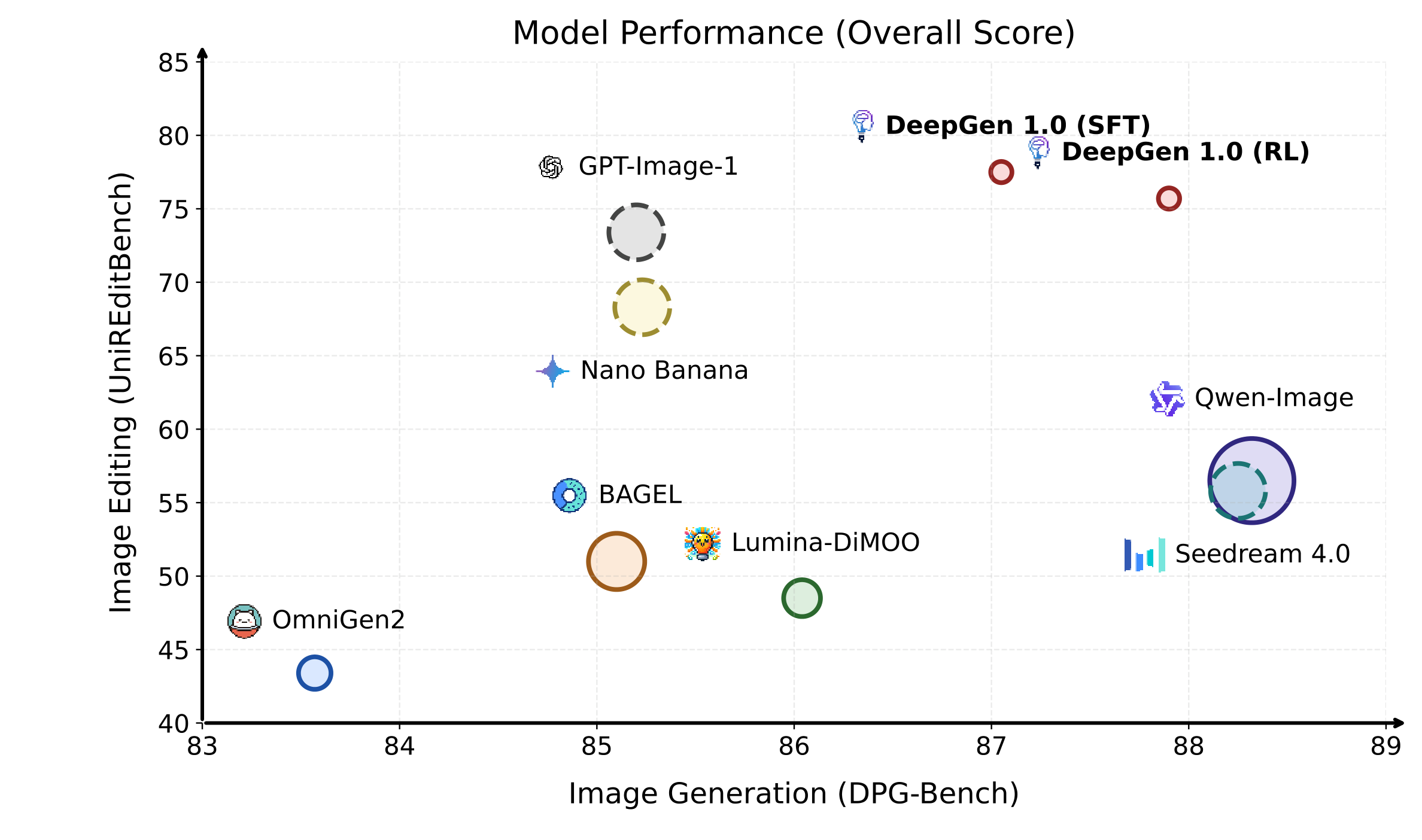
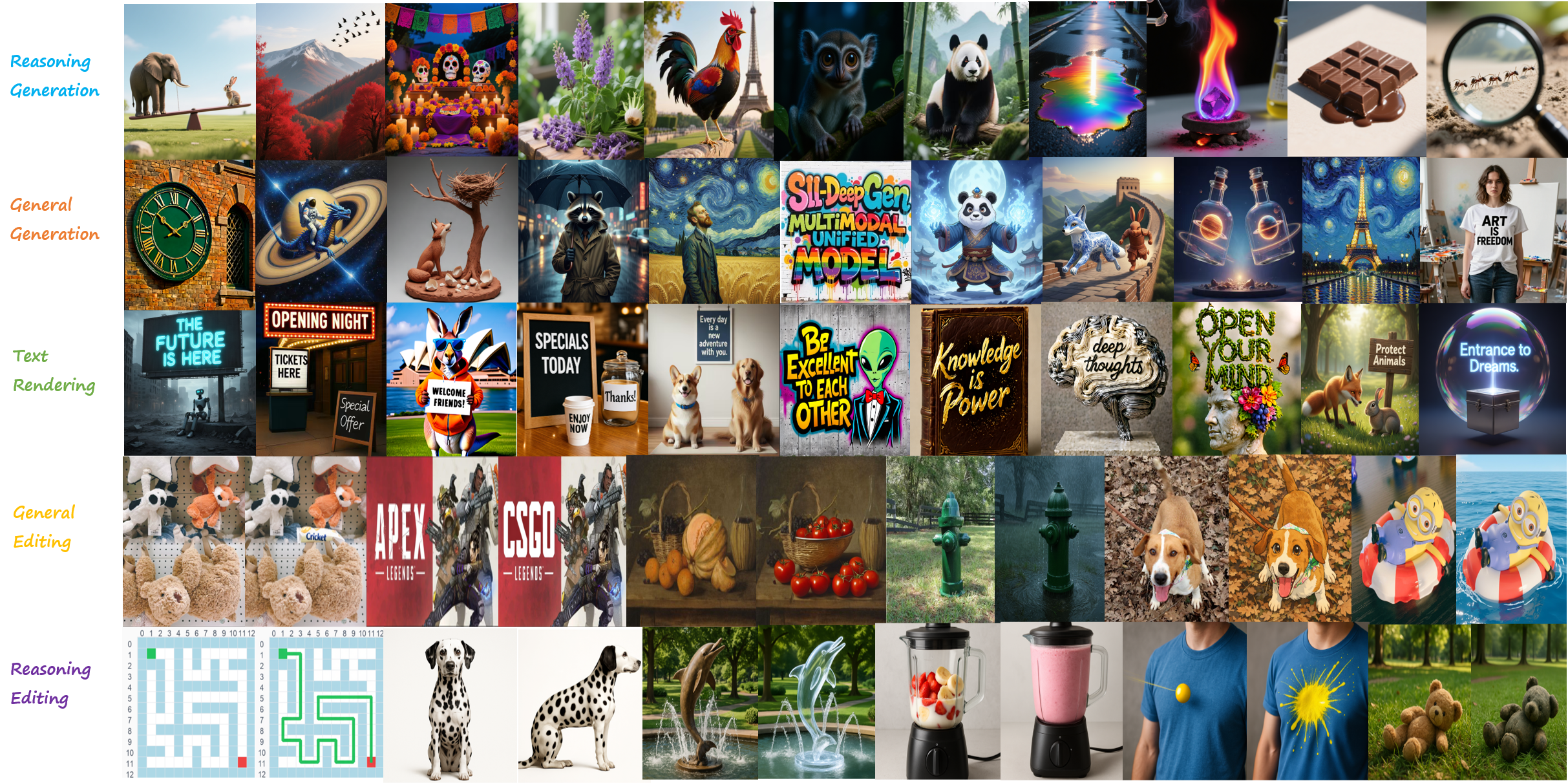
Broader Scenario and Dimension Coverage We propose DeepGen 1.0, a lightweight unified multimodal model with only 5B parameters (3B VLM + 2B DiT). It integrates five core capabilities: general image generation, general image editing, reasoning image generation, reasoning image editing, and text rendering—within a single model. Across multiple authoritative benchmarks, DeepGen 1.0 is competitive with or surpassing the state-of-the-art unified multimodal models that are 3× to 16× larger, achieving comprehensive performance, demonstrating that massive scaling is not the sole path to high-performance multimodal generation.
🧠 Method
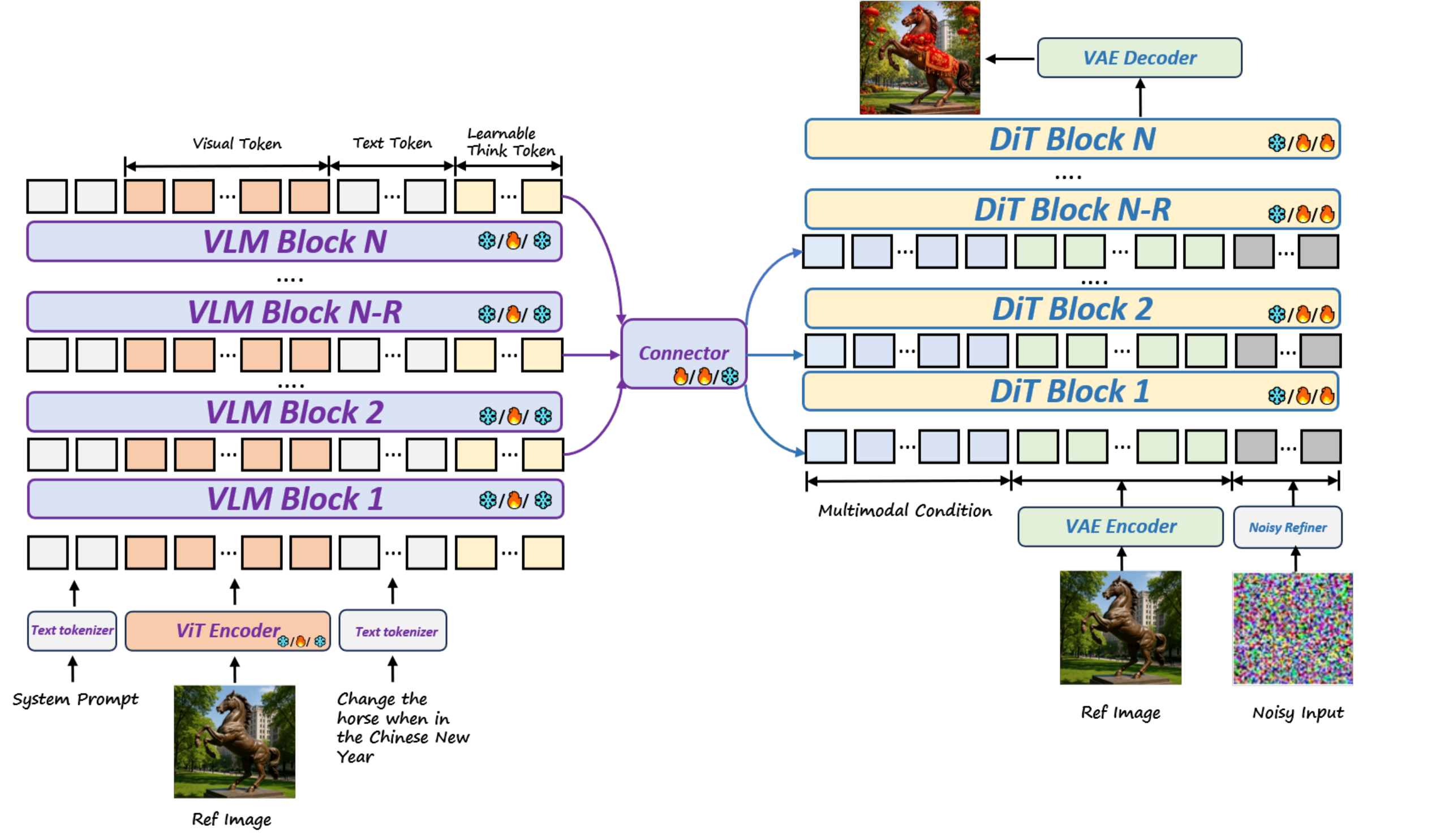
Our core observation is that a lightweight model, when empowered by synergistic architecture design and data-centric training strategies, can achieve comprehensive capabilities competitive with or even surpassing much larger counterparts. To overcome the limitations of lightweight models in semantic understanding and fine-grained control, we introduce Stacked Channel Bridging (SCB), a deep alignment framework that extracts hierarchical features from multiple VLM layers and fuses them with learnable "think tokens" to provide the generative backbone with structured, reasoning-rich guidance. We further design a data-centric training strategy spanning three progressive stages: (1) Alignment Pre-training on large-scale image-text pairs and editing triplets to synchronize VLM and DiT representations, (2) Joint Supervised Fine-tuning on a high-quality mixture of generation, editing, and reasoning tasks to foster omni-capabilities, and (3) Reinforcement Learning with MR-GRPO, which leverages a mixture of reward functions and supervision signals, resulting in substantial gains in generation quality and alignment with human preferences, while maintaining stable training progress and avoiding visual artifacts.
💻 Train & Eval
Set up environment
git clone https://github.com/deepgenteam/deepgen.git
cd deepgen
conda create -n deepgen python=3.12 -y
conda activate deepgen
pip install -r requirements.txt
pip install flash_attn==2.8.3 --no-build-isolation
pip install xtuner==0.2.0
pip install transformers==4.56.1
pip install triton==2.3.0
pip install -U opencv-python-headless
Data Prepare
Please See DATA for more details. We provide a detailed description of the data download and usage procedures for both the Pre-traning stage and the Supervised Fine-Tuning stage.
Inference
Diffusers (click to expand)
We provide a diffusers-compatible format at 🤗deepgenteam/DeepGen-1.0-diffusers.
Text-to-Image:
import torch
from diffusers import DiffusionPipeline

pipe = DiffusionPipeline.from_pretrained(
    "deepgenteam/DeepGen-1.0-diffusers",
    torch_dtype=torch.bfloat16,
    trust_remote_code=True,
)
pipe.to("cuda")

result = pipe(
    prompt="a photo of a blue pizza and a yellow baseball glove",
    height=512, width=512,
    num_inference_steps=50,
    guidance_scale=4.0,
    seed=42,
)
result.images[0].save("output.png")
Image Editing:
from PIL import Image

result = pipe(
    prompt="Place this guitar on a sandy beach with the sunset in the background.",
    image=Image.open("guitar.png"),
    negative_prompt="blurry, low quality, low resolution, distorted, deformed, broken content, missing parts, damaged details, artifacts, glitch, noise, pixelated, grainy, compression artifacts, bad composition, wrong proportion, incomplete editing, unfinished, unedited areas.",
    height=512, width=512,
    num_inference_steps=50,
    guidance_scale=4.0,
    seed=42,
)
result.images[0].save("edited.png")
Please refer to INFERENCE for more details, including the native pipeline usage.
Train
See TRAIN for more details. We provide a detailed description of the model and training configs for both the Pre-traning stage and the Supervised Fine-Tuning stage.
Eval
We provide the scripts for evaluating wide range of T2I and Editing benchmarks. Please See EVAL for more details.
📊 Benchmarks
1. General Image Generation
| Model | Params | Geneval ↑ | DPGBench ↑ | UniGenBench ↑ |
|---|---|---|---|---|
| OmniGen2 | 3B + 4B | 0.80 | 83.57 | 63.09 |
| BAGEL | 14B | 0.82 | 85.10 | 61.53 |
| X-Omni | 7B + 12B | 0.83 | 87.65🥉 | 53.77 |
| Lumina-DiMOO | 8B | 0.88🥇 | 86.04 | 71.12 |
| Hunyuan-Image-3.0 | 80B | 0.72 | 86.10 | — |
| Qwen-Image | 7B + 20B | 0.87 🥈 | 88.32 🥇 | 78.81 🥇 |
| LongCat-Image | 7B + 6B | 0.87 🥈 | 86.80 | — |
| Z-Image-Turbo | 4B + 6B | 0.84 | 85.15 | 71.40 |
| GLM-Image | 9B + 7B | — | 84.78 | — |
| DeepGen 1.0 (SFT) | 3B + 2B | 0.86 🥉 | 87.05 | 74.18 🥉 |
| DeepGen 1.0 (RL) | 3B + 2B | 0.87 🥈 | 87.90 🥈 | 75.74 🥈 |
2. General Image Editing
| Model | Params | GEdit-EN ↑ | ImgEdit ↑ |
|---|---|---|---|
| BAGEL | 14B | 6.52 | 3.20 |
| Qwen-Image-Edit [2509] | 7B + 20B | 7.54 🥈 | 4.35 🥈 |
| LongCat-Image-Edit | 7B + 6B | 7.60 🥇 | 4.50 🥇 |
| Mammoth2 | 8B + 3B + 2B | 6.60 | 4.06 |
| DeepGen 1.0 (SFT) | 3B + 2B | 7.12 | 4.09 |
| DeepGen 1.0 (RL) | 3B + 2B | 7.17 🥉 | 4.14 🥉 |
3. Reasoning Image Generation
| Model | Params | WISE ↑ | T2I-CoREBench ↑ |
|---|---|---|---|
| OmniGen2 | 3B + 4B | 0.47 | 36.1 |
| BAGEL | 14B | 0.70 🥉 | 41.1 |
| Hunyuan-Image-3.0 | 80B | 0.57 | 46.0 |
| Qwen-Image | 7B + 20B | 0.62 | 46.3 🥉 |
| LongCat-Image | 7B + 6B | 0.65 | 52.2 🥇 |
| Z-Image-Turbo | 4B + 6B | - | 43.7 |
| DeepGen 1.0 (SFT) | 3B + 2B | 0.72 🥈 | 45.7 |
| DeepGen 1.0 (RL) | 3B + 2B | 0.73 🥇 | 46.5 🥈 |
4. Reasoning Image Editing
| Model | Params | RISE ↑ | UniREditBench ↑ |
|---|---|---|---|
| OmniGen2 | 3B + 4B | - | 43.4 |
| BAGEL | 14B | 11.9 🥈 | 51.0 |
| Qwen-Image-Edit [2509] | 7B + 20B | 8.9 | 56.5 🥉 |
| DeepGen 1.0 (SFT) | 3B + 2B | 13.3 🥇 | 77.5 🥇 |
| DeepGen 1.0 (RL) | 3B + 2B | 10.8 🥉 | 75.7 🥈 |
📧 Contact
dywang24@m.fudan.edu.cn, wjqdev@gmail.com
🎨 Quantitative results
⭐ Citation
@article{wang2026deepgen,
  title={DeepGen 1.0: A Lightweight Unified Multimodal Model for Advancing Image Generation and Editing},
  author={Wang, Dianyi and Li, Ruihang and Han, Feng and Ma, Chaofan and Song, Wei and Wang, Siyuan and Wang, Yibin and Xin, Yi and Liu, Hongjian and Zhang, Zhixiong and others},
  journal={arXiv preprint arXiv:2602.12205},
  year={2026}
}
🙏 Acknowledgement
The project builds upon the following pioneering works:
- OpenUni: We thank the OpenUni releasing the elegant and concise code and pretrain dataset.
- UniPic2-SD3.5M-Kontext-2B: We use UniPic2-SD3.5M-Kontext-2B as our diffusion module, considering its efficiency and strong performance on both t2i and editing.
- UnifiedReward-Think: We use UnifiedReward-Think as our reward model for RL, considering its strong performance.
- Qwen2.5 VL: We useQwen2.5 VL-3B as our VLM module, considering its efficiency and strong performance on multimodal understanding abilities.
- BLIP3-o: We thank the BLIP3-o team for releasing the precious high-quality tuning dataset.
- OpenGPT-4o-Image: We thank the OpenGPT-4o-Image team for releasing the precious high-quality tuning dataset.
- ShareGPT-4o-Image: We thank the ShareGPT-4o-Image team for releasing the precious high-quality tuning dataset.
- Echo-4o: We thank the Echo-4o team for releasing the precious high-quality tuning dataset.
- OmniGen2: We thank the OmniGen2 team for releasing the precious high-quality editing tuning dataset and code.
- Uniworld-V1: We thank the Uniworld team for releasing the precious high-quality tuning dataset and code.
- Picobanana: We thank the Picobanana team for releasing the precious high-quality editing tuning dataset.
- Nano-consist: We thank the Nano-consist team for releasing the precious high-quality editing tuning dataset.
- NHR-edit: We thank the NHR-edit team for releasing the precious high-quality editing tuning dataset.
- UniREditBench: We thank the UniREditBench team for releasing the precious high-quality reason-based editing tuning dataset.
Significant stargazers

536 followers · starred Feb 2026
Similar repos


Languages
Python
99.9%
A Lightweight Unified Multimodal Model for Advancing Image Generation and Editing
See the codeREADME
DeepGen 1.0: A Lightweight Unified Multimodal Model for Advancing Image Generation and Editing
Shanghai Innovation Institute, DeepGen Team
🔥 News
- Feb 13, 2026: We released DeepGen 1.0, Pre-traning, Supervised Fine-Tuning and Reinforcement Learning checkpoints can be found in Huggingface, support both T2I generation and image editing.
- Feb 13, 2026: We released the training code support Pre-training, Supervised Fine-Tuning, Reinforcement Learning and evaluation code support wide range of benchmarks.
- Feb 13, 2026: We released the DeepGen 1.0 technical report on Arxiv
✨ Introduction
Broader Scenario and Dimension Coverage We propose DeepGen 1.0, a lightweight unified multimodal model with only 5B parameters (3B VLM + 2B DiT). It integrates five core capabilities: general image generation, general image editing, reasoning image generation, reasoning image editing, and text rendering—within a single model. Across multiple authoritative benchmarks, DeepGen 1.0 is competitive with or surpassing the state-of-the-art unified multimodal models that are 3× to 16× larger, achieving comprehensive performance, demonstrating that massive scaling is not the sole path to high-performance multimodal generation.
🧠 Method
Our core observation is that a lightweight model, when empowered by synergistic architecture design and data-centric training strategies, can achieve comprehensive capabilities competitive with or even surpassing much larger counterparts. To overcome the limitations of lightweight models in semantic understanding and fine-grained control, we introduce Stacked Channel Bridging (SCB), a deep alignment framework that extracts hierarchical features from multiple VLM layers and fuses them with learnable "think tokens" to provide the generative backbone with structured, reasoning-rich guidance. We further design a data-centric training strategy spanning three progressive stages: (1) Alignment Pre-training on large-scale image-text pairs and editing triplets to synchronize VLM and DiT representations, (2) Joint Supervised Fine-tuning on a high-quality mixture of generation, editing, and reasoning tasks to foster omni-capabilities, and (3) Reinforcement Learning with MR-GRPO, which leverages a mixture of reward functions and supervision signals, resulting in substantial gains in generation quality and alignment with human preferences, while maintaining stable training progress and avoiding visual artifacts.
💻 Train & Eval
Set up environment
git clone https://github.com/deepgenteam/deepgen.git
cd deepgen
conda create -n deepgen python=3.12 -y
conda activate deepgen
pip install -r requirements.txt
pip install flash_attn==2.8.3 --no-build-isolation
pip install xtuner==0.2.0
pip install transformers==4.56.1
pip install triton==2.3.0
pip install -U opencv-python-headless
Data Prepare
Please See DATA for more details. We provide a detailed description of the data download and usage procedures for both the Pre-traning stage and the Supervised Fine-Tuning stage.
Inference
Diffusers (click to expand)
We provide a diffusers-compatible format at 🤗deepgenteam/DeepGen-1.0-diffusers.
Text-to-Image:
import torch
from diffusers import DiffusionPipeline

pipe = DiffusionPipeline.from_pretrained(
    "deepgenteam/DeepGen-1.0-diffusers",
    torch_dtype=torch.bfloat16,
    trust_remote_code=True,
)
pipe.to("cuda")

result = pipe(
    prompt="a photo of a blue pizza and a yellow baseball glove",
    height=512, width=512,
    num_inference_steps=50,
    guidance_scale=4.0,
    seed=42,
)
result.images[0].save("output.png")
Image Editing:
from PIL import Image

result = pipe(
    prompt="Place this guitar on a sandy beach with the sunset in the background.",
    image=Image.open("guitar.png"),
    negative_prompt="blurry, low quality, low resolution, distorted, deformed, broken content, missing parts, damaged details, artifacts, glitch, noise, pixelated, grainy, compression artifacts, bad composition, wrong proportion, incomplete editing, unfinished, unedited areas.",
    height=512, width=512,
    num_inference_steps=50,
    guidance_scale=4.0,
    seed=42,
)
result.images[0].save("edited.png")
Please refer to INFERENCE for more details, including the native pipeline usage.
Train
See TRAIN for more details. We provide a detailed description of the model and training configs for both the Pre-traning stage and the Supervised Fine-Tuning stage.
Eval
We provide the scripts for evaluating wide range of T2I and Editing benchmarks. Please See EVAL for more details.
📊 Benchmarks
1. General Image Generation
| Model | Params | Geneval ↑ | DPGBench ↑ | UniGenBench ↑ |
|---|---|---|---|---|
| OmniGen2 | 3B + 4B | 0.80 | 83.57 | 63.09 |
| BAGEL | 14B | 0.82 | 85.10 | 61.53 |
| X-Omni | 7B + 12B | 0.83 | 87.65🥉 | 53.77 |
| Lumina-DiMOO | 8B | 0.88🥇 | 86.04 | 71.12 |
| Hunyuan-Image-3.0 | 80B | 0.72 | 86.10 | — |
| Qwen-Image | 7B + 20B | 0.87 🥈 | 88.32 🥇 | 78.81 🥇 |
| LongCat-Image | 7B + 6B | 0.87 🥈 | 86.80 | — |
| Z-Image-Turbo | 4B + 6B | 0.84 | 85.15 | 71.40 |
| GLM-Image | 9B + 7B | — | 84.78 | — |
| DeepGen 1.0 (SFT) | 3B + 2B | 0.86 🥉 | 87.05 | 74.18 🥉 |
| DeepGen 1.0 (RL) | 3B + 2B | 0.87 🥈 | 87.90 🥈 | 75.74 🥈 |
2. General Image Editing
| Model | Params | GEdit-EN ↑ | ImgEdit ↑ |
|---|---|---|---|
| BAGEL | 14B | 6.52 | 3.20 |
| Qwen-Image-Edit [2509] | 7B + 20B | 7.54 🥈 | 4.35 🥈 |
| LongCat-Image-Edit | 7B + 6B | 7.60 🥇 | 4.50 🥇 |
| Mammoth2 | 8B + 3B + 2B | 6.60 | 4.06 |
| DeepGen 1.0 (SFT) | 3B + 2B | 7.12 | 4.09 |
| DeepGen 1.0 (RL) | 3B + 2B | 7.17 🥉 | 4.14 🥉 |
3. Reasoning Image Generation
| Model | Params | WISE ↑ | T2I-CoREBench ↑ |
|---|---|---|---|
| OmniGen2 | 3B + 4B | 0.47 | 36.1 |
| BAGEL | 14B | 0.70 🥉 | 41.1 |
| Hunyuan-Image-3.0 | 80B | 0.57 | 46.0 |
| Qwen-Image | 7B + 20B | 0.62 | 46.3 🥉 |
| LongCat-Image | 7B + 6B | 0.65 | 52.2 🥇 |
| Z-Image-Turbo | 4B + 6B | - | 43.7 |
| DeepGen 1.0 (SFT) | 3B + 2B | 0.72 🥈 | 45.7 |
| DeepGen 1.0 (RL) | 3B + 2B | 0.73 🥇 | 46.5 🥈 |
4. Reasoning Image Editing
| Model | Params | RISE ↑ | UniREditBench ↑ |
|---|---|---|---|
| OmniGen2 | 3B + 4B | - | 43.4 |
| BAGEL | 14B | 11.9 🥈 | 51.0 |
| Qwen-Image-Edit [2509] | 7B + 20B | 8.9 | 56.5 🥉 |
| DeepGen 1.0 (SFT) | 3B + 2B | 13.3 🥇 | 77.5 🥇 |
| DeepGen 1.0 (RL) | 3B + 2B | 10.8 🥉 | 75.7 🥈 |
📧 Contact
dywang24@m.fudan.edu.cn, wjqdev@gmail.com
🎨 Quantitative results
⭐ Citation
@article{wang2026deepgen,
  title={DeepGen 1.0: A Lightweight Unified Multimodal Model for Advancing Image Generation and Editing},
  author={Wang, Dianyi and Li, Ruihang and Han, Feng and Ma, Chaofan and Song, Wei and Wang, Siyuan and Wang, Yibin and Xin, Yi and Liu, Hongjian and Zhang, Zhixiong and others},
  journal={arXiv preprint arXiv:2602.12205},
  year={2026}
}
🙏 Acknowledgement
The project builds upon the following pioneering works:
- OpenUni: We thank the OpenUni releasing the elegant and concise code and pretrain dataset.
- UniPic2-SD3.5M-Kontext-2B: We use UniPic2-SD3.5M-Kontext-2B as our diffusion module, considering its efficiency and strong performance on both t2i and editing.
- UnifiedReward-Think: We use UnifiedReward-Think as our reward model for RL, considering its strong performance.
- Qwen2.5 VL: We useQwen2.5 VL-3B as our VLM module, considering its efficiency and strong performance on multimodal understanding abilities.
- BLIP3-o: We thank the BLIP3-o team for releasing the precious high-quality tuning dataset.
- OpenGPT-4o-Image: We thank the OpenGPT-4o-Image team for releasing the precious high-quality tuning dataset.
- ShareGPT-4o-Image: We thank the ShareGPT-4o-Image team for releasing the precious high-quality tuning dataset.
- Echo-4o: We thank the Echo-4o team for releasing the precious high-quality tuning dataset.
- OmniGen2: We thank the OmniGen2 team for releasing the precious high-quality editing tuning dataset and code.
- Uniworld-V1: We thank the Uniworld team for releasing the precious high-quality tuning dataset and code.
- Picobanana: We thank the Picobanana team for releasing the precious high-quality editing tuning dataset.
- Nano-consist: We thank the Nano-consist team for releasing the precious high-quality editing tuning dataset.
- NHR-edit: We thank the NHR-edit team for releasing the precious high-quality editing tuning dataset.
- UniREditBench: We thank the UniREditBench team for releasing the precious high-quality reason-based editing tuning dataset.
Similar repos
Significant stargazers
536 followers · starred Feb 2026
Languages
Python
99.9%