Learn to build your Second Brain AI assistant with LLMs, agents, RAG, fine-tuning, LLMOps and AI systems techniques.
Jupyter Notebook
3,119
239 commits
updated Apr 6, 2026
Open-source course by Decoding AI in collaboration with
MongoDB, Comet, Opik, Unsloth and ZenML.
This course is part of Decoding AI's open-source series, teaching you how to build production-ready GenAI systems using LLMs, RAG, agents and LLMOps.
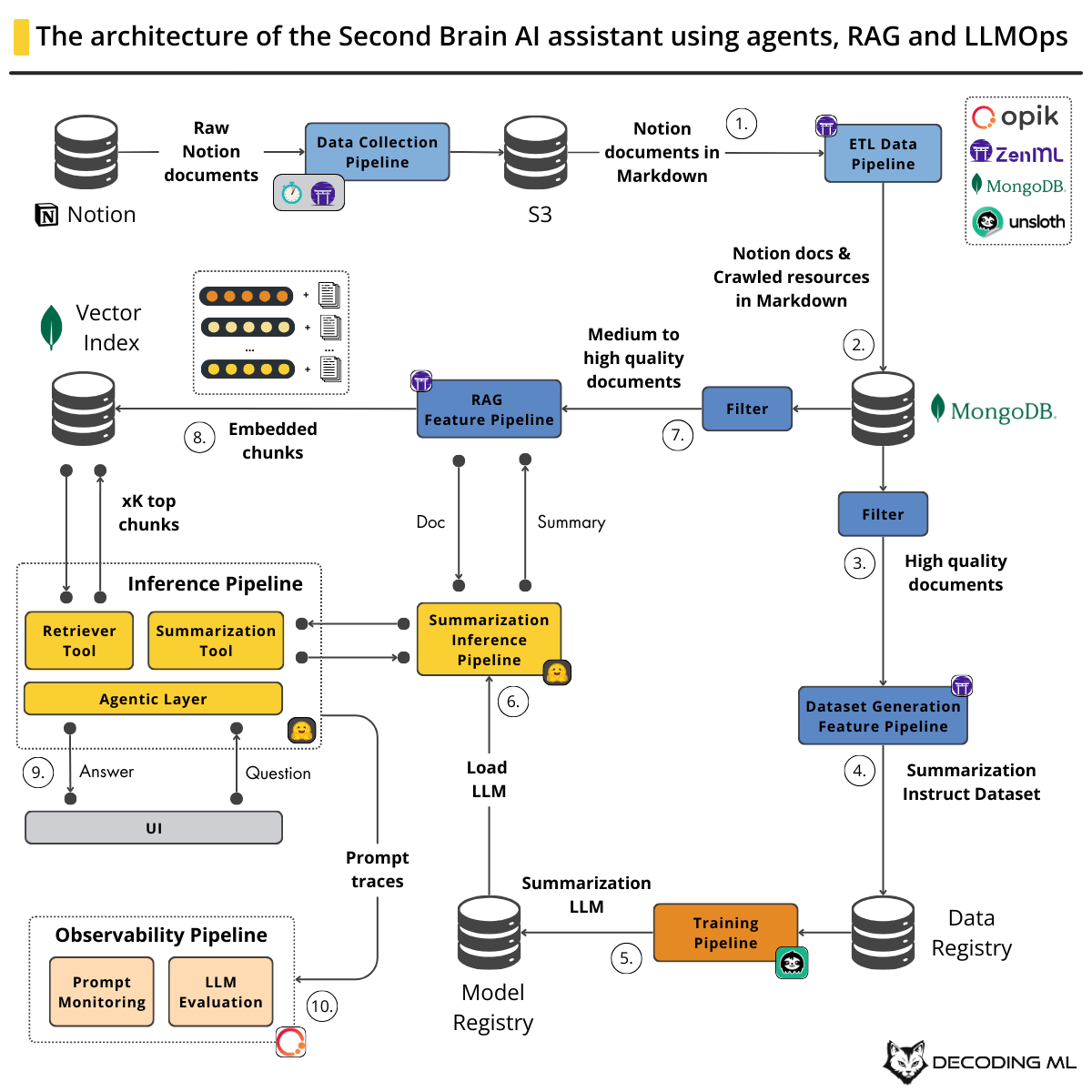
The Second Brain AI Assistant course contains 6 modules that will teach you how to build an advanced RAG and LLM system using LLMOps and ML systems best practices. You'll learn to build an end-to-end AI assistant that chats with your Second Brain - your personal knowledge base of notes, resources, and storage.
By the end of this course, you'll be able to architect and implement a production-ready agentic RAG and LLM system from scratch.
The Second Brain, a concept by Tiago Forte, is your personal knowledge base of notes, ideas, and resources. Our AI Assistant leverages this knowledge to answer questions, summarize documents, and provide insights.
Imagine asking your AI Assistant to recommend agent courses, list top PDF parsing tools, or summarize LLM optimization methods - all based on your research, without manually searching through notes.
While we use Notion for this course, the code is adaptable to other sources like Google Drive or Calendar. We'll provide our curated AI/ML resource list from Notion, covering GenAI, LLMs, RAG, MLOps, and more. No Notion account needed - but if you want to use yours, our flexible pipeline supports any Notion database.
|
|
After completing this course, you'll have access to your own Second Brain AI assistant, as seen in the video below:
|
|
📬 Stay UpdatedJoin Decoding AI for proven content on designing, coding, and deploying production-grade AI systems with software engineering and MLOps best practices to help you ship AI applications. Every week, straight to your inbox. |

While building the Second Brain AI assistant, you'll master:
🥷 With these skills, you'll become a ninja in building advanced agentic RAG and LLM systems using LLMOps and ML systems best practices.
|
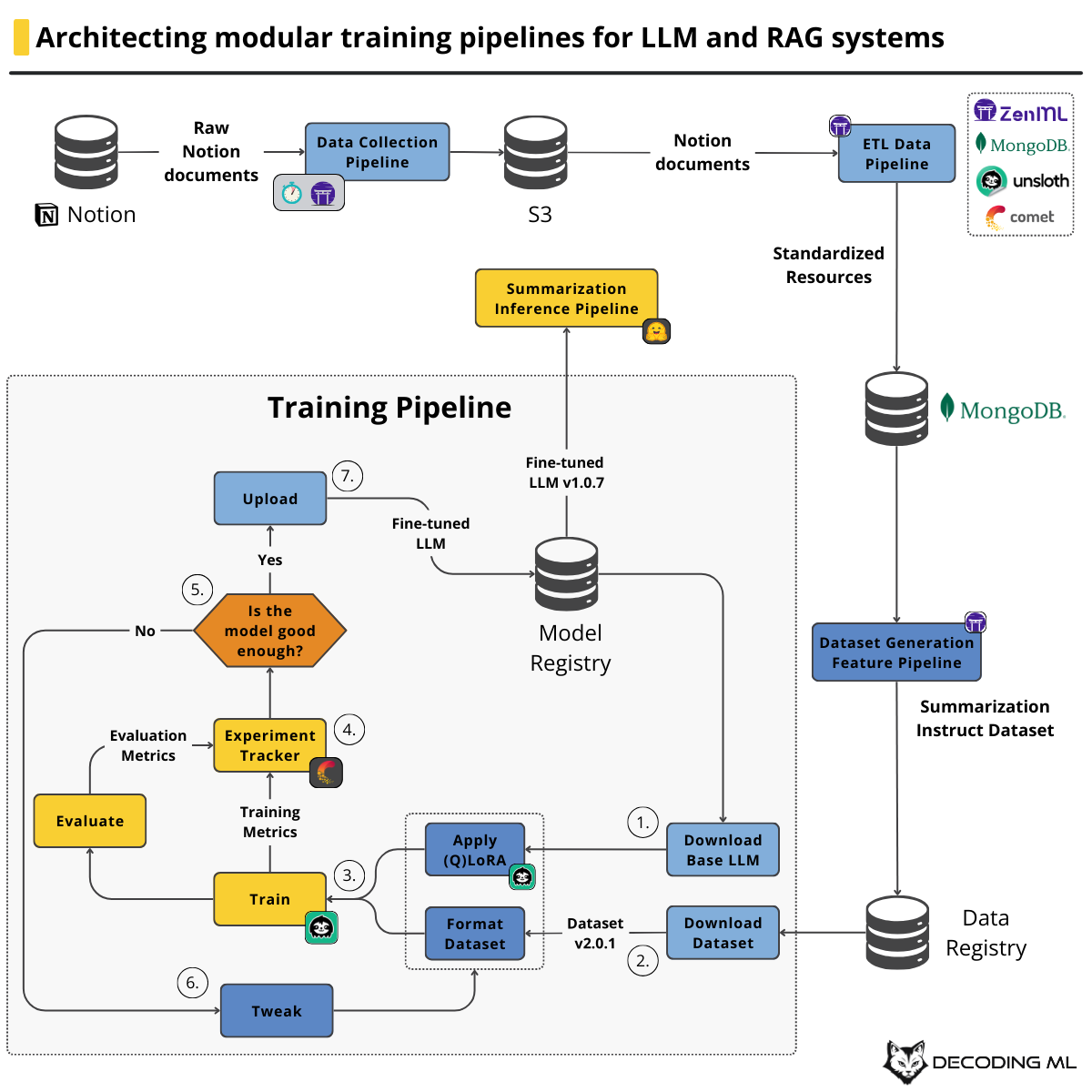
|
People interested in learning how to design and build LLM/RAG applications and systems.
This course is tailored for people who learn by building. After completing the course, you will have your own code template and enough inspiration to develop your personal GenAI applications.
| Target Audience | Why Join? |
|---|---|
| ML/AI Engineers | Build production-ready agentic RAG & LLM systems (beyond Notebook tutorials). |
| Data/Software Engineers | Architect end-to-end agentic RAG and LLM applications. |
| Data Scientists | Implement production AI systems using LLMOps and SWE best practices. |
| Category | Requirements |
|---|---|
| Skills | - Python (Intermediate) - Machine Learning, LLMs, RAG (Beginner) |
| Hardware | Modern laptop/PC (GPU optional - cloud alternatives provided) |
| Level | Intermediate (But with a little sweat and patience, anyone can do it) |
The course is open-source and free! You'll only need $1-$5 for tools if you run the code:
| Service | Maximum Cost |
|---|---|
| OpenAI's API | ~$3 |
| Hugging Face's Dedicated Endpoints (Optional) | ~$2 |
The best part? We offer multiple paths - you can complete the entire course for just ~$1 by choosing cost-efficient options. Reading-only? Everything's free!
As an open-source course, you don't have to enroll. Everything is self-paced, free of charge and with its resources freely accessible at:
This open-source course consists of 6 comprehensive modules covering theory, system design, and hands-on implementation.
Read this for a quick walkthrough of what you will learn in each module.
Our recommendation for getting the most out of this course:
| Module | Materials | Description | Running the code |
|---|---|---|---|
0 | Modules Overview | Quick walkthrough over what you will learn in each module. | No code |
1 | Build your Second Brain AI assistant | Architect an AI assistant for your Second Brain. | No code |
2 | Data pipelines for AI assistants | Build a data ETL pipeline to process custom Notion data, crawl documents, compute a quality score using LLMs & heuristics, and ingest them into a document database. | apps/second-brain-offline |
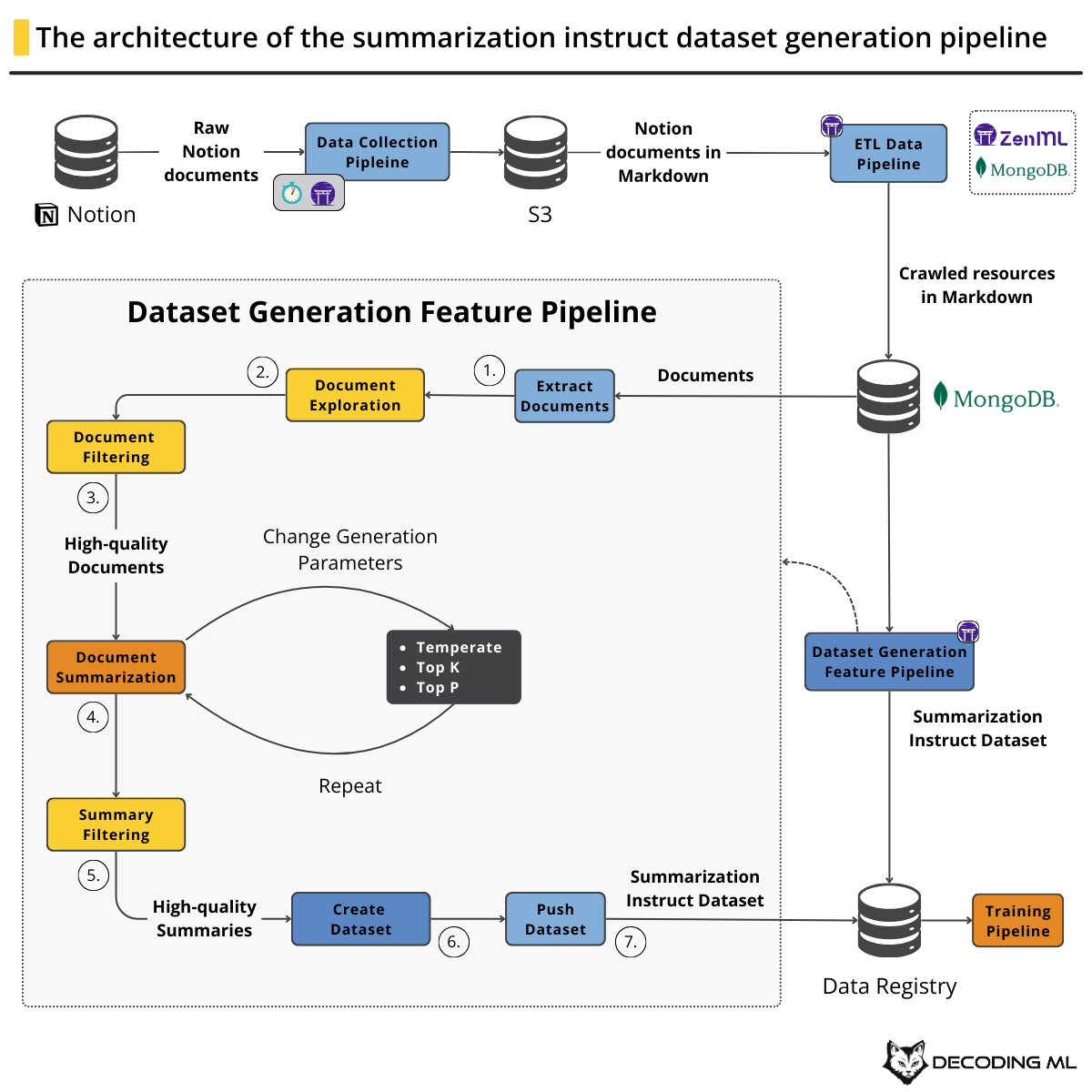
3 | From noisy docs to fine-tuning datasets | Use the Notion and crawled data to generate a high-quality summarization instruct dataset using distillation. | apps/second-brain-offline |
4 | Playbook to fine-tune and deploy LLMs | Fine-tune an open-source LLM (Llama 3.1 8B) to specialize in summarizing documents. Deploy it as a real-time API endpoint. | apps/second-brain-offline |
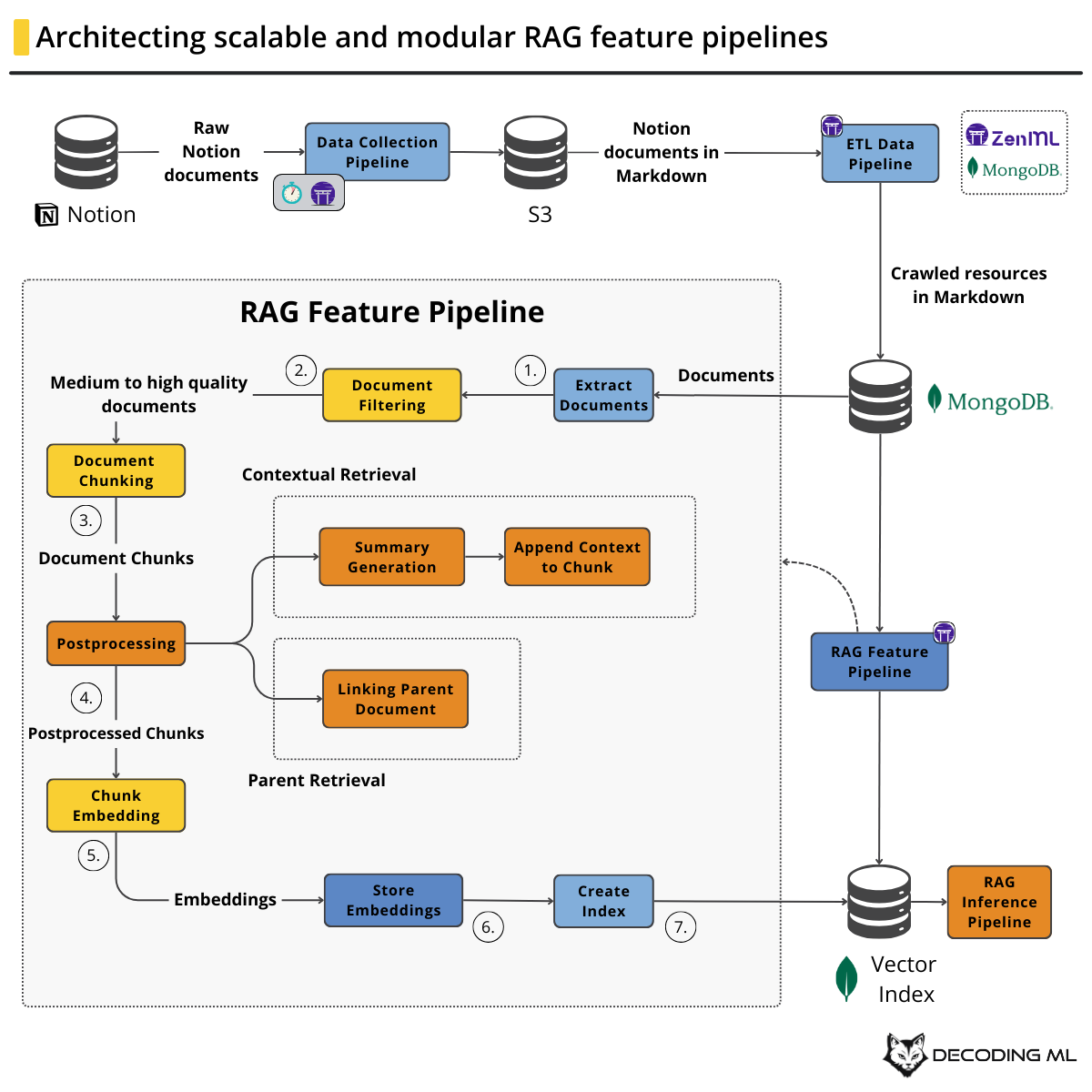
5 | Build RAG pipelines that actually work | Implement a modular RAG feature pipeline using advanced techniques such as context and parent retrieval. | apps/second-brain-offline |
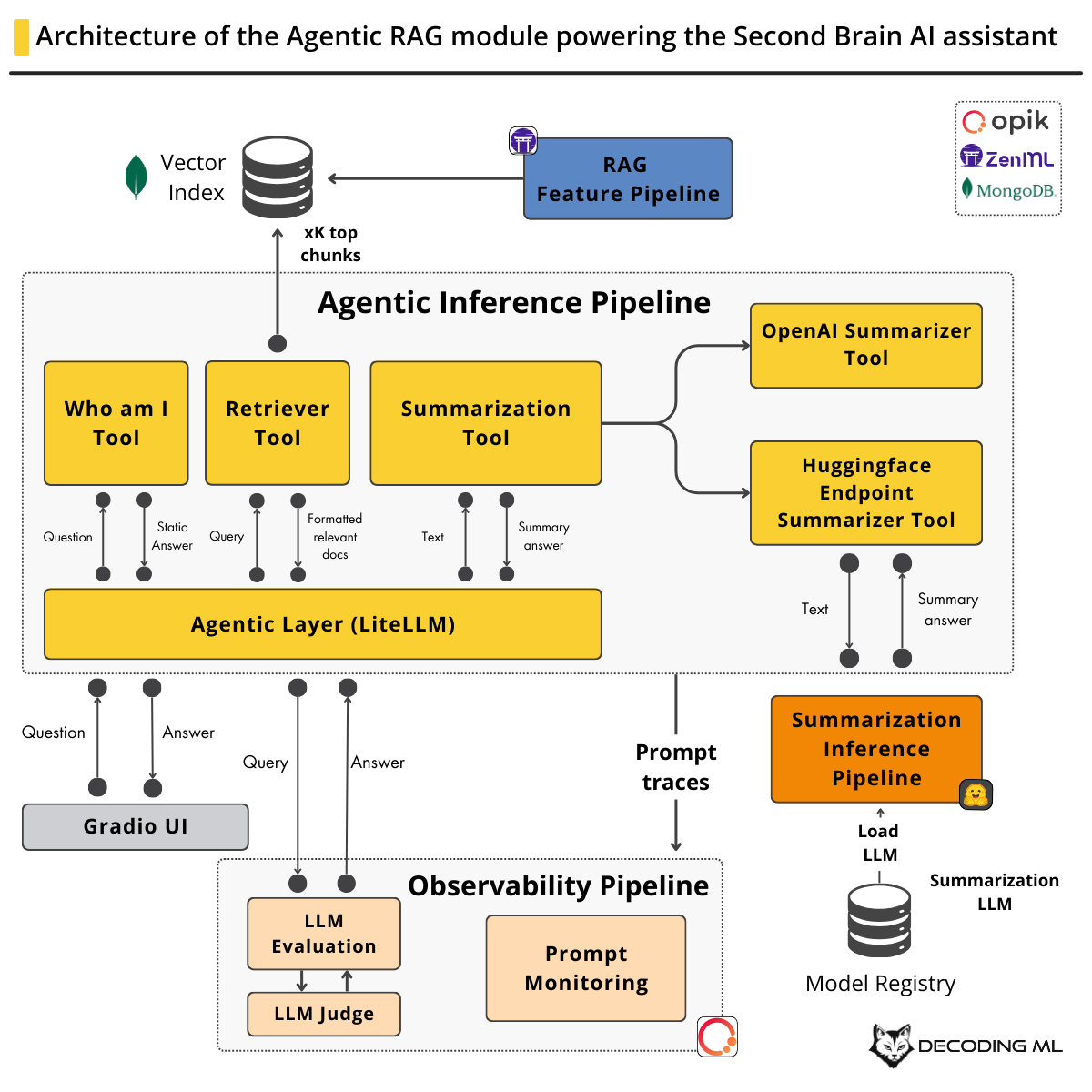
6 | LLMOps for production agentic RAG | Implement the RAG agentic inference pipeline and an observation pipeline to monitor and evaluate the performance of the AI assistant. | apps/second-brain-online |
|
|
📬 Stay UpdatedJoin Decoding AI for proven content on designing, coding, and deploying production-grade AI systems with software engineering and MLOps best practices to help you ship AI applications. Every week, straight to your inbox. |
While building the Second Brain AI assistant, we will build two separate Python applications:
.
├── apps /
|   ├── infrastructure/           # Docker infrastructure for the applications
|   ├── second-brain-offline/     # Offline ML pipelines
└─  └── second-brain-online/      # Online inference pipeline = our AI assistant
We will use our personal list of filtered resources (which we keep in Notion) on AI and ML, such as GenAI, LLMs, RAG, MLOps, LLMOps and information retrieval, containing ~100 pages and 500+ links which we will crawl and access from the Second Brain AI assistant.
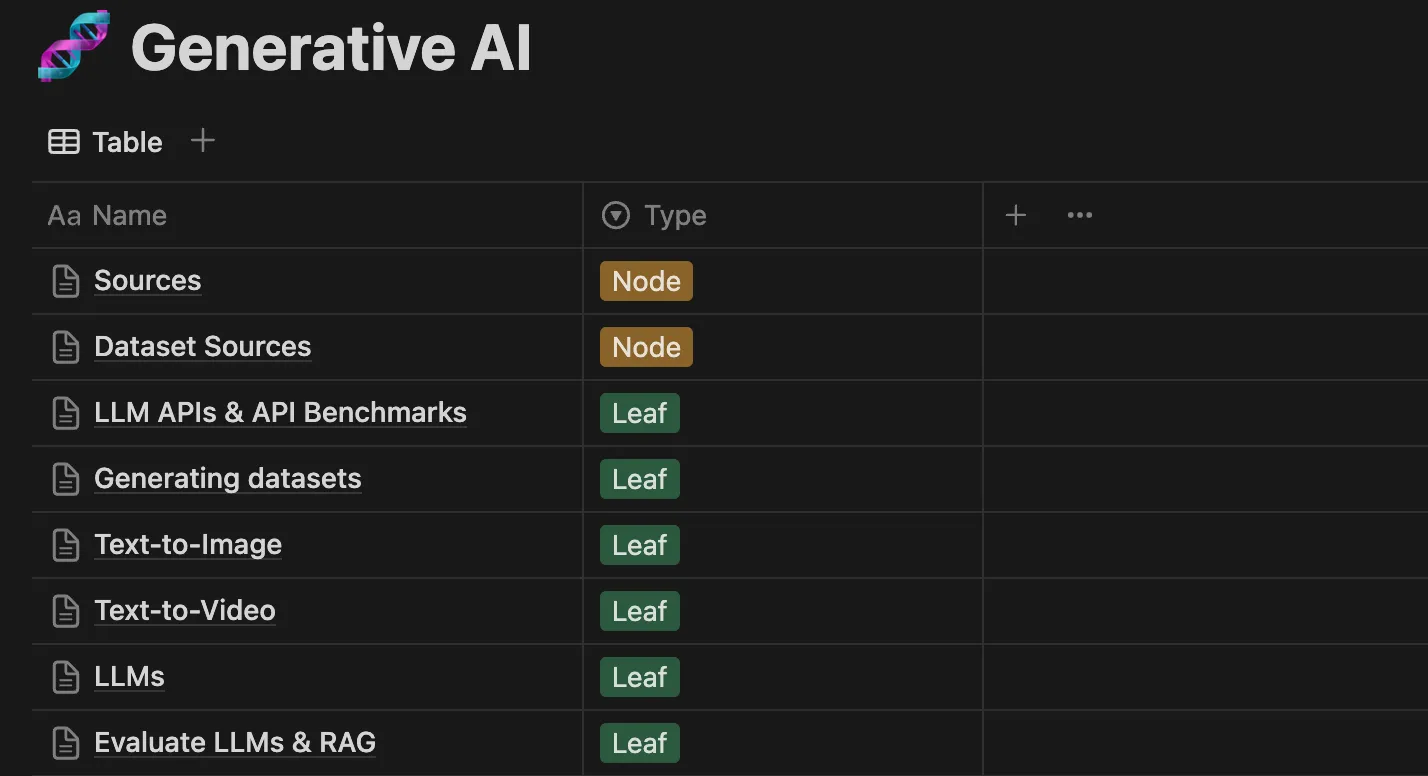
For ease of use, we stored a snapshot of our Notion data in a public S3 bucket, which you can download for free without AWS credentials.
Thus, you don't need to use Notion or give access to your Notion to complete this course. But if you want to, you can, as we expose in this GitHub repository, a flexible pipeline that can load any Notion database.
Find detailed setup instructions in each app's documentation:
| Application | Documentation |
|---|---|
| Offline ML Pipelines (data pipelines, RAG, fine-tuning, etc.) | apps/second-brain-offline |
| Online Inference Pipeline (Second Brain AI assistant) | apps/second-brain-online |
Pro tip: Read the accompanying articles first for a better understanding of the system you'll build.
Have questions or running into issues? We're here to help!
Open a GitHub issue for:
As an open-source course, we may not be able to fix all the bugs that arise.
If you find any bugs and know how to fix them, support future readers by contributing to this course with your bug fix.
You can always contribute by:
📍 For more details, see the contributing guide.
We will deeply appreciate your support for the AI community and future readers 🤗

|

|

|

|

|
 Paul Iusztin AI/ML Engineer |
 Ernesto Larios AI Engineer |
 Anca Ioana Muscalagiu SWE/ML Engineer |
This project is licensed under the MIT License - see the LICENSE file for details.
|
|
📬 Stay UpdatedJoin Decoding AI for proven content on designing, coding, and deploying production-grade AI systems with software engineering and MLOps best practices to help you ship AI applications. Every week, straight to your inbox. |
720 followers · starred Dec 2025
54 followers · starred Jan 2026
629 followers · starred Feb 2025
2 followers · starred Dec 2025
Learn to build your Second Brain AI assistant with LLMs, agents, RAG, fine-tuning, LLMOps and AI systems techniques.
Jupyter Notebook
3,119
239 commits
updated Apr 6, 2026
Open-source course by Decoding AI in collaboration with
MongoDB, Comet, Opik, Unsloth and ZenML.
This course is part of Decoding AI's open-source series, teaching you how to build production-ready GenAI systems using LLMs, RAG, agents and LLMOps.
The Second Brain AI Assistant course contains 6 modules that will teach you how to build an advanced RAG and LLM system using LLMOps and ML systems best practices. You'll learn to build an end-to-end AI assistant that chats with your Second Brain - your personal knowledge base of notes, resources, and storage.
By the end of this course, you'll be able to architect and implement a production-ready agentic RAG and LLM system from scratch.
The Second Brain, a concept by Tiago Forte, is your personal knowledge base of notes, ideas, and resources. Our AI Assistant leverages this knowledge to answer questions, summarize documents, and provide insights.
Imagine asking your AI Assistant to recommend agent courses, list top PDF parsing tools, or summarize LLM optimization methods - all based on your research, without manually searching through notes.
While we use Notion for this course, the code is adaptable to other sources like Google Drive or Calendar. We'll provide our curated AI/ML resource list from Notion, covering GenAI, LLMs, RAG, MLOps, and more. No Notion account needed - but if you want to use yours, our flexible pipeline supports any Notion database.
|
|
|
After completing this course, you'll have access to your own Second Brain AI assistant, as seen in the video below:
|
|
📬 Stay UpdatedJoin Decoding AI for proven content on designing, coding, and deploying production-grade AI systems with software engineering and MLOps best practices to help you ship AI applications. Every week, straight to your inbox. |
While building the Second Brain AI assistant, you'll master:
🥷 With these skills, you'll become a ninja in building advanced agentic RAG and LLM systems using LLMOps and ML systems best practices.
|
|
|
People interested in learning how to design and build LLM/RAG applications and systems.
This course is tailored for people who learn by building. After completing the course, you will have your own code template and enough inspiration to develop your personal GenAI applications.
| Target Audience | Why Join? |
|---|---|
| ML/AI Engineers | Build production-ready agentic RAG & LLM systems (beyond Notebook tutorials). |
| Data/Software Engineers | Architect end-to-end agentic RAG and LLM applications. |
| Data Scientists | Implement production AI systems using LLMOps and SWE best practices. |
| Category | Requirements |
|---|---|
| Skills | - Python (Intermediate) - Machine Learning, LLMs, RAG (Beginner) |
| Hardware | Modern laptop/PC (GPU optional - cloud alternatives provided) |
| Level | Intermediate (But with a little sweat and patience, anyone can do it) |
The course is open-source and free! You'll only need $1-$5 for tools if you run the code:
| Service | Maximum Cost |
|---|---|
| OpenAI's API | ~$3 |
| Hugging Face's Dedicated Endpoints (Optional) | ~$2 |
The best part? We offer multiple paths - you can complete the entire course for just ~$1 by choosing cost-efficient options. Reading-only? Everything's free!
As an open-source course, you don't have to enroll. Everything is self-paced, free of charge and with its resources freely accessible at:
This open-source course consists of 6 comprehensive modules covering theory, system design, and hands-on implementation.
Read this for a quick walkthrough of what you will learn in each module.
Our recommendation for getting the most out of this course:
| Module | Materials | Description | Running the code |
|---|---|---|---|
0 | Modules Overview | Quick walkthrough over what you will learn in each module. | No code |
1 | Build your Second Brain AI assistant | Architect an AI assistant for your Second Brain. | No code |
2 | Data pipelines for AI assistants | Build a data ETL pipeline to process custom Notion data, crawl documents, compute a quality score using LLMs & heuristics, and ingest them into a document database. | apps/second-brain-offline |
3 | From noisy docs to fine-tuning datasets | Use the Notion and crawled data to generate a high-quality summarization instruct dataset using distillation. | apps/second-brain-offline |
4 | Playbook to fine-tune and deploy LLMs | Fine-tune an open-source LLM (Llama 3.1 8B) to specialize in summarizing documents. Deploy it as a real-time API endpoint. | apps/second-brain-offline |
5 | Build RAG pipelines that actually work | Implement a modular RAG feature pipeline using advanced techniques such as context and parent retrieval. | apps/second-brain-offline |
6 | LLMOps for production agentic RAG | Implement the RAG agentic inference pipeline and an observation pipeline to monitor and evaluate the performance of the AI assistant. | apps/second-brain-online |
|
|
📬 Stay UpdatedJoin Decoding AI for proven content on designing, coding, and deploying production-grade AI systems with software engineering and MLOps best practices to help you ship AI applications. Every week, straight to your inbox. |
While building the Second Brain AI assistant, we will build two separate Python applications:
.
├── apps /
|   ├── infrastructure/           # Docker infrastructure for the applications
|   ├── second-brain-offline/     # Offline ML pipelines
└─  └── second-brain-online/      # Online inference pipeline = our AI assistant
We will use our personal list of filtered resources (which we keep in Notion) on AI and ML, such as GenAI, LLMs, RAG, MLOps, LLMOps and information retrieval, containing ~100 pages and 500+ links which we will crawl and access from the Second Brain AI assistant.
For ease of use, we stored a snapshot of our Notion data in a public S3 bucket, which you can download for free without AWS credentials.
Thus, you don't need to use Notion or give access to your Notion to complete this course. But if you want to, you can, as we expose in this GitHub repository, a flexible pipeline that can load any Notion database.
Find detailed setup instructions in each app's documentation:
| Application | Documentation |
|---|---|
| Offline ML Pipelines (data pipelines, RAG, fine-tuning, etc.) | apps/second-brain-offline |
| Online Inference Pipeline (Second Brain AI assistant) | apps/second-brain-online |
Pro tip: Read the accompanying articles first for a better understanding of the system you'll build.
Have questions or running into issues? We're here to help!
Open a GitHub issue for:
As an open-source course, we may not be able to fix all the bugs that arise.
If you find any bugs and know how to fix them, support future readers by contributing to this course with your bug fix.
You can always contribute by:
📍 For more details, see the contributing guide.
We will deeply appreciate your support for the AI community and future readers 🤗
|
|
|
|
|
|
|
Paul Iusztin AI/ML Engineer |
Ernesto Larios AI Engineer |
Anca Ioana Muscalagiu SWE/ML Engineer |
This project is licensed under the MIT License - see the LICENSE file for details.
|
|
📬 Stay UpdatedJoin Decoding AI for proven content on designing, coding, and deploying production-grade AI systems with software engineering and MLOps best practices to help you ship AI applications. Every week, straight to your inbox. |
720 followers · starred Dec 2025
54 followers · starred Jan 2026
629 followers · starred Feb 2025
2 followers · starred Dec 2025



