Agnostic pagination in plain ruby
See the code









Agnostic pagination in plain Ruby
[!TIP] ⭐ If you like Pagy, please support it with a Star! ⭐
We needed a leap version to unequivocally signal that it's not just a major version: it's a complete redesign of the legacy code at all levels, usage and API included.
Why 43? Because it's exactly one step beyond "The answer to the ultimate question of life, the Universe, and everything." 😉
This version introduces several enhancements, such as new :countish and :keynav_js paginators and improved automation and configuration processes, reducing setup requirements by 99%. The update also includes a simpler API and new interactive development tools, making it a comprehensive upgrade from previous versions.
See the Upgrade Guide
Take a look at the Examples for a quick overview of the new API.
[!TIP] ⭐ If you like Pagy, please support it with a Star! ⭐
# Include pagy in your code (usually application_controller.rb)
include Pagy::Method

# Offset-based pagination
@pagy, @records = pagy(:offset, Product.all)

# Keyset-based pagination (fastest technique)
@pagy, @records = pagy(:keyset, Product.order(my_order).all)

# Paginate your collection with one of several paginators
@pagy, @records = pagy(...)
See all the available paginators
# JSON:API nested query string. E.g.: ?page[number]=2&page[size]=100
@pagy, @records = pagy(:offset, Product.all, jsonapi: true)
@pagy, @records = pagy(:keyset, Product.order(my_order).all, jsonapi: true)
render json: { links: @pagy.urls_hash, data: @records }
render json: { pagy: @pagy.data_hash, data: @records }
Available paginators: :elasticsearch_rails, :meilisearch, :rails_active_search, :searchkick, :typesense_rails
# Extend your models (e.g. application_record.rb)
extend Pagy::Search

# Paginate with pagy:
search           = Product.pagy_search(params[:q])
@pagy, @response = pagy(:a_search_paginator, search)

# Or get pagy from paginated results:
@results = Product.search(params[:q])
@pagy    = pagy(:a_search_paginator, @results)
Combine time-range and offset pagination.
(Available time units: year, quarter, month, week, and day)
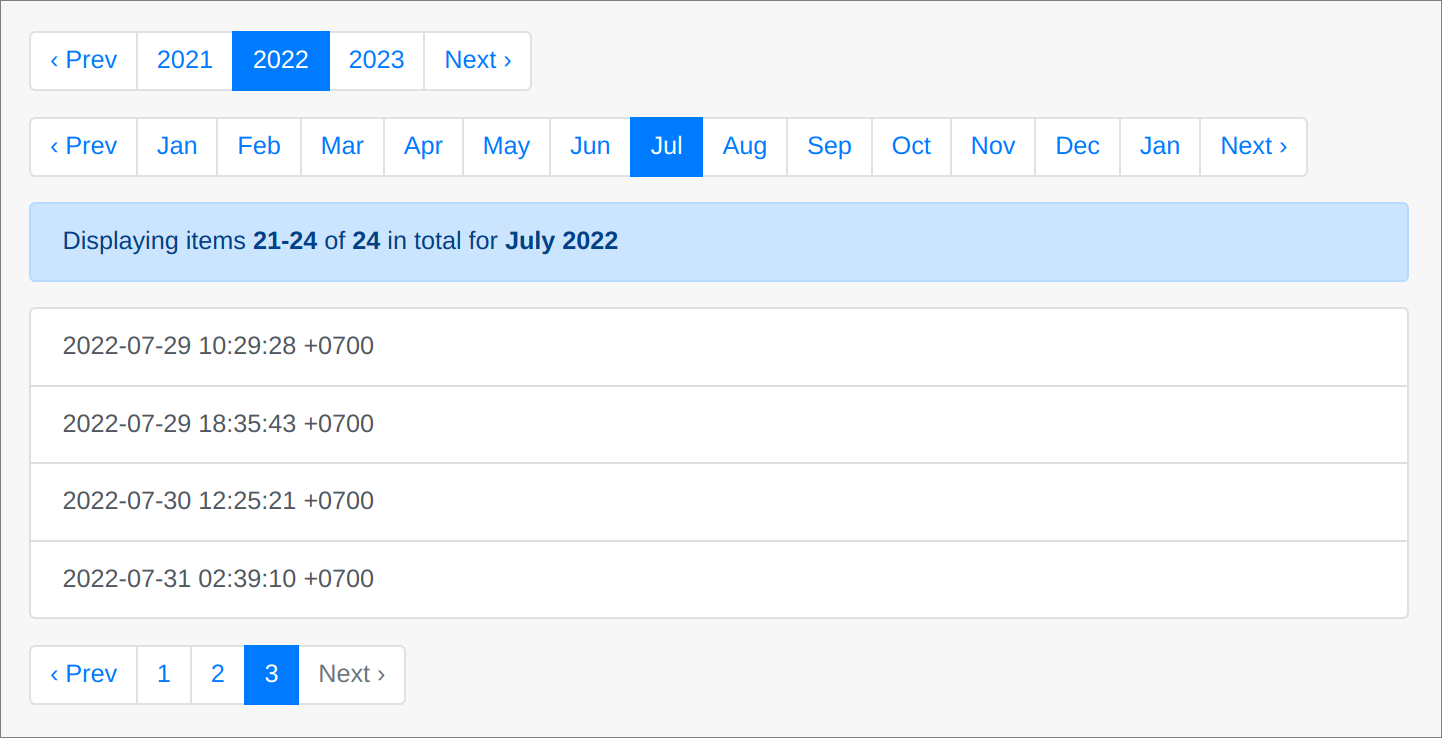
@calendar, @pagy, @records = pagy(:calendar, collection, year: {}, month: {}, offset: {})
<%== @calendar[:year].series_nav(:bootstrap) %>
<%== @calendar[:month].series_nav(:bootstrap) %>
<%== @pagy.info_tag %>
...
<%== @pagy.series_nav(:bootstrap) %>
series_navDefault :pagy, :bootstrap and :bulma styles shown.



<!-- Render server side nav bar helpers with different html and styles -->
<%== @pagy.series_nav %> <!-- pagy style -->
<%== @pagy.series_nav(:bootstrap) %>
<%== @pagy.series_nav(:bulma) %>
# pagy.rb initializer
javascript_dir = Rails.root.join('app/javascript')
Pagy.sync_javascript(javascript_dir, 'pagy.mjs') if Rails.env.development?
series_nav_jsFaster and responsive
Dynamically fills the container width.


<!-- Render client side nav bar helpers with different html and styles -->
<%== @pagy.series_nav_js %> <!-- pagy style -->
<%== @pagy.series_nav_js(:bootstrap) %>
<%== @pagy.series_nav_js(:bulma) %>
input_nav_jsFastest! Combines navigation and info in minimum space.

<!-- Render client side nav input helpers with different html and styles -->
<%== @pagy.input_nav_js %> <!-- pagy style -->
<%== @pagy.input_nav_js(:bootstrap) %>
<%== @pagy.input_nav_js(:bulma) %>
Integrate pagy with your app's themes interactively (watch demo), and ask specific questions to the Pagy AI right in your app! You need only a single line in your page/layout head to get the Pagy Wand and the Pagy AI:
<%== Pagy.dev_tools %>
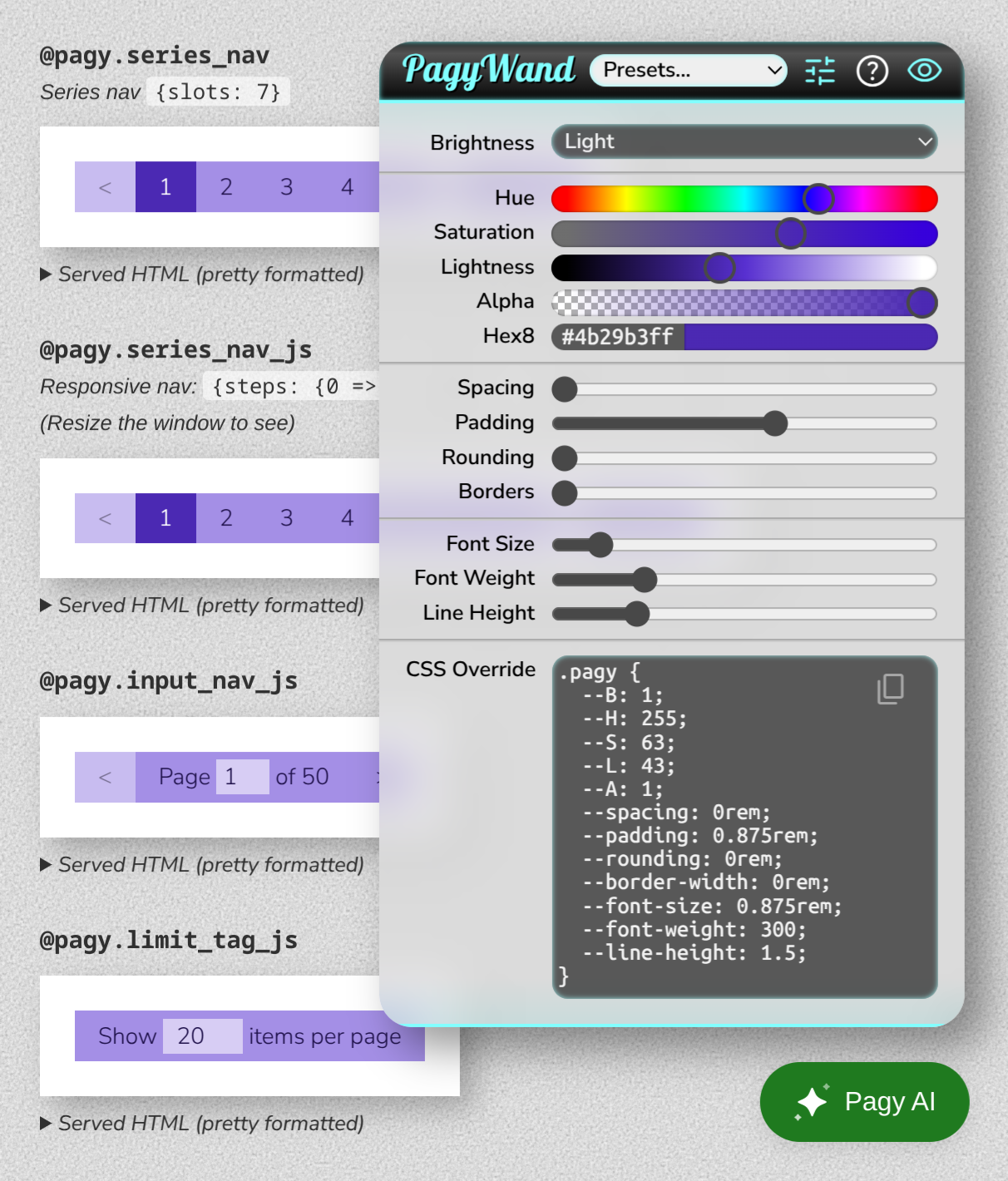
See Dev Tools
[!TIP] ⭐ If you like Pagy, please support it with a Star! ⭐
Special thanks to:
See Contributing
master branch is the latest rubygem-published release. It also contains docs and comment changes that don't affect the published code. It is never force-pushed.dev branch is the development branch with the new code that will be merged in the next release. It could be force-pushed.(top 24 of 67)
1,339 followers · starred Nov 2018
935 followers · starred Nov 2018
825 followers · starred Jun 2021
234 followers · starred Jun 2018
Agnostic pagination in plain ruby
See the code
Agnostic pagination in plain Ruby
[!TIP] ⭐ If you like Pagy, please support it with a Star! ⭐
We needed a leap version to unequivocally signal that it's not just a major version: it's a complete redesign of the legacy code at all levels, usage and API included.
Why 43? Because it's exactly one step beyond "The answer to the ultimate question of life, the Universe, and everything." 😉
This version introduces several enhancements, such as new :countish and :keynav_js paginators and improved automation and configuration processes, reducing setup requirements by 99%. The update also includes a simpler API and new interactive development tools, making it a comprehensive upgrade from previous versions.
See the Upgrade Guide
Take a look at the Examples for a quick overview of the new API.
[!TIP] ⭐ If you like Pagy, please support it with a Star! ⭐
# Include pagy in your code (usually application_controller.rb)
include Pagy::Method

# Offset-based pagination
@pagy, @records = pagy(:offset, Product.all)

# Keyset-based pagination (fastest technique)
@pagy, @records = pagy(:keyset, Product.order(my_order).all)

# Paginate your collection with one of several paginators
@pagy, @records = pagy(...)
See all the available paginators
# JSON:API nested query string. E.g.: ?page[number]=2&page[size]=100
@pagy, @records = pagy(:offset, Product.all, jsonapi: true)
@pagy, @records = pagy(:keyset, Product.order(my_order).all, jsonapi: true)
render json: { links: @pagy.urls_hash, data: @records }
render json: { pagy: @pagy.data_hash, data: @records }
Available paginators: :elasticsearch_rails, :meilisearch, :rails_active_search, :searchkick, :typesense_rails
# Extend your models (e.g. application_record.rb)
extend Pagy::Search

# Paginate with pagy:
search           = Product.pagy_search(params[:q])
@pagy, @response = pagy(:a_search_paginator, search)

# Or get pagy from paginated results:
@results = Product.search(params[:q])
@pagy    = pagy(:a_search_paginator, @results)
Combine time-range and offset pagination.
(Available time units: year, quarter, month, week, and day)
@calendar, @pagy, @records = pagy(:calendar, collection, year: {}, month: {}, offset: {})
<%== @calendar[:year].series_nav(:bootstrap) %>
<%== @calendar[:month].series_nav(:bootstrap) %>
<%== @pagy.info_tag %>
...
<%== @pagy.series_nav(:bootstrap) %>
series_navDefault :pagy, :bootstrap and :bulma styles shown.
<!-- Render server side nav bar helpers with different html and styles -->
<%== @pagy.series_nav %> <!-- pagy style -->
<%== @pagy.series_nav(:bootstrap) %>
<%== @pagy.series_nav(:bulma) %>
# pagy.rb initializer
javascript_dir = Rails.root.join('app/javascript')
Pagy.sync_javascript(javascript_dir, 'pagy.mjs') if Rails.env.development?
series_nav_jsFaster and responsive
Dynamically fills the container width.
<!-- Render client side nav bar helpers with different html and styles -->
<%== @pagy.series_nav_js %> <!-- pagy style -->
<%== @pagy.series_nav_js(:bootstrap) %>
<%== @pagy.series_nav_js(:bulma) %>
input_nav_jsFastest! Combines navigation and info in minimum space.
<!-- Render client side nav input helpers with different html and styles -->
<%== @pagy.input_nav_js %> <!-- pagy style -->
<%== @pagy.input_nav_js(:bootstrap) %>
<%== @pagy.input_nav_js(:bulma) %>
Integrate pagy with your app's themes interactively (watch demo), and ask specific questions to the Pagy AI right in your app! You need only a single line in your page/layout head to get the Pagy Wand and the Pagy AI:
<%== Pagy.dev_tools %>
See Dev Tools
[!TIP] ⭐ If you like Pagy, please support it with a Star! ⭐
Special thanks to:
See Contributing
master branch is the latest rubygem-published release. It also contains docs and comment changes that don't affect the published code. It is never force-pushed.dev branch is the development branch with the new code that will be merged in the next release. It could be force-pushed.(top 24 of 67)
1,339 followers · starred Nov 2018
935 followers · starred Nov 2018
825 followers · starred Jun 2021
234 followers · starred Jun 2018