
Forbidden Editor for Artists 😈
See the codeREADME









[!IMPORTANT] Darkly is in beta! Features are being added daily. Please report bugs so we can squash them.
Do you suffer from the oppressive sanity of rulers, guides, and nondestructive workflows? Break free with Darkly, home of happy accidents and beautiful catastrophies. Release your creativity from the bonds of logic. Madness isn't a bug, it's a feature.
Darkly is a Photoshop alternative where painters are first-class citizens. It has a powerful brush engine, and dark arts to help you commune with your imagination.
Use it on the web here.
Documentation here.
Darkly pledges to:
- 🛐 Honor human imagination
- ⚛️ Run offline and without a login
- ☯️ Never steal or license your art
- ☮️ Stay free and open source forever
https://github.com/user-attachments/assets/1fc0632d-5846-4c64-bac8-e39b0794b8b5
Features
Node-Based Brush Engine
Darkly's unique brushes live inside a node-based system. This enables infinite customizability, mixing and matching of brush features, and on-the-fly creation of custom brushes.
Dark Arts
Veils
Veils are where Darkly gets its name; "For now we see through a glass, darkly". They're a special layer that shrouds your canvas in a mysterious way, inviting you to see something that maybe wasn't there before.
Veils are nondestructive. You can paint as usual, behind the veil, and if you disable it, you'll see the full-res result.
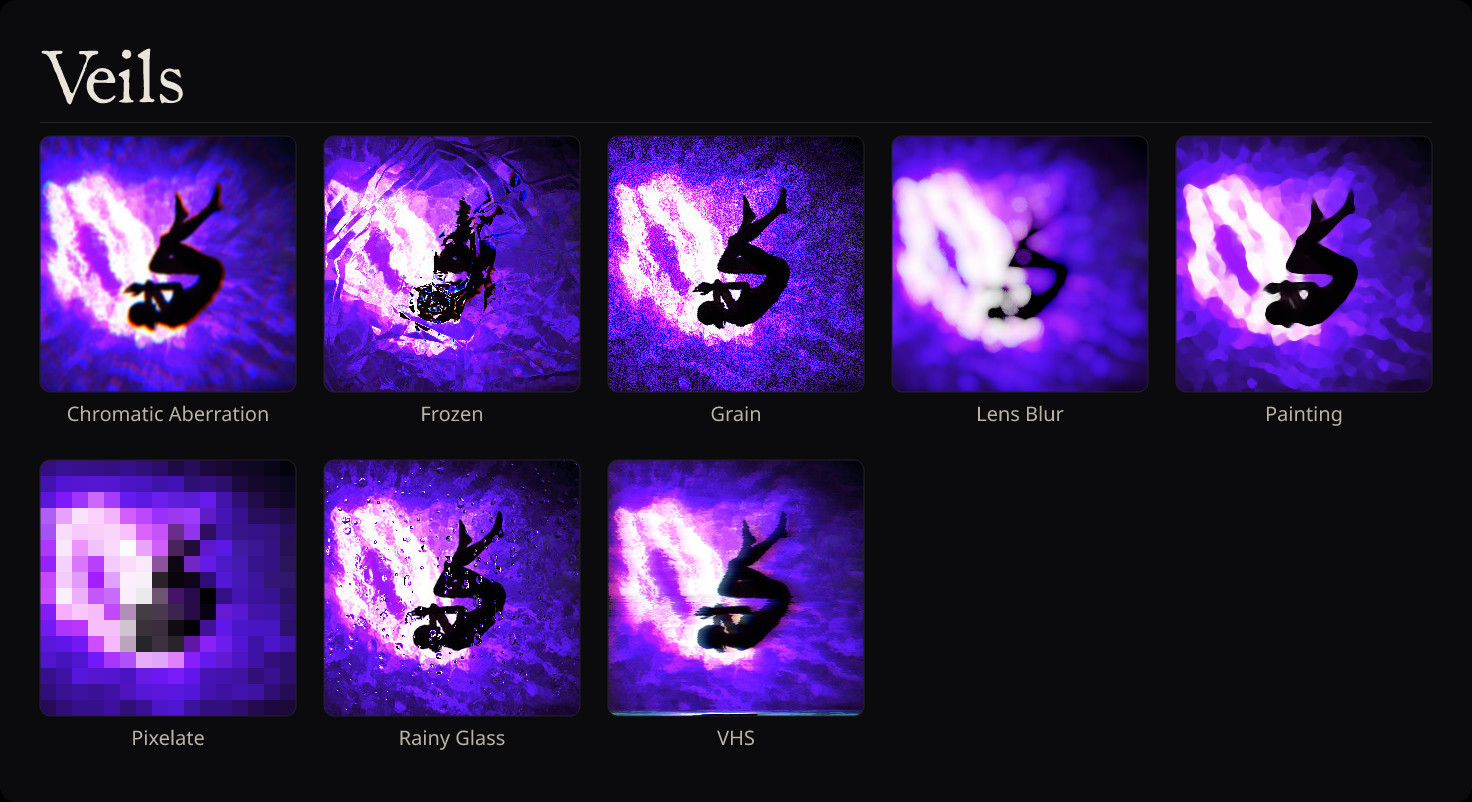
Veils are essentially fancy shaders, and they are fun toys. But they have practical uses too:
- By hiding fine details, they can prevent premature fixation on detail, freeing you to focus on composition.
- During the sketching / ideation phase, they can help with blank page syndrome and destructive self-criticism by giving you permission to be messy, and explore freely.
- They can also help remedy art fatigue (losing eyes for a piece by staring at it for too long) by helping you see it through a fresh lens.
[!NOTE] Adding too many veils can drain your battery due to the heavy load on your GPU.
Voids
Voids are a type of layer that specializes in pulling inspiration from outside sources.
You can use the Noise void to generate entropy, or Screenshare to stream another app (3D software, movie, or video game) directly into a layer. This is great for hybrid workflows, and situations where you need a quick reference, or want to try out different lighting or camera angles, without having to pose, render and paste over and over.
Voids support masks and blend modes. They are the natural compliment to veils, and a natural integration point for other art programs like Blender, which has its own dedicated void 🧡
Feature Roadmap
These features are ordered roughly by importance. They will be implemented mostly in order from top to bottom, prioritizing ones most requested by the community.
For a feature to count, it must be:
- Implemented in Rust backend
- Have a proper frontend action, with a menu path and hotkey in each editor preset, if applicable
Essential / Must-Have
- Node-based brush engine
- Brushes
- Simple round
- Ink pen
- Charcoal
- Smudge
- Watercolor
- Liquify
- Clone
- Blur
- Dodge/burn
- Calligraphy
- Oil / Impasto
- Brush tool, eraser, fill, gradient, color picker
- Text tool
- Pressure / tilt / spacing / distance / angle inputs
- Laplacian stabilizer
- HSV picker, foreground/background swatches
- Color picker
- Raster layers + groups
- 16 blend modes
- Layer masks
- Link/unlink mask and host transforms
- Rect, ellipse, lasso, polygon, magic wand selection
- Selection Replace / Add / Subtract / Intersect modes
- Pan / zoom / rotate view
- Undo / redo
- New document
- Open image from file
- Save / Open native
.darklydocument - Export to PNG / JPEG / WebP file
- Clipboard copy / cut / paste
- Documentation
Important: expected for serious work
- Generic transform tool
- Perspective transform
- Merge down
- Duplicate layer / group
- Crop to selection
- Canvas resize
- Image rescale
- Select All / Deselect / Invert
- Command palette
- Application menu
- Autosave + crash recovery
- Filter layers
- Brightness / Contrast
- Hue / Saturation / Lightness
- Levels
- Curves
- Invert colors
- Black and White (desaturate)
- Chromatic aberration
- Clipping mask
- Feather + antialias
- Grow / Shrink / Border / Smooth
- Flip canvas H / V
- Rotate canvas 90° CW / CCW / 180°
- Flip layer / selection H / V
- Smart objects
- Recent colors
- Saved swatches / palettes
- Palette popup
- Navigator / overview window
- History panel UI
- Process recording
- Mirror view
- Reset view
- Canvas-rotation snapping
- Fit to screen / center view
- 100% / zoom presets
- Symmetry / mirror painting
- Installable PWA
- Krita / Photoshop / GIMP hotkey presets
- Settings modal
- Theme system
- Hotkey system + searchable cheatsheet
- Floating layers
Advanced & specialized: power-user, niche, and polish
- Veils
- Veil picker
- Void layers
- Camera void
- Screenshare void
- Blender void
- Group blend mode / opacity
- Dockable / tiled panels (drag to reorder, tab, split-dock)
- Pop out panels into separate OS windows (cross-window drag)
- Oklab / Oklch foundational color system
- Brush save/load + editable nodes/wires
- Recent files
- PSD / XCF / KRA import
- Perspective, skew, free distort
- Warp / mesh transform
- Gradient map
- Color balance
- Channel mixer
- Threshold
- Posterize
- Color harmonies
- Palette file import
- Trim to content / autocrop
- Stroke selection
- Save / load selection to channel
- Snap canvas to right angles
- Branched history
Getting started
Prerequisites
# Install all workspace dependencies (frontend + website + shared styles)
npm install

# Build the WASM package
wasm-pack build frontend/wasm --target web

# Start the frontend dev server
npm --prefix frontend run dev

# ...or expose it on your LAN (binds all interfaces, 0.0.0.0)
npm --prefix frontend run dev -- --host
Open the URL printed by vite (typically https://localhost:5173). Requires a browser with WebGPU support (Chrome 113+, Edge 113+, Firefox Nightly with flag).
GPU backend configuration (Linux): Chrome's WebGPU defaults to a software rasterizer on many Linux setups. Launch Chromium with GPU and Vulkan support:
chromium --enable-features=Vulkan --enable-unsafe-webgpu
You can verify the active backend at chrome://gpu - look for "Vulkan" under Graphics Feature Status. On macOS and Windows this is generally not needed (Metal and D3D12 are used by default).
Use it in your own project
Darkly's core is a standalone, platform-agnostic Rust crate, darkly. The document model, brush engine, GPU compositor, and undo system all live here with zero platform dependencies, and run anywhere wgpu does: native (Vulkan / Metal / DX12) or the browser (WebGPU). The app above is a Svelte frontend over this exact crate, through a thin WebAssembly bridge.
If you're building a graphics tool in Rust -- a drawing app, annotation layer, whiteboard, texture editor, etc. -- you can embed the engine instead of writing all these features from scratch.


cargo add darkly
See the crate README for a runnable example, and the API docs for full details.
Contribution
We love hackers as much as we love artists. Contributions are welcome! Please see CONTRIBUTING.md for details on how to contribute and rules of thumb for the repo.
Use of AI
It's acceptable to use AI for this codebase, but careless vibe coding is strictly forbidden.
I (TheTechromancer) learned to code before AI, and have spent much of my career maintaining large codebases. The danger of feature creep and architectural bloat is real, which is why whenever a feature is implemented in Darkly, a human must first understand the changes and their long-term implications for the codebase.
Great care is being taken to keep Darkly lean and clean. This means enforcing modularity, guarding vigilantly against duplicate/dead code, and writing a shit ton of unit tests, including at least one regression test for every bug. See CONTRIBUTING.md for how we avoid AI slop.
Note that while we allow AI for coding, we are unlikely to accept any PR implementing generative AI in Darkly itself. AI features are not off the table; however they must run fully offline and without any reliance on third party APIs. Additionally, any feature that speeds up generation while sacrificing creative input or control from the artist, will likely be rejected.
Every PR must open with a short human-written description explaining why the effort was undertaken and who it's useful to, above the AI-generated technical description. PRs that look entirely machine-generated will be closed.
We are not sensitive to AI-related questions. If you're unsure, please ask!
Acknowledgments
Darkly stands on the shoulders of giants. Three programs in particular have influenced this project, and we love them dearly.
GIMP (source) - originally written by Spencer Kimball and Peter Mattis in 1995, and maintained today by Michael Natterer and Jehan Pagès, with decades of contributions from a community far too large to list here (see the upstream AUTHORS file).
Krita (source) - led by Halla Rempt, with core contributions over the years from Dmitry Kazakov, Cyrille Berger, Sven Langkamp, Wolthera van Hövell tot Westerflier, L. E. Segovia, Scott Petrovic, and many more (see the upstream developers.txt).
Graphite (source) - founded by Keavon Chambers (@Keavon), with the core team of Dennis Kobert (@TrueDoctor), Timon Schelling (@timon-schelling), and Adam Gerhant (@pendapia), plus heroic contributions from Hypercube (@0HyperCube), James Lindsay, and hundreds more. Graphite is a pioneer in bringing serious 2D graphics tooling to Rust + WebAssembly + WebGPU.
While Darkly's architecture is fundamentally different, it was really insightful to see how these tools tackled many of the same hard problems, and their unique and smart approaches that made them pillars of open source!
A special thank you to Nick Cameron for graciously gifting us the darkly crate on crates.io. 💜
Veils & Voids
Some of Darkly's veil and void shaders are ports or adaptations of work originally published on Shadertoy. I suck at shaders and the creators of these shaders are true artists. Please go see them in their native habitat!
- Lens Blur (veil) - based on "Bokeh Venice" by Dave Hoskins.
- Painting (veil) - based on "Generalized Kuwahara shader" by p4vv37, with technique notes from Acerola / Garrett Gunnell.
- Rainy glass (veil) - ported from "Heartfelt" by Martijn Steinrucken / BigWIngs.
- VHS (veil) - ported from "20151110_VHS" by FMS_Cat.
- Watercolor (veil) - based on "watercolor propagation" by aeva.
- Noise (void) - domain-warp algorithm from Inigo Quilez's "Domain warping" article; the texture-sampled noise primitive (a 3D volume sampled by the FBM octave loop) is inspired by "Watery" by nimitz (twitter: @stormoid).
Contributors

1,065 commits

19 commits
Similar repos


Languages
Rust
65.5%
TypeScript
22.6%
Svelte
8.4%
WGSL
2.2%
Forbidden Editor for Artists 😈
See the codeREADME
[!IMPORTANT] Darkly is in beta! Features are being added daily. Please report bugs so we can squash them.
Do you suffer from the oppressive sanity of rulers, guides, and nondestructive workflows? Break free with Darkly, home of happy accidents and beautiful catastrophies. Release your creativity from the bonds of logic. Madness isn't a bug, it's a feature.
Darkly is a Photoshop alternative where painters are first-class citizens. It has a powerful brush engine, and dark arts to help you commune with your imagination.
Use it on the web here.
Documentation here.
Darkly pledges to:
- 🛐 Honor human imagination
- ⚛️ Run offline and without a login
- ☯️ Never steal or license your art
- ☮️ Stay free and open source forever
https://github.com/user-attachments/assets/1fc0632d-5846-4c64-bac8-e39b0794b8b5
Features
Node-Based Brush Engine
Darkly's unique brushes live inside a node-based system. This enables infinite customizability, mixing and matching of brush features, and on-the-fly creation of custom brushes.
Dark Arts
Veils
Veils are where Darkly gets its name; "For now we see through a glass, darkly". They're a special layer that shrouds your canvas in a mysterious way, inviting you to see something that maybe wasn't there before.
Veils are nondestructive. You can paint as usual, behind the veil, and if you disable it, you'll see the full-res result.
Veils are essentially fancy shaders, and they are fun toys. But they have practical uses too:
- By hiding fine details, they can prevent premature fixation on detail, freeing you to focus on composition.
- During the sketching / ideation phase, they can help with blank page syndrome and destructive self-criticism by giving you permission to be messy, and explore freely.
- They can also help remedy art fatigue (losing eyes for a piece by staring at it for too long) by helping you see it through a fresh lens.
[!NOTE] Adding too many veils can drain your battery due to the heavy load on your GPU.
Voids
Voids are a type of layer that specializes in pulling inspiration from outside sources.
You can use the Noise void to generate entropy, or Screenshare to stream another app (3D software, movie, or video game) directly into a layer. This is great for hybrid workflows, and situations where you need a quick reference, or want to try out different lighting or camera angles, without having to pose, render and paste over and over.
Voids support masks and blend modes. They are the natural compliment to veils, and a natural integration point for other art programs like Blender, which has its own dedicated void 🧡
Feature Roadmap
These features are ordered roughly by importance. They will be implemented mostly in order from top to bottom, prioritizing ones most requested by the community.
For a feature to count, it must be:
- Implemented in Rust backend
- Have a proper frontend action, with a menu path and hotkey in each editor preset, if applicable
Essential / Must-Have
- Node-based brush engine
- Brushes
- Simple round
- Ink pen
- Charcoal
- Smudge
- Watercolor
- Liquify
- Clone
- Blur
- Dodge/burn
- Calligraphy
- Oil / Impasto
- Brush tool, eraser, fill, gradient, color picker
- Text tool
- Pressure / tilt / spacing / distance / angle inputs
- Laplacian stabilizer
- HSV picker, foreground/background swatches
- Color picker
- Raster layers + groups
- 16 blend modes
- Layer masks
- Link/unlink mask and host transforms
- Rect, ellipse, lasso, polygon, magic wand selection
- Selection Replace / Add / Subtract / Intersect modes
- Pan / zoom / rotate view
- Undo / redo
- New document
- Open image from file
- Save / Open native
.darklydocument - Export to PNG / JPEG / WebP file
- Clipboard copy / cut / paste
- Documentation
Important: expected for serious work
- Generic transform tool
- Perspective transform
- Merge down
- Duplicate layer / group
- Crop to selection
- Canvas resize
- Image rescale
- Select All / Deselect / Invert
- Command palette
- Application menu
- Autosave + crash recovery
- Filter layers
- Brightness / Contrast
- Hue / Saturation / Lightness
- Levels
- Curves
- Invert colors
- Black and White (desaturate)
- Chromatic aberration
- Clipping mask
- Feather + antialias
- Grow / Shrink / Border / Smooth
- Flip canvas H / V
- Rotate canvas 90° CW / CCW / 180°
- Flip layer / selection H / V
- Smart objects
- Recent colors
- Saved swatches / palettes
- Palette popup
- Navigator / overview window
- History panel UI
- Process recording
- Mirror view
- Reset view
- Canvas-rotation snapping
- Fit to screen / center view
- 100% / zoom presets
- Symmetry / mirror painting
- Installable PWA
- Krita / Photoshop / GIMP hotkey presets
- Settings modal
- Theme system
- Hotkey system + searchable cheatsheet
- Floating layers
Advanced & specialized: power-user, niche, and polish
- Veils
- Veil picker
- Void layers
- Camera void
- Screenshare void
- Blender void
- Group blend mode / opacity
- Dockable / tiled panels (drag to reorder, tab, split-dock)
- Pop out panels into separate OS windows (cross-window drag)
- Oklab / Oklch foundational color system
- Brush save/load + editable nodes/wires
- Recent files
- PSD / XCF / KRA import
- Perspective, skew, free distort
- Warp / mesh transform
- Gradient map
- Color balance
- Channel mixer
- Threshold
- Posterize
- Color harmonies
- Palette file import
- Trim to content / autocrop
- Stroke selection
- Save / load selection to channel
- Snap canvas to right angles
- Branched history
Getting started
Prerequisites
# Install all workspace dependencies (frontend + website + shared styles)
npm install

# Build the WASM package
wasm-pack build frontend/wasm --target web

# Start the frontend dev server
npm --prefix frontend run dev

# ...or expose it on your LAN (binds all interfaces, 0.0.0.0)
npm --prefix frontend run dev -- --host
Open the URL printed by vite (typically https://localhost:5173). Requires a browser with WebGPU support (Chrome 113+, Edge 113+, Firefox Nightly with flag).
GPU backend configuration (Linux): Chrome's WebGPU defaults to a software rasterizer on many Linux setups. Launch Chromium with GPU and Vulkan support:
chromium --enable-features=Vulkan --enable-unsafe-webgpu
You can verify the active backend at chrome://gpu - look for "Vulkan" under Graphics Feature Status. On macOS and Windows this is generally not needed (Metal and D3D12 are used by default).
Use it in your own project
Darkly's core is a standalone, platform-agnostic Rust crate, darkly. The document model, brush engine, GPU compositor, and undo system all live here with zero platform dependencies, and run anywhere wgpu does: native (Vulkan / Metal / DX12) or the browser (WebGPU). The app above is a Svelte frontend over this exact crate, through a thin WebAssembly bridge.
If you're building a graphics tool in Rust -- a drawing app, annotation layer, whiteboard, texture editor, etc. -- you can embed the engine instead of writing all these features from scratch.
cargo add darkly
See the crate README for a runnable example, and the API docs for full details.
Contribution
We love hackers as much as we love artists. Contributions are welcome! Please see CONTRIBUTING.md for details on how to contribute and rules of thumb for the repo.
Use of AI
It's acceptable to use AI for this codebase, but careless vibe coding is strictly forbidden.
I (TheTechromancer) learned to code before AI, and have spent much of my career maintaining large codebases. The danger of feature creep and architectural bloat is real, which is why whenever a feature is implemented in Darkly, a human must first understand the changes and their long-term implications for the codebase.
Great care is being taken to keep Darkly lean and clean. This means enforcing modularity, guarding vigilantly against duplicate/dead code, and writing a shit ton of unit tests, including at least one regression test for every bug. See CONTRIBUTING.md for how we avoid AI slop.
Note that while we allow AI for coding, we are unlikely to accept any PR implementing generative AI in Darkly itself. AI features are not off the table; however they must run fully offline and without any reliance on third party APIs. Additionally, any feature that speeds up generation while sacrificing creative input or control from the artist, will likely be rejected.
Every PR must open with a short human-written description explaining why the effort was undertaken and who it's useful to, above the AI-generated technical description. PRs that look entirely machine-generated will be closed.
We are not sensitive to AI-related questions. If you're unsure, please ask!
Acknowledgments
Darkly stands on the shoulders of giants. Three programs in particular have influenced this project, and we love them dearly.
GIMP (source) - originally written by Spencer Kimball and Peter Mattis in 1995, and maintained today by Michael Natterer and Jehan Pagès, with decades of contributions from a community far too large to list here (see the upstream AUTHORS file).
Krita (source) - led by Halla Rempt, with core contributions over the years from Dmitry Kazakov, Cyrille Berger, Sven Langkamp, Wolthera van Hövell tot Westerflier, L. E. Segovia, Scott Petrovic, and many more (see the upstream developers.txt).
Graphite (source) - founded by Keavon Chambers (@Keavon), with the core team of Dennis Kobert (@TrueDoctor), Timon Schelling (@timon-schelling), and Adam Gerhant (@pendapia), plus heroic contributions from Hypercube (@0HyperCube), James Lindsay, and hundreds more. Graphite is a pioneer in bringing serious 2D graphics tooling to Rust + WebAssembly + WebGPU.
While Darkly's architecture is fundamentally different, it was really insightful to see how these tools tackled many of the same hard problems, and their unique and smart approaches that made them pillars of open source!
A special thank you to Nick Cameron for graciously gifting us the darkly crate on crates.io. 💜
Veils & Voids
Some of Darkly's veil and void shaders are ports or adaptations of work originally published on Shadertoy. I suck at shaders and the creators of these shaders are true artists. Please go see them in their native habitat!
- Lens Blur (veil) - based on "Bokeh Venice" by Dave Hoskins.
- Painting (veil) - based on "Generalized Kuwahara shader" by p4vv37, with technique notes from Acerola / Garrett Gunnell.
- Rainy glass (veil) - ported from "Heartfelt" by Martijn Steinrucken / BigWIngs.
- VHS (veil) - ported from "20151110_VHS" by FMS_Cat.
- Watercolor (veil) - based on "watercolor propagation" by aeva.
- Noise (void) - domain-warp algorithm from Inigo Quilez's "Domain warping" article; the texture-sampled noise primitive (a 3D volume sampled by the FBM octave loop) is inspired by "Watery" by nimitz (twitter: @stormoid).
Similar repos
Contributors
1,065 commits
19 commits
Languages
Rust
65.5%
TypeScript
22.6%
Svelte
8.4%
WGSL
2.2%