
Agent Design Language (ADL): declarative YAML + Rust reference runtime for deterministic agent workflows.
Rust
4
4,940 commits
updated Aug 7, 2026
README
Canonical development has moved: New code, branches, and pull requests belong in agent-logic/agent-design-language.
Agent Design Language (ADL)
Agent Design Language is a deterministic cognitive architecture for building agent-based systems that are reliable, governable, observable, and reviewable.
ADL is a Rust-backed runtime and documentation system for turning agent work into explicit programs, governed tool calls, traceable artifacts, review packets, demos, and milestone evidence.



Homepage: agent-logic.ai
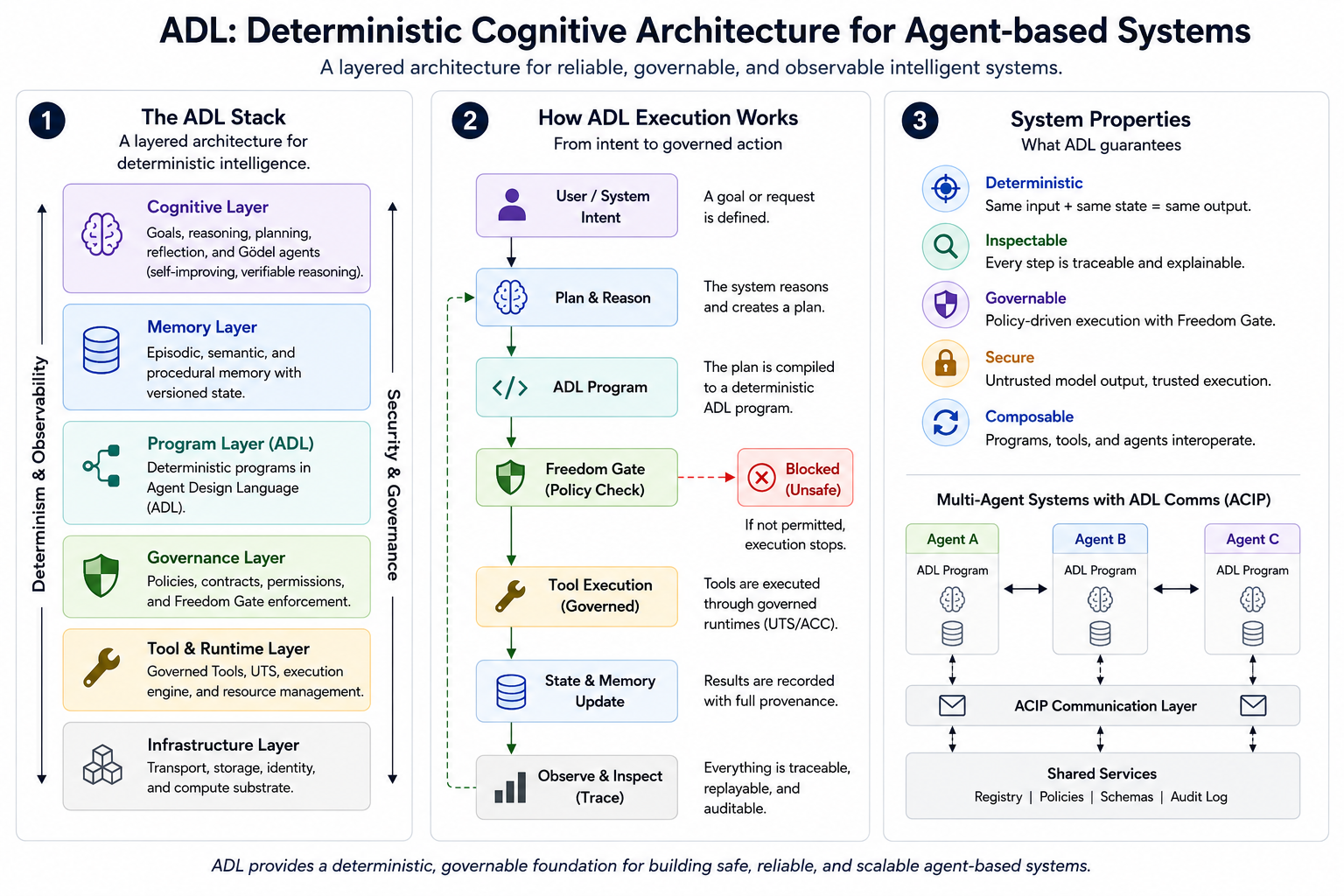
Table Of Contents
- Why ADL Exists
- What ADL Provides
- Core Ideas
- Quick Start
- Recent Demos And Proofs
- Recent Milestones
- Documentation Map
- Project Status
Why ADL Exists
Agent systems are crossing from impressive prototypes into real operational infrastructure. To make that transition safely, they need more than fluent model output: they need durable programs, explicit authority, governed tools, state you can trust, and evidence strong enough for teams to build on.
As these systems take on more authority, review and security work also need to become continuous. Serious agent platforms cannot rely only on occasional audits or after-the-fact explanations; they need workflows that can find, replay, and repair weaknesses as part of normal operation.
ADL turns those requirements into an architecture for dependable agent systems:
- deterministic workflows that make agent behavior reproducible
- governed tools that separate model intent from runtime authority
- Freedom Gate policy checks before risky action
- traces, artifacts, and replay surfaces that make outcomes durable
- milestone proof packages that connect product claims to evidence
The project goal is simple: make agent-based systems safe enough to operate, clear enough to trust, and structured enough to improve.
What ADL Provides
ADL already has a substantial platform baseline:
- a Rust runtime and CLI for deterministic workflow execution
- explicit workflow, task, agent, provider, and tool artifacts
- bounded concurrency, retry, failure policy, signing, and verification
- run artifacts, traces, replay-oriented inspection, and review records
- governed tool calls through UTS + ACC
- traceable agent communication through ACIP
- Runtime v2 and CSM Observatory planning and proof surfaces
- Gödel agents and the Gödel-Hadamard-Bayes algorithm
- structured PR/control-plane workflow with SIP, STP, SPP, VPP, SRP, and SOR records
For the full capability matrix, read the canonical feature index: docs/planning/ADL_FEATURE_LIST.md.
Core Ideas
ADL starts with a deterministic runtime. Agent behavior is represented as explicit programs, bounded state, policy decisions, and replayable artifacts so intelligence can become infrastructure instead of an unreproducible transcript.
- The ADL runtime and CSM, the Cognitive Spacetime Manifold, are the foundation: they turn agent intent into governed, replayable execution inside a persistent runtime world with durable traces, artifacts, state transitions, causality, identity continuity, and operator-visible observability.
- AEE, the Adaptive Execution Engine, is ADL's adaptation lineage: bounded strategy selection, recovery, learning, and policy-aware execution without hidden magic.
- The red/blue adversarial security model makes attack, defense, exploit replay, and purple-team coordination part of the runtime evidence story rather than a separate theater exercise.
- Gödel agents are the long-running direction for self-reference, self-improvement, and reviewable adaptation inside the deterministic runtime.
- The Gödel-Hadamard-Bayes algorithm is the cognitive loop behind that work: structured awareness, controlled hypothesis generation, and evidence-weighted judgment before authorized action.
- UTS + ACC gives the runtime governed tools: portable tool shape stays separate from permission, visibility, redaction, and audit evidence.
- ACIP gives agents a communication layer for conversation, consultation, delegation, review, handoff, and negotiation that remains traceable by the runtime.
Quick Start
Generate the retained v0.91 cognitive-being flagship proof packet:
cargo run --manifest-path adl/Cargo.toml -- runtime-v2 cognitive-being-flagship-demo --out artifacts/quickstart/cognitive-being-flagship
Inspect a retained v0.91 multi-agent workflow plan:
cargo run -q --manifest-path adl/Cargo.toml --bin adl -- adl/examples/v0-91-chatgpt-gemini-claude-triad-conversation.adl.yaml --print-plan
Recent Demos And Proofs
These are three high-signal recent demo entrypoints.
Start with the completed v0.91.4 C-SDLC release evidence lane:
Generate the v0.91 cognitive-being flagship proof bundle:
cargo run --manifest-path adl/Cargo.toml -- runtime-v2 cognitive-being-flagship-demo --out artifacts/v091/demo-d13-cognitive-being-flagship
Run the v0.90.5 governed-tools flagship demo:
cargo run --manifest-path adl/Cargo.toml -- demo demo-v0905-governed-tools-flagship --run --trace --out artifacts/v0905/flagship-demo --no-open
Run the v0.89.1 adversarial self-attack demo:
cargo run --manifest-path adl/Cargo.toml -- demo demo-h-v0891-adversarial-self-attack --run --trace --out .adl/reports/adversarial-demo --no-open
Review the v0.91 ChatGPT + Gemini + Claude triad conversation from issue #2764.
Recent Milestones
v0.92 - Active Development Milestone
v0.92 is the active development milestone. Its issue wave is prepared, the foundation lane is active, and the runtime, observatory, identity, resilience, and release-proof lanes remain governed by their declared dependency gates. Activation does not claim those planned outcomes are implemented or release-approved.
Start here:
- v0.92 README
- v0.92 sprint plan
- v0.92 issue wave
- v0.92 execution readiness
- v0.92 feature-proof coverage
- v0.92 milestone checklist
v0.91.8 - Retained Handoff Bridge
v0.91.7 is now published as the ADL v0.91.7 GitHub release
and remains the implementation/readiness tranche that fed the v0.91.8 bridge.
v0.91.8 completed its retained review and handoff bridge. The integrated quality gate merged at
2e9d2dd7c and records 67 audited issue outcomes, 0 unacceptable outcomes,
and passing ADL v2, Runtime v3, and C-SDLC v2 focused/integrated lanes. The
subsequent documentation, internal and external review, remediation,
revalidation, v0.92 handoff, and release-ceremony issues are closed. These
retained records supply upstream evidence for v0.92; they do not prove any
planned v0.92 outcome complete.
Start here:
- v0.91.8 README
- v0.91.8 sprint plan
- v0.91.8 issue wave
- v0.91.8 parallel plan
- v0.91.8 WP-16 quality gate
- v0.91.8 issue outcome audit
- v0.91.8 to v0.92 handoff Historical v0.91.7 evidence:
- v0.91.7 README
- v0.91.7 sprint plan
- v0.91.7 issue wave
- v0.91.7 feature-doc index
- v0.91.7 sprint-review register
v0.91.6 - Completed First Bridge Tranche
v0.91.6 is the completed first pre-v0.92 bridge/readiness tranche. Its retained handoff and release-tail evidence are inputs to v0.91.7; they are historical records rather than the current review entrypoint.
Start here:
v0.91.5 - Previous Bridge Package And Release-Tail Input
v0.91.5 remains the immediate upstream bridge package between the C-SDLC rollout closeout and the v0.92 first-birthday milestone. It carried multi-agent stabilization, provider/model breadth, public prompt records, demo readiness, AEE completion routing, and activation testing so v0.91.6 and v0.91.7 could open from a cleaner operational base.
Start here:
v0.91.4 - Completed Cognitive SDLC Default-Operation Milestone
v0.91.4 is complete as the Cognitive SDLC completion and hardening milestone.
Its issue wave closed through Sprint 4 release ceremony, and the crate version
is 0.91.4. The milestone turns the v0.91.3 first slice into default
operating practice:
validator/doctor/conductor/editor alignment, signed trace and ObsMem handoff
hardening, five-minute-sprint repeatability, validation-tail/PVF work, and
bounded sidecar evidence for CodeFriend and WildClawBench.
Start here:
- v0.91.4 README
- v0.91.4 issue wave
- v0.91.4 sprint plan
- v0.91.4 demo matrix
- v0.91.4 quality gate
- v0.91.4 release evidence
v0.91.3 - Completed Cognitive SDLC First-Slice Milestone
v0.91.3 is complete. It proved one bounded Cognitive State Transition with tracked cards, transition evidence, review synthesis, merge-readiness truth, ObsMem handoff, and a reviewer-facing first-proof/demo package. It does not claim full C-SDLC default operation; v0.91.4 owns repeatability, enforcement, signed trace proof, validation-tail hardening, and default adoption for future software-development issues.
v0.91.2 - Completed Tooling, Evaluation, Productization, And Workflow Pressure Release
v0.91.2 is complete. It closed the UTS + ACC benchmark, runtime/test-cycle recovery, CodeFriend productization, Workspace bridge, modernization, publication packet, rustdoc/doc cleanup, repo-visibility follow-on, and workflow-guardrail pressure-release band. Its release-tail review, remediation, next-milestone planning, and ceremony work prepared v0.91.3 and v0.91.4.
v0.91.1 - Completed Inhabited Runtime Readiness Milestone
v0.91.1 is complete. The core implementation, review, next-milestone handoff, final next-milestone review-pass wave, and release ceremony package landed before v0.91.2 opened.
It ended with an observatory-visible agent runtime proof inside the CSM boundary: lifecycle state, citizen standing/state, memory/identity architecture, Theory of Mind, capability testing, intelligence metrics, governed learning, secure ACIP/A2A hardening, and an agent-shaped runtime run that remains explicit about non-claims for birthday, identity continuity, and external federation.
Start here:
v0.91 - Released Moral Governance And Cognitive-Being Milestone
v0.91 is the completed 0.91.0 milestone. Its core line landed
the moral governance, wellbeing, kindness, humor, affect, cultivated
intelligence, structured planning, SRP, and secure intra-polis Agent Comms
band. Internal review, third-party review, accepted-finding remediation,
next-milestone handoff, release ceremony, tag, and release publication are
complete.
Start here:
v0.90.5 - Completed Governed Tools v1.0
v0.90.5 is the completed Governed Tools v1.0 milestone. It landed: Universal Tool Schema, ADL Capability Contract, deterministic registry and compiler surfaces, governed execution policy, trace/replay/redaction evidence, dangerous negative proofs, model compatibility work, and the first ACIP/Comms integration slice.
Start here:
v0.90.4 - Completed Citizen Economics And Contract Market
v0.90.4 is the completed bounded citizen-economics and contract-market milestone. It made contract schema, bid schema, evaluation, lifecycle, transition authority, external counterparty boundaries, delegation, and one bounded contract-market proof legible without claiming payment rails or production markets.
Documentation Map
- Feature list: canonical capability overview and roadmap truth.
- Explainers: short entrypoints for UTS + ACC, ACIP, AEE, red/blue security, Gödel Agents, and CSM.
- Docs index: repository documentation entrypoint.
- Changelog: milestone-level project history.
- ADRs: architecture decisions.
- GHB algorithm: cognitive loop behind Gödel-agent work.
- Examples: runnable ADL examples.
- Demos: demo-oriented proof surfaces.
- AGENTS.md: repository-local operating contract for coding agents.
Project Status
- Active milestone: v0.92 development and execution
- Foundation sprint umbrella: #5858
- Upstream handoff: v0.92 consumes the retained exact-revision v0.91.8 acceptance and handoff
- Current ADL package and workspace version:
0.92.0 - Most recently completed implementation/readiness handoff: v0.91.8
- Most recently published public release: v0.91.7 (GitHub release)
- Current milestone state: the v0.92 package and issue wave are active; feature implementation, integration, review, and release gates remain open and must be proved by their owning issues.
- Primary implementation language: Rust
ADL is under active development. The repository contains implemented runtime surfaces, completed milestone evidence, active milestone docs, and forward planning. Treat milestone documents as bounded engineering records: they say what is implemented, what is demoable, what is under active execution, and what remains planned.
Contributors

4,940 commits
Similar repos


Languages
Rust
69.4%
Shell
14.0%
Python
8.5%
Ruby
4.6%
C++
2.4%
Agent Design Language (ADL): declarative YAML + Rust reference runtime for deterministic agent workflows.
Rust
4
4,940 commits
updated Aug 7, 2026
README
Canonical development has moved: New code, branches, and pull requests belong in agent-logic/agent-design-language.
Agent Design Language (ADL)
Agent Design Language is a deterministic cognitive architecture for building agent-based systems that are reliable, governable, observable, and reviewable.
ADL is a Rust-backed runtime and documentation system for turning agent work into explicit programs, governed tool calls, traceable artifacts, review packets, demos, and milestone evidence.
Homepage: agent-logic.ai
Table Of Contents
- Why ADL Exists
- What ADL Provides
- Core Ideas
- Quick Start
- Recent Demos And Proofs
- Recent Milestones
- Documentation Map
- Project Status
Why ADL Exists
Agent systems are crossing from impressive prototypes into real operational infrastructure. To make that transition safely, they need more than fluent model output: they need durable programs, explicit authority, governed tools, state you can trust, and evidence strong enough for teams to build on.
As these systems take on more authority, review and security work also need to become continuous. Serious agent platforms cannot rely only on occasional audits or after-the-fact explanations; they need workflows that can find, replay, and repair weaknesses as part of normal operation.
ADL turns those requirements into an architecture for dependable agent systems:
- deterministic workflows that make agent behavior reproducible
- governed tools that separate model intent from runtime authority
- Freedom Gate policy checks before risky action
- traces, artifacts, and replay surfaces that make outcomes durable
- milestone proof packages that connect product claims to evidence
The project goal is simple: make agent-based systems safe enough to operate, clear enough to trust, and structured enough to improve.
What ADL Provides
ADL already has a substantial platform baseline:
- a Rust runtime and CLI for deterministic workflow execution
- explicit workflow, task, agent, provider, and tool artifacts
- bounded concurrency, retry, failure policy, signing, and verification
- run artifacts, traces, replay-oriented inspection, and review records
- governed tool calls through UTS + ACC
- traceable agent communication through ACIP
- Runtime v2 and CSM Observatory planning and proof surfaces
- Gödel agents and the Gödel-Hadamard-Bayes algorithm
- structured PR/control-plane workflow with SIP, STP, SPP, VPP, SRP, and SOR records
For the full capability matrix, read the canonical feature index: docs/planning/ADL_FEATURE_LIST.md.
Core Ideas
ADL starts with a deterministic runtime. Agent behavior is represented as explicit programs, bounded state, policy decisions, and replayable artifacts so intelligence can become infrastructure instead of an unreproducible transcript.
- The ADL runtime and CSM, the Cognitive Spacetime Manifold, are the foundation: they turn agent intent into governed, replayable execution inside a persistent runtime world with durable traces, artifacts, state transitions, causality, identity continuity, and operator-visible observability.
- AEE, the Adaptive Execution Engine, is ADL's adaptation lineage: bounded strategy selection, recovery, learning, and policy-aware execution without hidden magic.
- The red/blue adversarial security model makes attack, defense, exploit replay, and purple-team coordination part of the runtime evidence story rather than a separate theater exercise.
- Gödel agents are the long-running direction for self-reference, self-improvement, and reviewable adaptation inside the deterministic runtime.
- The Gödel-Hadamard-Bayes algorithm is the cognitive loop behind that work: structured awareness, controlled hypothesis generation, and evidence-weighted judgment before authorized action.
- UTS + ACC gives the runtime governed tools: portable tool shape stays separate from permission, visibility, redaction, and audit evidence.
- ACIP gives agents a communication layer for conversation, consultation, delegation, review, handoff, and negotiation that remains traceable by the runtime.
Quick Start
Generate the retained v0.91 cognitive-being flagship proof packet:
cargo run --manifest-path adl/Cargo.toml -- runtime-v2 cognitive-being-flagship-demo --out artifacts/quickstart/cognitive-being-flagship
Inspect a retained v0.91 multi-agent workflow plan:
cargo run -q --manifest-path adl/Cargo.toml --bin adl -- adl/examples/v0-91-chatgpt-gemini-claude-triad-conversation.adl.yaml --print-plan
Recent Demos And Proofs
These are three high-signal recent demo entrypoints.
Start with the completed v0.91.4 C-SDLC release evidence lane:
Generate the v0.91 cognitive-being flagship proof bundle:
cargo run --manifest-path adl/Cargo.toml -- runtime-v2 cognitive-being-flagship-demo --out artifacts/v091/demo-d13-cognitive-being-flagship
Run the v0.90.5 governed-tools flagship demo:
cargo run --manifest-path adl/Cargo.toml -- demo demo-v0905-governed-tools-flagship --run --trace --out artifacts/v0905/flagship-demo --no-open
Run the v0.89.1 adversarial self-attack demo:
cargo run --manifest-path adl/Cargo.toml -- demo demo-h-v0891-adversarial-self-attack --run --trace --out .adl/reports/adversarial-demo --no-open
Review the v0.91 ChatGPT + Gemini + Claude triad conversation from issue #2764.
Recent Milestones
v0.92 - Active Development Milestone
v0.92 is the active development milestone. Its issue wave is prepared, the foundation lane is active, and the runtime, observatory, identity, resilience, and release-proof lanes remain governed by their declared dependency gates. Activation does not claim those planned outcomes are implemented or release-approved.
Start here:
- v0.92 README
- v0.92 sprint plan
- v0.92 issue wave
- v0.92 execution readiness
- v0.92 feature-proof coverage
- v0.92 milestone checklist
v0.91.8 - Retained Handoff Bridge
v0.91.7 is now published as the ADL v0.91.7 GitHub release
and remains the implementation/readiness tranche that fed the v0.91.8 bridge.
v0.91.8 completed its retained review and handoff bridge. The integrated quality gate merged at
2e9d2dd7c and records 67 audited issue outcomes, 0 unacceptable outcomes,
and passing ADL v2, Runtime v3, and C-SDLC v2 focused/integrated lanes. The
subsequent documentation, internal and external review, remediation,
revalidation, v0.92 handoff, and release-ceremony issues are closed. These
retained records supply upstream evidence for v0.92; they do not prove any
planned v0.92 outcome complete.
Start here:
- v0.91.8 README
- v0.91.8 sprint plan
- v0.91.8 issue wave
- v0.91.8 parallel plan
- v0.91.8 WP-16 quality gate
- v0.91.8 issue outcome audit
- v0.91.8 to v0.92 handoff Historical v0.91.7 evidence:
- v0.91.7 README
- v0.91.7 sprint plan
- v0.91.7 issue wave
- v0.91.7 feature-doc index
- v0.91.7 sprint-review register
v0.91.6 - Completed First Bridge Tranche
v0.91.6 is the completed first pre-v0.92 bridge/readiness tranche. Its retained handoff and release-tail evidence are inputs to v0.91.7; they are historical records rather than the current review entrypoint.
Start here:
v0.91.5 - Previous Bridge Package And Release-Tail Input
v0.91.5 remains the immediate upstream bridge package between the C-SDLC rollout closeout and the v0.92 first-birthday milestone. It carried multi-agent stabilization, provider/model breadth, public prompt records, demo readiness, AEE completion routing, and activation testing so v0.91.6 and v0.91.7 could open from a cleaner operational base.
Start here:
v0.91.4 - Completed Cognitive SDLC Default-Operation Milestone
v0.91.4 is complete as the Cognitive SDLC completion and hardening milestone.
Its issue wave closed through Sprint 4 release ceremony, and the crate version
is 0.91.4. The milestone turns the v0.91.3 first slice into default
operating practice:
validator/doctor/conductor/editor alignment, signed trace and ObsMem handoff
hardening, five-minute-sprint repeatability, validation-tail/PVF work, and
bounded sidecar evidence for CodeFriend and WildClawBench.
Start here:
- v0.91.4 README
- v0.91.4 issue wave
- v0.91.4 sprint plan
- v0.91.4 demo matrix
- v0.91.4 quality gate
- v0.91.4 release evidence
v0.91.3 - Completed Cognitive SDLC First-Slice Milestone
v0.91.3 is complete. It proved one bounded Cognitive State Transition with tracked cards, transition evidence, review synthesis, merge-readiness truth, ObsMem handoff, and a reviewer-facing first-proof/demo package. It does not claim full C-SDLC default operation; v0.91.4 owns repeatability, enforcement, signed trace proof, validation-tail hardening, and default adoption for future software-development issues.
v0.91.2 - Completed Tooling, Evaluation, Productization, And Workflow Pressure Release
v0.91.2 is complete. It closed the UTS + ACC benchmark, runtime/test-cycle recovery, CodeFriend productization, Workspace bridge, modernization, publication packet, rustdoc/doc cleanup, repo-visibility follow-on, and workflow-guardrail pressure-release band. Its release-tail review, remediation, next-milestone planning, and ceremony work prepared v0.91.3 and v0.91.4.
v0.91.1 - Completed Inhabited Runtime Readiness Milestone
v0.91.1 is complete. The core implementation, review, next-milestone handoff, final next-milestone review-pass wave, and release ceremony package landed before v0.91.2 opened.
It ended with an observatory-visible agent runtime proof inside the CSM boundary: lifecycle state, citizen standing/state, memory/identity architecture, Theory of Mind, capability testing, intelligence metrics, governed learning, secure ACIP/A2A hardening, and an agent-shaped runtime run that remains explicit about non-claims for birthday, identity continuity, and external federation.
Start here:
v0.91 - Released Moral Governance And Cognitive-Being Milestone
v0.91 is the completed 0.91.0 milestone. Its core line landed
the moral governance, wellbeing, kindness, humor, affect, cultivated
intelligence, structured planning, SRP, and secure intra-polis Agent Comms
band. Internal review, third-party review, accepted-finding remediation,
next-milestone handoff, release ceremony, tag, and release publication are
complete.
Start here:
v0.90.5 - Completed Governed Tools v1.0
v0.90.5 is the completed Governed Tools v1.0 milestone. It landed: Universal Tool Schema, ADL Capability Contract, deterministic registry and compiler surfaces, governed execution policy, trace/replay/redaction evidence, dangerous negative proofs, model compatibility work, and the first ACIP/Comms integration slice.
Start here:
v0.90.4 - Completed Citizen Economics And Contract Market
v0.90.4 is the completed bounded citizen-economics and contract-market milestone. It made contract schema, bid schema, evaluation, lifecycle, transition authority, external counterparty boundaries, delegation, and one bounded contract-market proof legible without claiming payment rails or production markets.
Documentation Map
- Feature list: canonical capability overview and roadmap truth.
- Explainers: short entrypoints for UTS + ACC, ACIP, AEE, red/blue security, Gödel Agents, and CSM.
- Docs index: repository documentation entrypoint.
- Changelog: milestone-level project history.
- ADRs: architecture decisions.
- GHB algorithm: cognitive loop behind Gödel-agent work.
- Examples: runnable ADL examples.
- Demos: demo-oriented proof surfaces.
- AGENTS.md: repository-local operating contract for coding agents.
Project Status
- Active milestone: v0.92 development and execution
- Foundation sprint umbrella: #5858
- Upstream handoff: v0.92 consumes the retained exact-revision v0.91.8 acceptance and handoff
- Current ADL package and workspace version:
0.92.0 - Most recently completed implementation/readiness handoff: v0.91.8
- Most recently published public release: v0.91.7 (GitHub release)
- Current milestone state: the v0.92 package and issue wave are active; feature implementation, integration, review, and release gates remain open and must be proved by their owning issues.
- Primary implementation language: Rust
ADL is under active development. The repository contains implemented runtime surfaces, completed milestone evidence, active milestone docs, and forward planning. Treat milestone documents as bounded engineering records: they say what is implemented, what is demoable, what is under active execution, and what remains planned.
Similar repos
Contributors
4,940 commits
Languages
Rust
69.4%
Shell
14.0%
Python
8.5%
Ruby
4.6%
C++
2.4%