C++ Library for Audio Digital Signal Processing
C++
1,438
1,911 commits
updated Oct 13, 2026
 Audio DSP Library

 is a cross-platform C++ library for Audio Digital Signal Processing. Aptly named after the "Q factor", a dimensionless parameter that describes the quality of a resonant circuit, the Q DSP Library is designed to be simple and elegant, as the simplicity of its name suggests, and efficient enough to run
on small microcontrollers.
is a cross-platform C++ library for Audio Digital Signal Processing. Aptly named after the "Q factor", a dimensionless parameter that describes the quality of a resonant circuit, the Q DSP Library is designed to be simple and elegant, as the simplicity of its name suggests, and efficient enough to run
on small microcontrollers.
Q leverages the power of modern C++ and efficient use of functional programming techniques, especially function composition using fine-grained and reusable function objects (both stateless and stateful), to simplify complex DSP programming tasks without sacrificing readability.
Q is the host of some experimental Music related DSP facilities the author has accumulated over the years as part of research and development, and will continue to evolve to accommodate more facilities necessary for the fulfillment of various Music related projects.
The library is Open Source and released under the very liberal MIT License.
Status:
mastertracks the latest stable release (currently v1.5.4). The next release, v1.6, is developed ondevelop, where the docs stay in sync as changes land. See NEWS.md for what is new in each release.
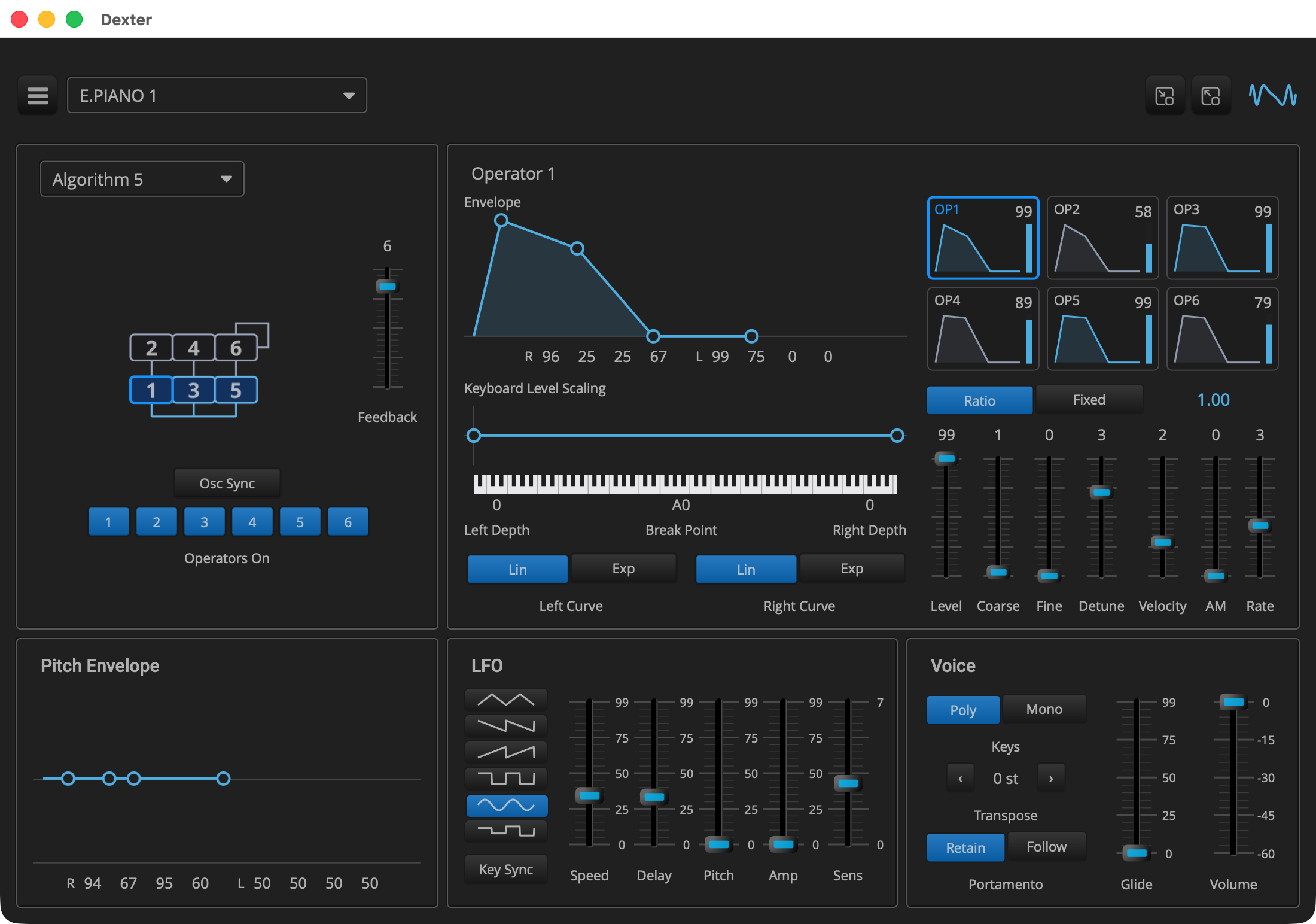
Dexter, a high-fidelity Yamaha DX7 emulation, built with QPlug: a library for building audio plugins using the Cycfi Elements GUI library. QPlug is an optional library in the Q ecosystem.
Modern C++
Desktop to Microcontroller
MIDI 2.0
Signal Processing
Plugins and I/O
Learning
Q comes in three layers. The core stands on its own; the other two are optional and each builds on it.
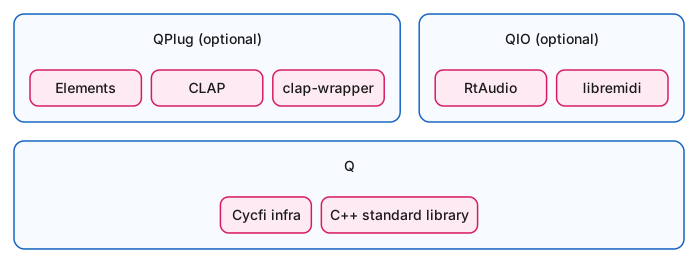
Q, the core (q_lib): The DSP library proper: filters, envelopes and dynamics, oscillators and synthesis, pitch detection, MIDI 1.0 and 2.0, and the support facilities they share. It is header-only and needs only the C++ standard library and the header-only Cycfi infra, so it runs on small microcontrollers as readily as on a desktop. See the Q Reference.
QIO (q_io): Audio and MIDI input and output for a desktop application: devices, streams and audio files, built on RtAudio and libremidi. The tests and examples use it; an application with its own I/O, a plugin for one, does without it. See the QIO Reference.
QPlug (q_plug): A framework for building audio plugins: write the DSP, the parameters and an Elements GUI as three plain classes, and get CLAP, VST3 and AudioUnit plugins and a standalone app. It is off by default. See the QPlug Reference.
None is installed by hand: CMake brings each in, pinned, the first time you configure.
Q, the core (q_lib): Only the C++ standard library and the header-only Cycfi infra, a git submodule. A clone without the submodule still builds: CMake fetches infra instead.
QIO (q_io): RtAudio for audio and libremidi for MIDI 1.0 and 2.0, libremidi from a Cycfi fork that carries bug fixes sent upstream.
QPlug (q_plug): Elements for the GUI, CLAP and clap-wrapper for the plugin formats and the standalone app, and nlohmann json for state and presets. Fetched only when QPlug is built.
The compiler, CMake and the few system packages each platform needs are in Q Setup and Installation and QPlug Setup and Installation.
The documentation follows the path through Q:

Joel got into electronics and programming in the 80s because almost everything in music, his first love, is becoming electronic and digital. Since then, he builds his own guitars, effect boxes and synths. He enjoys playing distortion-laden rock guitar, composes and produces his own music in his home studio.
Joel de Guzman is the principal architect and engineer at Cycfi Research. He is a software engineer specializing in advanced C++ and an advocate of Open Source. He has authored a number of highly successful Open Source projects such as Boost.Spirit, Boost.Phoenix and Boost.Fusion. These libraries are all part of the Boost Libraries, a well respected, peer-reviewed, Open Source, collaborative development effort.
Join the Discord channel to discuss Q and chat with the developer.
Copyright (c) 2014-2026 Joel de Guzman. All rights reserved. Distributed under the MIT License
69 followers · starred Mar 2023
269 followers · starred Jul 2021
77 followers · starred Sep 2019
239 followers · starred Mar 2021
C++ Library for Audio Digital Signal Processing
C++
1,438
1,911 commits
updated Oct 13, 2026
Audio DSP Library
is a cross-platform C++ library for Audio Digital Signal Processing. Aptly named after the "Q factor", a dimensionless parameter that describes the quality of a resonant circuit, the Q DSP Library is designed to be simple and elegant, as the simplicity of its name suggests, and efficient enough to run
on small microcontrollers.
Q leverages the power of modern C++ and efficient use of functional programming techniques, especially function composition using fine-grained and reusable function objects (both stateless and stateful), to simplify complex DSP programming tasks without sacrificing readability.
Q is the host of some experimental Music related DSP facilities the author has accumulated over the years as part of research and development, and will continue to evolve to accommodate more facilities necessary for the fulfillment of various Music related projects.
The library is Open Source and released under the very liberal MIT License.
Status:
mastertracks the latest stable release (currently v1.5.4). The next release, v1.6, is developed ondevelop, where the docs stay in sync as changes land. See NEWS.md for what is new in each release.
Dexter, a high-fidelity Yamaha DX7 emulation, built with QPlug: a library for building audio plugins using the Cycfi Elements GUI library. QPlug is an optional library in the Q ecosystem.
Modern C++
Desktop to Microcontroller
MIDI 2.0
Signal Processing
Plugins and I/O
Learning
Q comes in three layers. The core stands on its own; the other two are optional and each builds on it.
Q, the core (q_lib): The DSP library proper: filters, envelopes and dynamics, oscillators and synthesis, pitch detection, MIDI 1.0 and 2.0, and the support facilities they share. It is header-only and needs only the C++ standard library and the header-only Cycfi infra, so it runs on small microcontrollers as readily as on a desktop. See the Q Reference.
QIO (q_io): Audio and MIDI input and output for a desktop application: devices, streams and audio files, built on RtAudio and libremidi. The tests and examples use it; an application with its own I/O, a plugin for one, does without it. See the QIO Reference.
QPlug (q_plug): A framework for building audio plugins: write the DSP, the parameters and an Elements GUI as three plain classes, and get CLAP, VST3 and AudioUnit plugins and a standalone app. It is off by default. See the QPlug Reference.
None is installed by hand: CMake brings each in, pinned, the first time you configure.
Q, the core (q_lib): Only the C++ standard library and the header-only Cycfi infra, a git submodule. A clone without the submodule still builds: CMake fetches infra instead.
QIO (q_io): RtAudio for audio and libremidi for MIDI 1.0 and 2.0, libremidi from a Cycfi fork that carries bug fixes sent upstream.
QPlug (q_plug): Elements for the GUI, CLAP and clap-wrapper for the plugin formats and the standalone app, and nlohmann json for state and presets. Fetched only when QPlug is built.
The compiler, CMake and the few system packages each platform needs are in Q Setup and Installation and QPlug Setup and Installation.
The documentation follows the path through Q:
Joel got into electronics and programming in the 80s because almost everything in music, his first love, is becoming electronic and digital. Since then, he builds his own guitars, effect boxes and synths. He enjoys playing distortion-laden rock guitar, composes and produces his own music in his home studio.
Joel de Guzman is the principal architect and engineer at Cycfi Research. He is a software engineer specializing in advanced C++ and an advocate of Open Source. He has authored a number of highly successful Open Source projects such as Boost.Spirit, Boost.Phoenix and Boost.Fusion. These libraries are all part of the Boost Libraries, a well respected, peer-reviewed, Open Source, collaborative development effort.
Join the Discord channel to discuss Q and chat with the developer.
Copyright (c) 2014-2026 Joel de Guzman. All rights reserved. Distributed under the MIT License
69 followers · starred Mar 2023
269 followers · starred Jul 2021
77 followers · starred Sep 2019
239 followers · starred Mar 2021