
README
Lip Forcing: Few-Step Autoregressive Diffusion for Real-time Lip Synchronization
Paul Hyunbin Cho1* · Jinhyuk Jang1* · SeokYoung Lee1 · Joungbin Lee1 · Siyoon Jin1 · Heeseong Shin1 · Jung Yi1 · Yunjin Park2 · Chulmin Park2 · Seungryong Kim1†
1 KAIST AI · 2 AIPARK
* Equal contribution. † Corresponding author.
Paper | Project Page | Checkpoints
News
- 2026-07-07 · Initial release - 14B student weights + inference & training code.
- 2026-06-09 · Paper released on arXiv.
Roadmap
- 14B student weights
- Inference code
- Training code
- Paper on arXiv
- 1.3B student weights
- Gradio / Hugging Face Space demo
Overview
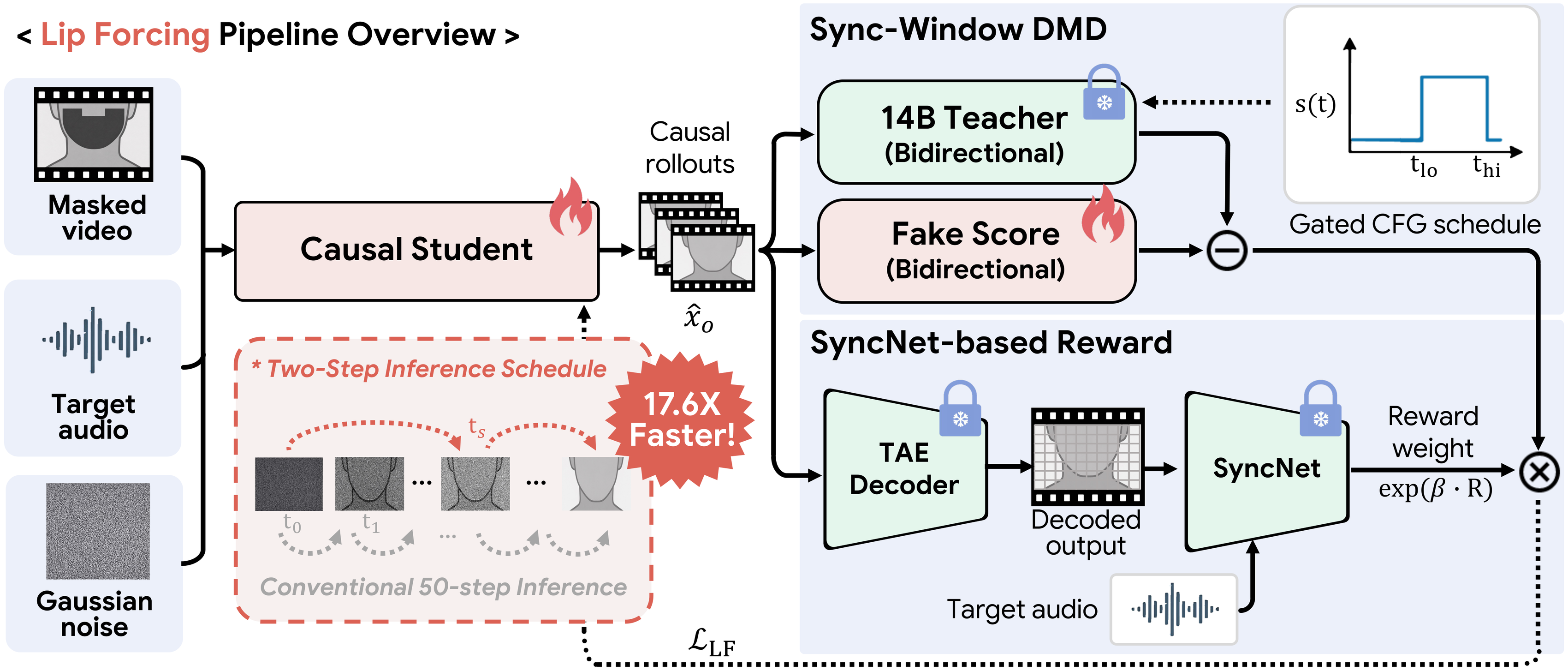
Lip Forcing is, to our knowledge, the first autoregressive diffusion method for video-to-video (V2V) lip synchronization. It distills a high-fidelity bidirectional 14B audio-conditioned teacher (OmniAvatar-LS, our lip-sync finetune of OmniAvatar) into causal few-step students that generate each chunk in just two denoising steps with no inference-time CFG - enabling real-time, streaming lip-sync on a reference video with sub-millisecond time-to-first-frame.
Highlights
- Real-time. The 1.3B student runs at 31 FPS - 17.6× faster than its same-scale bidirectional teacher, crossing the 25 FPS real-time threshold.
- Scales up. The 14B student (the largest diffusion model reported for V2V lip-sync) runs 39.8× faster than its teacher at comparable reference fidelity.
- Sub-millisecond time-to-first-frame at both scales - streaming, decode-as-you-go output.
- Both scales sit on the throughput–FVD Pareto frontier, ahead of prior diffusion lip-sync methods.
Installation
conda create -y -n lipforcing python=3.12 && conda activate lipforcing
git clone https://github.com/cvlab-kaist/LipForcing.git
cd LipForcing
pip install -e .
Optional: install flash-attn for faster attention (the student falls back to standard attention without it).
Tested on: Ubuntu 24.04 · Python 3.12 · PyTorch 2.10.0 (CUDA 12.8) · NVIDIA H200 (driver 570.86). Training used 4× H200; inference runs on a single GPU.
Weights
The released 14B student is a single self-contained file - base Wan and the OmniAvatar-LS adapter are merged in. Inference needs only the student checkpoint plus the external components (Wan VAE, wav2vec, UMT5-XXL text encoder or precomputed embeddings, TAEW, mouth mask); the teacher and base diffusion model are needed only for training.
Lip Forcing checkpoints - JinhyukJang/lipforcing:
| File | What | For |
|---|---|---|
lipforcing_14b.pth | 14B student - merged, self-contained | inference |
teacher/omniavatar_ls_14b.pt | OmniAvatar-LS 14B V2V teacher | training |
| 1.3B student | coming soon (same repo) |
Download everything for inference (into ./weights, matching the example commands below):
# Lip Forcing 14B student (merged, self-contained)
hf download JinhyukJang/lipforcing lipforcing_14b.pth --local-dir weights

# Wan 2.1 VAE + UMT5-XXL text encoder (+ tokenizer)
hf download Wan-AI/Wan2.1-T2V-14B Wan2.1_VAE.pth models_t5_umt5-xxl-enc-bf16.pth \
  google/umt5-xxl/special_tokens_map.json google/umt5-xxl/spiece.model \
  google/umt5-xxl/tokenizer.json google/umt5-xxl/tokenizer_config.json \
  --local-dir weights/Wan2.1-T2V-14B

# wav2vec2 audio encoder
hf download facebook/wav2vec2-base-960h --local-dir weights/wav2vec2-base-960h

# TAEW tiny decoder + LatentSync mouth mask
curl -L -o weights/taew2_1.pth https://raw.githubusercontent.com/madebyollin/taehv/main/taew2_1.pth
curl -L -o weights/mask.png https://raw.githubusercontent.com/bytedance/LatentSync/main/latentsync/utils/mask.png
Additionally for training:
# base Wan 2.1 T2V 14B diffusion shards
hf download Wan-AI/Wan2.1-T2V-14B --include "diffusion_pytorch_model*" --local-dir weights/Wan2.1-T2V-14B
# OmniAvatar-LS teacher
hf download JinhyukJang/lipforcing teacher/omniavatar_ls_14b.pt --local-dir weights
# SyncNet (Re-DMD reward)
curl -L -o weights/syncnet_v2.model https://www.robots.ox.ac.uk/~vgg/software/lipsync/data/syncnet_v2.model
External models - not redistributed here; download from the sources below:
| Model | For | Source |
|---|---|---|
| Wan2.1-T2V-14B (incl. Wan VAE + UMT5-XXL) | base diffusion (train) · VAE --vae_path · text encoder | Wan-AI/Wan2.1-T2V-14B |
| wav2vec2-base-960h | audio encoder --wav2vec_path | facebook/wav2vec2-base-960h |
TAEW taew2_1.pth | fast tiny VAE decoder --taehv_ckpt (streaming + reward) | github.com/madebyollin/taehv |
LatentSync mask.png | mouth mask --mask_path | bytedance/LatentSync - latentsync/utils/mask.png |
SyncNet-v2 syncnet_v2.model | SyncNet reward (training) | joonson/syncnet_python (download_model.sh) |
InsightFace buffalo_l | face detect/align (default preprocessing) | auto-downloaded by insightface into checkpoints/auxiliary/ on first use |
See DATA.md for the data format, on-the-fly preprocessing, and how the training configs wire these in.
Inference
python scripts/inference/inference_streaming.py \
  --ckpt_path weights/lipforcing_14b.pth \
  --vae_path weights/Wan2.1-T2V-14B/Wan2.1_VAE.pth \
  --wav2vec_path weights/wav2vec2-base-960h \
  --mask_path weights/mask.png \
  --taehv_ckpt weights/taew2_1.pth \
  --text_encoder_path weights/Wan2.1-T2V-14B/models_t5_umt5-xxl-enc-bf16.pth \
  --video_path ref.mp4 --audio_path speech.wav --output_path out.mp4
Streaming inference: each AR chunk is encoded, denoised, decoded, and composited on the fly - the first frames arrive before the clip finishes, GPU memory stays constant for any clip length (~37 GB at 14B with precomputed text embeddings), and face detection + 512×512 alignment + paste-back run automatically, so any talking-head video works as input.
Options & details
- Text conditioning is required: pass
--text_encoder_path(the UMT5-XXL.pthfrom the Wan repo; encodes--prompt, default "a person talking") or--text_embeds_path(a precomputedtext_emb.pt, faster to load and ~13 GB less peak VRAM than runtime encoding). - Decoder: defaults to StreamingTAEHV (fast tiny decoder);
--streaming_decoder wan_vaedecodes each chunk with the full Wan VAE (cache-continuous, identical to a full-clip decode) at lower speed. - Output length follows the audio:
floor(audio_seconds × 25)frames, converted to VAE latents (1 + (frames−1)/4) and rounded down to whole AR chunks - the output can be up to ~0.5 s shorter than the audio (it is muxed in sync). The reference video is ping-pong extended or truncated to match;--num_latent_framesforces an exact length. - Attention defaults to the trained sliding window (
--local_attn_size 7: 1 sink + 6 rolling latent frames, dynamic RoPE). Full attention over the entire clip (--local_attn_size -1 --sink_size 0 --no_dynamic_rope) makes VRAM grow with clip length (roughly +5 GB per second of output at 14B). - VRAM (14B, measured on H200): ~37 GB peak, constant w.r.t. clip length (the reference is encoded inside the AR loop by default - bit-identical to an upfront encode). Runtime text encoding transiently adds the UMT5-XXL encoder → ~50 GB peak. 48 GB cards work with precomputed embeddings.
--face_cache_dir(optional) caches face-detection results for repeated runs over the same videos. Face detection uses onnxruntime; installonnxruntime-gputo run it on GPU (the pinnedonnxruntimepackage is CPU-only and noticeably slower on long videos).- Batch / evaluation workflows:
scripts/inference/inference_segmentwise.pyruns the same generation but denoises the whole clip before decoding once; it adds batch--input_dirover training-style sample dirs (pair with--skip_preprocessing- those are pre-aligned 512×512 crops),--precomputed_dirfor cached training tensors, and--save_alignedfor the raw generated face video. - Run either script with
--helpfor the full flag list.
Training
Two stages (see DATA.md for data preparation and the required external weights):
Stage 1 - Diffusion-Forcing init
bash scripts/train_stage1_df.sh # → lipforcing/configs/experiments/OmniAvatar/config_df.py
Stage 2 - Self-Forcing DMD (SW-DMD + SyncNet reward)
bash scripts/train_stage2_sf.sh # → lipforcing/configs/experiments/OmniAvatar/config_sf.py
Override any config field with Hydra-style syntax: python train.py --config=<config.py> - key=value nested.key=value.
Training saves trainable-only checkpoints. To run inference on your own Stage-2 checkpoint,
either pass the base/adapter weights alongside it (--base_model_paths, --omniavatar_ckpt_path)
or bake everything into a single self-contained .pth with
scripts/export_merged_checkpoint.py (how the released lipforcing_14b.pth was produced;
see its docstring).
Both stages load the base Wan 2.1 T2V weights and the OmniAvatar-LS V2V adapter - which serves as
both the frozen distillation teacher and the student initialization - obtained as described in
DATA.md. The vendored OmniAvatar/ package supplies the encoders, VAE, and text/audio
preprocessing shared by training and inference; it is not a standalone teacher-training entry point.
Acknowledgements
Lip Forcing builds on:
- NVIDIA FastGen (Apache-2.0) - the distillation framework skeleton.
- Self Forcing (arXiv:2506.08009) - the autoregressive Self-Forcing DMD distillation behind Stage 2.
- Reward-Forcing (arXiv:2512.04678) - the reward-weighted DMD (Re-DMD) formulation behind our SyncNet reward.
- OmniAvatar (Apache-2.0) - the V2V teacher and the audio/VAE/text encoders + preprocessing (vendored under
OmniAvatar/). - Wan2.1 - the base diffusion model and VAE.
- LatentSync (Apache-2.0) - the face detection /
512×512 affine-alignment / compositing pipeline and the mouth mask (vendored under
OmniAvatar/utils/latentsync/).
Third-party licenses are in licenses/.
Citation
@article{cho2026lipforcing,
  title   = {Lip Forcing: Few-Step Autoregressive Diffusion for Real-time Lip Synchronization},
  author  = {Cho, Paul Hyunbin and Jang, Jinhyuk and Lee, SeokYoung and Lee, Joungbin and Jin, Siyoon and Shin, Heeseong and Yi, Jung and Park, Yunjin and Park, Chulmin and Kim, Seungryong},
  journal = {arXiv preprint arXiv:2606.11180},
  year    = {2026},
}
License
Apache License 2.0 - see LICENSE.
Similar repos





Languages
Python
99.2%
README
Lip Forcing: Few-Step Autoregressive Diffusion for Real-time Lip Synchronization
Paul Hyunbin Cho1* · Jinhyuk Jang1* · SeokYoung Lee1 · Joungbin Lee1 · Siyoon Jin1 · Heeseong Shin1 · Jung Yi1 · Yunjin Park2 · Chulmin Park2 · Seungryong Kim1†
1 KAIST AI · 2 AIPARK
* Equal contribution. † Corresponding author.
Paper | Project Page | Checkpoints
News
- 2026-07-07 · Initial release - 14B student weights + inference & training code.
- 2026-06-09 · Paper released on arXiv.
Roadmap
- 14B student weights
- Inference code
- Training code
- Paper on arXiv
- 1.3B student weights
- Gradio / Hugging Face Space demo
Overview
Lip Forcing is, to our knowledge, the first autoregressive diffusion method for video-to-video (V2V) lip synchronization. It distills a high-fidelity bidirectional 14B audio-conditioned teacher (OmniAvatar-LS, our lip-sync finetune of OmniAvatar) into causal few-step students that generate each chunk in just two denoising steps with no inference-time CFG - enabling real-time, streaming lip-sync on a reference video with sub-millisecond time-to-first-frame.
Highlights
- Real-time. The 1.3B student runs at 31 FPS - 17.6× faster than its same-scale bidirectional teacher, crossing the 25 FPS real-time threshold.
- Scales up. The 14B student (the largest diffusion model reported for V2V lip-sync) runs 39.8× faster than its teacher at comparable reference fidelity.
- Sub-millisecond time-to-first-frame at both scales - streaming, decode-as-you-go output.
- Both scales sit on the throughput–FVD Pareto frontier, ahead of prior diffusion lip-sync methods.
Installation
conda create -y -n lipforcing python=3.12 && conda activate lipforcing
git clone https://github.com/cvlab-kaist/LipForcing.git
cd LipForcing
pip install -e .
Optional: install flash-attn for faster attention (the student falls back to standard attention without it).
Tested on: Ubuntu 24.04 · Python 3.12 · PyTorch 2.10.0 (CUDA 12.8) · NVIDIA H200 (driver 570.86). Training used 4× H200; inference runs on a single GPU.
Weights
The released 14B student is a single self-contained file - base Wan and the OmniAvatar-LS adapter are merged in. Inference needs only the student checkpoint plus the external components (Wan VAE, wav2vec, UMT5-XXL text encoder or precomputed embeddings, TAEW, mouth mask); the teacher and base diffusion model are needed only for training.
Lip Forcing checkpoints - JinhyukJang/lipforcing:
| File | What | For |
|---|---|---|
lipforcing_14b.pth | 14B student - merged, self-contained | inference |
teacher/omniavatar_ls_14b.pt | OmniAvatar-LS 14B V2V teacher | training |
| 1.3B student | coming soon (same repo) |
Download everything for inference (into ./weights, matching the example commands below):
# Lip Forcing 14B student (merged, self-contained)
hf download JinhyukJang/lipforcing lipforcing_14b.pth --local-dir weights

# Wan 2.1 VAE + UMT5-XXL text encoder (+ tokenizer)
hf download Wan-AI/Wan2.1-T2V-14B Wan2.1_VAE.pth models_t5_umt5-xxl-enc-bf16.pth \
  google/umt5-xxl/special_tokens_map.json google/umt5-xxl/spiece.model \
  google/umt5-xxl/tokenizer.json google/umt5-xxl/tokenizer_config.json \
  --local-dir weights/Wan2.1-T2V-14B

# wav2vec2 audio encoder
hf download facebook/wav2vec2-base-960h --local-dir weights/wav2vec2-base-960h

# TAEW tiny decoder + LatentSync mouth mask
curl -L -o weights/taew2_1.pth https://raw.githubusercontent.com/madebyollin/taehv/main/taew2_1.pth
curl -L -o weights/mask.png https://raw.githubusercontent.com/bytedance/LatentSync/main/latentsync/utils/mask.png
Additionally for training:
# base Wan 2.1 T2V 14B diffusion shards
hf download Wan-AI/Wan2.1-T2V-14B --include "diffusion_pytorch_model*" --local-dir weights/Wan2.1-T2V-14B
# OmniAvatar-LS teacher
hf download JinhyukJang/lipforcing teacher/omniavatar_ls_14b.pt --local-dir weights
# SyncNet (Re-DMD reward)
curl -L -o weights/syncnet_v2.model https://www.robots.ox.ac.uk/~vgg/software/lipsync/data/syncnet_v2.model
External models - not redistributed here; download from the sources below:
| Model | For | Source |
|---|---|---|
| Wan2.1-T2V-14B (incl. Wan VAE + UMT5-XXL) | base diffusion (train) · VAE --vae_path · text encoder | Wan-AI/Wan2.1-T2V-14B |
| wav2vec2-base-960h | audio encoder --wav2vec_path | facebook/wav2vec2-base-960h |
TAEW taew2_1.pth | fast tiny VAE decoder --taehv_ckpt (streaming + reward) | github.com/madebyollin/taehv |
LatentSync mask.png | mouth mask --mask_path | bytedance/LatentSync - latentsync/utils/mask.png |
SyncNet-v2 syncnet_v2.model | SyncNet reward (training) | joonson/syncnet_python (download_model.sh) |
InsightFace buffalo_l | face detect/align (default preprocessing) | auto-downloaded by insightface into checkpoints/auxiliary/ on first use |
See DATA.md for the data format, on-the-fly preprocessing, and how the training configs wire these in.
Inference
python scripts/inference/inference_streaming.py \
  --ckpt_path weights/lipforcing_14b.pth \
  --vae_path weights/Wan2.1-T2V-14B/Wan2.1_VAE.pth \
  --wav2vec_path weights/wav2vec2-base-960h \
  --mask_path weights/mask.png \
  --taehv_ckpt weights/taew2_1.pth \
  --text_encoder_path weights/Wan2.1-T2V-14B/models_t5_umt5-xxl-enc-bf16.pth \
  --video_path ref.mp4 --audio_path speech.wav --output_path out.mp4
Streaming inference: each AR chunk is encoded, denoised, decoded, and composited on the fly - the first frames arrive before the clip finishes, GPU memory stays constant for any clip length (~37 GB at 14B with precomputed text embeddings), and face detection + 512×512 alignment + paste-back run automatically, so any talking-head video works as input.
Options & details
- Text conditioning is required: pass
--text_encoder_path(the UMT5-XXL.pthfrom the Wan repo; encodes--prompt, default "a person talking") or--text_embeds_path(a precomputedtext_emb.pt, faster to load and ~13 GB less peak VRAM than runtime encoding). - Decoder: defaults to StreamingTAEHV (fast tiny decoder);
--streaming_decoder wan_vaedecodes each chunk with the full Wan VAE (cache-continuous, identical to a full-clip decode) at lower speed. - Output length follows the audio:
floor(audio_seconds × 25)frames, converted to VAE latents (1 + (frames−1)/4) and rounded down to whole AR chunks - the output can be up to ~0.5 s shorter than the audio (it is muxed in sync). The reference video is ping-pong extended or truncated to match;--num_latent_framesforces an exact length. - Attention defaults to the trained sliding window (
--local_attn_size 7: 1 sink + 6 rolling latent frames, dynamic RoPE). Full attention over the entire clip (--local_attn_size -1 --sink_size 0 --no_dynamic_rope) makes VRAM grow with clip length (roughly +5 GB per second of output at 14B). - VRAM (14B, measured on H200): ~37 GB peak, constant w.r.t. clip length (the reference is encoded inside the AR loop by default - bit-identical to an upfront encode). Runtime text encoding transiently adds the UMT5-XXL encoder → ~50 GB peak. 48 GB cards work with precomputed embeddings.
--face_cache_dir(optional) caches face-detection results for repeated runs over the same videos. Face detection uses onnxruntime; installonnxruntime-gputo run it on GPU (the pinnedonnxruntimepackage is CPU-only and noticeably slower on long videos).- Batch / evaluation workflows:
scripts/inference/inference_segmentwise.pyruns the same generation but denoises the whole clip before decoding once; it adds batch--input_dirover training-style sample dirs (pair with--skip_preprocessing- those are pre-aligned 512×512 crops),--precomputed_dirfor cached training tensors, and--save_alignedfor the raw generated face video. - Run either script with
--helpfor the full flag list.
Training
Two stages (see DATA.md for data preparation and the required external weights):
Stage 1 - Diffusion-Forcing init
bash scripts/train_stage1_df.sh # → lipforcing/configs/experiments/OmniAvatar/config_df.py
Stage 2 - Self-Forcing DMD (SW-DMD + SyncNet reward)
bash scripts/train_stage2_sf.sh # → lipforcing/configs/experiments/OmniAvatar/config_sf.py
Override any config field with Hydra-style syntax: python train.py --config=<config.py> - key=value nested.key=value.
Training saves trainable-only checkpoints. To run inference on your own Stage-2 checkpoint,
either pass the base/adapter weights alongside it (--base_model_paths, --omniavatar_ckpt_path)
or bake everything into a single self-contained .pth with
scripts/export_merged_checkpoint.py (how the released lipforcing_14b.pth was produced;
see its docstring).
Both stages load the base Wan 2.1 T2V weights and the OmniAvatar-LS V2V adapter - which serves as
both the frozen distillation teacher and the student initialization - obtained as described in
DATA.md. The vendored OmniAvatar/ package supplies the encoders, VAE, and text/audio
preprocessing shared by training and inference; it is not a standalone teacher-training entry point.
Acknowledgements
Lip Forcing builds on:
- NVIDIA FastGen (Apache-2.0) - the distillation framework skeleton.
- Self Forcing (arXiv:2506.08009) - the autoregressive Self-Forcing DMD distillation behind Stage 2.
- Reward-Forcing (arXiv:2512.04678) - the reward-weighted DMD (Re-DMD) formulation behind our SyncNet reward.
- OmniAvatar (Apache-2.0) - the V2V teacher and the audio/VAE/text encoders + preprocessing (vendored under
OmniAvatar/). - Wan2.1 - the base diffusion model and VAE.
- LatentSync (Apache-2.0) - the face detection /
512×512 affine-alignment / compositing pipeline and the mouth mask (vendored under
OmniAvatar/utils/latentsync/).
Third-party licenses are in licenses/.
Citation
@article{cho2026lipforcing,
  title   = {Lip Forcing: Few-Step Autoregressive Diffusion for Real-time Lip Synchronization},
  author  = {Cho, Paul Hyunbin and Jang, Jinhyuk and Lee, SeokYoung and Lee, Joungbin and Jin, Siyoon and Shin, Heeseong and Yi, Jung and Park, Yunjin and Park, Chulmin and Kim, Seungryong},
  journal = {arXiv preprint arXiv:2606.11180},
  year    = {2026},
}
License
Apache License 2.0 - see LICENSE.
Similar repos
Languages
Python
99.2%