
README
roundme
roundme is a human-assisted rounding analyzer. It helps its operator determine whether an arithmetic operation should round up or down.
Features
- Recommends whether an arithmetic operation needs to round up or down
- Generates LaTeX-based reports in PDF
Rules
rounding() is the expected rounding direction for the result (up or down)
A + B => rounding(A), rounding(B)(addition does not change the rounding direction)A - B => rounding(A), ! rounding(B)(the rounding direction of the substracted element is inverse of the expected rounding)A * B => rounding(A), rounding(B), rounding(*)(multiplication does not change the rounding direction)A / B => rounding(A), ! rounding(B), rounding(/)(the rounding direction of the denominator is the inverse of the expected rounding)A ** BIf A>=1 => rounding(A), rounding(B)If A<1 => rounding(A), ! rounding(B)(if A is below 1, the rounding direction of the exponent is the inverse of the expected rounding)
How to use
- Run
roundme init-sampleto generate a default configuration file. - Run
roundme initto generate user configuration file. - Run
roundme analyzeto analyze the configuration file - Run
roundme analyze --output-format pdfto generate a PDF (require latexmk)
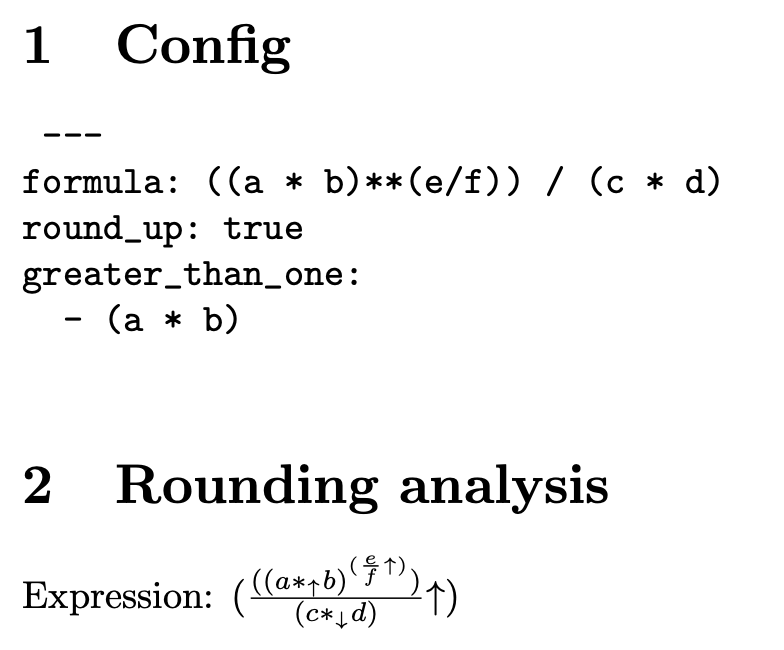
Running roundme analyze --output-format pdf on the default configuration will generate the following:
Configuration
roundme relies on a configuration file:
formula: a * b / c
round_up: true
less_than_one: ["a * b"] # optional
greater_than_one: ["c"] # optional
formulacontains the formula to be analyzeround_updetermines if the result of the formula should round up or downless_than_oneis used for the**rules (raw string comparison and sensible to space)greater_than_oneis used for the**rules (raw string comparison and sensible to space)
See the balancer V2 example.
Install
Install with
cargo install roundme
To install the latest GitHub version
git clone git@github.com:crytic/roundme.git
cd roundme
cargo install --path .


Similar repos


Languages
Rust
100.0%
README
roundme
roundme is a human-assisted rounding analyzer. It helps its operator determine whether an arithmetic operation should round up or down.
Features
- Recommends whether an arithmetic operation needs to round up or down
- Generates LaTeX-based reports in PDF
Rules
rounding() is the expected rounding direction for the result (up or down)
A + B => rounding(A), rounding(B)(addition does not change the rounding direction)A - B => rounding(A), ! rounding(B)(the rounding direction of the substracted element is inverse of the expected rounding)A * B => rounding(A), rounding(B), rounding(*)(multiplication does not change the rounding direction)A / B => rounding(A), ! rounding(B), rounding(/)(the rounding direction of the denominator is the inverse of the expected rounding)A ** BIf A>=1 => rounding(A), rounding(B)If A<1 => rounding(A), ! rounding(B)(if A is below 1, the rounding direction of the exponent is the inverse of the expected rounding)
How to use
- Run
roundme init-sampleto generate a default configuration file. - Run
roundme initto generate user configuration file. - Run
roundme analyzeto analyze the configuration file - Run
roundme analyze --output-format pdfto generate a PDF (require latexmk)
Running roundme analyze --output-format pdf on the default configuration will generate the following:
Configuration
roundme relies on a configuration file:
formula: a * b / c
round_up: true
less_than_one: ["a * b"] # optional
greater_than_one: ["c"] # optional
formulacontains the formula to be analyzeround_updetermines if the result of the formula should round up or downless_than_oneis used for the**rules (raw string comparison and sensible to space)greater_than_oneis used for the**rules (raw string comparison and sensible to space)
See the balancer V2 example.
Install
Install with
cargo install roundme
To install the latest GitHub version
git clone git@github.com:crytic/roundme.git
cd roundme
cargo install --path .
Similar repos
Languages
Rust
100.0%