
Self-hosted AI agent with persistent memory, plugins, tools, and skills written in Rust
Rust
5
7 commits
updated Aug 10, 2026
README
execlaw



Self-hosted Rust agent framework with persistent memory, hook-based plugins, tools, and skills. Bare metal best metal. All inference runs on operator hardware.
Documentation
| Doc | What it covers |
|---|---|
docs/architecture.md | System topology, design principles, FSM, data model, recovery, observability — the what. |
docs/agent-model.md | TurnExecutor, memory layers, reflection loop, planner/executor split — the how of one turn. |
docs/plugins.md | Plugin manifest schema, runtime tiers, sidecar model, Rhai primitives, and a step-by-step guide for writing a custom plugin. |
docs/setup-walkthroughs.md | Operator-facing pairing flows for Signal QR, WhatsApp wuzapi, Slack OAuth, Google OAuth + API-key. |
docs/desktop-installations.md | Cross-OS reference for the three desktop bundles — .app/.dmg, NSIS .exe, .deb. Tray architecture, service-manager mapping, install + uninstall flows, build scripts. |
docs/ollama.md | Pre-installed Ollama support across macOS / Linux / Windows. How discovery works, when to pick Ollama over Docker, the wizard's serving dropdown. |
docs/setup-mac.md | Apple Silicon first-run notes — native Ollama subprocess, model sizing, brand indicator. |
desktop-macos/README.md | macOS .app bundle internals — Tauri 2, SMAppService, build script. |
desktop-windows/README.md | Windows NSIS .exe bundle internals — Tauri 2, SCM service, build script. |
desktop-linux/README.md | Linux .deb bundle internals — Tauri 2, systemd --user unit, build script. |
docs/security.md | Disclosure path, threat model, cryptography, trust assumptions, known limitations, hardening checklist. |
docs/sidecar-supervisor-design.md | Supervised-container layer plugins compose against. |
docs/runner-design.md | Per-conversation runner container model. |
docs/voice-followups.md | Voice modality design notes. |
CONTRIBUTING.md | Workflow, code conventions, AGPL→Apache-2.0 licensing notes. |
AGENTS.md | Onboarding for AI coding agents working on this repo. |
What ships today
- Control plane (Rust binary): event log + scheduler + plugin host + container manager + outbox relay + axum server + SQLCipher vault.
- Per-conversation runner containers: stateless against the log, stateless OpenAI-compatible client to local inference (vLLM / OpenArc / Whisper / Kokoro).
- Trust ladder + Rule of Two:
Controller / Delegated / KnownTrusted / KnownLimited / UnknownPending / Blockedwith cold-contact escalation, signed approval-token JWTs, sideband HITL. - HMAC-chained event log: every committed row is tamper-evident; replay rebuilds state deterministically.
- Outbox + idempotency: framework-minted
(conversation_id, turn_seq, tool_call_ordinal)keys, retries with backoff, dead-letter queue. - Plugin framework (12 in-tree plugins — see Plugins shipped): script-tier (Rhai) + subprocess-tier (JSON-RPC), full manifest schema (tools / transports / identity providers / OAuth / sidecars / admin routes / webhook routes / UI panels / skills).
- Five shipped transports: Signal (signal-cli sidecar), WhatsApp (wuzapi sidecar), Slack (multi-workspace Socket Mode OAuth), Discord (multi-guild Gateway WebSocket), SMS (Android-gateway WebSocket).
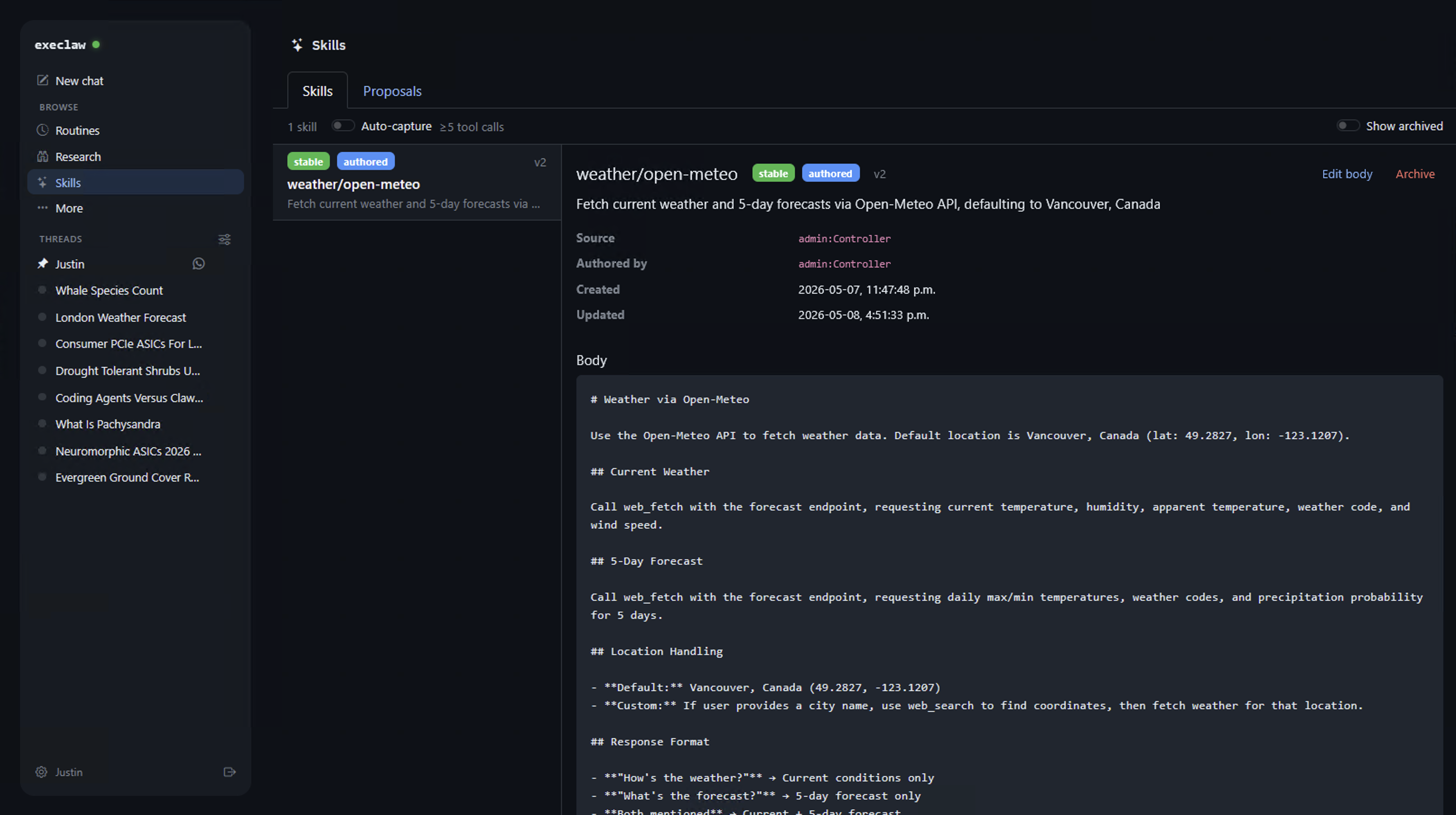
- HTTP integrations: Google Apps (Gmail/Calendar/Contacts/Tasks/Drive in one OAuth), Google Places, Open-Meteo (key-less weather), Yahoo Finance (market data), Pushover.
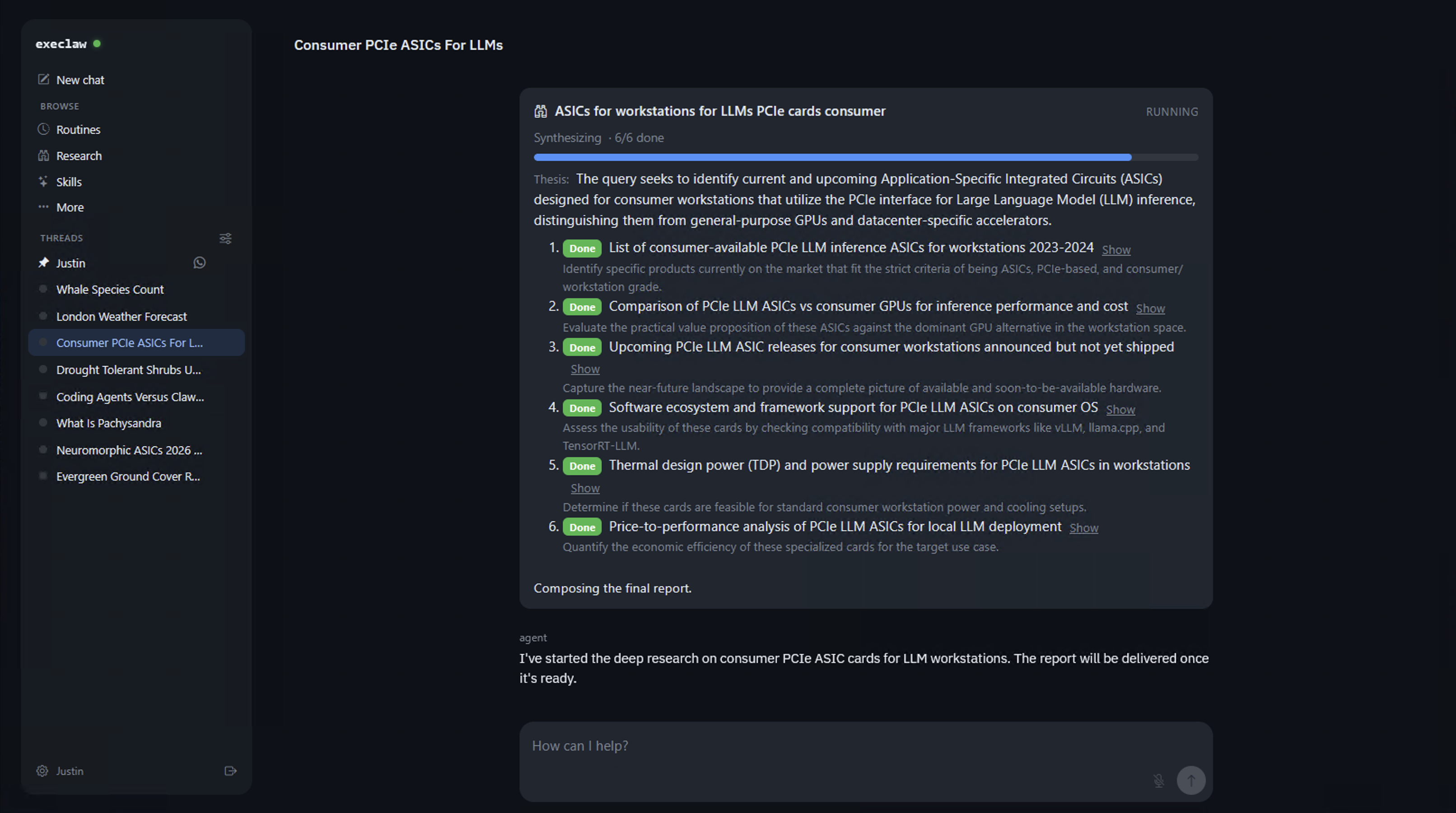
- Research subsystem: deep-research plan/gather/synthesize pipeline with retention and per-phase event flow.
- SPA: chat-first sidebar, pinned Control thread (every controller-channel message collapses here), token streaming, approval queue, per-plugin admin panels, settings. i18n out of the box — 8 languages (EN / ES / FR / DE / IT / NL / PL / PT), browser-locale auto-detection on first run, language switcher in the setup wizard and persisted to
localStorage. See Internationalisation (i18n) below. - Native desktop bundles for all three desktops —
.app/.dmgon macOS (Apple Silicon, SMAppService LaunchAgent), NSIS.exeon Windows (SCM service),.debon Linux (systemd--userunit). Each ships a tray icon, the bundled control plane, and the same SPA on127.0.0.1:3031. See Desktop installations below anddocs/desktop-installations.mdfor the full cross-OS reference.
See docs/architecture.md §18 for the full milestone breakdown.
Plugins shipped
All 12 in-tree plugins ship as ZIPs under dist/ and install via the SPA's Settings → Plugins page (or POST /api/admin/plugins/install). Source under plugins/.
| Plugin | Version | Tier | Kind | What it does |
|---|---|---|---|---|
signal | 0.5.0 | script | transport | Signal Messenger via a supervised signal-cli sidecar. Inbound consumer + outbound + group ops + QR/number pairing. |
whatsapp | 0.2.0 | script | transport | WhatsApp Multi-Device via a supervised wuzapi (whatsmeow-backed) sidecar. QR pairing, group ops, attachments, read receipts. |
slack | 0.3.2 | script | transport | Multi-workspace Slack via Socket Mode (no public URL). Sidecar-free — pure-Rhai over http_post + ws_subscribe + ws_send. |
discord | 0.2.0 | script | transport | Discord bot via the Gateway WebSocket. Multi-guild from one bot token, sidecar-free, gateway heartbeats over ws_set_keepalive. |
sms-socket | 0.2.0 | script | transport | SMS / MMS via the Android SMS Socket app — WebSocket to the operator's phone on LAN. |
google-apps | 0.3.0 | script | integration + identity | Gmail + Calendar + Contacts + Tasks + Drive in one OAuth grant. Per-module toggle. Identity provider for email/phone via the People API. |
google-places | 0.2.0 | script | integration | Google Places (New) API — text search, nearby search, place details. API-key only, no OAuth. |
open-meteo | 0.4.0 | script | integration | Key-less weather, marine, air-quality, seasonal, ensemble, flood, climate, geocoding, elevation via the public Open-Meteo APIs. |
finance-yahoo | 0.1.0 | script | integration | Real-time + historical market data via Yahoo Finance's public quote / chart endpoints. No API key. |
pushover | 0.2.0 | script | notifier | One-way Pushover push notifications to the operator's phone. |
identity-local-address-book | 0.1.0 | subprocess | identity | Local JSON contact list at ~/.execlaw/contacts.json — auto-trusts saved contacts as KnownTrusted. |
hello | 0.1.0 | subprocess | reference | Echo tool exercising the subprocess JSON-RPC tier. Template for new plugin authors. |
Tools, host-side built-ins, and the manifest schema are documented in docs/plugins.md. Chart rendering (chart.render) is a host-side built-in as of 2026-05-15 — it was previously inside open-meteo.
Internationalisation (i18n)
The SPA ships with eight languages built in:
| Code | Language |
|---|---|
en | English (the source-of-truth defaults, inline in JSX) |
es | Español |
fr | Français |
de | Deutsch |
it | Italiano |
nl | Nederlands |
pl | Polski |
pt | Português |
How language gets picked. On first load the SPA checks
localStorage["execlaw.preferred-language"]; if absent it falls back
to navigator.language (when that's one of the supported codes) and
finally to English. The setup wizard renders a compact globe-icon
language switcher in the top-right corner so the operator can flip
languages before they've committed to anything — the choice is
persisted to localStorage and applied to every subsequent visit.
How translations work in the code. English defaults live inline
in the React source via t("namespace.key", "English default string")
— the same pattern as the upstream business website. Other locale
bundles (web/src/locales/<lang>.json) are lazily code-split: only
the active language's JSON is fetched. When a key is missing from a
non-English bundle, t() silently falls back to the English default,
so a partial translation can ship without surfacing empty UI strings.
{{var}}-style interpolation works the same on the English path and
the translated path.
Implementation reference. Core: web/src/i18n/index.ts
(i18next bootstrap, lazy-loader registry, t() helper,
useT() / useCurrentLanguage() React hooks). UI:
web/src/i18n/LanguageSwitcher.tsx.
Locale bundles: web/src/locales/.
Adding a new language. Add the ISO code to SUPPORTED_LANGUAGES
in web/src/i18n/index.ts, register a lazy-loader entry in
localeLoaders, add an OPTIONS row in
web/src/i18n/LanguageSwitcher.tsx, and drop a
web/src/locales/<code>.json keyed by the same namespace.key
strings the JSX passes to t().
Not yet i18n-ized. Server-side strings (CLI output, log lines, plugin-author-facing error messages) are English-only. The translation surface is the operator-facing SPA UI; the operator talks to the agent in whatever language they want — the LLM handles that end on its own.
Minimum requirements
execlaw is self-hosted by design — there is no SaaS tier, no cloud fallback, and no plan for one. Inference happens on the operator's own hardware against a local OpenAI-compatible endpoint. The hardware floor is set by the LLM you choose to run, not by execlaw itself.
Operating system
| Platform | Status | Recommended install | Service backend |
|---|---|---|---|
| Linux x86_64 (Ubuntu 22.04+, Debian 12+, Mint 21+, Pop_OS! 22.04+) | Supported | execlaw_<v>_amd64.deb (Debian-family desktop) or execlaw install (CLI / non-Debian) | systemd --user (.deb) / systemd (CLI) |
| macOS arm64 (Apple Silicon, M1+) | Supported | execlaw.app menu bar bundle | launchd via SMAppService |
| macOS x86_64 (Intel) | Supported | execlaw install (CLI) | launchd |
| Windows 10 / 11 (x86_64, MSVC toolchain) | Supported | execlaw_<v>_x64-setup.exe (NSIS) or execlaw install (CLI / headless) | Service Control Manager |
The CLI path uses the service-manager crate. For desktop installs the recommended path is the OS-native bundle — .app on Apple Silicon, NSIS .exe on Windows, .deb on Debian-family Linux — each registers the background service through that OS's native API (SMAppService / SCM / systemd --user) so install + uninstall stay self-contained. See Desktop installations. CLI install still works on headless servers (and is the only path on non-Debian Linux and Intel Macs).
GPU / inference acceleration
You need a GPU capable of running the LLM you intend to use. The in-tree default is Qwen3.5-27B-AWQ (~14 GB VRAM for weights + a working KV cache budget for ~8K-token contexts). Two acceleration paths are supported out-of-the-box:
| Path | Hardware | Backend | Typical floor |
|---|---|---|---|
| NVIDIA CUDA | RTX 30-series or newer with ≥16 GB VRAM | service-vllm (vLLM, Docker) or native Ollama | RTX 4090 / 3090 / A4000 |
| Intel Arc / Xeon | Arc A770 / B580, Battlemage, Xeon w/ AMX | service-openarc (OpenVINO, Docker) or native Ollama | Arc A770 16 GB |
| Apple Silicon | M1 / M2 / M3 / M4 with 16+ GB unified memory | native Ollama subprocess (Metal) | M2 / M3 base 16 GB |
CPU-only inference is technically possible via llama.cpp or similar sidecars, but at 27B-AWQ the latency makes the agent loop unusable. Smaller models (Qwen2.5-7B-AWQ at ~5 GB VRAM) work on consumer 8 GB cards if you accept the quality drop — operators swap the model spec in Settings → Backends.
The voice subsystem (Whisper STT, Kokoro TTS) runs alongside the LLM — add ~1-2 GB VRAM headroom if you want both on the same card. Operators with a second GPU (typical Intel-Arc-for-voice + NVIDIA-for-LLM split) can pin each backend per-card via Settings → Runners.
Memory + disk
| Resource | Floor | Comfortable |
|---|---|---|
| System RAM | 16 GB | 32 GB |
Free disk for ~/.execlaw/ | 2 GB | 10 GB (DB + log retention + plugin sidecar volumes) |
| Free disk for Docker images | 30 GB | 80 GB+ (LLM weights dominate; vLLM + Whisper + Kokoro + plugin sidecars) |
Required runtime dependencies
- Docker — required for
per-conversation runner containers, plugin sidecars (signal-cli,
wuzapi, …), and managed-mode inference backends. The control plane
talks to the local Docker daemon via the standard socket
(
/var/run/docker.sockon Linux/macOS,\\.\pipe\docker_engineon Windows). Docker Desktop is fine on macOS/Windows; Docker Engine or Podman-with-the-docker-socket-shim works on Linux. Without Docker the agent loop runs text-only with the runner in-process; sidecars and managed inference are unavailable — usable for plain chat but not for the bridged-transport plugins. Apple Silicon exception: Docker Desktop on a Mac runs Linux in a microVM with no Metal access, so containerised inference on M-series GPUs falls back to CPU and is unusable. execlaw spawns Ollama as a native subprocess on Apple Silicon instead — seedocs/setup-mac.md. Docker is still needed for the bridged-transport sidecars (signal-cli, wuzapi). Cross-OS Ollama support: the native-subprocess path also works on Linux and Windows whenollamais installed on the host. The setup wizard discovers it automatically and offers it as an alternative serving method alongside vLLM / OpenVINO. Seedocs/ollama.mdfor when to pick which. - An NVIDIA or Intel GPU driver stack matching the inference path
you choose — CUDA 12+ runtime for NVIDIA, the OpenVINO drivers for
Intel. Both are normally installed alongside the GPU;
execlaw doctorprints what's missing. - An OS keyring backend for vault master-key storage — Keychain
on macOS, Credential Manager on Windows, Secret Service / KWallet
on Linux. The vault falls back to
~/.execlaw/master.keyif the keyring is unavailable; the file fallback is also the durable sink on Windows where Credential Manager has documented drift issues (seedocs/security.md§5).
Build-from-source dependencies
Only required if you're compiling rather than installing a release binary:
- Rust 1.85+ (edition 2024). MSRV documented at the workspace root; CI runs against current stable.
- Node.js 20+ for the SPA build (
web/). - A C toolchain for the SQLite bundling:
gcc/clangon Linux/macOS, MSVC on Windows. - Strawberry Perl 5.32+ on Windows only if you build the
production
sqlcipherfeature (vendored OpenSSL needs Perl). Not required for defaultbundled-sqlite-plaindev builds.
execlaw doctor runs preflight checks for all of the above and prints
remediation pointers per platform.
Quick start (production)
execlaw's control plane runs as a host service on bare metal — systemd on Linux, launchd on macOS, the Service Control Manager on Windows. The control plane itself is a single native binary; Docker is required only for the things the control plane spawns out (per- conversation runner containers, plugin sidecars like signal-cli / wuzapi, managed-mode inference backends). On a host without Docker the agent loop still works text-only with the runner running in-process; sidecars and managed inference are unavailable.
One-shot install
cargo install --path crates/cli   # or `cargo build --release` and copy the binary
execlaw install                   # migrate DB → register service → start it
curl http://127.0.0.1:3031/api/health    # → {"status":"ok"}
open  http://127.0.0.1:3031/api/docs     # Swagger + AsyncAPI
execlaw install registers a per-user service by default. Add
--system for a system-wide install (root / Administrator). On
Windows the Service Control Manager always runs system-level, so
--system is implied.
Desktop installations
For desktop hosts the recommended path is the OS-native bundle.
Each one ships a tray / menu-bar icon plus the same bundled control
plane, and each registers the background service through that OS's
native API so install + uninstall stay self-contained. Full
cross-OS reference: docs/desktop-installations.md.
macOS (Apple Silicon) — menu bar .app
Registers a LaunchAgent through Apple's modern SMAppService API,
so dragging the .app to the Trash automatically removes the
background service — no leftover plist in ~/Library/LaunchAgents/.
- Download
execlaw_<version>_aarch64.dmgfrom Releases. - Open
.dmg→ drag execlaw to/Applications. - First launch: right-click execlaw → Open (the build is unsigned, so a plain double-click hits Gatekeeper). macOS remembers the exception.
- macOS surfaces Background Items Added the first time —
that's
SMAppServiceregistering the LaunchAgent. Approve in System Settings → General → Login Items & Extensions if prompted (the tray's status row links you there). - Menu bar icon → Open execlaw → SPA loads on
http://127.0.0.1:3031/. First-run wizard takes it from there.
The menu bar also exposes Restart service, Open data folder,
View logs (log stream)…, and Uninstall execlaw… (the latter
deregisters the LaunchAgent and optionally wipes ~/.execlaw/
before you drag the .app to Trash).
Windows 10 / 11 — NSIS .exe installer
Registers a Service Control Manager service running as
LocalSystem so the control plane starts at boot.
- Download
execlaw_<version>_x64-setup.exefrom Releases. - Run the installer; UAC fires (the SCM service install needs
admin). NSIS's post-install hook calls
execlaw.exe service install --system+service start --system. - SmartScreen warns "Windows protected your PC" on first run (unsigned installer) → More info → Run anyway.
- Notification-area icon appears. Open execlaw opens a WebView2
window on
http://127.0.0.1:3031/.
Uninstall via Settings → Apps → execlaw → Uninstall (NSIS's
pre-uninstall hook stops + deregisters the service) or from the
tray's Uninstall execlaw… (UAC → service uninstall).
Linux (Debian / Ubuntu / Mint / Pop_OS!) — .deb
Registers a systemd --user unit on first tray-app launch. No
service registration happens at apt install time — apt's
postinst runs as root, but systemd --user units must live in
the operator's HOME to start under their UID.
- Download
execlaw_<version>_amd64.debfrom Releases. sudo apt install ./execlaw_<version>_amd64.deb.- Launch
execlaw-trayfrom the application menu (or/usr/bin/execlaw-trayfrom a shell). The tray callsexeclaw service install --userthenservice start --user. - SNI tray icon appears (Just Works on KDE Plasma, XFCE, MATE, Cinnamon, elementary OS; vanilla GNOME needs the AppIndicator and KStatusNotifierItem Support extension — Ubuntu bundles it since 22.04).
- Open execlaw → webkit2gtk-4.1 window on
http://127.0.0.1:3031/.
For boot-time start without an interactive login, run
loginctl enable-linger $USER once. To uninstall cleanly: tray
Uninstall execlaw… first (deregisters the user unit), then
sudo apt remove execlaw for the program files.
Building from source
| OS | Command | Toolchain ref |
|---|---|---|
| macOS | ./scripts/build-mac.sh | desktop-macos/README.md |
| Windows | ./scripts/build-windows.ps1 | desktop-windows/README.md |
| Linux | ./scripts/build-linux.sh | desktop-linux/README.md |
See docs/desktop-installations.md
for the cross-OS architecture reference,
docs/architecture.md for the broader
desktop-wrapper design, and
CONTRIBUTING.md → Cutting a release for the
tag → GitHub Release flow.
Service lifecycle
| Command | What it does |
|---|---|
execlaw install | First-run: migrate + register + start |
execlaw service install | Register (without starting) |
execlaw service start | Start the service |
execlaw service restart | Stop + start |
execlaw service stop | Stop the service |
execlaw service status | Print install state + per-OS log commands |
execlaw service uninstall | Deregister |
execlaw doctor | Preflight checks (DB, vault, optional Docker) |
execlaw serve | Run in the foreground (dev / debug) |
cargo bootstrap, cargo start, cargo stop, cargo restart,
cargo svc-status, and cargo doctor are convenience aliases that
forward to the equivalent execlaw … invocations
(see .cargo/config.toml).
Live logs
| OS | Command |
|---|---|
| Linux (user) | journalctl --user -u execlaw -f |
| Linux (system) | journalctl -u execlaw -f |
| macOS | log stream --predicate 'process == "execlaw"' |
| Windows | Get-EventLog -Source execlaw -LogName Application |
execlaw service status prints the right command for your platform.
First-run setup
curl -X POST http://127.0.0.1:3031/api/setup \
  -H 'content-type: application/json' \
  -d '{"admin_password":"pick-something-longer"}'
The SPA at http://127.0.0.1:3031/ will guide you through the rest
(backend wizard, plugin install, personality, etc.).
Dev mode (hot-reload, full stack)
Two long-running processes give you a restart-free edit cycle for both the Rust server and the SPA.
One-time setup
# Rust file-watcher.
cargo install cargo-watch --locked

# SPA dependencies.
cd web && npm install
Run both terminals
# Terminal 1 — Rust hot-reload. cargo-watch rebuilds + restarts the
# binary on every .rs save. Wraps `cargo run -p execlaw -- serve`.
bash scripts/dev-server.sh         # POSIX / WSL / Git Bash on Windows
# or:
pwsh scripts/dev-server.ps1        # Windows PowerShell
# or, from inside web/:
cd web && npm run dev:server       # alias for the bash script

# Terminal 2 — SPA hot-reload. Vite HMR; proxies /api → :3031.
cd web && npm run dev
Open http://127.0.0.1:5173/ — the SPA hits the Vite dev server, which
proxies API calls to the cargo-watch'd Rust binary on :3031. Editing
a .tsx file triggers a Vite HMR push; editing a .rs file triggers
a cargo build + binary restart and the next API call hits the new
code (typically <5s for incremental edits).
The dev server, the installed production service, and the Vite proxy
all default to 127.0.0.1:3031 — there's no port-swizzling between
modes. Override for one-off testing:
EXECLAW_DEV_BIND=127.0.0.1:9000 bash scripts/dev-server.sh
VITE_API_TARGET=http://127.0.0.1:9000 npm run dev
Useful npm scripts (in web/)
| Script | What it does |
|---|---|
npm run dev | Vite dev server with HMR on :5173. Proxies /api → :3031. |
npm run dev:server | Forwards to bash ../scripts/dev-server.sh so you can launch the Rust server from inside web/. |
npm run build | Production SPA bundle (web/dist/). |
npm run preview | Serve the built bundle locally. |
npm test / npm run test:watch | Vitest. |
npm run lint | tsc --noEmit. |
npm run size | Print bundle-size budget snapshot. |
Rust dev cheatsheet
# Plaintext SQLite path (fast; skips OpenSSL vendoring).
cargo test --workspace
cargo run -p execlaw -- doctor

# Full SQLCipher path (production build).
cargo test --workspace --no-default-features -F execlaw-core/sqlcipher

# Replay a turn — reconstructs the exact prompt, capability set,
# policy decision, and committed events for one conversation/seq.
cargo run -p execlaw -- replay <conversation_id> --at <seq>
Requires Rust 1.85+ (edition 2024). Bare-metal targets:
x86_64-unknown-linux-gnu, x86_64-pc-windows-msvc,
aarch64-apple-darwin. Intel Macs (x86_64-apple-darwin) are
explicitly not supported — the only macOS-specific code path
that matters is Metal-accelerated inference via Ollama, which lives
on Apple Silicon. Service registration on each supported target is
handled by the
service-manager crate.
Disk-space note
The Rust workspace's target/ directory grows quickly (40+ GB on a
warm dev box). If cargo-watch rebuilds start failing with
No space left on device, run cargo clean to reclaim.
Workspace layout
| Path | Purpose |
|---|---|
crates/core/ | Event log, FSM, migrations (flattened baseline + incremental), SQLCipher-encrypted storage, principal store, memory lifecycle. |
crates/session/ | Per-conversation pipeline composition (text vs voice). |
crates/inference-api/ | OpenAI-compatible LLM client. No cloud SDKs. |
crates/model-adapter/ | Provider-specific prompt + tool-call shape adapters (Qwen, Llama, OpenAI-compatible variants). |
crates/runner-local/ | TurnExecutor — full tool-loop turn path. |
crates/runner-protocol/ | Wire types for the per-conversation runner-container RPC. |
crates/runner-binary/ | Static-musl execlaw-runner binary baked into Dockerfile.runner. |
crates/voice-pipeline/ | STT → LLM → TTS two-lane Tokio graph. |
crates/plugin-sdk/ | plugin.toml manifest parser + ZIP staging. |
crates/plugin-host/ | Plugin registry + lifecycle (install / enable / disable / hydrate / purge). |
crates/script/ | Embedded Rhai engine + primitive bindings (HTTP, sidecar, vault, OAuth, WS, routing, JSON, time). |
crates/skills/ | Skills runtime (capture, retrieve, surface in prompt). |
crates/charting/ | Server-side chart rendering for the chart.render host built-in. |
crates/container-manager/ | bollard client + tiered hardware detection. |
crates/policy/ | Rule of Two, capability tokens, input guards, spotlighting. |
crates/vault/ | OS-keyring master key + Argon2id admin password. |
crates/transport-api/ | Trait a transport plugin implements. |
crates/identity-api/ | Trait an identity-provider plugin implements. |
crates/outbox/ | Outbox relay primitives (idempotency, retry, dead-letter). |
crates/server/ | Axum HTTP + WebSocket surface, sidecar supervisor, admin/webhook routers, chat path, SPA-embed via rust-embed. |
crates/mcp-client/ | MCP server registration + tool dispatch (alternative to plugin tools). |
crates/cli/ | execlaw binary (install, service, doctor, serve, replay, eval, …). |
crates/eval-harness/ | LLM-judge harness against local Qwen. |
plugins/ | In-tree reference + first-party plugins (see Plugins shipped). |
web/ | React + react-bootstrap SPA. Vite + Vitest. |
desktop-macos/ | Tauri 2 menu bar app for Apple Silicon. SMAppService LaunchAgent + WKWebView. Out-of-workspace cargo crate. |
desktop-windows/ | Tauri 2 tray app for x86_64 Windows. NSIS installer + SCM service + WebView2. Out-of-workspace cargo crate. |
desktop-linux/ | Tauri 2 tray app for x86_64 Debian-family Linux. .deb installer + systemd --user unit + webkit2gtk-4.1. Out-of-workspace cargo crate. |
scripts/ | dev-server.{sh,ps1} (cargo-watch wrappers), build-mac.sh / build-windows.ps1 / build-linux.sh (Tauri releases), trace-turn.{sh,ps1} (turn replay). |
docs/ | Architecture + agent-model + plugins + setup walkthroughs + desktop-installations + ollama + screenshots. |
evals/ | Rubric TOML files for the LLM-judge harness. |
spec/ | OpenAPI + AsyncAPI specs. |
dist/ | Built plugin install ZIPs (one per plugin / version). |
.github/workflows/ | CI (per-push), macos-bundle.yml / windows-bundle.yml / linux-bundle.yml (tag-driven .app+.dmg / NSIS .exe / .deb → GitHub Releases). |
License
Apache License, Version 2.0 — see LICENSE and
NOTICE.
Copyright (c) 2026 Justin Long.
Contributors

7 commits
Similar repos


Languages
Rust
74.9%
TypeScript
22.8%
Self-hosted AI agent with persistent memory, plugins, tools, and skills written in Rust
Rust
5
7 commits
updated Aug 10, 2026
README
execlaw
Self-hosted Rust agent framework with persistent memory, hook-based plugins, tools, and skills. Bare metal best metal. All inference runs on operator hardware.
Documentation
| Doc | What it covers |
|---|---|
docs/architecture.md | System topology, design principles, FSM, data model, recovery, observability — the what. |
docs/agent-model.md | TurnExecutor, memory layers, reflection loop, planner/executor split — the how of one turn. |
docs/plugins.md | Plugin manifest schema, runtime tiers, sidecar model, Rhai primitives, and a step-by-step guide for writing a custom plugin. |
docs/setup-walkthroughs.md | Operator-facing pairing flows for Signal QR, WhatsApp wuzapi, Slack OAuth, Google OAuth + API-key. |
docs/desktop-installations.md | Cross-OS reference for the three desktop bundles — .app/.dmg, NSIS .exe, .deb. Tray architecture, service-manager mapping, install + uninstall flows, build scripts. |
docs/ollama.md | Pre-installed Ollama support across macOS / Linux / Windows. How discovery works, when to pick Ollama over Docker, the wizard's serving dropdown. |
docs/setup-mac.md | Apple Silicon first-run notes — native Ollama subprocess, model sizing, brand indicator. |
desktop-macos/README.md | macOS .app bundle internals — Tauri 2, SMAppService, build script. |
desktop-windows/README.md | Windows NSIS .exe bundle internals — Tauri 2, SCM service, build script. |
desktop-linux/README.md | Linux .deb bundle internals — Tauri 2, systemd --user unit, build script. |
docs/security.md | Disclosure path, threat model, cryptography, trust assumptions, known limitations, hardening checklist. |
docs/sidecar-supervisor-design.md | Supervised-container layer plugins compose against. |
docs/runner-design.md | Per-conversation runner container model. |
docs/voice-followups.md | Voice modality design notes. |
CONTRIBUTING.md | Workflow, code conventions, AGPL→Apache-2.0 licensing notes. |
AGENTS.md | Onboarding for AI coding agents working on this repo. |
What ships today
- Control plane (Rust binary): event log + scheduler + plugin host + container manager + outbox relay + axum server + SQLCipher vault.
- Per-conversation runner containers: stateless against the log, stateless OpenAI-compatible client to local inference (vLLM / OpenArc / Whisper / Kokoro).
- Trust ladder + Rule of Two:
Controller / Delegated / KnownTrusted / KnownLimited / UnknownPending / Blockedwith cold-contact escalation, signed approval-token JWTs, sideband HITL. - HMAC-chained event log: every committed row is tamper-evident; replay rebuilds state deterministically.
- Outbox + idempotency: framework-minted
(conversation_id, turn_seq, tool_call_ordinal)keys, retries with backoff, dead-letter queue. - Plugin framework (12 in-tree plugins — see Plugins shipped): script-tier (Rhai) + subprocess-tier (JSON-RPC), full manifest schema (tools / transports / identity providers / OAuth / sidecars / admin routes / webhook routes / UI panels / skills).
- Five shipped transports: Signal (signal-cli sidecar), WhatsApp (wuzapi sidecar), Slack (multi-workspace Socket Mode OAuth), Discord (multi-guild Gateway WebSocket), SMS (Android-gateway WebSocket).
- HTTP integrations: Google Apps (Gmail/Calendar/Contacts/Tasks/Drive in one OAuth), Google Places, Open-Meteo (key-less weather), Yahoo Finance (market data), Pushover.
- Research subsystem: deep-research plan/gather/synthesize pipeline with retention and per-phase event flow.
- SPA: chat-first sidebar, pinned Control thread (every controller-channel message collapses here), token streaming, approval queue, per-plugin admin panels, settings. i18n out of the box — 8 languages (EN / ES / FR / DE / IT / NL / PL / PT), browser-locale auto-detection on first run, language switcher in the setup wizard and persisted to
localStorage. See Internationalisation (i18n) below. - Native desktop bundles for all three desktops —
.app/.dmgon macOS (Apple Silicon, SMAppService LaunchAgent), NSIS.exeon Windows (SCM service),.debon Linux (systemd--userunit). Each ships a tray icon, the bundled control plane, and the same SPA on127.0.0.1:3031. See Desktop installations below anddocs/desktop-installations.mdfor the full cross-OS reference.
See docs/architecture.md §18 for the full milestone breakdown.
Plugins shipped
All 12 in-tree plugins ship as ZIPs under dist/ and install via the SPA's Settings → Plugins page (or POST /api/admin/plugins/install). Source under plugins/.
| Plugin | Version | Tier | Kind | What it does |
|---|---|---|---|---|
signal | 0.5.0 | script | transport | Signal Messenger via a supervised signal-cli sidecar. Inbound consumer + outbound + group ops + QR/number pairing. |
whatsapp | 0.2.0 | script | transport | WhatsApp Multi-Device via a supervised wuzapi (whatsmeow-backed) sidecar. QR pairing, group ops, attachments, read receipts. |
slack | 0.3.2 | script | transport | Multi-workspace Slack via Socket Mode (no public URL). Sidecar-free — pure-Rhai over http_post + ws_subscribe + ws_send. |
discord | 0.2.0 | script | transport | Discord bot via the Gateway WebSocket. Multi-guild from one bot token, sidecar-free, gateway heartbeats over ws_set_keepalive. |
sms-socket | 0.2.0 | script | transport | SMS / MMS via the Android SMS Socket app — WebSocket to the operator's phone on LAN. |
google-apps | 0.3.0 | script | integration + identity | Gmail + Calendar + Contacts + Tasks + Drive in one OAuth grant. Per-module toggle. Identity provider for email/phone via the People API. |
google-places | 0.2.0 | script | integration | Google Places (New) API — text search, nearby search, place details. API-key only, no OAuth. |
open-meteo | 0.4.0 | script | integration | Key-less weather, marine, air-quality, seasonal, ensemble, flood, climate, geocoding, elevation via the public Open-Meteo APIs. |
finance-yahoo | 0.1.0 | script | integration | Real-time + historical market data via Yahoo Finance's public quote / chart endpoints. No API key. |
pushover | 0.2.0 | script | notifier | One-way Pushover push notifications to the operator's phone. |
identity-local-address-book | 0.1.0 | subprocess | identity | Local JSON contact list at ~/.execlaw/contacts.json — auto-trusts saved contacts as KnownTrusted. |
hello | 0.1.0 | subprocess | reference | Echo tool exercising the subprocess JSON-RPC tier. Template for new plugin authors. |
Tools, host-side built-ins, and the manifest schema are documented in docs/plugins.md. Chart rendering (chart.render) is a host-side built-in as of 2026-05-15 — it was previously inside open-meteo.
Internationalisation (i18n)
The SPA ships with eight languages built in:
| Code | Language |
|---|---|
en | English (the source-of-truth defaults, inline in JSX) |
es | Español |
fr | Français |
de | Deutsch |
it | Italiano |
nl | Nederlands |
pl | Polski |
pt | Português |
How language gets picked. On first load the SPA checks
localStorage["execlaw.preferred-language"]; if absent it falls back
to navigator.language (when that's one of the supported codes) and
finally to English. The setup wizard renders a compact globe-icon
language switcher in the top-right corner so the operator can flip
languages before they've committed to anything — the choice is
persisted to localStorage and applied to every subsequent visit.
How translations work in the code. English defaults live inline
in the React source via t("namespace.key", "English default string")
— the same pattern as the upstream business website. Other locale
bundles (web/src/locales/<lang>.json) are lazily code-split: only
the active language's JSON is fetched. When a key is missing from a
non-English bundle, t() silently falls back to the English default,
so a partial translation can ship without surfacing empty UI strings.
{{var}}-style interpolation works the same on the English path and
the translated path.
Implementation reference. Core: web/src/i18n/index.ts
(i18next bootstrap, lazy-loader registry, t() helper,
useT() / useCurrentLanguage() React hooks). UI:
web/src/i18n/LanguageSwitcher.tsx.
Locale bundles: web/src/locales/.
Adding a new language. Add the ISO code to SUPPORTED_LANGUAGES
in web/src/i18n/index.ts, register a lazy-loader entry in
localeLoaders, add an OPTIONS row in
web/src/i18n/LanguageSwitcher.tsx, and drop a
web/src/locales/<code>.json keyed by the same namespace.key
strings the JSX passes to t().
Not yet i18n-ized. Server-side strings (CLI output, log lines, plugin-author-facing error messages) are English-only. The translation surface is the operator-facing SPA UI; the operator talks to the agent in whatever language they want — the LLM handles that end on its own.
Minimum requirements
execlaw is self-hosted by design — there is no SaaS tier, no cloud fallback, and no plan for one. Inference happens on the operator's own hardware against a local OpenAI-compatible endpoint. The hardware floor is set by the LLM you choose to run, not by execlaw itself.
Operating system
| Platform | Status | Recommended install | Service backend |
|---|---|---|---|
| Linux x86_64 (Ubuntu 22.04+, Debian 12+, Mint 21+, Pop_OS! 22.04+) | Supported | execlaw_<v>_amd64.deb (Debian-family desktop) or execlaw install (CLI / non-Debian) | systemd --user (.deb) / systemd (CLI) |
| macOS arm64 (Apple Silicon, M1+) | Supported | execlaw.app menu bar bundle | launchd via SMAppService |
| macOS x86_64 (Intel) | Supported | execlaw install (CLI) | launchd |
| Windows 10 / 11 (x86_64, MSVC toolchain) | Supported | execlaw_<v>_x64-setup.exe (NSIS) or execlaw install (CLI / headless) | Service Control Manager |
The CLI path uses the service-manager crate. For desktop installs the recommended path is the OS-native bundle — .app on Apple Silicon, NSIS .exe on Windows, .deb on Debian-family Linux — each registers the background service through that OS's native API (SMAppService / SCM / systemd --user) so install + uninstall stay self-contained. See Desktop installations. CLI install still works on headless servers (and is the only path on non-Debian Linux and Intel Macs).
GPU / inference acceleration
You need a GPU capable of running the LLM you intend to use. The in-tree default is Qwen3.5-27B-AWQ (~14 GB VRAM for weights + a working KV cache budget for ~8K-token contexts). Two acceleration paths are supported out-of-the-box:
| Path | Hardware | Backend | Typical floor |
|---|---|---|---|
| NVIDIA CUDA | RTX 30-series or newer with ≥16 GB VRAM | service-vllm (vLLM, Docker) or native Ollama | RTX 4090 / 3090 / A4000 |
| Intel Arc / Xeon | Arc A770 / B580, Battlemage, Xeon w/ AMX | service-openarc (OpenVINO, Docker) or native Ollama | Arc A770 16 GB |
| Apple Silicon | M1 / M2 / M3 / M4 with 16+ GB unified memory | native Ollama subprocess (Metal) | M2 / M3 base 16 GB |
CPU-only inference is technically possible via llama.cpp or similar sidecars, but at 27B-AWQ the latency makes the agent loop unusable. Smaller models (Qwen2.5-7B-AWQ at ~5 GB VRAM) work on consumer 8 GB cards if you accept the quality drop — operators swap the model spec in Settings → Backends.
The voice subsystem (Whisper STT, Kokoro TTS) runs alongside the LLM — add ~1-2 GB VRAM headroom if you want both on the same card. Operators with a second GPU (typical Intel-Arc-for-voice + NVIDIA-for-LLM split) can pin each backend per-card via Settings → Runners.
Memory + disk
| Resource | Floor | Comfortable |
|---|---|---|
| System RAM | 16 GB | 32 GB |
Free disk for ~/.execlaw/ | 2 GB | 10 GB (DB + log retention + plugin sidecar volumes) |
| Free disk for Docker images | 30 GB | 80 GB+ (LLM weights dominate; vLLM + Whisper + Kokoro + plugin sidecars) |
Required runtime dependencies
- Docker — required for
per-conversation runner containers, plugin sidecars (signal-cli,
wuzapi, …), and managed-mode inference backends. The control plane
talks to the local Docker daemon via the standard socket
(
/var/run/docker.sockon Linux/macOS,\\.\pipe\docker_engineon Windows). Docker Desktop is fine on macOS/Windows; Docker Engine or Podman-with-the-docker-socket-shim works on Linux. Without Docker the agent loop runs text-only with the runner in-process; sidecars and managed inference are unavailable — usable for plain chat but not for the bridged-transport plugins. Apple Silicon exception: Docker Desktop on a Mac runs Linux in a microVM with no Metal access, so containerised inference on M-series GPUs falls back to CPU and is unusable. execlaw spawns Ollama as a native subprocess on Apple Silicon instead — seedocs/setup-mac.md. Docker is still needed for the bridged-transport sidecars (signal-cli, wuzapi). Cross-OS Ollama support: the native-subprocess path also works on Linux and Windows whenollamais installed on the host. The setup wizard discovers it automatically and offers it as an alternative serving method alongside vLLM / OpenVINO. Seedocs/ollama.mdfor when to pick which. - An NVIDIA or Intel GPU driver stack matching the inference path
you choose — CUDA 12+ runtime for NVIDIA, the OpenVINO drivers for
Intel. Both are normally installed alongside the GPU;
execlaw doctorprints what's missing. - An OS keyring backend for vault master-key storage — Keychain
on macOS, Credential Manager on Windows, Secret Service / KWallet
on Linux. The vault falls back to
~/.execlaw/master.keyif the keyring is unavailable; the file fallback is also the durable sink on Windows where Credential Manager has documented drift issues (seedocs/security.md§5).
Build-from-source dependencies
Only required if you're compiling rather than installing a release binary:
- Rust 1.85+ (edition 2024). MSRV documented at the workspace root; CI runs against current stable.
- Node.js 20+ for the SPA build (
web/). - A C toolchain for the SQLite bundling:
gcc/clangon Linux/macOS, MSVC on Windows. - Strawberry Perl 5.32+ on Windows only if you build the
production
sqlcipherfeature (vendored OpenSSL needs Perl). Not required for defaultbundled-sqlite-plaindev builds.
execlaw doctor runs preflight checks for all of the above and prints
remediation pointers per platform.
Quick start (production)
execlaw's control plane runs as a host service on bare metal — systemd on Linux, launchd on macOS, the Service Control Manager on Windows. The control plane itself is a single native binary; Docker is required only for the things the control plane spawns out (per- conversation runner containers, plugin sidecars like signal-cli / wuzapi, managed-mode inference backends). On a host without Docker the agent loop still works text-only with the runner running in-process; sidecars and managed inference are unavailable.
One-shot install
cargo install --path crates/cli   # or `cargo build --release` and copy the binary
execlaw install                   # migrate DB → register service → start it
curl http://127.0.0.1:3031/api/health    # → {"status":"ok"}
open  http://127.0.0.1:3031/api/docs     # Swagger + AsyncAPI
execlaw install registers a per-user service by default. Add
--system for a system-wide install (root / Administrator). On
Windows the Service Control Manager always runs system-level, so
--system is implied.
Desktop installations
For desktop hosts the recommended path is the OS-native bundle.
Each one ships a tray / menu-bar icon plus the same bundled control
plane, and each registers the background service through that OS's
native API so install + uninstall stay self-contained. Full
cross-OS reference: docs/desktop-installations.md.
macOS (Apple Silicon) — menu bar .app
Registers a LaunchAgent through Apple's modern SMAppService API,
so dragging the .app to the Trash automatically removes the
background service — no leftover plist in ~/Library/LaunchAgents/.
- Download
execlaw_<version>_aarch64.dmgfrom Releases. - Open
.dmg→ drag execlaw to/Applications. - First launch: right-click execlaw → Open (the build is unsigned, so a plain double-click hits Gatekeeper). macOS remembers the exception.
- macOS surfaces Background Items Added the first time —
that's
SMAppServiceregistering the LaunchAgent. Approve in System Settings → General → Login Items & Extensions if prompted (the tray's status row links you there). - Menu bar icon → Open execlaw → SPA loads on
http://127.0.0.1:3031/. First-run wizard takes it from there.
The menu bar also exposes Restart service, Open data folder,
View logs (log stream)…, and Uninstall execlaw… (the latter
deregisters the LaunchAgent and optionally wipes ~/.execlaw/
before you drag the .app to Trash).
Windows 10 / 11 — NSIS .exe installer
Registers a Service Control Manager service running as
LocalSystem so the control plane starts at boot.
- Download
execlaw_<version>_x64-setup.exefrom Releases. - Run the installer; UAC fires (the SCM service install needs
admin). NSIS's post-install hook calls
execlaw.exe service install --system+service start --system. - SmartScreen warns "Windows protected your PC" on first run (unsigned installer) → More info → Run anyway.
- Notification-area icon appears. Open execlaw opens a WebView2
window on
http://127.0.0.1:3031/.
Uninstall via Settings → Apps → execlaw → Uninstall (NSIS's
pre-uninstall hook stops + deregisters the service) or from the
tray's Uninstall execlaw… (UAC → service uninstall).
Linux (Debian / Ubuntu / Mint / Pop_OS!) — .deb
Registers a systemd --user unit on first tray-app launch. No
service registration happens at apt install time — apt's
postinst runs as root, but systemd --user units must live in
the operator's HOME to start under their UID.
- Download
execlaw_<version>_amd64.debfrom Releases. sudo apt install ./execlaw_<version>_amd64.deb.- Launch
execlaw-trayfrom the application menu (or/usr/bin/execlaw-trayfrom a shell). The tray callsexeclaw service install --userthenservice start --user. - SNI tray icon appears (Just Works on KDE Plasma, XFCE, MATE, Cinnamon, elementary OS; vanilla GNOME needs the AppIndicator and KStatusNotifierItem Support extension — Ubuntu bundles it since 22.04).
- Open execlaw → webkit2gtk-4.1 window on
http://127.0.0.1:3031/.
For boot-time start without an interactive login, run
loginctl enable-linger $USER once. To uninstall cleanly: tray
Uninstall execlaw… first (deregisters the user unit), then
sudo apt remove execlaw for the program files.
Building from source
| OS | Command | Toolchain ref |
|---|---|---|
| macOS | ./scripts/build-mac.sh | desktop-macos/README.md |
| Windows | ./scripts/build-windows.ps1 | desktop-windows/README.md |
| Linux | ./scripts/build-linux.sh | desktop-linux/README.md |
See docs/desktop-installations.md
for the cross-OS architecture reference,
docs/architecture.md for the broader
desktop-wrapper design, and
CONTRIBUTING.md → Cutting a release for the
tag → GitHub Release flow.
Service lifecycle
| Command | What it does |
|---|---|
execlaw install | First-run: migrate + register + start |
execlaw service install | Register (without starting) |
execlaw service start | Start the service |
execlaw service restart | Stop + start |
execlaw service stop | Stop the service |
execlaw service status | Print install state + per-OS log commands |
execlaw service uninstall | Deregister |
execlaw doctor | Preflight checks (DB, vault, optional Docker) |
execlaw serve | Run in the foreground (dev / debug) |
cargo bootstrap, cargo start, cargo stop, cargo restart,
cargo svc-status, and cargo doctor are convenience aliases that
forward to the equivalent execlaw … invocations
(see .cargo/config.toml).
Live logs
| OS | Command |
|---|---|
| Linux (user) | journalctl --user -u execlaw -f |
| Linux (system) | journalctl -u execlaw -f |
| macOS | log stream --predicate 'process == "execlaw"' |
| Windows | Get-EventLog -Source execlaw -LogName Application |
execlaw service status prints the right command for your platform.
First-run setup
curl -X POST http://127.0.0.1:3031/api/setup \
  -H 'content-type: application/json' \
  -d '{"admin_password":"pick-something-longer"}'
The SPA at http://127.0.0.1:3031/ will guide you through the rest
(backend wizard, plugin install, personality, etc.).
Dev mode (hot-reload, full stack)
Two long-running processes give you a restart-free edit cycle for both the Rust server and the SPA.
One-time setup
# Rust file-watcher.
cargo install cargo-watch --locked

# SPA dependencies.
cd web && npm install
Run both terminals
# Terminal 1 — Rust hot-reload. cargo-watch rebuilds + restarts the
# binary on every .rs save. Wraps `cargo run -p execlaw -- serve`.
bash scripts/dev-server.sh         # POSIX / WSL / Git Bash on Windows
# or:
pwsh scripts/dev-server.ps1        # Windows PowerShell
# or, from inside web/:
cd web && npm run dev:server       # alias for the bash script

# Terminal 2 — SPA hot-reload. Vite HMR; proxies /api → :3031.
cd web && npm run dev
Open http://127.0.0.1:5173/ — the SPA hits the Vite dev server, which
proxies API calls to the cargo-watch'd Rust binary on :3031. Editing
a .tsx file triggers a Vite HMR push; editing a .rs file triggers
a cargo build + binary restart and the next API call hits the new
code (typically <5s for incremental edits).
The dev server, the installed production service, and the Vite proxy
all default to 127.0.0.1:3031 — there's no port-swizzling between
modes. Override for one-off testing:
EXECLAW_DEV_BIND=127.0.0.1:9000 bash scripts/dev-server.sh
VITE_API_TARGET=http://127.0.0.1:9000 npm run dev
Useful npm scripts (in web/)
| Script | What it does |
|---|---|
npm run dev | Vite dev server with HMR on :5173. Proxies /api → :3031. |
npm run dev:server | Forwards to bash ../scripts/dev-server.sh so you can launch the Rust server from inside web/. |
npm run build | Production SPA bundle (web/dist/). |
npm run preview | Serve the built bundle locally. |
npm test / npm run test:watch | Vitest. |
npm run lint | tsc --noEmit. |
npm run size | Print bundle-size budget snapshot. |
Rust dev cheatsheet
# Plaintext SQLite path (fast; skips OpenSSL vendoring).
cargo test --workspace
cargo run -p execlaw -- doctor

# Full SQLCipher path (production build).
cargo test --workspace --no-default-features -F execlaw-core/sqlcipher

# Replay a turn — reconstructs the exact prompt, capability set,
# policy decision, and committed events for one conversation/seq.
cargo run -p execlaw -- replay <conversation_id> --at <seq>
Requires Rust 1.85+ (edition 2024). Bare-metal targets:
x86_64-unknown-linux-gnu, x86_64-pc-windows-msvc,
aarch64-apple-darwin. Intel Macs (x86_64-apple-darwin) are
explicitly not supported — the only macOS-specific code path
that matters is Metal-accelerated inference via Ollama, which lives
on Apple Silicon. Service registration on each supported target is
handled by the
service-manager crate.
Disk-space note
The Rust workspace's target/ directory grows quickly (40+ GB on a
warm dev box). If cargo-watch rebuilds start failing with
No space left on device, run cargo clean to reclaim.
Workspace layout
| Path | Purpose |
|---|---|
crates/core/ | Event log, FSM, migrations (flattened baseline + incremental), SQLCipher-encrypted storage, principal store, memory lifecycle. |
crates/session/ | Per-conversation pipeline composition (text vs voice). |
crates/inference-api/ | OpenAI-compatible LLM client. No cloud SDKs. |
crates/model-adapter/ | Provider-specific prompt + tool-call shape adapters (Qwen, Llama, OpenAI-compatible variants). |
crates/runner-local/ | TurnExecutor — full tool-loop turn path. |
crates/runner-protocol/ | Wire types for the per-conversation runner-container RPC. |
crates/runner-binary/ | Static-musl execlaw-runner binary baked into Dockerfile.runner. |
crates/voice-pipeline/ | STT → LLM → TTS two-lane Tokio graph. |
crates/plugin-sdk/ | plugin.toml manifest parser + ZIP staging. |
crates/plugin-host/ | Plugin registry + lifecycle (install / enable / disable / hydrate / purge). |
crates/script/ | Embedded Rhai engine + primitive bindings (HTTP, sidecar, vault, OAuth, WS, routing, JSON, time). |
crates/skills/ | Skills runtime (capture, retrieve, surface in prompt). |
crates/charting/ | Server-side chart rendering for the chart.render host built-in. |
crates/container-manager/ | bollard client + tiered hardware detection. |
crates/policy/ | Rule of Two, capability tokens, input guards, spotlighting. |
crates/vault/ | OS-keyring master key + Argon2id admin password. |
crates/transport-api/ | Trait a transport plugin implements. |
crates/identity-api/ | Trait an identity-provider plugin implements. |
crates/outbox/ | Outbox relay primitives (idempotency, retry, dead-letter). |
crates/server/ | Axum HTTP + WebSocket surface, sidecar supervisor, admin/webhook routers, chat path, SPA-embed via rust-embed. |
crates/mcp-client/ | MCP server registration + tool dispatch (alternative to plugin tools). |
crates/cli/ | execlaw binary (install, service, doctor, serve, replay, eval, …). |
crates/eval-harness/ | LLM-judge harness against local Qwen. |
plugins/ | In-tree reference + first-party plugins (see Plugins shipped). |
web/ | React + react-bootstrap SPA. Vite + Vitest. |
desktop-macos/ | Tauri 2 menu bar app for Apple Silicon. SMAppService LaunchAgent + WKWebView. Out-of-workspace cargo crate. |
desktop-windows/ | Tauri 2 tray app for x86_64 Windows. NSIS installer + SCM service + WebView2. Out-of-workspace cargo crate. |
desktop-linux/ | Tauri 2 tray app for x86_64 Debian-family Linux. .deb installer + systemd --user unit + webkit2gtk-4.1. Out-of-workspace cargo crate. |
scripts/ | dev-server.{sh,ps1} (cargo-watch wrappers), build-mac.sh / build-windows.ps1 / build-linux.sh (Tauri releases), trace-turn.{sh,ps1} (turn replay). |
docs/ | Architecture + agent-model + plugins + setup walkthroughs + desktop-installations + ollama + screenshots. |
evals/ | Rubric TOML files for the LLM-judge harness. |
spec/ | OpenAPI + AsyncAPI specs. |
dist/ | Built plugin install ZIPs (one per plugin / version). |
.github/workflows/ | CI (per-push), macos-bundle.yml / windows-bundle.yml / linux-bundle.yml (tag-driven .app+.dmg / NSIS .exe / .deb → GitHub Releases). |
License
Apache License, Version 2.0 — see LICENSE and
NOTICE.
Copyright (c) 2026 Justin Long.
Similar repos
Contributors
7 commits
Languages
Rust
74.9%
TypeScript
22.8%