
README

TontaubeV1
TontaubeV1 is a multilingual text-to-speech model by Craitech. It is designed for expressive voice cloning, long-form speech, and low-latency streaming, with first-class support for English and German and additional support for Spanish, French, Italian, Dutch, and Portuguese.
This repository contains the vLLM inference server. The model weights are distributed separately. The four Tontaube codebook models are released together. All enabled models are downloaded from their original Hugging Face repositories on first use and reused from local caches on subsequent starts.
Model weights · Technical report · Try TontaubeV1 online
Quick start
The shortest supported path requires Linux, an NVIDIA GPU and driver,
uv, FFmpeg, and the
Opus runtime. Clone the release and start the server:
git clone --branch v1.0.0 --depth 1 https://github.com/craitech/tontaube.git
cd tontaube
uv run --python 3.12 --frozen tontaube serve
uv creates the environment and installs the locked dependencies. On first
startup, Tontaube downloads all enabled models into local caches; later starts
reuse them. The API is available at http://127.0.0.1:8080 after model loading
finishes. Check readiness from another terminal with:
curl --fail http://127.0.0.1:8080/readyz
Generate a WAV with the bundled Marcus voice from another terminal:
curl --silent --show-error --fail http://127.0.0.1:8080/predict \
  -H 'content-type: application/json' \
  -d '{"text":"Welcome to Tontaube.","language":"english","tag":"conversational","format":"wav"}' \
| python3 -c 'import base64,json,sys; sys.stdout.buffer.write(base64.b64decode(json.load(sys.stdin)["audio_b64"]))' \
> welcome.wav
Clone a voice from a local audio file by sending it with the request. Use about 5–60 seconds of clean, single-speaker speech; longer references generally give stronger conditioning, up to the one-minute prompt cap.
VOICE_FILE=/path/to/reference.wav
python3 -c 'import base64,json,sys; print(json.dumps({"text":"This voice was cloned from a local reference.","language":"english","tag":"conversational","voice_audio_b64":base64.b64encode(open(sys.argv[1],"rb").read()).decode(),"format":"wav"}))' "$VOICE_FILE" \
| curl --silent --show-error --fail http://127.0.0.1:8080/predict \
  -H 'content-type: application/json' \
  --data-binary @- \
| python3 -c 'import base64,json,sys; sys.stdout.buffer.write(base64.b64decode(json.load(sys.stdin)["audio_b64"]))' \
> cloned.wav
English text verbalization is optional and disabled by default. To load it,
start the server with ENABLE_VERBALIZATION=1; requests that should use it must
also send "use_verbalization": true. The verbalizer uses substantial
additional VRAM (about 4.8–5.5 GiB with the bundled capacity profiles), so
leave it disabled when written and spoken forms are already identical.
Browser interface
With the API still running, start the optional UI in a second terminal:
uv run tontaube ui
Open http://127.0.0.1:3000/. It targets the local API by default, while its
Server URL field can point to a remote Tontaube server. The UI and inference
API are separate processes and can be started independently. A machine hosting
only the UI can use python3 -m app.ui_server without installing the GPU
environment. A remote API must allow the UI's exact origin through
TTS_CORS_ORIGINS.
The UI supports bundled voice selection, local voice-reference uploads,
sampling and acoustic controls, WAV/MP3/Opus responses, MP3 streaming, instant
playback, and downloads. It reads its own voices/ directory and uploads the
selected audio file with each request, so a remote inference server does not need the
sample files. References live together in voices/samples/; optional language
and style metadata in voices/manifest.json controls language filtering and
groups the voice menu by style. Voices without a declared language appear for
every language, while voices without a declared style remain ungrouped. A badge
also shows the selected voice's style without changing the independently
selected synthesis style.
Installation details
Requirements
The supported reference setup is Linux with an NVIDIA GPU. Python 3.12 is the reference interpreter. On Debian or Ubuntu, install the native audio packages with:
sudo apt-get update
sudo apt-get install -y ffmpeg libopus0
Native Windows, macOS, CPU-only inference, and non-NVIDIA accelerators are not
supported by this vLLM server. Windows users can use a CUDA-enabled WSL2 Linux
environment. Use an NVIDIA GPU with at least 24 GiB of VRAM for the low-vram
or default balanced profile, and at least 32 GiB for high-throughput. Select
the lower-capacity profile with:
TTS_CAPACITY_PROFILE=low-vram uv run tontaube serve
These are practical release targets rather than hard hardware checks. The
per-engine GiB budgets can be tuned with GPU_MEMORY_GIB_PER_CB and
VERBALIZATION_GPU_MEMORY_GIB; leave enough unassigned VRAM for DualCodec,
VibeVoice, CUDA, and request-time tensors.
The first clean-cache startup may use more memory while vLLM compiles and caches kernels. If that cold start runs out of memory, retrying once may succeed because the follow-up start can reuse the newly created caches. A deployment that must start reliably from a clean cache should instead lower its GiB budgets and validate them on the target GPU.
The application pins the Tontaube weights and upstream model revisions for
release v1.0.0. For a later release, use its matching source tag; do not mix
model bundles and inference code from different releases. While the Tontaube
repositories are private or gated, provide a read-only HF_TOKEN.
The English verbalizer is downloaded only with ENABLE_VERBALIZATION=1.
VibeVoice is enabled by default; set ENABLE_VIBEVOICE=0 to avoid downloading
and loading it. Without VibeVoice, non-streaming requests use raw DualCodec
output and the streaming routes are unavailable.
tontaube serve runs model preflight automatically before CUDA initialization.
Run uv run tontaube preflight separately only to diagnose model resolution
without starting the server.
Explicit environment setup
The quick-start command handles environment creation automatically. To prepare the environment separately instead, run:
uv sync --frozen --python 3.12
uv run tontaube serve
Do not replace uv sync --frozen with an unconstrained pip install. A stale
protobuf upper bound published by a transitive DualCodec dependency conflicts
with vLLM's current protobuf requirement; the repository contains the tested,
narrow override and lock file. Use the dedicated pip procedure below instead.
pip
The checked-in requirements-pip.lock contains the same resolved environment
as uv.lock, including hashes. Install every locked dependency without
re-resolving upstream metadata, then install Tontaube itself:
python3.12 -m venv .venv
source .venv/bin/activate
python -m pip install --no-deps --require-hashes -r requirements-pip.lock
python -m pip install --no-deps --no-build-isolation .
tontaube serve
--no-deps is intentional here: the complete dependency set is already in the
lock file, and resolving it again would reintroduce AudioTools' obsolete
protobuf constraint. Regenerate requirements-pip.lock from uv.lock for each
release rather than editing it manually.
Docker
Docker is available for deployments that want the CUDA, PyTorch, and vLLM stack encapsulated in an image. Install Docker Engine and the NVIDIA Container Toolkit, then build and run:
docker build -t tontaube-v1:1.0.0 .

docker run --rm --gpus all --ipc=host \
  -p 127.0.0.1:8080:8080 \
  -v tontaube-hf-cache:/root/.cache/huggingface \
  -v tontaube-cache:/root/.cache/tontaube \
  tontaube-v1:1.0.0
The named volumes preserve downloaded models and the prepared VibeVoice
acoustic component across container runs. Pass -e HF_TOKEN while the
Tontaube model repositories are private or gated.
Highlights
- Synthesis with bundled voices and zero-shot cloning from an audio reference
audiobook,conversational, andagenticspeaking styles- Long-form generation with boundary-aware text and audio chunking
- Low-latency MP3 and Opus streaming
- Character-level text tokenization and multilingual language conditioning
- Four codebook models served by vLLM in one inference process
- Optional English text verbalization, disabled by default
Examples
These MP3 samples were normalized to a consistent speech listening level.
Audiobook
English 1
English 2
English 3
German 1
Agentic
English 1
English 2
English 3
How it works
TontaubeV1 represents speech with four DualCodec codebooks at 12.5 Hz. CB0 predicts semantic audio tokens autoregressively. CB1, CB2, and CB3 predict the remaining acoustic codebooks from the completed lower-codebook rows. Acoustic chunks are independent of preceding acoustic chunks and can therefore be generated in parallel without accumulating voice drift across a long text.
CB0 is based on Qwen3-1.7B; CB1-CB3 are based on Qwen3-0.6B. Each stage uses a Tontaube audio-token output head. DualCodec supplies the discrete speech representation, while a reduced VibeVoice acoustic encoder/decoder is used for output re-encoding and streaming decode. The optional verbalizer is a separately trained model that converts written English into a more suitable spoken form before synthesis.
Text is tokenized primarily at the character level. Explicit text and audio boundaries, together with shared non-linear position IDs across codebooks, keep the modalities aligned while allowing long texts to continue without audible cuts. The complete serialization and position-ID scheme is described in the technical report.
Model architecture
| Predictor | Role | Transformer blocks | Width | Stored parameters |
|---|---|---|---|---|
| CB0 | Semantic audio and duration | 28 | 2,048 | 1,829,116,930 |
| CB1 | Acoustic refinement | 16 | 1,024 | 448,960,512 |
| CB2 | Acoustic refinement | 8 | 1,024 | 327,307,264 |
| CB3 | Acoustic refinement | 4 | 1,024 | 268,577,792 |
| Total | 56 | 2,873,962,498 |
Training
All four predictors were trained exclusively with supervised fine-tuning on approximately 200,000 hours of paired speech and text across seven languages, predominantly from public-domain audiobook recordings and openly released speech corpora.
Serving performance
With weights resident on one NVIDIA GeForce RTX 5090 and the process warmed, the streaming path reaches approximately 200 ms to first encoded audio. In separate non-streaming measurements, end-to-end real-time factor (RTF) is 0.08 for one input and aggregate RTF is 0.02 across eight concurrent inputs. Startup, model loading, and network latency are excluded.
Evaluation
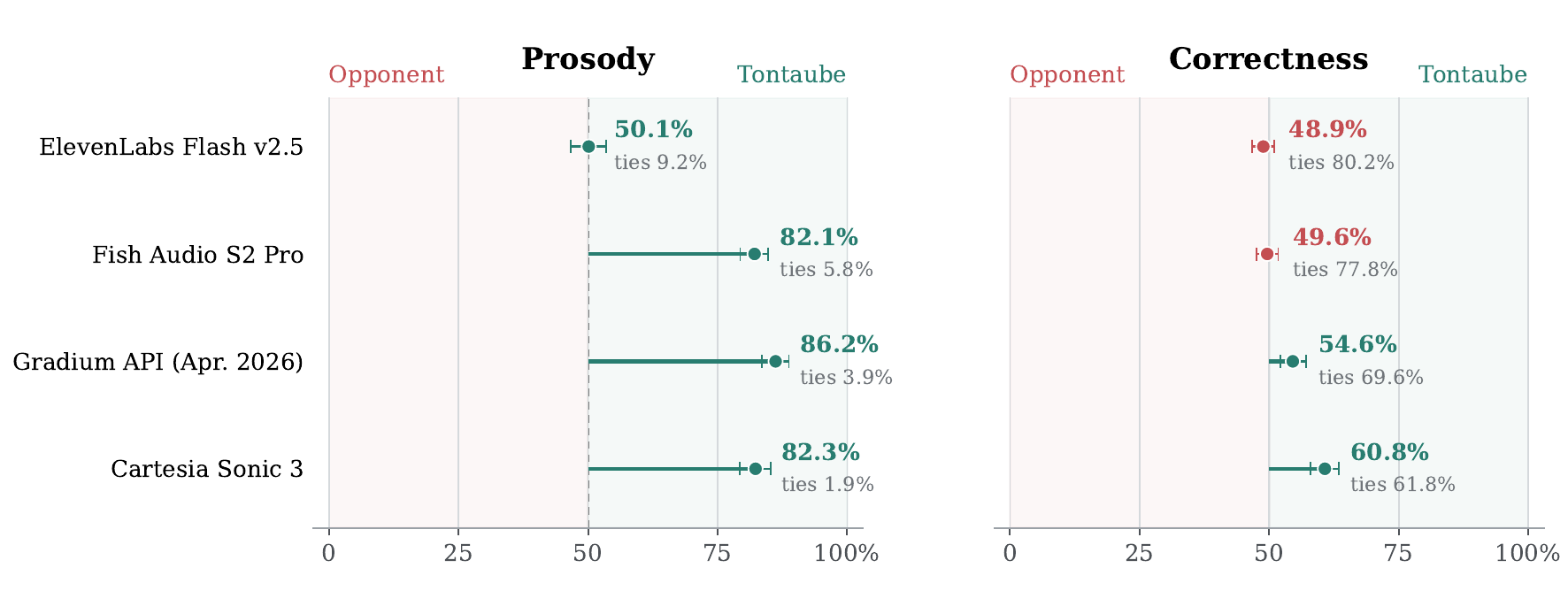
The LLM-as-a-judge pairwise audiobook-reading benchmark contains 400 fixed English passages of 250--500 characters. For each passage, Gemini 3.1 Pro Preview judges the same output pair twice, once in each presentation order, on prosody and word-by-word correctness. A TontaubeV1 preference, tie, or comparator preference scores 1, 0.5, or 0; the figure reports the mean over all 800 order-balanced judgments. A score of 50% denotes parity. Whiskers show 95% passage-cluster bootstrap intervals; labels beneath the points give tie rates across individual judge calls.
Exact preference scores
| Comparator | Prosody preference | Correctness preference |
|---|---|---|
| ElevenLabs Flash v2.5 | 50.1% | 48.9% |
| Fish Audio S2 Pro | 82.1% | 49.6% |
| Gradium API, April 2026 | 86.2% | 54.6% |
| Cartesia Sonic 3 | 82.3% | 60.8% |
TontaubeV1 uses semantic sampling temperature 0.55 and acoustic temperature
zero in these comparisons. Each waveform is independently normalized to an
average level of -20 dBFS before judging. Fish Audio uses the same frozen
cloning reference as TontaubeV1. ElevenLabs, Gradium, and Cartesia instead use
fixed provider voices while TontaubeV1 uses the cloning reference. Although
voice identity and timbre are excluded from the rubric, prosody is not fully
separable from the reference; this asymmetry may favor TontaubeV1 in those
three comparisons.
On the 1,088 English zero-shot examples of the Seed-TTS evaluation set,
TontaubeV1 obtains 1.66% mean utterance-level word error rate using Whisper
large-v3 transcription at semantic sampling temperature 0.6.
These automated evaluations measure English reading prosody and text correctness. They do not establish voice similarity, overall sound quality, multilingual quality, long-form continuity, or streaming quality. The technical report documents the full methodology, judge instructions, and further limitations.
Model sources and runtime assets
By default, CB0--CB3, DualCodec, W2V-BERT, and the optional verbalizer and
VibeVoice source weights are resolved with Hugging Face Hub and cached under
its configured cache directory. The reduced VibeVoice acoustic model produced
from the pinned upstream snapshot is cached separately under
~/.cache/tontaube.
Set CB0_MODEL_PATH, CB1_MODEL_PATH, CB2_MODEL_PATH, or CB3_MODEL_PATH
to override individual codebooks with local directories. Setting MODEL_PATH
uses <MODEL_PATH>/cb0 through <MODEL_PATH>/cb3 for all codebooks without
changing where the upstream runtime models resolve. DualCodec, W2V-BERT, and
the prepared VibeVoice acoustic model each have an independent local-path
override. Repository and revision variables provide the corresponding remote
overrides.
tontaube preflight downloads and prepares enabled generation models, then validates all
required files before GPU initialization. It does not download VibeVoice or the
verbalizer when the corresponding feature is disabled. MossFormer2 is loaded
separately on the first non-streaming request that enables it.
The interactive OpenAPI documentation is available at
http://127.0.0.1:8080/docs after startup.
Generate speech
POST /predict returns JSON containing base64-encoded audio. This example
writes the generated WAV to tontaube.wav:
curl --silent http://127.0.0.1:8080/predict \
  -H 'content-type: application/json' \
  -d '{
    "text": "Welcome to Tontaube.",
    "language": "english",
    "tag": "conversational",
    "temperature": 0.8,
    "format": "wav"
  }' \
| python3 -c 'import base64,json,sys; sys.stdout.buffer.write(base64.b64decode(json.load(sys.stdin)["audio_b64"]))' \
> tontaube.wav
The sampling-temperature default is 0.8. A lower value such as 0.6 favors
correctness; values near 1.0 can produce more natural and expressive results.
Automatic CB0 retries keep the requested temperature for the first two attempts,
then increase it by 0.05 per attempt (up to five attempts in total).
use_system_tag: false omits the language/style control block; it defaults to
true, using the selected language and tag.
For voice cloning, provide one of:
voice_audio_b64: base64-encoded reference audio in any FFmpeg-supported formatvoice_tokens: precomputed semantic and acoustic prompt-token rowsvoice_path: an audio path inside the server's configuredVOICE_PATH
When no voice source is supplied, the server uses the bundled Marcus reference.
prompt_max_tokens can cap CB0 at 1--750 voice-prompt tokens; the later
codebooks apply their own smaller caps. Reference audio should contain clean
speech from one speaker.
The bundled catalogue includes 39 standard voices as MP3 references across all
seven languages, plus seven legacy audio voices. Marcus is the default.
Select a voice in the UI, or use "voice_path": "samples/Marcus.mp3" with
the default bundled voice directory. Add your own audio files to
voices/samples/; see voice catalogue metadata.
Audio is synthesized at 24 kHz. By default, non-streaming /predict requests
trim quiet edges to approximately 250 ms of padding, shorten quiet pauses
longer than 2.5 seconds with a crossfade, and return 48 kHz audio using hybrid
MossFormer2_SR_48K enhancement. The hybrid retains the source's low-frequency
band and adds reconstructed high frequencies, using 4-second windows with
1-second overlap. Set trim_silence_padding_ms: null to disable edge trimming,
or mossformer2_postprocess: false to disable both enhancement and pause
shortening. Disable both to keep the original duration and 24 kHz waveform
before output encoding. Ogg/Opus files always use a 48 kHz playback clock.
The enhancer's approximately 420 MiB of weights are downloaded to the standard
Hugging Face cache on first use. Its CUDA weights and working memory are extra
to the codebook budgets; allow GPU headroom and expect a slower first request.
For server-sent MP3 chunks, send the request to POST /stream.
WS /ws/stream returns framed Opus audio from the 24 kHz synthesis stream.
Streaming does not apply edge trimming, pause shortening, or MossFormer2;
omit mossformer2_postprocess or set it to false for streaming.
Streaming always uses VibeVoice. The bitrate and priority fields apply to
every streaming route; vllm_priority is limited to non-streaming /predict
calls. An explicit
format must match the transport (mp3 for SSE, opus for WebSocket), or it
may be omitted. max_new_tokens is the total per-chunk CB0 budget, including
the initial silence token and any early streaming prefix, and accepts 50–400.
streaming_initial_seconds controls the first buffered audio chunk. It defaults
to 2.8 seconds and accepts 0.4–6.0 seconds in 0.4-second increments. Increasing
it raises time to first audio but gives playback more headroom; if a custom
max_new_tokens value is too small for it, the request is rejected explicitly.
Configuration
The main runtime settings are environment variables:
| Variable | Purpose |
|---|---|
TTS_MODEL_REPO_ID | HF repository containing cb0/ through cb3/; defaults to TontaubeAI/TontaubeV1 |
TTS_MODEL_REVISION | HF model revision; defaults to v1.0.0 |
CB0_MODEL_PATH ... CB3_MODEL_PATH | Optional per-codebook local-directory overrides |
MODEL_PATH | Optional local root containing cb0/ through cb3/ |
DUALCODEC_MODEL_PATH | Optional local DualCodec snapshot override |
DUALCODEC_MODEL_REPO_ID, DUALCODEC_MODEL_REVISION | Optional DualCodec Hub source overrides |
W2VBERT_MODEL_PATH | Optional local W2V-BERT model override |
W2VBERT_MODEL_REPO_ID, W2VBERT_MODEL_REVISION | Optional W2V-BERT Hub source overrides |
VIBEVOICE_MODEL_PATH | Optional local prepared VibeVoice acoustic-model override |
VIBEVOICE_MODEL_REPO_ID, VIBEVOICE_MODEL_REVISION | Optional VibeVoice Hub source overrides |
MOSSFORMER2_SR_MODEL_PATH | Optional local directory containing the two MossFormer2_SR_48K checkpoints |
MOSSFORMER2_SR_REPO_ID, MOSSFORMER2_SR_REVISION | Optional MossFormer2_SR_48K Hub source overrides |
TONTAUBE_CACHE_DIR | Cache for derived Tontaube runtime artifacts; defaults to ~/.cache/tontaube |
VOICE_PATH | Inference-server folder used for server-side voice_path requests and relative DEFAULT_VOICE overrides |
DEFAULT_VOICE | Audio reference used when none is supplied; defaults to bundled samples/Marcus.mp3, or accepts a path relative to VOICE_PATH or an absolute path |
REQUIRE_API_KEY | Require an x-api-key header; defaults to 0 |
TTS_API_KEY | Shared secret used when authentication is enabled |
TTS_CORS_ORIGINS | Comma-separated browser origins allowed to call the API; defaults to the local UI on port 3000 |
ENABLE_STREAMING | Enable SSE and WebSocket routes; defaults to 1 |
ENABLE_VIBEVOICE | Load VibeVoice for output re-encoding and streaming; defaults to 1 |
TTS_UI_HOST | Bind address for the standalone UI-only server; defaults to 127.0.0.1 |
TTS_UI_PORT | Port for the standalone UI-only server; defaults to 3000 |
TTS_UI_VOICE_PATH | Local sample-voice root served by the UI; defaults to the repository's voices/ folder |
TTS_HOST | HTTP bind address; defaults to 127.0.0.1 (0.0.0.0 in Docker) |
TTS_PORT | HTTP port; defaults to 8080 (PORT remains a fallback) |
TTS_LOG_LEVEL | Runtime log level; defaults to INFO, use DEBUG for token and decoding diagnostics |
ENABLE_VERBALIZATION | Load the optional English verbalizer; defaults to 0 |
VERBALIZATION_MODEL_REPO_ID | HF verbalizer repository; defaults to TontaubeAI/TontaubeV1-Verbalizer |
VERBALIZATION_MODEL_REVISION | HF verbalizer revision; defaults to v1.0.0 |
VERBALIZATION_MODEL_PATH | Optional local verbalizer-directory override |
VERBALIZATION_GPU_MEMORY_GIB | Verbalizer vLLM memory budget; defaults by profile to 4.8, 5.0, or 5.5 GiB |
VERBALIZATION_MAX_NUM_SEQS | Optional verbalizer concurrency override |
TTS_CAPACITY_PROFILE | low-vram, balanced (default), or high-throughput |
GPU_MEMORY_GIB_PER_CB | Four comma-separated vLLM memory budgets |
MAX_MODEL_LEN_PER_CB | Four comma-separated context limits |
MAX_NUM_SEQS_PER_CB | Four comma-separated active-sequence limits |
MAX_NUM_BATCHED_TOKENS_PER_CB | Four comma-separated scheduler token budgets |
MAX_INFLIGHT_REQUESTS | End-to-end request limit; defaults to twice the CB0 active-sequence limit |
To enable API-key authentication, provide both settings:
docker run --rm --gpus all --ipc=host \
  -p 127.0.0.1:8080:8080 \
  -v /absolute/path/to/tontaube-v1-models:/srv/models:ro \
  -e MODEL_PATH=/srv/models \
  -e REQUIRE_API_KEY=1 \
  -e TTS_API_KEY="replace-with-a-secret" \
  tontaube-v1:1.0.0
To enable the verbalizer, set ENABLE_VERBALIZATION=1. It must resolve and load
successfully at startup, and individual requests must also set
"use_verbalization": true. Such a request returns an explicit error when the
verbalizer is unavailable or the requested language is not English. When
verbalization is disabled, the model is not loaded.
Its active-sequence limit is 4 for low-vram, 10 for balanced, and 16 for
high-throughput.
Capacity tuning
All per-codebook variables are ordered cb0,cb1,cb2,cb3. Select a profile with
TTS_CAPACITY_PROFILE; balanced is the conservative release default:
| Profile | Active sequences (CB0--CB3) | End-to-end requests | GPU memory in GiB (CB0--CB3) | Batched tokens (CB0--CB3) |
|---|---|---|---|---|
low-vram | 1, 4, 4, 4 | 2 | 4.500, 1.860, 1.420, 1.220 | 2,500, 8,000, 9,600, 12,000 |
balanced | 3, 8, 8, 8 | 6 | 4.900, 2.470, 1.920, 1.590 | 7,500, 16,000, 19,200, 24,000 |
high-throughput | 8, 20, 20, 20 | 16 | 6.954, 5.204, 3.728, 3.250 | 20,000, 40,000, 48,000, 60,000 |
The budgets aim to retain request-time and compilation headroom. A clean-cache low-VRAM startup was validated on an RTX 5090 with vLLM, TorchInductor, Triton, and CUDA caches isolated. The resulting full-context capacities were:
| Profile | Measured capacity (CB0--CB3) | Reserve above active limits |
|---|---|---|
low-vram | 1.28, 4.72, 4.76, 4.55 | 28.0%, 18.0%, 19.0%, 13.8% |
The fractional “Maximum concurrency for N tokens per request” printed by vLLM
is the measured KV-cache capacity divided by N. For every profile, each
batched-token budget equals the corresponding context limit multiplied by its
active-sequence limit. This invariant lets every configured active sequence fit
in one prefill scheduler step. Lower budgets can split prefills and produce
incorrect logical-position assignment with the current model adapter.
Later starts can report more capacity because vLLM reuses its compilation caches. Treat a clean-cache result as the conservative measurement. If the first cold start runs out of memory, one follow-up attempt may work after some caches have been populated; lower the GiB budgets for reliable cold starts.
Profiles are starting points, not GPU-model detection. low-vram is intended
for the lowest supported concurrency and balanced for the release default;
both require at least 24 GiB of VRAM. high-throughput requires at least
32 GiB. Explicit
GPU_MEMORY_GIB_PER_CB, MAX_NUM_SEQS_PER_CB,
MAX_NUM_BATCHED_TOKENS_PER_CB, and MAX_INFLIGHT_REQUESTS values override
the selected profile. Unless overridden, the end-to-end request limit remains
twice the configured CB0 active-sequence limit.
For example:
TTS_CAPACITY_PROFILE=high-throughput \
uv run tontaube serve
Memory left for DualCodec, VibeVoice, CUDA, and request-time tensors must not be assigned to the vLLM engines. Load-test custom values on the target GPU.
Development
Install the repository with uv. The project metadata includes a narrow compatibility override for an obsolete protobuf constraint in AudioTools 0.7.2, which is pulled by DualCodec 0.4.2:
uv sync --frozen --python 3.12 --extra dev
This creates .venv and registers the custom Tontaube architecture as a vLLM
plugin in the API process and its engine workers. uv sync without
--extra dev installs only the runtime dependencies. A plain pip install .
cannot resolve the mutually exclusive protobuf metadata published by vLLM
0.16.0 and AudioTools 0.7.2; the Docker build uses the same explicit override
through uv's pip-compatible installer.
Run the unit tests without writing cache files into the repository:
PYTHONDONTWRITEBYTECODE=1 uv run pytest -q -p no:cacheprovider tests
Limitations and responsible use
Autoregressive generation can omit, repeat, or alter text and can terminate too early or too late. Reference conditioning may reproduce incidental recording properties or imperfectly preserve identity. Quality varies by language, speaker, style, and text domain. The optional verbalizer can normalize incorrectly or alter wording. Training emphasized audiobook speech, so audiobook generation may be more reliable than conversational or agentic generation.
English and German are the primary languages. German phoneme realization can be imperfect, and Spanish, French, Italian, Dutch, and Portuguese have not been evaluated by native speakers; no comparative quality claims are made for those languages.
Voice cloning can enable impersonation, fraud, non-consensual synthesis, and misleading media. Obtain permission for reference voices and apply appropriate authentication, rate limiting, disclosure, logging, and abuse-response measures in deployed systems. Generated speech must not be treated as verified identity or factual evidence.
The default unauthenticated server binds only to loopback and is intended for local use. Before exposing it to a network, enable API-key authentication and put it behind TLS and appropriate request/rate limits.
Roadmap
We are working on quantized releases that reduce inference-memory requirements. We also plan to publish fine-tuning code in a future release.
Acknowledgements
TontaubeV1 builds on Qwen3, DualCodec, and VibeVoice. Their respective licenses and attribution requirements continue to apply.
License
Except for the third-party components identified in
THIRD_PARTY_NOTICES, the inference source code in this
repository is licensed under the Apache License 2.0. The vendored
VibeVoice subset remains under its MIT license.
The synthetic sample voices in voices/ are released separately under the
MIT License. The generated showcase audio in
assets/showcase/ is provided as demonstration material and is not covered by
the Apache License 2.0.
The Apache License does not apply to model weights, tokenizer or codec weights and data, configuration files distributed with those model artifacts, or other separately distributed model artifacts. Tontaube-owned model materials are licensed separately under the Tontaube Community Model License 1.0; third-party model artifacts remain subject to their respective licenses.
Contributors

3 commits

1 commits
Similar repos


Languages
Python
90.5%
JavaScript
3.9%
CSS
2.7%
HTML
2.6%
README
TontaubeV1
TontaubeV1 is a multilingual text-to-speech model by Craitech. It is designed for expressive voice cloning, long-form speech, and low-latency streaming, with first-class support for English and German and additional support for Spanish, French, Italian, Dutch, and Portuguese.
This repository contains the vLLM inference server. The model weights are distributed separately. The four Tontaube codebook models are released together. All enabled models are downloaded from their original Hugging Face repositories on first use and reused from local caches on subsequent starts.
Model weights · Technical report · Try TontaubeV1 online
Quick start
The shortest supported path requires Linux, an NVIDIA GPU and driver,
uv, FFmpeg, and the
Opus runtime. Clone the release and start the server:
git clone --branch v1.0.0 --depth 1 https://github.com/craitech/tontaube.git
cd tontaube
uv run --python 3.12 --frozen tontaube serve
uv creates the environment and installs the locked dependencies. On first
startup, Tontaube downloads all enabled models into local caches; later starts
reuse them. The API is available at http://127.0.0.1:8080 after model loading
finishes. Check readiness from another terminal with:
curl --fail http://127.0.0.1:8080/readyz
Generate a WAV with the bundled Marcus voice from another terminal:
curl --silent --show-error --fail http://127.0.0.1:8080/predict \
  -H 'content-type: application/json' \
  -d '{"text":"Welcome to Tontaube.","language":"english","tag":"conversational","format":"wav"}' \
| python3 -c 'import base64,json,sys; sys.stdout.buffer.write(base64.b64decode(json.load(sys.stdin)["audio_b64"]))' \
> welcome.wav
Clone a voice from a local audio file by sending it with the request. Use about 5–60 seconds of clean, single-speaker speech; longer references generally give stronger conditioning, up to the one-minute prompt cap.
VOICE_FILE=/path/to/reference.wav
python3 -c 'import base64,json,sys; print(json.dumps({"text":"This voice was cloned from a local reference.","language":"english","tag":"conversational","voice_audio_b64":base64.b64encode(open(sys.argv[1],"rb").read()).decode(),"format":"wav"}))' "$VOICE_FILE" \
| curl --silent --show-error --fail http://127.0.0.1:8080/predict \
  -H 'content-type: application/json' \
  --data-binary @- \
| python3 -c 'import base64,json,sys; sys.stdout.buffer.write(base64.b64decode(json.load(sys.stdin)["audio_b64"]))' \
> cloned.wav
English text verbalization is optional and disabled by default. To load it,
start the server with ENABLE_VERBALIZATION=1; requests that should use it must
also send "use_verbalization": true. The verbalizer uses substantial
additional VRAM (about 4.8–5.5 GiB with the bundled capacity profiles), so
leave it disabled when written and spoken forms are already identical.
Browser interface
With the API still running, start the optional UI in a second terminal:
uv run tontaube ui
Open http://127.0.0.1:3000/. It targets the local API by default, while its
Server URL field can point to a remote Tontaube server. The UI and inference
API are separate processes and can be started independently. A machine hosting
only the UI can use python3 -m app.ui_server without installing the GPU
environment. A remote API must allow the UI's exact origin through
TTS_CORS_ORIGINS.
The UI supports bundled voice selection, local voice-reference uploads,
sampling and acoustic controls, WAV/MP3/Opus responses, MP3 streaming, instant
playback, and downloads. It reads its own voices/ directory and uploads the
selected audio file with each request, so a remote inference server does not need the
sample files. References live together in voices/samples/; optional language
and style metadata in voices/manifest.json controls language filtering and
groups the voice menu by style. Voices without a declared language appear for
every language, while voices without a declared style remain ungrouped. A badge
also shows the selected voice's style without changing the independently
selected synthesis style.
Installation details
Requirements
The supported reference setup is Linux with an NVIDIA GPU. Python 3.12 is the reference interpreter. On Debian or Ubuntu, install the native audio packages with:
sudo apt-get update
sudo apt-get install -y ffmpeg libopus0
Native Windows, macOS, CPU-only inference, and non-NVIDIA accelerators are not
supported by this vLLM server. Windows users can use a CUDA-enabled WSL2 Linux
environment. Use an NVIDIA GPU with at least 24 GiB of VRAM for the low-vram
or default balanced profile, and at least 32 GiB for high-throughput. Select
the lower-capacity profile with:
TTS_CAPACITY_PROFILE=low-vram uv run tontaube serve
These are practical release targets rather than hard hardware checks. The
per-engine GiB budgets can be tuned with GPU_MEMORY_GIB_PER_CB and
VERBALIZATION_GPU_MEMORY_GIB; leave enough unassigned VRAM for DualCodec,
VibeVoice, CUDA, and request-time tensors.
The first clean-cache startup may use more memory while vLLM compiles and caches kernels. If that cold start runs out of memory, retrying once may succeed because the follow-up start can reuse the newly created caches. A deployment that must start reliably from a clean cache should instead lower its GiB budgets and validate them on the target GPU.
The application pins the Tontaube weights and upstream model revisions for
release v1.0.0. For a later release, use its matching source tag; do not mix
model bundles and inference code from different releases. While the Tontaube
repositories are private or gated, provide a read-only HF_TOKEN.
The English verbalizer is downloaded only with ENABLE_VERBALIZATION=1.
VibeVoice is enabled by default; set ENABLE_VIBEVOICE=0 to avoid downloading
and loading it. Without VibeVoice, non-streaming requests use raw DualCodec
output and the streaming routes are unavailable.
tontaube serve runs model preflight automatically before CUDA initialization.
Run uv run tontaube preflight separately only to diagnose model resolution
without starting the server.
Explicit environment setup
The quick-start command handles environment creation automatically. To prepare the environment separately instead, run:
uv sync --frozen --python 3.12
uv run tontaube serve
Do not replace uv sync --frozen with an unconstrained pip install. A stale
protobuf upper bound published by a transitive DualCodec dependency conflicts
with vLLM's current protobuf requirement; the repository contains the tested,
narrow override and lock file. Use the dedicated pip procedure below instead.
pip
The checked-in requirements-pip.lock contains the same resolved environment
as uv.lock, including hashes. Install every locked dependency without
re-resolving upstream metadata, then install Tontaube itself:
python3.12 -m venv .venv
source .venv/bin/activate
python -m pip install --no-deps --require-hashes -r requirements-pip.lock
python -m pip install --no-deps --no-build-isolation .
tontaube serve
--no-deps is intentional here: the complete dependency set is already in the
lock file, and resolving it again would reintroduce AudioTools' obsolete
protobuf constraint. Regenerate requirements-pip.lock from uv.lock for each
release rather than editing it manually.
Docker
Docker is available for deployments that want the CUDA, PyTorch, and vLLM stack encapsulated in an image. Install Docker Engine and the NVIDIA Container Toolkit, then build and run:
docker build -t tontaube-v1:1.0.0 .

docker run --rm --gpus all --ipc=host \
  -p 127.0.0.1:8080:8080 \
  -v tontaube-hf-cache:/root/.cache/huggingface \
  -v tontaube-cache:/root/.cache/tontaube \
  tontaube-v1:1.0.0
The named volumes preserve downloaded models and the prepared VibeVoice
acoustic component across container runs. Pass -e HF_TOKEN while the
Tontaube model repositories are private or gated.
Highlights
- Synthesis with bundled voices and zero-shot cloning from an audio reference
audiobook,conversational, andagenticspeaking styles- Long-form generation with boundary-aware text and audio chunking
- Low-latency MP3 and Opus streaming
- Character-level text tokenization and multilingual language conditioning
- Four codebook models served by vLLM in one inference process
- Optional English text verbalization, disabled by default
Examples
These MP3 samples were normalized to a consistent speech listening level.
Audiobook
English 1
English 2
English 3
German 1
Agentic
English 1
English 2
English 3
How it works
TontaubeV1 represents speech with four DualCodec codebooks at 12.5 Hz. CB0 predicts semantic audio tokens autoregressively. CB1, CB2, and CB3 predict the remaining acoustic codebooks from the completed lower-codebook rows. Acoustic chunks are independent of preceding acoustic chunks and can therefore be generated in parallel without accumulating voice drift across a long text.
CB0 is based on Qwen3-1.7B; CB1-CB3 are based on Qwen3-0.6B. Each stage uses a Tontaube audio-token output head. DualCodec supplies the discrete speech representation, while a reduced VibeVoice acoustic encoder/decoder is used for output re-encoding and streaming decode. The optional verbalizer is a separately trained model that converts written English into a more suitable spoken form before synthesis.
Text is tokenized primarily at the character level. Explicit text and audio boundaries, together with shared non-linear position IDs across codebooks, keep the modalities aligned while allowing long texts to continue without audible cuts. The complete serialization and position-ID scheme is described in the technical report.
Model architecture
| Predictor | Role | Transformer blocks | Width | Stored parameters |
|---|---|---|---|---|
| CB0 | Semantic audio and duration | 28 | 2,048 | 1,829,116,930 |
| CB1 | Acoustic refinement | 16 | 1,024 | 448,960,512 |
| CB2 | Acoustic refinement | 8 | 1,024 | 327,307,264 |
| CB3 | Acoustic refinement | 4 | 1,024 | 268,577,792 |
| Total | 56 | 2,873,962,498 |
Training
All four predictors were trained exclusively with supervised fine-tuning on approximately 200,000 hours of paired speech and text across seven languages, predominantly from public-domain audiobook recordings and openly released speech corpora.
Serving performance
With weights resident on one NVIDIA GeForce RTX 5090 and the process warmed, the streaming path reaches approximately 200 ms to first encoded audio. In separate non-streaming measurements, end-to-end real-time factor (RTF) is 0.08 for one input and aggregate RTF is 0.02 across eight concurrent inputs. Startup, model loading, and network latency are excluded.
Evaluation
The LLM-as-a-judge pairwise audiobook-reading benchmark contains 400 fixed English passages of 250--500 characters. For each passage, Gemini 3.1 Pro Preview judges the same output pair twice, once in each presentation order, on prosody and word-by-word correctness. A TontaubeV1 preference, tie, or comparator preference scores 1, 0.5, or 0; the figure reports the mean over all 800 order-balanced judgments. A score of 50% denotes parity. Whiskers show 95% passage-cluster bootstrap intervals; labels beneath the points give tie rates across individual judge calls.
Exact preference scores
| Comparator | Prosody preference | Correctness preference |
|---|---|---|
| ElevenLabs Flash v2.5 | 50.1% | 48.9% |
| Fish Audio S2 Pro | 82.1% | 49.6% |
| Gradium API, April 2026 | 86.2% | 54.6% |
| Cartesia Sonic 3 | 82.3% | 60.8% |
TontaubeV1 uses semantic sampling temperature 0.55 and acoustic temperature
zero in these comparisons. Each waveform is independently normalized to an
average level of -20 dBFS before judging. Fish Audio uses the same frozen
cloning reference as TontaubeV1. ElevenLabs, Gradium, and Cartesia instead use
fixed provider voices while TontaubeV1 uses the cloning reference. Although
voice identity and timbre are excluded from the rubric, prosody is not fully
separable from the reference; this asymmetry may favor TontaubeV1 in those
three comparisons.
On the 1,088 English zero-shot examples of the Seed-TTS evaluation set,
TontaubeV1 obtains 1.66% mean utterance-level word error rate using Whisper
large-v3 transcription at semantic sampling temperature 0.6.
These automated evaluations measure English reading prosody and text correctness. They do not establish voice similarity, overall sound quality, multilingual quality, long-form continuity, or streaming quality. The technical report documents the full methodology, judge instructions, and further limitations.
Model sources and runtime assets
By default, CB0--CB3, DualCodec, W2V-BERT, and the optional verbalizer and
VibeVoice source weights are resolved with Hugging Face Hub and cached under
its configured cache directory. The reduced VibeVoice acoustic model produced
from the pinned upstream snapshot is cached separately under
~/.cache/tontaube.
Set CB0_MODEL_PATH, CB1_MODEL_PATH, CB2_MODEL_PATH, or CB3_MODEL_PATH
to override individual codebooks with local directories. Setting MODEL_PATH
uses <MODEL_PATH>/cb0 through <MODEL_PATH>/cb3 for all codebooks without
changing where the upstream runtime models resolve. DualCodec, W2V-BERT, and
the prepared VibeVoice acoustic model each have an independent local-path
override. Repository and revision variables provide the corresponding remote
overrides.
tontaube preflight downloads and prepares enabled generation models, then validates all
required files before GPU initialization. It does not download VibeVoice or the
verbalizer when the corresponding feature is disabled. MossFormer2 is loaded
separately on the first non-streaming request that enables it.
The interactive OpenAPI documentation is available at
http://127.0.0.1:8080/docs after startup.
Generate speech
POST /predict returns JSON containing base64-encoded audio. This example
writes the generated WAV to tontaube.wav:
curl --silent http://127.0.0.1:8080/predict \
  -H 'content-type: application/json' \
  -d '{
    "text": "Welcome to Tontaube.",
    "language": "english",
    "tag": "conversational",
    "temperature": 0.8,
    "format": "wav"
  }' \
| python3 -c 'import base64,json,sys; sys.stdout.buffer.write(base64.b64decode(json.load(sys.stdin)["audio_b64"]))' \
> tontaube.wav
The sampling-temperature default is 0.8. A lower value such as 0.6 favors
correctness; values near 1.0 can produce more natural and expressive results.
Automatic CB0 retries keep the requested temperature for the first two attempts,
then increase it by 0.05 per attempt (up to five attempts in total).
use_system_tag: false omits the language/style control block; it defaults to
true, using the selected language and tag.
For voice cloning, provide one of:
voice_audio_b64: base64-encoded reference audio in any FFmpeg-supported formatvoice_tokens: precomputed semantic and acoustic prompt-token rowsvoice_path: an audio path inside the server's configuredVOICE_PATH
When no voice source is supplied, the server uses the bundled Marcus reference.
prompt_max_tokens can cap CB0 at 1--750 voice-prompt tokens; the later
codebooks apply their own smaller caps. Reference audio should contain clean
speech from one speaker.
The bundled catalogue includes 39 standard voices as MP3 references across all
seven languages, plus seven legacy audio voices. Marcus is the default.
Select a voice in the UI, or use "voice_path": "samples/Marcus.mp3" with
the default bundled voice directory. Add your own audio files to
voices/samples/; see voice catalogue metadata.
Audio is synthesized at 24 kHz. By default, non-streaming /predict requests
trim quiet edges to approximately 250 ms of padding, shorten quiet pauses
longer than 2.5 seconds with a crossfade, and return 48 kHz audio using hybrid
MossFormer2_SR_48K enhancement. The hybrid retains the source's low-frequency
band and adds reconstructed high frequencies, using 4-second windows with
1-second overlap. Set trim_silence_padding_ms: null to disable edge trimming,
or mossformer2_postprocess: false to disable both enhancement and pause
shortening. Disable both to keep the original duration and 24 kHz waveform
before output encoding. Ogg/Opus files always use a 48 kHz playback clock.
The enhancer's approximately 420 MiB of weights are downloaded to the standard
Hugging Face cache on first use. Its CUDA weights and working memory are extra
to the codebook budgets; allow GPU headroom and expect a slower first request.
For server-sent MP3 chunks, send the request to POST /stream.
WS /ws/stream returns framed Opus audio from the 24 kHz synthesis stream.
Streaming does not apply edge trimming, pause shortening, or MossFormer2;
omit mossformer2_postprocess or set it to false for streaming.
Streaming always uses VibeVoice. The bitrate and priority fields apply to
every streaming route; vllm_priority is limited to non-streaming /predict
calls. An explicit
format must match the transport (mp3 for SSE, opus for WebSocket), or it
may be omitted. max_new_tokens is the total per-chunk CB0 budget, including
the initial silence token and any early streaming prefix, and accepts 50–400.
streaming_initial_seconds controls the first buffered audio chunk. It defaults
to 2.8 seconds and accepts 0.4–6.0 seconds in 0.4-second increments. Increasing
it raises time to first audio but gives playback more headroom; if a custom
max_new_tokens value is too small for it, the request is rejected explicitly.
Configuration
The main runtime settings are environment variables:
| Variable | Purpose |
|---|---|
TTS_MODEL_REPO_ID | HF repository containing cb0/ through cb3/; defaults to TontaubeAI/TontaubeV1 |
TTS_MODEL_REVISION | HF model revision; defaults to v1.0.0 |
CB0_MODEL_PATH ... CB3_MODEL_PATH | Optional per-codebook local-directory overrides |
MODEL_PATH | Optional local root containing cb0/ through cb3/ |
DUALCODEC_MODEL_PATH | Optional local DualCodec snapshot override |
DUALCODEC_MODEL_REPO_ID, DUALCODEC_MODEL_REVISION | Optional DualCodec Hub source overrides |
W2VBERT_MODEL_PATH | Optional local W2V-BERT model override |
W2VBERT_MODEL_REPO_ID, W2VBERT_MODEL_REVISION | Optional W2V-BERT Hub source overrides |
VIBEVOICE_MODEL_PATH | Optional local prepared VibeVoice acoustic-model override |
VIBEVOICE_MODEL_REPO_ID, VIBEVOICE_MODEL_REVISION | Optional VibeVoice Hub source overrides |
MOSSFORMER2_SR_MODEL_PATH | Optional local directory containing the two MossFormer2_SR_48K checkpoints |
MOSSFORMER2_SR_REPO_ID, MOSSFORMER2_SR_REVISION | Optional MossFormer2_SR_48K Hub source overrides |
TONTAUBE_CACHE_DIR | Cache for derived Tontaube runtime artifacts; defaults to ~/.cache/tontaube |
VOICE_PATH | Inference-server folder used for server-side voice_path requests and relative DEFAULT_VOICE overrides |
DEFAULT_VOICE | Audio reference used when none is supplied; defaults to bundled samples/Marcus.mp3, or accepts a path relative to VOICE_PATH or an absolute path |
REQUIRE_API_KEY | Require an x-api-key header; defaults to 0 |
TTS_API_KEY | Shared secret used when authentication is enabled |
TTS_CORS_ORIGINS | Comma-separated browser origins allowed to call the API; defaults to the local UI on port 3000 |
ENABLE_STREAMING | Enable SSE and WebSocket routes; defaults to 1 |
ENABLE_VIBEVOICE | Load VibeVoice for output re-encoding and streaming; defaults to 1 |
TTS_UI_HOST | Bind address for the standalone UI-only server; defaults to 127.0.0.1 |
TTS_UI_PORT | Port for the standalone UI-only server; defaults to 3000 |
TTS_UI_VOICE_PATH | Local sample-voice root served by the UI; defaults to the repository's voices/ folder |
TTS_HOST | HTTP bind address; defaults to 127.0.0.1 (0.0.0.0 in Docker) |
TTS_PORT | HTTP port; defaults to 8080 (PORT remains a fallback) |
TTS_LOG_LEVEL | Runtime log level; defaults to INFO, use DEBUG for token and decoding diagnostics |
ENABLE_VERBALIZATION | Load the optional English verbalizer; defaults to 0 |
VERBALIZATION_MODEL_REPO_ID | HF verbalizer repository; defaults to TontaubeAI/TontaubeV1-Verbalizer |
VERBALIZATION_MODEL_REVISION | HF verbalizer revision; defaults to v1.0.0 |
VERBALIZATION_MODEL_PATH | Optional local verbalizer-directory override |
VERBALIZATION_GPU_MEMORY_GIB | Verbalizer vLLM memory budget; defaults by profile to 4.8, 5.0, or 5.5 GiB |
VERBALIZATION_MAX_NUM_SEQS | Optional verbalizer concurrency override |
TTS_CAPACITY_PROFILE | low-vram, balanced (default), or high-throughput |
GPU_MEMORY_GIB_PER_CB | Four comma-separated vLLM memory budgets |
MAX_MODEL_LEN_PER_CB | Four comma-separated context limits |
MAX_NUM_SEQS_PER_CB | Four comma-separated active-sequence limits |
MAX_NUM_BATCHED_TOKENS_PER_CB | Four comma-separated scheduler token budgets |
MAX_INFLIGHT_REQUESTS | End-to-end request limit; defaults to twice the CB0 active-sequence limit |
To enable API-key authentication, provide both settings:
docker run --rm --gpus all --ipc=host \
  -p 127.0.0.1:8080:8080 \
  -v /absolute/path/to/tontaube-v1-models:/srv/models:ro \
  -e MODEL_PATH=/srv/models \
  -e REQUIRE_API_KEY=1 \
  -e TTS_API_KEY="replace-with-a-secret" \
  tontaube-v1:1.0.0
To enable the verbalizer, set ENABLE_VERBALIZATION=1. It must resolve and load
successfully at startup, and individual requests must also set
"use_verbalization": true. Such a request returns an explicit error when the
verbalizer is unavailable or the requested language is not English. When
verbalization is disabled, the model is not loaded.
Its active-sequence limit is 4 for low-vram, 10 for balanced, and 16 for
high-throughput.
Capacity tuning
All per-codebook variables are ordered cb0,cb1,cb2,cb3. Select a profile with
TTS_CAPACITY_PROFILE; balanced is the conservative release default:
| Profile | Active sequences (CB0--CB3) | End-to-end requests | GPU memory in GiB (CB0--CB3) | Batched tokens (CB0--CB3) |
|---|---|---|---|---|
low-vram | 1, 4, 4, 4 | 2 | 4.500, 1.860, 1.420, 1.220 | 2,500, 8,000, 9,600, 12,000 |
balanced | 3, 8, 8, 8 | 6 | 4.900, 2.470, 1.920, 1.590 | 7,500, 16,000, 19,200, 24,000 |
high-throughput | 8, 20, 20, 20 | 16 | 6.954, 5.204, 3.728, 3.250 | 20,000, 40,000, 48,000, 60,000 |
The budgets aim to retain request-time and compilation headroom. A clean-cache low-VRAM startup was validated on an RTX 5090 with vLLM, TorchInductor, Triton, and CUDA caches isolated. The resulting full-context capacities were:
| Profile | Measured capacity (CB0--CB3) | Reserve above active limits |
|---|---|---|
low-vram | 1.28, 4.72, 4.76, 4.55 | 28.0%, 18.0%, 19.0%, 13.8% |
The fractional “Maximum concurrency for N tokens per request” printed by vLLM
is the measured KV-cache capacity divided by N. For every profile, each
batched-token budget equals the corresponding context limit multiplied by its
active-sequence limit. This invariant lets every configured active sequence fit
in one prefill scheduler step. Lower budgets can split prefills and produce
incorrect logical-position assignment with the current model adapter.
Later starts can report more capacity because vLLM reuses its compilation caches. Treat a clean-cache result as the conservative measurement. If the first cold start runs out of memory, one follow-up attempt may work after some caches have been populated; lower the GiB budgets for reliable cold starts.
Profiles are starting points, not GPU-model detection. low-vram is intended
for the lowest supported concurrency and balanced for the release default;
both require at least 24 GiB of VRAM. high-throughput requires at least
32 GiB. Explicit
GPU_MEMORY_GIB_PER_CB, MAX_NUM_SEQS_PER_CB,
MAX_NUM_BATCHED_TOKENS_PER_CB, and MAX_INFLIGHT_REQUESTS values override
the selected profile. Unless overridden, the end-to-end request limit remains
twice the configured CB0 active-sequence limit.
For example:
TTS_CAPACITY_PROFILE=high-throughput \
uv run tontaube serve
Memory left for DualCodec, VibeVoice, CUDA, and request-time tensors must not be assigned to the vLLM engines. Load-test custom values on the target GPU.
Development
Install the repository with uv. The project metadata includes a narrow compatibility override for an obsolete protobuf constraint in AudioTools 0.7.2, which is pulled by DualCodec 0.4.2:
uv sync --frozen --python 3.12 --extra dev
This creates .venv and registers the custom Tontaube architecture as a vLLM
plugin in the API process and its engine workers. uv sync without
--extra dev installs only the runtime dependencies. A plain pip install .
cannot resolve the mutually exclusive protobuf metadata published by vLLM
0.16.0 and AudioTools 0.7.2; the Docker build uses the same explicit override
through uv's pip-compatible installer.
Run the unit tests without writing cache files into the repository:
PYTHONDONTWRITEBYTECODE=1 uv run pytest -q -p no:cacheprovider tests
Limitations and responsible use
Autoregressive generation can omit, repeat, or alter text and can terminate too early or too late. Reference conditioning may reproduce incidental recording properties or imperfectly preserve identity. Quality varies by language, speaker, style, and text domain. The optional verbalizer can normalize incorrectly or alter wording. Training emphasized audiobook speech, so audiobook generation may be more reliable than conversational or agentic generation.
English and German are the primary languages. German phoneme realization can be imperfect, and Spanish, French, Italian, Dutch, and Portuguese have not been evaluated by native speakers; no comparative quality claims are made for those languages.
Voice cloning can enable impersonation, fraud, non-consensual synthesis, and misleading media. Obtain permission for reference voices and apply appropriate authentication, rate limiting, disclosure, logging, and abuse-response measures in deployed systems. Generated speech must not be treated as verified identity or factual evidence.
The default unauthenticated server binds only to loopback and is intended for local use. Before exposing it to a network, enable API-key authentication and put it behind TLS and appropriate request/rate limits.
Roadmap
We are working on quantized releases that reduce inference-memory requirements. We also plan to publish fine-tuning code in a future release.
Acknowledgements
TontaubeV1 builds on Qwen3, DualCodec, and VibeVoice. Their respective licenses and attribution requirements continue to apply.
License
Except for the third-party components identified in
THIRD_PARTY_NOTICES, the inference source code in this
repository is licensed under the Apache License 2.0. The vendored
VibeVoice subset remains under its MIT license.
The synthetic sample voices in voices/ are released separately under the
MIT License. The generated showcase audio in
assets/showcase/ is provided as demonstration material and is not covered by
the Apache License 2.0.
The Apache License does not apply to model weights, tokenizer or codec weights and data, configuration files distributed with those model artifacts, or other separately distributed model artifacts. Tontaube-owned model materials are licensed separately under the Tontaube Community Model License 1.0; third-party model artifacts remain subject to their respective licenses.
Similar repos
Contributors
3 commits
1 commits
Languages
Python
90.5%
JavaScript
3.9%
CSS
2.7%
HTML
2.6%