Web-based SQLite database browser written in Python
Python
4,171
248 commits
updated Sep 27, 2026

sqlite-web is a web-based SQLite database browser written in Python.
Project dependencies:
$ pip install sqlite-web
$ sqlite_web /path/to/database.db
If you have multiple databases:
$ sqlite_web /path/to/db1.db /path/to/db2.db /path/to/db3.db
Or run with docker:
$ docker run -it --rm \
    -p 8080:8080 \
    -v /path/to/your-data:/data \
    ghcr.io/coleifer/sqlite-web:latest \
    db_filename.db
Or run with the high-performance gevent WSGI server (requires gevent):
$ sqlite_wsgi /path/to/db.db
Then navigate to http://localhost:8080/ to view your database.
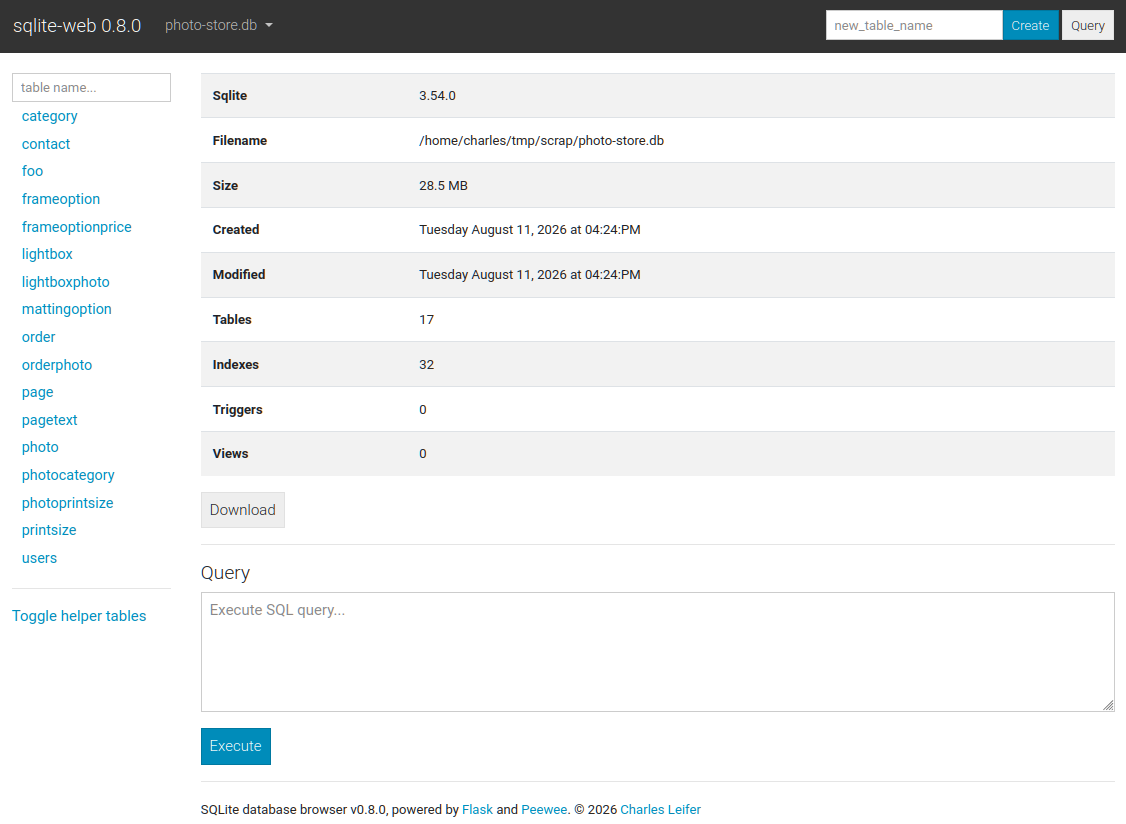
--enable-load or --enable-filesystem)The index page shows some basic information about the database, including the number of tables and indexes, as well as its size on disk:
The structure tab displays information about the structure of the table,
including columns, indexes, triggers, and foreign keys (if any exist). From
this page you can also create, rename or drop columns and indexes.
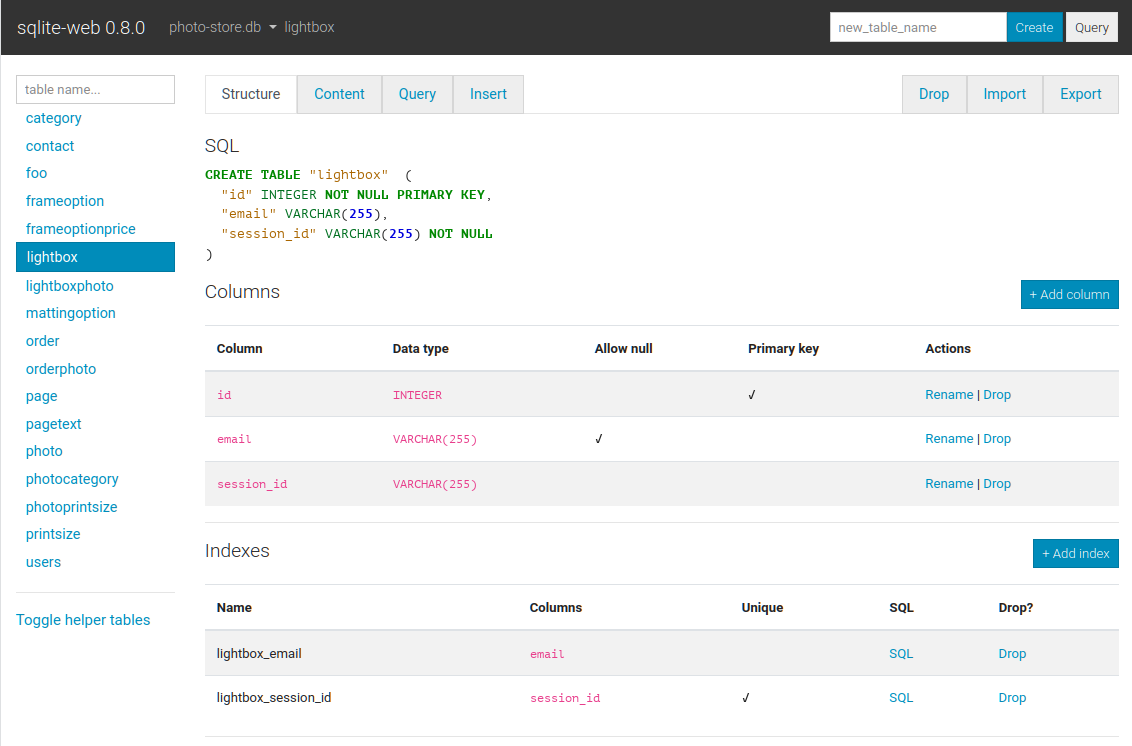
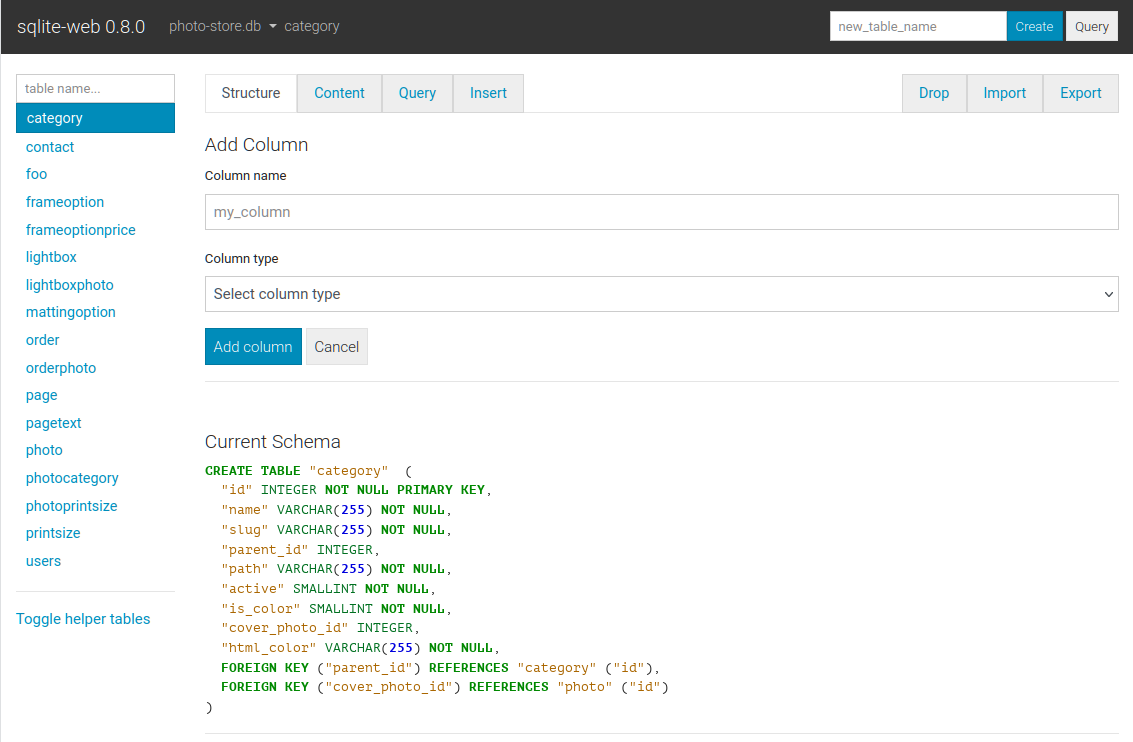
Columns are easy to add, drop or rename:
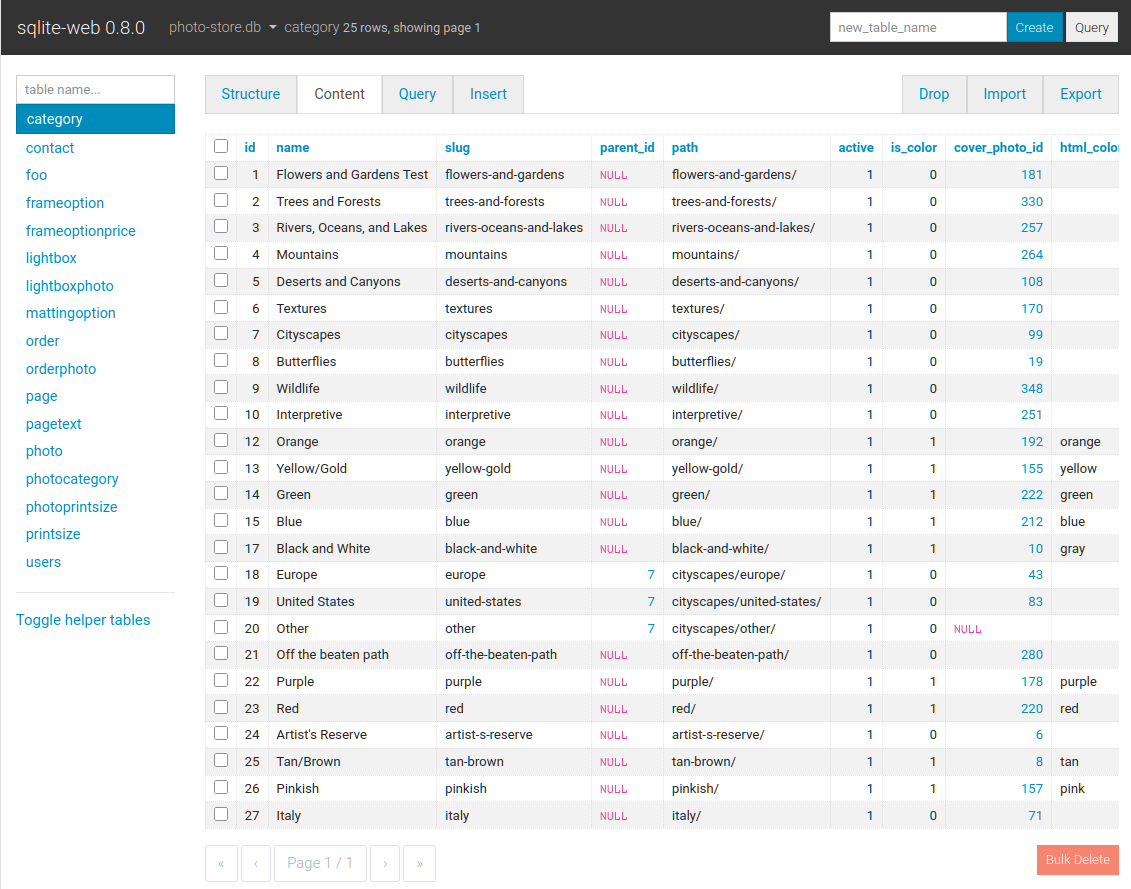
The content tab displays all the table data. Links in the table header can be
used to sort the data, foreign-keys are shown as clickable links, and row-data
can be copied easily:
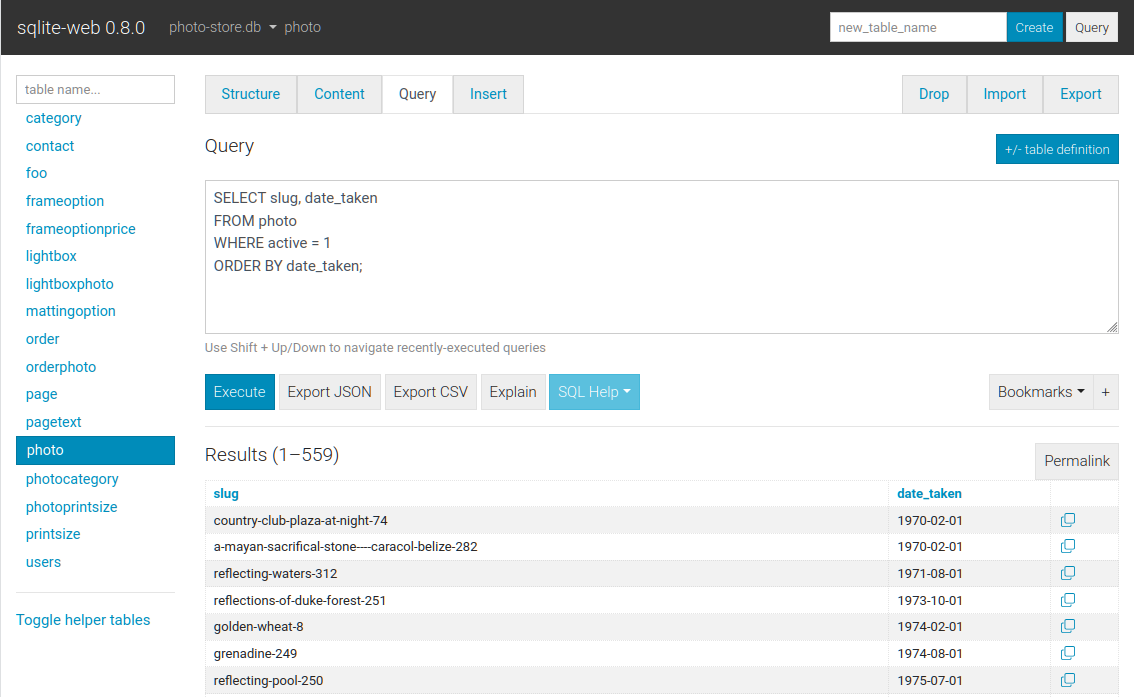
The query tab allows you to execute queries on a table. The query results are
displayed in a table and can be exported to either JSON or CSV. Multiple
queries can be executed, and results for each will be displayed. Data-modifying
queries report the number of rows changed.
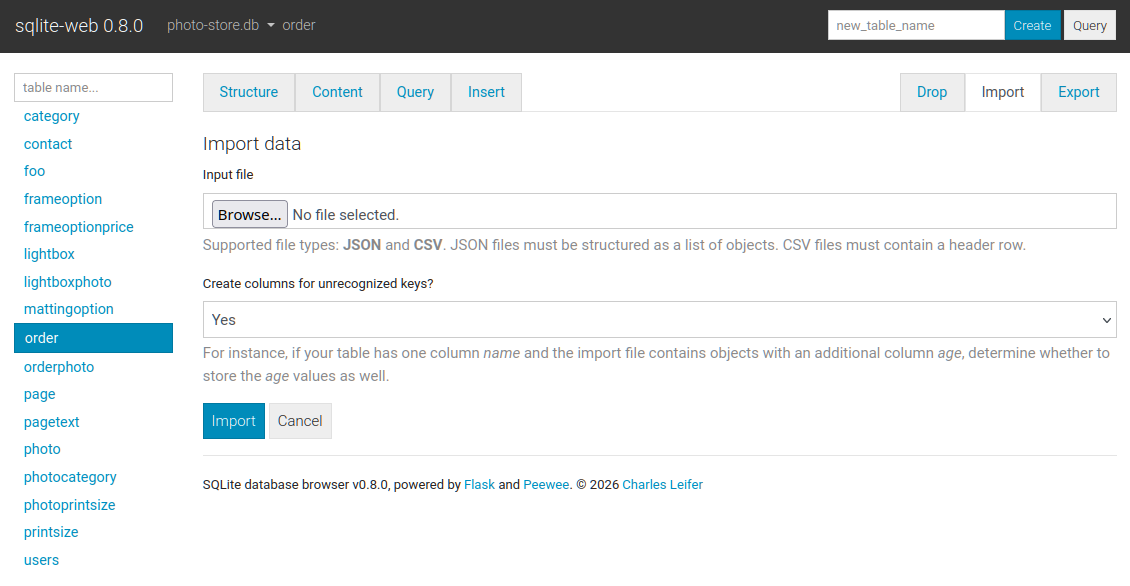
The import tab supports importing CSV and JSON files into a table. There is
an option to automatically create columns for any unrecognized keys in the
import file:
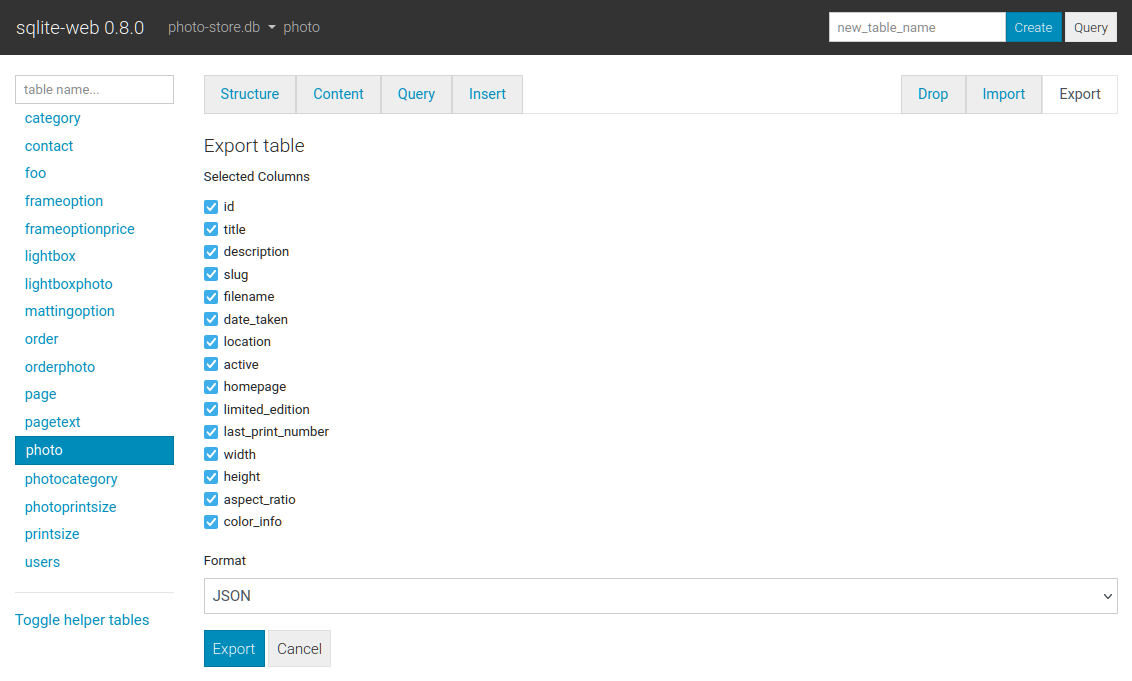
The export tab supports exporting all, or a subset, of columns:
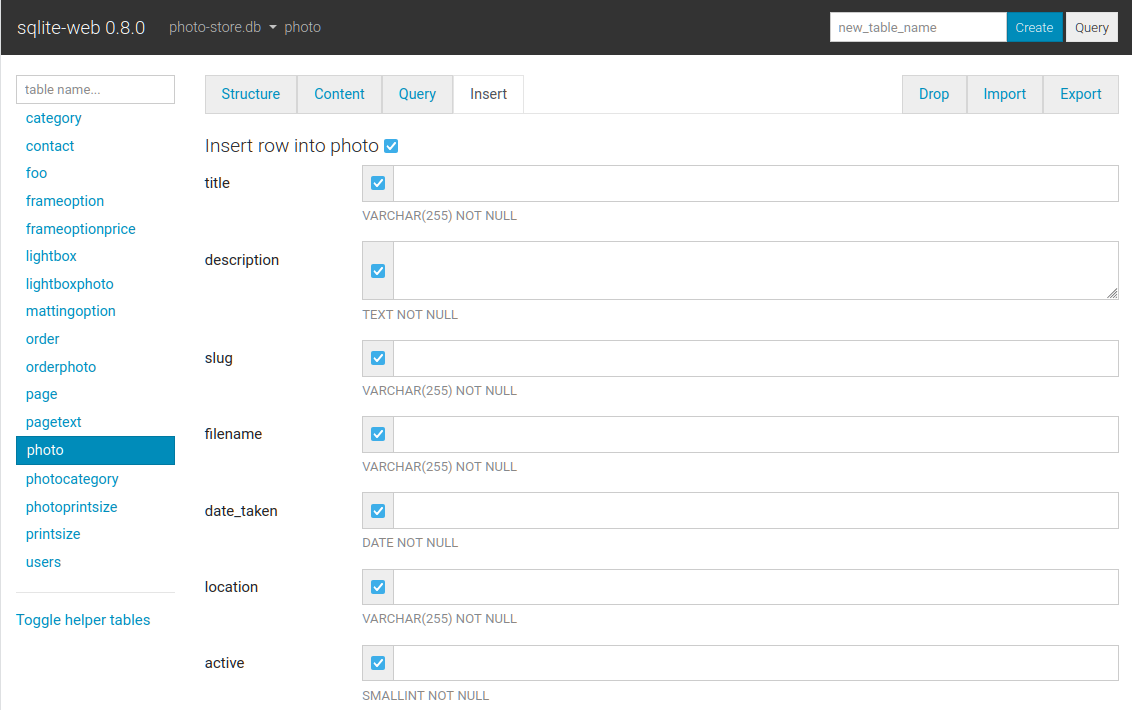
Basic INSERT, UPDATE and DELETE queries are supported:
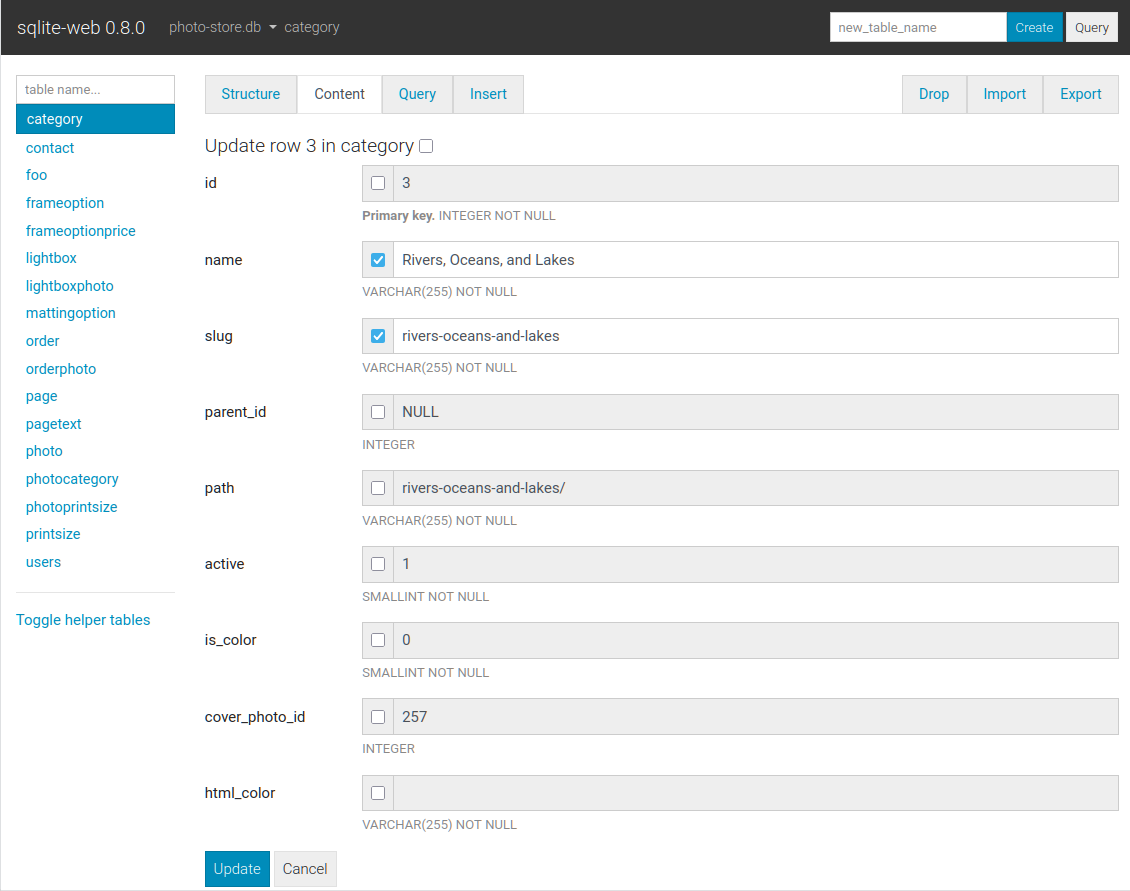
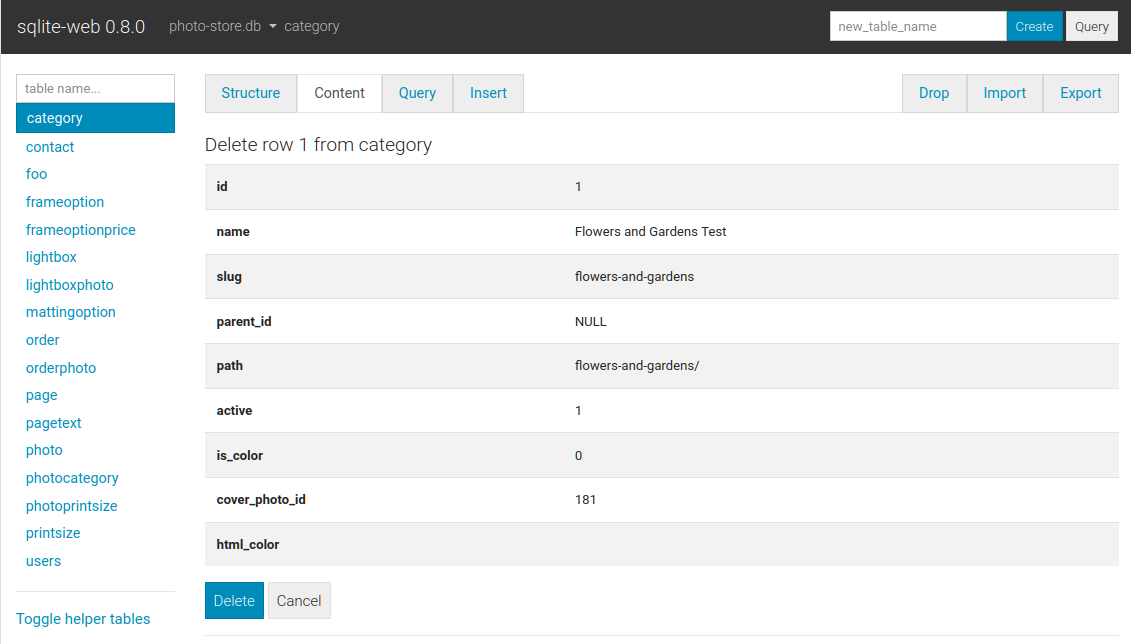
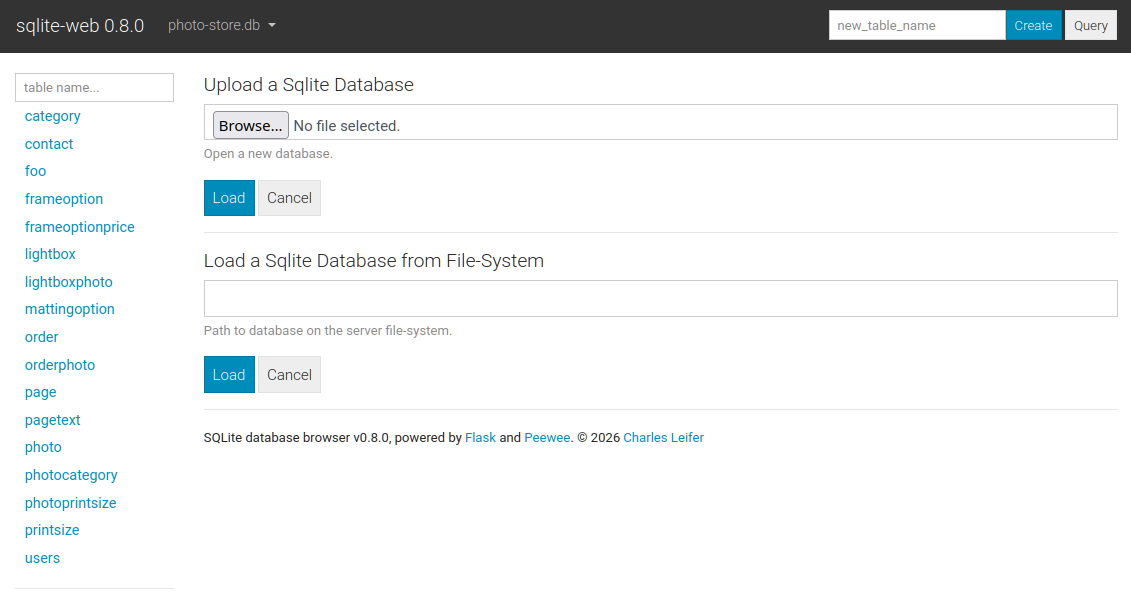
When configured with --enable-load or --enable-filesystem additional
databases can be loaded or unloaded at run-time:
The syntax for invoking sqlite-web is:
$ sqlite_web [options] /path/to/database.db /path/to/another.db
The following options are available:
-p, --port: default is 8080-H, --host: default is 127.0.0.1-d, --debug: default is false-l, --log-file: filename for application logs.-q, --quiet: only log errors.-b, --browser: open a web-browser when sqlite-web starts.-x, --no-browser: do not open a web-browser when sqlite-web starts.-P, --password: prompt for password to access sqlite-web.
Alternatively, the password can be stored in the "SQLITE_WEB_PASSWORD"
environment variable, in which case the application will not prompt for a
password, but will use the value from the environment.-r, --read-only: open database in read-only mode.-R, --rows-per-page: set pagination on content page, default 50 rows.-Q, --query-rows-per-page: set pagination on query page, default 1000 rows.-T, --no-truncate: disable ellipsis for long text values. If this option
is used, the full text value is always shown.-B, --base64: BLOB data as base64 (default is hex).-e, --extension: path or name of loadable extension(s). To load
multiple extensions, specify -e [path] for each extension.-s, --startup-hook: path to a startup hook used to initialize the
connection before each request, e.g. my.module.some_callable. Should
accept one parameter, the SqliteDatabase instance.-f, --foreign-keys: enable foreign-key constraint pragma.-u, --url-prefix: URL prefix for application, e.g. "/sqlite-web".-L, --enable-load: Enable loading additional databases at runtime (upload
only). For adding local databases use --enable-filesystem.-U, --upload-dir: Destination directory for uploaded database. Only has
an effect together with -L. If not specified, a system tempdir is used.-F, --enable-filesystem: Enable loading additional databases by
specifying on-disk path at runtime. Be careful with this.-c, --ssl-cert and -k, --ssl-key - specify SSL cert and private key.-a, --ad-hoc - run using an ad-hoc SSL context. Requires the
cryptography package (pip install sqlite-web[ssl]).A Dockerfile is provided with sqlite-web. To use:
#
# Use GitHub container registry:
#

$ docker run -it --rm \
    -p 8080:8080 \
    -v /path/to/your-data:/data \
    ghcr.io/coleifer/sqlite-web:latest \
    db_filename.db

#
# OR build the image yourself (run from the repository root):
#

$ docker build -t coleifer/sqlite-web -f docker/Dockerfile .
$ docker run -it --rm \
    -p 8080:8080 \
    -v /path/to/your-data:/data \
    coleifer/sqlite-web \
    db_filename.db
Command-line options can be passed in when running via Docker. For example, if
you want to run it at a separate URL prefix, for example /sqlite-web/:
$ docker run -it --rm \
    -p 8080:8080 \
    -v /path/to/your-data:/data \
    ghcr.io/coleifer/sqlite-web:latest \
    db_filename.db \
    --url-prefix="/sqlite-web/"
To run sqlite-web with the high-performance gevent WSGI server, you can run
sqlite_wsgi instead of sqlite_web:
$ sqlite_wsgi /path/to/db.db
More complete example:
$ sqlite_wsgi -p 8000 -H '0.0.0.0' /path/to/db1.db /path/to/db2.db
Overall
Maintained
Code review
PyPI
Latest release
Releases this year
(top 24 of 30)
13,514 followers · starred Nov 2023
39 followers · starred Feb 2016
424 followers · starred Sep 2020
118 followers · starred Jan 2024
Web-based SQLite database browser written in Python
Python
4,171
248 commits
updated Sep 27, 2026
sqlite-web is a web-based SQLite database browser written in Python.
Project dependencies:
$ pip install sqlite-web
$ sqlite_web /path/to/database.db
If you have multiple databases:
$ sqlite_web /path/to/db1.db /path/to/db2.db /path/to/db3.db
Or run with docker:
$ docker run -it --rm \
    -p 8080:8080 \
    -v /path/to/your-data:/data \
    ghcr.io/coleifer/sqlite-web:latest \
    db_filename.db
Or run with the high-performance gevent WSGI server (requires gevent):
$ sqlite_wsgi /path/to/db.db
Then navigate to http://localhost:8080/ to view your database.
--enable-load or --enable-filesystem)The index page shows some basic information about the database, including the number of tables and indexes, as well as its size on disk:
The structure tab displays information about the structure of the table,
including columns, indexes, triggers, and foreign keys (if any exist). From
this page you can also create, rename or drop columns and indexes.
Columns are easy to add, drop or rename:
The content tab displays all the table data. Links in the table header can be
used to sort the data, foreign-keys are shown as clickable links, and row-data
can be copied easily:
The query tab allows you to execute queries on a table. The query results are
displayed in a table and can be exported to either JSON or CSV. Multiple
queries can be executed, and results for each will be displayed. Data-modifying
queries report the number of rows changed.
The import tab supports importing CSV and JSON files into a table. There is
an option to automatically create columns for any unrecognized keys in the
import file:
The export tab supports exporting all, or a subset, of columns:
Basic INSERT, UPDATE and DELETE queries are supported:
When configured with --enable-load or --enable-filesystem additional
databases can be loaded or unloaded at run-time:
The syntax for invoking sqlite-web is:
$ sqlite_web [options] /path/to/database.db /path/to/another.db
The following options are available:
-p, --port: default is 8080-H, --host: default is 127.0.0.1-d, --debug: default is false-l, --log-file: filename for application logs.-q, --quiet: only log errors.-b, --browser: open a web-browser when sqlite-web starts.-x, --no-browser: do not open a web-browser when sqlite-web starts.-P, --password: prompt for password to access sqlite-web.
Alternatively, the password can be stored in the "SQLITE_WEB_PASSWORD"
environment variable, in which case the application will not prompt for a
password, but will use the value from the environment.-r, --read-only: open database in read-only mode.-R, --rows-per-page: set pagination on content page, default 50 rows.-Q, --query-rows-per-page: set pagination on query page, default 1000 rows.-T, --no-truncate: disable ellipsis for long text values. If this option
is used, the full text value is always shown.-B, --base64: BLOB data as base64 (default is hex).-e, --extension: path or name of loadable extension(s). To load
multiple extensions, specify -e [path] for each extension.-s, --startup-hook: path to a startup hook used to initialize the
connection before each request, e.g. my.module.some_callable. Should
accept one parameter, the SqliteDatabase instance.-f, --foreign-keys: enable foreign-key constraint pragma.-u, --url-prefix: URL prefix for application, e.g. "/sqlite-web".-L, --enable-load: Enable loading additional databases at runtime (upload
only). For adding local databases use --enable-filesystem.-U, --upload-dir: Destination directory for uploaded database. Only has
an effect together with -L. If not specified, a system tempdir is used.-F, --enable-filesystem: Enable loading additional databases by
specifying on-disk path at runtime. Be careful with this.-c, --ssl-cert and -k, --ssl-key - specify SSL cert and private key.-a, --ad-hoc - run using an ad-hoc SSL context. Requires the
cryptography package (pip install sqlite-web[ssl]).A Dockerfile is provided with sqlite-web. To use:
#
# Use GitHub container registry:
#

$ docker run -it --rm \
    -p 8080:8080 \
    -v /path/to/your-data:/data \
    ghcr.io/coleifer/sqlite-web:latest \
    db_filename.db

#
# OR build the image yourself (run from the repository root):
#

$ docker build -t coleifer/sqlite-web -f docker/Dockerfile .
$ docker run -it --rm \
    -p 8080:8080 \
    -v /path/to/your-data:/data \
    coleifer/sqlite-web \
    db_filename.db
Command-line options can be passed in when running via Docker. For example, if
you want to run it at a separate URL prefix, for example /sqlite-web/:
$ docker run -it --rm \
    -p 8080:8080 \
    -v /path/to/your-data:/data \
    ghcr.io/coleifer/sqlite-web:latest \
    db_filename.db \
    --url-prefix="/sqlite-web/"
To run sqlite-web with the high-performance gevent WSGI server, you can run
sqlite_wsgi instead of sqlite_web:
$ sqlite_wsgi /path/to/db.db
More complete example:
$ sqlite_wsgi -p 8000 -H '0.0.0.0' /path/to/db1.db /path/to/db2.db
Overall
Maintained
Code review
PyPI
Latest release
Releases this year
(top 24 of 30)
13,514 followers · starred Nov 2023
39 followers · starred Feb 2016
424 followers · starred Sep 2020
118 followers · starred Jan 2024



