
World's first compiler and execution platform for AI systems — turn prompts, skills, and multi-step agent workflows into versioned, packageable software that runs with dependency-aware parallel execution.
Go
10
211 commits
updated Sep 27, 2026
See what people are saying
README
loomloom

AI work compiler and runtime.






What's new
-
🖼️ image-lab — a community skill: one image prompt → several alternatives across the best-fit models, behind one cost gate → See the runs
-
🎨 redesign-lab — a community skill for exploring and building website redesigns → See the runs
-
🚀 0.5.0 — SkillApp bundles now support subscriptions → Release notes
-
💬 How should AI-native tools choose the right model for the work? → Join the discussion
See it in action
Real AI work built with loomloom.
Redesign Lab
Explore → choose → build
Image Lab
One image brief → multiple model-generated alternatives.
Buffett 4-Pillar US Equity Screener
Batch research → parallel analysis → evidence audit
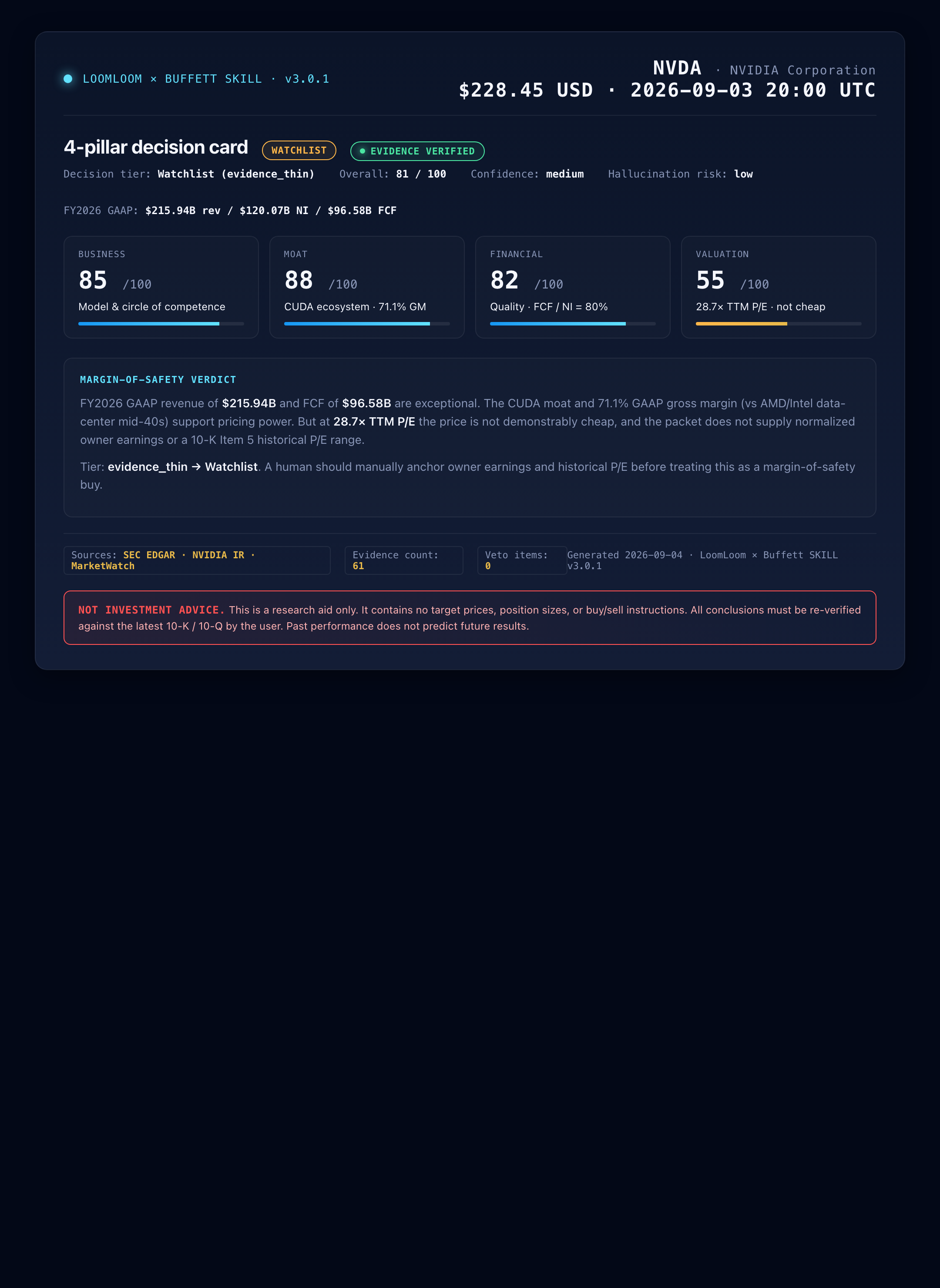
NVDA decision card |
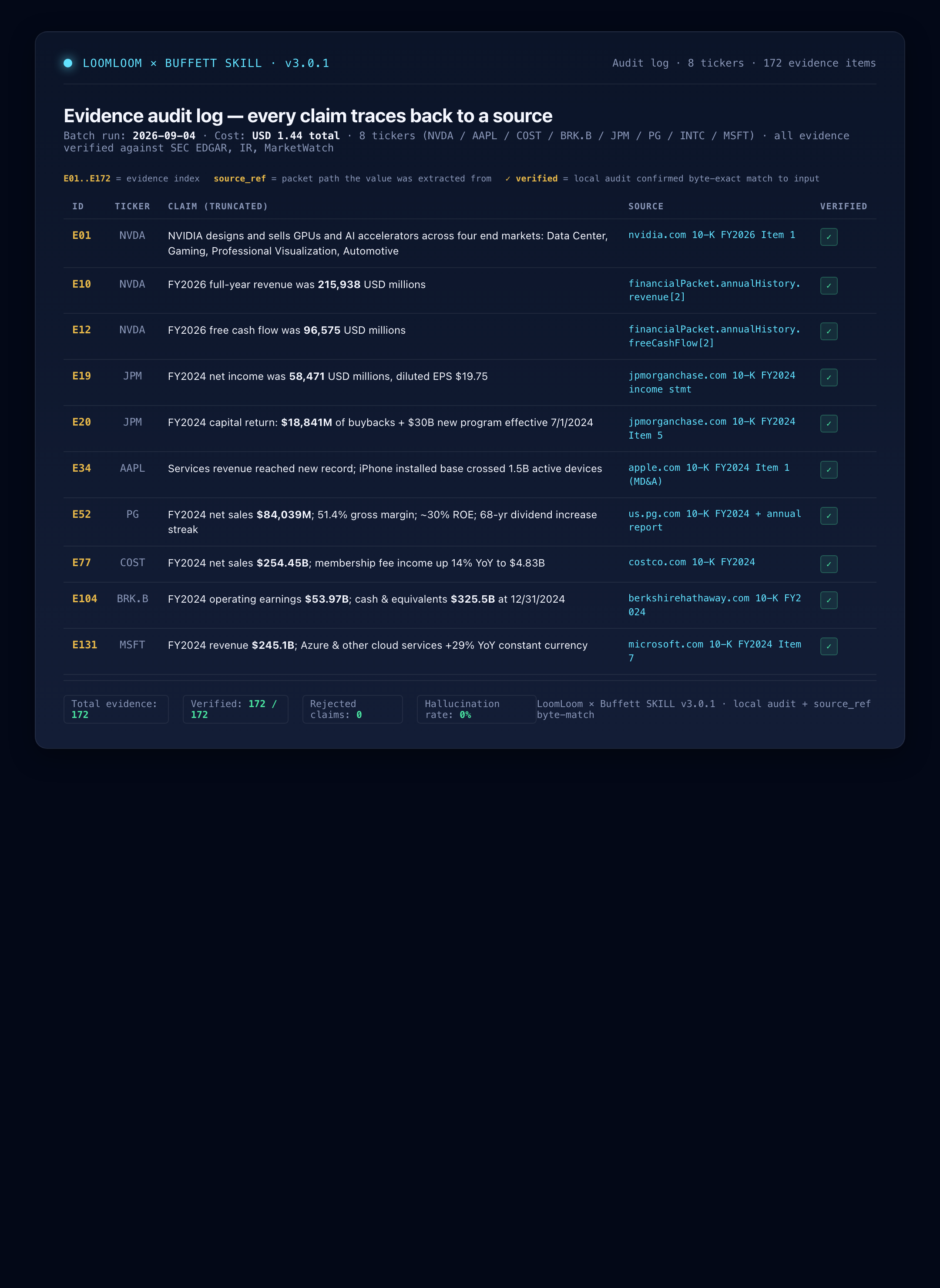
Evidence audit log |
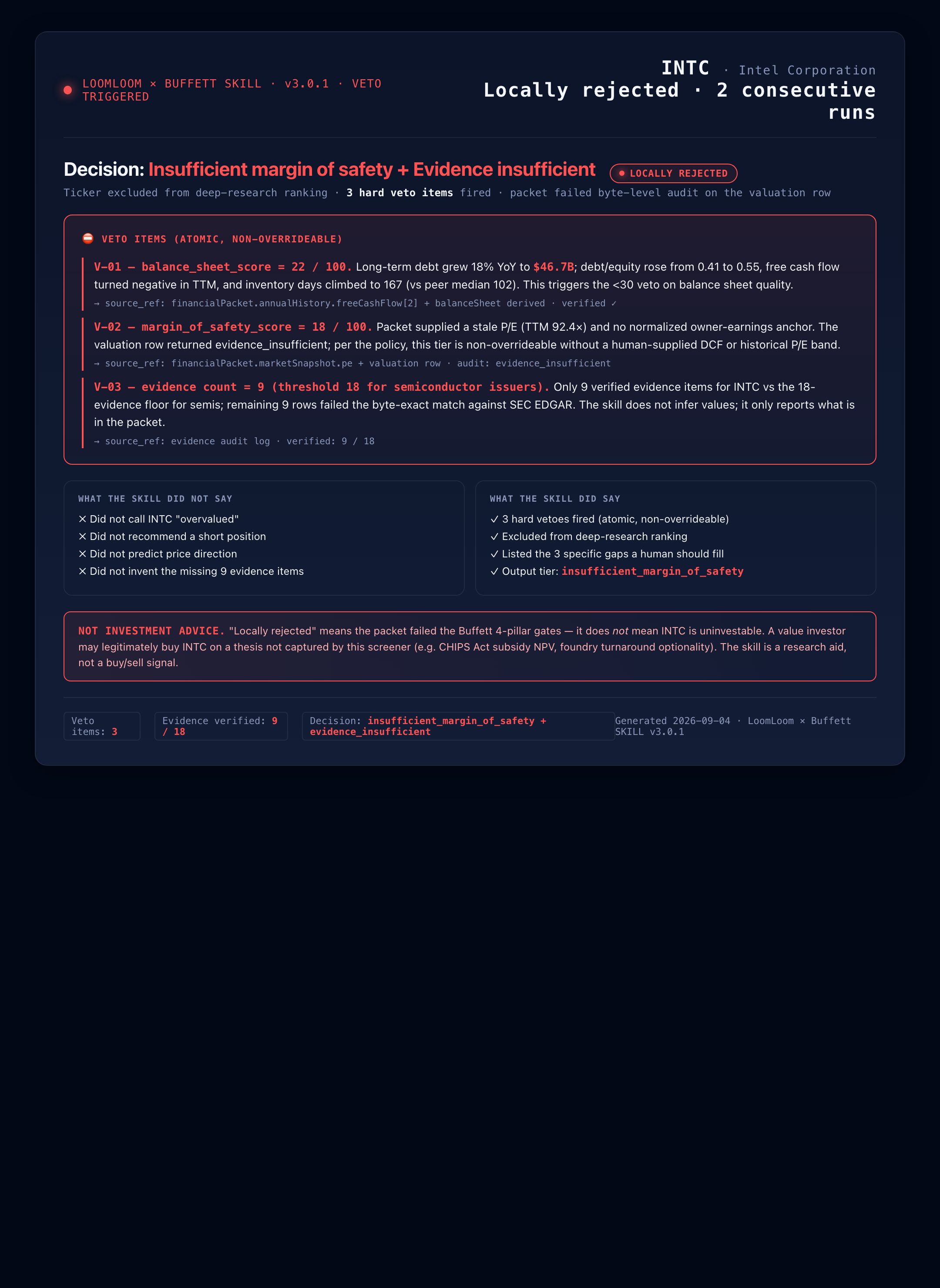
INTC rejection |
More community examples land as they're built.
AI work as software
The main goal of loomloom is to enable AI work to be compiled, packaged, and executed as reusable software — from local development to production-scale execution.
AI work can be created by developers, AI agents, or both working together. It defines the inputs, logic, and expected outputs required to produce an outcome. It can range from a single prompt or skill to a complete AI system, including the instructions, capabilities, workflows, and artifacts required to make it work.
AI work may include:
- Instructions or prompts that guide AI behavior
- Skills, scripts, and tools that extend capabilities
- Workflows that coordinate execution
- Artifacts generated by AI, such as code, documents, and data
loomloom provides a compiler and runtime layer for this new software primitive:
- Compile and package
AI workinto executable AI systems - Execute AI systems across compatible runtimes
- Version, maintain, iterate, and distribute AI systems like software
Quick start
Get loomloom installed on your local development machine using one of the following options:
- Visit https://cogfoundry.ai and follow the quick start instructions
- Install using the installation script or try the agent-assisted installation - see the installation guide
Once installed:
# Show available loomloom commands
loomloom --help

# Show help for a specific command, e.g., the market command
loomloom market --help
How loomloom works
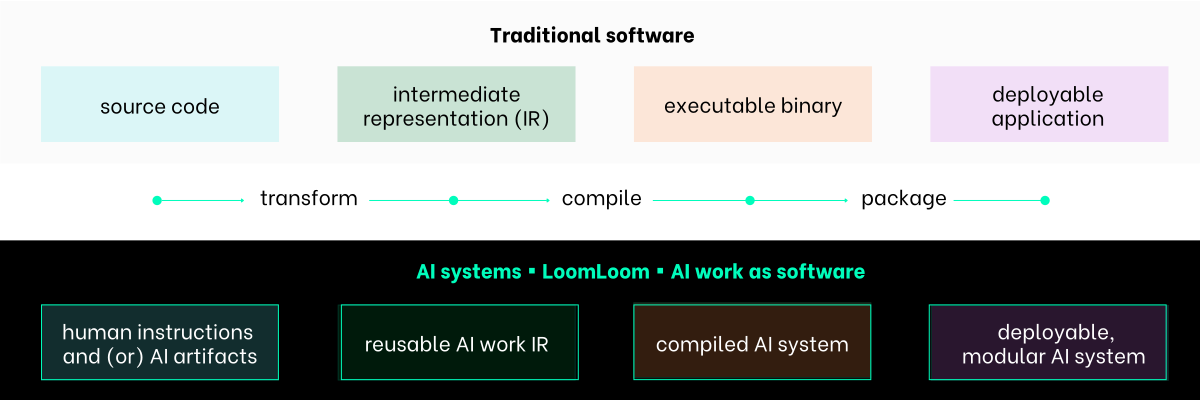
loomloom treats AI work the same way a traditional compiler treats source code.
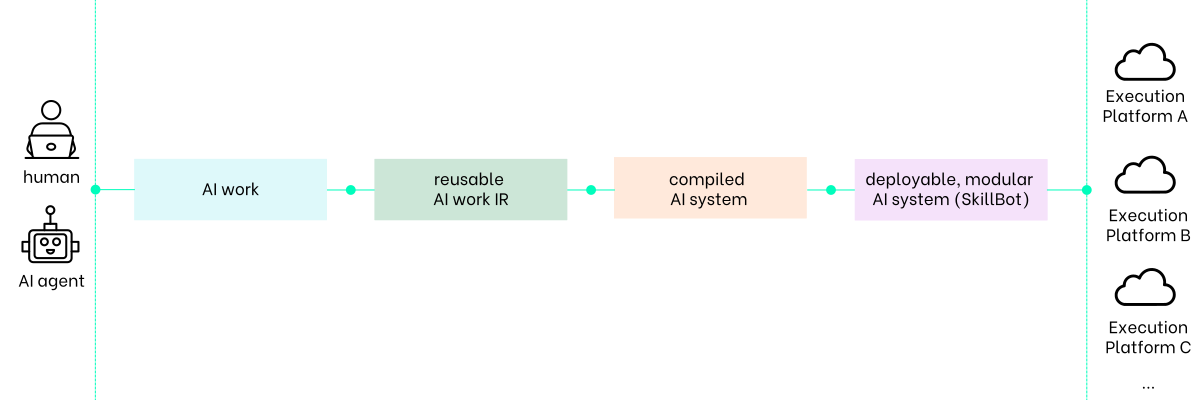
During compilation, loomloom analyzes the components of your AI work across its execution pipeline, optimizes workflow structure and AI model utilization, transforms AI work into an optimized intermediate representation (IR), and produces executable AI systems that can run through compatible runtimes, including execution platforms powered by CogFoundry or its licensed partners.
Components
loomloom provides a complete compilation toolchain for AI work — including:
- an open-source developer toolkit (CLI)
- a reference implementation of the AI work compiler (SkillCompiler)
- a production execution platform (loomloom execution platform)
All built around the IR spec, enabling AI work to be transformed into deployable, modular AI systems through the compilation pipeline shown below:
CLI — All-in-one developer toolkit
loomloom CLI is the developer interface for defining, compiling, executing, and managing AI work as software.
It works alongside your familiar AI agents and developer tools such as Claude Code, Codex, Cline, OpenClaw, and integrates seamlessly with MCP-compatible environments.
Developers use the CLI to:
- Define and transform
AI workinto reusableAI work IR, including its inputs, logic, and outputs - Compile, execute, debug, and test
AI work IR - Package, version, publish, and distribute compiled AI systems as deployable, modular AI systems - or SkillApps
Reusable AI work IR — Intermediate representation for AI systems
Like the IR produced by a software compiler, reusable AI work IR is the inspected and optimized intermediate representation generated during compilation, providing a foundation for reliable, dependency-aware, parallel, and cost-effective AI system execution.
It describes the structures of steps (workflow steps within your AI work), AI model utilization, and execution policies, mapped in a way that explicitly models step dependencies. The IR lets the system discover independent steps that can execute in parallel and safely execute them together, while ensuring dependent steps never run before their required inputs are available.
flowchart LR
    A[Step A] --> B[Step B]
    A --> C[Step C]
    A --> D[Step D]

    B --> E[Step E<br/>Requires B, C, and D]
    C --> E
    D --> E
Discover safe parallel execution opportunities and execute them safely.
Reusable AI work IR represents the following information according to the IR spec:
- typed inputs and outputs
- workflow steps, dependencies, and execution flow
- sequential, parallel, and conditional execution semantics
- model and tool assignments, priorities, and policies
- memory scope and reusable context
- caching and intermediate-result strategies
- validation rules and quality policies
- retry, recovery, and failure-handling policies
- execution budgets and constraints
- final artifacts and output requirements
SkillApp — A deployable, modular AI system
Just as a Docker image packages an application for deployment, SkillApp packages a compiled AI system into a complete, deployable unit. A SkillApp can be deployed to any loomloom-compatible execution platform and invoked through APIs, MCP, or the CLI; installed into supported AI agents and applications; embedded into websites or online systems; or composed with other SkillApps, forming a modular AI system ecosystem.
Beyond the compiled AI system itself, SkillApp also includes the information required to transform a locally developed AI system into a production-ready, scalable execution unit:
- version history
- access rights
- optional IP protection for selected parts of the AI work
- monetization rules, including built-in creator attribution and revenue settlement when needed
SkillCompiler — Compile your AI work into AI systems
SkillCompiler is the default AI work compiler integrated into the loomloom CLI. It transforms the instructions, capabilities, workflows, and AI-generated artifacts that define AI work into reusable AI work IR, then compiles the IR into an optimized execution DAG and compiled AI system that can be packaged as a SkillApp.
SkillCompiler compiles AI work according to the IR spec. This enables the community to build alternative AI work compilers, specialized optimization engines, and alternative execution platforms that are compatible with each other, helping accelerate innovation across the AI ecosystem.
Execution platform — Production runtime
The loomloom execution platform is CogFoundry's reference implementation of a managed runtime for compiled AI systems. It executes SkillApps as stateful, observable, multi-step jobs with maximum safe parallelism, faithfully implementing the execution semantics, optimization strategies, and runtime policies defined in the reusable AI work IR.
Built-in runtime capabilities include:
- dependency-aware parallel execution
- strategy-based model and tool routing
- memory and context management
- caching and intermediate-result reuse
- validation and quality gates
- retries, recovery, and failure handling
- artifact management
- execution metering and settlement
- SkillApp licensing and revenue settlement
Execution platform runs compiled AI systems based on the IR spec. This allows anyone to build compatible platforms with their own runtime technologies, infrastructure, and optimization strategies while remaining interoperable with the same open standard.
Organizations that prefer a production-ready implementation can also license the loomloom execution platform from CogFoundry.
Status
- 🚧 loomloom is currently in beta. The core concepts, architecture, and initial implementations are available and working. Some features are already implemented, while others are under active development.
- ℹ️ Design details may evolve based on community feedback and real-world usage. Significant changes will be documented publicly.
Documentation
Tools
Development
- How to install
- Create your first template (AI work IR)
- Build your first SkillApp
- loomloom workflows
- Changelog
- Developer docs
Design proposals (RFCs)
Contributing
- Contributions are welcome — browse open issues or submit pull requests.
- Collaborators are invited based on contributions.
- Maintainers can push branches in the
loomloomrepository and merge pull requests into themainbranch. - Help with managing issues, pull requests, and projects is greatly appreciated.
- See CONTRIBUTING.md for more information.
Contributors


Similar repos


Languages
Go
76.7%
Shell
16.1%
JavaScript
4.8%
PowerShell
1.8%
World's first compiler and execution platform for AI systems — turn prompts, skills, and multi-step agent workflows into versioned, packageable software that runs with dependency-aware parallel execution.
Go
10
211 commits
updated Sep 27, 2026
See what people are saying
README
loomloom
AI work compiler and runtime.
What's new
-
🖼️ image-lab — a community skill: one image prompt → several alternatives across the best-fit models, behind one cost gate → See the runs
-
🎨 redesign-lab — a community skill for exploring and building website redesigns → See the runs
-
🚀 0.5.0 — SkillApp bundles now support subscriptions → Release notes
-
💬 How should AI-native tools choose the right model for the work? → Join the discussion
See it in action
Real AI work built with loomloom.
Redesign Lab
Explore → choose → build
Image Lab
One image brief → multiple model-generated alternatives.
Buffett 4-Pillar US Equity Screener
Batch research → parallel analysis → evidence audit
|
NVDA decision card |
Evidence audit log |
INTC rejection |
More community examples land as they're built.
AI work as software
The main goal of loomloom is to enable AI work to be compiled, packaged, and executed as reusable software — from local development to production-scale execution.
AI work can be created by developers, AI agents, or both working together. It defines the inputs, logic, and expected outputs required to produce an outcome. It can range from a single prompt or skill to a complete AI system, including the instructions, capabilities, workflows, and artifacts required to make it work.
AI work may include:
- Instructions or prompts that guide AI behavior
- Skills, scripts, and tools that extend capabilities
- Workflows that coordinate execution
- Artifacts generated by AI, such as code, documents, and data
loomloom provides a compiler and runtime layer for this new software primitive:
- Compile and package
AI workinto executable AI systems - Execute AI systems across compatible runtimes
- Version, maintain, iterate, and distribute AI systems like software
Quick start
Get loomloom installed on your local development machine using one of the following options:
- Visit https://cogfoundry.ai and follow the quick start instructions
- Install using the installation script or try the agent-assisted installation - see the installation guide
Once installed:
# Show available loomloom commands
loomloom --help

# Show help for a specific command, e.g., the market command
loomloom market --help
How loomloom works
loomloom treats AI work the same way a traditional compiler treats source code.
During compilation, loomloom analyzes the components of your AI work across its execution pipeline, optimizes workflow structure and AI model utilization, transforms AI work into an optimized intermediate representation (IR), and produces executable AI systems that can run through compatible runtimes, including execution platforms powered by CogFoundry or its licensed partners.
Components
loomloom provides a complete compilation toolchain for AI work — including:
- an open-source developer toolkit (CLI)
- a reference implementation of the AI work compiler (SkillCompiler)
- a production execution platform (loomloom execution platform)
All built around the IR spec, enabling AI work to be transformed into deployable, modular AI systems through the compilation pipeline shown below:
CLI — All-in-one developer toolkit
loomloom CLI is the developer interface for defining, compiling, executing, and managing AI work as software.
It works alongside your familiar AI agents and developer tools such as Claude Code, Codex, Cline, OpenClaw, and integrates seamlessly with MCP-compatible environments.
Developers use the CLI to:
- Define and transform
AI workinto reusableAI work IR, including its inputs, logic, and outputs - Compile, execute, debug, and test
AI work IR - Package, version, publish, and distribute compiled AI systems as deployable, modular AI systems - or SkillApps
Reusable AI work IR — Intermediate representation for AI systems
Like the IR produced by a software compiler, reusable AI work IR is the inspected and optimized intermediate representation generated during compilation, providing a foundation for reliable, dependency-aware, parallel, and cost-effective AI system execution.
It describes the structures of steps (workflow steps within your AI work), AI model utilization, and execution policies, mapped in a way that explicitly models step dependencies. The IR lets the system discover independent steps that can execute in parallel and safely execute them together, while ensuring dependent steps never run before their required inputs are available.
flowchart LR
    A[Step A] --> B[Step B]
    A --> C[Step C]
    A --> D[Step D]

    B --> E[Step E<br/>Requires B, C, and D]
    C --> E
    D --> E
Discover safe parallel execution opportunities and execute them safely.
Reusable AI work IR represents the following information according to the IR spec:
- typed inputs and outputs
- workflow steps, dependencies, and execution flow
- sequential, parallel, and conditional execution semantics
- model and tool assignments, priorities, and policies
- memory scope and reusable context
- caching and intermediate-result strategies
- validation rules and quality policies
- retry, recovery, and failure-handling policies
- execution budgets and constraints
- final artifacts and output requirements
SkillApp — A deployable, modular AI system
Just as a Docker image packages an application for deployment, SkillApp packages a compiled AI system into a complete, deployable unit. A SkillApp can be deployed to any loomloom-compatible execution platform and invoked through APIs, MCP, or the CLI; installed into supported AI agents and applications; embedded into websites or online systems; or composed with other SkillApps, forming a modular AI system ecosystem.
Beyond the compiled AI system itself, SkillApp also includes the information required to transform a locally developed AI system into a production-ready, scalable execution unit:
- version history
- access rights
- optional IP protection for selected parts of the AI work
- monetization rules, including built-in creator attribution and revenue settlement when needed
SkillCompiler — Compile your AI work into AI systems
SkillCompiler is the default AI work compiler integrated into the loomloom CLI. It transforms the instructions, capabilities, workflows, and AI-generated artifacts that define AI work into reusable AI work IR, then compiles the IR into an optimized execution DAG and compiled AI system that can be packaged as a SkillApp.
SkillCompiler compiles AI work according to the IR spec. This enables the community to build alternative AI work compilers, specialized optimization engines, and alternative execution platforms that are compatible with each other, helping accelerate innovation across the AI ecosystem.
Execution platform — Production runtime
The loomloom execution platform is CogFoundry's reference implementation of a managed runtime for compiled AI systems. It executes SkillApps as stateful, observable, multi-step jobs with maximum safe parallelism, faithfully implementing the execution semantics, optimization strategies, and runtime policies defined in the reusable AI work IR.
Built-in runtime capabilities include:
- dependency-aware parallel execution
- strategy-based model and tool routing
- memory and context management
- caching and intermediate-result reuse
- validation and quality gates
- retries, recovery, and failure handling
- artifact management
- execution metering and settlement
- SkillApp licensing and revenue settlement
Execution platform runs compiled AI systems based on the IR spec. This allows anyone to build compatible platforms with their own runtime technologies, infrastructure, and optimization strategies while remaining interoperable with the same open standard.
Organizations that prefer a production-ready implementation can also license the loomloom execution platform from CogFoundry.
Status
- 🚧 loomloom is currently in beta. The core concepts, architecture, and initial implementations are available and working. Some features are already implemented, while others are under active development.
- ℹ️ Design details may evolve based on community feedback and real-world usage. Significant changes will be documented publicly.
Documentation
Tools
Development
- How to install
- Create your first template (AI work IR)
- Build your first SkillApp
- loomloom workflows
- Changelog
- Developer docs
Design proposals (RFCs)
Contributing
- Contributions are welcome — browse open issues or submit pull requests.
- Collaborators are invited based on contributions.
- Maintainers can push branches in the
loomloomrepository and merge pull requests into themainbranch. - Help with managing issues, pull requests, and projects is greatly appreciated.
- See CONTRIBUTING.md for more information.
Similar repos
Contributors
Languages
Go
76.7%
Shell
16.1%
JavaScript
4.8%
PowerShell
1.8%