
A Rust agent SDK, harness, and coding agent — safe by construction (non-bypassable authorization → approval → guarded IO).
See the codeREADME
A Rust agent platform where the model proposes and a deterministic runtime disposes.
Typed stages, authored flows, guarded execution, replayable evidence.




Install · Quickstart · Documentation · Architecture · Contributing
The LLM is not the runtime
The model never becomes the execution engine. It may author Flux-Lang source, declare intent, explore through exact provider-native operation schemas, and propose literal actions, but authored text is inert until it is parsed and analysed. Only an explicitly requested run enters the deterministic Rust runtime, where authorization, approval and guarded IO own every effect.
request → typed intent → scoped exploration → action batch → approval → guarded execution
                       authored Flux-Lang + deterministic runtime
That boundary is what makes effects reviewable before they run, authored workflows repeatable, and every operation governable. The same envelope covers local tools, plugins, sub-agents, the SDK and the server — there is no second path.
An entire app, declared
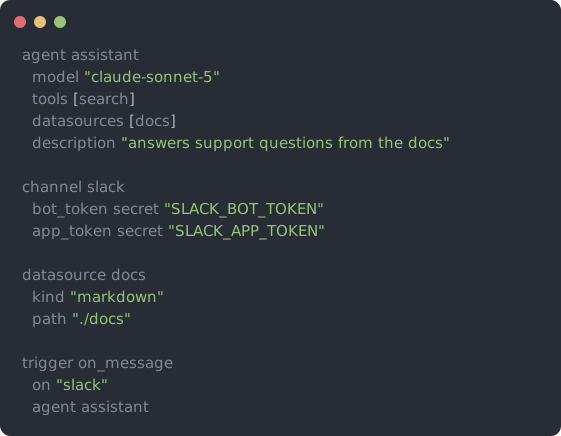
A Slack support agent: the agent, the channel it answers on, the corpus it answers from, and the trigger that wakes it.
flux app run support-bot.flux
Secrets are environment-variable references, never inline values — the host resolves them at load and
redacts them from every log. The full example, with setup notes, is
crates/flux-app/examples/support-bot.flux.
Why flux
| Agent | Local CLI and TUI, a Rust SDK, an HTTP server, A2A support — one execution envelope behind all four. |
| Flux-Lang | Typed authored flows for orchestration, with an in-repo language server (diagnostics, completion, hover, formatting) and a tree-sitter grammar for Helix, Neovim and Zed. |
| Improvement loop | Evidence-driven eval and self-improvement tooling. |
Reach for flux when you want an action batch you can inspect and approve before it runs, guardrails that are explicit rather than implied, deterministic replay/fork/diff, or an embeddable agent surface inside your own product.
Install
cargo install --git https://github.com/codewandler/flux flux-cli

# optional: the .flux language server for your editor
cargo install --git https://github.com/codewandler/flux flux-lsp
Or take a prebuilt binary for Linux and macOS:
curl --proto '=https' --tlsv1.2 -LsSf -o flux-installer.sh \
  https://github.com/codewandler/flux/releases/latest/download/flux-cli-installer.sh
sh flux-installer.sh   # downloaded first, so the script is reviewable before it runs
Hardened install — verify GitHub provenance before extracting
For sensitive environments, pin a version and verify its attestation. Replace the placeholders with a release and target from the release page:
release=vX.Y.Z
archive=flux-cli-<target>.tar.xz
gh release download "$release" --repo codewandler/flux --pattern "$archive"
source_digest="$(gh api "repos/codewandler/flux/commits/$release" --jq .sha)"
gh attestation verify "$archive" --repo codewandler/flux \
  --signer-workflow codewandler/flux/.github/workflows/release.yml \
  --source-ref "refs/tags/$release" --source-digest "$source_digest" \
  --deny-self-hosted-runners
tar -xJf "$archive"
Verification binds the tag to its exact source commit and rejects any asset outside the closed, attestation-checked distribution set. Releases predating provenance publication should be built from a reviewed tag instead.
From a clone: cargo build --release → target/release/flux, or task install for flux and
flux-lsp together. task install requires Python 3.10+ before Cargo starts (python3, then
python on Linux/macOS; python, then py -3 on Windows). It preserves an absolute or
workspace-relative CARGO_TARGET_DIR, holds shared ownership of that reusable target for the whole
verification/install sequence, and refuses concurrent task clean rather than risking live
compiler output. Set PYTHON=<executable> only when the platform's standard launcher is not the
desired interpreter. Plugin packs ship separately as plugins-v*.
Quickstart
No API key required — the offline mock provider exercises the full pipeline:
flux run --yes -m mock "write a quick note"
mock · session s_1658
routing intent…
◆ intent: complete the offline mock turn
  capabilities: workspace.write · 5 operations
exploring…

→ [1/50] append    flux-mock.txt (+21 bytes)
  ✓ appended 21 bytes to flux-mock.txt  · exec 731µs
Finished.
─────────────────────── 1 step · 790ms · ctx 1.4k · out 12 · cache 87% ↺1.2k ✎0
The intent, the capabilities it unlocked, every operation with its arguments and effect, and the cost. Then with a real provider:
flux run "add a test for the parser"
flux run --show-loop "summarize README.md into SUMMARY.txt"   # reveal the batch machinery
flux loop show                                                # inspect the authored outer loop

flux            # REPL
flux tui        # full-screen UI
flux app run --serve 127.0.0.1:8787 --yes    # HTTP server
Effects are local by default. To keep the model, runtime and approval UI on your machine while file,
process and network effects land in a separately administered workspace, select the remote mode with
flux tui --remote https://worker.example:8790. The remote side is an authenticated TLS service;
setup, trust boundaries and the deliberate no-sync rule are covered in the
topologies guide.
Safety and execution model
Every operation passes the same chain:
capability scope floor → policy (deny by default) → permissions → approval → guarded IO
There is no bypass path:
- workspace file, process and network operations are guarded by
flux-system— one path, not one of several - unsafe or ambiguous commands can be denied at analysis time or at approval time
- effectful native calls are frozen into an approved batch and re-checked at dispatch
- every secret is registered with the redactor and scrubbed from tool output and logs
- evidence is persisted per session and per event, for audit and replay
Sub-agents inherit the identical chain: their loops and operation calls face the same checks.
Execution hosts
A provider decides which model answers. A host decides which machine the effects land on.
Declare one by name and select it with --host:
flux host add build --backend remote --url https://build.internal --credential-ref env/BUILD_TOKEN
flux host probe build      # identity check — executes nothing on the substrate
flux --host build run "cargo test"
The credential is always a reference to where it lives (env/…, plugin/…, kubernetes/…),
never a value — add refuses an inline secret before anything is written, and the URL must be
credential-free. Selection is permission-gated: each binding declares who may use it, the default
posture is deny, and unattended automation never inherits a grant given only to interactive use. The
selected host is immutable for the session and inherited by sub-agents, and the audit trail records
which host every action ran on.
backend | Runs effects on |
|---|---|
local | this machine |
sandboxed | this machine under the OS sandbox (bubblewrap on Linux, Seatbelt on macOS) — fails closed if no usable confinement exists |
container | a container substrate |
kubernetes | a pod substrate |
microvm | a VM/microVM guest serving the remote protocol |
remote | another machine over the authenticated remote protocol |
The vocabulary is closed — an unknown kind is a hard config error, and [[host]] refuses unknown
keys outright, because a silently dropped typo in a substrate binding would change where effects
land. Flux never provisions the machine: a binding consumes an endpoint that already exists, and one
declared before its endpoint exists lists as unwired and refuses selection naming what is missing,
rather than quietly falling back to your machine. Web requests follow the selection too; browser
automation and crawling stay local, since they drive a local browser.
[[host]] in ~/.flux/config.toml
[[host]]
id = "build"
backend = "remote"
url = "https://build.internal"
credential_ref = "env/BUILD_TOKEN"

[[host]]
id = "confined"
backend = "sandboxed"
flux host ls / show render id, backend kind, address and availability (--output json is the
automation API); flux host metrics <name> reports that machine's own condition — CPU, load,
memory, swap, disk, uptime, temperature, fans — with anything it cannot measure reported as
explicitly unavailable with a reason, never as zero. The agent gets the same views (host.list,
host.info, host.probe) and never reads a credential value.
Providers
A provider is a wire codec × credential pair, selected with -m <provider>/<model>.
flux auth status
flux auth login claude   # opt-in OAuth
Bare aliases skip the prefix: fable, opus, sonnet and haiku resolve on anthropic; claude,
codex and aws resolve their provider's default model; mock runs offline.
All providers and their credentials
-m provider | Wire | Auth |
|---|---|---|
anthropic | Anthropic Messages | ANTHROPIC_API_KEY |
openai | OpenAI Chat | OPENAI_API_KEY |
openrouter | Anthropic Messages | OPENROUTER_API_KEY |
ollama | OpenAI Chat | local |
ollama-anthropic | Anthropic Messages | local |
claude | Anthropic Messages | Claude subscription OAuth (~/.claude/.credentials.json) |
codex | OpenAI Responses | ChatGPT/Codex OAuth (~/.codex/auth.json) |
aws | Bedrock Anthropic | AWS env / SSO / IRSA / EKS Pod Identity |
mock | — | none — offline test provider, exercises the full pipeline |
Configuration
Precedence: CLI flags → project .flux/config.toml → user ~/.flux/config.toml → defaults.
Example .flux/config.toml
model = "claude/opus"

[private_net]
web = ["localhost"]

[private_net.plugins]
prometheus = ["prometheus.local"]

[permissions]
allow = ["read", "glob", "grep", "search", "Bash(git:*)"]
deny  = ["Bash(rm:*)"]

[[policy.grants]]
subjects = [{ kind = "user", id = "*" }]
resources = [{ kind = "path", path = "src/**" }]
actions = ["workspace.write"]
allow_private_net = true is still honored for compatibility, but plugin private-network grants always
require an explicit [private_net.plugins] entry.
Full reference: configuration.
Capabilities
- Built-in tools cover file, search, web and delegation operations. The generic shell (
bash) is opt-in, behind theshellsignal — prefer a dedicated, accurately-gated operation. - Skills and markdown slash-commands load from both
.flux/and.claude/trees, project and user-global, nested multi-file skills included. Manual-only by default, with an opt-in model-invoked mode. - Plugin operations are manifest-scoped with enforced privileges. Approval and policy hooks
(
.flux/hooks/*.js) can validate, transform or deny calls. flux tuiis the same daily driver in a dense borderless UI: mid-turn steering (type while a turn runs, with queued messages still editable), themes, history and transcript search,@path completion, hunk-view diffs, session picker and replay, live model switching. Launchflux tui --fleet[=ROOT]to resume the exact Fleet-main coordinator and supervise its Board, workers, decisions, failures and exact progress stats withF2; ordinaryflux tuiremains an explicitly labelled standalone chat.
Programs, presets, and the SDK
Programs compose multi-agent journeys in Flux-Lang — a .flux file declaring agents, channels,
datasources, triggers and journeys. Presets cover common flow structures.
flux app run support-bot.flux            # serve its declared channels until Ctrl-C
flux run support-bot.flux                # same program, path auto-detected
flux run workflows.flux --entry triage --arg queue=new   # one named flow from a multi-flow module

flux preset list
flux preset retry_with_backoff max=3 delay_ms=200 op=read input='"README.md"' bind=r --run --yes
To embed flux in Rust, the SDK assembles the same flow engine and safety pipeline the CLI uses:
let provider = Box::new(flux_providers::anthropic::anthropic_from_env()?);
let client = flux_sdk::Client::builder().model("anthropic/opus").build(provider, ".")?;
let out = client.run("Summarize the README").await?;
println!("{}", out.text);
Exchange integrations
Flux can mount the connected, granted operations of one Exchange Service Account into each agent turn. The environment setup below is a transitional C-503 compatibility seam for the embedded client, not the managed Linux-local Milestone 1 onboarding contract. C-509 replaces it there with an Exchange-owned handoff directly into secure storage; independently provisioned remote Exchange use retains this configured origin/bearer on every Flux target until secure remote provisioning is separately contracted. For that temporary seam, configure the origin and bearer in the host environment:
export FLUX_EXCHANGE_URL=https://exchange.example.com
export FLUX_EXCHANGE_SERVICE_ACCOUNT_TOKEN=fxsa_...
flux
Flux refreshes the account's effective catalogue between turns and sends operation inputs to the
bound Exchange origin. In this transitional seam the token is startup configuration, never a tool
argument. Exchange retains
tenant, connection, credential, grant and runtime authority. If Exchange is absent or unavailable,
its operations disappear while Flux's language, agent loop and core tools remain available.
Bearer transport requires HTTPS except for an origin that resolves entirely to loopback, which is
reserved for local development.
One-shot invoke is the shipped slice; subscriptions, streaming, cancellation frames, terminal
lifecycle and leases remain future lifecycle work.
Plugin packs
Official integrations — GitLab, Slack, Kubernetes, SQL and more — currently ship as a signed native plugin pack. This is temporary compatibility behavior: the current release index is minisign-checked and every archive hash is verified before install, so the commands below remain the supported way to use those integrations today.
The accepted migration makes Flux's embedded Exchange client the only future official integration path. Its Service Account catalogue and one-shot invocation binding now ship. Exchange executes connector-declared runtimes; Flux itself executes no connector runtime and has no official fallback. Each adapter retires only after its Exchange replacement passes frozen parity evidence, then C-506 removes the plugin protocol, host, installer, signed pack and release artifacts. Flux remains useful without Exchange for its language, agent loop and core tools.
flux plugin install gitlab
flux plugin install --all
HTTP API
flux app run --serve <addr> --yes hosts a Flux agent. All non-health routes require bearer auth by
default, and a non-loopback bind without FLUX_SERVER_TOKEN is rejected at startup.
Routes
| Route | Purpose |
|---|---|
GET /health | Liveness |
GET /.well-known/agent-card.json | A2A discovery card |
POST /a2a | A2A message send/stream endpoints |
POST /sessions | Start a new session |
GET /sessions/:id | Session status |
POST /sessions/:id/messages | Run one turn |
GET /sessions/:id/stream?input=... | SSE stream |
POST /webhook | External trigger |
Documentation
codewandler.github.io/flux — getting started · the agent loop · Flux-Lang · editor setup · SDK · plugins · team presentation
In-repo: docs/README.md (the docs map) ·
docs/architecture.md · docs/vision.md ·
docs/usage.md (command surface map)
Contributing
flux is a layered Rust workspace, contracts through extensions. The safety guarantees are enforced by the runtime layer and checked by an architecture gate.
cargo build --workspace
cargo test --workspace
cargo clippy --workspace --all-targets -- -D warnings
cargo fmt --all
cargo test -p flux-codegate      # architecture layering lint
AGENTS.md is the authoritative contributor contract — architecture boundaries, safety invariants, conventions and release mechanics. Read it before opening a PR.
License
MIT OR Apache-2.0, at your option.
Contributors

2,364 commits

14 commits
Similar repos


Languages
Rust
96.8%
Shell
2.0%
A Rust agent SDK, harness, and coding agent — safe by construction (non-bypassable authorization → approval → guarded IO).
See the codeREADME
A Rust agent platform where the model proposes and a deterministic runtime disposes.
Typed stages, authored flows, guarded execution, replayable evidence.
Install · Quickstart · Documentation · Architecture · Contributing
The LLM is not the runtime
The model never becomes the execution engine. It may author Flux-Lang source, declare intent, explore through exact provider-native operation schemas, and propose literal actions, but authored text is inert until it is parsed and analysed. Only an explicitly requested run enters the deterministic Rust runtime, where authorization, approval and guarded IO own every effect.
request → typed intent → scoped exploration → action batch → approval → guarded execution
                       authored Flux-Lang + deterministic runtime
That boundary is what makes effects reviewable before they run, authored workflows repeatable, and every operation governable. The same envelope covers local tools, plugins, sub-agents, the SDK and the server — there is no second path.
An entire app, declared
A Slack support agent: the agent, the channel it answers on, the corpus it answers from, and the trigger that wakes it.
flux app run support-bot.flux
Secrets are environment-variable references, never inline values — the host resolves them at load and
redacts them from every log. The full example, with setup notes, is
crates/flux-app/examples/support-bot.flux.
Why flux
| Agent | Local CLI and TUI, a Rust SDK, an HTTP server, A2A support — one execution envelope behind all four. |
| Flux-Lang | Typed authored flows for orchestration, with an in-repo language server (diagnostics, completion, hover, formatting) and a tree-sitter grammar for Helix, Neovim and Zed. |
| Improvement loop | Evidence-driven eval and self-improvement tooling. |
Reach for flux when you want an action batch you can inspect and approve before it runs, guardrails that are explicit rather than implied, deterministic replay/fork/diff, or an embeddable agent surface inside your own product.
Install
cargo install --git https://github.com/codewandler/flux flux-cli

# optional: the .flux language server for your editor
cargo install --git https://github.com/codewandler/flux flux-lsp
Or take a prebuilt binary for Linux and macOS:
curl --proto '=https' --tlsv1.2 -LsSf -o flux-installer.sh \
  https://github.com/codewandler/flux/releases/latest/download/flux-cli-installer.sh
sh flux-installer.sh   # downloaded first, so the script is reviewable before it runs
Hardened install — verify GitHub provenance before extracting
For sensitive environments, pin a version and verify its attestation. Replace the placeholders with a release and target from the release page:
release=vX.Y.Z
archive=flux-cli-<target>.tar.xz
gh release download "$release" --repo codewandler/flux --pattern "$archive"
source_digest="$(gh api "repos/codewandler/flux/commits/$release" --jq .sha)"
gh attestation verify "$archive" --repo codewandler/flux \
  --signer-workflow codewandler/flux/.github/workflows/release.yml \
  --source-ref "refs/tags/$release" --source-digest "$source_digest" \
  --deny-self-hosted-runners
tar -xJf "$archive"
Verification binds the tag to its exact source commit and rejects any asset outside the closed, attestation-checked distribution set. Releases predating provenance publication should be built from a reviewed tag instead.
From a clone: cargo build --release → target/release/flux, or task install for flux and
flux-lsp together. task install requires Python 3.10+ before Cargo starts (python3, then
python on Linux/macOS; python, then py -3 on Windows). It preserves an absolute or
workspace-relative CARGO_TARGET_DIR, holds shared ownership of that reusable target for the whole
verification/install sequence, and refuses concurrent task clean rather than risking live
compiler output. Set PYTHON=<executable> only when the platform's standard launcher is not the
desired interpreter. Plugin packs ship separately as plugins-v*.
Quickstart
No API key required — the offline mock provider exercises the full pipeline:
flux run --yes -m mock "write a quick note"
mock · session s_1658
routing intent…
◆ intent: complete the offline mock turn
  capabilities: workspace.write · 5 operations
exploring…

→ [1/50] append    flux-mock.txt (+21 bytes)
  ✓ appended 21 bytes to flux-mock.txt  · exec 731µs
Finished.
─────────────────────── 1 step · 790ms · ctx 1.4k · out 12 · cache 87% ↺1.2k ✎0
The intent, the capabilities it unlocked, every operation with its arguments and effect, and the cost. Then with a real provider:
flux run "add a test for the parser"
flux run --show-loop "summarize README.md into SUMMARY.txt"   # reveal the batch machinery
flux loop show                                                # inspect the authored outer loop

flux            # REPL
flux tui        # full-screen UI
flux app run --serve 127.0.0.1:8787 --yes    # HTTP server
Effects are local by default. To keep the model, runtime and approval UI on your machine while file,
process and network effects land in a separately administered workspace, select the remote mode with
flux tui --remote https://worker.example:8790. The remote side is an authenticated TLS service;
setup, trust boundaries and the deliberate no-sync rule are covered in the
topologies guide.
Safety and execution model
Every operation passes the same chain:
capability scope floor → policy (deny by default) → permissions → approval → guarded IO
There is no bypass path:
- workspace file, process and network operations are guarded by
flux-system— one path, not one of several - unsafe or ambiguous commands can be denied at analysis time or at approval time
- effectful native calls are frozen into an approved batch and re-checked at dispatch
- every secret is registered with the redactor and scrubbed from tool output and logs
- evidence is persisted per session and per event, for audit and replay
Sub-agents inherit the identical chain: their loops and operation calls face the same checks.
Execution hosts
A provider decides which model answers. A host decides which machine the effects land on.
Declare one by name and select it with --host:
flux host add build --backend remote --url https://build.internal --credential-ref env/BUILD_TOKEN
flux host probe build      # identity check — executes nothing on the substrate
flux --host build run "cargo test"
The credential is always a reference to where it lives (env/…, plugin/…, kubernetes/…),
never a value — add refuses an inline secret before anything is written, and the URL must be
credential-free. Selection is permission-gated: each binding declares who may use it, the default
posture is deny, and unattended automation never inherits a grant given only to interactive use. The
selected host is immutable for the session and inherited by sub-agents, and the audit trail records
which host every action ran on.
backend | Runs effects on |
|---|---|
local | this machine |
sandboxed | this machine under the OS sandbox (bubblewrap on Linux, Seatbelt on macOS) — fails closed if no usable confinement exists |
container | a container substrate |
kubernetes | a pod substrate |
microvm | a VM/microVM guest serving the remote protocol |
remote | another machine over the authenticated remote protocol |
The vocabulary is closed — an unknown kind is a hard config error, and [[host]] refuses unknown
keys outright, because a silently dropped typo in a substrate binding would change where effects
land. Flux never provisions the machine: a binding consumes an endpoint that already exists, and one
declared before its endpoint exists lists as unwired and refuses selection naming what is missing,
rather than quietly falling back to your machine. Web requests follow the selection too; browser
automation and crawling stay local, since they drive a local browser.
[[host]] in ~/.flux/config.toml
[[host]]
id = "build"
backend = "remote"
url = "https://build.internal"
credential_ref = "env/BUILD_TOKEN"

[[host]]
id = "confined"
backend = "sandboxed"
flux host ls / show render id, backend kind, address and availability (--output json is the
automation API); flux host metrics <name> reports that machine's own condition — CPU, load,
memory, swap, disk, uptime, temperature, fans — with anything it cannot measure reported as
explicitly unavailable with a reason, never as zero. The agent gets the same views (host.list,
host.info, host.probe) and never reads a credential value.
Providers
A provider is a wire codec × credential pair, selected with -m <provider>/<model>.
flux auth status
flux auth login claude   # opt-in OAuth
Bare aliases skip the prefix: fable, opus, sonnet and haiku resolve on anthropic; claude,
codex and aws resolve their provider's default model; mock runs offline.
All providers and their credentials
-m provider | Wire | Auth |
|---|---|---|
anthropic | Anthropic Messages | ANTHROPIC_API_KEY |
openai | OpenAI Chat | OPENAI_API_KEY |
openrouter | Anthropic Messages | OPENROUTER_API_KEY |
ollama | OpenAI Chat | local |
ollama-anthropic | Anthropic Messages | local |
claude | Anthropic Messages | Claude subscription OAuth (~/.claude/.credentials.json) |
codex | OpenAI Responses | ChatGPT/Codex OAuth (~/.codex/auth.json) |
aws | Bedrock Anthropic | AWS env / SSO / IRSA / EKS Pod Identity |
mock | — | none — offline test provider, exercises the full pipeline |
Configuration
Precedence: CLI flags → project .flux/config.toml → user ~/.flux/config.toml → defaults.
Example .flux/config.toml
model = "claude/opus"

[private_net]
web = ["localhost"]

[private_net.plugins]
prometheus = ["prometheus.local"]

[permissions]
allow = ["read", "glob", "grep", "search", "Bash(git:*)"]
deny  = ["Bash(rm:*)"]

[[policy.grants]]
subjects = [{ kind = "user", id = "*" }]
resources = [{ kind = "path", path = "src/**" }]
actions = ["workspace.write"]
allow_private_net = true is still honored for compatibility, but plugin private-network grants always
require an explicit [private_net.plugins] entry.
Full reference: configuration.
Capabilities
- Built-in tools cover file, search, web and delegation operations. The generic shell (
bash) is opt-in, behind theshellsignal — prefer a dedicated, accurately-gated operation. - Skills and markdown slash-commands load from both
.flux/and.claude/trees, project and user-global, nested multi-file skills included. Manual-only by default, with an opt-in model-invoked mode. - Plugin operations are manifest-scoped with enforced privileges. Approval and policy hooks
(
.flux/hooks/*.js) can validate, transform or deny calls. flux tuiis the same daily driver in a dense borderless UI: mid-turn steering (type while a turn runs, with queued messages still editable), themes, history and transcript search,@path completion, hunk-view diffs, session picker and replay, live model switching. Launchflux tui --fleet[=ROOT]to resume the exact Fleet-main coordinator and supervise its Board, workers, decisions, failures and exact progress stats withF2; ordinaryflux tuiremains an explicitly labelled standalone chat.
Programs, presets, and the SDK
Programs compose multi-agent journeys in Flux-Lang — a .flux file declaring agents, channels,
datasources, triggers and journeys. Presets cover common flow structures.
flux app run support-bot.flux            # serve its declared channels until Ctrl-C
flux run support-bot.flux                # same program, path auto-detected
flux run workflows.flux --entry triage --arg queue=new   # one named flow from a multi-flow module

flux preset list
flux preset retry_with_backoff max=3 delay_ms=200 op=read input='"README.md"' bind=r --run --yes
To embed flux in Rust, the SDK assembles the same flow engine and safety pipeline the CLI uses:
let provider = Box::new(flux_providers::anthropic::anthropic_from_env()?);
let client = flux_sdk::Client::builder().model("anthropic/opus").build(provider, ".")?;
let out = client.run("Summarize the README").await?;
println!("{}", out.text);
Exchange integrations
Flux can mount the connected, granted operations of one Exchange Service Account into each agent turn. The environment setup below is a transitional C-503 compatibility seam for the embedded client, not the managed Linux-local Milestone 1 onboarding contract. C-509 replaces it there with an Exchange-owned handoff directly into secure storage; independently provisioned remote Exchange use retains this configured origin/bearer on every Flux target until secure remote provisioning is separately contracted. For that temporary seam, configure the origin and bearer in the host environment:
export FLUX_EXCHANGE_URL=https://exchange.example.com
export FLUX_EXCHANGE_SERVICE_ACCOUNT_TOKEN=fxsa_...
flux
Flux refreshes the account's effective catalogue between turns and sends operation inputs to the
bound Exchange origin. In this transitional seam the token is startup configuration, never a tool
argument. Exchange retains
tenant, connection, credential, grant and runtime authority. If Exchange is absent or unavailable,
its operations disappear while Flux's language, agent loop and core tools remain available.
Bearer transport requires HTTPS except for an origin that resolves entirely to loopback, which is
reserved for local development.
One-shot invoke is the shipped slice; subscriptions, streaming, cancellation frames, terminal
lifecycle and leases remain future lifecycle work.
Plugin packs
Official integrations — GitLab, Slack, Kubernetes, SQL and more — currently ship as a signed native plugin pack. This is temporary compatibility behavior: the current release index is minisign-checked and every archive hash is verified before install, so the commands below remain the supported way to use those integrations today.
The accepted migration makes Flux's embedded Exchange client the only future official integration path. Its Service Account catalogue and one-shot invocation binding now ship. Exchange executes connector-declared runtimes; Flux itself executes no connector runtime and has no official fallback. Each adapter retires only after its Exchange replacement passes frozen parity evidence, then C-506 removes the plugin protocol, host, installer, signed pack and release artifacts. Flux remains useful without Exchange for its language, agent loop and core tools.
flux plugin install gitlab
flux plugin install --all
HTTP API
flux app run --serve <addr> --yes hosts a Flux agent. All non-health routes require bearer auth by
default, and a non-loopback bind without FLUX_SERVER_TOKEN is rejected at startup.
Routes
| Route | Purpose |
|---|---|
GET /health | Liveness |
GET /.well-known/agent-card.json | A2A discovery card |
POST /a2a | A2A message send/stream endpoints |
POST /sessions | Start a new session |
GET /sessions/:id | Session status |
POST /sessions/:id/messages | Run one turn |
GET /sessions/:id/stream?input=... | SSE stream |
POST /webhook | External trigger |
Documentation
codewandler.github.io/flux — getting started · the agent loop · Flux-Lang · editor setup · SDK · plugins · team presentation
In-repo: docs/README.md (the docs map) ·
docs/architecture.md · docs/vision.md ·
docs/usage.md (command surface map)
Contributing
flux is a layered Rust workspace, contracts through extensions. The safety guarantees are enforced by the runtime layer and checked by an architecture gate.
cargo build --workspace
cargo test --workspace
cargo clippy --workspace --all-targets -- -D warnings
cargo fmt --all
cargo test -p flux-codegate      # architecture layering lint
AGENTS.md is the authoritative contributor contract — architecture boundaries, safety invariants, conventions and release mechanics. Read it before opening a PR.
License
MIT OR Apache-2.0, at your option.
Similar repos
Contributors
2,364 commits
14 commits
Languages
Rust
96.8%
Shell
2.0%