
README
snaptokens
Fast BPE and Unigram tokenization in Rust.
snaptokens is a high-performance tokenizer, built to be compatible with hf tokenziers.
Optional .st snapshots support both BPE and Unigram loading.
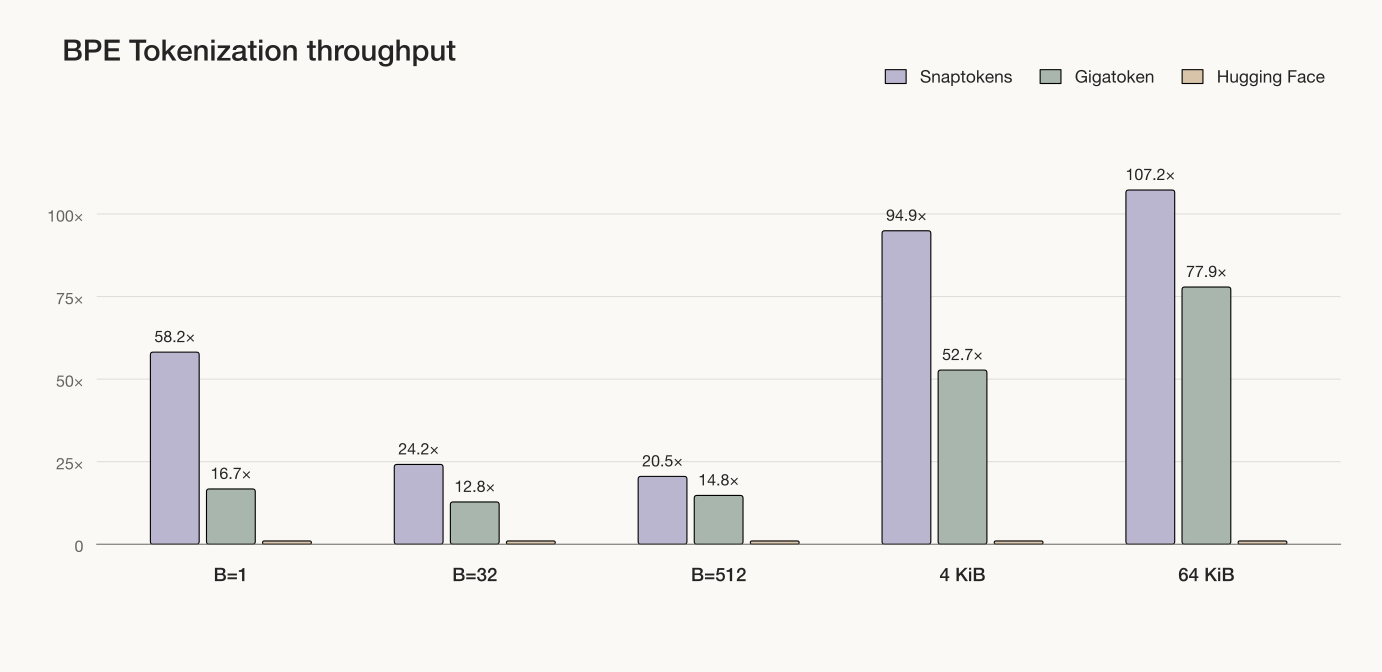
The current twelve-tokenizer, fifteen-host comparison is 2.19× faster than Gigatoken, 13.06× faster than fastokens, and 46.41× faster than Hugging Face by geometric mean of paired medians. It is (to the best of my knowledge) [the fastest OSS BPE and Unigram tokenizer, in the world]((https://github.com/coder-2011/snaptokens/blob/main/benchmarks/speed.md)
Optimizations
- Hand-written scanners replace general regex machinery for recognized production tokenizer patterns, with a table-driven ASCII path and exact Unicode fallback.
- Split, ByteLevel transformation, and BPE are fused so raw bytes map directly to initial token IDs and cache hits skip ByteLevel work entirely.
- BPE uses precomputed flat lookups: byte-to-token IDs, all 65,536 initial byte pairs, open-addressed merge ranks, and CSR merge adjacency.
- Pre-tokenized text stays in one contiguous buffer with byte ranges instead of allocating a string for every piece.
- Thread-local and shared caches are amortized across whole chunks, while a fixed Rayon pool keeps worker caches warm and balances uneven BPE work.
- Non-ByteLevel tokenizers split only at vocabulary-proven unbridgeable byte pairs; byte-fallback models stay on the normal exact merge path.
- Eligible Unigram documents cut at whitespace-aligned anchors so charsmap, Metaspace walking, and Viterbi run per partition on the shared pool instead of serializing a rewritten buffer.
- Opt-in
.stsnapshots store native BPE tables or validated Unigram inputs to reduce tokenizer loading work.
Benchmarks
The 2026-07-31 suite uses DeepSeek R1, Gemma 3, GLM 4.7, GPT-2, GPT-OSS, Llama 3, MiniMax M2.1, Mistral Nemo, Nemotron 3, Phi-4 mini, Qwen 2.5, and Qwen 3. It runs five batch and input shapes across a variety of machines
The full benchmark report contains a much more thorough analysis. The complete evidence includes every piece of data
On Unigram, we measure Snaptokens at 160 MB/s / 66.1× Hugging Face. Not, supported by Gigatoken, and 2.21x faster than Tokie.
Install
Install the Python package:
pip install snaptokens
Or add the Rust crate:
[dependencies]
snaptokens = "0.2"
Usage
Python:
from snaptokens import Tokenizer

tokenizer = Tokenizer.from_file("/path/to/tokenizer.json")
ids = tokenizer.encode("Tokenization should not be the bottleneck.").ids
Python's encode(), encode_batch(), and encode_batch_flat() apply the
tokenizer's configured special tokens by default, matching Hugging Face.
Pass add_special_tokens=False to omit them.
enable_truncation(max_length=100, direction="right") limits the returned
sequence, including requested post-processor special tokens.
Pass st_cache=True to create and reuse an adjacent .st snapshot. A direct .st
path loads without that flag.
To replace a Transformers v4 or v5 fast-tokenizer backend:
import snaptokens

snaptokens.patch_transformers()
Call snaptokens.unpatch_transformers() to restore the original backend.
Rust:
use std::error::Error;

use snaptokens::Tokenizer;

/// Loads one local tokenizer and encodes a prompt.
fn main() -> Result<(), Box<dyn Error>> {
    let tokenizer = Tokenizer::load_file("/path/to/tokenizer.json")?;
    let ids = tokenizer.encode("Tokenization should not be the bottleneck.", false)?;

    println!("{ids:?}");
    Ok(())
}
Pass true as the second argument to apply the tokenizer's configured special-token
post-processing.
Benchmark tools
The runnable benchmark tools live in benchmarks/tools/. They are repository-only development tools and are not included in published crate archives. Run one with Cargo and pass its arguments after --:
cargo bench --manifest-path benchmarks/tools/Cargo.toml --bench simple_bench -- /path/to/tokenizer.json --max-samples 50
cargo bench --manifest-path benchmarks/tools/Cargo.toml --bench load_bench -- /path/to/tokenizer.json json 10
cargo bench --manifest-path benchmarks/tools/Cargo.toml --bench print_pipeline -- /path/to/tokenizer.json
cargo bench --manifest-path benchmarks/tools/Cargo.toml --bench profile_sample -- /path/to/tokenizer.json 10
Optional .st snapshots
Create and reuse a snapshot from a compatible Hugging Face tokenizer.json:
from snaptokens import Tokenizer

tokenizer = Tokenizer.from_file("/path/to/tokenizer.json", st_cache=True)
# The snapshot also loads without the original JSON or a cache flag.
restored = Tokenizer.from_file("/path/to/tokenizer.st")
use snaptokens::Tokenizer;

let tokenizer = Tokenizer::load_file_with_st_cache("/path/to/tokenizer.json")?;
let restored = Tokenizer::load_file_with_st_cache("/path/to/tokenizer.st")?;
The first cached JSON load writes a sibling tokenizer.st atomically after the
complete tokenizer has been constructed. Later cached loads validate and reuse
the snapshot without reading the JSON. The payload checksum detects corruption;
changes to the source JSON are not checked. Delete the sibling .st to rebuild
it after editing the JSON. An invalid or unsupported snapshot is rebuilt when
its JSON source is available. Direct .st loads report validation errors without
rebuilding. JSON-only loading remains read-only.
BPE version 3 stores native lookup and merge tables with a packed vocabulary.
Unigram version 4 stores vocabulary strings, exact scores, the unknown-token ID,
and byte-fallback settings, then validates them and rebuilds the matcher on load.
Both preserve the tokenizer pipeline, including added tokens, normalization,
pre-tokenization, post-processing and decoding. Python also restores stored
padding and supported truncation settings. .st does not expand support to
otherwise unsupported tokenizer pipelines or native SentencePiece .model files.
The recorded twelve-model BPE comparison measured the following warm-load ratios:
| CPU | JSON / ST |
|---|---|
| Apple ARM | 9.33× |
| AMD x86-64 | 10.86× |
| Intel x86-64 | 9.73× |
These are descriptive geometric-mean ratios from twelve rounds in a fixed format order, including load and destruction. They measure loading, not encoding, and are not a randomized cross-format comparison. The BPE results and method identify the measured commits, which precede the structural refactor and format cleanup. The current PR head has not been remeasured.
A separate pinned T5/UMT5 comparison on one Intel host measured direct .st
loading at 1.157× JSON throughput across twelve paired rounds. See the
Unigram results.
This Unigram result has not been confirmed across CPU classes.
Scope
Snaptokens provides inference for BPE tokenizers and compatible Hugging Face
tokenizer.json Unigram pipelines, with optional .st snapshots for both. Native
SentencePiece .model files are not supported.
Credits
Licensed under Apache-2.0.
Status
Unchecked items are not currently supported.
- Hugging Face JSON Unigram: Tagged and legacy untagged Unigram JSON, including T5-style Precompiled normalization,
WhitespaceSplit → Metaspace, and Metaspace decoding. - Other model algorithms: WordPiece, WordLevel, and model types other than BPE or Unigram. Native SentencePiece
.modelfiles are explicitly rejected. - BPE options beyond its core:
dropout,unk_token,fuse_unk,continuing_subword_prefix, andend_of_word_suffixare not represented or guaranteed exact. - Normalizers: NFD/NFKC/NFKD, Lowercase, Strip, and BertNormalizer.
- Pre-tokenizers: Whitespace (distinct from supported WhitespaceSplit), Bert, Digits, Punctuation, and UnicodeScripts.
- Post-processors: Bert/Roberta processors and pair-sequence processing; parsed pair templates are unused.
- Decoders: WordPiece, BPE, CTC, and Strip decoders.
- Training: Tokenizer training and vocabulary/model-construction APIs.
- Pair encoding: Pair encoding and pair post-processing; Python raises
NotImplementedError. - Offset/word metadata: Python token strings, character offsets, sequence IDs, word IDs, and overflow rows after truncation; the associated mapping methods raise
NotImplementedError. - Serialized padding/truncation settings: Python JSON and
.stloading restore stored padding and supported single-sequence truncation settings. Nonzero stride andonly_secondare rejected because overflow rows and pair encoding are unsupported. - Splitting added special tokens:
encode_special_tokens=TrueraisesNotImplementedError.
Contributors

192 commits
Similar repos



Languages
Rust
61.1%
Assembly
20.0%
Python
13.3%
Shell
4.9%
README
snaptokens
Fast BPE and Unigram tokenization in Rust.
snaptokens is a high-performance tokenizer, built to be compatible with hf tokenziers.
Optional .st snapshots support both BPE and Unigram loading.
The current twelve-tokenizer, fifteen-host comparison is 2.19× faster than Gigatoken, 13.06× faster than fastokens, and 46.41× faster than Hugging Face by geometric mean of paired medians. It is (to the best of my knowledge) [the fastest OSS BPE and Unigram tokenizer, in the world]((https://github.com/coder-2011/snaptokens/blob/main/benchmarks/speed.md)
Optimizations
- Hand-written scanners replace general regex machinery for recognized production tokenizer patterns, with a table-driven ASCII path and exact Unicode fallback.
- Split, ByteLevel transformation, and BPE are fused so raw bytes map directly to initial token IDs and cache hits skip ByteLevel work entirely.
- BPE uses precomputed flat lookups: byte-to-token IDs, all 65,536 initial byte pairs, open-addressed merge ranks, and CSR merge adjacency.
- Pre-tokenized text stays in one contiguous buffer with byte ranges instead of allocating a string for every piece.
- Thread-local and shared caches are amortized across whole chunks, while a fixed Rayon pool keeps worker caches warm and balances uneven BPE work.
- Non-ByteLevel tokenizers split only at vocabulary-proven unbridgeable byte pairs; byte-fallback models stay on the normal exact merge path.
- Eligible Unigram documents cut at whitespace-aligned anchors so charsmap, Metaspace walking, and Viterbi run per partition on the shared pool instead of serializing a rewritten buffer.
- Opt-in
.stsnapshots store native BPE tables or validated Unigram inputs to reduce tokenizer loading work.
Benchmarks
The 2026-07-31 suite uses DeepSeek R1, Gemma 3, GLM 4.7, GPT-2, GPT-OSS, Llama 3, MiniMax M2.1, Mistral Nemo, Nemotron 3, Phi-4 mini, Qwen 2.5, and Qwen 3. It runs five batch and input shapes across a variety of machines
The full benchmark report contains a much more thorough analysis. The complete evidence includes every piece of data
On Unigram, we measure Snaptokens at 160 MB/s / 66.1× Hugging Face. Not, supported by Gigatoken, and 2.21x faster than Tokie.
Install
Install the Python package:
pip install snaptokens
Or add the Rust crate:
[dependencies]
snaptokens = "0.2"
Usage
Python:
from snaptokens import Tokenizer

tokenizer = Tokenizer.from_file("/path/to/tokenizer.json")
ids = tokenizer.encode("Tokenization should not be the bottleneck.").ids
Python's encode(), encode_batch(), and encode_batch_flat() apply the
tokenizer's configured special tokens by default, matching Hugging Face.
Pass add_special_tokens=False to omit them.
enable_truncation(max_length=100, direction="right") limits the returned
sequence, including requested post-processor special tokens.
Pass st_cache=True to create and reuse an adjacent .st snapshot. A direct .st
path loads without that flag.
To replace a Transformers v4 or v5 fast-tokenizer backend:
import snaptokens

snaptokens.patch_transformers()
Call snaptokens.unpatch_transformers() to restore the original backend.
Rust:
use std::error::Error;

use snaptokens::Tokenizer;

/// Loads one local tokenizer and encodes a prompt.
fn main() -> Result<(), Box<dyn Error>> {
    let tokenizer = Tokenizer::load_file("/path/to/tokenizer.json")?;
    let ids = tokenizer.encode("Tokenization should not be the bottleneck.", false)?;

    println!("{ids:?}");
    Ok(())
}
Pass true as the second argument to apply the tokenizer's configured special-token
post-processing.
Benchmark tools
The runnable benchmark tools live in benchmarks/tools/. They are repository-only development tools and are not included in published crate archives. Run one with Cargo and pass its arguments after --:
cargo bench --manifest-path benchmarks/tools/Cargo.toml --bench simple_bench -- /path/to/tokenizer.json --max-samples 50
cargo bench --manifest-path benchmarks/tools/Cargo.toml --bench load_bench -- /path/to/tokenizer.json json 10
cargo bench --manifest-path benchmarks/tools/Cargo.toml --bench print_pipeline -- /path/to/tokenizer.json
cargo bench --manifest-path benchmarks/tools/Cargo.toml --bench profile_sample -- /path/to/tokenizer.json 10
Optional .st snapshots
Create and reuse a snapshot from a compatible Hugging Face tokenizer.json:
from snaptokens import Tokenizer

tokenizer = Tokenizer.from_file("/path/to/tokenizer.json", st_cache=True)
# The snapshot also loads without the original JSON or a cache flag.
restored = Tokenizer.from_file("/path/to/tokenizer.st")
use snaptokens::Tokenizer;

let tokenizer = Tokenizer::load_file_with_st_cache("/path/to/tokenizer.json")?;
let restored = Tokenizer::load_file_with_st_cache("/path/to/tokenizer.st")?;
The first cached JSON load writes a sibling tokenizer.st atomically after the
complete tokenizer has been constructed. Later cached loads validate and reuse
the snapshot without reading the JSON. The payload checksum detects corruption;
changes to the source JSON are not checked. Delete the sibling .st to rebuild
it after editing the JSON. An invalid or unsupported snapshot is rebuilt when
its JSON source is available. Direct .st loads report validation errors without
rebuilding. JSON-only loading remains read-only.
BPE version 3 stores native lookup and merge tables with a packed vocabulary.
Unigram version 4 stores vocabulary strings, exact scores, the unknown-token ID,
and byte-fallback settings, then validates them and rebuilds the matcher on load.
Both preserve the tokenizer pipeline, including added tokens, normalization,
pre-tokenization, post-processing and decoding. Python also restores stored
padding and supported truncation settings. .st does not expand support to
otherwise unsupported tokenizer pipelines or native SentencePiece .model files.
The recorded twelve-model BPE comparison measured the following warm-load ratios:
| CPU | JSON / ST |
|---|---|
| Apple ARM | 9.33× |
| AMD x86-64 | 10.86× |
| Intel x86-64 | 9.73× |
These are descriptive geometric-mean ratios from twelve rounds in a fixed format order, including load and destruction. They measure loading, not encoding, and are not a randomized cross-format comparison. The BPE results and method identify the measured commits, which precede the structural refactor and format cleanup. The current PR head has not been remeasured.
A separate pinned T5/UMT5 comparison on one Intel host measured direct .st
loading at 1.157× JSON throughput across twelve paired rounds. See the
Unigram results.
This Unigram result has not been confirmed across CPU classes.
Scope
Snaptokens provides inference for BPE tokenizers and compatible Hugging Face
tokenizer.json Unigram pipelines, with optional .st snapshots for both. Native
SentencePiece .model files are not supported.
Credits
Licensed under Apache-2.0.
Status
Unchecked items are not currently supported.
- Hugging Face JSON Unigram: Tagged and legacy untagged Unigram JSON, including T5-style Precompiled normalization,
WhitespaceSplit → Metaspace, and Metaspace decoding. - Other model algorithms: WordPiece, WordLevel, and model types other than BPE or Unigram. Native SentencePiece
.modelfiles are explicitly rejected. - BPE options beyond its core:
dropout,unk_token,fuse_unk,continuing_subword_prefix, andend_of_word_suffixare not represented or guaranteed exact. - Normalizers: NFD/NFKC/NFKD, Lowercase, Strip, and BertNormalizer.
- Pre-tokenizers: Whitespace (distinct from supported WhitespaceSplit), Bert, Digits, Punctuation, and UnicodeScripts.
- Post-processors: Bert/Roberta processors and pair-sequence processing; parsed pair templates are unused.
- Decoders: WordPiece, BPE, CTC, and Strip decoders.
- Training: Tokenizer training and vocabulary/model-construction APIs.
- Pair encoding: Pair encoding and pair post-processing; Python raises
NotImplementedError. - Offset/word metadata: Python token strings, character offsets, sequence IDs, word IDs, and overflow rows after truncation; the associated mapping methods raise
NotImplementedError. - Serialized padding/truncation settings: Python JSON and
.stloading restore stored padding and supported single-sequence truncation settings. Nonzero stride andonly_secondare rejected because overflow rows and pair encoding are unsupported. - Splitting added special tokens:
encode_special_tokens=TrueraisesNotImplementedError.
Similar repos
Contributors
192 commits
Languages
Rust
61.1%
Assembly
20.0%
Python
13.3%
Shell
4.9%